


Explore thousands of items. Use clickable links under collections and library for broad categories. Search by keyword (including topic,city, state.) Limit by time period, type of item, region. See our search tips page for more assistance.
Collections
Library
Type
Region
Coverage:
-
Published:
-
Sean Wilentz
Oxford University Press (2004)
publisher: Since its publication in 1984, Chants Democratic has endured as a classic narrative on labor and the rise of American democracy. In it, Sean Wilentz explores the dramatic social and intellectual changes that accompanied early industrialization in New York. He provides a panoramic chronicle of New York City’s labor strife, social movements, and political turmoil in the eras of Thomas Jefferson and Andrew Jackson. Twenty years after its initial publication, Wilentz has added a new preface that takes stock of his own thinking, then and now, about New York City and the rise of the American working class.
a classic narrative on labor, republicanism, and the rise of American democracy.

Sean Wilentz
WW Norton & Co (2016)
One of our most eminent historians reminds us of the commanding role party politics has played in America's enduring struggle against economic inequality. 'There are two keys to unlocking the secrets of American politics and American political history.' So begins The Politicians & the Egalitarians, Princeton historian Sean Wilentz's bold new work of history. First, America is built on an egalitarian tradition. At the nation's founding, Americans believed that extremes of wealth and want would destroy their revolutionary experiment in republican government. Ever since, that idea has shaped national political conflict and scored major egalitarian victories--from the Civil War and Progressive eras to the New Deal and the Great Society--along the way. Second, partisanship is a permanent fixture in America, and America is the better for it. Every major egalitarian victory in United States history has resulted neither from abandonment of partisan politics nor from social movement protests but from a convergence of protest and politics, and then sharp struggles led by principled and effective party politicians. There is little to be gained from the dream of a post-partisan world. With these two insights Sean Wilentz offers a crystal-clear portrait of American history, told through politicians and egalitarians including Thomas Paine, Abraham Lincoln, and W.E.B. Du Bois--a portrait that runs counter to current political and historical thinking.
ommanding role party politics has played in America's enduring struggle against economic inequality

Seattle Civil Rights & Labor HIstory Project
Veterans of Seattle’s civil rights campaigns tell their stories in streaming video oral histories
Streamable oral histories of civil rights activists
Seattle Civil Rights & Labor HIstory Project
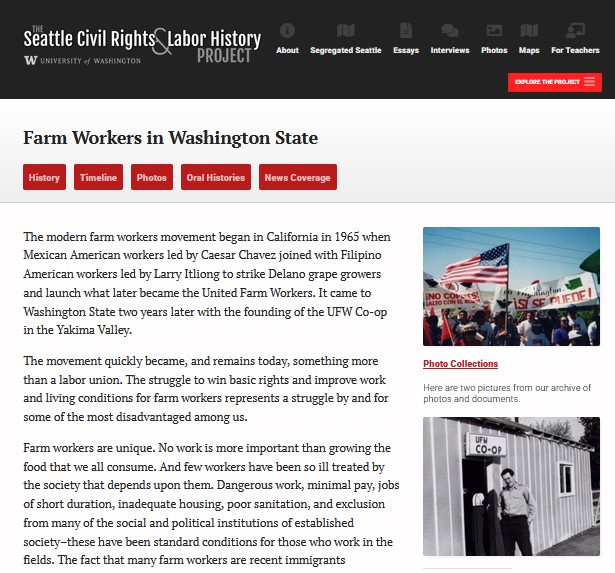
This multi-media special section details and documents the history of farm workers from the 1890s to the present and explores the labor activism and political activism that has been associated with agricultural workers. Much of the project focuses on the years since the UFW’s founding, but we also look at earlier generations, including campaigns by the Industrial Workers of the World in the early 20th Century, and Filipino led farm labor unions after the 1930s. Includes sections on introduction to the history, Timeline, Photos, Oral Histories, News Coverage
details and documents the history of farm workers from the 1890s to the present, includes timeline, photos, oral history, media covering
Seattle Civil Rights & Labor History, Trevor Griffey
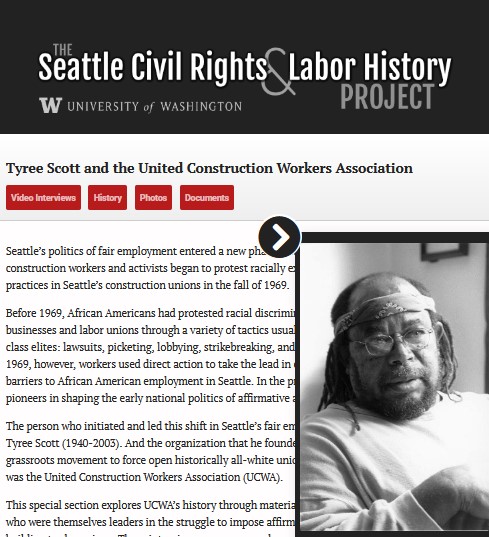
This special section explores United Construction Workers Association’s history through materials collected by workers who were themselves leaders in the struggle to impose affirmative action on Seattle’s building trades unions. These interviews, newspapers, documents, and photographs are shared courtesy LELO’s UCWA History Project.
Content:
UCWA History by Trevor Griffey
Tyree Scott and the Central Contractors Association (CCA), 1969
UCWA Founded, Imposes Affirmative Action, 1970-72
UCWA Expands to organize other cities, industries, 1973-75
UCWA and Third World Marxism, 1975-80
Postscript
Interviews The UCWA History Project, a worker led group organized by Northwest Labor and Employment Law Office (NW LELO), conducted oral history sessions with former UCWA members on December 29 and December 30, 2003. Here are streaming video excerpts.
No Separate Peace - Between 1975 and 1978, the UCWA published a newspaper: No Separate Peace. Here are readable reproductions of each issue of the newspaper.
Time Line of CCA and UCWA activities 1969-1975(.pdf file) from William A. Little, Community Organization and Leadership: A Case Study of Minority Workers in Seattle. Thesis (Ph. D.)–University of Washington. 1976 (by permission of author)
Documents Some of the memos that UCWA produced.
Tyree Scott Papers, UW Special Collections Library
explores struggle for fair employment for construction workers in Seattle’s building trades unions.

Seattle Civil Rights & Labor History, United Construction Workers
Between 1975 and 1978, the United Construction Workers Association published a newspaper: No Separate Peace. Here are digitized issues of the newspaper.
Explores discrimination in the building trades in Seattle and activism against it between 1975-1978

Sergio González
Wisconsin Historical Society Press (2017)
Beginning with the arrival of the first large wave of agricultural and industrial workers in the early 1920s, Wisconsin's Mexican community has played an integral role in the state's cultural, social, economic, and religious history. Although some came as migrant laborers who worked as seasonal workers and then returned to their homes and families in Mexico, a large number of Mexican immigrants settled across the state's cities and rural towns and in the process developed vibrant communities.
Arriving after the settlement of most European-origin immigrants, Mexicans strove to carve out their own space in Wisconsin and its unique immigrant history. This manuscript will endeavor to tell both the story of those who came and those who stayed to make Wisconsin their home. Unlike many other immigrant groups, especially those from Europe, who witnessed a sharp decline in immigration beginning in the 1920s, Mexican immigration to Wisconsin has continued and grown to the present day. With communities across Wisconsin, ranging from Milwaukee to Wautoma to Green Bay to La Crosse, Mexicans have become integral members of the state's various communities, culture, and economies. Today, Mexicans rank as the third largest race or ethnicity category in Wisconsin, trailing only Non-Hispanic whites and Non-Hispanic Blacks. Despite having a sizable presence in Wisconsin since the 1920s, however, manuscript-length writing regarding the state's Mexican community has been limited. This manuscript will contribute to the growing field of historical research documenting this nearly century old community."--Provided by publisher
Mexicans strove to carve out their own space in Wisconsin and its unique immigrant history.

Seth Luther
During the reform era of the 1830s and 1840s, Seth Luther, a Massachusetts carpenter, became one of the earliest and most vocal and effective labor reformers in the nation. He was especially active on issues pertaining to the exploitation of children and was instrumental in helping to pass the nation's first law to control child labor -- enacted by Massachusetts in 1842. The legislation prohibited restricted the hours of labor for children to ten hours a day. Here you can excerpt from one of his more famous pamphlets, An Address to the Working-Men of New-England (1832).
A pamphlet written by Seth Luther, one of the U.S.' first labor reformers, having been active in the the first half of the nineteenth century.

Seth Rockman
Featuring scholarship primarily published since 2012, this bibliography is meant to draw on the diverse expertise of the students in the course to define the field as broadly as possible in terms of chronology, geography, methodology, and disciplinarity. Students were tasked with contributing entries, while Professor Rockman contributed an introductory framing for each week. The bibliography follows a general chronology from the era of early modern global integration to the present. Many now-canonical texts in the field were omitted in favor of recent scholarship, much of which was produced by scholars who would not necessarily identify as historians of capitalism. Certain topics (e.g. labor resistance to capitalism, colonialism, slavery and abolition) appear in multiple places.The entries devote less attention to intellectual history and the theorization of capitalism, and instead foreground the “capitalism in action” of people doing specific things in discrete times and places. Spring 2021
History of Capitalism Bibliography
Table of Contents
Background
Theoretical Framings
Early Modern Global Integration
Developmental Pathways
Institutional Regimes of Money and Property
Entangled Consumer Revolutions
The Shape of Everyday Life
Making Business Work
Global Enclosures
Labor and Commodity
Finance Capital
Regimes of Planning
Neoliberalism’s Long Past
bibliography, dated 2021, mostly focused on work of history of capitalism; some collections, annotation

Seth Rockman
University of Chicago Press (2024)
"An eye-opening rethinking of nineteenth-century American history that reveals the interdependence of the Northern industrial economy and Southern slave labor. The industrializing North and the agricultural South--that's how we have been taught to think about the United States in the early nineteenth century. But in doing so, we overlook the economic ties that held the nation together before the Civil War. We miss slavery's long reach into small New England communities, just as we fail to see the role of Northern manufacturing in shaping the terrain of human bondage in the South. Using plantation goods--the shirts, hats, hoes, shovels, shoes, axes, and whips made in the North for use in the South--historian Seth Rockman locates the biggest stories in American history in the everyday objects that stitched together the lives and livelihoods of Americans--white and Black, male and female, enslaved and free--across an expanding nation. By following the stories of material objects, such as shoes made by Massachusetts farm women that found their way to the feet of a Mississippi slave,
Rockman reveals a national economy organized by slavery--a slavery that outsourced the production of its supplies to the North, and a North that outsourced its slavery to the South. Melding business and labor history through powerful storytelling, Plantation Goods brings Northern industrialists, Southern slaveholders, enslaved field hands, and paid factory laborers into the same picture. In one part of the country, entrepreneurs envisioned fortunes to be made from 'planter's hoes' and rural women spent their days weaving 'negro cloth' and assembling 'slave brogans.' In another, enslaved people actively consumed textiles and tools imported from the North to contest their bondage. In between, merchants, marketers, storekeepers, and debt collectors laid claim to the profits of a thriving interregional trade. Examining producers and consumers linked in economic and moral relationships across great geographic and political distances, Plantation Goods explores how people in the nineteenth century thought about complicity with slavery while showing how slavery structured life nationwide and established a modern world of entrepreneurship and exploitation. Rockman brings together lines of American history that have for too long been told separately, as slavery and capitalism converge in something as deceptively ordinary as a humble pair of shoes"-- Provided by publisher
Book reveals the interdependence of the Northern industrial economy and Southern slave labor.

Seth Rockman
Johns Hopkins University Press (2009)
"Enslaved mariners, white seamstresses, Irish dockhands, free black domestic servants, and native-born street sweepers. All navigated the low-end labor market in post-revolutionary Baltimore. Seth Rockman considers this diverse workforce, exploring how race, sex, nativity, and legal status determined the economic opportunities and vulnerabilities of working families in the early republic.
In the era of Frederick Douglass, Baltimore's distinctive economy featured many slaves who earned wages and white workers who performed backbreaking labor. By focusing his study on this boomtown, Rockman reassesses the roles of race and region and rewrites the history of class and capitalism in the United States during this time. Rockman describes the material experiences of low-wage workers -- how they found work, translated labor into food, fuel, and rent, and navigated underground economies and social welfare systems.
He also explores what happened if they failed to find work or lost their jobs. Rockman argues that the American working class emerged from the everyday struggles of these low-wage workers. Their labor was indispensable to the early republic's market revolution, and it was central to the transformation of the United States into the wealthiest society in the Western world. Rockman's research includes construction site payrolls, employment advertisements, almshouse records, court petitions, and the nation's first "living wage" campaign. These rich accounts of day laborers and domestic servants illuminate the history of early republic capitalism and its consequences for working families."--Publisher description
explores how race, sex, nativity, and legal status determined the economic opportunities and vulnerabilities of working families in the early republic.

Shane Hamilton
Princeton University Press (2008)
"Trucking Country is a social history of long-haul trucking that explores the cotentious politics of free-market capitalism in post-World War II America. Shane Hamilton paints an eye-opening portrait of the rural highways of the American heartland, and in doing so explains why working-class populist voters are drawn to conservative politicians who seemingly don't represent their financial interests." "Hamilton challenges the popular notion of "red state'" conservatism as a devil's bargain between culturally conservative rural workers and economically conservative demagogues in the Republican Party. The roots of rural conservatism, Hamilton demonstrates, took hold long before the culture wars and free-market fanaticism of the 1990s. As Hamilton shows, truckers helped build an economic order that brought low-priced consumer goods to a greater number of Americans. They piloted the big rigs that linked America's factory farms and agribusiness food processors to suburban supermarkets across the country." "Trucking Country is the gripping account of truckers whose support of post-New Deal free enterprise was so virulent that it sparked violent highway blockades in the 1970s. Its the story of "bandit" drivers who inspired country songwriters and Hollywood filmmakers to celebrate the "last American cowboy, '' and of ordinary blue-collar workers who helped make possible the deregulatory policies of Jimmy Carter and Ronald Reagan and set the stage for Wal-Mart to become America's most powerful corporation in today's low-price, low-wage economy."--Jacket
paints an eye-opening portrait of the rural highways of the American heartland, and in doing so explains why working-class populist voters are drawn to conservative politicians.

Shannan Clark
Oxford University Press (2021)
During most of the twentieth century, the production of America's consumer culture was centralized in New York to an extent unparalleled in the history of the modern United States. Within a few square miles were the headquarters of networks like NBC and CBS, the editorial offices of book and magazine publishers, major newspapers, and advertising and design agencies. Every day tens of thousands of writers, editors, artists, performers, technicians, secretaries, and other white-collar workers made advertisements, produced media content, and enhanced the appearance of goods in order to boost sales.
While this center of creativity has often been portrayed as a smoothly running machine, within these offices many white-collar workers challenged the managers and executives who directed their labor. This book examines these workers and New York's culture industries throughout the twentieth century. As manufacturers and retailers competed to attract consumers' attention, their advertising expenditures financed the growth of enterprises engaged in the production of culture.
With the shock of the Great Depression, employees in these firms organized unions to improve their working conditions, launched alternative media and cultural endeavors supported by public, labor, or cooperative patronage, and fought in other ways to expand their creative autonomy. As blacklisting and attacks on unions undermined these efforts after the Second World War, workers in advertising, design, publishing, and broadcasting found themselves constrained in their ability to respond to economic dislocations and to combat discrimination on the basis of gender and race in these fields of cultural production
examines white-collar workers and New York's culture industries throughout the twentieth century.
Shannon, David, History Matters
The New Deal launched a series of federal employment programs, including the Works Progress Administration (WPA), which not only provided jobs but also initiated many important studies of the depression's human toll. One such study, published by the WPA Division of Research in 1939, included transcripts of interviews by WPA workers with Dubuque, Iowa, families. The DiMarcos interview revealed that the disabled faced a double challenge during the depression: finding employment while competing for scarce jobs with the able-bodied. The DiMarcos, a deaf couple with a small child, recall in their own words (because they were deaf they had to write responses to the WPA interviewer’s questions), the struggles they endured during six years of unemployment.
Interview of the DiMarco family by the WPA during the Great Depression.

Sharon Ann Murphy
The University of Chicago Press (2023)
"a powerful and unprecedented dive into the entangled history of banking and slavery in nineteenth-century America. Slaveholders developed credit and creditworthiness by using enslaved people as collateral, and this allowed them to undertake an endless array of projects. But Murphy further shows that this credit system grew and changed as banks sought new ways to realize their own profits and power. She demonstrates not merely how slavery was financed by banks but how banks were financed by slavery. By extension, everything banks enabled, not least the physical expansion of the United States itself, was also then literally indebted to that noxious institution"-- Provided by publisher
Introduction: Banking in the Nation’s Largest Slave Market Part I: Financing Southwestern Expansion through the 1810s 1 The Limits of Early Bank Financing of Slavery 2 Adapting Slave Financing to the Needs of the Frontier South during the Nation’s First Boom and Bust Part II: Financing an Empire of Slavery in the 1820s and 1830s 3 Old South Banks and Frontier Finance 4 Pushing Financial Boundaries with Traditional Banks 5 Reimagining Banking for a Slave Economy Part III: The Collateral Damage of the Panics of 1837 and 1839 6 Foreclosing (or Not) on Delinquent Slaveholders 7 Escaping Debt: Bankruptcy, Fraud, and Going to Texas 8 When Banks Fail 9 From Commercial Banking to Private Finance Epilogue: Banks, Debt, Emancipation, Reparations, and Memory Acknowledgments Abbreviations Notes Index
demonstrates how slavery was financed by banks and how banks were financed by slavery.

Sharon Hartman Strom
University of Illinois Press (1992)
By World War I, managers wanted young women with some high school education for new "light manufacturing" jobs in the office. Women could be paid significantly less than men with equivalent educations and the "marriage bar"--The practice of not hiring or retaining married women--ensured that most of them would leave the workplace before the issue of higher salaries arose. Encouraged by free training gained in high schools and by working conditions better than those available in factories, young working-class women sought out office jobs. Facing sexual discrimination in most of the professions and higher-level office jobs, middle-class women often found themselves "falling into" clerical positions
analyzes women office-workers' ambitions and explores how the influences of scientific management, personnel management, and secondary vocational education affected office workplaces and hierarchies.

Sharon McConnell-Sidorick
The University of North Carolina Press (2017)
The 1920s Jazz Age is remembered for flappers and speakeasies, not for the success of a declining labor movement. A more complex story was unfolding among the young women and men in the hosiery mills of Kensington, the working-class heart of Philadelphia. Their product was silk stockings, the iconic fashion item of the flapper culture then sweeping America and the world. Although the young people who flooded into this booming industry were avid participants in Jazz Age culture, they also embraced a surprising, rights-based labor movement, headed by the socialist-led American Federation of Full-Fashioned Hosiery Workers (AFFFHW).
In this first history of this remarkable union, Sharon McConnell-Sidorick reveals how activists ingeniously fused youth culture and radical politics to build a subculture that included dances and parties as well as picket lines and sit-down strikes, while forging a vision for social change. In documenting AFFFHW members and the Kensington community, McConnell-Sidorick shows how labor federations like the Congress of Industrial Organizations and government programs like the New Deal did not spring from the heads of union leaders or policy experts but were instead nurtured by grassroots social movements across America.
young women and men who worked in the hosiery mills of Kensington, the working class heart of Philadelphia, and their effort to create a radical labor movement

Shaun Richman
University of Illinois Press (2025)
One of New York City’s most powerful unions, the Hotel and Gaming Trades Council, AFL-CIO, represents almost 40,000 workers. Shaun Richman’s history places the labor organization within the context of American industrial and craft unionism and reveals how it came to influence politics and economic development in the city and beyond.
From the start, New York’s organized hotel workers experimented with and adapted how they organized and governed members and related to other labor unions. Richman follows union fortunes from early IWW activity through the Communist-led affiliates of the American Federation of Labor in the 1920s and 1930s, the shaping of breakthrough negotiating strategies, and the postwar era. As Richman shows, workers adopted a radicalism and militancy seldom associated with an AFL organization while openly negotiating the Communist Party’s power and influence within the union until the Party’s eclipse in the 1950s.
--Part of this story explains how Wobbies or syndicalists became Communists, something that is usually left out of the history of the 1930s, nor are the AFL communists ever much discussed.
An inspiring story of action and perseverance, We Always Had a Union profiles a foundational American labor union and offers lessons for today’s workers and organizers.
Introduction 1
1 The Unsafest Proposition in the World, 1912–1913 11
2 Bolsheviki Methods, 1913–1918 33
3 Practical Trade Union Tactics, 1919–1924 49
4 Strange as It May Seem, 1925–1929 61
5 Political Sentimental Giddiness, 1929–1934 75
6 An Industry Has Been Freed, 1934–1938 104
7 Status Quo, 1938–1939 127
8 Only the Question of Final Alliances Remains, 1939–1941 150
9 We Cook, Serve, Work for Victory, 1941–1945 169
10 In Normal Order, 1945–1947 190
11 The Crack, 1947–1950 215
12 Trusteeship, 1950–1953 239
Afterword 261
The history of a labor powerhouse and the lessons it offers for organizers today
Sheet Metal Workers International Union
Published in Chicago, -Aug. 1926; in Washington, D.C., Sept. 1926-
"Official publication of the Sheet Metal Workers' International Association."
Official Journal of the Sheet Metal Workers International Union, a craft union
Shelley Ettinger, History Matters
Although the 1970s saw an increase of women entering non-traditional and unionized jobs, many skilled and building trades remained effectively closed to women. As a result, in many cities throughout the 1970s and 1980s, private and city bus companies provided important opportunities for women interested in non-traditional jobs. Boasting large numbers of women and lesbians and an atmosphere of social tolerance, these jobs were seen as gay-friendly and provided female workers with a strong voice in union politics and a sense of community and solidarity.
Shelley Ettinger became a bus driver in Ann Arbor, Michigan in 1977. Encouraged to join by other lesbians, Ettinger remembered an atmosphere of female and lesbian camaraderie that expanded beyond the bus yard into social gatherings and soft-ball games.
A teaching document featuring an account of the lesbian experience as a bus driver in Ann Arbor, MI

Shelton Stromquist
University of Illinois Press (1993)
Covers the political economy of the railroad industry and the transition between 1877 and 1894, the two large railroad strikes that defined the Gilded Age railroad era, of great capitalists. Finds the settling of railroad workers into communities were important factors in their union drives. Examining the 1888 strike on the Burlington line in two towns in Iowa, for example, he found signiicant community support for strikers, while in market towns there were less support for strikes. "'Boomer' railroad men have a cherished place in the popular imagination. Although the romance of their vocations and the itinerancy of their lives have been exaggerated, the term ‘Boomer' fittingly characterizes a significant portion of the generation of workers that built and operated the railroads during the expansive years of the late nineteenth century. There are numerous excellent accounts of the major railroad strikes for this period. There is also a rich literature of local studies that focus primarily on changes in working class culture and community in a variety of industrial settings. But we lack a framework for integrating the local analysis of social and cultural patterns with changes in the political economy of nineteenth-century American capitalism, and we lack an analysis of strikes that locates episodes within broader patterns of emerging class conflict. This volume is an attempt to build such a larger framework."
Examines local episodes of railroad labor conflict from 1877-1894

Shelton Stromquist
Verso Books (2023)
For more than a century, municipal socialism has fired the imaginations of workers fighting to make cities livable and democratic. At every turn propertied elites challenged their right to govern.
Shelton Stromquist offers the first global account of the origins of this new trans-local socialist politics. He explains how and why cities after 1890 became crucibles for municipal socialism. Drawing on the colorful stories of local activists and their social-democratic movements in cities as diverse as Broken Hill, Christchurch, Malmö, Bradford, Stuttgart, Vienna, and Hamilton, OH, the book shows how this new urban politics arose.
Long governed by propertied elites, cities in the nineteenth century were transformed by mass migration and industrialization that tore apart their physical and social fabric. Amidst massive strikes and faced with epidemic disease, fouled streets, unsafe water, decrepit housing, and with little economic security and few public amenities, urban workers invented a local politics that promised to democratize cities they might themselves govern and reclaim the wealth they created. This new politics challenged the class power of urban elites as well as the centralizing tendencies of national social-democratic movements. Municipal socialist ideas have continued to inspire activists in their fight for the right of cities to govern themselves
How workers fought for municipal socialism to make cities around the globe livable and democratic - and what the lessons are for today

Shelton Stromquist
University of Illinois Press (2008)
"Examining the impact of American Cold War politics on disparate local arenas, Labor's Cold War reveals that anticommunist challenges reshaped local political cultures and set the stage for new rounds of political debate.
The contributors demonstrate that the anticommunist movement was more diverse, more pervasive, and more sharply and creatively contested than previous studies have shown. Even as the national anticommunist movement strengthened, workers and their allies defended ongoing progressive politics at the local level. Examples include struggles for fair employment, over public housing, for expansion of New Deal-style regional development, to abolish racial and ethnic discrimination policies, for rights to union representation, and for a voice in wage and price controls.
Local political stories from New Mexico, California, occupied Japan, Milwaukee, Detroit, St. Louis, and Schenectedy provide important alternative perspectives on the transformative power of anticommunism in the postwar period and contribute to an ongoing revision of the history of the Cold War United States and its political legacies."--Back cover
Contributors include Kenneth Burt, Robert W. Cherny, Rosemary Feurer, Eric Fure-Slocum, Christopher Gerteis, Lisa Kannenberg, David Lewis-Colman, James J. Lorence, Shelton Stromquist, and Seth Wigderson
Contents
Introduction: "Was All (Cold War) Politics Local?"Shelton Stromquist
1. Anti-Communist Networks and Labor: The Pacific Coast in the 1930s Robert W. Cherny
2. Labor's Community-Based Economic and Environmental Planning, and Cold War Politics: The UE's St. Louis District, 1941- 48 Rosemary Feurer
3. The Fight for Fair Employment and the Shifting Alliances among Latinos and Labor in Cold War Los AngelesKenneth C. Burt
4. From Fellow Traveler to Friendly Witness: Shelton Tappes, Liberal Anti-Communism, and Working-Class Civil Rights in the United Auto Workers David M. Lewis-Colman
5. Putting the "I" before "UE": Labor's Cold War in Schenectady-- GE Lisa Kannenberg
6. Housing, Race, and the Cold War in a Labor CityEric Fure- Slocum
7. Mexican-American Workers, Clinton Jencks, and Mine-Mill Social Activism in the Southwest, 1945-52 James J. Lorence
8. The Wages of Anticommunism: U.S. Labor and the Korean War Seth Wigderson
9. Subjectivity Lost: Labor and the Cold War in Occupied Japan Christopher Gerteis
Contributors
Index
demonstrates that the anticommunist movement was more diverse, more pervasive, and more sharply and creatively contested than previous studies have shown.

Shelton Stromquist
University of Illinois Press (2006)
Annotation In this much needed comprehensive study of the Progressive movement, its reformers, their ideology, and the social circumstances they tried to change, Shelton Stromquist contends that the persistence of class conflict in America challenged the very defining feature of Progressivism: its promise of social harmony through democratic renewal.Profiling the movement's work in diverse arenas of social reform, politics, labour regulation and "race improvement," Stromquist argues that while progressive reformers may have emphasized different programs, they crafted a common language of social reconciliation in which an imagined civic community ("the People") would transcend parochial class and political loyalties. As progressive reformers sought to reinvent a society in which class had no enduring place, they also marginalized new immigrants and African Americans as being unprepared for civic responsibilities. In so doing, Stromquist argues that Progressives laid the foundation for twentieth-century liberals' inability to see their world in class terms and to conceive of social remedies that might alter the structures of class power
The labor problem and the crisis of the old order
Constituting progressivism
The politics of reform
Communities of reformers
Class bridging and the world of female reform
The boundaries of difference
Class wars and the crisis of progressivism
Conclusion: war and the ragged edges of reform
contends that the persistence of class conflict in America challenged the very defining feature of Progressivism.

Shelton Stromquist
University of Iowa Press (1993)
In Solidarity and Survival, three generations of Iowa workers tell of their unrelenting efforts to create a labor movement in the coal mines and on the rails, in packinghouses and farm equipment plants, on construction sites and in hospital wards. Drawing on nearly one thousand interviews collected over more than a decade by oral historians working for the Iowa Federation of Labor, AFL-CIO, Shelton Stromquist presents the resonant voices of the men and women who defined a new, prominent place for themselves in the lives of their communities and in the politics of their state
presents the resonant voices of the men and women who defined a new, prominent place for themselves in the lives of their communities and in the politics of their state.