


Explore thousands of items. Use clickable links under collections and library for broad categories. Search by keyword (including topic,city, state.) Limit by time period, type of item, region. See our search tips page for more assistance.
Collections
Library
Type
Region
Coverage:
-
Published:
-

Shelton Stromquist
University of Iowa Press (1997)
The rise and decline of industrial unionism in the packinghouse industry is a unique story that casts into bold relief the conflicts between labor and capital and the tensions based on race and gender in a perpetually changing workforce. The essayists in Unionizing the Jungles discuss the structurally distinctive features of the packinghouse industry - such as the fact that violence and extreme antiunionism were central elements of its culture - the primary actors in the union-building process, the roots of the distinctive interracialism of the United Packinghouse Workers of America and the explosion of industrial unionism in the 1930s, and the community-based militant unionism of the Independent Union of All Workers
discusses the structurally distinctive features of the packinghouse industry, the primary actors in the union-building process, the roots of the distinctive interracialism of the United Packinghouse Workers of America, and the explosion of industrial unionism in the 1930s.

Shennette Garrett-Scott
Columbia University Press (2019)
Shennette Garrett-Scott explores black financial innovation and its transformative impact on U.S. capitalism through the story of the St. Luke Bank in Richmond, Virginia: the first and only bank run by black women. Banking on Freedom offers an unparalleled account of how black women carved out economic, social, and political power
explores black financial innovation and its transformative impact on U.S. capitalism

Shepherd W McKinley
University Press of Florida (2014)
In the first book ever written about the impact of phosphate mining on the South Carolina plantation economy, Shepherd McKinley explains how the convergence of the phosphate and fertilizer industries carried long-term impacts for America and the South.
Fueling the rapid growth of lowcountry fertilizer companies, phosphate mining provided elite plantation owners a way to stem losses from emancipation. At the same time, mining created an autonomous alternative to sharecropping, enabling freed people to extract housing and labor concessions.
Stinking Stones and Rocks of Gold develops an overarching view of what can be considered one of many key factors in the birth of southern industry. This top-down, bottom-up history (business, labor, social, and economic) analyzes an alternative path for all peoples in the post-emancipation South.
he impact of phosphate mining on the South Carolina plantation economy

Sherrow O. Pinder
Lexington Books (2020)
Pinder examines the interrelatedness of globalization and workfare and how this interrelatedness is impacting black single mother welfare recipients. The book builds on these insights and seeks to illuminate a crucial but largely overlooked aspect of the negative impact of workfare on black women and the American economy.
examines the interrelatedness of globalization and workfare and how this interrelatedness is impacting black single mother welfare recipients

Sherry Lee Linkon
University Press of Kansas (2002)
"Once the symbol of a robust steel industry and blue-collar economy, Youngstown, Ohio, and its famous Jeanette Blast Furnace have become key icons in the tragic tale of American deindustrialization. Sherry Lee Linkon and John Russo examine the inevitable tension between those discordant visions, which continue to exert great power over Steeltown's citizens as they struggle to redefine their lives."--Jacket Acknowledgments
Introduction: Remembering Youngstown
1. Reading the Landscape: Conflict and Production of Place
2. Steel Town
3. Deindustrialization and the Struggle over Memory
4. From “Steel Town” to a “Nice Place to Do Time”
Epilogue: Community Memory and Youngstown's Future
examine the inevitable tension between the discordant visions of Youngstown as a steel town and its modern image.

Sherry Lee Linkon
University of Michigan Press (2018)
Starting in the late 1970s, tens of thousands of American industrial workers lost jobs in factories and mines. Deindustrialization had dramatic effects on those workers and their communities, but its longterm effects continue to ripple through working-class culture. Economic restructuring changed the experience of work, disrupted people's sense of self, reshaped local landscapes, and redefined community identities and expectations. Through it all, working-class writers have told stories that reflect the importance of memory and the struggle to imagine a different future. These stories make clear that the social costs of deindustrialization affect not only those who lost their jobs but also their children, their communities, and American culture. Through analysis of poetry, fiction, creative nonfiction, film, and drama,
The Half-Life of Deindustrialization shows why people and communities cannot simply "get over" the losses of mining. The past provides inspiration and strength for working-class people, even as the contrast between past and present highlights what has been lost in the service economy. The memory of productive labor and stable, proud working-class communities shapes how people respond to contemporary economic, social, and political issues. These stories can help us understand the resentment, frustration, pride, and persistence of the American working class"-- Provided by publisher
working-class writers have told stories that reflect the importance of memory and the struggle to imagine a different future

Shiloh Museum of Ozark History
focuses on the colorful history of the Northwest Arkansas Ozarks region. Rather than fancy artifacts or famous names, the museum features what they call “the real shapers of Ozark history—the everyday men, women, and children who lived in our towns and rural communities.” There are also historical buildings and garden areas on the grounds to explore, and the 37-mile Northwest Arkansas Razorback Greenway can be accessed from the property, so bring your bike.
The Shiloh Museum of Ozark History is a regional history museum focusing on six counties of the Arkansas Ozarks, which includes Benton, Boone, Carroll, Madison, Newton, and Washington. The museum takes its name from the pioneer community of Shiloh, which became Springdale in the 1870s.
Since our founding in 1968, the Shiloh Museum of Ozark History has had a steadfast commitment to telling the stories of the “regular” people who have occupied the land in the Arkansas Ozarks or who have moved here over the years. Just as our population continues to grow and change, so does our understanding of the history, culture, and people who make up our community. We welcome everyone and want people to see themselves reflected in all we do.
The way we tell the stories of our community must also change with our increased understanding. We are committed to providing exhibits, programs, and events that both reflect and appeal to as many people as possible. Making our services and site accessible is also a high priority, and that includes taking our passion for learning, our knowledge, and our expertise outside the museum and into the six-county region whose history we collect and study. We recognize that our collections, programs, research, and internal processes need constant scrutinizing and examination to be able to offer more thorough and complete narratives of the history of our region.
We are proud to be the caretakers of our history and to be entrusted with the stories of all the people and cultures–past, present, and future–that make up the Arkansas Ozarks.
The Shiloh Museum of Ozark History appreciates and acknowledges the tradition in many cultures of blessing the land, the people, or an event. In that spirit, we respectfully recognize the complicated history of the land we are on and the six counties we serve. No accounting or acknowledgment here can fully articulate the contributions, suffering, triumphs, or lives of the many cultures who have called this place their home for thousands of years. Of the many who have come before us, some were the victims of oppression and ethnic cleansing, sometimes at the hand of colonizers and settlers, and other times as a result of natural events or historical circumstance, the effects of which are still felt today.
While as a museum we cannot make full reparations to the many people who were either harmed or who labored on this land, we do strive through our exhibits, programs, events, collections, and scholarship to honor and celebrate all of the people, cultures, and traditions that have formed the communities and land we are today.
Adapted July 2023
museum features what they call “the real shapers of Ozark history—the everyday men, women, and children who lived in our towns and rural communities.”

Shoshana Zuboff
Basic Books (1988)
An analysis of the impact of computer technology in the workplace. Includes in-depth interviews with workers and managers
Preface p. xi
Acknowledgments p. xvii
Introduction: Dilemmas of Transformation in the Age of the Smart Machine p. 3
Knowledge and Computer-Mediated Work p. 17
The Laboring Body: Suffering and Skill in Production Work p. 19
The Abstraction of Industrial Work p. 58
The White-Collar Body in History p. 97
Office Technology as Exile and Integration p. 124
Mastering the Electronic Text p. 174
Authority: The Spiritual Dimension of Power p. 219
What Was Managerial Authority? p. 224
The Dominion of the Smart Machine p. 245
The Limits of Hierarchy in an Informated Organization p. 285
Technique: The Material Dimension of Power p. 311
The Information Panopticon p. 315
Panoptic Power and the Social Text p. 362
Conclusion: Managing the Informated Organization p. 387
The Scope of Information Technology in the Modern Workplace p. 415
Notes on Field-Research Methodology p. 423
Notes p. 430
Index p. 459
Table of Contents provided by Blackwell's Book Services and R.R. Bowker. Used with permission.
An analysis of the impact of computer technology in the workplace.

Shoshana Zuboff
PublicAffairs (2019)
Shoshana Zuboff, named "the true prophet of the information age" by the Financial Times, has always been ahead of her time. Her seminal book In the Age of the Smart Machine foresaw the consequences of a then-unfolding era of computer technology. Now, three decades later she asks why the once-celebrated miracle of digital is turning into a nightmare. Zuboff tackles the social, political, business, personal, and technological meaning of "surveillance capitalism" as an unprecedented new market form. It is not simply about tracking us and selling ads, it is the business model for an ominous new marketplace that aims at nothing less than predicting and modifying our everyday behavior--where we go, what we do, what we say, how we feel, who we're with. The consequences of surveillance capitalism for us as individuals and as a society vividly come to life in The Age of Surveillance Capitalism's pathbreaking analysis of power. The threat has shifted from a totalitarian "big brother" state to a universal global architecture of automatic sensors and smart capabilities: A "big other" that imposes a fundamentally new form of power and unprecedented concentrations of knowledge in private companies--free from democratic oversight and control"-- Provided by publisher
tackles the social, political, business, personal, and technological meaning of "surveillance capitalism"

Silicosis workers, History Matters
Silicosis, a deadly lung disease caused when workers inhale fine particles of silica dust—a mineral found in sand, quartz, and granite—became a national cause célèbre during the Great Depression when it was recognized as a significant disease among lead, zinc, and silver miners, sandblasters, and foundry and tunnel workers. In 1938 the federal government declared silicosis America's number one industrial health problem and Secretary of Labor Frances Perkins convened a National Silicosis Conference in Washington, D.C. Despite such attempts to deal with the silicosis crisis, workers continued to complain of their plight. Hundreds of letters were sent to federal officials from across the country. The three letters included here (sent to Secretary Perkins) attested to workers’ desperation and to their confidence that the government would agree to investigate.
A collection of letters written by workers to Francis Perkins, the secretary of Labor.

Simon Bittmann
Columbia University Press (2024)
Working for Debt explores how the fight against wage loans divided the American credit market along class, race, and gender lines. Simon Bittmann argues that the moral and political crusades of Progressive Era reformers helped create the exclusionary credit markets that favored white male breadwinners
Introduction
Part I: Exploitation
1. The Time of Credit: Debt and Social Stratification in Illinois, 1900–1917
2. A Racial Economy of Obligation: Credit, Work, and Justice in the Industrial South, 1900–1920
Part II: Regulation
3. Financial Slavery: Crusading for Markets in Georgia, New York, and Illinois
4. The Plight of the White Breadwinner: Money, Morals, and Welfare in the Progressive Era
5. White Loans, Black Sales: Fighting Georgia Salary Buyers, 1924–1931
Part III: Segmentation
6. From Usury to Consumer Credit: The Shame of Kentucky, 1928–1934
7. Leading the Middle Class Out of the Depression: Personal Finance in the 1930s
8. Is Banking Moneylending? Capital, Community, and Exclusion in the New Deal
ConclusionAcknowledgments Appendix to Chapter 1: The Classification of Loan Justifications
Notes
BibliographyIndex
explores how the fight against wage loans divided the American credit market along class, race, and gender lines.

Simon Fraser University
Selected publications, documents, and other significant items from the complete Canadian Farmworkers Union collection. 500+ publications, documents, and other significant items from the complete CFU archival collection held by the SFU Library's Special Collections.
digital items from farmworkers union orgainizing in Canada

Skye Wu
Elections are at the core of American society: they determine the trajectory of social issues, create accountability for political representatives and set the foundation for generations of change. Because of this, access to the ballot box has been a long-contested issue that remains the subject of intense scrutiny. The Voting Project is a Midstory series dedicated to understanding and unearthing the history, traditions and future of electoral politics in Ohio and the Midwest.At first glance, the Midwest seems to be undergoing an electoral shift to the right. This change in voting attitudes manifested itself in 2016; in a single election, many Midwestern states—with the exception of Illinois and Minnesota—flipped from “blue” to “red” on the electoral map. But the region’s electoral history shows a much more complicated position.
The key votes in the 2016 presidential election were cast in the Midwest—ironic, considering this part of America is “ignored by political journalists and taken for granted by Democratic strategists,” according to political analyst Michael Barone in The Surprising New Political Battleground: The Midwest. Out of the 100 electoral college votes that switched from Democratic in 2012 to Republican in 2016, 50 were from the Midwest, coming from Ohio, Michigan, Wisconsin, and Iowa.
Such a drastic shift might create the impression that the Midwest is dominated by white voters without a college degree who lean conservative—a stereotype heightened by political events of the last few years. Many know Midwestern states as swing states, but taking a closer look at the demographic, economic and cultural past of the region gives us more insight into why we are seeing these increasing divides and the Midwest’s electoral realities across racial and socioeconomic status. Two important factors in the Midwest’s divisive electoral history remain its Black populations and the influence of labor unions.
A Midstory article that examines the interplay between elections, and the shaping factors of race and class. Out of the 100 electoral college votes that switched from Democratic in 2012 to Republican in 2016, 50 were from the Midwest,
Slave Voyages
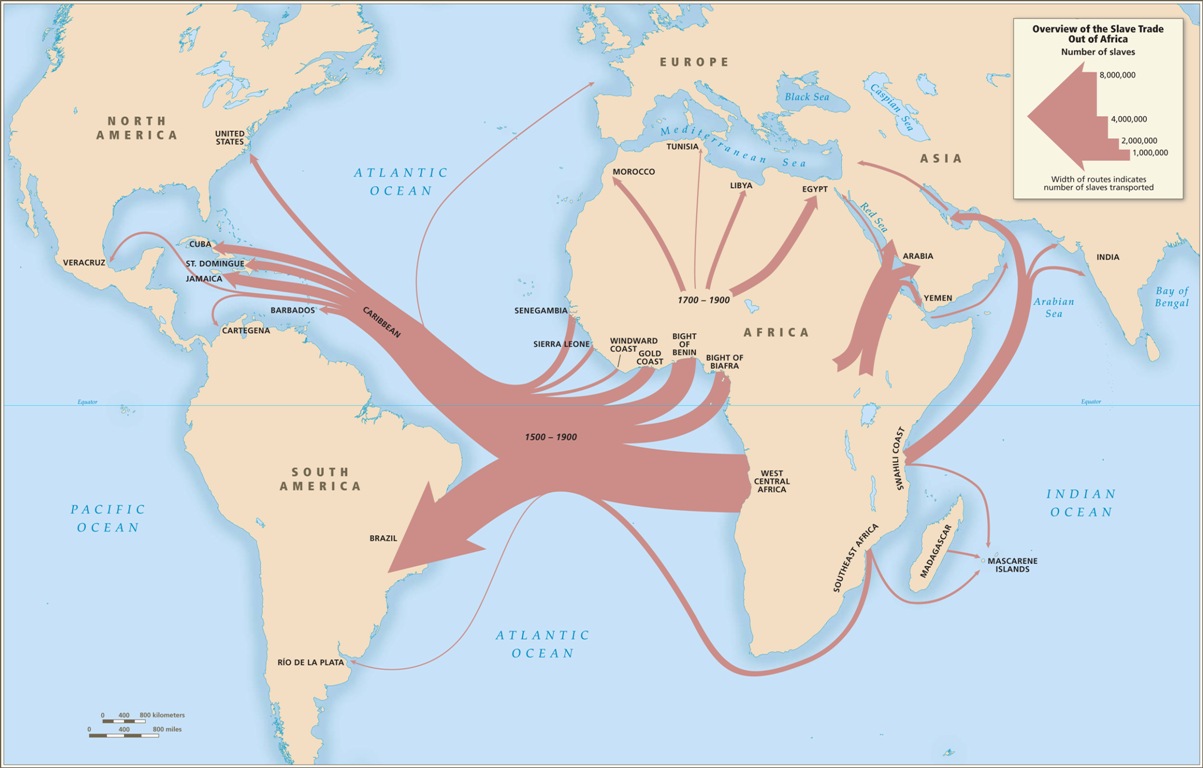
1. Overview of the slave trade out of Africa, 1500-1900
2. Migration of sugar cultivation from Asia into the Atlantic
3. Old World slave trade routes in the Atlantic before 1759
4. Wind and ocean currents of the Atlantic basins
5. Major regions and ports involved in the trans-Atlantic slave trade, all years
6. Countries and regions in the Atlantic World where slave voyages were organized by share of captives carried off from Africa
7. Major coastal regions from which captives left Africa
8. Major regions where captives disembarked
9. Volume and direction of the trans-Atlantic slave trade from all African to all American regions
maps for understanding slave trade
Slave Voyages
Explore the Origins and Forced Relocations of Enslaved Africans Across the Atlantic World
The SlaveVoyages website is a collaborative digital initiative that compiles and makes publicly accessible records of the largest slave trades in history. Search these records to learn about the broad origins and forced relocations of more than 12 million African people who were sent across the Atlantic in slave ships, and hundreds of thousands more who were trafficked within the Americas. Explore where they were taken, the numerous rebellions that occurred, the horrific loss of life during the voyages, the identities and nationalities of the perpetrators, and much more.
A collaborative digital initiative that compiles and makes publicly accessible records of the largest slave trades in history as well as other resources surrounding the slave trade.
Slave Voyages
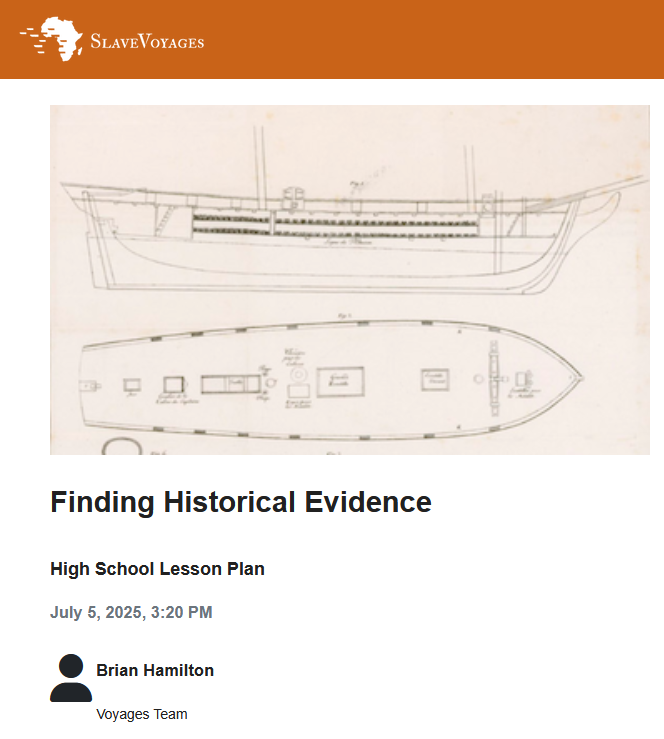
11th-12th grade:AP World History; African and African-American Studies. This lesson puts equal emphasis on the history of the trans-Atlantic slave trade and on the craft of forming historical arguments. Students are asked to read a recent work from David Brion Davis, a leading historian of slavery, and to compare his arguments with evidence from the database. This forms the foundation for a discussion of what kinds of claims are harder to defend than others and why some types of evidence are more convincing than others.
advanced high school lesson plan for world history or US history
Sloss Furnaces
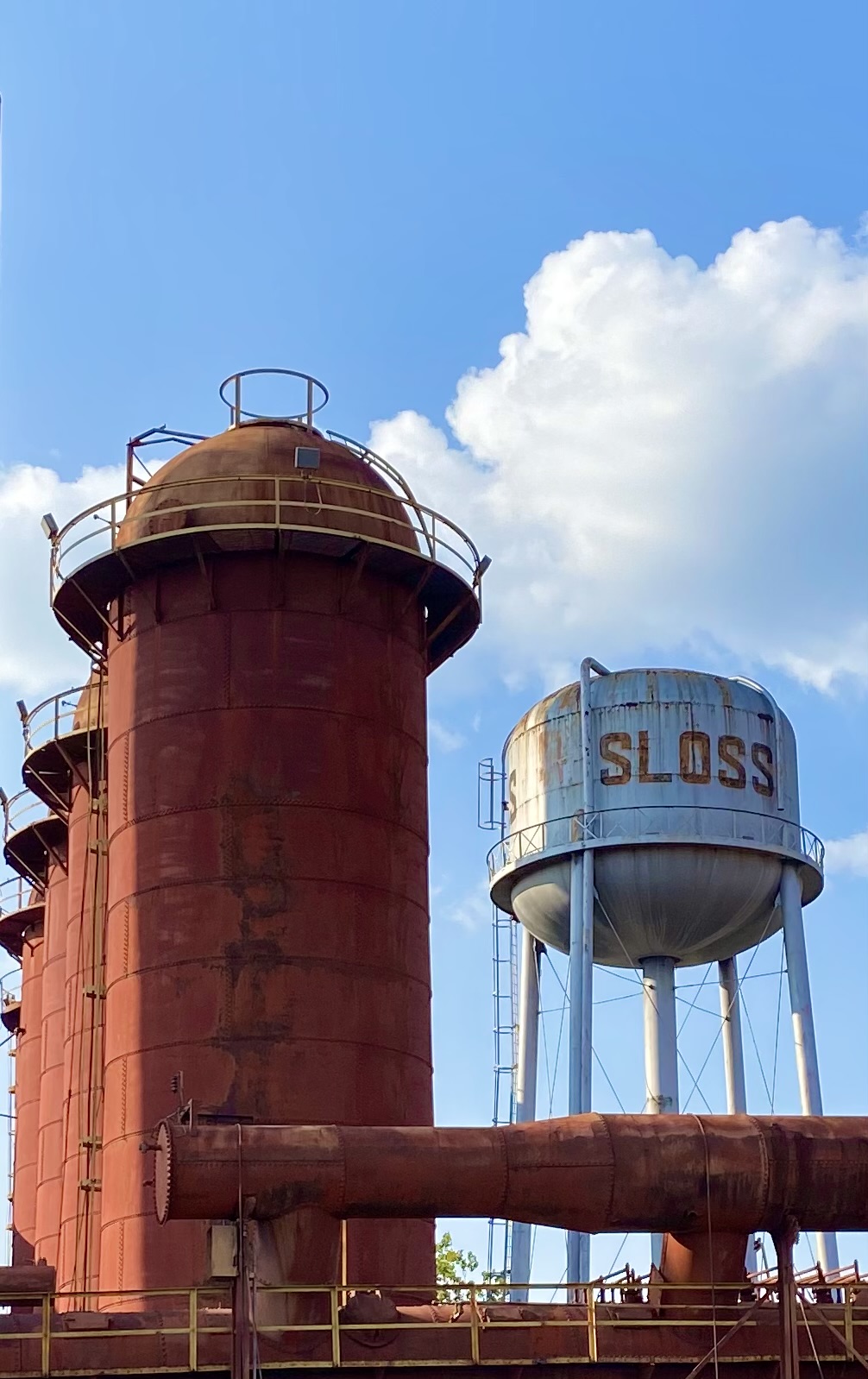
Sloss Furnaces is a National Historic Landmark owned by the City of Birmingham and supported by the Sloss Furnaces Foundation.The history of Sloss Furnaces is the history of Birmingham and the industrial age. It is the stories of the people that worked here. Sloss escaped destruction after 90 years of operation when the iron stopped pouring in 1971, saved by dedicated residents and a major investment by the City of Birmingham. Sloss Furnaces opened as a national historic landmark in 1981 and continues to be a place of learning, art and entertainment that draws people from around the world.
In the years following the Civil War, railroad men, land developers and speculators moved into Jones Valley to take advantage of the area’s rich mineral resources. All the ingredients needed to make iron lay within a thirty-mile radius. Seams of iron ore stretched for 25 miles through Red Mountain, the southeastern boundary of Jones Valley. To the north and west were abundant deposits of coal, while limestone, dolomite, and clay underlay the valley itself. In 1871 southern entrepreneurs founded a new city called Birmingham and began the systematic exploitation of its minerals.Thousands of workers from the rural South and around the world came seeking jobs. At one time, Sloss Furnaces was the largest pig iron producer in the world.Sloss provided jobs for thousands of former slaves and European immigrants, but had a history of racial injustice, union busting and dangerous working conditions.Sloss has a unique role in the history of civil rights in Birmingham and in the ways we now connect our diverse communities through art, education, and cultural events.
The history of Sloss Furnaces is the history of Birmingham and the industrial age. This site includes labor, including enslavement, in the history it tells.
Sloss Furnaces
a self-guided tour map that can be used with the video whose link is found in another entry.
The history of Sloss Furnaces is the history of Birmingham and the industrial age. This site includes labor, including enslavement, in the history it tells.
Sloss Furnaces
This is a walkthrough of Sloss Furnaces in Birmingham, AL.
Sloss Furnaces has educated, entertained and inspired our community for nearly 50 years - a vibrant cultural center that welcomes people from around the world - a place that tells our collective story as the birthplace of Birmingham.
The numbers you see here represent the extraordinary scale of operations at Sloss Furnaces before it stopped producing iron in 1971 and became a national historic landmark in 1981.
Admission to Sloss Furnaces is FREE. You can take a self-guided tour through this 15 acre site and learn about the process and the people that made this incredible place operate 24/7. Guided tours are also available for a small fee, with immersive special tours scheduled throughout the year.
Youtube guided tour. The history of Sloss Furnaces is the history of Birmingham and the industrial age. This site includes labor, including enslavement, in the history it tells.
Smithsonian
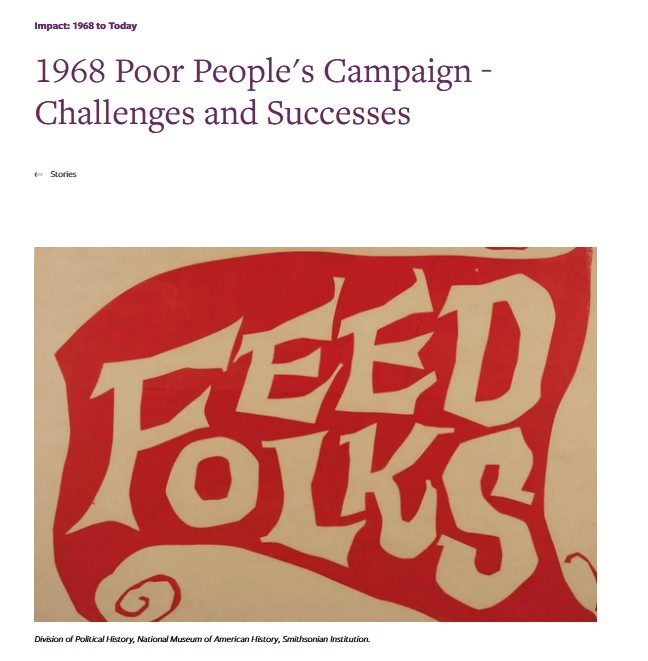
Smithsonian exhibit and video of The Poor People's Campaign, 1968. The Poor People's Campaign faced many challenges. SCLC leadership still was mourning Martin Luther King Jr.'s death when the campaign began. There were logistical challenges in bringing people from across the country to Washington, D.C.—feeding them, securing their safety, and finding shelter along the way. There was also the challenge of launching a large-scale national movement, in which different communities came to Washington with a wide range of needs and objectives. The SCLC had to find unity among differences. Despite these challenges, the movement had it successes and impact. On this site, there are videos from the era.
Hunger in America (Youtube), which aired in May 1968 on CBS, brought poverty and hunger into American homes. The program focused on poverty in four regions of the country: a Latino community in Texas; a white community in Virginia; a Native American reservation in Arizona; and an African American community in Alabama. The documentary’s portrayal of poverty’s effect on children moved Americans to write their representatives and demand the government provide assistance.
A Smithsonian/National Museum of African American History & Culture-published article on the 1968 Poor People's Campaign, complete with historical images.
Smithsonian
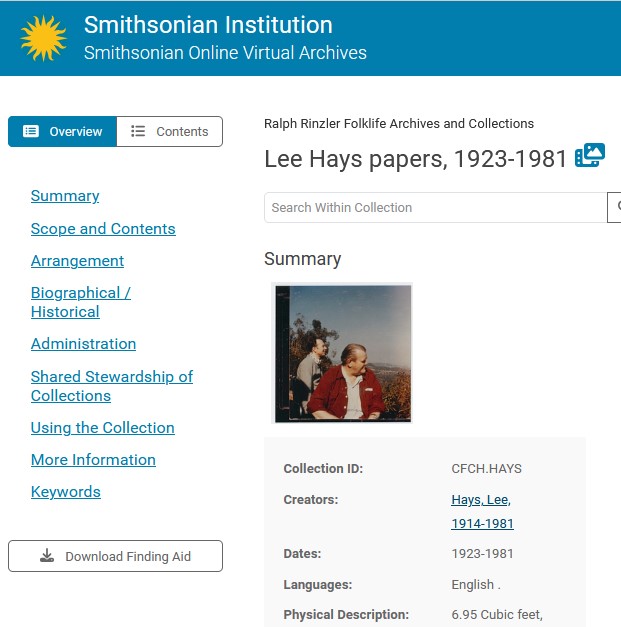
digitized portion of the archive of Lee Hays (1914-1981) an influential American singer, songwriter, author, and activist. His legacy, both literary and musical, emphasizes the dynamic relationship between traditional culture and contemporary events and issues. As is clear from his essay "The Folk Song Bridge", Hays conceived of "folk music" as a living, breathing "process".
Lee Hays papers date from 1923 to 1981. The collection contains original writings, correspondence, and miscellaneous projects by Lee Hays; business records, interviews and features related to Lee Hays, including photographs; clippings saved by Lee Hays; and audio recordings made by Lee Hays, including recorded interviews with Cisco Houston. Items available include material about Woody Guthrie, Pete Seeger, Studs Terkel, Don West, Claude Williams, The Weavers
digitized materials from one of the mid-20th century labor songwriters, part of the folk revival
Social Democratic Herald, Marxists.org
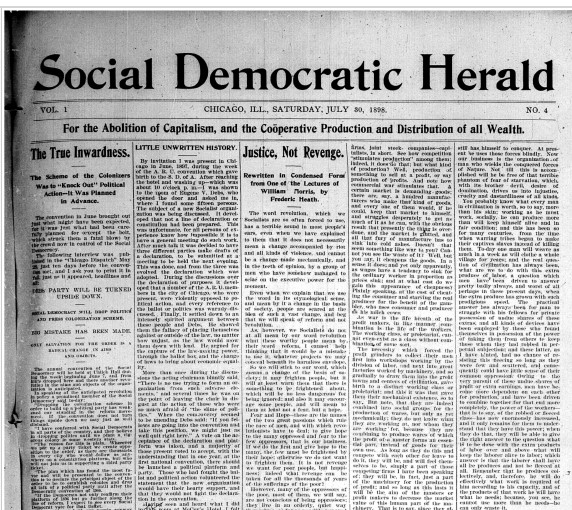
Official organ of the Social Democratic Party of America with headquarters in Chicago. The organization emerged from the Social Democracy of America in an 1898 split and wound up merging with the similarly named organization with headquarters in Springfield, Mass. to form the Socialist Party of America in August 1901.
From Marxists.org: " The Social Democracy of America (SDA), founded in 1897 by Eugene V. Debs from the remnants of his American Railway Union, was deeply divided between those who favored a tactic of launching a series of colonies to build socialism by practical example and others who favored establishment of a European-style socialist political party with a view to capture of the government apparatus through the ballot box. The June 1898 convention would be the group's last, with the minority political action wing quitting the organization to establish a new organization, the Social Democratic Party of America (SDP).
With the old official organ, The Social Democrat, remaining with the colonizationists, a new newspaper was needed for the new party, and on July 9, 1898, The Social Democratic Herald was born. The paper was published in Chicago under the editorship of Alfred Shenstone Edwards.
The Herald would remain the official organ for the Social Democratic Party with headquarters in Chicago, headed by Theodore Debs, younger brother of Eugene, throughout a long and difficult unification process with dissidents who split from the Socialist Labor Party back in 1899. The two groups would eventually bury their petty jealousies and minor differences and unify forces at a Socialist Unity Convention held in Indianapolis in the summer of 1901 — a meeting which established the Socialist Party of America (SPA).
Social Democratic Party newspaper digitized
Social Democratic Herald, archive.org
Official organ of the Social Democratic Party of America with headquarters in Chicago. The organization emerged from the Social Democracy of America in an 1898 split and wound up merging with the similarly named organization with headquarters in Springfield, Mass. to form the Socialist Party of America in August 1901.
Social Democratic Party newspaper digitized
Social Justice Walking Tour
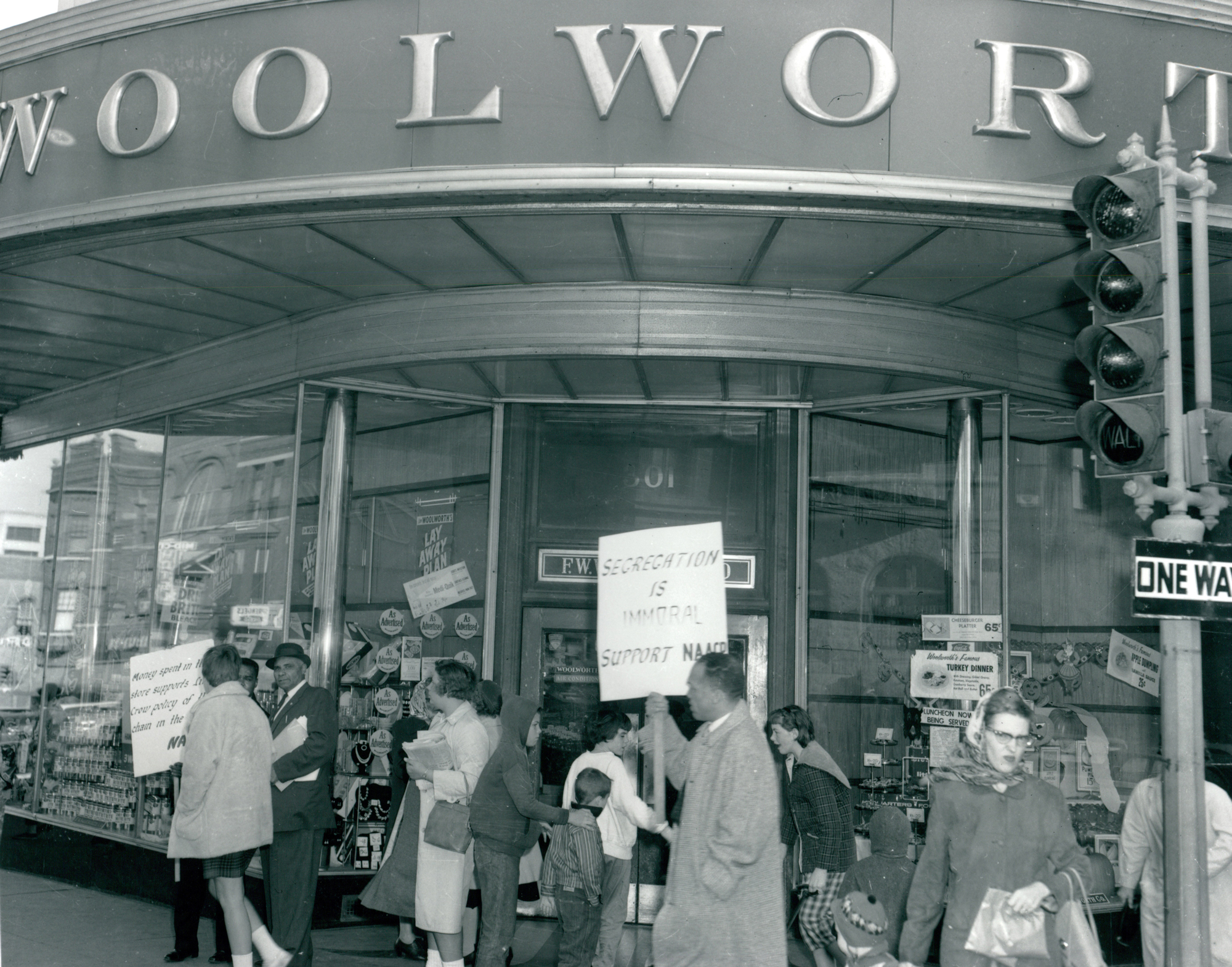
In 1917 Bloomington-Normal’s street railway workers were unhappy about their pay and the number of days they worked per week. They organized a union to consolidate their power, hopeful that change would happen. This is part of a tour including 3 other sites in Bloomington, Illinois
https://www.motherjonesmuseum.org/bloomington-1917-strike and full tour https://www.youtube.com/watch?v=fXZet-3INY8&t=164s
Digital exhibit featuring Mary Harris "Mother" Jones

Socialist Labor Party
The Labor Review was published in Detroit, Michigan also under title THree Stars, and is a magazine of the Socialist Labor Party.
a sample page from an early labor socialist paper
Museum/Exhibits
Tours
Maps
Digital Projects
Organizations
Sites
Film/Video
Audio/Interview
Podcast/Program
Text/Document
Image
Graphs/Data
Timeline
Southwest
West
Midwest
Southeast
Northeast
Mexico
Canada
Global
Books
Teaching
Lectures
Digital Archives
Journals
Bibliographies
Topic Intro