


Explore thousands of items. Use clickable links under collections and library for broad categories. Search by keyword (including topic,city, state.) Limit by time period, type of item, region. See our search tips page for more assistance.
Collections
Library
Type
Region
Coverage:
-
Published:
-
Socialist Labor Party, Marxists,org
The People was an official organ of the Socialist Labor Party of America (SLP), a weekly newspaper established in New York City in 1891. The paper is best remembered as a vehicle for the ideas of Daniel DeLeon (1852–1914), the dominant ideological leader of the SLP from the 1890s until the time of his death. The paper became a daily in 1900, reverting to weekly publication in 1914 for budgetary reasons. Publication of the paper was moved to Palo Alto, California during its later years, finally terminating publication in 2008. Its 117 years of continuous publication make The People the longest running socialist newspaper in the history of American political radicalism. Daily (1900-1914), Weekly (1914-?), Monthly (2003-2008).
Socialist Labor Party newspaper digitized

Socialist Labor Party, Socialist Party, Marxists.org
Chicago — Est. March 11, 1899. Edited by A.M. Simons, this newspaper started as a local Socialist Labor Party publication, becoming a voice of the Springfield SDP after the split of the anti-DeLeon faction in July. Continued through the end of 1901, when it was replaced by the Chicago Socialist in March 1902, going daily as the Chicago Daily Socialist . 1907 and running until termination in 1912. The short-lived terminal name of the publication was the Chicago Evening World.
description by Tim Davenport
Chicago newspaper of the Socialist Party, much labor news, digitized

Socialist Party
The Reading Labor Advocate was the official organ of the Socialist Party, USA of Berks County, Pennsylvania and of the Federated Trades Council of Reading. Here we present a run of the weekly paper from late 1932 to late 1934.
During that period, Pennsylvania was a major stronghold of the Socialist Party. The Socialist Party chapter in Berks County was the largest and fastest growing party local at the time. Local Berks was also among the most electorally successful and longest-lasting of all Socialist Party locals in US history. By 1929, Reading was the only city in the country whose city council was completely controlled by the Socialist party. In the 1932 election in Reading, Norman Thomas, the Socialist candidate for President, garnered 21% of the vote. Raymond Hofses, editor of The Reading Labor Advocate, garnered 27% of the vote in his race for a Congressional seat.
The Reading Labor Advocate was the official organ of the Socialist Party, USA of Berks County, Pennsylvania and of the Federated Trades Council of Reading.

Socialist Party Mississippi
1 issue available of this newspaper
Mississippi socialist paper

Socialist Party of America
The Alaska Socialist was an American semi-monthly newspaper published in Fairbanks, Alaska. After moving to Alaska following a scandal, Lena Morrow Lewis established the paper in 1913. Its first issue was published on September 29, 1913, and was associated with the Socialist Party of America.“Published in the Interests of the Workers of Alaska and Advocating Industrial and Political Action”, was the paper of the Socialist Party of Alaska, produced twice-monthly by the Socialist Publishing Company in Fairbanks, Alaska beginning in 1913 and edited by A Knowles. It lasted until 1915. One of two rival socialist papers in Fairbanks, the other was the Socialist Press edited by George Hinton and began in 1914 fighting for control of the Socialist Party local with the ‘Alaska Socialist’ and its editor Alfred Knowles. The Socialist Press won the contest and Knowles papers ceased in 1915, while the ‘Socialist Press’ continued until 1918. The papers combative attitude and anti-war position got it and its editor into much trouble, including with Federal Authorities who shut the paper down as ‘pro-German’ because it was opposed to conscription."-Revolution Newstand description
Alaska socialist paper
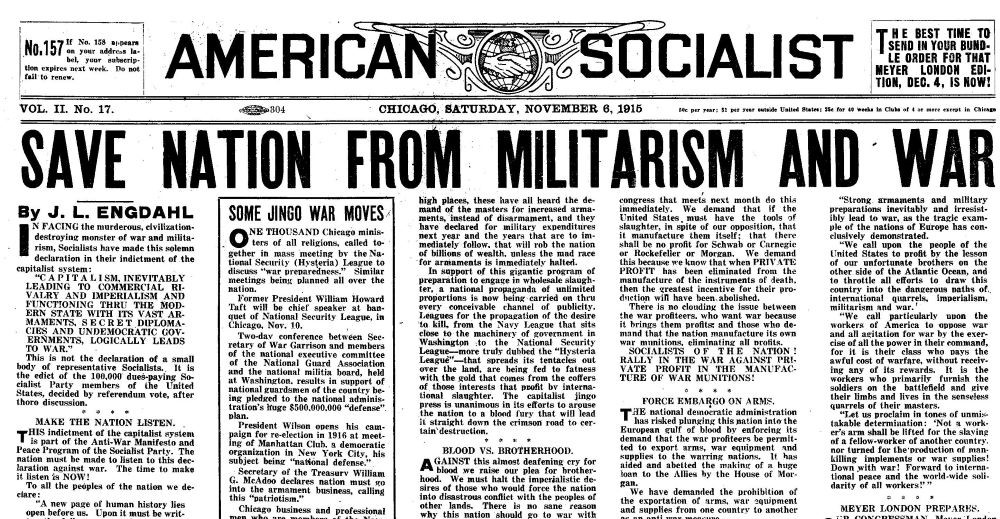
Socialist Party, American Socialist
American Socialist newspaper was the offical organ of the Socialist Party of America in the pre-WWI years. Published in Chicago it was edited by J. L. Enghdal. It relfected the reformist and electoralist tendencies of the leadership of Party nationally at that time while at the same time providing a platform for the most coherent radical voices opposing the Imperialist war, which the U.S. had not yet entered. It was also very much a campaign paper covering the increasing number of electoral victories of the SP at this time. Of special note was the coverage it afforded the left-wing anti-war candidacy of Eugene V. Debs. The American Socialist was actually the continuation of the official semi-internal bulletin of the SPA titled The Socialist Party Official Bulletin founded in 1904. In May of 1913 the name was changed to Party Builder. The first issue of American Socialist is basically the continuation from the last issue of Party Builder
American Socialist newspaper was the offical organ of the Socialist Party of America in the pre-WWI years.

Socialist Party, Marxists.org
Published from Butte Montana In addition to a range of material relating to the organization and affairs of the ALU, the Journal covered the activities of the federations participant members, including the Western Federation of Miners and the United Brotherhood of Railway Employees. It also provided regular coverage of the vigorous organized labor movement in Butte. SOcialist and industrial unioni orientation. In January 1905, ALU Journal was replaced by a monthly called Voice of Labor, with a growing syndicalist editorial line. The union would go on to become one of the primary founding organizations of the Industrial Workers of the World in 1905.--from Marxists.org
Butte, Montana based radical labor journal, digitized archive
Solomon Northup, History Matters
The slave auction was one of the most barbaric practices of the harsh system of slavery. The slave trade within the United States destroyed families and tore apart communities, especially after 1840 when slavery was extended into the newer lands of the lower South and Southwest. Planters in the older settled areas of the upper South could realize substantial profits selling enslaved people, and New Orleans became the center of the trade. The resulting forced migration involved hundreds of thousands of African Americans. Some moved with their masters, but the migration also tore apart slave families residing on different plantations. Others were sold on the block, as Solomon Northup described in his Twelve Years a Slave. Narrative of Solomon, a Citizen of New-York, Kidnapped in Washington City in 1841.
Solomon Northrup's description of the U.S. slave trade through a retelling of what it was like to be sold at a New Orleans slave auction.
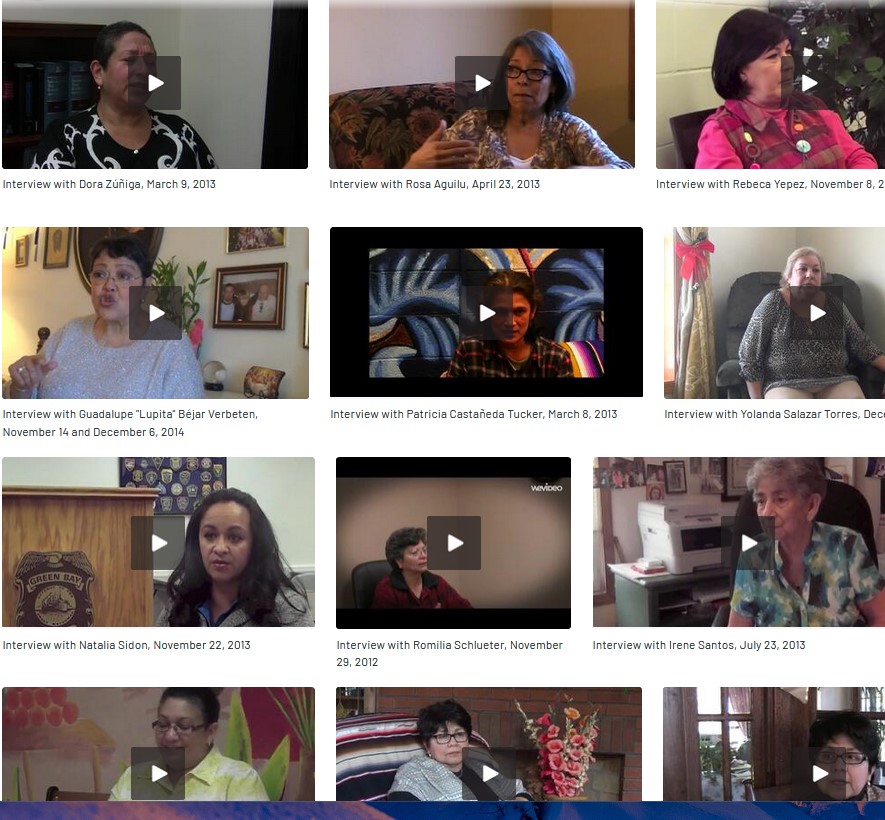
Somos Latinas
The Somos Latinas (We Women) History Project (2012-2016) was created to document the many significant and largely hidden contributions of Latinas in Wisconsin engaged in their communities to positively impact society in K-12 and post-secondary education, civil rights, women's rights, domestic abuse services, immigration reform, political representation, peace and justice, and other areas.
The online collection currently includes 52 interviews from 37 Latinas from across Wisconsin. NOTE: Additions and corrections to the collection are ongoing. You may encounter interviews without transcripts or transcripts that have not been fully edited.
An oral history project comprised of fifty-two interviews focusing on Latina experiences in Wisconsin.

Sonia Hernandez
University of Illinois Press (2021)
Caritina Piña Montalvo personified the vital role played by Mexican women in the anarcho-syndicalist movement. Sonia Hernández tells the story of how Piña and other Mexicanas in the Gulf of Mexico region fought for labor rights both locally and abroad in service to the anarchist ideal of a worldwide community of workers.
An international labor broker, Piña never left her native Tamaulipas. Yet she excelled in connecting groups in the United States and Mexico. Her story explains the conditions that led to anarcho-syndicalism's rise as a tool to achieve labor and gender equity. It also reveals how women's ideas and expressions of feminist beliefs informed their experiences as leaders in and members of the labor movement"-- Provided by publisher
tells the story of how Mexicanas in the Gulf of Mexico region fought for labor rights both locally and abroad in service to the anarchist ideal of a worldwide community of workers.

Sonia Hernandez
Texas A&M University Press (2014)
In Working Women into the Borderlands, author Sonia Hernández sheds light on how women's labor was shaped by US capital in the northeast region of Mexico and how women's labor activism simultaneously shaped the nature of foreign investment and relations between Mexicans and Americans. As capital investments fueled the growth of heavy industries in cities and ports such as Monterrey and Tampico, women's work complemented and strengthened their male counterparts' labor in industries which were historically male-dominated. As Hernández reveals, women laborers were expected
Introduction: Norteño history as borderlands history
Selling the Norteño borderlands: capital, land, and labor
Peasant women's work in a changing countryside during the Porfiriato
"We cannot suffer any longer from the patrón's bad treatment": everyday forms of peasant negotiation
(En)Gendering revolution in the borderlands: revolucionarias, combatants, and supporters in the northeast
Women's labor and activism in the greater Mexican borderlands, 1910-1930
Class, gender, and power in the postrevolutionary borderlands
Epilogue
Appendix 1. Selected mutual-aid societies and related collective organizations in the Mexican Northeast, 1880-1910
Appendix 2. Selected organizations in Texas affiliated with the Partido Liberal Mexicano, 1911-1917
Appendix 3. Selected estatutos (by-laws) and artículos of the Unión de Obreras "Fraternidad Femenil" (Xicoténcatl, Tamaulipas)
how women's labor was shaped by US capital in the northeast region of Mexico

Sophia Z. Lee
Cambridge University Press (2014)
Today, most Americans lack constitutional rights on the job. Instead of enjoying free speech or privacy, they can be fired for almost any reason or no reason at all. This book uses history to explain why. It takes readers back to the 1930s and 1940s when advocates across the political spectrum - labor leaders, civil rights advocates, and conservatives opposed to government regulation - set out to enshrine constitutional rights in the workplace. The book tells their interlocking stories of fighting for constitutional protections for American workers, recovers their surprising successes, explains their ultimate failure, and helps readers assess this outcome"--Amazon.com
interlocking stories of fighting for constitutional protections for American workers,

Sophie White
The University of North Carolina Press (2019)
In eighteenth-century New Orleans, the legal testimony of some 150 enslaved women and men--like the testimony of free colonists--was meticulously recorded and preserved. Questioned in criminal trials as defendants, victims, and witnesses about attacks, murders, robberies, and escapes, they answered with stories about themselves, stories that rebutted the premise on which slavery was founded. Focusing on four especially dramatic court cases, Voices of the Enslaved draws us into Louisiana's courtrooms, prisons, courtyards, plantations, bayous, and convents to demonstrate how enslaved people viewed and experienced their worlds. Sophie White offers both a richly textured account of slavery in French Louisiana and a powerful meditation on the limits and possibilities of the archive"-- Provided by publisher
draws us into Louisiana's courtrooms, prisons, courtyards, plantations, bayous, and convents to demonstrate how enslaved people viewed and experienced their worlds

South Asian American Digital Archive
Link is just one exhibit at this site. The site redirects to main page so you must find it from the landing page by clicking searching for solidarity forever. The site aims to documenting, preserving, and sharing stories that represent Southeast Asian unique and diverse experiences. SAADA also envisions American and world histories that fully acknowledge the importance of immigrants and ethnic communities in the past, strengthen such communities in the present, and inspire discussion about their role in the future.
A digital archive containing over 5,000 entries helping to generate knowledge about the experiences of South Asian immigrants to America.
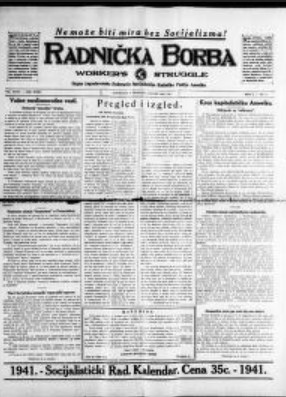
South Slavic Socialist Federation
The Croatian-language Radnička Borba("Workers" Struggle") began in 1907 as the official organ for the New York branch of the South Slavic Socialist Federation (SSSF). Within the SSSF, there was dissent over which American Socialist party to support - members in New York supported the Socialist Labor Party (SLP) while a faction in Chicago supported the Socialist Party - leading to a split in the SSSF and establishment of two separate newspapers: the Radnička Borba in New York and the Radnička Straža ("Workingmen's Guard") in Chicago. Of these two groups, the Chicago-based group had more success because the Socialist Party was the less radical and less sectarian. A lack of support for the SLP led to the Radnička Borba suspending publication in early 1908 after just five issues. SLP members in Ohio decided to take over and moved the group's headquarters to Cleveland where the Radnička Borba resumed publication in 1909. The SLP did not have money to assist in the publication of the Radnička Borba, but the Cleveland group managed to raise $500 for a printing press
New York and later Ohio Croatian Socialist Labor Party newspaper

Southeast Chicago Historical Museum and Society
The museum houses a rich array of oral histories and exhibits that tell the story of Chicago's industrial Southeast side. The storytelling project, the highlight of the website, offers curated exhibits on race, the Memorial Day Massacre, and Immigration, with many more coming soon. Another exciting feature is the organizations dense digital archive of both sources and oral histories.
Museum profiles steelworkers and deindustrialization

Southeast Chicago Historical Society
Chicago, Illinois, Memorial Day Massacre
photos from Ed Sadlowski Campaign, General Labor, Progressive Steel Workers Union, Memorial Day Massacre, USWA Local 65, USWA Local 1033
Southeast Chicago History Museum
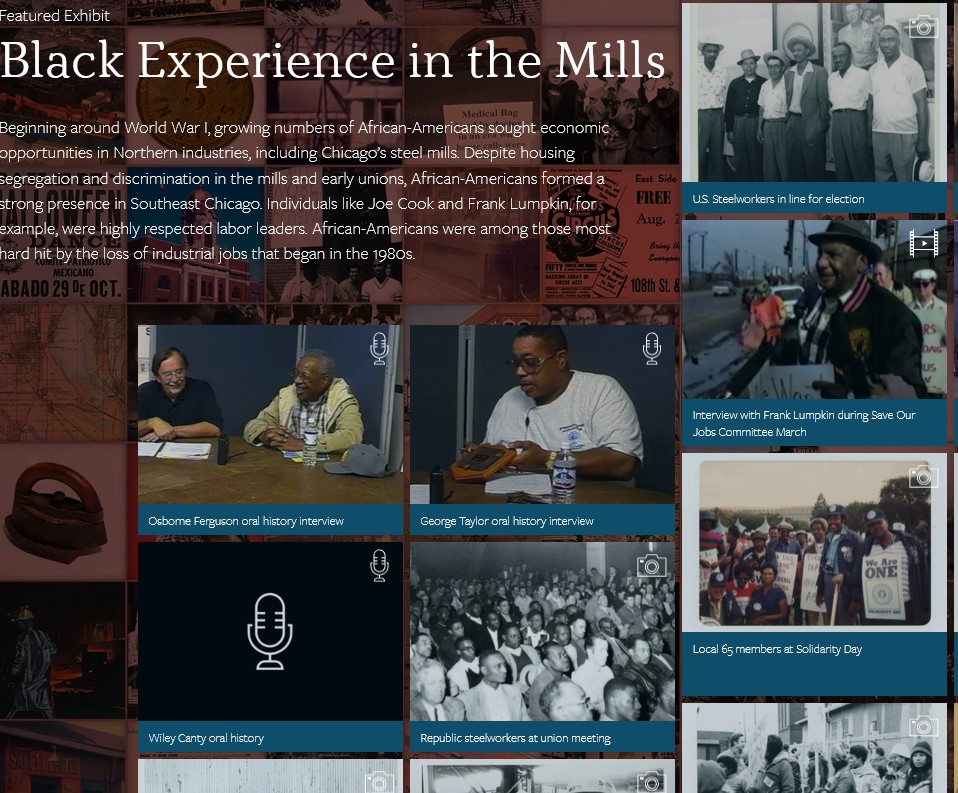
Beginning around World War I, growing numbers of African-Americans sought economic opportunities in Northern industries, including Chicago’s steel mills. Despite housing segregation and discrimination in the mills and early unions, African-Americans formed a strong presence in Southeast Chicago. Individuals like Joe Cook and Frank Lumpkin, for example, were highly respected labor leaders. African-Americans were among those most hard hit by the loss of industrial jobs that began in the 1980s.This is a digital exhibit that includes oral histories, images, video clips and some documents about that experience
Digital exhibit on Black steelworkers in Southeast Chicago and Indiana

Southeast Chicago History Museum
The Calumet region was once one of the largest steel-producing regions in the world. Steel mills and other industry first sprang up along Lake Michigan in the late 19th century; by the mid-twentieth century the mills employed over a hundred thousand people in Illinois and Indiana. Immigrants and migrants of different races and ethnicities came to the region in search of a better life. When Southeast Chicago’s mills began to close in the 1980s, it disrupted lives and communities and ushered in a new, less certain era. It also sparked an urge to reflect on the past.
While other neighborhoods emerged later, this website focuses on the old steel mill neighborhoods of Southeast Chicago. These include: South Chicago, South Deering, the East Side, and Hegewisch.
Map of Calumet from Southeast Chicago History website
Southeast Chicago History Museum
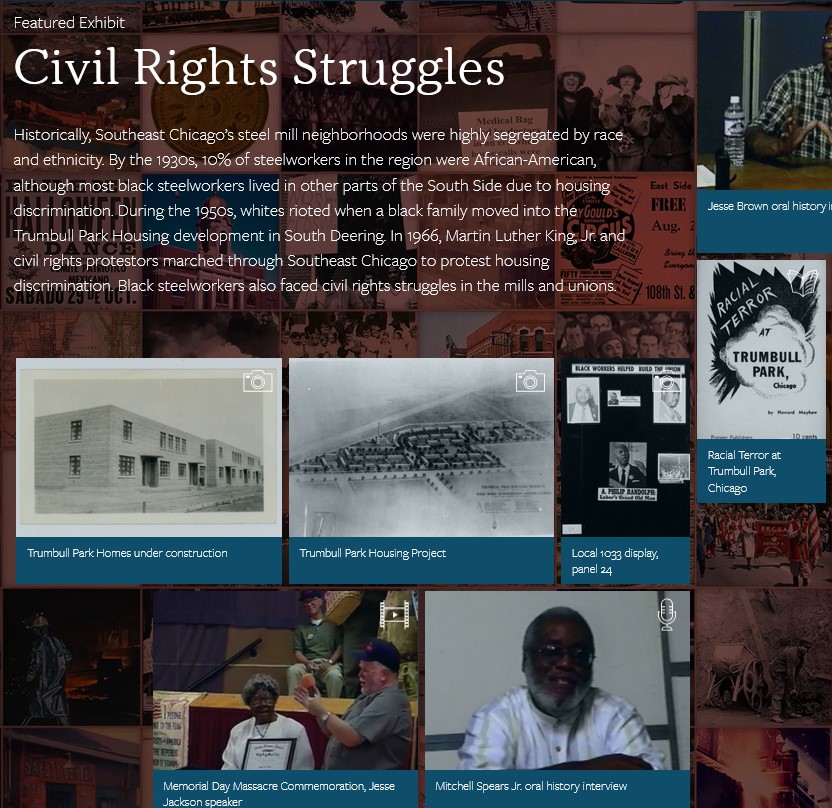
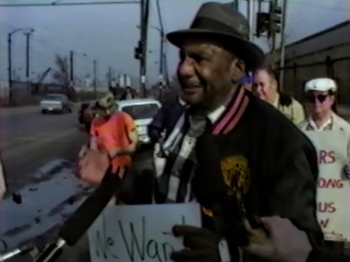
Digital exhibit. Historically, Southeast Chicago’s steel mill neighborhoods were highly segregated by race and ethnicity. By the 1930s, 10% of steelworkers in the region were African-American, although most black steelworkers lived in other parts of the South Side due to housing discrimination. During the 1950s, whites rioted when a black family moved into the Trumbull Park Housing development in South Deering. In 1966, Martin Luther King, Jr. and civil rights protestors marched through Southeast Chicago to protest housing discrimination. Black steelworkers also faced civil rights struggles in the mills and unions.
Through artificacts and oral history, an online digital exhibit of the civil rights struggles of the area
Southeast Chicago History Museum
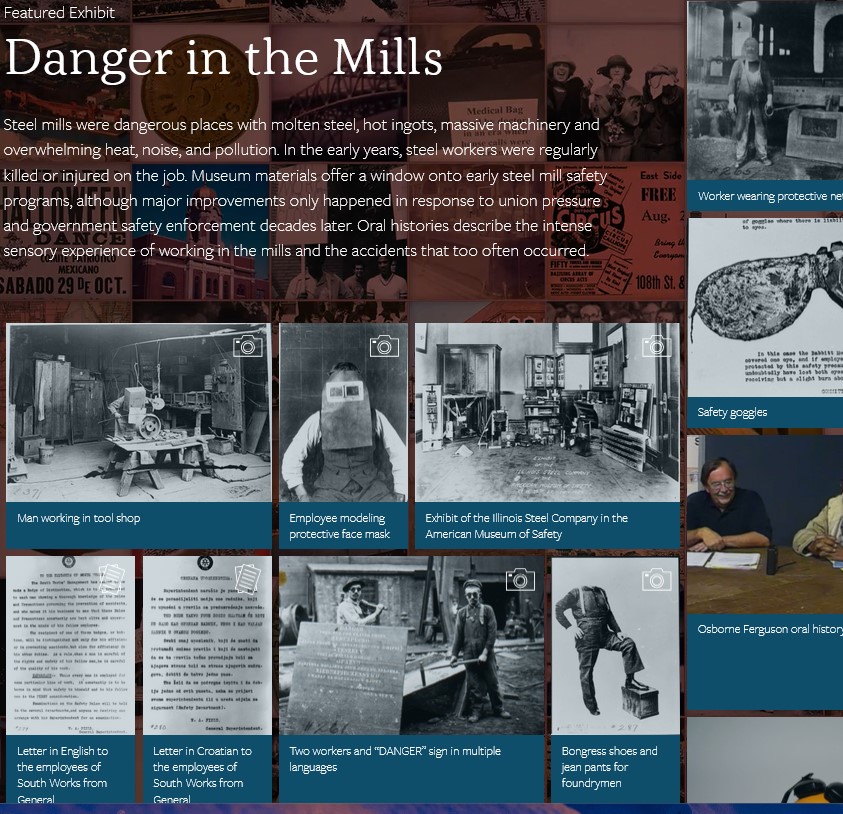
Steel mills were dangerous places with molten steel, hot ingots, massive machinery and overwhelming heat, noise, and pollution. In the early years, steel workers were regularly killed or injured on the job. Museum materials offer a window onto early steel mill safety programs, although major improvements only happened in response to union pressure and government safety enforcement decades later. Oral histories describe the intense sensory experience of working in the mills and the accidents that too often occurred.
Digital exhibit provides window to workplace dangers in Southeast Chicago mills
Southeast Chicago History Museum
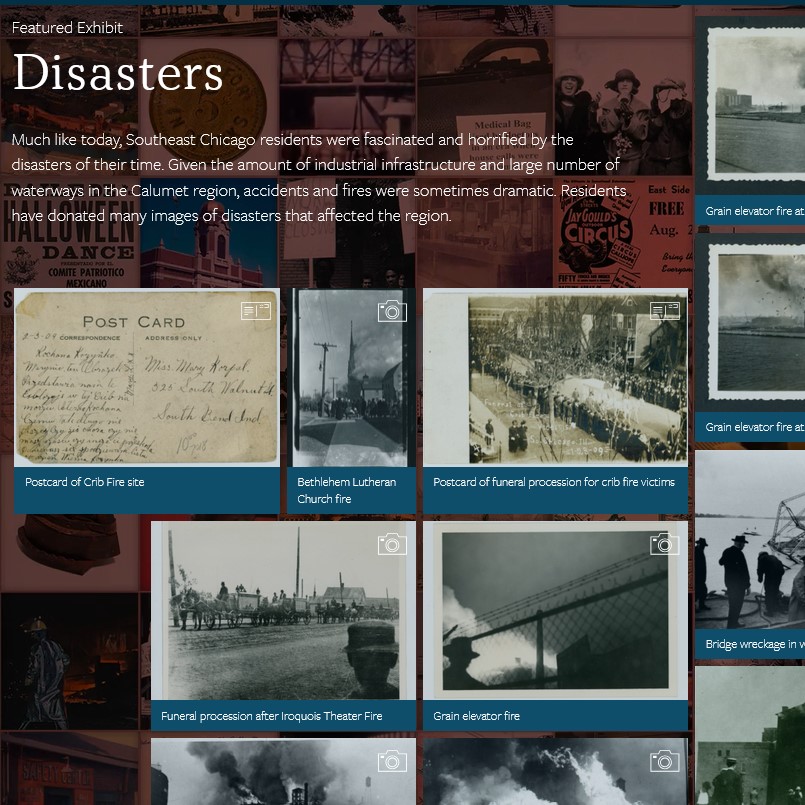
Much like today, Southeast Chicago residents were fascinated and horrified by the disasters of their time. Given the amount of industrial infrastructure and large number of waterways in the Calumet region, accidents and fires were sometimes dramatic. Residents have donated many images of disasters that affected the region.
A digital collection of photos related to disasters suffered in Southside Chicago
Southeast Chicago History Museum
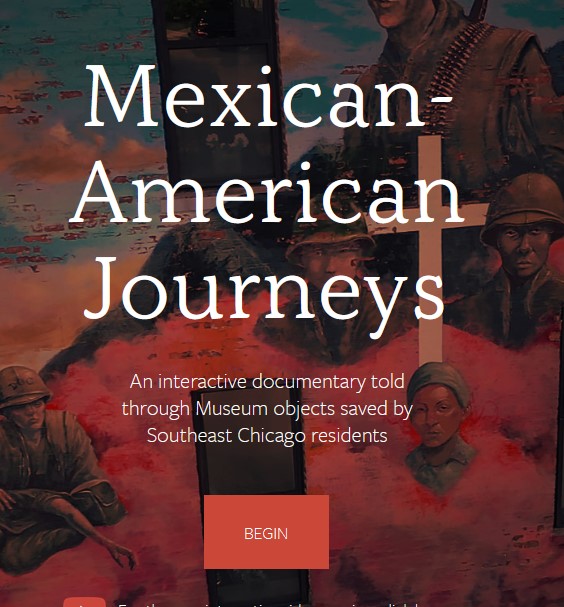
a multi-media digital exhibit of Mexican migration and people/institutions of Southeast Chicago
Digital exhibit of the tories of Mexican-Americans who came to Southeast Chicago steel and other industries and the life they made
Southeast Chicago History Museum
The Southeast Chicago Historical Museum opened in 1985 in Chicago’s Calumet Park fieldhouse on the Lake Michigan waterfront. This community-based Museum is maintained by the Southeast Chicago Historical Society. The Museum houses a rich collection of materials donated by residents, as well as oral history collections and exhibits prepared by area students and volunteers.
The Museum was given a crucial boost in the early 1980s by a large donation of materials collected by the Southeast Chicago Historical Project (SECHP). This community-driven project was the brainchild of local labor leader Ed Sadlowski with partners from Chicago’s Columbia College. They combined forces with area resident Jim Fitzgibbons and the East Side Historical Society founded in 1976. The idea was to support the people of Southeast Chicago in coming together to explore their own history. With funding from the National Endowment for the Humanities, the project resulted in an enormous collection of materials from disparate groups, encompassing the four neighborhoods that made up the old steel mill communities of Southeast Chicago – South Chicago, South Deering, East Side, and Hegewisch.
Remarkably, the Society and Museum have been maintained for nearly 40 years on an all-volunteer basis and the collection has tripled in size. The Society also sponsors a lively Facebook group that encourages discussion of the region’s history. Rod Sellers is Director of the Museum. Karen Brozynski is President of the Society, and Carolyn Mulac is Secretary and Treasurer. The Museum/Fieldhouse is located at 9801 S. Avenue G, Chicago, IL, 60617.
Southeast Chicago Archive and Storytelling Project has online exhibits, oral histories
Southeast Chicago History Museum
An interactive documentary told through Museum objects saved by Southeast Chicago residents. The Calumet region of Southeast Chicago and Northwest Indiana was once one of the largest industrial corridors in the world, dominated by steel mills
Digital exhibit on Deindustrialization and its struggles in Southeast CHicago and Northern Indiana
Museum/Exhibits
Tours
Maps
Digital Projects
Organizations
Sites
Film/Video
Audio/Interview
Podcast/Program
Text/Document
Image
Graphs/Data
Timeline
Southwest
West
Midwest
Southeast
Northeast
Mexico
Canada
Global
Books
Teaching
Lectures
Digital Archives
Journals
Bibliographies
Topic Intro