


Explore thousands of items. Use clickable links under collections and library for broad categories. Search by keyword (including topic,city, state.) Limit by time period, type of item, region. See our search tips page for more assistance.
Collections
Library
Type
Region
Coverage:
-
Published:
-
Southeast Chicago History Museum
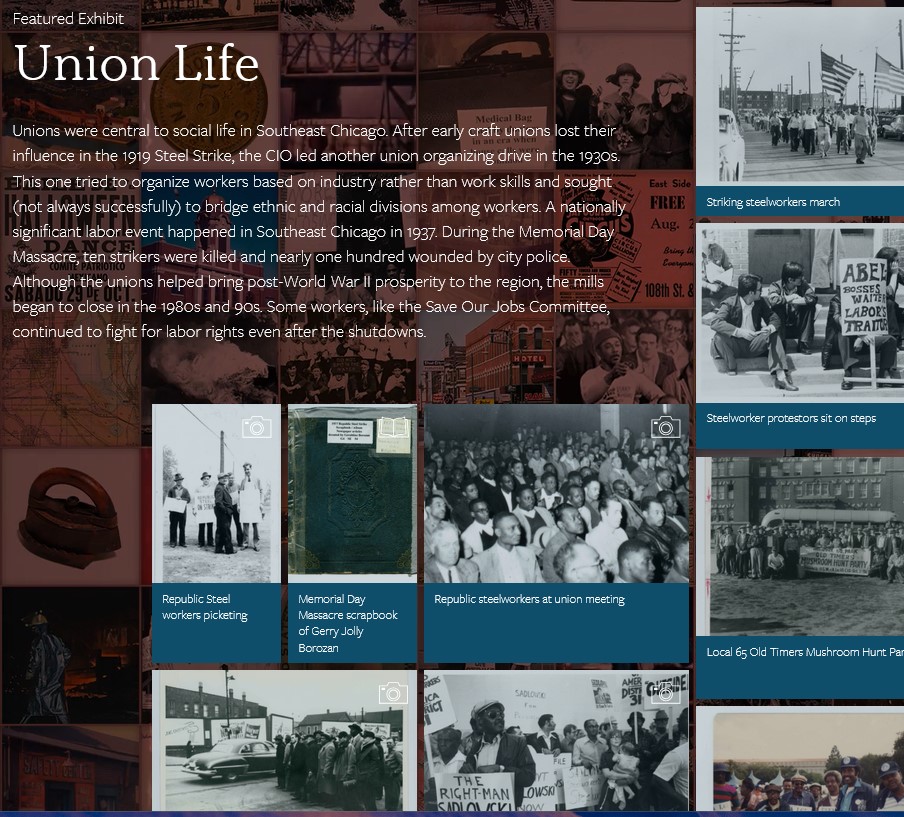
Unions were central to social life in Southeast Chicago. After early craft unions lost their influence in the 1919 Steel Strike, the CIO led another union organizing drive in the 1930s. This one tried to organize workers based on industry rather than work skills and sought (not always successfully) to bridge ethnic and racial divisions among workers. A nationally significant labor event happened in Southeast Chicago in 1937. During the Memorial Day Massacre, ten strikers were killed and nearly one hundred wounded by city police. Although the unions helped bring post-World War II prosperity to the region, the mills began to close in the 1980s and 90s. Some workers, like the Save Our Jobs Committee, continued to fight for labor rights even after the shutdowns. This exhibit profiles that through oral histories, artifacts, photos and video clips
Digital exhibit on Union life in Southeast Chicago steel communities
Southeast Chicago History Museum
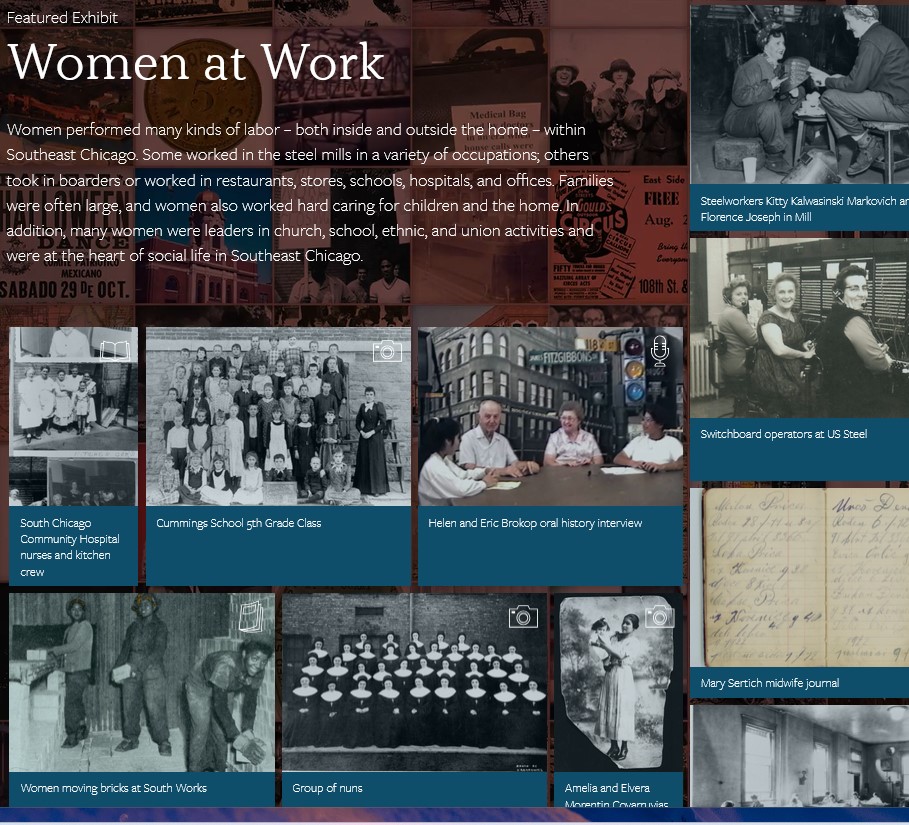
Women performed many kinds of labor – both inside and outside the home – within Southeast Chicago. Some worked in the steel mills in a variety of occupations; others took in boarders or worked in restaurants, stores, schools, hospitals, and offices. Families were often large, and women also worked hard caring for children and the home. In addition, many women were leaders in church, school, ethnic, and union activities and were at the heart of social life in Southeast Chicago.These are images, oral histories, artifacts, documents and photos of that experience
Digital exhibit on women's experiiences in steel communities of Southeast Chicago and Northern Indiana
Southeast Chicago Museum
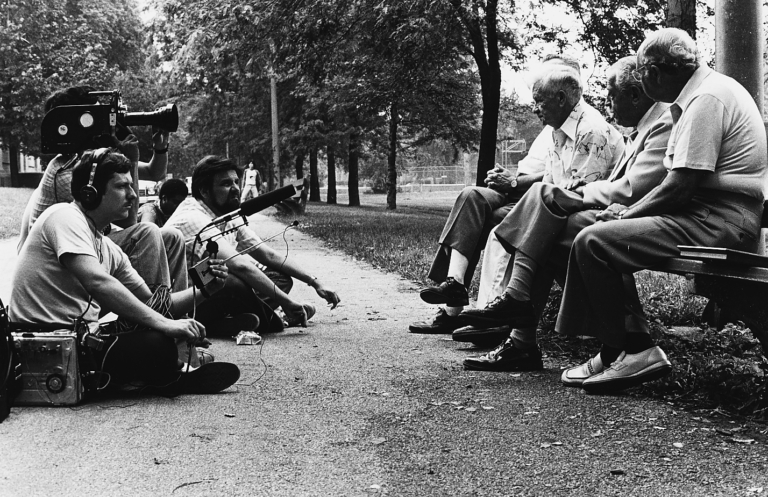
This Study Guide contains materials to supplement this website for use by teachers, researchers, Southeast Chicago residents, and the general public. These materials include a bibliography of readings on Southeast Chicago; a list of related websites; educational activities; and materials for classroom use (with more to come!). Thanks for input on this study guide to area educators Rod Sellers, Steven Walsh, Steve Sanchez, Hector Sanchez, Lauren Bianchi, Roni Facen.
southeast Chicago teaching materials for steel communities
Southeast Chicago Museum
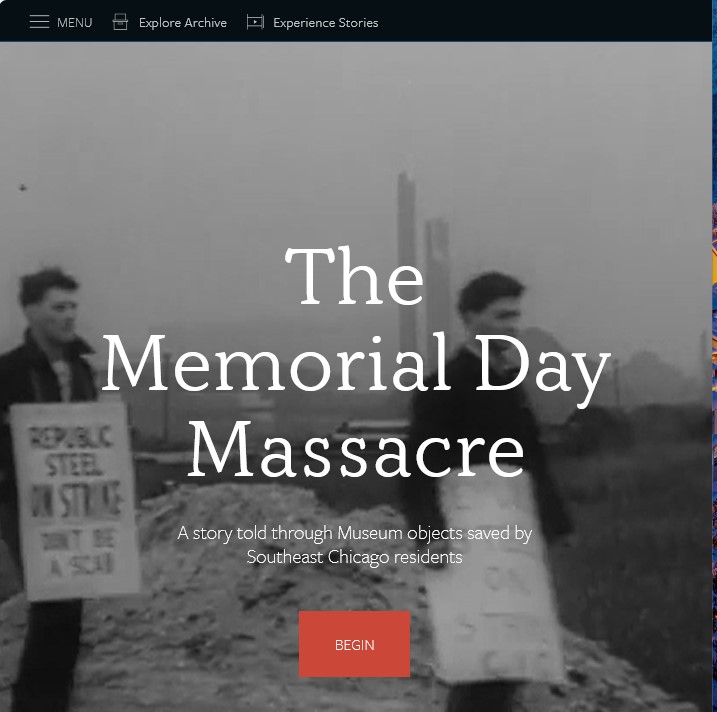
Told through Geraldine Jolly Borozan 1937 scrapbook photos and video and oral histories from the conflict at Republic steel. In 1937 a rally and march for unionization. Police opened fire on the peaceful march, killing ten strikers.
A story told through Museum objects saved by Southeast Chicago residents

Southeast Historical Society
The Industrial Heritage Archive of Chicago's Calumet Region is an online museum of images that commemorates and celebrates the historic industries and workers of Chicago's Calumet Region. The steel, coke, and transportation industries of this region were instrumental in the early development of American industry and its growth throughout the twentieth century. With the loss of these historic industries, we hope to promote and provide an easily accessible means to the public of understanding our country's industrial growth, the evolution of that history, and its importance and relevance in today's technological world.<br>
<br>
The Pullman State Historic Site, the Southeast Chicago Historical Society, and the Calumet Heritage Partnership (Chicago Steel Heritage Project) have joined together to create this Industrial Heritage Archive. Our intent is to preserve and make available to the public the historic images, maps, and plans of the Calumet regions' factories, structures, equipment, and workers.
The Industrial Heritage Archive of Chicago's Calumet Region is an online museum of images
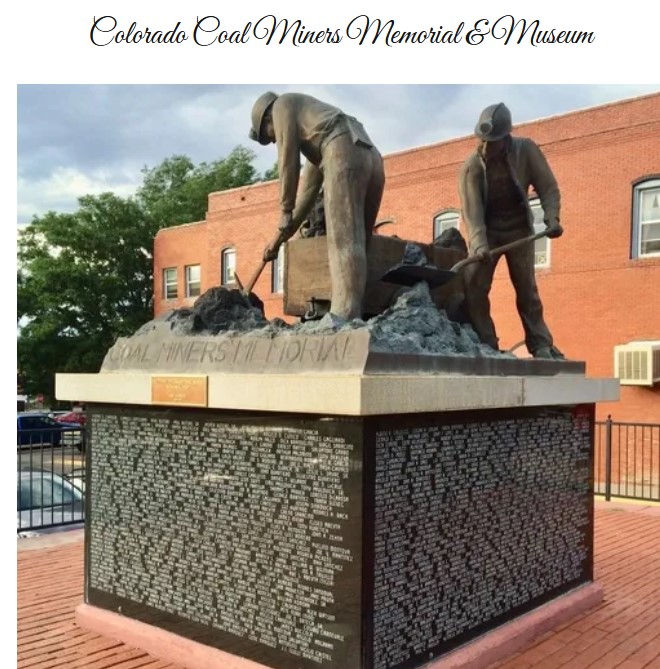
Southern Colorado Coal Miners Memorial & Museum
Our vision at the Southern Colorado Coal Miners Memorial & Museum is to preserve the long history of coal mining in the region and to continue to educate the public on the essential role it played in the lives of Coloradoans.
The museum is proud to house the collection of large scale paintings, "Remembering the Ludlow Massacre." This body of artwork vividly evokes the life of the Miners during a monumental period in American history as well as the legacy of coal mining and organized labor.
A small museum in Trinidad, Colorado that has sustained memory of the Ludlow Massacre, and hosts amazing art of Lindsay Hand
Southern Conference Educational Fund, Georgia State University
The Southern Conference Educational Fund (SCEF) was established in 1946 as the educational arm of the Southern Conference for Human Welfare (SCHW). SCEF became a completely separate organization the following year and based most of its activities out of its New Orleans, Louisiana, office. James Anderson Dombrowski directed the group and edited its monthly newspaper, the Southern Patriot. Dombrowski and Aubrey Williams became the most visible figures in SCEF during the 1950s, and they helped establish the organization as a leading proponent of integration and civil rights in the South.
Veteran journalists and labor and civil rights activists Anne and Carl Braden (United Electrical Workers and Farm Equipment Workers) directed SCEF from the mid 1960s into the 1970s. They forged close ties with regional and local southern civil rights groups, kept civil rights issues in the national media and strengthened SCEF fundraising activities. SCEF worked closely with the Student Nonviolent Coordinating Committee (SNCC) from the early 1960s on. Anti-communists in Congress and state government frequently attacked SCEF as a communist front. In 1963, police raided the New Orleans offices and arrested several officials for violating Louisiana's anti-communist laws. The United States Supreme Court overturned the laws in 1965, after SCEF challenged the arrests in court.
The Bradens moved SCEF's offices from New Orleans to Louisville, Kentucky, in 1966. The organization continued to work toward the goal of a southern interracial future. In July of 1973, a group of Black Panthers kidnapped, at gunpoint, two SCEF officials, Helen Greever and Earl Scott. The two eventually escaped, but the incident caused deep divisions within SCEF that were evidenced over the following few months. At a SCEF board meeting in Birmingham, Alabama, in October of 1973, board member Walter Collins denounced several Communist Party members, including Greever, arguing that they had placed the policies of the party over the best interests of SCEF. Collins argued that the Communists had caused the disputes with the Panthers. He and other board members voted to oust the Communists over the opposition of the Bradens.
Eventually, SCEF moved to Atlanta, Georgia where internal disputes and financial problems plagued the organization. The Southern Patriot changed its name to the Southern Struggle. Several local chapters, in Florida, West Virginia, and North Carolina, remained particularly active. By 1981, however, financial problems caused the group to consider moving to Dallas, merging with other organizations, or disbanding altogether.
1000 photos and hundreds of other items from the leading Southern group that sought to connect labor and civil rights, and fought repression during the 1960s and 1970s
Southern Labor Studies Association
The mission of the Southern Labor Studies Association is to promote the study, teaching, and preservation of the history of southern labor by activities that:
Encourage dialogue and discussion about key issues and events relevant to the past and present of labor in the U.S. South;
Enhance connections between academics and labor activists in the U.S. South;
Organize the Southern Labor Studies Conference as well as sessions on southern labor and working-class history at other venues;
Connect graduate students working on southern labor and working-class studies with one another and advanced scholars within and across academic disciplines;
Promote the preservation of materials related to southern labor and working class history;
Promote working-class history in public school curricula and provide resources for public school teachers.
promotes the study, teaching, and preservation of the history of southern labor
Southern Labor Studies Association, the Labor and Working-Class History Association, LABOR: Studies in Working-Class History, and International Labor and Working-Class History
Learn about new research from the leading historian organizations. Local, regional, national and global topics. Available wherever you get your podcasts
A variety of topics from 4 leading labor history journals and organizations
Southern Tenant Farmers Union
Newspaper of the Southern Tenant Farmers Union
Issues of the Share Croppers Voice of the STFU
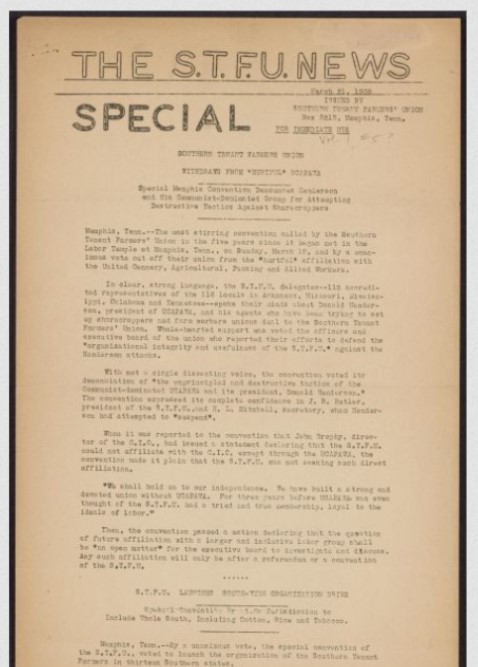
Southern Tenant Farmers Union
Newspaper of the Southern Tenant Farmers Union; place the words The Southern Tenant Farmers' Union Nes in the search box to get all results
issues of the Southern Tenant Farmers Union News
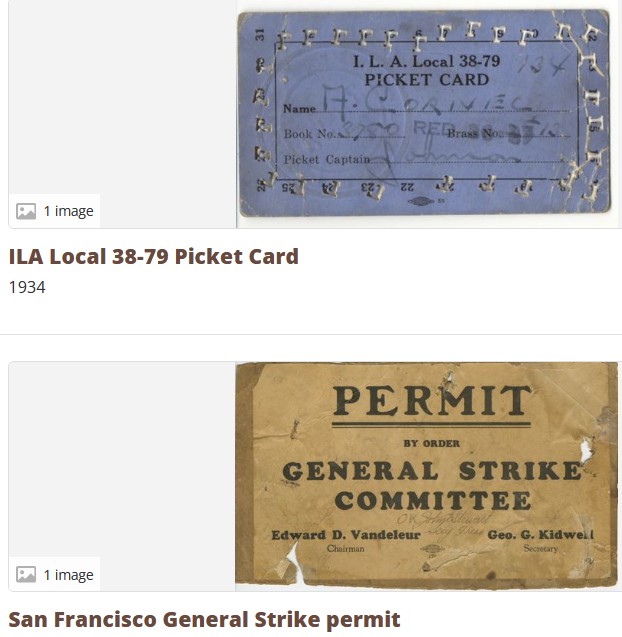
Southern Tenant Farmers Union, San Francisco State University
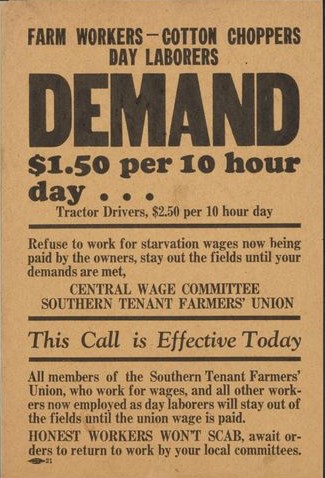
Contains 25 pages digitized newspapers of the Southern Tenant Farmers Union, 1939-1944 and a poster
features digitized papers of the Southern Tenant Farmers Union and broadsides
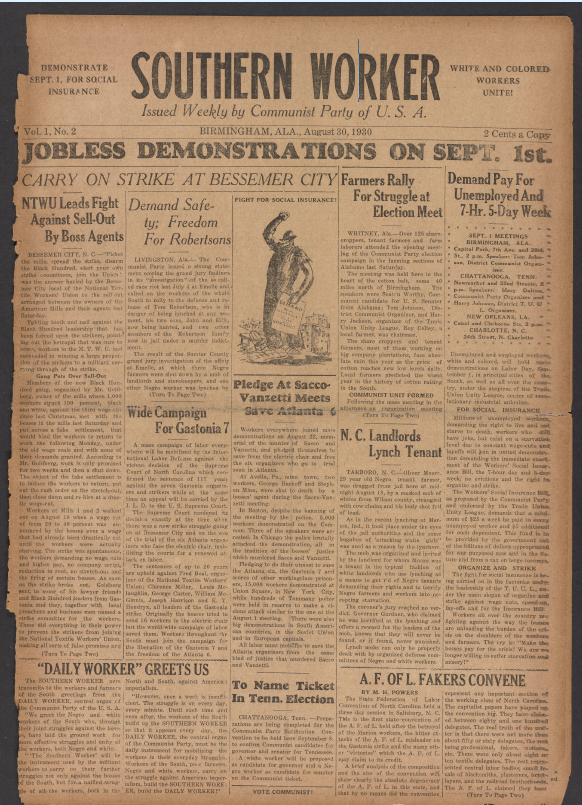
Southern Worker
A total of 90 issues of the Southern Worker are archived here as pdfs. These are generally digitizations of a poorly shot microfilm — the original filming institution has managed to misplace the master negative , leaving the world nothing but badly worn service copies of the film. Image quality consequently varies greatly from issue to issue, with parts of some issues largely or partially illegible. Efforts will be made to improve these images over time.
Communist Party newspaper of the South

Southwest Washington Labor Press
The Grays Harbor timber region, including the towns of Aberdeen, Hoquiam, and Cosmopolis, was a hotbed of radical labor activity early in the 20th century. Workers endured long hours, low pay, and frequent injuries, many fatal, making them receptive to organizations such as the Industrial Workers of the World (IWW) and the Socialist Party of America. These organizations advocated more far-reaching social changes than those promoted by traditional trade unions, represented by the American Federation of Labor (AFL) nationally and the Washington State Federation of Labor at the state level. IWW members were central to the November 1911 to January 1912 fight against an Aberdeen ordinance severely curtailing street speaking, and a Grays Harbor lumber strike from March to May 1912. Members of the more conservative AFL-affiliated local unions were represented on both sides during these fights; some supported the striking workers while others sided with authorities and mill operators, a few even aiding efforts to intimidate or deport IWW members and strikers.
As early as July 1912, an AFL affiliated labor paper, the Hoquiam Free Press, was publishing on Grays Harbor. By 1915, the Southwest Washington Labor Press was the representative paper for AFL affiliated trade unionists in the area. Copies of the Southwest Washington Labor Press and its predecessors during these turbulent early years are sadly unavailable to shed light on what stance the paper may have taken on the conflicts that so closely preceded its birth.
The Southwest Washington Labor Press consisted largely of syndicated columns from the International Labor News Service with contributions from the managing editors and the board of directors. Editorship of the Press passed between several union newspaper men, including from Alfred E. Wolters to Louis Calvin Hinman on May 23, 1924, and to Jesse H. Godfrey with the September 4, 1925 issue. The board was a mix of representatives from the Aberdeen and Hoquiam local labor councils. The colophon boasted the Press was "Owned and controlled by Organized Labor. Official Organ of Aberdeen Central Labor Council, Hoquiam Trades and Labor Council and the Washington State Federation of Labor."
Published weekly on Fridays, each issue consisted of local and international stories, entertainment news, and health advice, and they usually included a cartoon and an infographic related to the news of the week or to seasonal changes to the labor landscape. Editorials published under the section headers "By the Way" and "The Cherry Tree" appeared intermittently throughout the mid-1920s. "By the Way" was first published February 22, 1924 with the caption "comment and criticism about things doing in the world." The section featured multiple short pieces on varying topics, including the unfolding Teapot Dome scandal, the Communist Party (which the paper opposed), child labor conditions, and the lack of African American representation in textbooks. "By the Way" even reports of the Navy shooting whales, concluding "there are plenty of means of affording warships target practice without killing helpless monsters of the deep." Appearing a few years later, "The Cherry Tree" featured longer discussions on a single topic, ranging from conscription of capital and labor during wartime, to the importance of wages for workers commensurate with the wealth they create, to realism in art and entertainment.
From efforts to pass an anti-child labor amendment to court cases about prison labor and prisoner leasing, the national labor agenda presented in the Press focused on the institutions of organized labor and their fight with the institutions of capital. Locally, support for the typographical workers, stereotypers, electrotypers, and mailers of the William Randolph Hearst owned Seattle Post-Intelligencer (P-I) appeared on the pages of the Press during contentious negotiations with the paper's owners in 1924 and 1925. In keeping with the AFL's support of public power on the national level, the paper backed the Wynooche [sic] Power Project for the creation of an Aberdeen municipal power system. The Press took the stance that a local utility project would support the growing population of Grays Harbor County; the editorial argued that funding it by selling bonds would put the power, very literally, in the hands of the people. Voters approved the project in a June 29, 1926 special election.
The influence of labor-conscious engagement in local economies carried through to the advertisements and classifieds. Each week, with the assurance that "the merchants whose advertisements appear in our columns are wide-awake, progressive business men entitled to your support," the Press devoted ample page space to ads. This included a full page "Hoquiam-Aberdeen Classified Directory Labor's Friends" with a list of labor-friendly businesses, contact information for specific labor unions, and prominent "Do Not Patronize" lists compiled by the Aberdeen and Hoquiam councils. The guarantee also covered political ads, as demonstrated by those for local elections in the latter half of 1926. from :https://washingtondigitalnewspapers.org/?a=cl&cl=CL1&sp=SWLP
Grays Harbor labor paper
St. Louis Labor, Marxists.org
St. Louis, Mo. — Est. Jan. 5, 1901. Organ of the potent Social Democratic Party of St. Louis and that city’s labor movement, which had a strong socialist component from the German-dominated Brewers’ Union. Became St. Louis Labor then simply Labor, billed as the "organ of the St. Louis Socialist Party". Long running paper issued to 1925. Two filmings, either individually complete but complete when taken together, by State Historical Society of Missouri and State Historical Society of Wisconsin. The paper functioned is filled with American Federation of Labor news in the region and major strikes
Missouri Socialist newspaper, digitized

Stacey L. Smith
The University of North Carolina Press (2013)
Most histories of the Civil War era portray the struggle over slavery as a conflict that exclusively pitted North against South, free labor against slave labor, and black against white. In Freedom’s Frontier, Stacey L. Smith examines the battle over slavery as it unfolded on the multiracial Pacific Coast. Despite its antislavery constitution, California was home to a dizzying array of bound and semibound labor systems: African American slavery, American Indian indenture, Latino and Chinese contract labor, and a brutal sex traffic in bound Indian and Chinese women. Using untapped legislative and court records, Smith reconstructs the lives of California’s unfree workers and documents the political and legal struggles over their destiny as the nation moved through the Civil War, emancipation, and Reconstruction.
Smith reveals that the state’s anti-Chinese movement, forged in its struggle over unfree labor, reached eastward to transform federal Reconstruction policy and national race relations for decades to come. Throughout, she illuminates the startling ways in which the contest over slavery’s fate included a western struggle that encompassed diverse labor systems and workers not easily classified as free or slave, black or white.
the lives of California's unfree workers and documents the political and legal struggles over their destiny as the nation moved through the Civil War, emancipation, and Reconstruction.
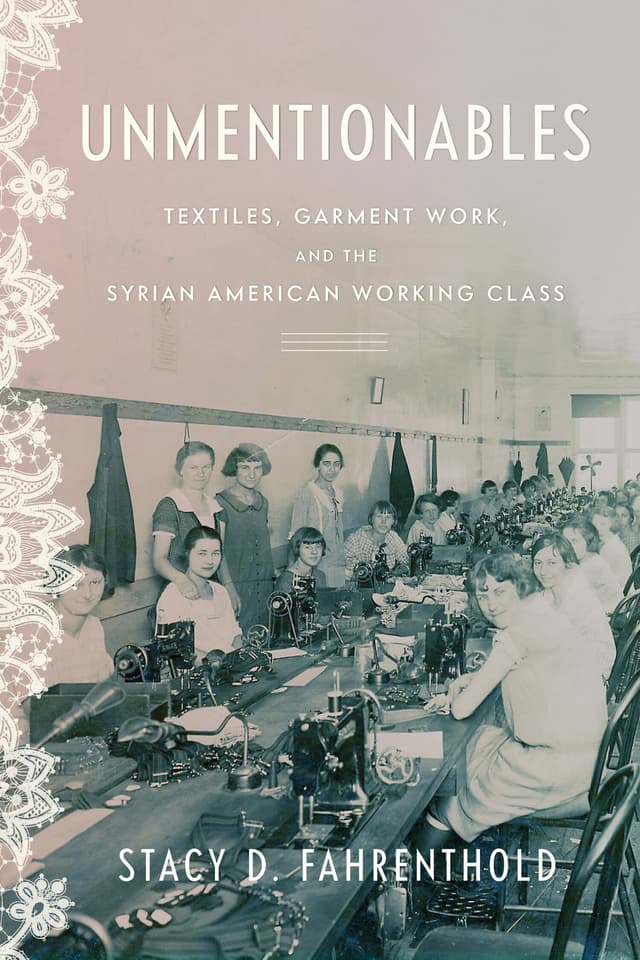
Stacy Fahrenthold
Stanford University Press (2024)
As weavers, garment workers, and peddlers, Syrian immigrants in the Americas fed the early twentieth-century transnational textile trade. These migrants and the commodities they produced--silk, linen, and cotton; lace and embroidery; undergarments and ready-wear clothing--moved along steamship routes from Beirut through Marseille and Madeira to New York City, New England, and Veracruz. As migrants and merchants crisscrossed the Atlantic in pursuit of work, Syrian textile manufacturing expanded across the hemisphere.
Unmentionables offers a history of the global textile industry and the Syrians, Lebanese, and Palestinians who worked in it. Stacy Fahrenthold examines how Arab workers navigated processes of racialization, immigration restriction, and labor contestation.
She writes women workers--the majority of Syrian garment workers--back into US labor history. She also situates the rise of Syrian American industrial elites, who exerted supply chain power to combat labor uprisings, resist unionization, and stake claim to the global textile industry.
Critiquing the hegemony of the Syrian peddler in histories of this diaspora, Unmentionables introduces alternative narrators: union activists who led street demonstrations, women garment workers who shut down kimono factories, child laborers who threw snowballs at police, and the diasporic merchant capitalists who contended with all of them"-- Provided by publisher
Introduction: Looking for work
Snowballs and bayonets : The Syrian Strikers of Lawrence
Mutual aid : Syrian Societies in Industrial Massachusetts
The Syrian shop : Garment Manufacturing in New York City
Laboring for empire : Madeira Island's Fase Síria
Logistics : Selling Textiles in the US-Mexico Borderlands
Conclusion: Syrian Shops for the Syrians
Offers a history of the global textile industry and the Syrians, Lebanese, and Palestinians who worked in it.
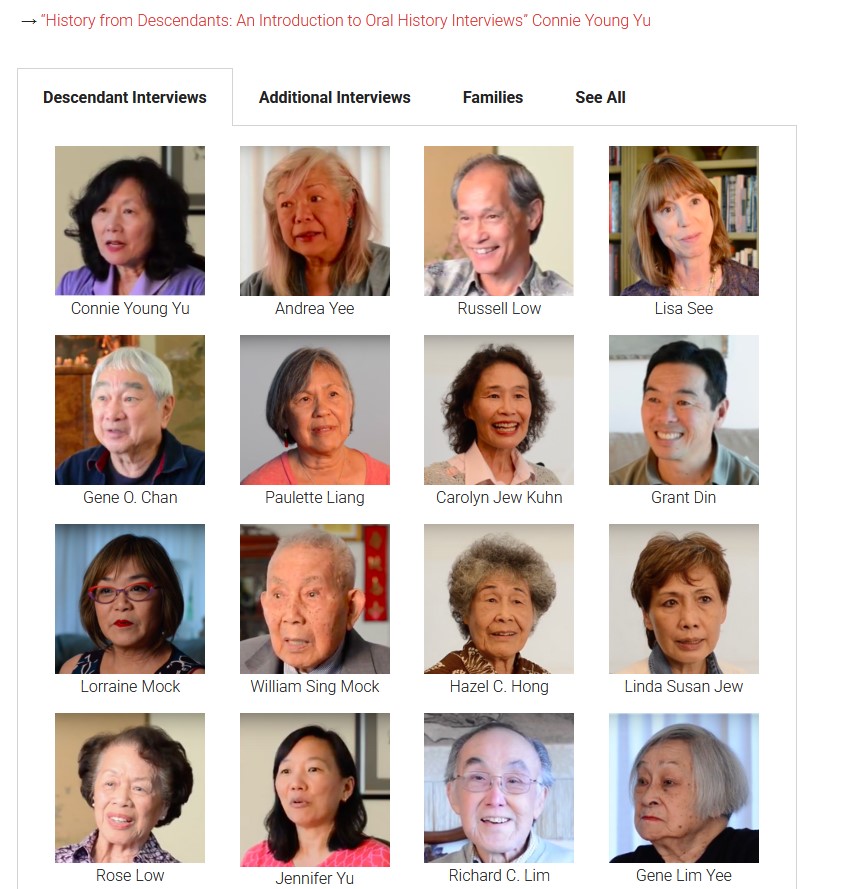
Stanford University
On this site you can view video and read transcripts of interviews of people who have descended from the Chinese laborers who worked on the first transcontinental railroad. The interviews seek to discover as much as possible about the workers as transmitted through family lore. The amount that we can learn is limited and dimmed by time, of course, but at least names, home villages, and other material can be added to our understanding of these workers. We can also learn the dynamic histories of the families who, despite cruel discrimination, struggled and flourished in the United States.
An introductory essay by Connie Young Yu, a descendant of a railroad workers and one of the interviewers, describes how the interviews were conducted and provides more background, photos of artifacts, and interpretation of the experiences of early Chinese immigrants and their families.
Also included are three additional videos: interviews with two historians, Charlie Chin and Philip Choy, and Maxine Hong Kingston reads passages from her book China Men that recount the experiences of her grandfather and other men who worked on the railroad.
transcripts of interviews of people who have descended from the Chinese laborers

Stanley Aronowitz
Verso (2015)
"Union membership in the United States has fallen below 11 percent, the lowest rate since before the New Deal. Longtime scholar of the American union movement Stanley Aronowitz argues that the labor movement as we have known it for most of the last 100 years is effectively dead. And he asserts that this death has been a long time coming--the organizing principles chosen by the labor movement at midcentury have come back to haunt the movement today. In an expansive survey of new initiatives, strikes, organizations and allies Aronowitz analyzes the possibilities of labor's renewal, and sets out a program for a new, broad, radical workers' movement"-- Provided by publisher
Preface: Union defeat at Volkswagen
Introduction: an institution without a vision
The winter of our discontent
The mass psychology of liberalism
The rise and fall of the modern labor movement
The struggle for union reform: rank-and-file unionism
The underlying failure of organized labor
Toward a new labor movement, part one
Toward a new labor movement, part two
Asserts that the labor movement is dead, analyzes the possibilities of labor's renewal, and sets out a program for a new, broad, radical workers' movement.

State Historical Society of Iowa
Teaching Resources with multiple primary sources to explore the meaning of this coal town in the Midwest. The town of Buxton in southeastern Iowa was unique in that a majority of its residents were African American. The Consolidation Coal Company worked for the Chicago and Northwestern Railroad. Having a hard time recruiting white miners, Consolidation Coal sent agents to southern states to hire African-American workers. In 1873, it founded the town of Buxton and opened nearby mines. It grew quickly and, according to one source, became the largest coal town west of the Mississippi. In the 1905 census, the town boasted 2,700 African American people and 1,991 white people. The town supported African-American doctors, lawyers and other professionals, and an African-American YMCA with a gymnasium, an indoor swimming pool and many programs for Buxton residents. The town was proud of its baseball team, the Buxton Wonders. White residents included immigrants from Sweden and elsewhere, and they existed peacefully with the African-Americans throughout the community's history.
Explore the history of a coal mining town where African-American workers thrived.
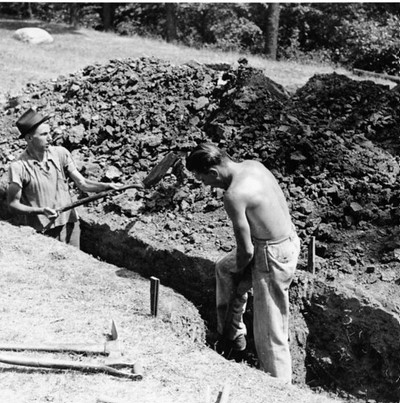
State Historical Society of Iowa
The National Youth Administration (NYA) was a federal agency established in 1935 as part of President Franklin D. Roosevelt's "New Deal". The program's purpose was to help unemployed young adults between the ages of 16 and 25 find part-time jobs through which they could earn money to further their education. The 102 photos in this collection document work programs in various Iowa communities and were compiled for an album "Pictorial Highlights on the Iowa NYA" by the agency's state administrator, Theodore P. Eslick. The prints were processed by youth working at the NYA Photographic Laboratory in Des Moines.
A State Historical Society of Iowa collection on the National Youth Administration, which was New Deal program.
State Historical Society of Missouri
These collections include more information on the African-American experience in Missouri, particularly during the Civil War-era. Here, you can find documents on African American war claims and pensions, investigations into the Union Army's treatment of African-American soldiers and laborers, and more. One can also find reference to migrations from the South to Missouri as part of the Great Migration, and information on the experiences of German and Irish immigrants to the region.
The State Historical Society of Missouri's expansive collection of articles, books, a catalog, a brief history, digital collections, manuscripts, newspapers, photos, and regimental histories related to the Civil War in Missouri.

State Historical Society of Missouri
The Marshall Dial Oral History Collection includes transcripts of interviews with residents of the Missouri Bootheel for Marshall Dial's radio program, "Stories they Tell." Most interviews were conducted in the 1980s.
oral histories from a poor area of Missouri

State Historical Society of Missouri
The State Historical Society of Missouri is pleased to present a growing collection of digitized historic newspapers. These images are freely available to the public and are keyword-searchable.
Focused on merging meaningful historic content with innovative modern technology, the State Historical Society of Missouri employs the highest national digitization standards: newspapers in our collection are digitized to National Digital Newspaper Program specifications. Many of Missouri’s digital newspapers are also available through the Library of Congress’s Chronicling America site, which ultimately aims to include newspaper pages from all states and U.S. territories in its collection.
The State Historical Society of Missouri's digitized newspaper collection, including nearly 530 Missouri newspapers and a few selections from Illinois, Kansas, and South Carolina.

State Historical Society of Missouri
The African American Experience in Missouri digital collection includes digitized manuscripts by or about African Americans, including personal papers, records of Black organizations and churches, and collections with significant information on African Americans, civil rights, and daily life.
A resource collection for exploring the history of race and migration in Missouri and the Midwest.