


Explore thousands of items. Use clickable links under collections and library for broad categories. Search by keyword (including topic,city, state.) Limit by time period, type of item, region. See our search tips page for more assistance.
Collections
Library
Type
Region
Coverage:
-
Published:
-

State Historical Society of Missouri
Materials documenting slavery in Missouri include bills of sale, manumission papers, letters, ledgers, and wills. Items like bills of sale usually include names, dates, locations, and ages of enslaved individuals, providing invaluable information for historians and genealogists
SHSMO documents on slavery in Missouri
State Historical Society of Missouri
The story of the African American experience in Missouri is told through the personal papers of individuals and families as well as the records of black organizations and churches. Civil War pensions shed light on the aftermath of the war, while photographs, letters, scrapbooks, writings, and newspapers provide insight into the daily life of African Americans living in the state. The State Historical Society of Missouri is pleased to make available these rich resources that document their lives as Missourians.
The African American Experience in Missouri digital collection includes digitized manuscripts by or about African Americans, including personal papers, records of black organizations and churches, and collections with significant information on African Americans, civil rights, slavery, and daily life.

Staughton Lynd
Haymarket Books (2015)
In the 1960s historians on both sides of the Atlantic began to challenge the assumptions of their colleagues and push for an understanding of history "from below." In this collection, Staughton Lynd, himself one of the pioneers of this approach, laments the passing of fellow luminaries David Montgomery, E.P. Thompson, Alfred Young, and Howard Zinn, and makes the case that contemporary academics and activists alike should take more seriously the stories and perspectives of Native Americans, slaves, rank-and-file workers, and other still-too-frequently marginalized voices
A historiographical work reminiscing on the important labor history works of the 1960's.
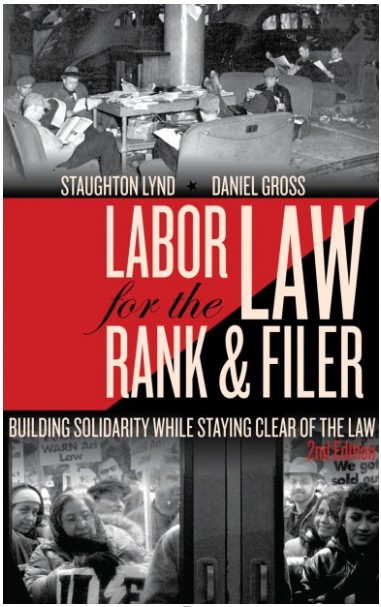
Staughton Lynd, Daniel Gross
PM Press (2011)
Blending cutting-edge legal strategies for winning justice at work with a theory of dramatic, bottom-up social change, this practical guide to workers' rights aims to make work better while reinvigorating the labor movement. A powerful organization model called "solidarity unionism" is explained, showing how the labor force can avoid the pitfalls of the legal system and utilize direct action to win fair rights. The new edition includes new cases governing fundamental labor rights and can be used not only by union workers, but can serve as a guerrilla legal handbook for any employee in this uns
A powerful organization model called "solidarity unionism" is explained, showing how the labor force can avoid the pitfalls of the legal system and utilize direct action to win fair rights.
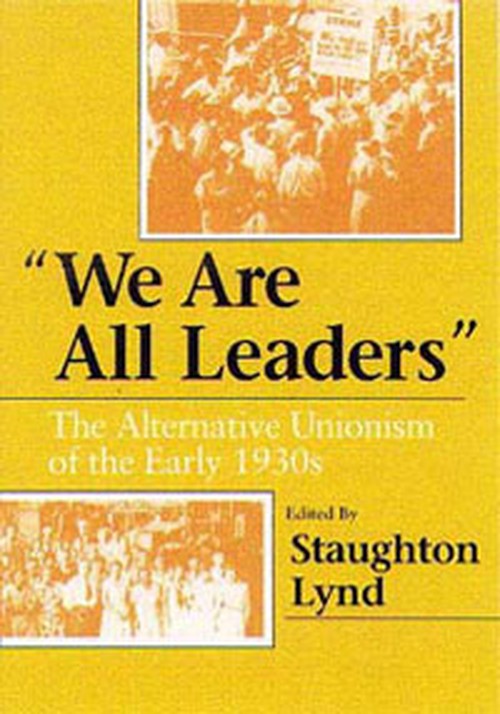
Staughton Lynd, ed.
University of Illinois Press (1996)
This collection of articles delves into the little-known community-based unionism of the 1930s. Worlds apart from bureaucratic business unions like the AFL-CIO, these organizations emerged from workers involved in many kinds of labor, from African American nutpickers in St. Louis to chemical and rubber workers in Akron, and from bootleg miners in Pennsylvania to tenant farmers in the Mississippi Delta.
The contributors draw on eyewitness interviews, first-person narratives, trade union documents, and other primary sources to describe experimental forms of worker activism during the period. This alternative unionism was democratic, deeply rooted in mutual aid among workers in different crafts and work sites, and politically independent. The key to it was a value system based on egalitarianism. The cry, "We are all leaders!" resonated among rank-and-file activists. Their struggle, though often overlooked by historians, has much to teach us about union organizing today.
Contributors: John Borsos, Eric Leif Davin, Elizabeth Faue, Rosemary Feurer, Janet Irons, Michael Kozura, Mark D. Naison, Peter Rachleff, and Stan Weir
Introduction Staughton Lynd 1
1 The Nutpickers' Union, 1933-34 Crossing the Boundaries of Community and Workplace Rosemary Faurer 27
2 Organizing "Wall to Wall" The Independent Union of All Workers, 1933-37 Peter Rachleff 51
3 The Challenge of National Coordination Southern Textile Workers and the General Textile Strike of 1934 Janet Irons 72
4 The Southern Tenant Farmers' Union and the CIO Mark D. Naison 102
5 The Very Last Hurrah? The Defeat of the Labor Party Idea, 1934-36 Eric Leif Davin 117
6 Paths of Unionization Community, Bureaucracy, and Gender in the Minneapolis Labor Movement of the 1930s Elizabeth Faue 172
7 We Stood Our Ground Anthracite Miners and the Expropriation of Corporate Property, 1930-41 Michael Kozura 199
8 "We Make You This Appeal in the Name of Every Union Man and Woman in Barberton" Solidarity Unionism in Barberton, Ohio, 1933-41 John Borsos 238
9 Unions with Leaders Who Stay on the Job Stan Weir 294
Contributors 335 Index 337
presents a grassroots approach to the 1930s labor struggles; an anthology of essays from communities such as Barberton, Ohio, Minnesota, St. Louis, Missouri, and a diverse array of workers such as nutpickers, textile workers, miners, sharecroppers

Stefan Epp-Koop
University of Manitoba Press (2015)
Explores the dynamic political movement that came out of the largest labour protest in Canadian history and the ramifications for Winnipeg throughout the 1920s and 1930s. Few have studied the political Left at the municipal level--even though it is at this grassroots level that many people participate in political activity. Winnipeg was a deeply divided city. On one side, the conservative political descendants of the General Strike's Citizen's Committee of 1000 advocated for minimal government and low taxes. On the other side were the Independent Labour Party and the Communist Party of Canada, two parties rooted in the city's working class, though often in conflict with each other. The political strength of the Left would ebb and flow throughout the 1920s and 1930s but peaked in the mid-1930s when the ILP's John Queen became mayor and the two parties on the Left combined to hold a majority of council seats. Astonishingly, Winnipeg was governed by a mayor who had served jail time for his role in the General Strike."
Explores the dynamic political movement that came out of the largest labour protest in Canadian history, the Winnipeg General Strike
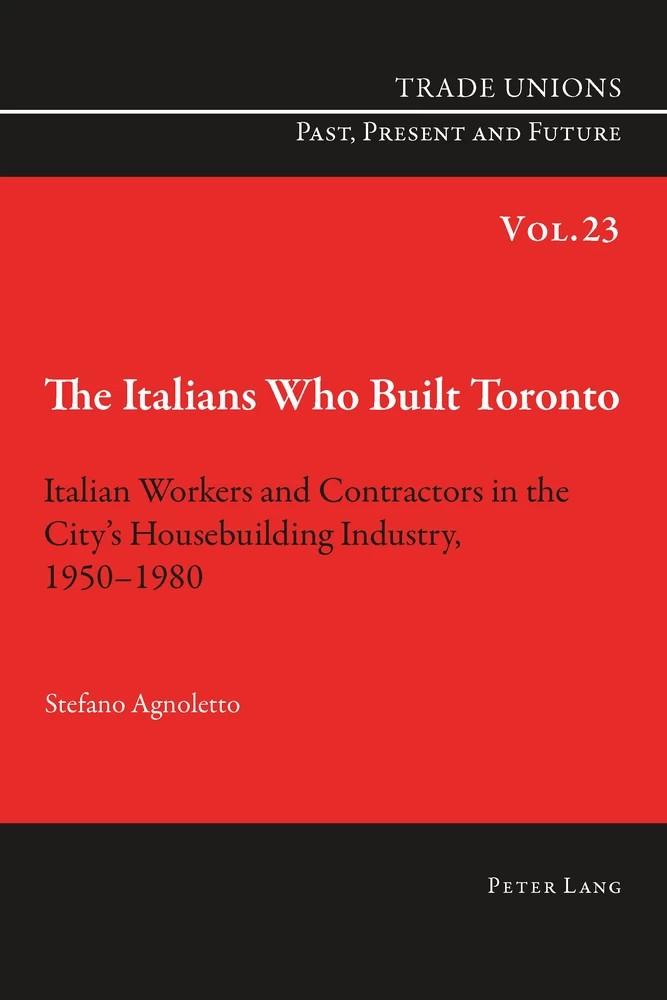
Stefano Agnoletto
Oxford University Press (2014)
After World War II, hundreds of thousands of Italians emigrated to Toronto. This book describes their labour, business, social and cultural history as they settled in their new home. It addresses fundamental issues that impacted both them and the city, including ethnic economic niching, unionization, urban proletarianization and migrants' entrepreneurship. In addressing these issues the book focuses on the role played by a specific economic sector in enabling immigrants to find their place in their new host society. More specifically, this study looks at the residential sector of the construction industry that, between the 1950s and the 1970s, represented a typical economic ethnic niche for newly arrived Italians"--Back cover
Contents
Chapter 1: Introduction
1.1 ‘If One Were to Write a Labour and Business History of Postwar Italian Toronto’
1.2 Research hypotheses
1.3 Sources, methodology and structure
Chapter 2: Post World War II Toronto: a favourable yet contradictory setting for Italian newcomers
2.1 Toronto ‘the Good’
2.2 Social changes, demographic trends, economic prosperity and governance strategies in post-WWII Toronto
2.3 Building the ‘vertical mosaic’ of the multicultural Canada
2.4 The ethnic mosaic of post-WWII multicultural Toronto
2.5 Appendix
Chapter 3: The Italian Community
3.1 The origins of the community before WWII: from a community of male sojourners to a permanent settlement
3.2 The ‘Italian invasion’ of post-WWII Toronto: the ‘ordering in bulk’ system and migration chains
3.3 From peasants to urban wage earners in ethnic niches
3.4 Appendix
Chapter 4: Italians in Toronto: a successful history?
4.1 Becoming Italians in Toronto: networking, class and gender
4.2 ‘Italians help Italians’: the Canadian welfare state, the communitarian welfare system, and political militancy
4.3 From downtown to the suburbs
Chapter 5: The Italian niche: the ‘jungle’ of the construction industry
5.1 ‘You know, Italians build houses’. Opportunities and barriers at the beginning of the Italian niche
5.2 Exploited workers and Italian contractors in the ‘jungle’ of an ethnic-capitalist labour market
5.3 ‘A shovel, a truck, two or three paesani’. Artisans, workers or entrepreneurs? Italian contractors and employers
5.4 A glocal interpretation of the origins of an economic ethnic niche
5.5 Appendix
Chapter 6: Sciopero! The processes of unionization and the 1960–1961 strikes
6.1 Challenging the exploitation: attempts at unionization in the 1950s
6.2 Italian workers organize themselves: the Brandon Union Group
6.3 ‘Canadian wages, Canadian hours!’ The turning point of the 1960 strike
6.4 The 1961 strike and the Goldenberg Commission
Chapter 7: The ‘Italian way’. Unionization and class conflicts in the 1960s and the 1970s
7.1 The end of the Brandon Union Group and the ‘normalization’ of Italian unionism (1962–1963)
7.2 The Industrial Standards Act campaign (1963): a new union strategy
7.3 The ‘concrete forming campaign’ and the ‘union wars’ (1965–1973)
7.4 Portraits of industrial relations in an ethnic niche
Chapter 8: Structure vs identity? An overview of the literature and theoretical frameworks
8.1 Urban market economies and immigrants in North America: the key issues
8.2 Culture vs economics? The origins of economic ethnic niches
8.3 Migrant workers and unionization
8.4 Ethnicity, class and ‘niching’. An interpretative hypothesis
This book explores the lives of Italian laborers, business owners, and everyday people in the construction industry in Toronto and how their economic activities created a cultural space for them in Canada

Stephanie D. Hinnershitz
University of Pennsylvania Press (2021)
Japanese American Incarceration argues that the incarceration of Japanese Americans created a massive system of prison labor that blurred the lines between free and forced work during World War II
argues that the incarceration of Japanese Americans created a massive system of prison labor that blurred the lines between free and forced work during World War II.

Stephanie E. Jones-Rogers
Yale University Press (2019)
Bridging women's history, the history of the South, and African American history, this book makes a bold argument about the role of white women in American slavery. Historian Stephanie E. Jones-Rogers draws on a variety of sources to show that slave-owning women were sophisticated economic actors who directly engaged in and benefited from the South's slave market. Because women typically inherited more slaves than land, enslaved people were often their primary source of wealth. Not only did white women often refuse to cede ownership of their slaves to their husbands, they employed management techniques that were as effective and brutal as those used by slave-owning men. White women actively participated in the slave market, profited from it, and used it for economic and social empowerment. By examining the economically entangled lives of enslaved people and slave-owning women, Jones-Rogers presents a narrative that forces us to rethink the economics and social conventions of slaveholding America"-- Provided by publisher
the role of white women in American slavery.

Stephanie Fortado, Emily E. LB. Twarog
National Park Service (2023)
A U.S. Department of the Interior National Park Service Study of Lowell National Historical Park. This Historic Resource Study (HRS) in an effort to update their exhibit spaces at the Boott Cotton Mill and Boarding House.
An on-line book about Lowell mill site with a guide to the sites.

Stephanie Ross, Larry Savage
Fernwood Publishing (2013)
For decades, public sector unions in Canada have been plagued by austerity, privatization, taxpayer backlash and restrictions on union rights. In recent years, the intensity of state-led attacks against public sector workers has reached a fevered pitch, raising the question of the role of public sector unions in protecting their members and the broader public interest. Public Sector Unions in the Age of Austerity examines the unique characteristics of public sector unionism in a Canadian context. Contributors to this multi-disciplinary collection explore both the strategic possibilities and challenges facing public sector unions that are intent on resisting austerity, enhancing their power and connecting their interests as workers with those of citizens who desire a more just and equitable public sphere."--Publisher's website
review: This book is a fine addition to Fernwood Press’s Labour in Canada series, which provides accessible, compact analyses of labor market and union trends. The editors, Stephanie Ross and Larry Savage, argue that public-sector unions deserve special consideration because, as public institutions, they are well positioned to challenge neoliberal austerity politics. In Canada, one out of every five working people is employed in the public sector, in which the editors and contributors include “para-public organizations like hospitals, schools, universities and Crown corporations” (10). Union density is high, with about 70 percent of public-sector workers belonging to unions, as opposed to 15.9 percent in the private sector. Although the members of public-sector unions implement state policies that have as their goal the reproduction and expansion of capitalism, they also deliver programs and services that embody the “social rights” of the welfare state, and in so doing they often champion the aspirations of a broader public.
unique characteristics of public sector unionism in a Canadian context

Stephen D. Rosenberg
Harvard University Press (2021)
Time for Things seeks an answer to the question of why, in mature industrial capitalist societies, increasing productivity has tended to get used to increase output and consumption as opposed to reducing the burden of work. Put simply, why do we live in a world so full of goods, many of which have questionable or marginal value, and (by comparison) so lacking in free time?"--
Modern life is full of stuff yet bereft of time. An economic sociologist offers an ingenious explanation for why, over the past seventy-five years, Americans have come to prefer consumption to leisure.
Productivity has increased steadily since the mid-twentieth century, yet Americans today work roughly as much as they did then: forty hours per week. We have witnessed, during this same period, relentless growth in consumption. This pattern represents a striking departure from the preceding century, when working hours fell precipitously. It also contradicts standard economic theory, which tells us that increasing consumption yields diminishing marginal utility, and empirical research, which shows that work is a significant source of discontent. So why do we continue to trade our time for more stuff?
Time for Things offers a novel explanation for this puzzle. Stephen Rosenberg argues that, during the twentieth century, workers began to construe consumer goods as stores of potential free time to rationalize the exchange of their labor for a wage. For example, when a worker exchanges their labor for an automobile, they acquire a duration of free activity that can be held in reserve, counterbalancing the unfree activity represented by work. This understanding of commodities as repositories of hypothetical utility was made possible, Rosenberg suggests, by the standardization of durable consumer goods, as well as warranties, brands, and product-testing, which assured wage earners that the goods they purchased would be of consistent, measurable quality.
This theory clarifies perplexing aspects of behavior under industrial capitalism—the urgency to spend earnings on things, the preference to own rather than rent consumer goods—as well as a variety of historical developments, including the coincident rise of mass consumption and the legitimation of wage labor.
Provided by publisher
Why do we live in a world so full of goods, many of which have questionable or marginal value, and (by comparison) so lacking in free time?

Stephen Daldry
The story of a talented young boy who becomes torn between his unexpected love of dance and the disintegration of his family. Backdrop against the miners strike of 1984
A Stephen Daldry film set during the 1984-1985 miners' strike that took place in County Durham, North East England.

Stephen H. Norwood
The University of North Carolina Press (2002)
Using a social-historical approach, the author focuses on the mercenaries the corporations enlisted in their anti-union efforts and considers the paramilitary methods unions developed to counter them. The book also traces the economic restructuring which transformed corporate anti-unionism.
Introduction
The emergence of the anti-labor mercenary
The student as strikebreaker: College youth and the crisis of masculinity in the early twentieth century
Gunfighters on the urban frontier: Strikebreakers in the car wars
Forging a new masculinity: African American strikebreaking in the North in the early twentieth century
Cossacks of the coal fields: Corporate mercenaries in the mine wars
Ford's brass knuckles: Harry Bennett, the cult of muscularity, and anti-labor terror, 1920-1945
They shall not pass: Paramilitary combat against strikebreaking in the auto industry, 1933-1939
Epilogue: anti-unionism in America, 1945-2000
focuses on mercenaries corporations enlisted in their anti-union efforts and considers the paramilitary methods unions developed to counter them.

Stephen M. Ward
The University of North Carolina Press (2016)
James and Grace Lee Boggs were two largely unsung but critically important figures in the black freedom struggle. James Boggs was the son of an Alabama sharecropper who came to Detroit during the Great Migration, becoming an automobile worker and a union leader. Grace Lee was a Chinese American scholar who studied Hegel, worked with Caribbean political theorist C.L.R. James, and moved to Detroit to work toward a new American revolution. As husband and wife, the couple was influential in the early stages of what would become the Black Power movement, laying the intellectual foundation for labor and urban struggles during one of the most active social movement periods in modern U.S. history.
The lives of radical Detroit labor activists
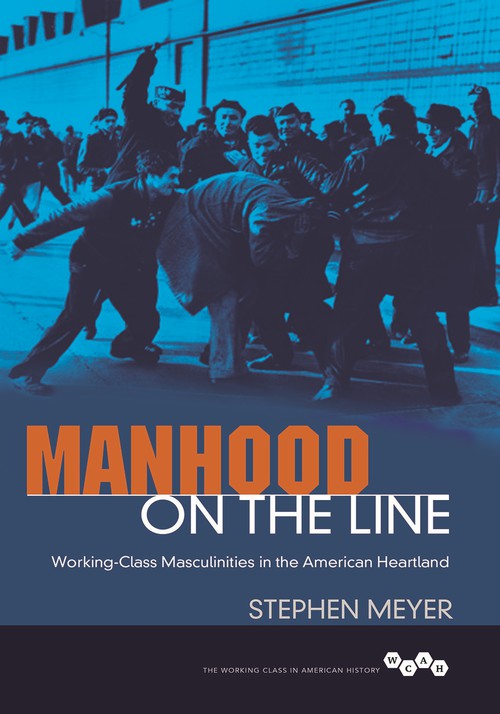
Stephen Meyer
University of Illinois Press (2016)
Introduction: Forms and Stephen Meyer charts the complex vagaries of men reinventing manhood in twentieth century America. Their ideas of masculinity destroyed by principles of mass production, workers created a white-dominated culture that defended its turf against other racial groups and revived a crude, hypersexualized treatment of women that went far beyond the shop floor. At the same time, they recast unionization battles as manly struggles against a system killing their very selves. Drawing on a wealth of archival material, Meyer recreates a social milieu in stunning detail--the mean labor and stolen pleasures, the battles on the street and in the soul, and a masculinity that expressed itself in violence and sexism but also as a wellspring of the fortitude necessary to maintain one's dignity while doing hard work in hard world.roduction and Auto-Worker Masculinity (pp. 12-32)
2 Reclaiming Manhood: Shop Culture, Industrial Unionism, and the Derogation of Women, 1920s and 1930s (pp. 33-57)
3 ʺRats, Finks, and Stool Pigeonsʺ: The Disreputable Manhood of Factory Spies in the 1920s and 1930s (pp. 58-81)
4 Fighting to Provide: The Battle to Organize the Ford River Rouge Plant, 1930–1945 (pp. 82-111)
5 Fashioning Dense Masculine Space: Industrial Unionism and Altered Shop-Floor Relations, 1935–1960s (pp. 112-140)
6 The Female ʺInvasionʺ: Women and the Male Workplace, 1940–1945 (pp. 141-164)
7 The Challenge to White Manhood: Black Men and Women Move to White Male Jobs, 1940–1945 (pp. 165-191)
Conclusion: The More Things Change, the More They Stay the Same (pp. 192-210)
Drawing on a wealth of archival material, Meyer recreates a social milieu in stunning detail--the mean labor and stolen pleasures, the battles on the street and in the soul, and a masculinity that expressed itself in violence and sexism but also as a wellspring of the fortitude necessary to maintain one's dignity while doing hard work in hard world.roduction and Auto-Worker Masculinity

Stephen Meyer
Rutgers University Press (1992)
During the first half of this century, Allis-Chalmers was Wisconsin's largest employer. The firm hired a variety of workers, including the native-born, immigrants, the skilled, the unskilled, and eventually women and a small number of blacks. Stephen Meyer presents a history of the Allis-Chalmers workers, and of the growth and destruction of the militant, left-wing union they built. The story of these workers and their union serves as a microcosm of the history of American labor in the twentieth century. Meyer describes how skilled workers, fearful of mechanization, worked to develop a robust union in the 1930s. He details the battle for unionization among the more militant CIO, the conservative AFL, Communists, and Allis-Chalmers management officials. Meyer tells us about several of the key players in this battle--Harold Story, the Allis-Chalmers vice president and chief labor strategist, and Harold Christoffel, the electrical worker who became the powerful first president of the union. Meyer also analyzes the technical and social transition from batch to mass production, the social and cultural world of the ordinary workers at the workplace, and the factional struggles on the shop floor and picket line. He concludes by examining the CIO's entry into Wisconsin politics, the subsequent campaign against union leftists, the rise of Joseph McCarthy, the consolidation of Walter Reuther's position as UAW president, and the passage of the Taft-Hartley law.
This volume analyzes the Communist and anti-Communist factions of the Wisconsin labor movement, including the role the UAW and CIO played in purging radical unions

Stephen Meyer
For American automobile workers, one relatively constant feature of their daily factory lives was this simplified, monotonous, and degraded work. Although work tasks, work situations, and work routines varied considerably from automobile firm to automobile firm and from one shop or department to another, the work tasks of assembly line workers were the simplest, most boring, and most degrading. As Chinoy observed in the 1960s, while a small proportion, no more than 18%, of auto workers were classified as assemblers, many other auto factory jobs, such as “paint sprayers, polishers, welders, upholsterers,” and others, “have been subject to the same kinds of job experiences as those engaged in assembly.” And, many, many others worked at machines whose rhythms and cycles shaped and determined their specific work tasks and work pace.
a historiographical essay from a leading labor historian of the era

Stephen Meyer
State University of New York Press (1981)
In 1903, Henry Ford founded the Ford Motor Company in a small Detroit workshop. Five years later, he introduced the Model T and met with extraordinary commercial success. Between 1910 and 1914, he developed mass production and made the conveyor a symbol of the auto-industrial age. Then, in 1914, Ford acquired an overnight reputation as humanitarian, philanthropist and social reformer; and simultaneously infuriated the business community and stunned social reformers with his announcement of the outrageous Five Dollar Day. More than simply high-wage policy, the Five Dollar Day attempted to solve attitudinal and behavioral problems with an effort to change the worker's domestic environment. Half of the five dollars represented "wages" and the other half was called "profits"-which the worker received only when he met specific standards of efficiency and home life that accorded with the ideal of an American way of life which the company felt was the basis for industrial efficiency.
A history of paternalism and industrial relations within the Ford Motor Company.

Stephen Preskill
University of California Press (2021)
How Myles Horton and the Highlander Folk School catalyzed social justice and democratic education. For too long, the story of life-changing teacher and activist Myles Horton has escaped the public spotlight. An inspiring and humble leader whose work influenced the Civil Rights Movement, Horton helped thousands of marginalized people gain greater control over their lives. Born and raised in early twentieth-century Tennessee, Horton was appalled by the disrespect and discrimination that was heaped on poor people-both black and white-throughout Appalachia. He resolved to create a place, available to all, where regular people could talk to each other, learn from one another, and get to the heart of issues of class and race and right and wrong. And so in 1932, Horton cofounded the Highlander Folk School, smack in the middle of Tennessee. Education in Black and White is the first biography of Myles Horton in 25 years and focuses, in particular, on the educational theories and strategies he first developed at Highlander to serve the interests of the poor, the marginalized, and the oppressed. His personal vision became an essential influence on everyone from Rosa Parks and Martin Luther King, Jr., to Eleanor Roosevelt and Congressman John Lewis. Stephen Preskill chronicles how Myles Horton gained influence as an advocate for organized labor, an activist for civil rights, a supporter of Appalachian self-empowerment, an architect of an international popular education network, and a champion for direct democracy, showing how the example he set remains education's last best hope today"-- Provided by publisher
focuses, in particular, on the educational theories and strategies Myles Horton first developed at Highlander to serve the interests of the poor, the marginalized, and the oppressed.

Stephen Waring
University of North Carolina Press (1994)
This intellectual history interprets recent American business management ideas as political theory, describing their underlying assumptions about power and value. According to Stephen Waring, most business management theory descends from either Frederick Taylor’s 'bureaucratic' theory of scientific management or Elton Mayo’s 'corporatist' idea of human relations. Waring discusses the subsequent evolution of several management theories and techniques, including organization theory, computer simulation, management by objectives, sensitivity training, job enrichment, and innovations usually attributed to the Japanese, such as quality control circles.
This theoretical text reinterprets recent American business management ideas as political theory, describing their underlying assumptions about power and value.

Stetson Kennedy, Georgia State University
Georgia State University Library's Southern Labor Archives' digitized collection of Stetson Kennedy papers. Includes photographs of working class life and poverty. A folklorist, Kennedy infiltrated the KKK in the 1940s. For further research, consult the guide to the Stetson Kennedy papers at Georgia State University Library. the Stetson Kennedy research guide, and the Stetson Kennedy Official Website. For search https://archivesspace.library.gsu.edu/repositories/2/resources/350
Stetson Kennedy (1916-2011) was an author, folklorist, environmentalist, labor activist, and human rights advocate known for his infiltration of the Ku Klux Klan during the 1940s. He authored eight books, including Palmetto Country, Southern Exposure, and The Klan Unmasked. He became one of the country's pioneering folklorists while working for the WPA Florida Writers' Project, and at the age of 21, was put in charge of folklore, oral history, and ethnic studies.
After World War II, Kennedy infiltrated the Ku Klux Klan and exposed their secrets, helping Georgia authorities revoke the Klan's corporate charter. He also supplied Klan secrets to the writers of the Superman radio program which resulted in a series of four episodes in which Superman battled the KKK.
In addition to his passion for folklore, Kennedy counted as close friends famous writers and musicians, including Erskine Caldwell, Jean Paul Sartre and Woody Guthrie.
Until the very last days of his life, Kennedy continued to champion the causes that drove his decades of activism. His advice to young people was always to "pick a cause and stick to it." Kennedy's legacy lives on through his writings, Beluthahatchee Park, and the remarkable impact he made on all those who knew him.
Stetson Kennedy Papers are digitized material from the life of a labor, civil rights activist in the South.Documents of the life of a labor folklorist and anti-KKK activist in the South, 1940s-1960s

Steve Babson
Mission Point Press (2023)
Labor historian and educator Steve Babson reminds us of the record of 1890s Populists in this highly readable illustrated short book. . The Populists of the 1890s transformed the nation’s political terrain, and this book tells the story of the hard-pressed farmers who launched that movement. Their call for a widening democracy to counter corporate monopoly and profiteering tapped into a growing resentment of the rich, a resentment that grew as the economy alternated between rapid growth, producing more millionaires, and severe economic depressions, producing more poverty. The Populist challenge to unbridled capitalism would finally force Republicans and especially Democrats to recognize the growing support for progressive change within their own ranks. These historical Populists are now forgotten as today’s pundits would have us believe that “populists” of the left—no less so than the right—are uniquely drawn to authoritarian politics. Often enough, the term serves as a sly pejorative, hinting at the unreliable behavior and hidden agendas of anyone who challenges established authority. You won’t find that in this book. The historical Populists are presented here as champions of democracy and forward-looking reforms. Recovering the historical meaning of their challenge to corporate absolutism is a first step in linking that past to current struggles against the corporate behemoths of our time.
Analyzes the origins of the agrarian Populist party, demonstrating its democratic ideals

Steve Babson
Rowman & Littlefield (1999)
"Labor scholar and activist Steve Babson's narrative examines the numerous attempts to organize workers from the Great Uprising of 1877 to the "sitdown" strikes of the 1930s to the present day. Babson illuminates the tumultuous past, evolving agenda, and continuing conflicts of the labor movement. He identifies the causes of labor's decline in recent decades and explains union leaders' attempts to revive their organizations. Most important, Babson shows readers how the fortunes of organized labor are tied to larger trends in American history."--Jacket
examines the numerous attempts to organize workers from the Great Uprising of 1877 to the present day.

Steve Estes
The University of North Carolina Press (2015)
Once one of the wealthiest cities in America, Charleston, South Carolina, established a society built on the racial hierarchies of slavery and segregation. By the 1970s, the legal structures behind these racial divisions had broken down, and the wealth built upon them faded. Like many southern cities, Charleston had to construct a new public image. In this important book, Steve Estes chronicles the rise and fall of black political empowerment and examines the ways Charleston responded to the civil rights movement, embracing some changes and resisting others. Based on detailed archival research and more than fifty oral history interviews, Charleston in Black and White addresses the complex roles played not only by race but also by politics, labor relations, criminal justice, education, religion, tourism, economics, and the military in shaping a modern southern city. Despite the advances and opportunities that have come to the city since the 1960s, Charleston (like much of the South) has not fully reckoned with its troubled racial past, which still influences the present and will continue to shape the future. -- Front jacket flap
Chronicles the rise and fall of black political empowerment and examines the ways Charleston responded to the civil rights movemen
Museum/Exhibits
Tours
Maps
Digital Projects
Organizations
Sites
Film/Video
Audio/Interview
Podcast/Program
Text/Document
Image
Graphs/Data
Timeline
Southwest
West
Midwest
Southeast
Northeast
Mexico
Canada
Global
Books
Teaching
Lectures
Digital Archives
Journals
Bibliographies
Topic Intro