


Explore thousands of items. Use clickable links under collections and library for broad categories. Search by keyword (including topic,city, state.) Limit by time period, type of item, region. See our search tips page for more assistance.
Collections
Library
Type
Region
Coverage:
-
Published:
-

Sue Fawn Chung
University of Illinois Press (2011)
Both a history of an overlooked community and a well-rounded reassessment of prevailing assumptions about Chinese immigrants in the American West, In Pursuit of Gold brings to life in rich detail the world of turn-of-the-century mining towns in the Northwest. Sue Fawn Chung meticulously recreates the lives of Chinese immigrants, miners, merchants, and others who populated these towns and interacted amicably with their white and Native American neighbors, defying the common perception of nineteenth-century Chinese communities as insular enclaves subject to increasing prejudice and violence.
While most research has focused on Chinese miners in California, this book is the first extensive study of Chinese experiences in the towns of John Day in Oregon and Tuscarora, Island Mountain, and Gold Creek in Nevada. Chung illustrates the relationships between miners and merchants within the communities and in the larger context of immigration, arguing that the leaders of the Chinese and non-Chinese communities worked together to create economic interdependence and to short-circuit many of the hostilities and tensions that plagued other mining towns.
Peppered with fascinating details about these communities from the intricacies of Chinese gambling games to the techniques of hydraulic mining, In Pursuit of Gold draws on a wealth of historical materials, including immigration records, census manuscripts, legal documents, newspapers, memoirs, and manuscript collections. Chung supplements this historical research with invaluable firsthand observations of artifacts that she experienced in archaeological digs and restoration efforts at several of the sites of the former booming mining towns.
In clear, analytical prose, Chung expertly characterizes the movement of Chinese miners into Oregon and Nevada, the heyday of their mining efforts in the region, and the decline of the communities due to changes in the mining industry. Highlighting the positive experiences and friendships many of the immigrants had in these relatively isolated mining communities, In Pursuit of Gold also suggests comparisons with the Chinese diaspora in other locations such as British Columbia and South Africa.
A fresh assessment of Chinese immigrant participation in American mining towns

Sujani K. Reddy
The University of North Carolina Press (2015)
In this rich interdisciplinary study, Sujani Reddy examines the consequential lives of Indian nurses whose careers have unfolded in the contexts of empire, migration, familial relations, race, and gender. As Reddy shows, the nursing profession developed in India against a complex backdrop of British and US imperialism
Contents:
Feminizing the Christian medical mission
Searching for Salome
Reconstructing the imperial nation
Remaking mother India
From Kerala to America
Putting the "foreign" in nurse im/migration
Indian nurses navigate the U.S. division of nursing labor
Workers and wives
the consequential lives of Indian nurses

Summit County Labor News
Paper began in 1923, ran through 1970s, but there is a more limited run on-line
Akron Ohio labor paper

Supt. W. M. Mink, History Matters
Mill superintendent W. M. Mink Explains the 1919 Steel Strike (History Matters): In the dramatic 1919 steel strike, 350,000 workers walked off their jobs and crippled the industry. The U.S. Senate Committee on Education and Labor set out to investigate the strike while it was still in progress. In his testimony before the committee, W. M. Mink, mill superintendent at the Homestead steelworks, testified that the cause of the strike was simple—the infection of “the Bolshevik spirit”among “the foreigners.”
Transcribed testimoney of W. M. Mink over the 1919 Steel Strike.

Susan Dewey
University of California Press (2011)
This path-breaking book examines the lives of five topless dancers in the economically devastated "rust belt" of upstate New York. With insight and empathy, Susan Dewey shows how these women negotiate their lives as parents, employees, and family members while working in a profession widely regarded as incompatible with motherhood and fidelity.
Neither disparaging nor romanticizing her subjects, Dewey investigates the complicated dynamic of performance, resilience, economic need, and emotional vulnerability that comprises the life of a stripper. An accessibly written text that uses academic th
Examines the lives of five topless dancers in the New York, showing how these women negotiate their lives as parents, employees, and family members

Susan Eisenberg
ILR Press (1998)
Susan Eisenberg began her electrical apprenticeship in 1978, the year President Jimmy Carter set goals and timetables for the hiring of women on federally assisted construction projects and for the inclusion of women in apprenticeship programs. Eisenberg expected not only a challenging job and the camaraderie of a labor union but also the chance to be part of a historic transformation, social and economic, that would make the construction trades accessible to women
gracefully weaves the voices of thirty women who worked as carpenters, electricians, ironworkers, painters, and plumbers to examine why their numbers remained small.

Susan L. Marquis
ILR Press (2017)
I am Not a Tractor! celebrates the courage, vision, and creativity of the farmworkers and community leaders who have transformed one of the worst agricultural situation in the United States into one of the best.
Susan Marquis highlights past abuses workers suffered in Florida's tomato fields: toxic pesticide exposure, beatings, sexual assault, rampant wage theft, and even, astonishingly, modern-day slavery. Marquis unveils how, even without new legislation, regulation, or government participation, these farmworkers have dramatically improved their work conditions.
Marquis credits this success to the immigrants from Mexico, Haiti, and Guatemala who formed the Coalition of Immokalee Workers, a neuroscience major who takes great pride in the watermelon crew he runs, a leading farmer/grower who was once homeless, and a retired New York State judge who volunteered to stuff envelopes and ended up building a ground-breaking institution. Through the "Fair Food Program" that they have developed, fought for, and implemented, these people have changed the lives of more than thirty thousand field workers. I Am Not a Tractor! offers a range of solutions to a problem that is rooted in our nation's slave history and that is worsened by ongoing conflict over immigration"-- Publisher's Web site
farmworkers and community leaders who have transformed one of the worst agricultural situation in the United States into one of the bes

Susan Levine
Temple University Press (1984)
Focuses on carpet weavers in New York and Pennsylvania in the 1880s and 1890s, the emergence of the Knights of Labor uninonizing, efforts at reforms, strikes in Philadelphia, Yonkers, Amsterdam, New York. Discuses equal rights philosophy in the Knights, but also the limits that domestic destiny had on women as organizers.
carpet weaving women in the Knights of Labor, their strikes and alliances, organizing strategies

Susan Porter Benson
University of Illinois Press (1986)
The luxurious appearance and handsome profits of American department stores from 1890 to 1940 masked a three-way struggle among saleswomen, managers, and customers for control of the selling floor. Counter Cultures explores the complex nature and contradictions of the conflict in an arena where class, gender, and the emerging culture of consumption all came together. The result is a fascinating illumination of the emotional labor of the workplace and the work-culture of consumerism that still defines the workday for millions of Americans.
explores the complex nature and contradictions of the conflict in an arena where class, gender, and the emerging culture of consumption all came together.

Susanna Rosenbaum
Duke University Press (2017)
Susanna Rosenbaum examines how immigrant Mexican and Central American domestic workers in Los Angeles and the predominantly white, upper-middle-class women who employ them seek to achieve the ""American Dream, "" underscoring how the American Dream's ideology is racialized and gendered while exposing how pursuing it lies at the intersection of motherhood and domestic labor
how immigrant Mexican and Central American domestic workers in Los Angeles and the predominantly white, upper-middle-class women who employ them seek to achieve the ""American Dream, "

Susie S. Porter
University of Nebraska Press (2018)
In late nineteenth-century Mexico a woman's presence in the home was a marker of middle-class identity. However, as economic conditions declined during the Mexican Revolution and jobs traditionally held by women disappeared, a growing number of women began to look for work outside the domestic sphere. As these "angels of the home" began to take office jobs, middle-class identity became more porous.
To understand how office workers shaped middle-class identities in Mexico, From Angel to Office Worker examines the material conditions of women's work and analyzes how women themselves reconfigured public debates over their employment. At the heart of the women's movement was a labor movement led by secretaries and office workers whose demands included respect for seniority, equal pay for equal work, and resources to support working mothers, both married and unmarried. Office workers also developed a critique of gender inequality and sexual exploitation both within and outside the workplace. From Angel to Office Workeris a major contribution to modern Mexican history as historians begin to ask new questions about the relationships between labor, politics, and the cultural and public spheres."-- Provided by publisher
a labor movement led by secretaries and office workers whose demands included respect for seniority, equal pay for equal work, and resources to support working mothers, both married and unmarried

Suzanne, Mary Margaret Fonow Franzway
University of Illinois Press (2011)
In this timely and detailed examination of the intersections of feminism, labor politics, and global studies, Suzanne Franzway and Mary Margaret Fonow reveal the ways in which women across the world are transforming labor unions in the contemporary era. Situating specific case studies within broad feminist topics,
Franzway and Fonow concentrate on union feminists mobilizing at multiple sites, issues of wages and equity, child care campaigns, work-life balance, and queer organizing, demonstrating how unions around the world are broadening their focuses from contractual details to empowerment and family and feminist issues. By connecting the diversity of women's experiences around the world both inside and outside the home and highlighting the innovative ways women workers attain their common goals, Making Feminist Politics lays the groundwork for recognition of the total individual in the future of feminist politics within global union movements.
women across the world are transforming labor unions in the contemporary era

Sven Beckert
Alfred A Knopf (2014)
The epic story of the rise and fall of the empire of cotton, its centrality in the world economy, and its making and remaking of global capitalism. Sven Beckert's rich, fascinating book tells the story of how, in a remarkably brief period, European entrepreneurs and powerful statesmen recast the world's most significant manufacturing industry combining imperial expansion and slave labor with new machines and wage workers to change the world. Here is the story of how, beginning well before the advent of machine production in 1780, these men created a potent innovation (Beckert calls it war capitalism, capitalism based on unrestrained actions of private individuals; the domination of masters over slaves, of colonial capitalists over indigenous inhabitants), and crucially affected the disparate realms of cotton that had existed for millennia. We see how this thing called war capitalism shaped the rise of cotton, and then was used as a lever to transform the world. The empire of cotton was, from the beginning, a fulcrum of constant global struggle between slaves and planters, merchants and statesmen, farmers and merchants, workers and factory owners. In this as in so many other ways, Beckert makes clear how these forces ushered in the modern world. The result is a book as unsettling and disturbing as it is enlightening: a book that brilliantly weaves together the story of cotton with how the present global world came to exist"--Provided by publisher
The epic story of the rise and fall of the cotton industry, its centrality in the world economy, and its making and remaking of global capitalism.

Sven Beckert, Seth Rockman
University of Pennsylvania Press (2016)
anthology /essay collection
ntroduction. Slavery's Capitalism—Sven Beckert and Seth Rockman
PART I. PLANTATION TECHNOLOGIES
Chapter 1. Toward a Political Economy of Slave Labor: Hands, Whipping-Machines, and Modern Power—Edward E. Baptist
Chapter 2. Slavery's Scientific Management: Masters and Managers—Caitlin Rosenthal
Chapter 3. An International Harvest: The Second Slavery, the Virginia-Brazil Connection, and the Development of the McCormick Reaper—Daniel B. Rood
PART II. SLAVERY AND FINANCE
Chapter 4. Neighbor-to-Neighbor Capitalism: Local Credit Networks and the Mortgaging of Slaves—Bonnie Martin
Chapter 5. The Contours of Cotton Capitalism: Speculation, Slavery, and Economic Panic in Mississippi, 1832-1841—Joshua D. Rothman
Chapter 6. "Broad is de Road dat Leads ter Death": Human Capital and Enslaved Mortality—Daina Ramey Berry
Chapter 7. August Belmont and the World the Slaves Made—Kathryn Boodry
PART III. NETWORKS OF INTEREST AND THE NORTH
Chapter 8. "What have we to do with slavery?" New Englanders and the Slave Economies of the West Indies—Eric Kimball
Chapter 9. "No country but their counting-houses": The U.S.-Cuba-Baltic Circuit, 1809-1812—Stephen Chambers
Chapter 10. The Coastwise Slave Trade and a Mercantile Community of Interest—Calvin Schermerhorn
PART IV. NATIONAL INSTITUTIONS AND NATURAL BOUNDARIES
Chapter 11. War and Priests: Catholic Colleges and Slavery in the Age of Revolution—Craig Steven Wilder
Chapter 12. Capitalism, Slavery, and the New Epoch: Mathew Carey's 1819—Andrew Shankman
Chapter 13. The Market, Utility, and Slavery in Southern Legal Thought—Alfred L. Brophy
Chapter 14. Why Did Northerners Oppose the Expansion of Slavery? Economic Development and Education in the Limestone South—John Majewski/
A collection of essays that argues for slavery's centrality to the emergence of American capitalism in the decades between the Revolution and the Civil War.
Switchmen's Union of North America.
The journal of the Switchmen's Union of North America. A craft union.
N. Y., January 9, 1902. An “ outlaw strike” in 1920 resulted in a dual organization of switchmen which functioned for two or three years. The
membership of the dual organization, however, has been gradually reabsorbed by the parent body.
Objects.—“ The objects of the Switchmen’s Union are: First, benevolence; to unite and promote the general welfare and advance the interests—social, moral, and intellectual-—of its members; benevolence, very needful in a calling as hazardous as ours, has led to the organization of this union. Second, hope, believing that it is for the best interests both of our members and their employers that a good understanding should exist at all time between them, it will be the constant endeavor of this union to establish mutual confidence and create and maintain harmonious relations between employer and employee. Third, protection, by kindly bearing with each other’s weaknesses, aiding with our counsel distressed or erring brothers, and to exercise at all times its
beneficial influence in the interests of right and justice, such are the aims and purposes of the Switchmen’s Union of North America.”
Switchmen's Union of North America Official Journal

Sylvie Laurent
University of California Press (2019)
Shortly before his assassination, Martin Luther King, Jr. called for a radical redistribution of economic and political power to transform the whole of society.
A neglected and obscured episode of the late Civil Rights movement, The Poor People's Campaign, designed by King in 1967 and carried out after his death, brought together impoverished Americans of all races to demand better wages, better jobs, better homes, and better education. He believed that not only a fight for rights but the radical distribution of wealth had to be demanded through interracial protest.
King and the Other America explores this overlooked campaign to not only understand King's commitment to social justice but to understand the long-term trajectory of the Civil Rights Movement. Digging into earlier 20th century arguments about economic inequality across America, which King drew on through his entire political and religious life, Sylvie Laurent argues that the Poor People's Campaign was the logical culmination of King's influences and ideas and the lasting impact he had on young activists and the public. Fifty years later, growing inequality and grinding poverty in the United States have spurred new efforts to rejuvenate the campaign.
This book is essential to understanding today's movement through King's radical, intellectual thought and his struggle for genuine equality for all"--Provided by publisher
argues that the Poor People's Campaign was the logical culmination of King's influences and ideas and the lasting impact he had on young activists and the public

T. Fulton Gantt, History Matters
This description of a Washington D.C. Knights of Labor assembly hall in the late 1880s appeared in T. Fulton Gantt’s novel, Breaking the Chains: A Story of the Present Industrial Struggle,. It was was first published in 1887, in serial form, in The Lance, a labor newspaper in Salem, Oregon. Many other novels from this period addressed the problems of labor conflict and inequality, but Gantt was one of the very few to see unionization as the answer to the problems of working people. Although the Knights officially prohibited lawyers (“non-producers”) from membership, Gantt was both a member of the bar and the Knights. Gantt’s description, which presumably drew from his own experience in District Assembly 66 in Washington, D.C., conveyed a sense of the diverse social, political, and intellectual functions that the meeting hall played for its members, as well as the issues that animated their debates.
A detailed account of the Knights of Labor assembly hall.

T. Phillips Thompson and Jay Atherton
University of Toronto Press (1975)
1886 witnessed the height of a period of violent industrial strife in North America. In that year the eight-hour day movement culminated in Chicago's notorious Haymarket Riot. Both the Trades and Labor Congress of Canada and the American Federation of Labor became firmly established and held their first annual meetings; the Knights of Labor were at their peak. Unemployment, working dislocation, and social unrest were focusing public attention on the abuses of the emerging industrial system. Those with power -- the big business monopolies -- were exploiting those without, and the various levels of government seemed unable or unwilling to intervene. It was all too evident that wealth and progress were for the few, and poverty and alienation were for the many. What were the cases of this inequality, and how could the balance be restored? This was the ‘Labor Question’ that engaged the imagination of so many writers in the 1880s, men such as Henry George, Laurence Gronlund, Edward Bellamy -- and T. Phillips Thompson. Thompson was one of the leading spokesmen of the Canadian labor and socialist movements for over three decades. This book presents a distillation of his thought in a constructive critique of the American political and economic system. Time has proved Thompson a prophet: much of what he advocated in The Politics of Labor has come to pass in the years since 1886.
This book presents a constructive critique of the American political and economic system by T. Phillips Thompson, one of the leading spokesmen of the Canadian labor and socialist movements.

TWA, State Historical Society of Missouri
The single document that knits the TWA story together is the in-house company publication, the TWA Skyliner—published from 1929-2002—which reported on the events of the airline and its staff but also the company’s role in Missouri and the national and international changes within the airline industry. This TWA Skyliner Magazine collection offers issues from 1929 to 1989.
Trans World Airline company publication, the TWA Skyliner reported on the events of the airline
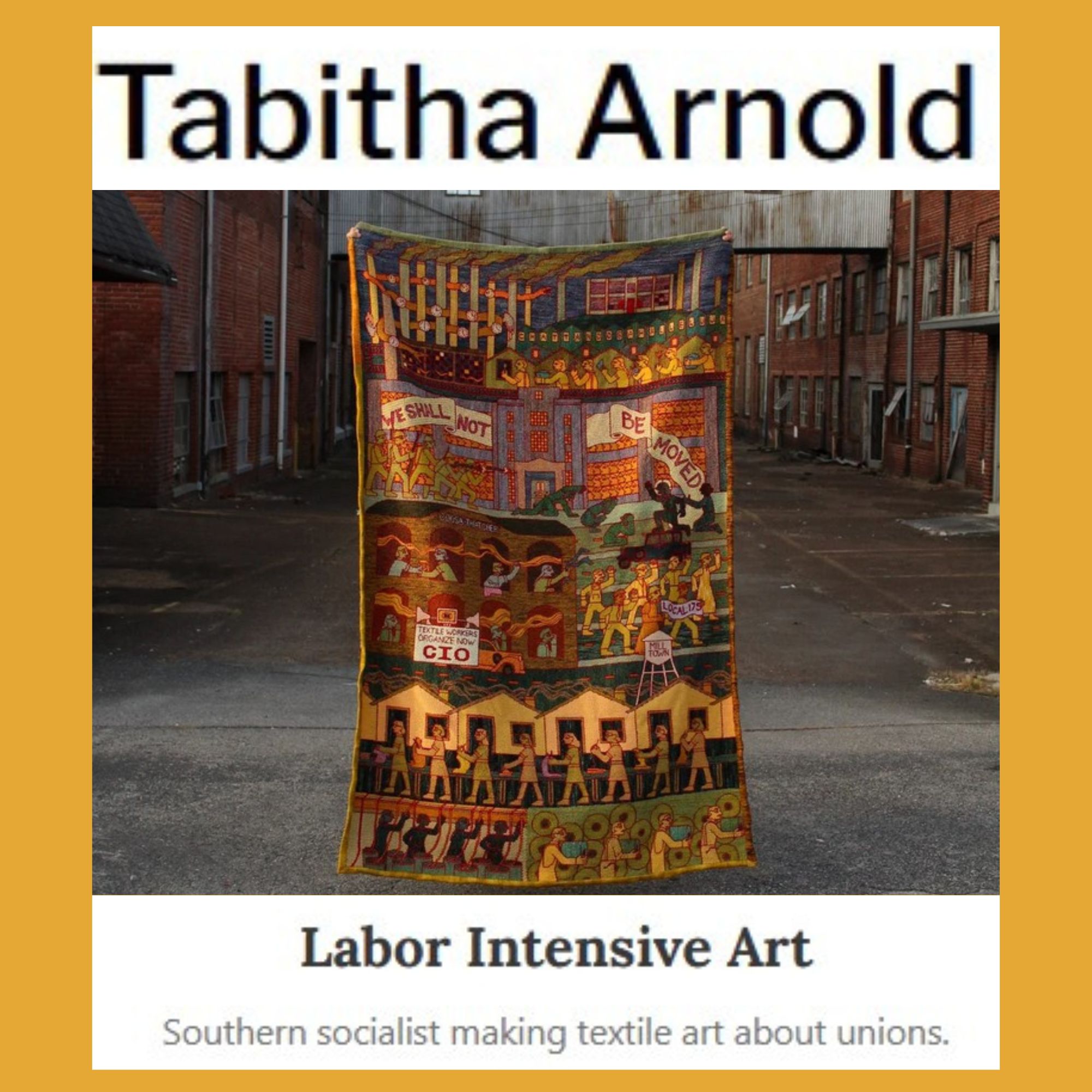
Tabitha Arnold
Born and based in Chattanooga, Arnold earned a painting degree from the Pennsylvania Academy of Fine Arts in Philadelphia, where a retrospective show by Ann Hamilton inspired her to pick up weaving. When Arnold became involved in an emergent cafe workers’ labor movement, she began to make tapestries about unions, using a rug-making tool as a makeshift embroidery needle.
As a socialist and labor organizer, her work reflects coming of age during a new wave of unionization in the United States. Arnold’s textiles borrow imagery from Bible Belt spirituality, social-realist propaganda, and ancient art motifs to create new historical artifacts from a working-class perspective. Her pieces weave contemporary events with images of historical class struggle, with a special focus on lesser-known stories of labor organizing in the Appalachian South.
Arnold weaves contemporary events with images of historical class struggle, with a special focus on lesser-known stories of labor organizing in the Appalachian South.

Talitha LeFlouria
Historian Talitha LeFlouria explains the chain gang system, population breakdown and its significance in the South.
Historian Talitha LeFlouria explains the chain gang system
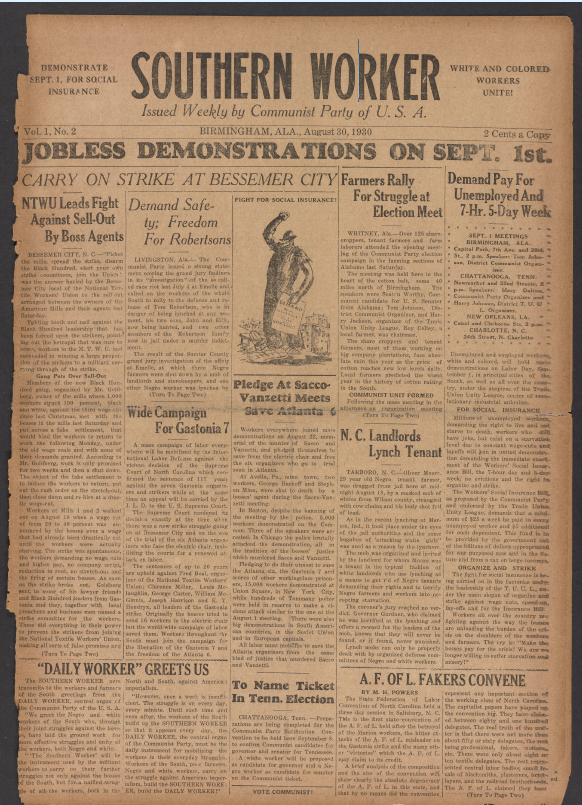
Tamiment Library
Distributed between 1930 and 1937, Southern Worker was a regional newspaper produced by the Communist Party, USA. First edited by Solomon “Sol” Auberbach, who adopted the pseudonym “James S. Allen,” Southern Worker documents the Communist Party's attempt to unify Black and white laborers and farmers in a common struggle against capitalism, corporations, and inequality. In the inaugural August 16th, 1930 issue, the Southern Worker announces, “It is a paper of and for both white and black workers and farmers. It recognizes only one division, the bosses against the workers and the workers against the bosses. In this class struggle, the Southern Worker stands always, without exception, unflinchingly, for the workers. It is a workers' paper.”
While the paper addressed issues of labor broadly, it did reflect and speak to the concerns of Black laborers specifically, with an intentional focus on racist Jim Crow laws that prevented access to jobs to Black workers. Additionally, the Southern Worker maintained a prominently vocal anti-lynching stance and provided reporting and analysis on the Scottsboro Boys trials.
In 1937, the paper folded, with the September 1937 issue as the last publication of the Southern Worker. Represented here are 65 issues of the paper, from its first issue released on August 16, 1930 through March 5, 1932.
This digital edition reproduces the holdings of the Tamiment Library & Robert F. Wagner Labor Archives at New York University. To contact the library, please email special.collections@nyu.edu.
Communist Party newspaper of the South

Tamiment Library
The Tamiment Library Poster Collection consists of items published between 1904 and 2019, that relate to left-radicalism, progressive movements, labor unions, and counter-culture in the United States, and in over thirty other countries. With new additions being received on a regular basis, the collection can be expected to grow well beyond its present size of 2,165 posters and broadsides.
The 2,165 posters and broadsides in the Tamiment/Wagner Poster and Broadside Collection relate to left-radicalism, progressive movements, labor unions and the counter-culture. Most were produced in the United States, but a significant number of posters on these same subjects from other countries are also included. Information on dates of individual items is scanty, but the approximate date-span for the collection is from 1904 to 2019, with the bulk of the material falling between 1970 and 1990.
176 posters and broadsides

Tamiment Library & Wagner Archives
The New York City Labor History Map began as a joint project between the Tamiment Library and Robert F. Wagner Labor Archives and the New York Labor History Association (NYLHA). The original map was created using Google Maps by a former Tamiment staff member. This map is no longer accessible on the web but textual information was saved offline, allowing for future updates. This digital project included fact checking the old map’s existing information points and locations and finding photographs to help visualize the corresponding historical events. Photographs from the Tamiment Library’s archival collections and the public domain are used.
Another section introduces context for the mapping. https://wp.nyu.edu/mappingnyclaborhistory/
The map documents the history of working people in New York City and their struggles to gain concessions such as the eight-hour work day, better pay, improved working conditions, decent and affordable housing, collective bargaining rights, healthcare, and pension plans. It also documents important aspects of the city’s political and social history, major union leaders and contributors, and their work to better conditions for workers. The map was created to be used as an alternative teaching tool.
The map uses ESRI ArcGIS software and is broken into seven sections including: strikes and boycotts, founding and headquarters, residences, newspaper or press locations, labor housing, arts and education, and iconic New York landmarks. Users can move between tabs to look at one section or look at all points together on the all-tab section. The map primarily focuses on 20th century events but also includes points from 1712 to 2003. Creating a digital map allows for future updates and additions, making the map an ongoing flexible project ripe for growth. This project’s purpose was to make this resource available digitally and to create an accompanying exhibit on the AFL-CIO to better contextualize the map.
strikes and boycotts, founding and headquarters, residences, newspaper or press locations, labor housing, arts and education, and iconic New York landmarks.
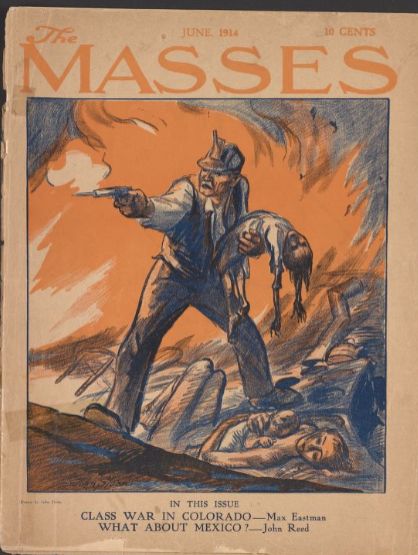
Tamiment Library, New York University
The Masses, a richly illustrated radical magazine, was published monthly in New York from 1911 until 1917, when it was suppressed by the government for its anti-war and anti-government perspective. The Masses blended art and politics and included fiction, nonfiction, poetry, and illustrations by many of the leading radical figures of the day. This digital edition reproduces the holdings of the Tamiment Library & Robert F. Wagner Labor Archives at New York University. To contact the library, please email special.collections@nyu.edu.
illustrated left-wing magazine