


Explore thousands of items. Use clickable links under collections and library for broad categories. Search by keyword (including topic,city, state.) Limit by time period, type of item, region. See our search tips page for more assistance.
Collections
Library
Type
Region
Coverage:
-
Published:
-
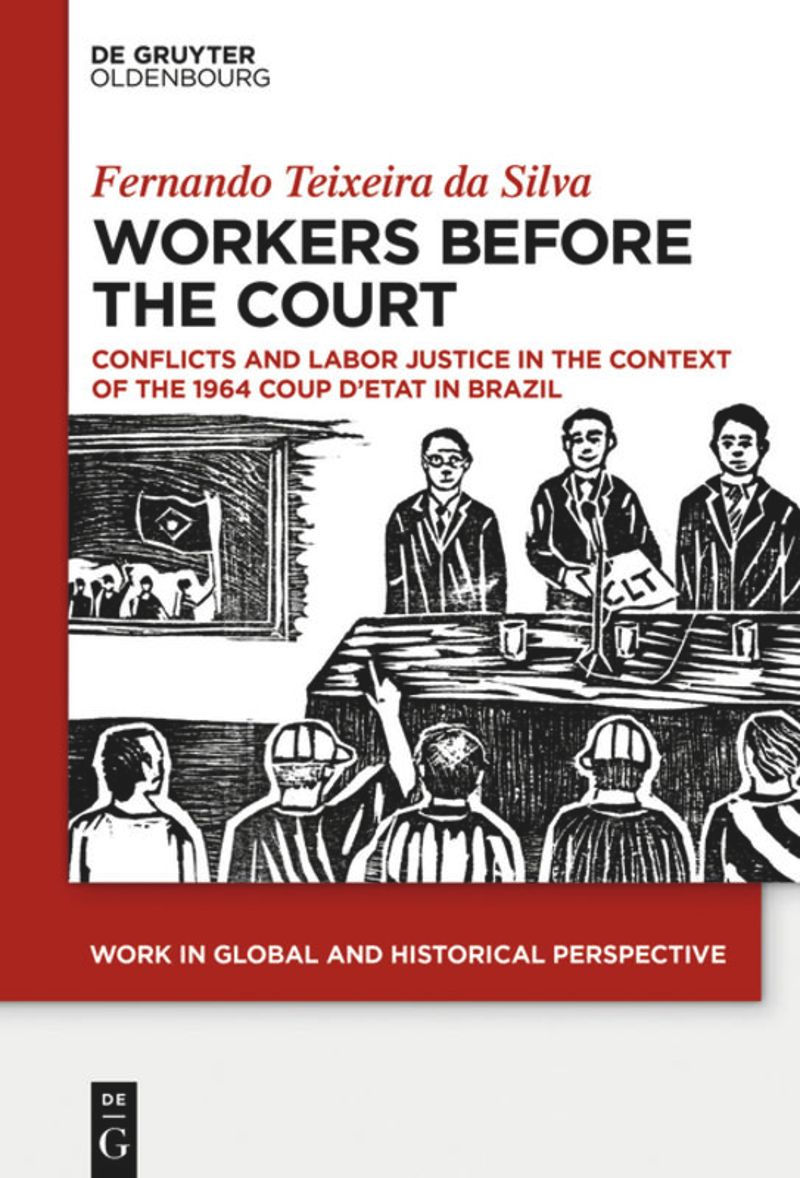
Texeira da Silva Fernando
De Gruyter Oldenbourg (2019)
Law and justice are studied in this book from the perspective of social andglobal history. The main focus of Workers Before the Tribunal is to overcome traditional binary oppositions between corporativist and contratualist models of labor relations, the former representing a view inwhich the working class would have more autonomy in struggling for betterlabor conditions, the latter meaning the protagonism of the State inpromoting labor rights. Teixeira da Silva presents three main arguments. First, he shows that the Brazilian labor justice system created during the Getúlio Vargas dictatorship (1930-1945), although inspired by Mussolini's legalorder in Italy, is very different from the Fascist Magistratura del Lavoro. Second, in his comparative analysis with other national cases, such as the United States, France, Germany and Australia, the author argues that therewas a large circulation of ideas and practices, resulting in a more complexdynamic of appropriation of international ideas on labor rights andinstitutions in Brazil. Third, Teixeira da Silva demonstrates that litigation in labor courts was one strategy of the working-class movement in Brazil, together with strikes and other means of confrontation. Therefore, he questions historiographical and politicalapproaches that see labor justice as a weak substitute for classaction. The "jurisdictionalization" of labor relations became aconstitutive element in the making of the Brazilian working class. The book is anchored in the research of hundreds of labor litigation cases during the dramatic months preceding the 1964 civil-military coup d'état that inaugurated a quarter century of dictatorial rule in Brazil
The book is anchored in the research of hundreds of labor litigation cases during the dramatic months preceding the 1964 civil-military coup d'état that inaugurated a quarter century of dictatorial rule in Brazil
Textile strikers, History Matters
The 1934 textile strike failed to bring the transformation in work conditions and social relations that the strikers had hoped to win and was widely considered a devastating defeat for Labor. An important window into the persistence of poor conditions in the mills is the letters that the mill workers (both male and female) wrote to Franklin and Eleanor Roosevelt and other government officials describing their plight. These letters provided compelling evidence of the discontent that lingered after the 1934 strike. Included here are five letters from textile mill communities in Tennessee, North Carolina, and South Carolina, which were written to Washington between 1937 and 1942. The letters testified not only to the difficult work conditions but also to the pervasive fear the workers felt if they tried to organize or complain publicly. One person who signed himself “just a worker” puts it simply: “I will have to be nameless or lose my job.”
Collection of letters written by textile workers to the President.

Thavolia Glymph
Cambridge University Press (2008)
"This book views the plantation household as a site of production where competing visions of gender were wielded as weapons in class struggles between black and white women. Mistresses were powerful beings in the hierarchy of slavery rather than powerless victims of the same patriarchal system responsible for the oppression of the enslaved. Glymph challenges popular depictions of plantation mistresses as "friends" and "allies" of slaves and sheds light on the political importance of ostensible private struggles, and on the political agendas at work in framing the domestic as private and household relations as personal."
Book argues that in decades before Civil War, white women were actively involved in violence and coercion to perform hard labor, and in punishments.
challenges popular depictions of mistresses as 'friends' and 'allies' of slaves in the plantation household.

The Agitator, Marxists.org
published by Jay Fox and Home, Washington anarchist colony, 2x a month. Renamed The Sydicalist in 1913, see that entry
digitized anarchist and syndicalist journal

The Alaska Socialist
The Alaska Socialist, “Published in the Interests of the Workers of Alaska and Advocating Industrial and Political Action”, was the paper of the Socialist Party of Alaska, produced twice-monthly by the Socialist Publishing Company in Fairbanks, Alaska beginning in 1913 and edited by A Knowles. It lasted until 1915. One of two rival socialist papers in Fairbanks, the other was the Socialist Press edited by George Hinton and began in 1914 fighting for control of the Socialist Party local with the ‘Alaska Socialist’ and its editor Alfred Knowles. The Socialist Press won the contest and Knowles papers ceased in 1915, while the ‘Socialist Press’ continued until 1918. The papers combative attitude and anti-war position got it and its editor into much trouble, including with Federal Authorities who shut the paper down as ‘pro-German’ because it was opposed to conscription.
Alaska socialist paper
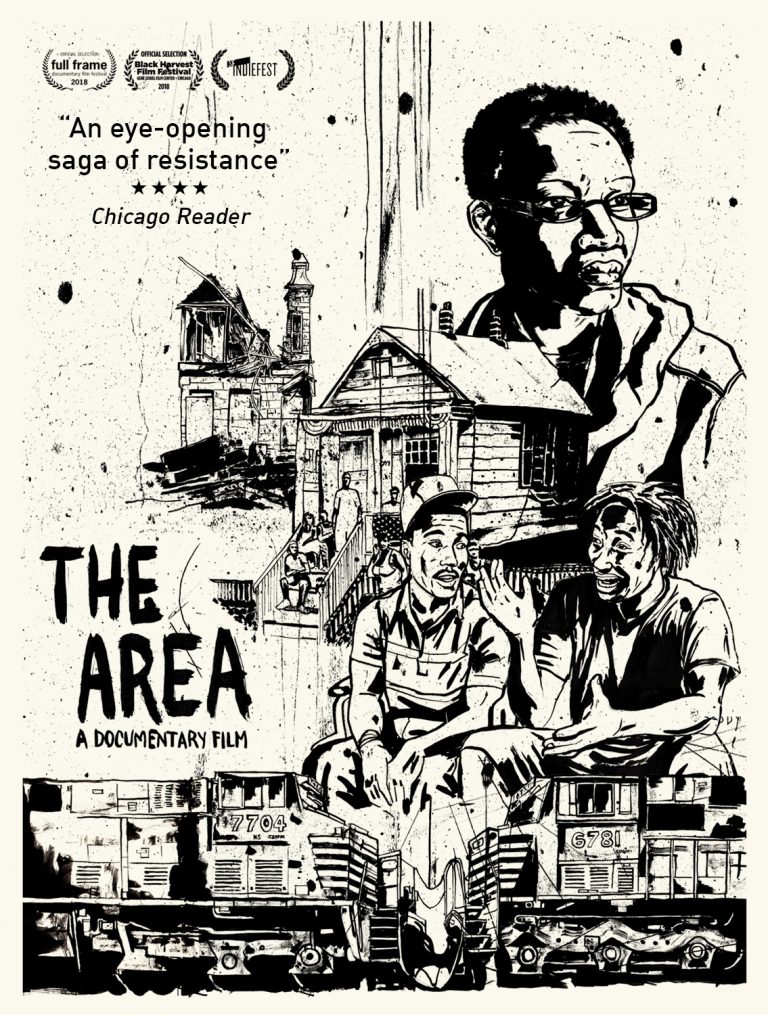
The Area
Projectr ()
When the train company representatives told Deborah Payne that her South Side Chicago neighborhood would be demolished to build a freight yard, she vowed to be “the last house standing.” A thirty-year resident of the Englewood community, she had raised generations of neighborhood children alongside her own, forging deep friendships and traditions in this Black American community surrounded by the tracks.
THE AREA is the five-year odyssey of her neighborhood, where more than 400 Black American families are being displaced by a multi-billion dollar freight company. As their community is literally being torn apart, residents maintain friendships and traditions while fighting for the respect they deserve. Through their experiences, the film weaves an all-too-real story about the disproportionate harm that structural racism has done to Black communities, while illustrating the hope and promise neighbors find in one another as they fight for their home.
Depicts 400 African-American families displaced by freight company.

The Arkansas Union Labor Bulletin
The Arkansas Union Labor Bulletin (also formerly known as the Union Label Bulletin) was established around 1900 by W.L Oury and Jack Buckalew as an independent venture. The newspaper was published in Little Rock, Arkansas, and featured political news and information about labor rights in the state. It was purchased by the Arkansas State Federation of Labor in 1915, at which time it became the official organ of the federation. It also became the official organ of the Farmer's State Union at that time. 17,000 pages of a newspaper.
Arkansas Labor Paper
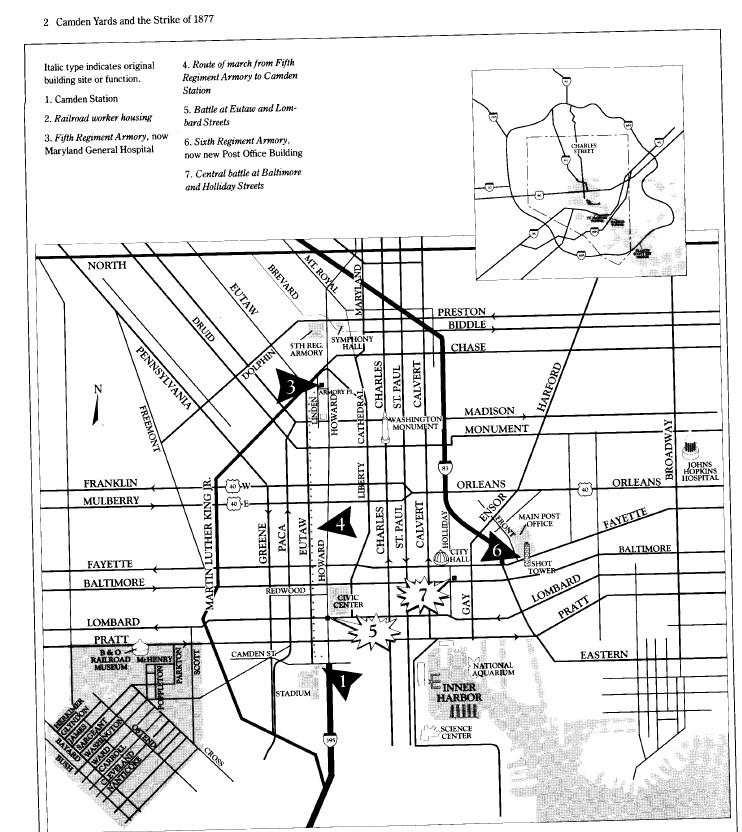
The Baltimore Book
excerpt from The Baltimore Book, map of 1877 strike locations, Camden Yards with legend of events, and key excerpts of the story
excerpt from a book on Baltimore, guide to map
The Black Metropolis Research Consortium
Limited number of digital archives available, for example, images from the Urban League, The Black Metropolis Research Consortium (BMRC) is a Chicago-based membership association of libraries, universities, museums, community/arts organizations, and other archival institutions. The BMRC’s mission is to connect all who seek to document, share, understand and preserve Black experiences. It is the vision of BMRC to be essential to promoting discovery, preservation, and use of Black historical collections. There are many labor subjects that can be researched, leading to digitized and non-digitized materials
Through consortial programs, the BMRC aids in expanding broad access to its members’ holdings of materials that document African American and African diasporic culture, history, and politics, with a specific focus on materials relating to Chicago. The BMRC is located at the University of Chicago, which serves as the Black Metropolis Research Consortium’s host institution and fiscal agent.
A Chicago-based research center dedicated to researching, preserving, and discovering Black experiences.
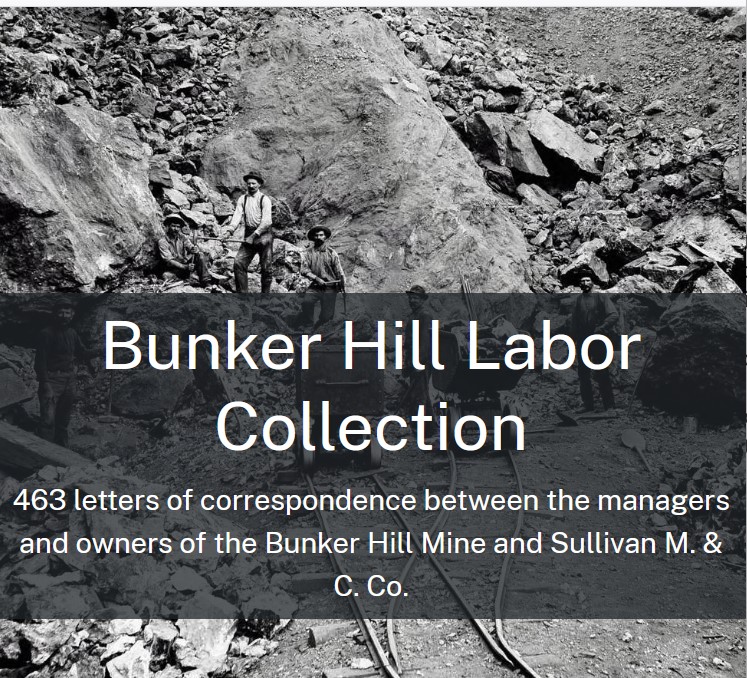
The Bunker Hill Labor History Collection, University of Idaho
The manager’s letters are letters from the manager of the mine in Kellogg to the president of the company in San Francisco, detailing the operations of the mine, union activities, and related information. In 1892 the letters were from V.M. Clement to John Hayes Hammond; letters for 1893 are lacking; 1894- 1896 are from F.W. Bradley to N.H. Harris; 1897-1898, Frederick Burbidge to Bradley, also Bradley and Burbidge to Alex Granger; and 1899-1909 Burbidge to Bradley or Granger.
Includes correspondence about unions, detectives, labor spies, murder, legal disputes, miners
The majority of these letters are inter-company correspondence between the Kellogg and San Francisco offices, although there are a few letters from suppliers.
463 letters of correspondence between the managers and owners of the Bunker Hill Mine and Sullivan M. & C. Co.
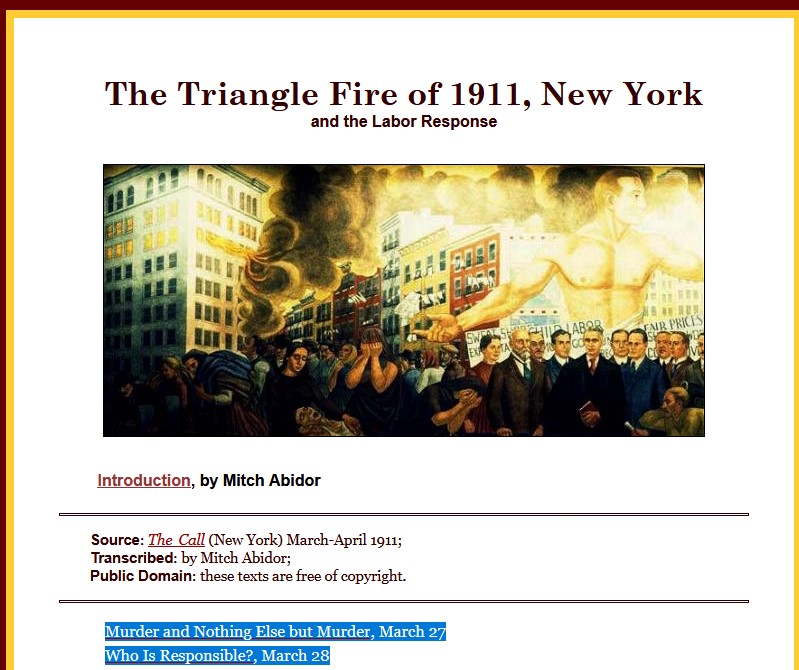
The Call, Marxists.org, Mitch Abidor
These reports of the Tiriangle Shirtwaist Fire of 1911 show labor and radicals' response and accounts of the fire, great to use for teaching documents. Mitch Abidor has a wrap around essay to use.
Murder and Nothing Else but Murder, March 27
Who Is Responsible?, March 28
Fireproof Buildings, March 29
Demonstrate!, March 30
Great Throng of Workers Pack Memorial Meeting, March 30
The Triangle, March 31
Be Ready Wednesday!, April 3
Joint Labor Conference of the Triangle Fire Disaster, April 4
March On!, April 5
The March, April 6
Mightiest Demonstration of Labor Ever Seen Shakes N.Y. Streets, April 6
reports of the Triangle Shirtwaist Fire from the New York Call, assembled and contextualized with a wrap around essay
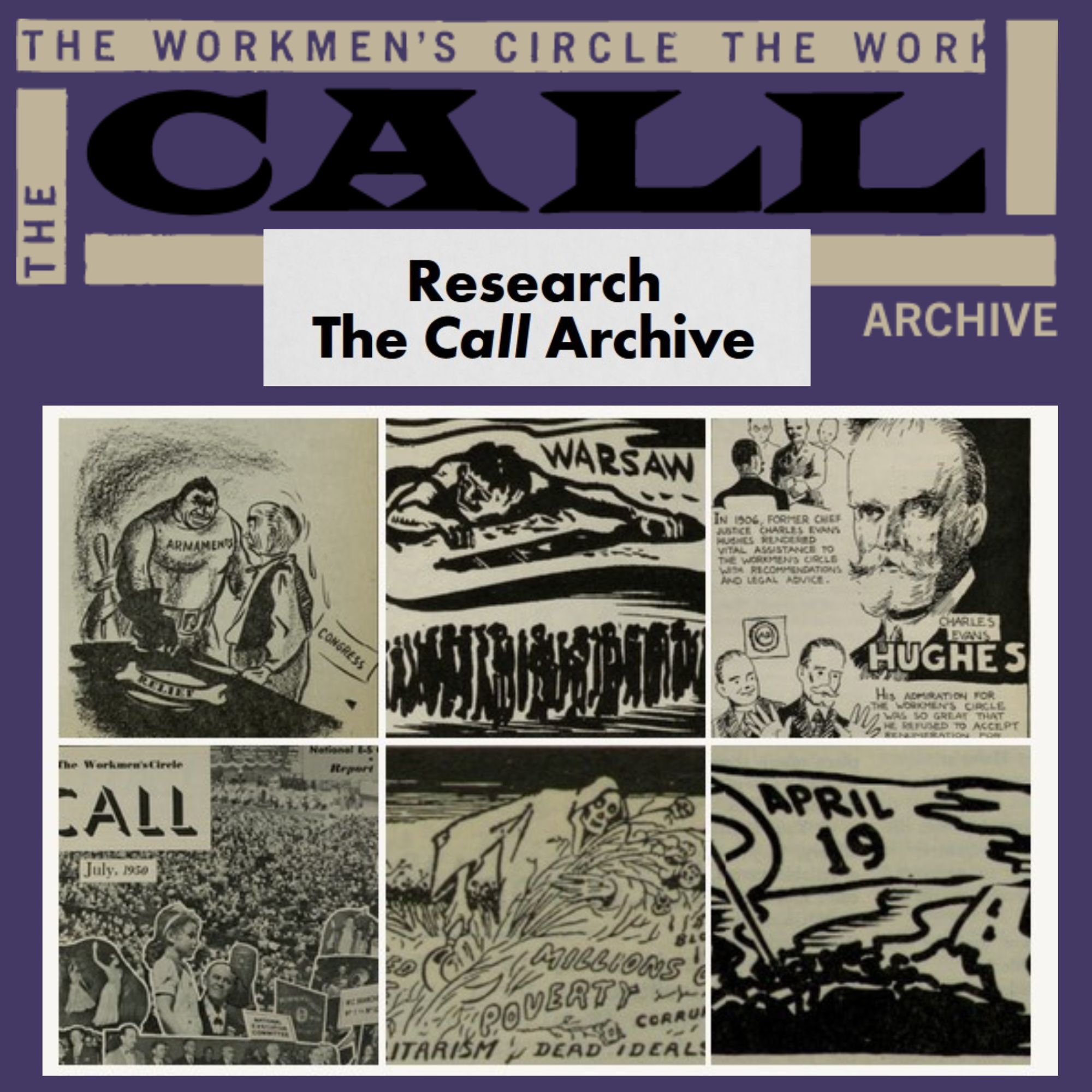
The Call, Workmen's Circle
From https://www.thecall.org/ : Born out of a wave of immigration, the Workmen's Circle was founded to help Yiddish-speaking Jews adapt to American life while preserving their cultural identity. For decades, its Yiddish publications kept members connected. But as a new, English-speaking generation emerged, the organization launched an English-language newsletter, the Call, to bridge old and new.
First appearing as the Young Circle League News Bulletin in 1929, in 1933 it evolved into the Call of Youth. By 1938 became known as The Workmen's Circle Call. For over half a century, its pages served as a hub for political advocacy, labor organizing, and Jewish culture—featuring contributors from Eleanor Roosevelt to Upton Sinclair, alongside the organization's own leading voices.
This digital archive preserves fifty years of the Call. These bound volumes—once stored in the New York headquarters—now offer an unfiltered look into the heart of the Jewish labor movement and the evolving American experience. Here, the defining conversations of the twentieth century unfold in real time.
The Call was originally created as an English-language newsletter for the Workmen’s Circle’s youth wing. Also known as Call of Youth and the Young Circle Bulletin, it was published continuously from 1929 onward, eventually becoming the Workers Circle’s primary English-language newsletter. The Call not only featured discussion of Ashkenazi Jewish culture in America, but became a mouthpiece for American labor and progressive movement leaders, with op-eds from the likes of New York City Mayor Fiorello La Guardia and Socialist Party presidential candidate Norman Thomas.
Most discussed issues: Workers RIGHTS
Fascism and World War II
Civil Rights Activism
Jewish Immigration
CLASH OF IDEOLOGIES
Yiddish Arts and Culture
Chapters Across NORTH AMERICA
Jewish Life in America
Graphics & Illustrations
Organizational History
Today, the Workmen’s Circle is known as the Workers Circle, a name change adopted in 2019 to emphasize the inclusive nature of its community.
Travel through the history of the Workers Circle by exploring these themes, or jump straight into the Call Archive.
50 years of a leading left-wing newsletter, a hub for political advocacy, labor organizing, and Jewish culture

The Examiner
A cooperative association “comprising individuals of various creeds, professions, and nationalities” and “loving freedom and hating oppression” brought out the first issue of the weekly Examiner on Saturday, November 19, 1881. The masthead carried the description: “Devoted to the discussion of all questions relating to the moral, social and material advancement of the people.” A “Salutatory” on page one contextualizes this mission in great detail. At the appearance of its first issue, the Examiner was heralded by the Fall River Labor Standard as “a labor paper in a state that is all in the hands of the enemy.” The cooperative added to the progressive profile of the paper by advertising the agreement of Connecticut reformer and suffragist Isabella Beecher Hooker to write a column. The editor was Robert H. Pyne. His politics might be gleaned from news accounts of him addressing, in 1887, a mass meeting to protest the hanging at the Chicago Haymarket and, as state organizer of the United Labor Party, the Hartford Central Labor Union. In 1896, he was reported as speaking at a convention of the Connecticut People’s Party.
The earliest issues carry a great deal of news and commentary from and about Ireland. There are regular reports from the meetings of local Land League groups. One such report sits beside an editorial chastising a conservative priest who tried to keep his parishioners from attending a Land League fundraising ball. Pyne also editorialized about U.S. from a working-class point of view and penned a 1901 editorial opposing the campaign to colonize the Philippines. Labor meetings and strikes and campaigns are thoroughly covered, often in a column called “Industrial Notes.” The editor also frequently comments on the diverse and competing ideologies guiding various sections of the Connecticut labor movement. The effectiveness of “politics” versus the strike and the boycott was frequently addressed. Letters to the Editor often provide insight into the same debates. The Examiner is, thus, a rich source of detailed news about working people’s community and political activities. Regional editions were produced, according to the Hartford City Directory of 1888, for Meriden, Waterbury, Derby, and Springfield, Massachusetts. One regional issue published for Derby on April 24, 1886, can be found on paper on the Connecticut State Library.
Sometime in the late 1880s, the Examiner changed its title to the Weekly Examiner. Robert H. Pyne remained the editor, but these later issues carry far fewer local labor-themed articles and much more syndicated national content. According to Pyne’s obituary in the New York Tribune of May 20, 1913, the Weekly Examiner was “consolidated” with Hartford’s Labor Standard around 1909.
An Irish-American newspaper, containing editorials and reports on working-class Ireland, including the Land Leagues

The Freedom Archives
There are a number of labor items in the Freedom Archives which contains over 12,000 hours of audio and video recordings which date from the late-1960s to the mid-90s and chronicle the progressive history of the Bay Area, the United States, and international movements. Collection includes weekly news, poetry, music programs; in-depth interviews and reports on social and cultural issues; numerous voices from behind prison walls; diverse activists; and pamphlets, journals and other materials from many radical organizations and movements.
12,000 hours of audio and video recordings as well as print materialslate-1960s to the mid-90s. These collections chronicle the progressive history of the Bay Area, the United States, and international movements for liberation and social justice.
The Harbinger
An Account of a Visitor to Lowell (1836) The long hours, factory bells, regimentation and working conditions are depicted in this account SOURCE: The Harbinger, November 14, 1836
conditions in the Lowell Mills, 1836

The Institute of Texan Cultures Department of Education
The Tejano experience includes working to create a more just society through struggles for educational rights, worker's rights, and political inclusion. While there have been gains, the quest for equal protection of the law and the ability to participate equally as Americans is ongoing. The Tejano experience includes working to create a more just society through struggles for educational rights, worker's rights, and political inclusion. This series of activities can be broken into several classes or used individually as desired.
A lesson plan that pairs well with the 2010 film Harvest of Loneliness; this lesson plan emphasizes Tejano struggles for social justice.

The Labor Advocate
"The Cincinnati Labor Advocate first appeared in 1913 during the height of the Reform Movement in Ohio. Published by the Building Trades Council of Cincinnati, the weekly paper gave commentary on the struggles surrounding the implementation of Ohio’s new labor reform amendments. The initial motto of the Labor Advocate was “A Paper for All Who Toil,” but a later addition included “A Paper without a Muzzle for All Who Toil” to show its editorial independence. W.E. Meyers was the editor of the Labor Advocate in the initial years and kept the paper non-partisan in official political affiliation but staunchly pro-labor until it ended publication in 1937."*
Cincinnati, Ohio labor paper, Published by the Building Trades Council of Cincinnati
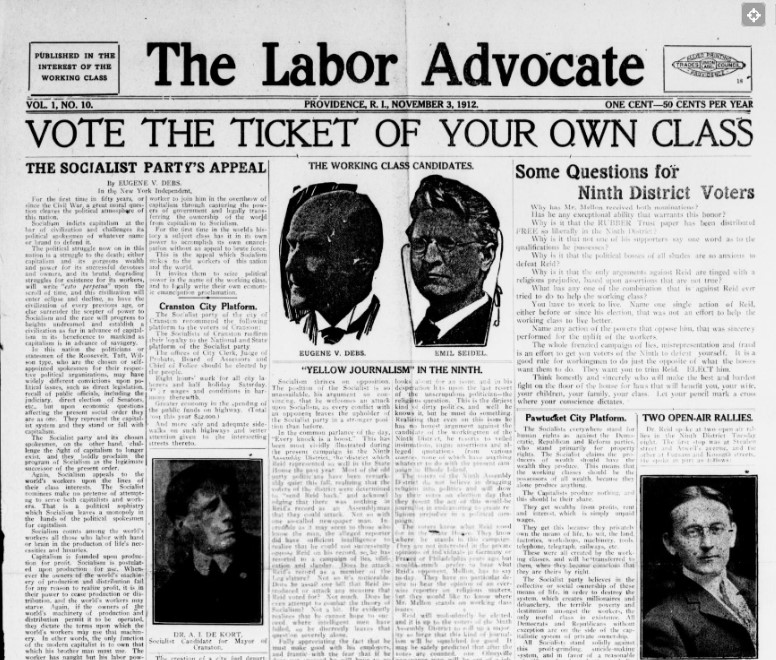
The Labor Advocate
Published by the Socialist Party of Rhode Island with an initial office at 50 Verndale Avenue in Providence, the Labor Advocate had a clear agenda and appeared at an important time in Rhode Island and American labor history. It was a self-declared “strictly union paper” and was even “printed and published by Union Labor.”
The first issue also reported on the “Lawrence Strike” in nearby Massachusetts, which involved approximately 27,000, mostly immigrant, textile workers. Led by the Industrial Workers of the World (IWW), the violent but ultimately successful strike began January 12 and ended March 14 of that year and was known as the Strike of Bread and Roses
The newspaper began a tally list of labor strikes by state and of “8-hour victories,” as reduced working day was a major labor touchstone. In Providence, workers were striking at Brown and Sharpe Manufacturing, the world’s largest tool company. The newspaper ran open condemnations of housing conditions for mill workers in Rhode Island and throughout the country.
Platforms of the Socialist Party of Rhode Island and the national party, as well as world news of socialist politics and politicians, were featured in each issue. Much coverage was given to Eugene V. Debs who won almost one million votes in the 1912 presidential election. More merchant advertisements started to appear as time progressed, and the newspaper gained popularity. Also advertised were events to benefit and organize the Socialist Party of Rhode Island. such as excursions and picnics. It soon added a “Social Forms and Entertainments” column, which was run next to articles criticizing wealthy families like the Vanderbilts for throwing lavish, expensive parties.
In 1913, the Labor Advocate started to run listings of local branches of the Socialist Party of Rhode Island. The different ethnic groups each had their own meeting, so there was one for the English, French, German, Jewish, and Polish. By 1915, Finnish, Swedish, Bohemian, Russian, Belgian, and Portuguese branches were added.
George H. Walsh was the sole proprietor in 1912, and Robert F. Hunt was eventually listed as editor. The office was at 26 Custom House Street. The next year Helen K. Dougherty and James P. Reid were added as associate editors. The newspaper was taken over or replaced by the Labor World which was published in Woonsocket starting October 16, 1915 with Joseph E. Kucher as managing editor.
"Published by the Socialist Party of Rhode Island the Labor Advocate . . . was a self-declared “strictly union paper” and was even “printed and published by Union Labor.”

The Labor Argus
"Official organ of the Socialist Party." - Merged with: Socialist and labor star (Huntington, W. Va.), to form: The Argus-star (non-extant). Beginning publication in the spring of 1906, the Charleston [West Virginia] Labor Argus offered organized labor a platform in West Virginia’s public affairs. Published by Frank Snyder, the Argus hoped to foster “more cordial relations between employee and employer, rather than to foment discord between these two classes.” Published weekly, the paper fluctuated in size over the span of its existence, although it usually comprised four to six pages.
Labor issues dominated the Labor Argus‘ columns. Snyder strongly supported the United Mine Workers of America, and the Argus kept readers abreast of union news. Moreover, as Frederick Barkey’s Working Class Radicals: The Socialist Party in West Virginia illuminates, the Argus owned a political independent streak. The newspaper bypassed Republican and Democratic rhetoric and supported laborers’ attempts to organize themselves politically. The Argus proved critical of mine owners, the oppressive mine “guard” system, and those who failed to condemn violent or unsafe labor practices. For just this reason, the Argus occasionally feuded with the Charleston News and Mail and refused to back the candidacy of Republican Howard Taft in the 1908 presidential election, instead supporting Democrat William Jennings Bryan. Beyond labor issues, the Argus also covered national news and during its first year devoted significant space to literary pieces as well.
In 1911, the paper came under the leadership of new editor Charles H. Boswell and the Socialist Party. Promising to remold the Labor Argus into a “red hot radical revolutionary rag,” the paper shifted its political center further left and fully embraced socialism and the Socialist Party. Similar to other Socialist papers, the Argus often ran articles exploring the tenets of socialism, socialism’s relationship with religion, and the platform of the Socialist Party. The revamped Labor Argus continued its hardline support of laborers; the Argus criticized the first settlement of the Paint Creek labor strike in 1913, despite both the governor’s and United Mine Workers’ support for the deal. This criticism led to a search of the Argus‘ Charleston office by state authorities in April 1913 and a temporary confiscation of its equipment.
Despite the setback, however, the Charleston Labor Argus continued publication for another year and half. At the start of 1915, recognizing their mutual readership, the Charleston Labor Argus merged with the Socialist Labor Star of Huntington, West Virginia, to form the Argus Star with offices in both Charleston and Huntington.
Provided By: West Virginia University
Charleston Socialist Party Paper

The Labor Enquirer
Throughout its run, the unapologetically socialist Enquirer acted as the official organ of the Knights of Labor, Denver Assembly 89, which for a time published its Preamble and Declaration of Principles in every issue. The paper also was the organ of the Rocky Mountain League and the Union Labor Party of Colorado. The publishers themselves were deeply involved and active in the labor movement and Socialist politics. Buchanan was one of the five national committee men of the Knights of Labor, president of the local Trades Assembly and the Workingmen's County Convention, and a member of the Denver Typographical Union. Laverty was an executive committee member and the secretary-treasurer of the Denver Typographical Union and served on the executive committee of the Trades Assembly.
Denver Colorado labor socialist paper

The Labor Herald
Established by the Knights of Labor, the Labor Herald began publication on September 15, 1885, in Richmond, Virginia. The Herald's primary purpose was to inform working people of the goals and objectives of the Knights of Labor. Articles in described the plight of women, labor struggles in Richmond and other areas of the country, and national and local politics and the newspaper sought to educate the working people of the demands and tools of union organization against the interests of banks and corporations. The four-page, large-format paper (21" by 27¾") sold for five cents a copy and the subscription rate was one dollar a year.
Richmond, Virginia Knights of Labor Newspaper

The Labor Journal
official paper of the Everett Trades Council, the Central Labor Council of Everett, and the local chapter of the American Federation of Labor (AFL). Originally published in 1891 as an annual newsletter, the Labor Journal quickly became the vehicle for Progressive politics and labor news in Everett and the surrounding region.
Everett Washington labor paper

The Labor Review
"A complete weekly newspaper serving the interest of labor in the Williamson field."
Williamson WV labor paper

The Labor Standard
Began in 1908.- "A publication especially intended for the bread-winner and his family." - "An advocate of the principles of organized labor."
- Published in regional editions for: New Haven, Bridgeport, New Britain, Waterbury, Danbury, Meriden, Middletown, Derby, Ansonia, Norwalk, Torrington, Stamford, . Special editions issued at intervals for other cities, -
Connecticut labor paper
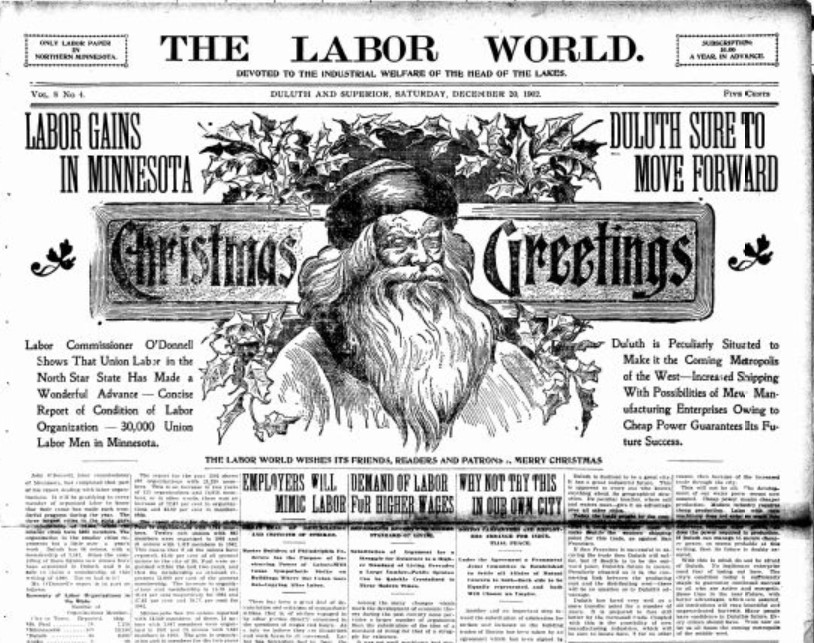
The Labor World
The Duluth Labor World stated in its founding issue on April 11, 1896, that the paper "will pat no one on the back to gain patronage or support. The labor question will be handled without gloves by the Labor World, and if need be with knife in hand." These strong words were penned by founding editor, Sabrie Akin, a self-described socialist, who would fight for the cause of working men and women in support of labor unions throughout her life.
Akin’s brother, Roy Goodwin, was instrumental in arranging for a January 6, 1896 Duluth visit and speech by Eugene V. Debs, a fellow socialist made famous for his involvement in the Pullman strike of 1894 and his subsequent prison term. Shortly after seeing Debs speak, Akin announced her intention to create a publication that focused on labor issues. Less than a year later Akin would make good on her promise.
The first incarnation of the Labor World was published as a biweekly 20-page publication in magazine form. In the spring of 1897, Akin purchased and consolidated three local news publications: the Virginia Hustler and Mountain Iron Manitou, the Duluth Citizen, and the Duluth Press. After these additions, the Labor World was published weekly as a four-page tabloid. The official motto of the paper was "Thou shalt love thy neighbor as thyself." --from https://www.mnhs.org/newspapers/hub/labor-world
labor and socialist newspaper from Minnesota
Museum/Exhibits
Tours
Maps
Digital Projects
Organizations
Sites
Film/Video
Audio/Interview
Podcast/Program
Text/Document
Image
Graphs/Data
Timeline
Southwest
West
Midwest
Southeast
Northeast
Mexico
Canada
Global
Books
Teaching
Lectures
Digital Archives
Journals
Bibliographies
Topic Intro