


Collections
Library
Type
Region
Coverage:
-
Published:
-
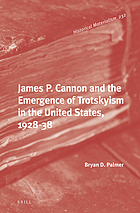
Bryan D. Palmer
"Bryan D. Palmer reinterprets the history of labour and the left in the United States during the 1930s through a discussion of the emergence of Trotskyism in the most advanced capitalist country in the world. Focussing on James P. Cannon, the founder of American Trotskyism, Palmer builds on his previously published and award-winning book, James P. Cannon and the Emergence of the American Revolutionary Left, 1890-1928 (2007), with a deeply-researched and elegantly-written study of Cannon and the Trotskyist movement in the United States from 1928-38. Situating this dissident communist movement within the history of class struggle, both national and international, Palmer examines how Cannon and others fought to revive a combative trade unionism, thwart fascism and the drift to war, refuse Stalinism's many degenerations, and build a new Party and a new International, both of which would be dedicating to reviving and realizing the possibilities of revolutionary socialism. The result is a study that provides a definitive account of the largest and most influential Trotskyist movement in the world in the 1930s, a mobilization whose history recasts understandings of the more extensively-studied experience of United States working-class militancy and the place of the Comintern-affiliated Communist Party within it"-- Provided by publisher
reinterprets the history of labour and the left in the United States through a discussion of the emergence of Trotskyism in the most advanced capitalist country in the world, focussing on James P. Cannon
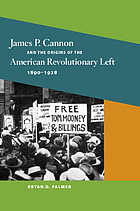
Bryan D. Palmer
A study of James P Cannon's early years (1890-1928) that details how the life of a Wobbly hobo agitator gave way to leadership in the emerging communist underground of the 1919 era.
details how the life of James P. Cannon gave way to leadership in the emerging communist underground of the 1919 era.
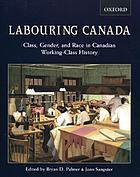
Bryan D. Palmer
Part I: Aboriginal Peoples and Class Formation [Native peoples, First Nations, Indians]
Carolyn Podruchny: Unfair Masters and Rascally Servants: Relations Among Bourgeois, Clerks, and Voyageurs in the Montreal Fur Trade
John Lutz: After the Fur Trade: The Aboriginal Labouring Class of British Columbia, 1849-1900
Part II: Immigrant Settlers and the Tensions of Class Formation
Bonnie Huskins: From Haute Cuisine to Ox Roasts: Feasting and the Negotiation of Class in Mid-19th Century Saint John and Halifax
Ruth Bleasdale: Class Conflict on the Canals of Upper Canada in the 1840s
Part III: Industrializing Canada: Waged Work, Everyday Life, and Class Mobilization, 1860-1900
Bettina Bradbury: Gender at Work at Home: Family Decisions, The Labour Market, and Girls' Contributions to the Family Economy
Christina Burr: 'The Other Side': The Rhetoric of Labour Reform. Gregory S. Kealey and Bryan D. Palmer: The Bonds of Unity: The Knights of Labor in Ontario, 1880-1900
Part IV: Radicals and Union Struggles in Industrializing Canada
Mark Leier: Rallying Round the Standard in British Columbia
Craig Heron: The Workers' Revolt
Janice Newton: The Plight of the Working Girl
Part V: Capitalist Canada Consolidated and the weight of Special Oppression, 1880-1939
Sarah-Jane (Saje) Mathieu: North of the Colour Line: Sleeping Car Porters and the Battle Against Jim Crow on Canadian Rails, 1880-1920
Andrew Parnaby: 'The best men that ever worked the lumber': Aboriginal Longshoremen on Burrard Inlet, 1863-1939
Part VI: The Depression Decade
John Manley: 'starve, Be Damned!': Communists and Canada's Urban Unemployed
Denyse Baillargeon: Working for Pay and Managing the Household Finances
Part VII: Workplace and Welfare, 1920-1960
Joan Sangster: The Softball Solution: Female Workers, Male Managers, and the Operation of Paternalism at Westclox, 1923-1960. Carmela Patrias: Race, Employment Discrimination, and State Complicity in Wartime Canada, 1939-1945
Peter McInnis: Teamwork for Harmony: Labour-Management Production Committees and the Post-War Settlement in Canada
Part VIII: Managing the Marginal
Robert Campbell: Managing the Marginal: Regulating and Negotiating Decency in Vancouver's Beer Parlours
Becki L. Ross: Bumping and Grinding on the Line: Making Nudity Pay
Part IX: The Changing Face of Class Struggle in the Post-War Period
Magdalena Fahrni: Parents, Pupils, and the Montreal Teachers' Strike of 1949
Pamela Sugiman: Becoming Union Wise, 1950-1963
Alvin Finkel: Trade Unions and the Welfare State in Canada, 1945-1990
Part X: The 1960s and the Legacies of Conflict
Bryan D. Palmer: Wildcat Workers in the 1960s: The Unruly Face of Class Struggle. Ralph P. Guntzel: The Quebec Labour Movement and Quebec Sovereigntism, 1960-2000
Sedef Arat-Koç: From 'Mothers of the Nation' to Migrant Workers
Part XI: The State of the Unions
Leo Panitch and Donald Swartz: Towards Permanent Exceptionalism: Coercion and Consent in Canadian Industrial Relations
David Camfield: Neoliberalism and Working-Class Resistance in British Columiba: The Hospital Employees' Union Struggle, 2002-2004
Nadita Rani Sharma: Race, Class and the Making of Difference: The Social Organization of 'Migrant Workers' in Canada
a collection of classic and contemporary articles exploring the nature of work in Canadian history.
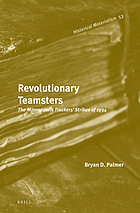
Bryan D. Palmer
Can workers win? Bryan D. Palmer presents a detailed account of the Minneapolis teamsters' strikes of 1934 to suggest that working-class victories are possible, however bad the circumstances.
Can workers win? Bryan D. Palmer presents a detailed account of the Minneapolis teamsters' strikes of 1934 to suggest that working-class victories are possible, however bad the circumstances.

Bryan D. Palmer
details the fight against the BC Social Credit "restraint" program. IN 1983 "a Social Credit government led by Bill Bennett introduced 26 pieces of legislation that dismantled collective bargaining rights in the public sector and gutted provisioning in health care, welfare, and an array of social services. This 1983 assault, done in the name of downsizing government and implementing fiscal restraint, followed a political playbook drafted by the architect of neoliberalism, Chicago School economist, Milton Friedman.British Columbians of all kinds rallied in opposition. They waged a 130-day campaign to force the provincial government to rescind the entire legislative package. Huge rallies in Vancouver and Victoria, occupations of government offices and institutions like the Tranquille mental health facility in Kamloops (scheduled to be shuttered by the government), nightly meetings, and publication of a weekly newspaper, Solidarity Times, left no doubt as to the agitated state of the west coast."
details the fight against the BC Social Credit "restraint" program.
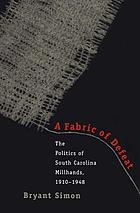
Bryant Simon
Bryant Simon brings to life the politics of white South Carolina millhands during the first half of the twentieth century. His revealing and moving account explores how this group of southern laborers though about and participated in politics and public power. -- back cover
brings to life the politics of white South Carolina millhands during the first half of the twentieth century.

Bryant Simon
In 1979, on the day after Labor Day, a chicken processing factory in Hamlet, North Carolina, burst into flames. The blaze immediately created a wall of heat and split the factory in half. Twenty-five people--eighteen of whom were women, twelve of whom were black--perished behind the plant's bolted doors. In previous decades, Hamlet had thrived thanks to the railroad. But by the 1970s, it was a postindustrial backwater, a magnet for businesses searching for cheap labor and little oversight. One of these businesses was Imperial Food Products, which paid its workers a dollar above the nation's paltry minimum wage--then $4.25 an hour--to scrape gobs of fat off frozen chicken breasts before they were battered and fried into golden-brown tenders. If a worker complained about the pace of the line or missed a shift to take care of children or went to the bathroom too often they were fired. But workers kept quiet and kept coming back because jobs were scarce. Eighty years after the Triangle Shirtwaist Factory fire, industrial disasters were supposed to have been a thing of the past. After spending several years talking to local residents, state officials, and survivors of the fire, award-winning historian Bryant Simon has written a vivid, potent, and gripping work of narrative nonfiction .... The Hamlet Fire is a disturbing social autopsy of a town, a nation, and a time that shows how cheap labor, cheap government, and cheap food came together in a way that was bound for tragedy."--Jacket
Hamlet, North Carolina disaster
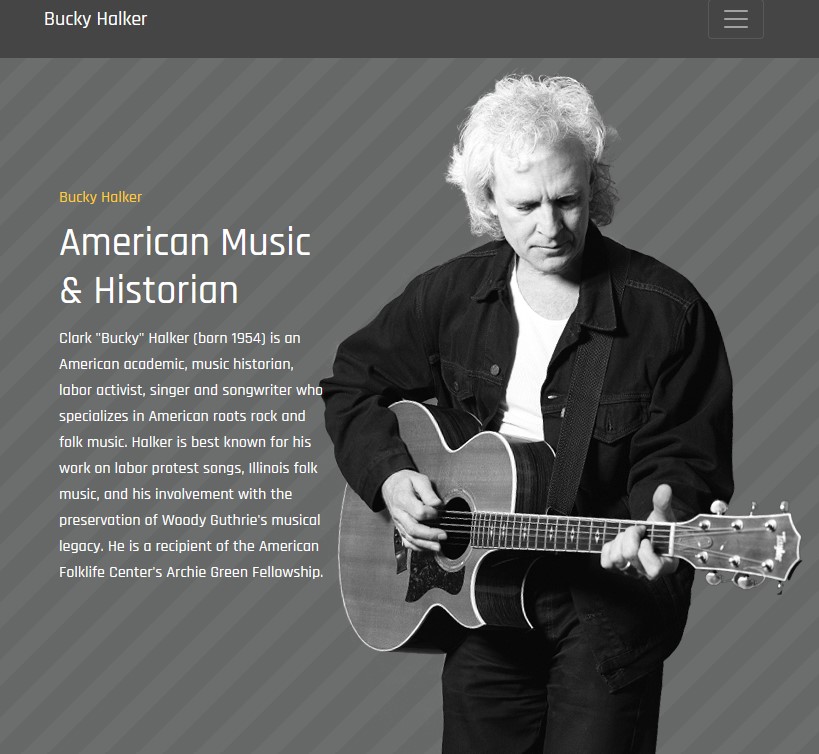
Bucky Halker
Clark "Bucky" Halker (born 1954) is an American academic, music historian, labor activist, singer and songwriter who specializes in American roots rock and folk music. Halker is best known for his work on labor protest songs, Illinois folk music, and his involvement with the preservation of Woody Guthrie's musical legacy. He is a recipient of the American Folklife Center's Archie Green Fellowship.
Halker is best known for his work on labor protest songs, Illinois folk music, and his involvement with the preservation of Woody Guthrie's musical legacy.
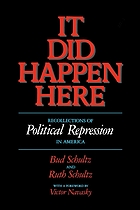
Bud Schultz
In this moving book, two skilled oral historians collect the words of Americans who have been victims of political repression in their own country. Disturbing and provocative, It Did Happen Here is must-reading for everyone who cares about protecting the rights and liberties upon which this country has been built
Contents; Preface;
Foreword; PART I: The Commandments of Repression;
Introduction to Part I; Thou Shall Not Speak; Thou Shall Not Sing; Thou Shall Not Teach; Thou Shall Not Preach; Thou Shall Not Resist;
PART II: The Method to the Madness;
Introduction to Part II; Outlawing Dissent: Trials of Heresy;
The Congressional Inquisition; The Compulsion of Loyalty; Criminalization of Dissent: The Frame-Up;
PART III: The Face of a Police State;
Introduction to Part III; Police Unleashed; Secret Police: American as Apple Pie; The American Experience with Concentration Camps
two skilled oral historians collect the words of Americans who have been victims of political repression in their own country.
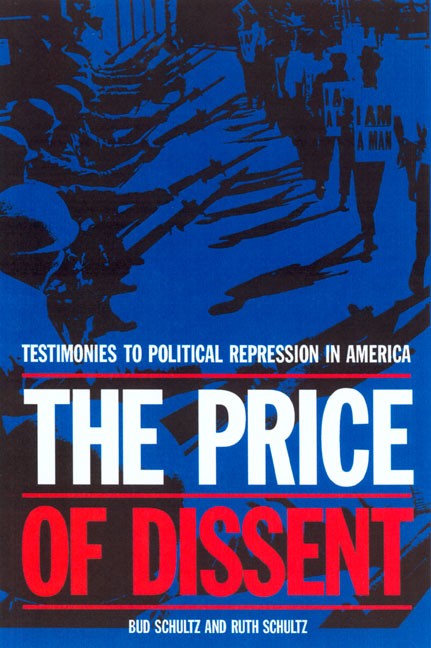
Bud Schultz
Focuses on the activists in three of the "most dramatic, sustained" social movements of the twentieth century: the labor, civil rights, and antiwar movements. Provides an overview and brief history of each of these movements. Activists in each of these movements recall the courage needed to stand up to resistance from the police and the government (from the FBI to Congress and the White House), and the struggle to overcome violence and accusations of treachery and subversion
Focuses on the activists in the labor, civil rights, and antiwar movements.

Bureau of Labor Statistics, History Matters
A number of states established bureaus of labor during the Gilded Age to investigate working and living conditions among industrial workers. In the first half of the 19th century, some moral reformers had believed that the new Lowell mills would be a place of educational and moral uplift for women workers. But by the late 19th century, many worried that factories were breeding grounds for prostitution and other forms of “degenerate” behavior. As a result, investigations about working women often focused obsessively on the question of morality. This excerpt from the 1884 Fifteenth Annual Report of the Massachusetts Bureau of Labor Statistics presented bureau head Carroll Wright’s assessment of the working and living conditions of the young working women of Boston. To secure first-hand information, the agency interviewed 1,000 female workers on subjects ranging from their relations with employers to their after-hours activities.
An excerpt from the 1884 Fifteenth Annual Report of the Massachusetts Bureau of Labor Statistics which details a perspective on the working and living conditions of the young working women of Boston.
Butler Center for Arkansas Studies, Central Arkansas Library System
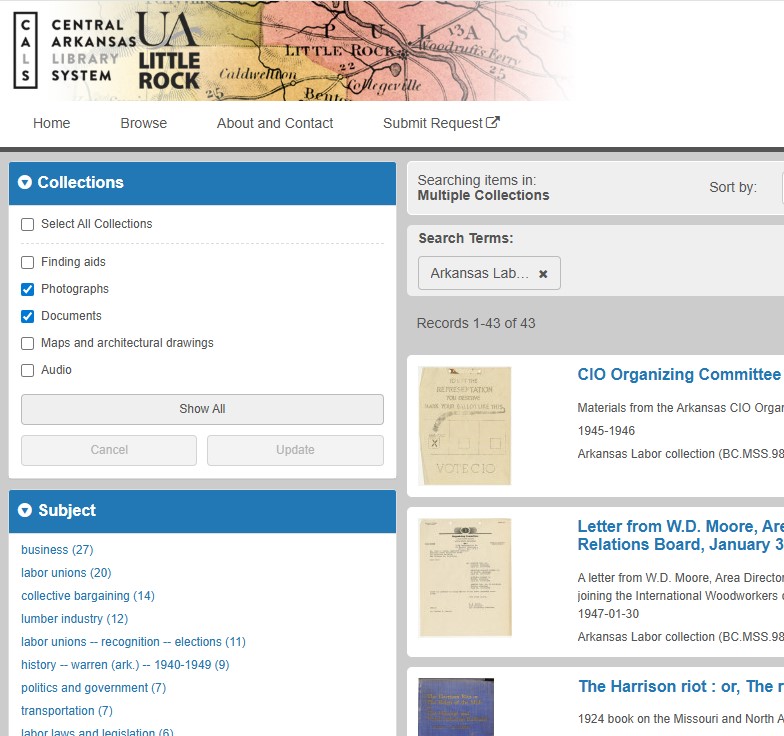
The middle of the twentieth century was a time of explosive growth for American industry and a test of strength for the nation’s labor movement. For most of this period, the economy of Arkansas was directly tied to the cotton crop. Not until the defense industry boom of World War II, would industry begin to outpace agriculture. By gathering a variety of materials from the collections of the Central Arkansas Library System’s Butler Center for Arkansas Studies on the Arkansas labor movement, this project aims to capture a formative moment in the struggle of Arkansas workers for dignity, security, and basic democratic rights. This digital project has interactive elements and sound. Be sure to click through each element and turn up the volume to get the entire experience.
43 items from Central Arkansas library system, including photos and documents covering Arkansas' industry, agriculture, and labor in the early-to-mid 20th century

Butler County Press
The Butler County Press was established at the turn of the twentieth century in southwest Ohio by Edward E. Weiss and John F. Mayer as “the official organ of organized labor of Hamilton and vicinity.” Weiss and Mayer also involved themselves in the operations of its printer, Nonpareil Printing Company, and were known for fair, community-minded attitudes that kept the loyalty of their readers. Although they claimed no responsibility for the perspectives published in the paper, which they often sourced from other cities, the editors of the Butler County Press favored lighthearted material about everyday people. The final page of each issue was reserved for local business advertisements beneath the banner, “Patronize Hamilton Industries.” This page also featured a roster of nearby unions with instructions on when and where interested workers could join their meetings.
Hamilton and the surrounding Butler County hosted a range of manufacturers, including textiles and machinery, that made the area receptive to unionization. Rather than finding sponsorship with any particular industries or union groups, the Butler County Press was endorsed by the Trades and Labor Council of Hamilton, Ohio, which represented the interests of all working-class folk in the area. According to the newspaper, one of the major union ideals was “to allow the laboring men to live like Americans,” a sentiment that extended outside the workplace and into the community.
As the only newspaper publishing labor interests in the county at the time, the Butler County Press reliably produced at least four pages every Friday. On or near Labor Day, it released an extended issue that celebrated national success in labor movements and urged readers to support local business. Although the news content featured primarily national stories, the ad content was strictly local. In the wake of the devastating flood that demolished parts of the Miami Valley in 1913, shoe warehouses reassured that “not a pair of water-soaked or flood-damaged shoes” were in stock—a notice only appreciable by the residents of the area. The Butler County Press adopted more entertaining content by adding photographs to its news stories and including amusing cartoons. Perhaps due to the paper’s lack of competition and appeal to toilers of every trade, the paper retained its title throughout its lifespan between 1900 and 1946, when it appears to have concluded with a final Labor Day special.
A digital collection of “the official organ of organized labor of Hamilton and vicinity.”
Butte Labor History Center
Mission statement: The Butte Labor History Center provides education and information to the public about the internationally significant labor movement in and around Butte, Montana, with a focus on the 1878-1932 time period. We are not an advocacy organization.
The Butte Labor History Center commemorates the internationally significant labor story in Butte, Montana, The Richest Hill On Earth.
Butte Labor History Center
Miners Union Hall Memorial
Anaconda Company Pay Office
Anaconda Road Massacre
Finlander Hall
Frank Little's Abduction
Frank Little's grave
Granite Mountain Memorial
Butte Strike Bulletin
Women's Protective Union
Hennessey Building
Carpenters Union Hall
Socialist Hall
Berkeley Pit
Silver Bow County Court House
Original Mine
Steward Mine
Mountain Con Mine
Anselmo Mine
Orphan Girl Mine
Bluebird Mill site
Butte Archives
World Museum of Mining
Hard Rock Miner sculpture
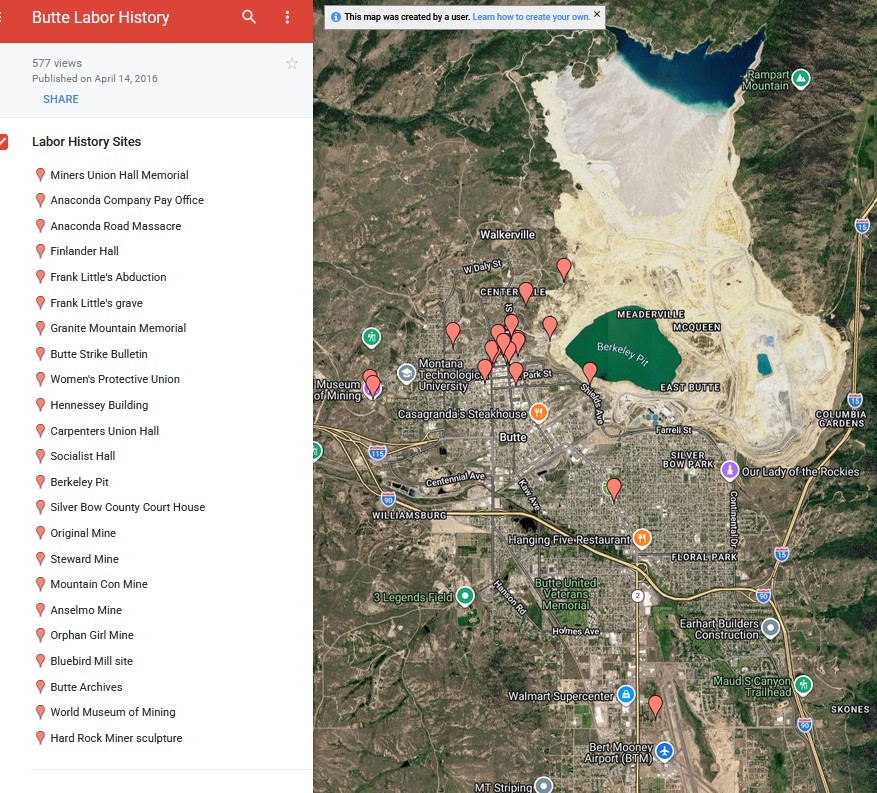
18 sites on a google map platform, of Butte Montana Labor History
C-SPAN
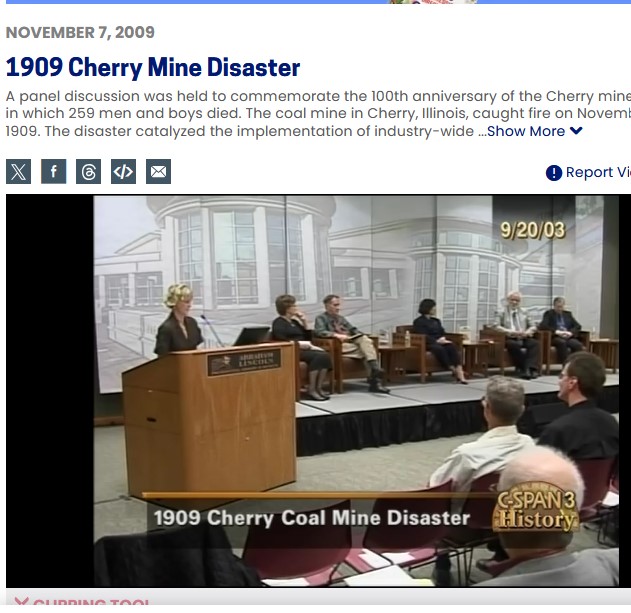
A panel discussion was held to commemorate the 100th anniversary of the Cherry mine disaster in which 259 men and boys died. The coal mine in Cherry, Illinois, caught fire on November 13, 1909. The disaster catalyzed the implementation of industry-wide mine safety regulations and a liability act that later became the Illinois Workmen’s Compensation Act. After each author presented his perspective on the tragedy, they responded to questions from members of the audience.
The panelists were: Dean Cotton and Lorena Galletti Cotton, authors of Oneness: Angiolina, The 1909 Cherry Mine Disaster (AuthorHouse; September 29, 2004); Karen Tintori, author of Trapped: The 1909 Cherry Mine Disaster (Atria; September 1, 2002); Steve Stout, author of Black Damp: The Story of the Cherry Mining Disaster (Utica House Publishing; 1993); and Ronald Bluemer, author of Fire Below (Grand Village Press; January 1, 2007).
A recorded panel discussion over the 1909 Cherry Mine Disaster.
CARLI Digital Collections
Daily Life Along the Chicago, Burlington & Quincy Railroad is part of the Chicago, Burlington & Quincy Railroad Company Archives held at the Newberry Library. The CB&Q Archives (ca. 5,000 cubic feet) mainly document the 19th-century operations of the Burlington and its component roads. Beyond their significance for the study of nineteenth century railroad history and labor history, the archives are a relatively unexplored and valuable resource for those interested in topics related to the social and economic development of the region served by the CB&Q.
This digital collection contains a selection of three thousand unique negative images shot by Esther Bubley and Russell Lee, focusing on Illinois scenes, the railroad, and its workers.
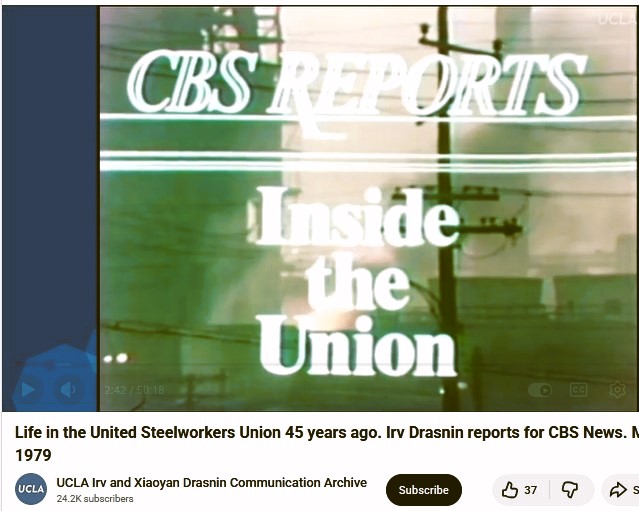
CBS Reports
At the heart of the documentary is the debate over the right of union members to ratify contracts—a demand passionately pushed by Local 1010. The leadership, led by figures like Lloyd McBride, opposes this demand, arguing that allowing the entire membership to vote on contracts would weaken the union's bargaining position and could lead to divisiveness. The leadership's stance reflects a broader strategy of maintaining centralized control over decision-making processes, which they believe is necessary to preserve the union's strength and unity.
The documentary also highlights the dissatisfaction among many delegates with the way the union's leadership manages the convention. The manipulation of procedures, such as the denial of a roll-call vote that would have transparently recorded each delegate's position on crucial issues, is portrayed as an undemocratic move designed to suppress dissent and maintain the status quo. These tactics underscore the deep divide between the leadership, who are focused on maintaining their power, and the rank-and-file members, who are increasingly demanding more say in the union's decisions.
Despite the setbacks faced by reformers like those in Local 1010, the film acknowledges the progress they have made in challenging the entrenched power of the leadership. The documentary suggests that while the union's leadership has become more resistant to change, the growing push for greater democracy and transparency within the union cannot be easily ignored.
"Inside the Union" ultimately situates these internal struggles within the larger context of the American labor movement, which is depicted as being at a crossroads. The film raises important questions about the future of organized labor, particularly the need for unions to genuinely represent and engage their members in an era of increasing economic and social challenges. Through its portrayal of the Steelworkers' convention, the documentary provides a vivid illustration of the complexities and contradictions that have long characterized the labor movement in the United States.
Working conditions, including harsh safety conditions, at the Inlan Steel Plant, and dissent in the United Steelworkers
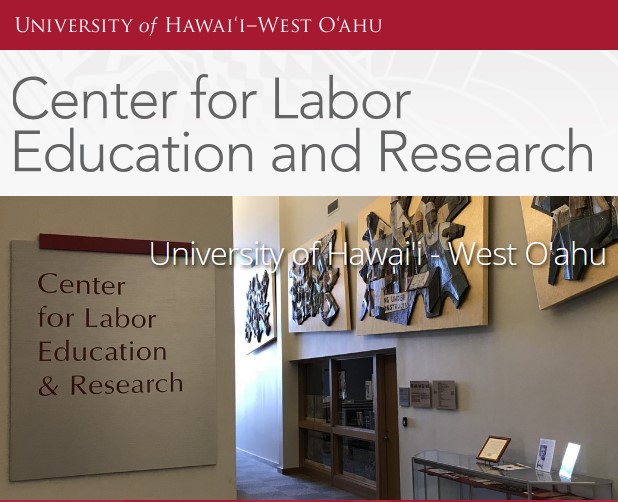
CLEAR
In addition to our traditional labor law library and labor history archive containing books, files and materials for use at the Center, we are engaged in an ongoing program to preserve and digitize holdings for on line access. This eLibrary of resources is a 'work in progress' and it is our hope will be enlarged as time and money permits.
The Aloha Trade
The Aloha Trade: Hawaii's Hotel Industry, 1941-1987 by Bernard W. Stern (Honolulu: University of Hawai‘i, Center for Labor Education & Research, 1989).
Aupuni i Lā'au
Aupuni i Lā'au: A History of Hawai'i's Carpenters Union Local 745 by Edward D. Beechert (Honolulu: University of Hawai‘i, Center for Labor Education & Research, 1993)
The Hilo Massacre
The Hilo Massacre: Hawaii's Bloody Monday, August 1st, 1938 (Honolulu: University of Hawai‘i, Center for Labor Education & Research, 1988).
Honolulu Record
A newspaper published from 1948 through 1958, consisting of ten volumes and 5,056 pages of text; a chronicle of the worker perspective and labor movement in Hawaiʻi. [WIP]
Rutledge Unionism
Rutledge Unionism: Labor Relations in the Honolulu Transit Industry by Bernard W. Stern (Honolulu: University of Hawai‘i, Center for Labor Education & Research, 1986).
CLEAR Guide to
Hawaiʻi Labor History
PDF downloadable version of CLEAR Guide to Hawaiʻi Labor History by William J. Puette (Kapolei: University of Hawai‘i - West Oʻahu, Center for Labor Education & Research, 2018).
This eLibrary of resources is a 'work in progress' and it is our hope will be enlarged as time and money permits.
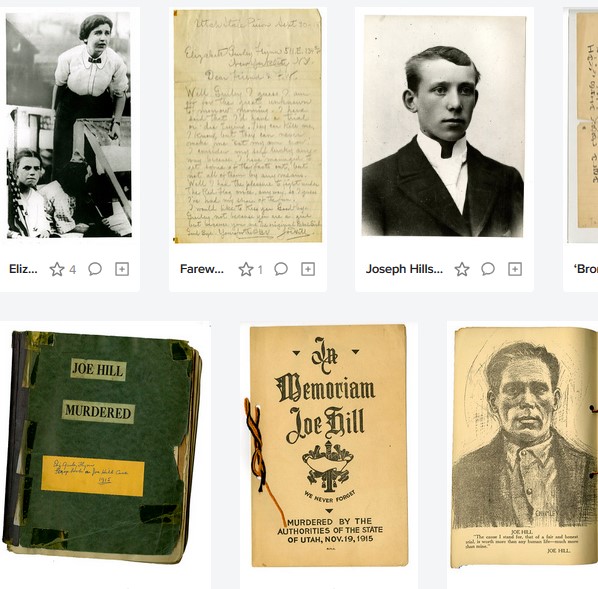
CPUSA
a flickr set of images and documents of 3 major figures in the early CP and IWW
IWW, Joe Hill, Elizabeth Gurley Flynn, William Z. Foster

CSU Dominguez Hills
This collection includes photographs and documents from the Tradeswomen Archives Project, which helps document the growth of the number of women working in construction and other non-traditional fields in Southern California, nationally, and around the world. The Project comprises both traditional physical archives, which are housed at CSU Dominguez Hills, and a digital archive consisting of virtual donations received through a web portal. The physical archive comprises a number of collections created by women who worked in the building trades for years, including those of Dr. Vivian Price, Dr. Lynn Shaw, Jane Templin, Pat Williams, and the Oregon Tradewomen, Inc. The digital archive consists of materials sent by dozens of donors. The images include photographs and other materials related to tradeswomen education and training apprenticeship programs; tradeswomen organizations such as Women In Non-Traditional Employment Roles (WINTER), Electric Women, and others; women constructing the Century Freeway in Los Angeles, as well as working at other sites in Los Angeles, Las Vegas, and abroad; and policies such as Affirmative Action for women. There are also materials related to studies, dissertations, and documentary films on tradeswomen.
752 images from the Tradeswomen Archives Project, which documents the number of women working in construction and other non-traditional fields in Southern California
Caitlin Rosenthal
Accounting for Slavery offers a history of business and management practices on slave plantations in the British West Indies and the American South, covering the century from approximately 1780-1880. Far from lagging behind Northern manufacturers, the most sophisticated Southern planters used complex management techniques, measuring and monitoring their human capital with precision. More broadly, the book explores the complex relationship between slavery and capitalism in American history. The traditional story of modern management focuses on the factories of England and New England, largely ignoring plantation economies. Drawing on extensive archival research into plantation accounting practices, the author argues that the harsh realities of slavery were compatible with a highly quantitative, calculating style of management. Planters allocated and reallocated slaves' labor from task to task, precisely monitored their productivity, and depreciated their "human capital" decades before depreciation became a common accounting technique.
Planters allocated and reallocated slaves' labor from task to task, precisely monitored their productivity, and depreciated their "human capital" decades before depreciation became a common accounting technique.
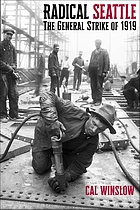
Cal Winslow
The book is the first, complete account of the General Strike of Seattle, when in February 1919, 110 local unions shut down the entire city of Seattle, Washington. For five days, workers from all trades and sectors - streetcar drivers, telephone operators, musicians, miners, loggers, shipyard workers - fed the people, ensured that babies had milk, that the sick were cared for. This had never happened before in the United States and has not happened since. Cal Winslow explains why.
the first, complete account of the General Strike of Seattle.
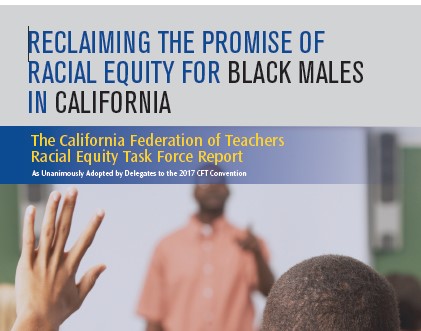
Calfiornia Federation of Labor
“Reclaiming the Promise of Racial Equity in Education, Economics and Our Criminal Justice System,” was adopted by the American Federation of Teachers executive council
in the fall of 2015. It established a broad framework of approaches to address the inequities facing Black males of all ages, with an understanding that it would be up to
state federations and local unions to decide the specific implementation steps needed in their respective states and cities.
A presentation by the California Federation of Teachers sharing their 2017 Racial Equity Task Force Report.
California Federation of Teachers
A long film on the history of labor in California.Consider pairing this teaching film with the CFT's free resources for educators, which can be found and perused at this link: https://www.cft.org/curricula.
The first disc of a highly awarded CFT-produced film series introducing students, union members, and members of the public to the basics of California Labor History from the Gold Rush to now.
Museum/Exhibits
Tours
Maps
Digital Projects
Organizations
Sites
Film/Video
Audio/Interview
Podcast/Program
Text/Document
Image
Graphs/Data
Timeline
Southwest
West
Midwest
Southeast
Northeast
Mexico
Canada
Global
Books
Teaching
Lectures
Digital Archives
Journals
Bibliographies
Topic Intro