


Explore thousands of items. Use clickable links under collections and library for broad categories. Search by keyword (including topic,city, state.) Limit by time period, type of item, region. See our search tips page for more assistance.
Collections
Library
Type
Region
Coverage:
-
Published:
-

Timothy J. Lombardo
University of Pennsylvania Press (2018)
Blue-Collar Conservatism examines the blue-collar, white supporters of Frank Rizzo--Philadelphia's police commissioner turned mayor--and shows how the intersection of law enforcement and urban politics created one of the least understood but most consequential political developments in recent American history
he blue-collar, white supporters of Frank Rizzo

Timothy J. Minchin
University of Georgia Press (2021)
America's Other Automakers provides an interpretive history of foreign-owned automotive plants in mostly Southern states. The transplant industry's growth occurred in waves; the Japanese arrived first in the 1980s, followed by luxury German car-makers in the 1990s, and Korean manufacturers after 2000s. Choosing early examples from each wave, America's Other Automakers looks at foundational factories that paved the way for other automakers, especially from the same country, to follow. Through an archive of articles, statements issued by local government officials, failure of unionizing efforts, reports of discriminatory hiring and other primary sources, Minchin critically engages seven case studies of seven large assembly facilities and their impact on the communities they were built in"-- Provided by publisher
provides an interpretive history of foreign-owned automotive plants in mostly Southern states.

Timothy J. Minchin
The University of North Carolina Press (2017)
From the Reagan years to the present, the labour movement has faced a profoundly hostile climate. As America's largest labour federation, the AFL-CIO was forced to reckon with severe political and economic headwinds. Yet the AFL-CIO survived, consistently fighting for programs that benefited millions of Americans, including social security, unemployment insurance, the minimum wage, and universal health care. With a membership of more than 13 million, it was also able to launch the largest labour march in American history, 1981's Solidarity Day, and to play an important role in politics. In a history that spans from 1979 to the present, Timothy J. Minchin tells a sweeping, national story of how the AFL-CIO sustained itself and remained a significant voice in spite of its powerful enemies and internal constraints
sweeping, national story of how the AFL-CIO sustained itself

Timothy J. Minchin
The University of North Carolina Press (2001)
Using previously-untapped legal records and oral history interviews, this work provides an in-depth account of the struggle to integrate the southern paper mills in the United States over the period 1945-80. Jobs were strictly segregated till the 1960s with black workers in menial positions.
provides an in-depth account of the struggle to integrate the southern paper mills in the United States.

Timothy Messer-Kruse
Palgrave McMillan (2011)
The Trial of the Haymarket Anarchists is the culmination of seven years of research into the 1886 Haymarket bombing and subsequent trial. It not only overturns the prevailing consensus on this event, it documents in detail how the basic facts, as far as they can be determined, have been distorted, obscured, or suppressed for seventy years. Based on both a reexamination of well-known sources and the discovery of many new ones, Timothy Messer-Kruse demonstrates that the received wisdom regarding Chicago's anarchist leaders--that they were tried and convicted for their ideas in a trial in which little evidence of their guilt was presented--is absolutely false"--Provided by publisher
argues the trial for the Haymarket martyrs was fair

Timothy P Bowman
Texas A&M University Press (2016)
Blood Oranges traces the origins and legacy of racial differences between Anglo Americans and ethnic Mexicans (Mexican nationals and Mexican Americans) in the South Texas borderlands in the twentieth century. Author Tim Bowman uncovers a complex web of historical circumstances that caused ethnic Mexicans in the region to rank among the poorest, least educated, and unhealthiest demographic in the country. The key to this development, Bowman finds, was a “modern colonization movement,” a process that had its roots in the Mexican-American war of the nineteenth century but reached its culmination in the twentieth century. South Texas, in Bowman’s words, became an “internal economy just inside of the US-Mexico border.” Beginning in the twentieth century, Anglo Americans consciously transformed the region from that of a culturally “Mexican” space, with an economy based on cattle, into one dominated by commercial agriculture focused on citrus and winter vegetables. As Anglos gained political and economic control in the region, they also consolidated their power along racial lines with laws and customs not unlike the “Jim Crow” system of southern segregation. Bowman argues that the Mexican labor class was thus transformed into a marginalized racial caste, the legacy of which remained in place even as large-scale agribusiness cemented its hold on the regional economy later in the century. Blood Oranges stands to be a major contribution to the history of South Texas and borderland studies alike.
Uncovers the origins and legacy of racial differences between Anglo Americans and ethnic Mexicans in the South Texas borderlands

Tithi Bhattacharya, ed.
Pluto Press (2017)
This groundbreaking collection explores the profound power of Social Reproduction Theory to deepen our understanding of everyday life under capitalism. While many Marxists tend to focus on the productive economy, this book focuses on issues such as child care, health care, education, family life and the roles of gender, race and sexuality, all of which are central to understanding the relationship between economic exploitation and social oppression. In this book, leading writers such as Lise Vogel, Nancy Fraser, David McNally and Susan Ferguson reveal the ways in which daily and generational reproductive labour, found in households, schools, hospitals and prisons, also sustains the drive for accumulation. Presenting a more sophisticated alternative to intersectionality, these essays provide ideas which have important strategic implications for anti-capitalists, anti-racists and feminists attempting to find a path through the seemingly ever more complex world we live in.
This groundbreaking collection of essays explores the profound power of Social Reproduction Theory to deepen our understanding of care work, often performed by women, and its relationship to capitalist production of commodities

Tobias Higbie
University of Illinois Press (2019)
Business leaders, conservative ideologues, and even some radicals of the early twentieth century dismissed working people's intellect as stunted, twisted, or altogether missing. They compared workers toiling in America's sprawling factories to animals, children, and robots. Working people regularly defied these expectations, cultivating the knowledge of experience and embracing a vibrant subculture of self-education and reading. Labor's Mind uses diaries and personal correspondence, labor college records, and a range of print and visual media to recover this social history of the working-class mind. As Higbie shows, networks of working-class learners and their middle-class allies formed nothing less than a shadow labor movement. Dispersed across the industrial landscape, this movement helped bridge conflicts within radical and progressive politics even as it trained workers for the transformative new unionism of the 1930s. Revelatory and sympathetic, Labor's Mind reclaims a forgotten chapter in working-class intellectual life while mapping present-day possibilities for labor, higher education, and digitally enabled self-study
Contents
Introduction -- "A little avenue to self-mastery": the social world of working-class readers -- "All sorts of wild, impassioned talk": open forums and the working-class public sphere -- "To see and hear things that have always been there": labor's pedagogy of the organized -- Brain workers in the house of labor: life stories and the politics of experience -- Icons of ignorance and enlightenment: the visual culture of critical consciousness -- Conclusion: self-education in the shadow of the Cold War.
uses diaries and personal correspondence, labor college records, and a range of print and visual media to recover a social history of the working-class mind.

Todd Carmody
Duke University Press (2022)
Work Requirements reframes the history of work-based social welfare practice as a representational project tasked with shoring up the inherent meaningfulness of work, examining what Todd Carmody calls the "print culture of social welfare" to show how work became an indicator of social deservingness over the late nineteenth and early twentieth centuries. Prior to the emergence of the formal US welfare state, textual projects-from documentary photographs to insurance claims-contributed to the idea that individuals must be engaged in work to deserve social welfare. Progressive charity reformers and advocates of Black industrial education pushed for social welfare reforms to make people with disabilities, poor people, people of color, and incarcerated people into wage-earning citizens. Carmody shows how the bootstrap narrative, Taylorist studies of labor, and nineteenth-century ideas of race and disability fed into a specific ideology about labor-particularly, that someone's willingness to work could be scientifically measured and systematically evaluated-that continues to shape US welfare policy today."-- Provided by publisher
How understandings of work impact people with disabilities, and a reframing of both welfare and accesibility policy as representative politics

Toledo Union Journal
The Toledo Union Journal was a publication hard won by the 26,500 Local 12 members of the United Auto Workers-Congress of Industrial Organizations (UAW-CIO) in Toledo, Ohio, who struggled for years to gain critical mass in membership and funds to start the paper. The Local 12 of the UAW-CIO, formerly known as Federal Labor Union 18384, is known for its participation in the Auto-Lite Strike and Battle of Toledo. In May 1934, automobile employees at Auto-Lite, the Spicer Manufacturing Company, Logan Gear, and Bingham Stamping unanimously voted to strike for increased wages and formal recognition of their newly formed union. Because only Spicer Manufacturing honored their promise to negotiate when the union members returned to work, strikes resumed, and the Ohio National Guard was called to break the strikes. After weeks of conflict, the remaining employers agreed to negotiate resolutions, and the Local 12 gained enough traction in the Toledo labor force to publish their own newspaper eight years later.
In its inaugural issue of November 27, 1942, the Toledo Union Journal featured a pledge to “[express] our opinions fearlessly, and fight to preserve and extend the gains which we have so painfully accumulated over the past nine years.” It also sought to restore public confidence in journalism generally, citing its distrust of “one newspaper towns” and the belief that monopolizing publishers often misrepresented and disparaged labor sentiments. In many issues, it heavily criticized the Toledo Blade for presenting disparaging stories about labor interests to the general public. Sometimes it published examples from the Blade to point out unfair language and challenge its editors to write, as it said, in “good taste.” The Journal aimed to cover both political and social interests to its readers, primarily unionized Toledo workers and their families. It also highlighted the union’s community outreach efforts, as seen in its July 1, 1955, issue, where the front page proudly showcased a new union-funded health clinic for its constituents. In addition to local affairs, the paper also printed entire policy updates from national union leaders to keep local members informed and involved during meetings.
The Toledo Union Journal was printed as an eight-column paper that averaged six to eight pages each Friday. Though it switched to a smaller, five-column paper that averaged 10-12 pages in October 1950, it returned to the eight-column format in June 1953. The Toledo Union Journal still publishes today as a monthly digital newsletter.
Journal emerged out of Local 12 of UAW-CIO, Auto-Lite Strike and Battle of Toledo, 1934.
Tom Goldscheider
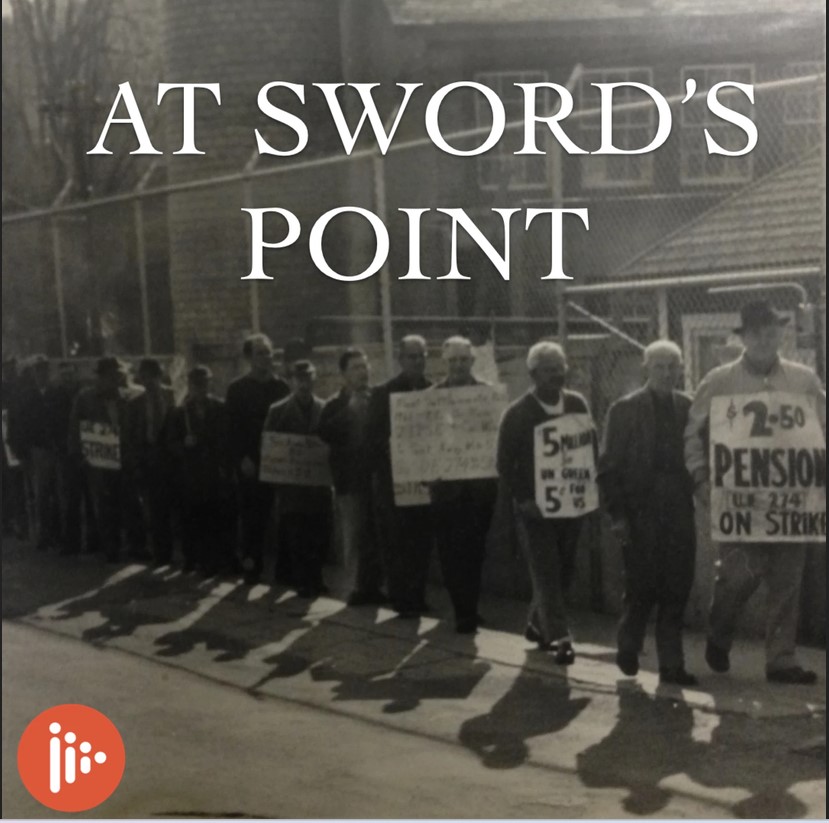
In "At Sword’s Point", Tom Goldscheider revisits a pivotal moment in American history, when the dismantling of American organized labor began. This is a radio podcast that recounts t the machine tool industry of Greenfield, Massachusetts where tap and die, the basis of industrial mass production was invented. Management sought to control innovation. These workers fought back against the red scare and this story tells why
the story of a rural town where workers fought back against McCarthyism and the red scare

Tom Goyens
University of Illinois Press (2017)
New York City's identity as a cultural and artistic center, as a point of arrival for millions of immigrants sympathetic to anarchist ideas, and as a hub of capitalism made the city a unique and dynamic terrain for anarchist activity. For 150 years, Gotham's cosmopolitan setting created a unique interplay between anarchism's human actors and an urban space that invites constant reinvention.
Tom Goyens gathers essays that demonstrate anarchism's endurance as a political and cultural ideology and movement in New York from the 1870s to 2011. The authors cover the gamut of anarchy's emergence in and connection to the city. Some offer important new insights on German, Yiddish, Italian, and Spanish-speaking anarchists. Others explore anarchism's influence on religion, politics, and the visual and performing arts. A concluding essay looks at Occupy Wall Street's roots in New York City's anarchist tradition.
Contributors: Allan Antliff, Marcella Bencivenni, Caitlin Casey, Christopher J. Castañeda, Andrew Cornell, Heather Gautney, Tom Goyens, Anne Klejment, Alan W. Moore, Erin Wallace, and Kenyon Zimmer"-- Provided by publisher
Introduction / Tom Goyens
Johann Most and the German anarchists / Tom Goyens
Saul Yanovsky and Yiddish Anarchism on the Lower East Side / Kenyon Zimmer
Fired by the ideal: Italian anarchists in New York City, 1880s-1920s / Marcella Bencivenni
Times of propaganda and struggle: El Despertar and Brooklyn's Spanish anarchists, 1890-1905 / Christopher J, Castañeda
From Union Square to heaven: Dorothy Day and the origin of Catholic worker anarchism / Anne Klejment
New wind: the why?/resistance group and the roots of contemporary anarchism, 1942-1954 / Andrew Cornell
Poetic tension: the aesthetic politics of the living theatre / Allan Antliff
Up against the wall motherfucker: ideology and action in a "street gang with an analysis" / Caitlin Casey
Gordon Matta-Clark's Anarchitecture / Erin Wallace
ABC No Rio as an anarchist space / Alan W. Moore
The influence of anarchism in Occupy Wall Street / Heather Gautney
Anthology of essays on anarchy's emergence in and connection to the city, including labor issues.
The intersection of anarchy and over 150 years of city history

Tommy Douglas
A political tale expressing the viewpoint that Canada's politcal system forced voters to choose between two parties that did not represent their interests. The mice in Tommy Douglas' telling of Mouseland stand in for Canadian voters, who are portrayed as voting in black cats and white cats who run a government that does not make life better for the mice. When a mouse speaks up in favor of a government run by mice, the cat-led government accuse him of being a Bolshevik and imprison him. Douglas ends on a cogent take-home point - that "you can lock up a mouse or a man, but you can't lock up and idea!" A full transcript is also available, listed under the title "The Story of Mouseland Transcript".
A political film expressing the viewpoint that Canada's politcal system forced voters to choose between two parties that did not represent their interests.
Tommy Douglas
A political tale expressing the viewpoint that Canada's politcal system forced voters to choose between two parties that did not represent their interests. The mice in Douglas' telling of Mouseland stand in for Canadian voters, who are portrayed as voting in black cats and white cats who run a government that does not make life better for the mice. When a mouse speaks up in favor of a government run by mice, the cat-led government accuse him of being a Bolshevik and imprison him. Douglas ends on a cogent take-home point - that "you can lock up a mouse or a man, but you can't lock up and idea!" The film is also available under the "Mouseland (1944)" title.
The transcript of "Mouseland," as told by Tommy Douglas who led Canada's Saskatchewan Co-operative Commonwealth Federation from 1944 to 1961.

Toni Gilpin
Haymarket Books (2019)
Republic Steel, Memorial Day Massacre, massacre, Chicago, Illinois
details the bitter, deep-rooted conflict between industrial behemoth International Harvester and the uniquely radical Farm Equipment Workers union.

Tony Buba, Ray Henderson
Tony Buba, Raymond Henderson (1996)
When a local television station ran a program about the closing of the major steel mills in the Pittsburgh region, Ray Henderson, a former mill worker who had worked in the mills for 18 years, couldn’t help notice that not one black worker was shown, despite the fact that African-American workers had formed a critical part of the labor force in western Pennsylvania for 125 years.
With his old friend Tony Buba, Henderson set out to collaborate on a history of African-Americans and their contributions not just to the steel industry, but to the labor movement itself. Through eloquent living witnesses and revelatory archival footage, Struggles In Steel presents a striking counterpoint to the stereotypical black male image.
96 minute documentary of efforts by African Americans to bring equitable treatment in the mills, and the way that closing the mills impeded that
Tony Buba, Ray Henderson
Tony Buba, Raymond Henderson (1996)
Struggles In Steel: A Story of African-American Steelworkers is a fascinating and moving one-hour documentary that chronicles the little-known history of African-American steelworkers. Told through interviews with over 70 veteran African-American workers from America’s "Steel Belt," Struggles In Steel recounts their complex history -- a story of grueling work combined with heart-breaking discrimination and unfulfilled potential. While jobs at the steel mills were highly sought after since they were often the highest-paying jobs available to African-American workers, these same workers were given the toughest, dirtiest and most dangerous jobs the so-called "man-killing" jobs. The African-American steelworkers, many of whom joined the mill after fighting for their country in World Wars I and II, faced discrimination from both their employers and their union and found that their chances for advancement, despite their education, qualifications or experience, were repeatedly thwarted. The program is also the story of the end of an era in American industrialism; shortly after African-Americans were granted long-overdue workplace rights, the mills closed down, turning once-thriving middle-class communities into wastelands. Struggles In Steel is the story of generations of hard-working men and women who had to fight for the right to work at difficult jobs, facing incredible obstacles to giving their families a decent life. See facilitator guide at https://newsreel.org/guides/struggles.htm
A guide helping educators discuss Struggles in Steel with students, complete with several discussion questions, guided descriptions of the movie, and historical context.

Toure Reed
Verso (2020)
The fate of poor and working-class African Americans-who are unquestionably represented among neoliberalism's victims-is inextricably linked to that of other poor and working-class Americans. Reed contends that the road to a more just society for African Americans and everyone else is obstructed, in part, by a discourse that equates entrepreneurialism with freedom and independence. This, ultimately, insists on divorcing race and class. In the age of runaway inequality and Black Lives Matter, there is an emerging consensus that our society has failed to redress racial disparities. The culprit, however, is not the sway of a metaphysical racism or the modern survival of a primordial tribalism. Instead, it can be traced to far more comprehensible forces, such as the contradictions in access to New Deal era welfare programs, the blinders imposed by the Cold War, and Ronald Reagan's neoliberal assault on the half-century long Keynesian consensus
contends that the road to a more just society for African Americans and everyone else is obstructed, in part, by a discourse that equates entrepreneurialism with freedom and independence.

Traci Parker
The University of North Carolina Press (2019)
Traci Parker examines the movement to racially integrate white-collar work and consumption in American department stores and its neglected role in the mid-twentieth century black freedom movement.
Built on the goals, organization, and momentum of the 1930's 'Don't Buy Where You Can't Work' Movement, the department store movement recruited the power of store workers and labor unions, held behind-the-scene meetings with store officials in the postwar era, executed successful lunch counter sit-ins and selective patronage programs in the 1950s and 1960s, and challenged race discrimination in the courts in the 1970s. However, with the conclusion of the Sears, Roebuck, and Co. affirmative action cases, the movement effectively ended in 1981"-- Provided by publisher
the movement to racially integrate white-collar work and consumption in American department stores and its neglected role in the mid-twentieth century black freedom movement

Tracy Roof
Johns Hopkins University Press (2011)
Despite achieving monumental reforms in the United States such as the eight-hour workday, a federal minimum wage, and workplace health and safety laws, organized labor’s record on much of its agenda has been mixed. Tracy Roof’s sweeping examination of labor unions and the American legislative process explains how this came to be and what it means for American workers.
Tracing a 75-year arc in labor movement history, Roof discusses the complex interplay between unions and Congress, showing the effects of each on the other, how the relationship has evolved, and the resulting political outcomes. She analyzes labor’s success at passing legislation and pushing political reform in the face of legislative institutional barriers such as the Senate filibuster and an entrenched and powerful committee structure, looks at the roots and impact of the interdependent relationship between the Democratic Party and the labor movement, and assesses labor’s prospects for future progress in creating a comprehensive welfare state. Roof’s original investigation details the history, actions, and consequences of major policy battles over areas such as labor law reform and health care policy. In the process, she brings to light practical and existential questions for labor leaders, scholars, and policy makers.
Although American labor remains a force within the political process, decades of steadily declining membership and hostile political forces pose real threats to the movement. Roof’s shrewd exploration of unions, Congress, and the political process challenges conventional explanations for organized labor’s political failings.
discusses the complex interplay between unions and Congress, showing the effects of each on the other, how the relationship has evolved, and the resulting political outcomes
Trade Union Educational League, Marxists.org
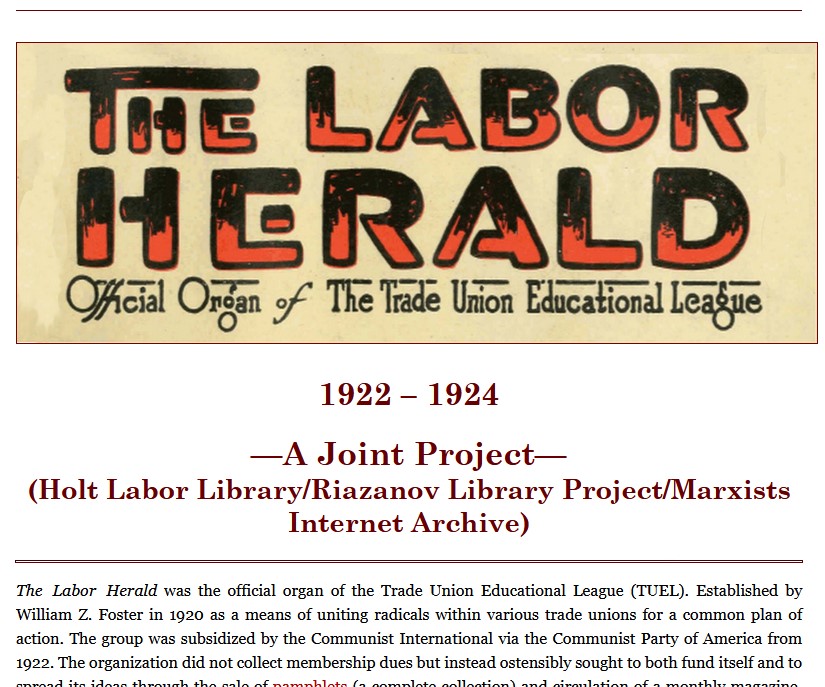
The Labor Herald was the official organ of the Trade Union Educational League (TUEL). Established by William Z. Foster in 1920 as a means of uniting radicals within various trade unions for a common plan of action. The group was subsidized by the Communist International via the Communist Party of America from 1922. The organization did not collect membership dues but instead ostensibly sought to both fund itself and to spread its ideas through the sale of pamphlets (a complete collection) and circulation of a monthly magazine. After several years of initial success, the group was marginalized by the unions of the American Federation of Labor, which objected to its strategy of “boring from within” existing unions in order to depose sitting union leaderships.
In 1924, The Labor Herald was merged with The Liberator and Soviet Russia Periodical to establish The Workers’ Monthly as an official organ of the Workers (Communist) Party.
The Labor Herald was the official organ of the Trade Union Educational League (TUEL).

Travis Sutton Byrd
University Tennessee Press (2018)
In Travis Sutton Byrd's second exploration of the North Carolina textile industry, he probes more broadly the 1929 labor strikes and connects them with the events of 1934 and a larger, economically depressed North Carolina over a five year period. Byrd contends that the five years of labor strife discussed in this study broadly represent the death of the New South resurgence in North Carolina as a myriad of small, industrial towns throughout the mountain and Piedmont region felt the weight of the Great Depression"-- Provided by publisher
contends that the five years of labor strife discussed in this study broadly represent the death of the New South resurgence

Travis Sutton Byrd
Univ Tennessee Press (2015)
It was called "the summer of dynamite." In 1929, on the eve of the Great Depression, the southern textile belt--from the rayon mills of upper East Tennessee to the bleacheries and weave rooms of the Carolina piedmont--exploded in a full-on civil war marked by political intrigue, kidnapping, attempted and outright murder, rioting, and the threat of armed insurrection against the state. Communists agitated in Gastonia, North Carolina; the American Federation of Labor led organizing efforts in nearby Marion; and the regional elite was forced to choose sides as its forces collided with those of the millworkers and rival unions battling for organizational supremacy. Drawing on never-before-utilized sources, including minutes of corporate board meetings, union rosters, scrapbooks kept by local residents, courtroom testimony, a wide assortment of news reports, and ballads written by striking workers, Travis Sutton Byrd has woven together a complex and arresting account of the textile strikes that signaled the passage of the great mill-building campaigns of the New South into the modern era. Focusing especially on labor unrest in the town of Marion, while intertwining that story with events elsewhere in the textile belt, Byrd shows in fascinating detail the ways in which the industrial culture of the New South came unraveled during one fateful summer. With fearful memories of turn-of-century Fusion politics--a coalition between the working class and the Republican Party--shaping the response of the region's Democratic, business-as-usual elite, the outcome was a campaign by the AFL to "Organize the South," an effort that laid the groundwork for reform under Franklin Roosevelt's New Deal. With its novelistic narrative and rich cast of characters--owners and politicians, millhands and reporters, reformers and radicals--Unraveled will seize the attention of anyone interested in the politics of class, culture, and regional transformation. -- Back cover
a complex and arresting account of the Marion textile strikes, connecting them to the wider textile industry

Trevor Burnard
University Of Chicago Press (2015)
As with any enterprise involving violence and lots of money, running a plantation in early British America was a serious and brutal enterprise. Beyond resources and weapons, a plantation required a significant force of cruel and rapacious men men who, as Trevor Burnard sees it, lacked any better options for making money. In the contentious Planters, Merchants, and Slaves, Burnard argues that white men did not choose to develop and maintain the plantation system out of virulent racism or sadism, but rather out of economic logic because to speak bluntly it worked. These economically successful and ethically monstrous plantations required racial divisions to exist, but their successes were always measured in gold, rather than skin or blood. Burnard argues that the best example of plantations functioning as intended is not those found in the fractious and poor North American colonies, but those in their booming and integrated commercial hub, Jamaica. Sure to be controversial, this book is a major intervention in the scholarship on slavery, economic development, and political power in early British America, mounting a powerful and original argument that boldly challenges historical orthodoxy. -- Amazon.com
argues that the best example of plantations functioning as intended is not those found in the fractious and poor North American colonies, but in integrated commercial hub, Jamaica
Trish Kahle
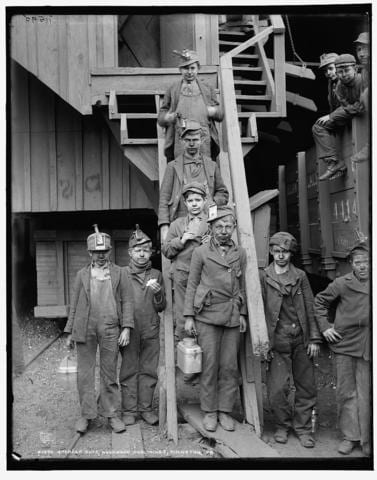
Not exactly a teaching unit, but a collection of documents and photos with some questions attached, with an orienting essay on the issue
Introductory essay and a handful of documents with some questions attached oriented mainly to Colorado and West Virginia. Includes Timeline. Ends with unionization.