


Explore thousands of items. Use clickable links under collections and library for broad categories. Search by keyword (including topic,city, state.) Limit by time period, type of item, region. See our search tips page for more assistance.
Collections
Library
Type
Region
Coverage:
-
Published:
-
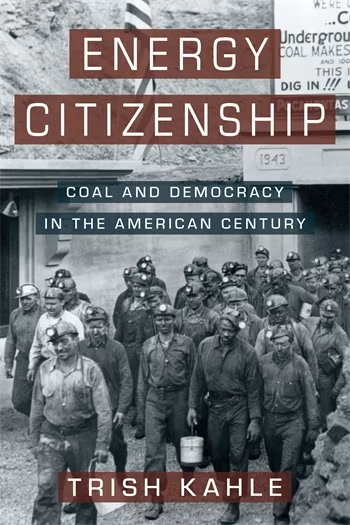
Trish Kahle
Columbia University Press (2024)
Coal Citizenship places coal miners at the center of a sweeping history of the modern United States. Drawing on extensive archival research, it argues that miners' labors, activism, and deaths have been foundational to how the United States makes energy policy and how Americans understand their political community. Starting in the 1880s, when coal became the dominant energy source in the United States, and extending through Ronald Reagan's inauguration in 1981, the book charts how, as miners extracted coal, they also turned themselves into coal citizens who retained a special hold on U.S. politics, social movements, and the struggle over what is owed to the workers who supplied coal to an energy-hungry nation. Coal Citizenship thus reveals how American democracy has been marked not only by its fossil fuel dependence, but also by the way both miners and a wider group of Americans understood the rights and obligations of citizenship as flowing from the coal which bound them together"-- Provided by publisher
argues that miners' labors, activism, and deaths have been foundational to how the United States makes energy policy and how Americans understand their political community

Trudy Irene Scee
Down East Books (2016)
Historian Trudy Irene Scee explores the dance industries of Maine, how they were effected by national events, and how events in Maine effected national trends. She explores the difficulties women faced in the early 20th century and how they turned to new forms of entertainment to make money and pay for food and shelter. The focus of the book centers on the 1910s through the 1970s, but extends back into the 1800s, largely exploring the dance halls of the nineteenth century (be they saloons with hurdy-gurdy girls and the like, or dance halls with women performing the early forms of taxi- and bel
dance industries of Maine
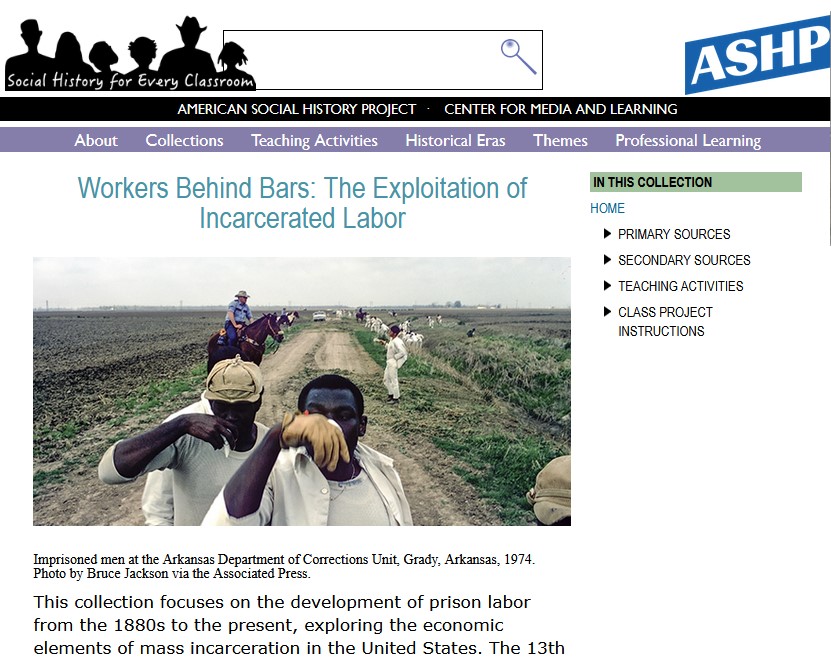
Trystin Curbelo, Carli Snyder
Introduction to Convict leasing, with a story of a strike of convict laborers and a brief introduction, and links to 5 documents for further inquiry, plus basic questions.
This collection focuses on the development of prison labor from the 1880s to the present, exploring the economic elements of mass incarceration in the United States. It uses an overview by a scholar of the subject and then a range of primary sources.
The collection includes speeches, historical images, newspaper articles, poems, and letters that highlight the voices of abolitionists, reformers and prison workers. Incarcerated people describe the abuse, agony, and injustices they endured and their efforts to call public attention to conditions behind bars. In addition, the collection shows how prison labor has been essential to maintaining the prison system. Documents span from prison reformers in the 1880s who debated the morality of prison labor to modern jail abolitionists who pushed for its outlawing, and highlight the structural injustices and institutional prejudices that led to the disproportionate impact of incarceration on Black men and men of color. The collection provides insight into the connections between capitalist interests and the use of prison labor, demonstrating the ways in which private businesses have benefited from incarcerated labor inside the prison-industrial complex.
Documents include:
Convict Laborer Explains Abuses to Alabama Board of Inspectors of Convicts (1884)
Ida B. Wells Criticizes Convict Leasing (1893)
Convict Laborers in Georgia (1895)
Selena Sloan Butler Speaks out Against the Chain-Gang System (1897)
Imprisoned Women Laborers in Georgia (approx. 1895-1920)
The Howard Association of London Addresses Cruelties in Southern U.S. Convict Chain Gangs and Camps (1901)
Incarcerated Black Boys Labor in a Field (1903)
African American Convict Laborer Recounts Years of Servitude (1904)
Poem from San Quentin Prison (1905)
Labor Advocates Urge the Reform of Incarcerated Work Practices (1923)
Recording of "Ain't That Berta" (1939)
A Penitentiary Administrator Describes the Benefits of Prison Labor (1961)
A Louisiana Prisoner Argues in Favor of Teaching Inmates Skills (1982)
Angela Davis on the Prison Industrial Complex (1998)
Imprisoned Advocate Argues for Prison Wage Increase (2023)
Letcher County Residents Protest A Federal Prison Project (2023)
Speeches, historical images, newspaper articles, poems, and letters that highlight the voices of abolitionists, reformers and prison workers.

Tsongas Industrial History Center
This interdisciplinary document set and teaching materials/activities invites students to enter the world of Barilla Taylor, a young woman who left her home to work in Lowell's textile mills. Barilla was one of the thousands of young women who left family farms beginning in 1823 to work in the factories of Lowell, Massachusetts. She left Roxbury, Maine – the only home she had ever known – in October of 1843. She probably never returned. Barilla died in Lowell in August 1845. She was 17 years old.
There are letters, the timetable of the Lowell Mills from 1853, receipts, corporation records including hospital records. This is a well-developed set of materials.
Why did Barilla leave the farm, and how did her family view her move to Lowell? How did the experiences of urban life and wage earning change her world? What factors influenced her decisions? Some of these questions can be answered, while others will remain a mystery. What is certain is that the coming of industrial order had deep and lasting implications for women.
a robust set of documents and lesson ideas for teaching the Lowell Mills and issues of labor history

Tula A. Connell
University of Illinois Press (2016)
Milwaukee in the 1950s seemingly embodied the postwar liberal consensus that subscribed to a continuation of the New Deal order. However, beneath this superficial consensus bubbled an ideological ferment of conservatism. Despite the widespread national acceptance of economic policies advanced in response to the Depression, conservatives staged a grassroots resurgence during the 1950s that went beyond the intellectual movement of that time. Fueled first by opposition to government involvement in shaping economic priorities and then by resistance to employee challenges for broader workplace rights, this response preceded and at times became indistinguishable from the race-based reaction identified by many scholars as launching the conservative movement in the 1960s. Through an examination of the major challenges facing a midcentury urban mayor, Milwaukee Mayor Frank Zeidler, this study explores how historical trends often documented at the national level--reemergence of a conservative movement, the evolution from class politics to rights politics, the question of race, the struggle by public-sector employees to attain bargaining rights, the role of corporate-led efforts to influence public opinion--took shape at the local level"
Examines the local roots of the midcentury resurgence of conservatism, focusing on Milwaukee

U. Roberto Romano
Shine Global (2011)
Every year there are more than 400,000 American children who are torn away from their friends, schools and homes to pick the food we all eat. This award-winning documentary provides an intimate glimpse into the lives of these children who struggle to dream while working 12 to 14 hours a day, 7 days a week to feed America.
A film about the "children who feed America," farmworkers.
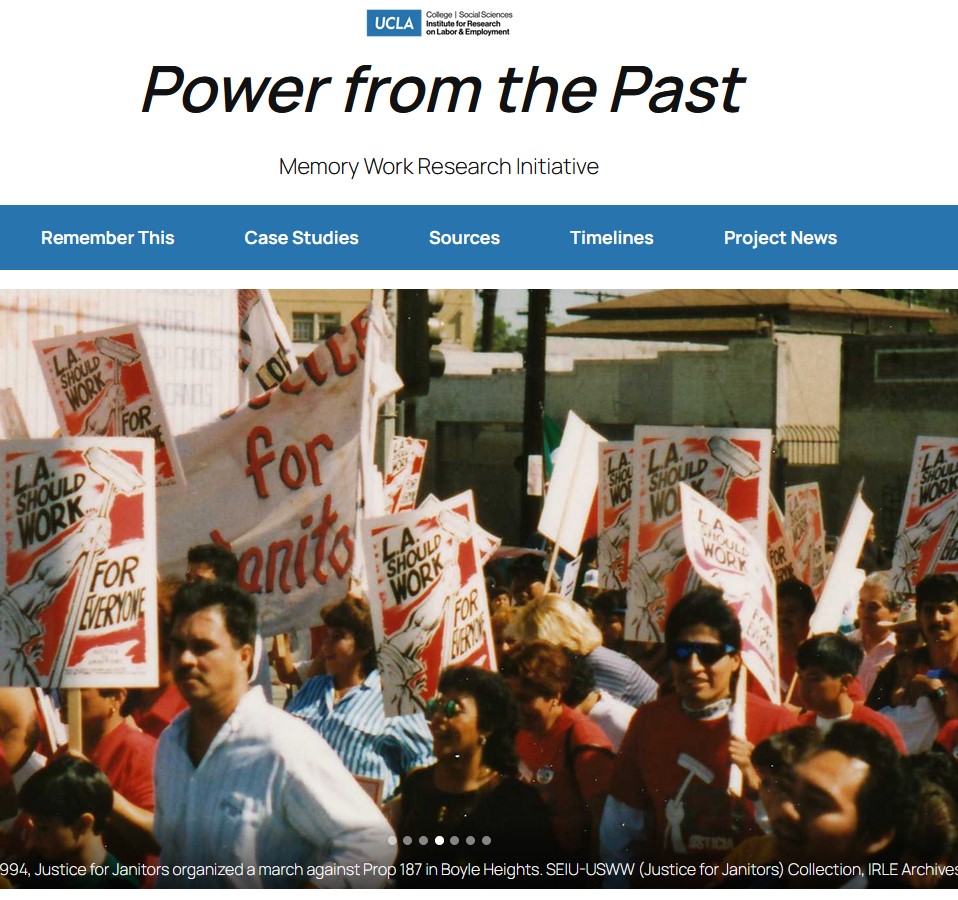
UCLA Institute for Research on Labor & Employment.
Memory Work Los Angeles is a digital project and digital archive. It is a growing collection of documents, images, interviews, and interpretive histories developed through a collaboration between the Los Angeles labor movement and UCLA faculty, staff, and students. Launched as the Justice for Janitors History Project digital collection, the effort evolved to include physical collections and oral histories highlighting the recent history of progressive unionism in southern California. Includes some videos. All projects have timelines and a toolkit for researchers, students, teachers and organizers. The site also enables exploring the collection by format - documents, videos, topics, collections, time period, with the dominant items being immigrant rights and Justice for Janitors.
The City Should Work for Everyone Justice for Janitors in Los Angeles
sing dramatic public actions, community solidarity, and strategic research, janitors in the Service Employees International Union (SEIU) took on multinational corporations and local business elites. Their campaign in Los Angeles garnered international attention in June 1990, after local janitors engaged in peaceful protest in Century City were violently attacked by the LAPD.
Immigrant Organizing and the L.A. Garment Industry
Garment workers have been at the forefront of the labor movement in Los Angeles for more than a century. Pioneering new forms of union organization and workers’ education, garment workers have long been a leading force in the fight for immigrant rights.
Building Power for Hotel Workers UNITE HERE Local 11
Local 11’s contract campaigns were examples of organized labor’s new assertiveness in the 1990s. More hotels were controlled by multinational corporations and hotel management in Los Angeles resisted efforts to unionize their workers. The union built worker committees in every workplace it represented and mobilized members for dramatic public actions that put pressure on hotels and politicians to negotiate good contracts for workers.
Fair UC Now! Campaign Archive
n the fall of 2022, academic workers across the University of California walked off their jobs in the largest ever strike in U.S. higher education. The six-week long strike challenged the university’s image as an engine of economic mobility for Californians struggling with the high cost of living.
Winning a Living Wage
After years of austerity politics and economic transformations that devastated working-class communities, religious leaders, workers, and community activists came together beginning in 1996 to fight for a living wage in Los Angeles. The premise of their campaign was seemingly simple — all working people deserve to live in dignity — but provided a capacious framework that encompassed a wide variety of issues and concerns. The coalition’s victory over the opposition of the mayor and the city’s powerful business interests demonstrated the effectiveness of their community-based approach to municipal governance.
A Century of Labor Studies at UCLA
The Institute for Research on Labor and Employment (IRLE) launched 80 years ago in 1946. We are diving into the archives to recover forgotten stories and personalities associated with labor research and education across the University of California.
Digital project of documents, images, interviews, and interpretive histories developed through a collaboration between the Los Angeles labor movement and UCLA faculty, staff, and students

UCLA Institute for Research on Labor & Employment.
The Institute for Research on Labor and Employment (IRLE) is a multidisciplinary research center advancing labor research and education for economic justice. Through the work of its units, academic department and research initiatives, the Institute powers wide-ranging economic equity agendas that bring UCLA into the Los Angeles community and beyond.
multidisciplinary research center dedicated to advancing labor research and education for workplace justice

UCLA Institute for Research on Labor & Employment.
91 videos on organizing for social and economic justice in Los Angeles and Southern California from 1990s to the present; some are source materials, others videos produced for campaigns such as Justice for Janitors and others. See also https://vimeo.com/memoryworkla for an introduction and featured items.
91 videos on organizing for social and econmic justice in Los Angeles and Southern California
UE News
A great introduction to the 1877 Railroad Strike The Great Railroad Strike of 1877 was the first major strike in an industry that propelled America’s industrial revolution. It was the first national strike, stretching from Atlantic to Pacific. In some cities, especially St. Louis, the struggle became one of the nation’s first general strikes. This was the first major strike broken by the U.S. military. Probably in no other strike had so many working people met a violent death at the hands of the authorities.
A digital essay that contributes introductory information on the General Strike of 1877.
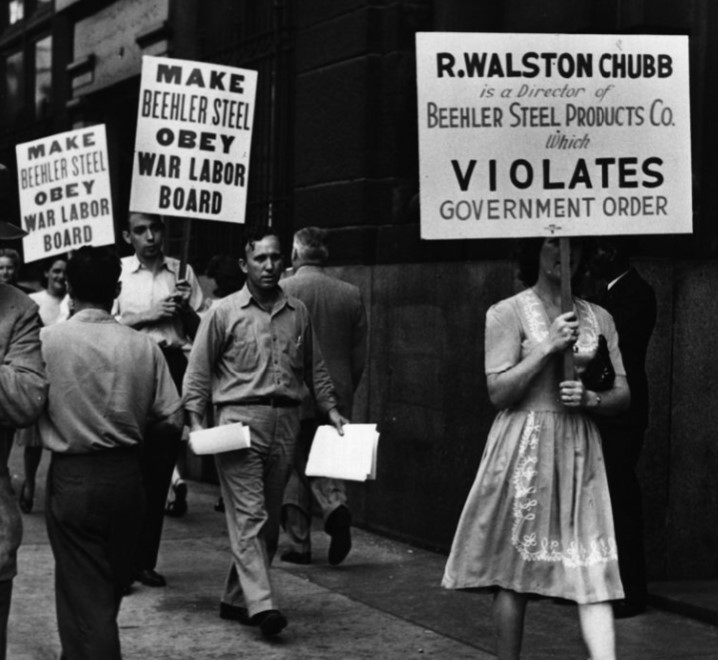
UE, United Electrical Radio and Machine Workers, ULS Pittsburgh
an amazing collection of photographs from the third largest CIO affiliate in its heyday years, depicts a range of factory grievances and rallies, including automation, civil rights and labor rights
UE New photos, from the left wing union that survived the McCarthy purges

UE, United Electrical Radio and Machine Workers, ULS Pittsburgh
United Electrical, Radio, and Machine Workers Union, newspaper 1939-2011
full run of a leading CIO union, digitized

UHP1917
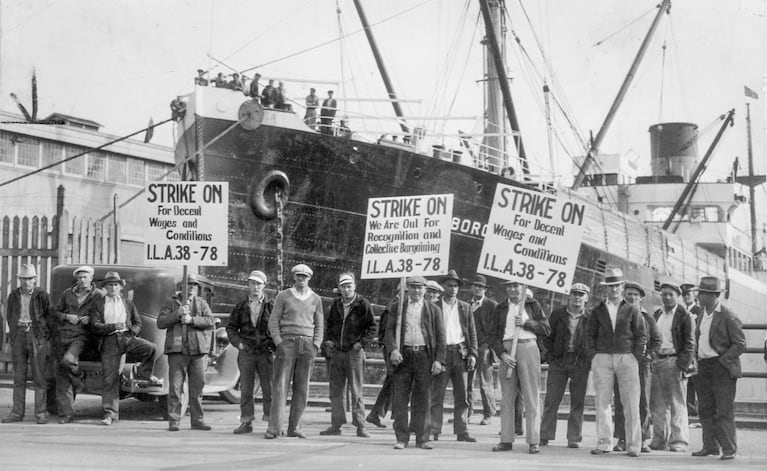
In Minneapolis worker militancy combined with politically conscious leadership. The strikes showed the promise offered by a party that coupled powerful political principles with a united mass of American workers.
A brief, one-minute clip of archival footage showing Teamster actions during the 1934 Minneapolis Strikes
UHP1917
In Minneapolis we saw the native militancy of the workers fused with a politically conscious leadership. Minneapolis showed how great can be the role of such leadership. It gave great promise for the party founded on correct political principles and fused and united with the mass of American workers. In that combination one can see the power that will conquer the whole world.
Silent video containing footage from strike that was one of the most important uprisings of the 1934 wave of strikes
UNITE HERE Local 11
UNITE HERE Local 11, currently representing over 30,000 hospitality workers in southern California and Arizona, has a long history in Los Angeles. Hotel Employees and Restaurant Employees (HERE) Local 11 brought together previously separate locals for waiters, waitresses, bartenders, cooks, and other hotel workers. In the 1970s and 1980s, the predominantly Spanish-speaking membership of Local 11 fought for fuller participation in their union against a largely Anglo leadership. In 1989, María Elena Durazo became the first Latina to lead a major Los Angeles union. She began reorienting the local towards greater membership participation and a more assertive stance with employers. Durazo and Local 11 helped launch what would become the Los Angeles Alliance for a New Economy (LAANE) in 1993, and the two organizations collaborated with other unions on many later campaigns, notably the Los Angeles Living Wage Campaign. Local 11 merged with locals in Santa Monica and Long Beach, and later moved into Arizona. Its parent union took the name UNITE HERE in 2004.
The UNITE HERE Local 11 Oral History Project features interviews with rank-and-file leaders, local union staff, and national union officials. They document the transformation of internal union culture, and the experiences and perspectives of union activists from a variety of workplaces. Long-time organizer and former Local 11 and LAANE staff member Vivian Rothstein led the project with the assistance of current Local 11 staff member Danielle Wilson. Karen Brodkin (UCLA Anthropology), Virginia Espino (UCLA Labor Studies and Chicano/a Studies), Antonio Mendoza (Local 11), Mar Preston (former LAANE community organizer), and Gaspar Rivera Salgado (UCLA Labor Center) each helped conduct interviews. The UCLA Institute for Research on Labor & Employment (IRLE), Labor Center, Department of History, and the Library Department of Special Collections supported the project.
oral histories of unionized hospitality workers
US Census Bureau
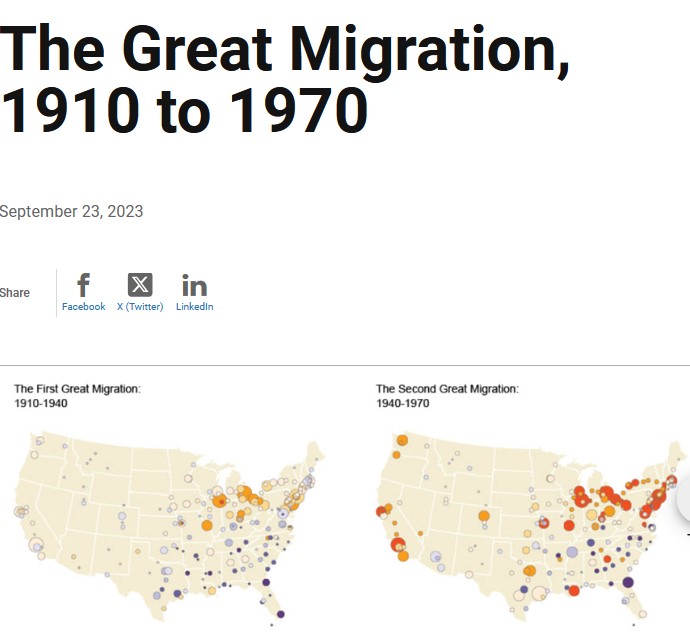
The Great Migration generally refers to the massive internal migration of Blacks from the South to urban centers in other parts of the country. Between 1910 and 1970, an estimated 6 million Blacks left the South. This graphic compares the early migration (1910-1940), sometimes referred to as the First Great Migration, and the later (1940-1970) also known as the Second Great Migration.
In the early 20th century, strict legislation limited immigration into the U.S. and brought about a shortage of labor in many industrial and manufacturing centers in the Northeast and Midwest. These cities became common destinations for Black migrants from the South. Cities that experienced substantial changes in racial composition between 1910 and 1940 include Chicago, Detroit, New York City, and Philadelphia. During and after WWII, Black migrants flooded into many of the cities that were destinations before the war, following friends and relatives that had made the journey earlier. Poor economic conditions in the Jim Crow South spurred a larger migration flow than was the case in the 1910-to-1940 period and resulted in the creation of large Black population centers in many cities across the Northeast, Midwest, and West.
NOTE: Data are from decennial censuses, 1910 through 1970. Population counts are based on unrevised numbers. Data for the Black population for cities in Alaska and Hawaii were not available in 1940 or earlier decades. Cities shown are those that were either in the top 100 cities in the country or top 3 of a state and had a Black population of at least 100 people. These criteria were placed on 1940 data for the First Great Migration and 1970 data for the Second Great Migration.
An article on the Great Migration (1910-1970), accompanied by visualizations of census data and maps.
US Congress
U.S. Government Printing Office ()
Entire hearings with testimony from workers, managers, observers, of the 1919 steel strike
Transcribed hearings over the 1919 General Steel Strike, hosted by the Interned Archive.

US Congress, History Matters
The nationwide labor upsurge of 1934 reached its peak in San Francisco. On May 9, 1934, leaders of the International Longshoremen’s Association (ILA) called a strike of all West Coast dockworkers, demanding a wage scale, a “closed shop” (union membership as a requirement of employment), and union-administered hiring halls. A few days later seamen and teamsters joined the strike, effectively stopping all shipping from San Diego to Seattle. Enraged employers, backed by a sympathetic mayor and police chief, used every means available to open the waterfront and protect strikebreakers, whom they imported in large numbers. Working closely with local politicians and the press, the employers set out to convince the public that the strike was controlled by “Reds” intent on overthrowing the government. These scare tactics led to an investigation of employer actions by a Senate subcommittee. Violations of Free Speech and Rights of Labor, the subcommittee’s 1942 report, described the concerted efforts of the Industrial Association, the newspapers, and the San Francisco police to discredit the strike.
A Congressional report over the 1934 San Francisco Strike, a critical turning point in US labor history
US Senate
While many assume that workers in the nineteenth-century American West enjoyed easily available land and a fluid social structure, the region’s history of radical unionism at the turn of the century suggests otherwise. In 1902, corporate mining interests in Colorado decided to crush the Western Federation of Miners (WFM). By the following year, civil war erupted in Cripple Creek, Colorado, as state and local officials and local businessmen joined with the large corporations against the miners. Before it was over, thirty men had been killed in numerous gun battles. Documents gathered as part of a 1905 federal investigation included a “yellow dog” (anti-union) contract that prospective mining employees were required to sign. The documents also included a letter from mine owners asking landlords not to lease property to union sympathizers; a resolution by the Denver Citizen’s Alliance attacking the WFM; orders directing Colorado National Guard troops to deport 73 striking miners and their leaders to Kansas; and finally a plea by a Colorado union official to the Red Cross for the organization’s aid.
Document set that shows anti-union strategies at Cripple Creek, Colorado in 1903, against Western Federation of Miners.
US Treasury Department
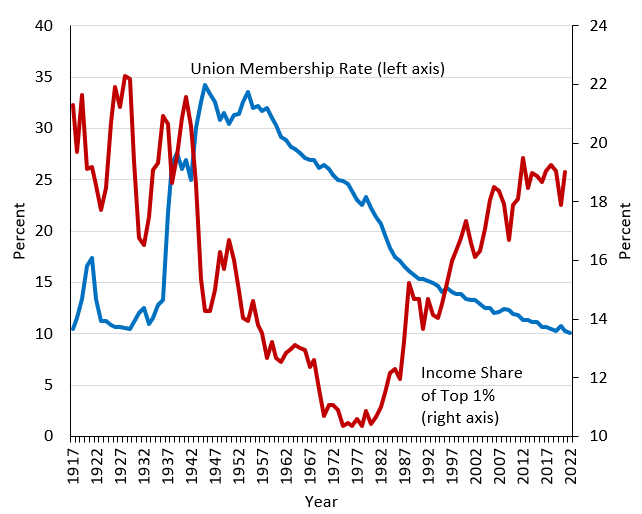
union membership rate vs. income inequality, in one chart August 28, 2023 By Laura Feiveson, Deputy Assistant Secretary for Microeconomics
Today, the Treasury Department released a first-of-its-kind report on labor unions, highlighting the evidence that unions serve to strengthen the middle class and grow the economy at large. Over the last half century, middle-class households have experienced stagnating wages, rising income volatility, and reduced intergenerational mobility, even as the economy as a whole has prospered. Unions can improve the well-being of middle-class workers in ways that directly combat these negative trends. Pro-union policy can make a real difference to middle-class households by raising their incomes, improving their work environments, and boosting their job satisfaction. In doing so, unions can help to make the economy more equitable and robust.
Over the last century, union membership rates and income inequality have diverged, as shown in Figure 1. Union membership peaked in the 1950s at one-third of the workforce. At that time, despite pervasive racial and gender discrimination, overall income inequality was close to its lowest level since its peak before the Great Depression, and was continuing to fall. Over the subsequent decades, union membership steadily declined, while income inequality began to steadily rise after a trough in the 1970s. In 2022, union membership plateaued at 10 percent of workers while the top one percent of income earners earned almost 20 percent of total income.
union membership rates vs. income inequality

UTSA Libraries Special Collections
Uenmployed Workers, Texas
photos from Texas unemployed in the 1930s

Udo Sautter
Cambridge University Press (1991)
An account of the beginnings and the development of unemployment reform up to the New Deal. As a consequence of the large-scale industrialization after the Civil War, joblessness could no longer be considered to be caused by character defects, but had to be ascribed to societal forces. It became clear that traditional remedial measures could not cope with the problem adequately. In times of depression, the large number of unemployed far exceeded the aid capacity of private philanthropies and civic authorities. And the continuous expansion of the labor market made it obvious that local action would remain insufficient, especially if prevention could take the place of the less-desirable solution. By the time the United States entered World War I, reformist thinkers had devised the major tools that were later used to deal with unemployment. After the war and during most of the 1920s, these tools underwent thorough examination and refinement. The early years of the Great Depression saw them used tentatively. On the eve of the New Deal, a well-reasoned and successfully tested group of social programs was available. This book essentially refutes a social-control explanation for this process, and stresses the progressive motivation of the reformers involvedist of figures and tables
Abbreviations used in the text or footnotes
Acknowledgments
Introduction
Perceiving the problem: 1870s to the entry into World War I
Nascence and growth of the USES: World War I
Pondering the issues: post-war to the mid-1920s
Accepting the task: 1928-1933
Epilogue
Appendix
Index
A history of unemployment reform in the progressive era, refutes notions that progressive reformers only sought reform for social control

Ulbe Bosma, ed.
Brill (2018)
The Life Work of a Labor Historian: Essays in Honor of Marcel van der Linden (eds. Ulbe Bosma and Karin Hofmeester), presents the latest developments in the history of labor and capitalism. As part of Global Labor History, Jan Lucassen, Magaly Rodrígues García, Sidney Chalhoub, and Willem van Schendel discuss new concepts of work and workers, including sex workers, slaves in Brazil, and voluntary communal laborers in North-East India, while Andreas Eckert shows the relevance of area studies. Jürgen Kocka presents a history of capitalism and its critics to date, Pepijn Brandon analyzes Marx?s ideas on the link between free and coerced labor, and Jan Breman looks at the effects of capitalism on rural solidarity through the lens of Tocqueville
Essays on new concepts and themes within labor history, including transnational analysis, examinations of both unwaged and unfree work, as well as new understandings of the history of capitalism
Under the Iron Heel: Repressing the IWW and Free Speech
The story of how a popular labor song was lost, and then found. John McCutcheon, a folk singer, tells the story of how the Colorado Strike Song was recorded for the first time. About 1/2 way in you will hear McCutcheon who recorded it for the 2014anniversary of the strike. Also Songs Heidie Ho, From Solidarity Rocks; Woody Guthrie; from The Labor Exchange, Colorado's only labor focused radio show, airing on KGNU Community Radio, Mondays at 6:00 PM Mountain Time.
The story of how a popular labor song was lost, and then found.

Union Films
Harassed by shortages, Tom Grey votes for the removal of price control after reading propaganda issued by the National Association of Manufacturers (NAM). When prices rise, he views a Union film, "The Big Squeeze," which places the blame for high prices on monopoly control of our economy, and points out the advantages of membership in the Union. Membership recruiting film for UERMWA/CIO presenting the viewpoint that there is a need for a rollback in prices, higher wages, and participation of the working class in politics.
Part I of a union recruitment film criticizing monopoly control of the U.S. economy and advocating union membership as a defense against corporate power.