


Explore thousands of items. Use clickable links under collections and library for broad categories. Search by keyword (including topic,city, state.) Limit by time period, type of item, region. See our search tips page for more assistance.
Collections
Library
Type
Region
Coverage:
-
Published:
-

Union Films
Harassed by shortages, Tom Grey votes for the removal of price control after reading propaganda issued by the National Association of Manufacturers (NAM). When prices rise, he views a Union film, "The Big Squeeze," which places the blame for high prices on monopoly control of our economy, and points out the advantages of membership in the Union. Membership recruiting film for UERMWA/CIO presenting the viewpoint that there is a need for a rollback in prices, higher wages, and participation of the working class in politics.
Part II of a union recruitment film criticizing monopoly control of the U.S. economy and advocating union membership as a defense against corporate power.

Union Songs
Bibliography of books on union songs/folk songs
Bibliography of union songs
Union Songs
more than 843 union songs and poems, searchable by tot;e.
843 union songs in alpha and author order
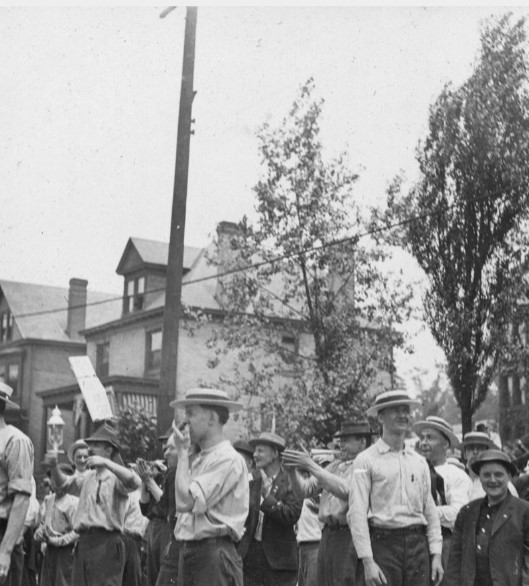
Union Switch & Signal Company, University of Pittsburgh
The online photograph collection of the Union Switch & Signal Strike contains images selected from a photograph album. The photographs portray strikers from US&S, and several other Westinghouse plants, marching in the streets of Swissvale in June 1914. There are also photographs of company management, including Superintendent George H. Pfeil, and non-striking workers in the plant as well as a copy of a strike bulletin.
In the 1910's. Workers in East Pittsburgh's "Electric Valley" created impressive, if short-lived, workers' organizations. In the 1914 Strike at Westinghouse and Union Switch and Signal, women workers, often employed as coil winders, played a leading role, as this remarkable photo album shows below. In the 1930's, some female coil winders, like Margaret Darin, were again active, this time helping bring permanent union organization to the valley.
Some of the photographs from this album have been reproduced by Charles J. McCollester in "Turtle Creek Fights Taylorism: The Westinghouse Strike of 1914," Labor's Heritage 4:2 (Summer 1992): 4-27
A University of Pittsburgh photographic archive for researching and studying the Union Switch and Signal Strike of 1914.
Unite Public Workers
A collection of digitized issues of the UPW Organizer published by the United Public Workers, AFSCME Local 646, AFL-CIO. The newspaper, labeled as the "Official Newspaper of the United Public Workers - State of Hawaii," was edited by John Kelly (1967), Max Roffman (January - July 1972), UPW State Director Henry Epstein (August 1972 - 1981), and UPW State Director Gary Rodrigues (1981).
The newspaper typically ran once a month along with special issues for elections or news on specific islands.
The newspaper, labeled as the "Official Newspaper of the United Public Workers - State of Hawaii," offers example of a robust public sector union efforts.
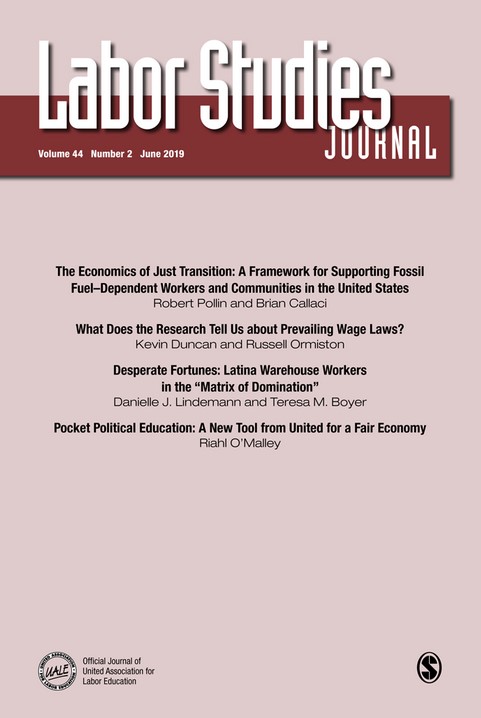
United Association for Labor Education
The Labor Studies Journal is the official journal of the United Association for Labor Education (UALE). It is a multi-disciplinary journal which seeks submissions based on research about work, workers, labor organizations, and labor studies and worker education in the US and internationally.
The Journal is interested in manuscripts using a diversity of research methods, both qualitative and quantitative, directed at a general audience including union, university, and community based labor educators, labor activists and scholars from across the social sciences and humanities. As a multi-disciplinary journal, manuscripts should be directed at a general audience, and care should be taken to make methods, especially highly quantitative ones, accessible to a general reader. Topics range from:
Union organizing strategies
Labor movement revitalization
New forms of worker representation (labor centers, etc.)
Race, gender and “identity” issues and labor
Immigration and labor
Globalization and labor
Labor and political trends
International labor movements
Labor education practices and approaches
Labor and the evolving economy
In addition to articles about the United States labor movement and workforce, LSJ welcomes submissions that are international and comparative. We are interested in foreign based authors who are writing about relevant subject matter in non-US countries, which have significant international or comparative implications for labor studies.
The Labor Studies Journal (LSJ) is the official journal of the United Association for Labor Education (UALE). Published quarterly, LSJ is a multi-disciplinary journal covering issues related to work, workers, labor organizations, and labor studies and worker education in the US and internationally
United Association for Labor Education
The United Association for Labor Education is an organization of labor educators based primarily in the United States and Canada. However, we are open to all labor educators and organizationals globally. We are a member organization of the International Federation of Workers’ Education Associations.
Our US-based membership is divided into 4 regions: Northeast, South, Midwest, and West. Each US region has a Regional Representative on the Executive Board. In addition, the Executive Board also has 3 At-Large members with at least one of those members representing Canada to ensure that Canadian voices are represented on the Board.
Each US region and Canada host an event every other year to bring folks together on a more localized level to share resources and network. Please see our Events page more details on these events.
organization of labor educators based primarily in the United States and Canada.

United Automobile Workers
Newspaper of the United Automobile Worker, a major union of the Congress of Industrial Organizations, digitized searchable
United Automobile Workers union newspaper
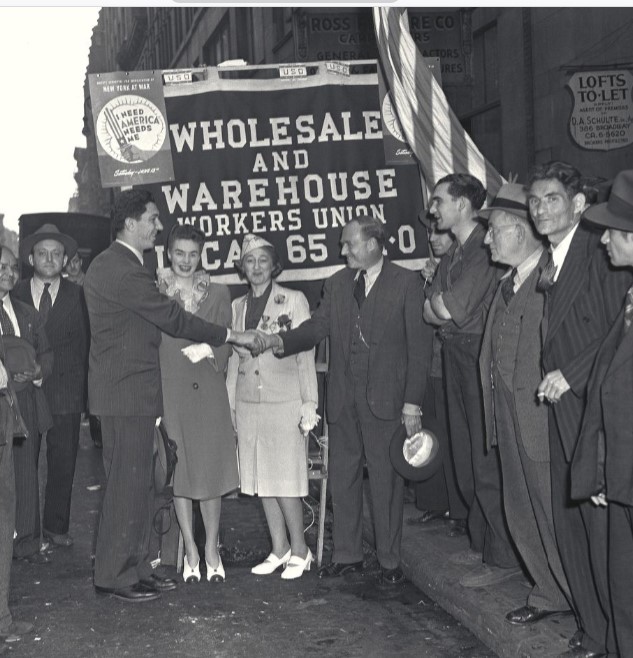
United Automobile Workers District 65
2754 items of a much larger collection. Between 1937 and 1942, District Council 65, United Automobile Workers (UAW) was at the center of a group of New York City left-wing locals organizing large numbers of warehouse and retail workers; it later expanded its organizing to include white-collar workers in publishing and universities.The collection consists of nearly 30,000 black and white negatives spanning the late 1930s through the early 1960s, with the bulk from the 1940s and 1950s, shot by members of District 65's own Camera Club, which functioned as staff photographers for the union's newspaper. The images document the everyday organizational life of District 65, its leaders and its diverse membership (including men and women of Jewish, African-American, Irish and Hispanic descent), while at the same time providing especially strong documentation generally for left and liberal causes of the 1940s-1960s, including civil rights, rank and file participation in union activities, working class leisure and recreational activities.
2754 images of District 65, United Automobile

United Automobile Workers Local 599, University of Michigan
With regular editions from 1937 to 2008, Headlight was the voice of Flint’s largest labor organization and a rare working-class periodical. Researchers from as far away as Korea and Japan and as close to home as U-M Flint have requested access to this material that is now completely digitized and freely available to the public. Headlight will offer researchers an unparalleled look into working-class communities, interests, and civic life.
“With every issue now keyword-searchable, curious researchers can trace how UAW Local 599 shaped debates on wages, civil rights, and urban development—month by month, voice by voice,” said U-M Flint’s Dr Thomas Henthorn. “This collection turns what was once a fragile artifact into an open, durable archive, inviting students, community members, and researchers worldwide to explore Flint’s history in unprecedented depth.”
Flint, Michigan United Auto Workers newspaper, full run, fully searchable.

United Automobile Workers, History Matters
The Wagner Bill was the egislation passed in Roosevelt’s second “hundred days.” Following on the heels of intense industrial unrest, large-scale strikes, and social turmoil, the act guaranteed workers the right to organize unions, and to strike, boycott and picket their employers. It also outlawed “unfair” labor practices by employers, including blacklisting union activists or intimidating workers who sought to join an independent union, and ensured workers the right to collective bargaining. This leaflet distributed by the United Automobile Workers captures the impact of the Wagner Act on union organizing, as it provided a spur for industrial unionism.
Flyer for the United Auto Workers, directed toward Ford Workers.

United Automobile Workers, University of Maryland
Digitized Labor Periodicals from University of Maryland, College Park
largest auto workers union newspaper, digitized

United Automobile Workers; Writers: Ring Lardner Jr., Maurice Rapf, Phil Eastman.
Animated film speaking out for racial tolerance. Using small green demons to caricature racial prejudice, the cartoon argues that the only real difference among the races is skin color and that underneath, all people are the same. Bosley Crowther wrote that the UAW, seeking to widen labor support in the auto industry, sponsored the film “to counteract a critical race-relations problem among the workers in Detroit.”
Note: Based on the pamphlet Races of Mankind by Ruth Benedict and Gene Weltfish, Brotherhood of Man premiered at the Museum of Modern Art. Anticommunists attacked the film because of the involvement of known leftists, such as Ring Lardner Jr., one of the “Hollywood Ten,” and Maurice Rapf, a blacklisted screenwriter who helped organize the Screen Writers Guild. For more on similar labor-sponsored films of the period, see “The UAW-CIO Pioneers Use of Films among Labor Unions,” Business Screen 6, no. 4 (1945): 46; and Elizabeth A. Fones-Wolf, Selling Free Enterprise: The Business Assault on Labor and Liberalism, 1945–60 (Urbana and Chicago, IL: University of Illinois Press, 1994), 125.
short film on anti-racism from UAW, 1947

United Electrical, Radio and Machine Workers of America
[Dayton, Ohio] : Locals of the United Electrical, Radio and Machine Workers of America, CIO, 1940-1944. See also another site for access: https://ohiomemory.ohiohistory.org/archives/4963
Dayton, Ohio labor newspaper

United German Socialists of Cleveland
Translation: United German Socialists of Cleveland The Echo: Wochenblatt der Vereinigten Deutschen Socialisten Clevelands ‘Weekly of the United German Socialists of Cleveland’ was the paper of the United German Branches of the Cleveland Socialist Party, and the German Agitation Committee of the Socialist Party of Ohio begun in 1911. Wilhelm Ludwig Rosenberg was its first editor, others included Joseph Mosler, Fritz Frebe, and Herman G. Haupt. The Cleveland Socialist Party had six German speaking locals. The Echo had an anti-war stand and attacked German Socialists who supported the the war and social-patriotism.The Ohio German Federations were supportive of the Left Wing in the Socialist Party in their majority, but deeply divided over the CPA and CLP Communist factions. The Ohio German Federations did not survive the wars and revolutions of that period in tact. The paper ran until 1920."-Revolution Newstand
Cleveland German socialist paper
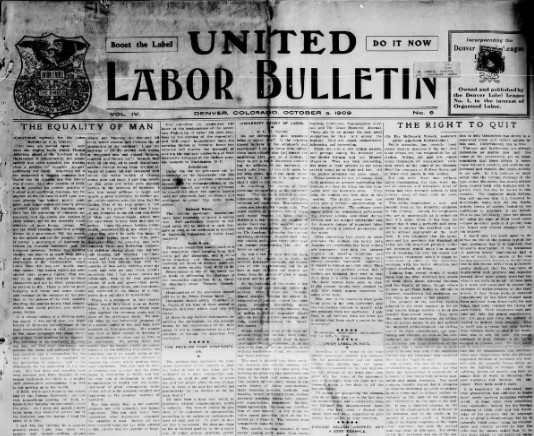
United Label League
Established in 1905, the United Labor Bulletin was the official publication of the United Label League, No.1, and "the only official organ endorsed and owned by organized labor in Denver." The newspaper was not listed in N.W. Ayer & Son's American Newspaper Annual and Directory until 1914, under the editorship of James A. Conkle, who appears to have taken the position as early as 1910. In July 1913, Conkle sold the Bulletin to the United Labor Bulletin Printing and Publishing Company, a corporation founded by Clint C. Houston, F.R. Bishop, and Fred Wessel.Discover Birth, Marriage, and Obituary announcements in United Labor Bulletin, sorted by date.
Denver Colorado labor paper

United Mine Workers, Pennsylvania State University
The United Mine Workers of America photographic, graphic, and artifacts collection consists of materials dating as early as 1891 and as late as 1997.
These materials include a photographic survey of American miners’ homes, panoramic photographs of UMWA conventions and conferences, oversize graphics and cartoons, and reproduced images of original documentation exhibited by the UMWA, as well as several union related artifacts.
This digital collection forms a part of the "Beneath the Surface and Cast in Steel: Forging the American Industrial Union Movement Digital Project" funded by the Council on Library and Information Resources. As part of this grant project, staff in the Special Collections Library developed the "UMWA Miners Survey Map" to illustrate relationships between the various mining communities in the Appalachian region.
89 photographs or artifacts
United States Congress
U.S. Government Printing Office ()
Here, you can find a link to the full text of a 19-volume U.S. Congressional report on the conditions of working women and children, which ran between December 1908 and April 1909. The investigation which generated the report covered Maine, Massachusetts, Rhode Island, Ohio, Illinois, Indiana, Michigan, Wisconsin, Maryland, North Carolina, Georgia, Florida, and Louisiana, all on the grounds that these seventeen states constituted the U.S.' "chief manufacturing States." The nineteenth volume contains the most detailed information on inquiries "as to the regular schedule of horus, overtime, safeguards against accidents from elevators and machinery, conditions of ventilation and sanitation, provisions for the comfort of employees, and so on."
A 19-volume report on the conditions women and children wage-earners in the United States, covering seventeen states and running between December 1908 and April 1909.

United States Steel
A company produced documentary film lauding the Bay Bridge's construction by depicting workers suspended on the bridge's in-progress infrastructure, steel beams being put into place, and othewise providing useful information on the bridge's construction, composition, and dimensions.
A sixteen-minute film produced by United States Steel that details the building of the "Bay Bridge," otherwise known as the San Francisco-Oakland Bay Bridge.

Univerity of Maryland
includes Voice of Labor, United Automobile Worker, CIO News, AFL-CIO materials
From radical to conservative, platformed on Internet Archive
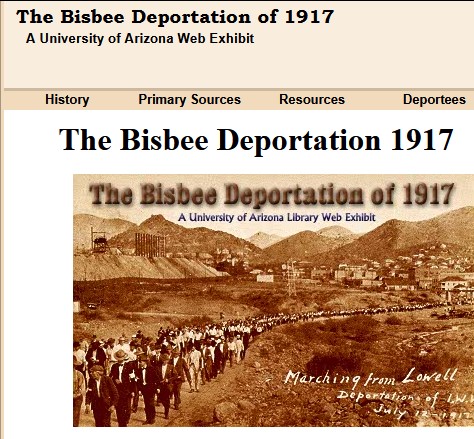
University of Arizona
An archived site, but most of the materials are still available even if it operates a little slowly. This is a digital exhibit and digital project, with teaching materials as well as primary sources and an exhibit platorm
The Bisbee Deportation of 1917 was an event specific to Arizona that influenced the labor movement throughout the United States. What started as a labor dispute between copper mining companies and their workers turned into vigilante action against the allegedly nefarious activities of the Industrial Workers of the World (I.W.W.). This site is a research-based collection of primary and secondary sources for the study of the deportation of over 1,000 striking miners from Bisbee on 12 July, 1917.
Materials include I.W.W. publications, personal recollections, newspaper articles, court records, government reports, correspondence, and journal articles that are part of the collections of three libraries: The University of Arizona Library, the Arizona Historical Society, Tucson, Arizona, and the Sharlot Hall Museum, Prescott, Arizona.
An archived site about the copper miners strike and repression including deportation; teaching materials

University of Arizona Libraries Special Collections
University of Arizona (2018)
This active learning-based session was developed for undergraduate students in HNRS 212: Humanities in Context: The Southwest. It introduces students to the University of Arizona Libraries Special Collections and primary sources from UAL Special Collections and the Library of Congress related to the Bisbee Deportation in July 1917, when striking mine workers were illegally deported from Arizona.
Through document analysis, students practice critical thinking and work individually and then collaboratively to construct the facts of the Bisbee Deportation. This exercise is facilitated by the archivist, who guides students with contextual questions about the content, intended audience, purpose, and author of their documents.
Bisbee '17 film teaching/lesson plan
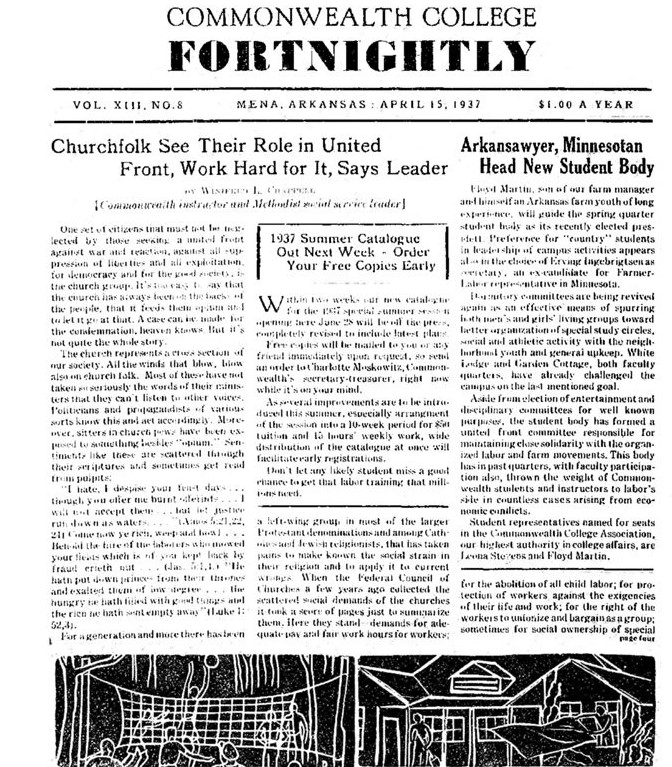
University of Arkansas library
Commonwealth College in Mena, Arkansas, published hundreds of issues of its newspaper, the Fortnightly, from 1926 to 1938. This digital collection provides fully searchable access to more than 200 issues, allowing researchers to utilize the most complete record of activity at Arkansas’s historic radical labor school. Commonwealth College’s original mission was to produce educated leaders for the growing labor movement. The college became more involved in radical labor activism after the leadership was taken over by Lucien Koch, a leader of student-staff revolt. Over the course of the 1930s, Commonwealth became more outwardly affiliated with the Socialist Party, and members of the community were more politically radical, and they became Communist Party members and operatives. After the Southern Tenant Farmers Union formed in northeastern Arkansas in 1934, Commonwealth quickly aligned itself with the rapidly growing union of tens of thousands of sharecroppers and tenant farmers which also included Socialists in leadership positions. Political factionalizing and rifts related to the Communist Party in both the STFU and at Commonwealth caused disruption and reorganization at the school, and the STFU formally severed ties in 1938. After struggling on for nearly two more years, legal harassment and fines levied by local and state officials eventually led to Commonwealth closing its doors, with all of its property being sold.
The Commonwealth College Fortnightly was issued at Commonwealth College in Mena, Arkansas from volume 2, number 1 (January 1, 1926) through volume 14, number 5 (March 15,1938). The digital copies of the Fortnightly provided here represent all of the copies that can still be located. The Fortnightly offers a close look at the community life and activities of Commonwealth. Issues include mentions of special visitors, reports on national and international labor and political developments, and updates on the teachers and groups associated with the school.
200 issues of Fortnightly, publication of radical Commonwealth College, Mena Arkansas 1926-19398
University of California
In the last two decades of the 20th century, labor unions in Los Angeles defied a national trend of decline for the labor movement. Led by a new generation of leaders who drew inspiration from social movements of the 1960s, the L.A. labor movement grew by organizing immigrant, Latino, and African American workers in the service economy. In a series of high profile strikes, unions took on the power of transnational corporations and, more often than not, they won. Buoyed by these victories, the L.A. County Federation of Labor then helped to reshape electoral politics in California by mobilizing working-class voters. Items in this collection are drawn from the records of the United Service Workers West/SEIU (Justice for Janitors), the Los Angeles Alliance for a New Economy (LAANE), UNITE HERE Local 11, and the records of the UCLA Institute for Research on Labor and Employment.
Los Angeles organizing stories

University of California Berkeley Labor Center
The effects of a widening wealth gap in the United States are magnified in the Black Community because of the persistence of institutional racism, resulting in constricted labor market opportunities for African Americans. Black communities suffer from the broad impacts of racism, transformed neighborhoods and networks after de-segregation, and rapidly changing demographics in metropolitan areas. While many localities struggle against these forces, few communities engage in campaigns to improve the numbers of jobs and also the quality of jobs held by African Americans. Millions of Black workers toil for low wages, few benefits, little prospects for advancement, and no on-the-job protection. The Black Worker Project at the UC Berkeley Labor Center focuses on job quality issues in the Black community. We are especially concerned with how to support local community organizing with useful tools, including high quality research and leadership training, which can lead to concrete policy solutions that have a real impact on the jobs situation locally and nationally.
The UC Berkeley's Labor Center resources on Black workers, with links to programs, Black worker research centers, and more.
Museum/Exhibits
Tours
Maps
Digital Projects
Organizations
Sites
Film/Video
Audio/Interview
Podcast/Program
Text/Document
Image
Graphs/Data
Timeline
Southwest
West
Midwest
Southeast
Northeast
Mexico
Canada
Global
Books
Teaching
Lectures
Digital Archives
Journals
Bibliographies
Topic Intro