


Explore thousands of items. Use clickable links under collections and library for broad categories. Search by keyword (including topic,city, state.) Limit by time period, type of item, region. See our search tips page for more assistance.
Collections
Library
Type
Region
Coverage:
-
Published:
-
University of California, The Online Archive of California
Images from Produce Market, Food Convoy; Food Lines, Food Raids; Longshoremen and Pickets; Embarcadero Scenes; Police Scenes, Arrests; Funerals; Miscellaneous; and Portraits, Court Room Scenes.The General Strike of San Francisco occurred July 16-19, 1934 as an outgrowth of the International Longshoremen's Association strike. The ILA strike for control of hiring halls and better pay and hours had closed most Pacific ports except Los Angeles. The attempt of San Francisco employers to open local docks led to a battle between strikers and police on "Bloody Thursday" (July 5), which left two dead and many injured. Harry Bridges, head of the city's division of the ILA, got the general support of other unions, although electricity and food remained available. The four-day strike ended with agreement on arbitration in which the ILA got most of the demands it had made on behalf of longshoremen.
253 images from general strike San Francisco
University of Chicago
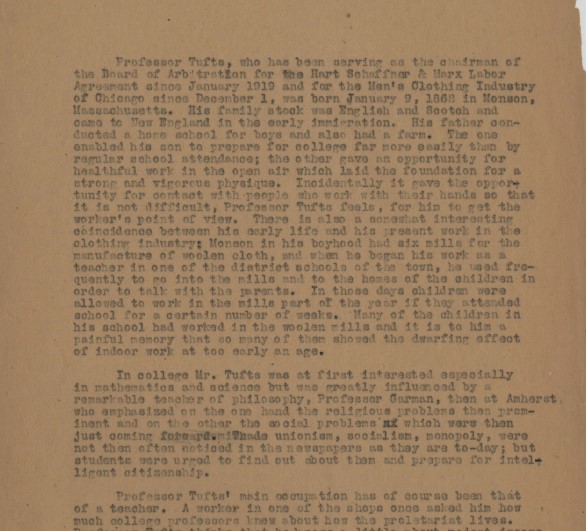
The Hart, Schaffner and Marx Labor Agreement grew out of the unsuccessful nineteen-week strike of workers in the Chicago men's clothing industry in 1910. It was initially signed by representatives of the workers and Hart, Schaffner and Marx, largely at the instance of Joseph Schaffner, and represented a compromise between the United Garment Worker's (UGW) demand for a closed shop and management desire for an open one. Under the agreement of March 13, 1911, an arbitration board was set up for the settlement of shop grievances. It was composed of Clarence Darrow for the workpeople and Carl Meyer for the company. Inasmuch as Dean Wigmore of Northwestern Law School, whom they chose as impartial chairman, was unable to serve, the two functioned alone. Early in 1912, a trade board, with joint representation, was set up as a court of first resort when shop chairmen (UGW agents) and foremen were unable to settle disputes on the floor. James Mullenbach was impartial chairman of this body from its inception until 1935. At the same time, John E. Williams became impartial chairman of the arbitration board, holding the position until 1919, when he was succeeded by James H. Tufts. In 1914, a supplementary agreement established a "preferential shop," based on the system obtaining in the New York market, and giving the UGW preference in hiring. At the same time, the Arbitration Board was given power under an "emergency clause" to adjust wages.
A University of Chicago collection of three document boxes from the Hart, Schaffner, and Marx Labor Agreement of 1911.

University of Denver
"The 1913-1914 Colorado Coal Strike was one of the most violent strikes in United States history. Although they were ultimately defeated, the coal miners in this strike held out for 14 months in makeshift tent colonies on the Colorado prairie. The strike resulted in an estimated 66 deaths and an unknown number of wounded. Although the United Mine Workers of America (UMWA) lost the Colorado Strike, it was, and still is, seen as a victory in a broad sense for the union. The Coal War was a shocking event, one that galvanized U.S. public opinion and eventually came to symbolize the wave of industrial violence that lead to the "progressive" era reforms in labor relations (Crawford, 1995; Gitelman 1998). Coal miners in Colorado did ultimately see some material gains."
Lesson Plans are at https://www.du.edu/ludlow/cfplans.html
An archaelogical dig and its findings, including maps

University of Illinois
Together with the introduction of rural mail delivery, the telephone, and the automobile, farm newspapers played a key role in the modernization of rural America. The Farm, Field and Fireside collection contains historically significant U.S. farm weeklies published in the late nineteenth and early twentieth centuries. These titles document a time of transition in American agriculture, politics, family life, and technology.
The Farm, Field and Fireside collection contains historically significant U.S. farm weeklies published in the late nineteenth and early twentieth centuries.

University of Illinois
The Women in Computing and Information Technology Oral History Project includes interviews conducted with women faculty in the U of I Department of Computer Science and IT professionals on campus as part of the ACM-grant funded project "From Margin to Center: Reframing the History of Women in Computing and Information Technology through Oral Histories."
A University of Illinois collection of six oral histories taken from women faculty in the U of I's Computer Science and Information Technologies divisions.

University of Illinois Archives
The digitized content of the Thomas J. and Elizabeth Chambers Morgan collection consists of letters, notes, speeches and addresses, and newspaper clippings regarding Thomas and Elizabeth Morgan involvement with Mother Jones, the labor movement, and the Socialist Party.
Thomas J. Morgan (1847-1912), known as Tommy Morgan, a lawyer, socialist, and labor leader, was born in Birmingham, England, and came to Chicago where he became president of the Machinists' Union in 1874. He was active in numerous labor organizations as an official, speaker, and writer as well as a frequent labor and socialist nominee for political office. From 1909 to 1911, he issued a weekly publication, The Provoker. His wife, Elizabeth Chambers Morgan, was also deeply involved in the labor movement. Among other activities, she investigated sweatshop conditions among women workers in Chicago in 1891. She compiled the correspondence and clippings in this collection.
The digitized content contains letters, notes, speeches and addresses, and newspaper clippings relating to Thomas and Elizabeth Morgan's involvement with Mother Jones, the labor movement and the Socialist Party, and Morgan's The Provoker. Included are letters to Thomas J. Morgan expressing support of The Provoker and some criticizing him for the publication, and letters to and from Elizabeth Morgan about the Woman's Federal Labor Union.
f letters, notes, speeches and addresses, and newspaper clippings regarding Thomas and Elizabeth Morgan involvement with Mother Jones, the labor movement, and the Socialist Party.
University of Illinois-Springfield
The UIS Oral History Collection is a large collection of taped, transcribed and digitized audio interviews and textual memoirs collected from the 1950s to the present. These oral histories, mostly collected from a wide variety of persons in and around Illinois, are a vital record of life in the Midwest from the late 19th century to the present. Nearly all of the UIS Oral History Collection, both the audio interviews and transcripts, are available online at the Illinois Digital Archives (IDA).
A collection of over 2,960 hours of audio tape focusing on life in the twentieth-century Midwest, with insights on the lives and culture of African-American, Italian-American, and Jewish communities.
University of Iowa
The Edna Griffin papers date from 1948 to 2004 and measure 2 linear inches. The papers contain very few personal items. The biographical information includes details about several awards Griffin received. Most of the articles in the newspaper clippings folder describe the celebrations marking the 50th anniversary of Griffin's successful effort to desegregate Katz Drug Store. The transcript and audiocassette of an interview with Phyllis Griffin, Edna Griffin's daughter, conducted by Noah Lawrence in 2004 is also included; Phyllis Griffin reflects on the values her mother imparted to her, the relationship between her parents, and her mother's early life experiences. Photocopies of the documents in Griffin's FBI file, declassified in 2006, offer many details about Griffin's work with the Progressive Party during the late 1940s and early 1950s. Here, you will find six links for exploring the University of Iowa's holdings relevant to Edna Griffin's life. Each link is numbered and labeled to match a description below.
Link I - Edna Griffin Papers Main Guide: The University of Iowa Libraries' guide to the Edna Griffin Papers.
Link II - Edna Griffin Images: five photographs of Edna Griffin.
Link III - Phyllis Griffin Interview Transcript, December 21, 2004: the full transcript of an interview between Phyllis Griffin and Edna Griffin.
Link IV - Edna Griffin Newspaper Clippings, 1972-2000: fifteen newspaper clippings from various moments in Edna Griffin's life, mostly pertaining to her organizing efforts at Katz Drug Store.
Link V - Edna Griffin's FBI File, December 1951-February 1955: fifteen scans from the Federal Bureau of Investigation's file on Edna Griffin.
Link VI - State v. Katz, 1949: Twelve separate documents from the State v. Katz case, which involved the Katz Drug Store in Des Moines, Iowa, against which Edna Griffin led sit-ins, boycotted, and picketed because of the store's attempts to restrict service to white customers only.
Link I - Edna Griffin Papers Main Guide: http://aspace.lib.uiowa.edu/repositories/4/resources/1950/collection_organization
Link II - Edna Griffin Images: https://digital.lib.uiowa.edu/islandora/object/ui%3Aaawiowa_3147
Link III - Phyllis Griffin Interview Transcript, December 21, 2004: https://digital.lib.uiowa.edu/islandora/object/ui%3Aaawiowa_3179
Link IV - Edna Griffin Newspaper Clippings, 1972-2000: https://digital.lib.uiowa.edu/islandora/object/ui%3Aaawiowa_3140
Link V - Edna Griffin's FBI File, December 1951-February 1955: https://digital.lib.uiowa.edu/islandora/object/ui%3Aaawiowa_3115
Link VI - State v. Katz, 1949: https://digital.lib.uiowa.edu/islandora/object/ui%3Aaawiowa_2941
The papers of Edna Griffin (known as the "Rosa Parks of Iowa") are preserved in the Iowa Women's Archives.

University of Maryland
Over 1400 digital labor photographs
over 1400 digitized photos
University of Maryland
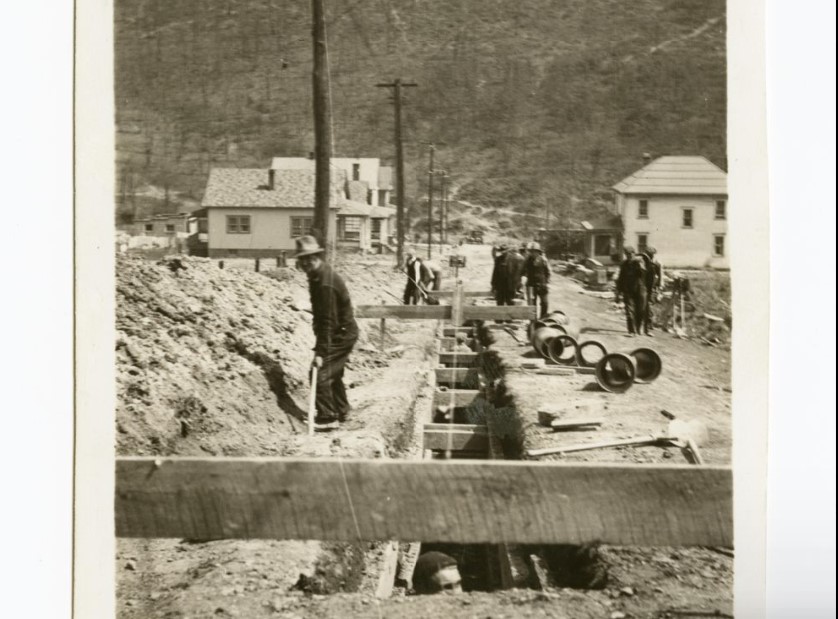
This online database contains over 2000 digitized individual documents, photographs, and artifact fron the Labor Collections. Mostly after 1950. It includes protest newsletters, flyers, photographs, posters and buttons related to various social justice movements. Search for materials geographically as well as by type and keywords
Over 2000 digitized items from across the US, including Coalition of Labor Union Women, Bakery and Confectionary, AFL-CIO,
University of Maryland
searchable digitized items from multiple collections; search for more specific topics in the search button
almost 2000 items of labor material
University of Maryland
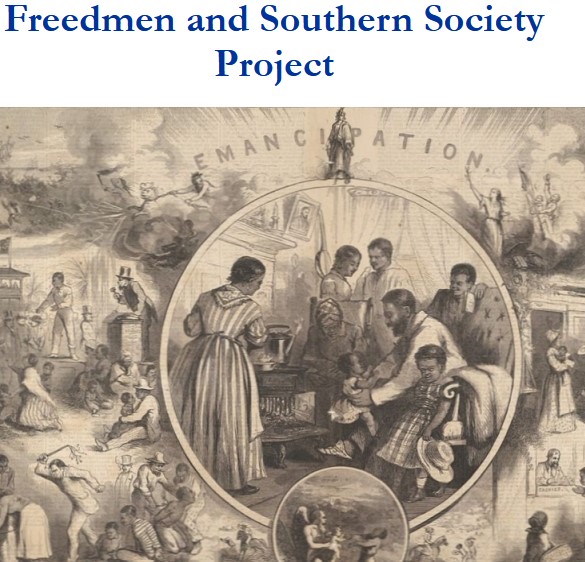
A major digital site for understanding Civil War and Reconstruction era. A selection of documents and teaching guides, in a section Articles in Magazines for General Readers and/or K–12 TeachersNo event in American history matches the drama of emancipation. In the United States, emancipation accompanied the defeat of the world's most powerful slaveholding class, freed a larger number of slaves than did the end of slavery in all other New World societies combined, and accomplished a profound social revolution. The Freedmen and Southern Society Project was established in 1976 to capture the essence of that revolution in the words of its participants: liberated slaves and defeated slaveholders, soldiers and civilians, common folk and the elite, Northerners and Southerners.
Drawing upon the rich resources of the National Archives of the United States, the project's editors pored over millions of documents, selecting some 50,000. They are presently transcribing, organizing, and annotating them to explain how black people traversed the bloody ground from slavery to freedom between the beginning of the Civil War in 1861 and the beginning of Radical Reconstruction in 1867.Placed in the context of the Civil War and Reconstruction with the aid of original essays, the documents uncovered by the project's editors are presented in Freedom: A Documentary History of Emancipation, 1861–1867. A total of ten volumes of Freedom is projected; six have been published to date.
The Destruction of Slavery (series 1, volume 1)
The Wartime Genesis of Free Labor: The Upper South (series 1, volume 2)
The Wartime Genesis of Free Labor: The Lower South (series 1, volume 3)
The Black Military Experience (series 2)
Land and Labor, 1865 (series 3, volume 1)
Land and Labor, 1866–1867 (series 3, volume 2)
A selection of documents from Freedom is available on this web site.
Four volumes prepared for general readers and classroom use have also been published.
Free at Last: A Documentary History of Slavery, Freedom, and the Civil War
Slaves No More: Three Essays on Emancipation and the Civil War
Families and Freedom: A Documentary History of African-American Kinship in the Civil War Era
Freedom's Soldiers: The Black Military Experience in the Civil War
The documents convey with first-person immediacy the experiences of the liberated: the quiet personal satisfaction of meeting an old master on equal terms and the outrage of being ejected from a segregated street car; the elation of a fugitive slave enlisting in the Union army and the humiliation of a laborer cheated out of hard-earned wages; the joy of a family reunited after years of separation and the distress of having a child involuntarily apprenticed to a former owner; the hope that freedom would bring a new world and the fear that, in too many ways, life would be much as before.
Digital Project on the post-emancipation experience of freedpeople includes primary documents, a bibliography, teaching guides and a chronology of emancipation.
University of Maryland
The freedmen's labor contracts, which the bureau assisted in drawing up, consist of agreements between freedmen laborers and planters stating terms of employment, such as pay, clothing, and medical care due the freedman; the part of the crop to be retained by him; and whether a plot for growing subsistence crops was to be provided. The reports of contracts made were submitted by subordinate officers. Some reports are tabular statements that show the number of contracts approved by the bureau; others are narrative reports that give the name of the employer, the number of employees, and the terms of the contracts approved. Indentures of apprenticeship are preprinted or handwritten forms giving pertinent data concerning the contracted parties, dates of apprenticeship, and include a statement of the obligations and responsibilities of each party. Registers of indentures provide the date, name of the person indentured, name of the officer who officiated, and name of the custodian to whom the person was indentured. Some of the monthly reports of indentures are narrative, while others list persons apprenticed, to whom apprenticed, date of indenture, when the indenture was recorded, and when it was approved by probate court.
The Freedmen's Bureau Online website, which hosts all manner of records relating to Freedmen's labor, but specifically their so-called "freedmen's labor contracts."

University of Maryland
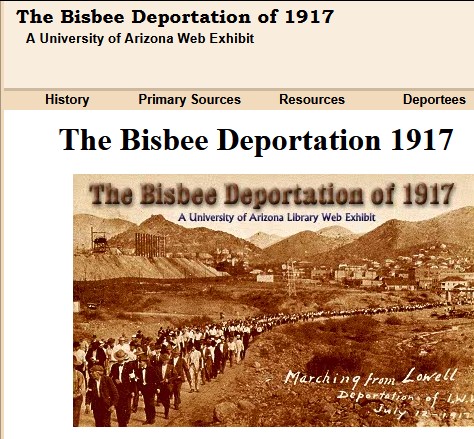
More than two hundred fifty miners lost their lives as a result of a fire that started in the mines of the St. Paul Coal Co. in Cherry, Ill., on Nov. 13, 1909. The United Mine Workers of America blamed their deaths on the failure of the company to alert the miners for two hours--by which time the fire was out of control--and on the inadequacy of both the escape routes and the water supply. This site includes links to: Albert Buckle's and John Stuckert's account of escaping the mine and excerpts from the Illinois State Inspector of Mine's official report on the disaster.
A webpage with brief information on the Cherry Mine Disaster and hyperlinks to important characters in the event.
University of Maryland Archival collections
5 items related to labor and automation, including interviews
5 items related to labor and automation

University of Maryland, College Park
Digitized Labor Periodicals from University of Maryland, College Park
Communist Labor Party newspaper
University of Maryland, Lewis HIne
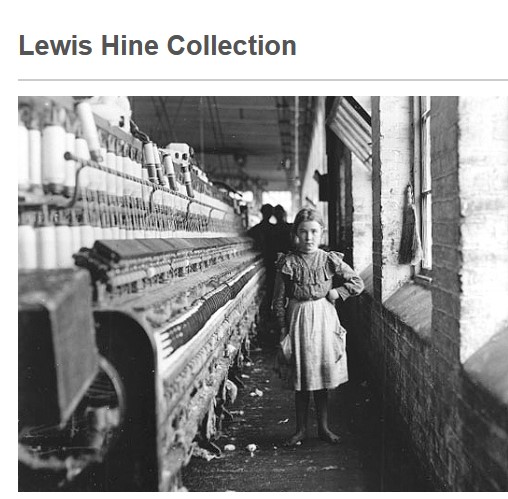
UMBC’s Hine collection includes over 5,000 Hine photographs from 32 states – Over 4,500 of which are digitized and available online. All photos have the NCLC captions. The UMBC holdings are unique in that they are the only complete Hine collection with the backs of the photographs visible. We hope to scan the backs of the photographs and rescan the images at a higher resolution in the near future.
The extensive photographic survey of child labor made by Lewis Hine (1874-1940) during the early twentieth century provided reform groups and the public with visual evidence of the negative impact that work had on children. Hine's photographs helped mobilize society against child labor, while providing an extensive record of working children.
the only complete Hine collection with the backs of the photographs visible
University of Massachusetts Lowell Graduate School of Education
The Workers on the Line program consists of a 90-minute interpretive tour and a 90-minute hands-on workshop. They provide students with the opportunity to explore the causes and nature of the conflict between workers and owners that grew out of the Industrial Revolution. On the tour, students discover firsthand the unique resources of Lowell National Historical Park. The hands-on workshop complements the tour by bringing the significance of historic resources to life as students work on an assembly line. Students tour the Boott Cotton Mills Museum, where they conduct investigations of historical situations that caused workers to organize and protest. A visit to the Boott Mills weave room, with the thunderous roar of eighty-eight power looms, is a graphic example of one important worker grievance. In the workshop, students become workers on textile printing assembly lines. As they take on the role of production workers, they experience a loss of control over their lives as equipment is "speeded up." When wages are cut, they must decide whether to join a union and go on strike.
A lesson plan that uses Lowell Mills and themes of workers issues that resonate today. The Workers on the Line program consists of a 90-minute interpretive tour and a 90-minute hands-on workshop
University of Massachusetts, Boston
This collection contains seven interviews with immigrant women workers who are active leaders around the Chinese Progressive Association and the Asian Pacific American Labor Alliance. The Chinese Women Workers' Oral History Project is a project of the Asian Pacific American Labor Alliance of Massachusetts, University of Massachusetts Boston's Center for Women in Politics and Public Policy, and the Institute for Asian American Studies to document the individual stories of immigrant women workers who have important experiences with grassroots organizing within the labor movement and the community. These important stories of grassroots leadership too ofter are untold and unrecognized.
Interviews from 2020 for limited project

University of Massachusetts, Boston
Local 201 of the International Union of Electronic, Electrical, Salaried, Machine and Furniture Workers/Communications Workers of America (IUE-CWA) has represented workers at General Electric in Lynn, Massachusetts since 1933. Local 201 members and their elected leaders have shaped labor history locally and nationally: building the Congress of Industrial Organizations, bringing landmark sex bias suits, leading campaigns for health and safety legislation, and fighting the outsourcing, downsizing, and offshoring of manufacturing jobs for decades. As the largest private sector union on the North Shore of Massachusetts, Local 201 has been instrumental in leading the North Shore Labor Council (AFL-CIO) and creating the New Lynn Coalition. Today, Local 201 is made up of approximately 1,500 workers at General Electric-Lynn, Lynn Wastewater Treatment Plant, Ametek Aerospace-Wilmington, MA, Avis and Budget Rental (East Boston) and Saugus Librarians. For more information on Local 201, visit https://local201.org/.
Local 201 Oral History Project: In celebration of their ninetieth anniversary, Local 201 partnered with UMass Boston to launch an oral history project in January of 2023. As of September 2023, over fifty interviews have been collected, both in person and on Zoom video calls. The project is co-directed by Local 201 retiree Frank Emspak (Professor Emeritus, University of Wisconsin School of Labor Education) and UMass Boston's Nick Juravich (Assistant Professor of History and Labor Studies), who conducted interviews along with UMass Boston students Layanie Oscar, Scott Richardson, and Kristen Thompson. Student interviewers were supported with funding from the UMass Boston Labor Resource Center and History Department. For more information on the Local 201 History Project, email Nick Juravich at nicholas.juravich@umb.edu.
Local 201 90th Anniversary Digitization Event (2023): In October 2023, Local 201 held a digitization event in partnership with Lynn Museum/Lynn Arts, UMass Boston, 201 Retirees Association, and IUE-CWA Local 201.
digitized items from CWA Local 201, 1933-2023

University of Massachusetts-Boston
On September 9, 1919, more than 1,100 Boston Police officers went on strike for fair wages, decent working conditions and their right to organize. To commemorate the centennial of this event, the 1919 Boston Police Strike Project created a database of the strikers’ biographies. As the project gained visibility, many family members of strikers approached the project team with stories and memories to share. To respond to this interest, UMass Boston launched a pilot project to interview striker descendants and to collect photographs and personal stories that document how the strikers and the strike have been remembered.
This collection currently includes three pilot interviews with descendants.
3 oral histories about the 1919 Police Strike in Boston, the first strike by a public employees union in the US.

University of Michigan-Flint
The General Motors Corporation Sit-Down Strike that occurred in Flint, Michigan, during the winter of 1936-1937 was a pivotal moment in American labor history. It certainly remains the most important event in the history of Flint. Although some of the influential figures in the strike had been interviewed in the 1960s, some in conjunction with Sidney Fine's research for his book Sit-Down, most of the memories of the strike were kept by a dwindling number of its veterans.
In 1978, Neil Leighton, of the Department of Political Science of University of Michigan-Flint, in association with Kenneth B. West, of the Department of History, and William Meyer, of the Department of Political Science, and others, including students, began an oral history project that lasted for about ten years. The project interviewed over 170 people. These included labor organizers and strike leaders, rank-and-file workers with varying degrees of support for unionization, radicals, community members, policemen, National Guardsmen, and others.
Although the subjects of the interviews vary, they generally cover the interviewee's personal and work histories, exposure to labor unions, working conditions before and after the Strike, the Strike itself, and UAW politics after the Strike. Other interviews may include such topics as migration to Flint, W.P.A., C.C.C., and other Depression-era work programs, Masonic/Catholic favoritism, preference of hiring outsiders to local people. In total, they cover the history of Flint's working class during the first half of the 20th century. Most of the interviews have been transcribed, and the transcriptions are searchable by keyword.
Oral histories with the Flint sit-down strikers of 1936-1937, digitally available
University of Minnesota
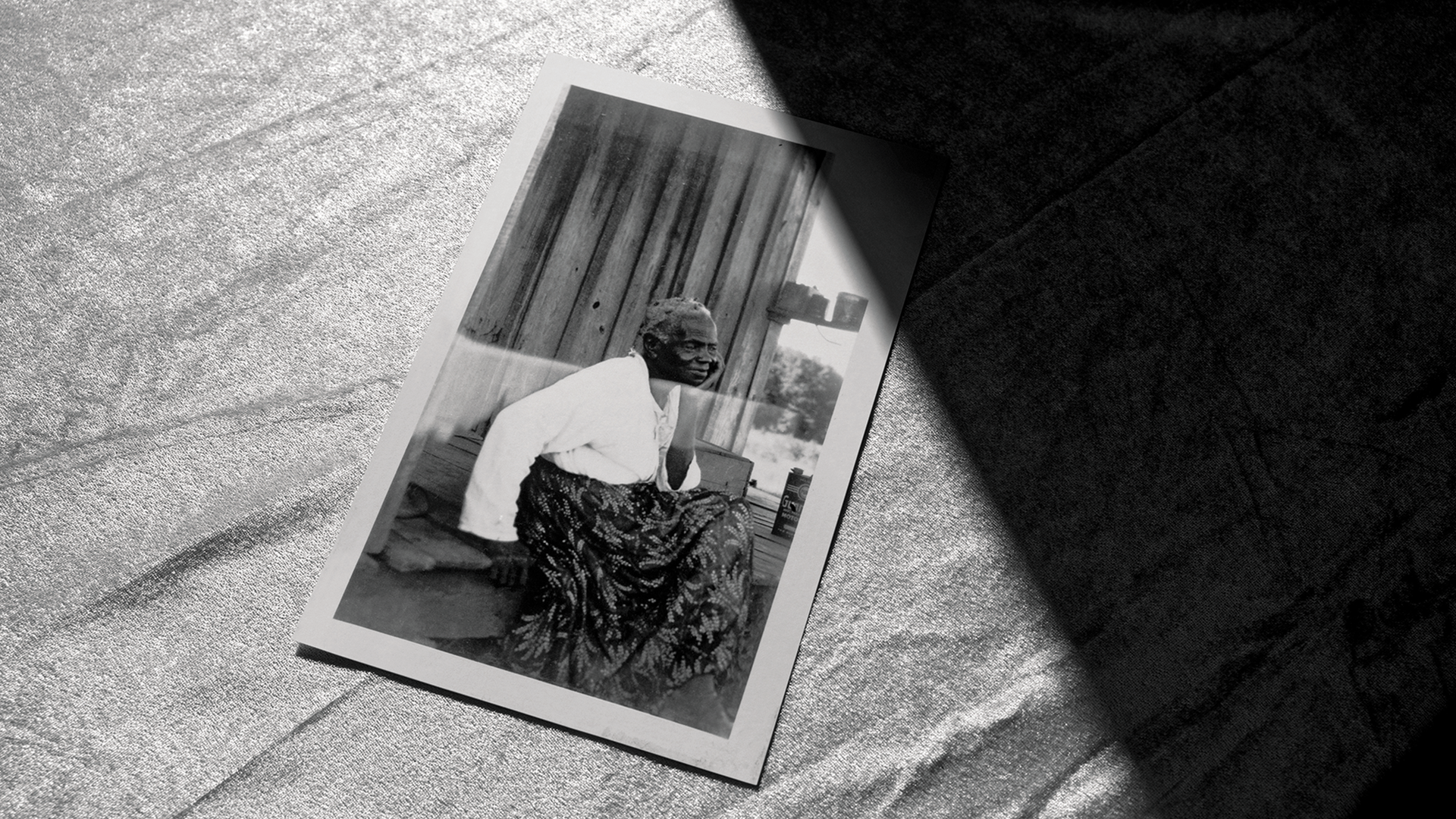
Collection includes original narratives and typed/handwritten transcripts. The original narratives, which were incredibly fragile, have been preserved and restored and are now available to see in person. Photocopies of the handwritten and typed transcripts were created to provide access. Digital preservation copies have also been created.
Link I: https://archives.lib.umn.edu/repositories/5/resources/6427
Link II: https://umedia.lib.umn.edu/search?browse=true&facet_field=collection_name_s&facet_limit=25&facet_offset=0&facet_sort=index&facets%5Bcollection_name_s%5D%5B%5D=Narratives+by+Formerly+Enslaved+Peoples+Collection&letter=N
An oral history collection focusing on twenty-two narratives provided by formerly enslaved peoples, transcribed in the 1930s.

University of Minnesota
Minutes (1912-1915), in Finnish, of the Finnish Socialist Club (Astoria, Ore.), Board of Directors. Although the minutes deal mainly with business affairs, they indirectly reflect much of the cultural and political activity in the Astoria Finnish socialist community during this time. For example, the minutes for 1913 include records of donations to the striking copper miners in Michigan. Except for Board minutes published in the newspaper Toveri, these are the only known extant minutes of the Finnish Socialist Club of Astoria, Oregon.
An archival collection comprised of minutes from the Finnish Socialist Club of Astoria, Oregon, with records of their donations to Michigan copper miners.

University of Minnesota
Records of Five Towns Community House, which served five suburban communities located on Long Island in Nassau County, New York. The records consist of minutes, agenda, correspondence, reports, statistical reports, financial records, ephemera, newspaper clippings, press releases, ephemera and photographs. The records document the administration, programs, and staff of Five Towns Community House and reflect its involvement with the local community. Materials related to group work with settlement youth clubs provide insights into community life. In addition, the records document how settlement programs and theories were implemented at the local level. Also included are files on the supervision of social work students who had field work placements at the house.
Correspondence, minutes, agenda, reports, statistics, photographs, and more from the Five Towns Community House which served surburban communities on Long Island, New York.
Museum/Exhibits
Tours
Maps
Digital Projects
Organizations
Sites
Film/Video
Audio/Interview
Podcast/Program
Text/Document
Image
Graphs/Data
Timeline
Southwest
West
Midwest
Southeast
Northeast
Mexico
Canada
Global
Books
Teaching
Lectures
Digital Archives
Journals
Bibliographies
Topic Intro