


Explore thousands of items. Use clickable links under collections and library for broad categories. Search by keyword (including topic,city, state.) Limit by time period, type of item, region. See our search tips page for more assistance.
Collections
Library
Type
Region
Coverage:
-
Published:
-

University of Minnesota
A collection of nineteen photographs demonstrating the experiences of Hungarian Americans in the United States, with a focus on political activities, independence demonstrations, community life, and prominent figures.
A photograph collection held by the University of Minnesota, detailing the experiences of Hungarian Americans in the 1950s, 1990s, and 2000s.
University of Minnesota
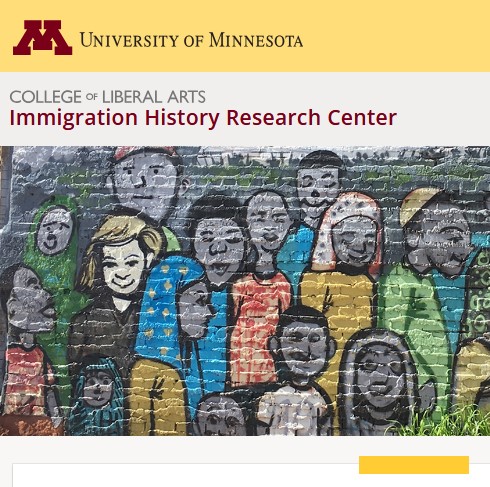
A large collection with tens of thousands of digitized items. THe word labor in the search engine returns over 20,000 items. Text and photo documents related to a wide array of migrant and immigrant experiences in the Midwest.
The general collections of the Immigration History Research Center at the University of Minnesota.
University of Minnesota
Reports, minutes, correspondence, newsletters and clippings, conference materials, and other records documenting various committees, programs, and conferences intended to monitor and promote the process of integration and the elimination of racial inequality within the YMCA, as well as to identify and address the unmet needs of African American and other non-white people served by the organization. Major bodies represented include the National Study
Commission on Interracial Practices (1950-1954), the Commission on Interracial Policies and Program (1955-1967), the Committee on Interracial Advance (1965-1969), and BAN-WYS (1968-1980). Records are organized primarily by committee, conference, or program, but there are additional materials from these bodies included in the files of individual National Board staff members (primarily those of Leo B. Marsh) as well as in the substantial series of reports. Also included are collected printed materials concerning race relations published by various other organizations, including the NAACP.
A collection of documents demonstrating the YMCA's process of promoting racial integration from 1946 to 1980.

University of Minnesota
The Italian American collection contains roughly two hundred primary source documents (photos, text documents, administrative records), covers the years 1919 to 1974, and offers insight into the lives of Italian Americans in the Midwest.
A University of Minnesota collection centered on the experiences of Italian Americans, as seen through a large variety of mixed materials.
University of Minnesota
Collection consists of 7 oral histories conducted with Italian Americans in Duluth, Minnesota by Josephine Moran in 1979-1980.
A Univesity of Minnesota-held oral history project focusing on Italians and Italian Americans in Duluth, Minnesota.
University of Minnesota
All oral histories are recorded onto cassette tapes; for those where there are transcripts available, this is noted. Transcripts are handwritten and typed and contain notes surrounding the project the oral history was taken for. The oral histories span from 1962 to 2010, although some are undated. Many of the oral histories from this collection were part of larger projects both affiliated with JHSUM or not, and include: South Dakota Oral History, World War II Project, Gentiles Preferred Project, Nahum Kipnis Project, Soviet Women "Old Lives, New Lives" Project, Beth Jacob Oral History Project, Radical History Project, North Side Project, Judges and Lawyers Project, UJFC Jewish Settlers in Minnesota Project, and more.
An oral history collection organized by the Jewish Historical Society of the Upper Midwest, covering a wide array of topics and historical projects.
University of Minnesota
The collection contains administrative documents, budgets and financials, news clippings and flyers, correspondence, committee files, minutes, newsletters, scrapbooks, and program flyers. Extent dates are 1975-2010: bulk dates are 1975-1996.
University of Minnesota
The collection documents the beginnings of La Raza on campus, including its founding as the Latin Liberation Front. It also documents the connections between the local and national community and the student organization,
and the international political, economic and socal issues that informed the organization's scope and activities. There is also material in the collection documenting the challenges faced in establishing and supporting the Chicano Studies Department on campus.
Programming documentation, in the form of program flyers and announcements, is relatively comprehensive for the 1980s through 2004.
A collection focused on the history of La Raza/Latin Liberation Front on the University of Minnesota's campus.
University of Minnesota
Most of the 75 images depict life in the UNRRA-administered DP Camps in Germany immediately following World War II. Subjects include Jewish war orphans and Displaced Persons, injured German children, as well as Belarusian, Polish, and Yugoslav Displaced Persons, and “repatriation” processes. The subject matter of the collection also shows effects of the war more broadly, and Rude's activity as a photojournalist in the subsequent decades. This includes
3 images from South America, described by CHGS as "Select photographs of Rude’s taken in Paraguay …and depict dictator Alfredo Stroessner, who sheltered Nazi war criminal Josef Mengele before he fled to Brazil.” All photographs from the collection have been digitized and are available.
A collection of seventy-five photographs depicting displaced persons lives in camps after WWII.
University of Minnesota
The National Conference of Christians and Jews records include annual reports, conference and institute proceedings, speeches, administrative records, studies, project files, pamphlets and NCCJ publications, and correspondence. The records also contain the speeches, articles and correspondence of Everett Ross Clinchy, who was the founding director of the organization, as well as materials from other early officers and significant figures.
The NCCJ records document the organization's effort to facilitate dialogue and understanding between major religions and to promote religious freedom and tolerance, racial justice, and cultural understanding. Among many other topics, the records document such NCCJ programs as: Brotherhood Week, "Tolerance Trio" tours by religious leaders associated with the conference; special projects, such as the Religious Freedom and Public Affairs Project; conferences, seminars, and institutes held by the NCCJ; responses to political and religious persecution of Jews during the 1930s and work during World War II; efforts to reconcile Christian actions during the Holocaust and to commemorate the events of the Holocaust; and efforts to promote religious tolerance in politics, industry and in all levels of education, including theological seminary education. Mid 20th century concepts of democracy, brotherhood, good will, tolerance, and religious liberty are frequently reflected in the records. The early history and activities of the International Conference of Christians and Jews are also reflected in the records.
A collection based on documents from the history of the National Conference of Christians and Jews, dating between 1927 and 1989 and containing over two hundred documents and images

University of Minnesota
National Federation of Settlements and Neighborhood Centers records consist of correspondence, memoranda, reports, minutes, financial records, photographs, and other documents received from the National Federation of Settlements and Neighborhood Centers, now United Neighborhood Centers of America. The Federation, an association of local settlement houses and neighborhood centers from across the United States and Canada, was founded in 1911.
The records
document the work, methodology, membership, and administration of the NFSNC, which was known at the National Federation of Settlements until 1949 and became United Neighborhood Center of America in 1980. The records form an integral part of the Archives' holdings on the history of social reform and social welfare. In addition to advising and supporting the work of member agencies, the Federation determined the needs and goals of settlements and interpreted them to a national audience. Some of the significant issues documented in the NFSNC records are: the ''Americanization" of immigrants in the settlements; the peace movement, especially between 1914 and 1941; the establishment and direction of youth work programs; the role of settlements during wartime; the establishment of such federal welfare programs as unemployment relief and social security; music in the settlements; the relationship of the settlements to New Deal welfare programs; the settlements' responses to the Great Depression; prohibition; the trade union movement; various White House conferences; and unemployment. The records also reflect a substantial amount of theoretical speculation on the settlement movement in general: its functions and programs, methods, goals. The detailed information about these issues and individuals makes this a key collection for the study of social reform, social welfare, and urban life in twentieth century America.
A collection of ninety-five documents from the history of the National Federation of Settlements and Neighborhood Centers, showing the organization's inner-workings.

University of Minnesota
The series created in 2000 still resonates with us today as the debate over logos for sports teams featuring negative depictions of Native Americans has come to the forefront. Daniel Snyder, owner of the Washington Redskins, continues to fight a name change for the team despite rising public opposition. In 2014, the U.S. Patent and Trademark Office ruled the Redskins trademark was invalid on the grounds that it was disparaging to certain groups, making the future of the Redskins name uncertain. Cleveland Indians mascot “Chief Wahoo” (who is the inspiration for the artwork) may not be featured as prominently as he once was, but still remains as part of the team’s logo.; Oscar Arredondo, an Aztec Native American has directed much of his work towards the use of Indian symbols as trademarks and logos for sport's teams, especially those at colleges and universities. Native Americans, like African-Americans and Jews have been the target of derogatory and stereotypical portrayals throughout American Popular culture. In addition to team logos, there have been negative depictions in film, TV, books, postcards, games, comic books, ads and other so-called collectable items. Arrendo features these items in his large collage A Mile in My Moccasins.6'6" x 38' x 16". Mixed Media. 1995 - 2000. Arredondo’s assemblage sculptures continue the narrative by bringing together Indian history and contemporary stereotypes. Arredondo was born in Washington, D.C, living in many different places around the country due to his father’s position with NASA. He graduated from the Kansas City Art Institute in 1987. Cleveland Home of the...was an exhibition hosted by the Center in 2000.
A series of graphic artworks mimicking the Cleveland Indians' mascot created by Oscar Arredondo in 2000, highlighting the issue of derogatory racial/ethnic stereotypes in U.S. popular culture.

University of Minnesota
The Polish American collection contains nearly two hundred materials in total, spread across one hundred and seventy-three black-and-white photographs, four examples of correspondence, and six other pieces of media. The collection ranges from 1880 to 1992.
A digitized collection of nearly two hundred archivals materials offering insight into Polish and Polish American communities in the Midwest.
University of Minnesota
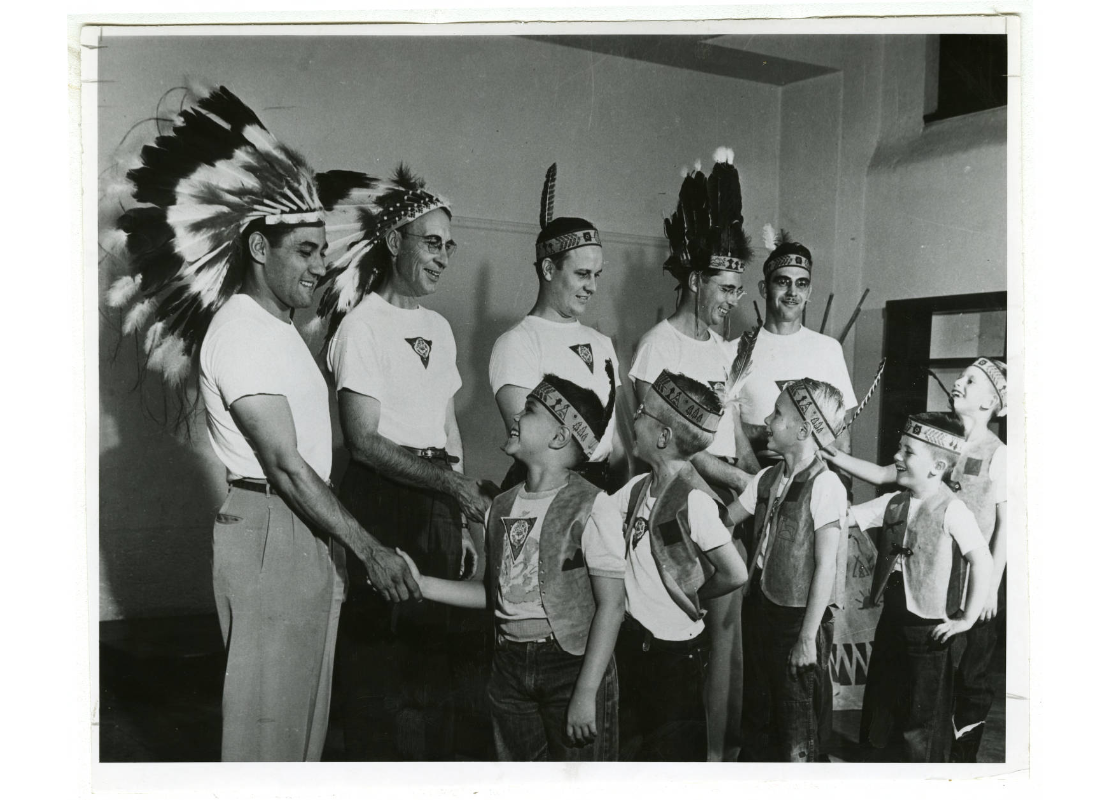
Reports, correspondence, newsletters, and historical material regarding YMCA work with indigenous people in the United States, particularly the Dakota Indians in South Dakota and Nebraska. Much of the collection consists of historical files compiling early correspondence, reports, articles, and constitutions, along with summaries of events prepared by various YMCA historians and librarians. Also included in the collection are records concerning several
of the Indian schools and YMCA Indian summer schools, especially the schools in Carson, Nevada and Carlisle, Pennsylvania, as well as Riggs Institute in Flandreau, South Dakota, and small amounts of material from or about various Native American YMCA branches in South Dakota. The collection also includes several newsletters, including one in the Dakota language. Material from the 1970s and later consists primarily of records of the Sioux Young Men's Christian Association and its relationship with the YMCA's World Service division, including material collected and donated by Daryl Soltau, a board of trustees member of the General Convention of Sioux YMCAs.
A collection of sixty-eight digitized materials related to the YMCA's work with Native American communities between 1874 and 2014.

University of Minnesota
A faculty yearbook photograph of author George Grebenstchikoff.
A collection currently based on a single photograph.

University of Minnesota
Five images and three text documents from Slovak American communities in the Midwest, covering the years 1899 to 1958.
A collection of images and text documents showing insight into the lives and experiences of Slovak Americans in the Midwest.

University of Minnesota
The Slovenian American collection holds twenty-two archival materials in total, comprised of twenty-one images and one text documents. It spans the years 1895 to 1945.
A collection offering insight into the lives and experiences of Slovenian Americans in the Midwest.

University of Minnesota
This collection contains nearly four thousand digitized images from the American Jewish World newspaper, from 1915 to 2007.
A large collection centered on the American Jewish World newspaper, covering the years 1915 to 2007.

University of Minnesota
This collection is hosted by the University of Minnesota, and it ranges in time from 1910 to 1967, covering Greek-American involvement in several important historical events across the twentieth century. While it is mainly a photograph archive, there are also a few examples of correspondence and other text documents.
A collection mostly comprised on ninety-eight images and two text documents giving insight into the experiences of Greek migrants and Greek-Americans in the Midwest.

University of Minnesota
The Ukrainian American collection contains around one hundred archival materials offering insight into their experiences in coming to and living in the United States. It covers the years 1910 to 1998, and includes Black-and-white photographs, prints, manuscripts, book jackets, and a color photograph.
A collection demonstrating the lives and experiences of Ukranians and Ukrainian Americans in the Midwest and elsewhere.
University of Minnesota
11 video recordings of interviews with survivors (or their descendants) of the Ukrainian Famine (Holodomor) of the 1930s. The participants in the project live in Minnesota. Included are also transcripts of all interviews and translations for those in Ukrainian. The following individuals were interviewed: Olga and Halia Chorolec, Olga Kovalevsky, Kira Stetsenko Tsarehradsky, Tatiana Riabokin, Helen Bahmet, Olexa Breslawec, Alla and Oleskiy Khrystych,
Lydia Iwaskewycz, Stefan Iwaskewycz, Alexander Poletz, and Zina Poletz Gutmanis. The interviews are available online in the U Media Archive, please see "Digital material" below. Included are also print materials documenting the famine anniversary commemoration events, and a volume comprising print versions of transcripts of the interviews.
A collection of eleven video recordings from survivors and their descendants, focusing on their experiences in the Ukrainian Famine (Holodomor) of the 1930s.
University of Minnesota
Records (1934-1953) of the Ukrainian Folk Ballet of the Twin Cities consist of three scrapbooks containing the constitution, programs, newpaper clippings, and photographs. All items from the three scrapbooks in the collection have been digitized and are available in the University of Minnesota's U Media Archive. A video featuring items from the collection is also available in U Media Archive.
A collection from the records of the Ukranian Folk Ballet of the Twin Cities.

University of Minnesota
The Italian American collection contains roughly two hundred primary source documents (photos, text documents, administrative records), covers the years 1919 to 1974, and offers insight into the inner-workings of the United Neighborhood Houses of New York.
An archival collection held by the University of Minnesota, offering insight into the organizational history of the United Neighborhood Houses of New York.

University of Minnesota Libraries
The Social Welfare History Archives is part of the Migration and Social Services Collections in the Archives and Special Collections Department (ASC) at the University of Minnesota Libraries. This site has many digitized items and exhibits focused on social welfare work
History of the Social Welfare History Archives
The SWHA was founded in 1964 by University of Minnesota history professor, Clarke Chambers. While researching the history of social service organizations, he realized that their records documented communities and social issues that were often overlooked by historians. He recognized the importance of these resources and worked to locate and archive them. Over time, SWHA developed into an international source of archival records on topics like social work, social issues, and reform.
many digitized items and exhibits focused on social welfare work and related topics

University of Minnesota Library Special Collections,
The Digitizing Immigrant Letters Project aims to make available on-line letters from the IHRC Archives and other collections (private individuals, partner institutions) that were written between 1850 and 1970 both by immigrants (the so-called “America letters”) and to immigrants (“homeland letters”). This project connects on-line letters from the IHRCA and other collections written between 1850-1970, both by immigrants (the so-called “America letters”) and to immigrants (“homeland letters”). It encourages scholars, teachers, students and the public to interpret letters that express emotion and intimacy among loved ones separated by migration.
On this portal website you can explore the archive by basic keyword searching the information about the letters (metadata) as well as their translations into English (available for all letters) and transcriptions. You can also browse the letters arranged in sets by the archival collection from which they were selected, and by date or language.
on-line letters from the IHRC Archives and other collections
University of Minnesota Library Special Collections, Linnea Anderson, Kate Dietrick, Caitlin Marineau
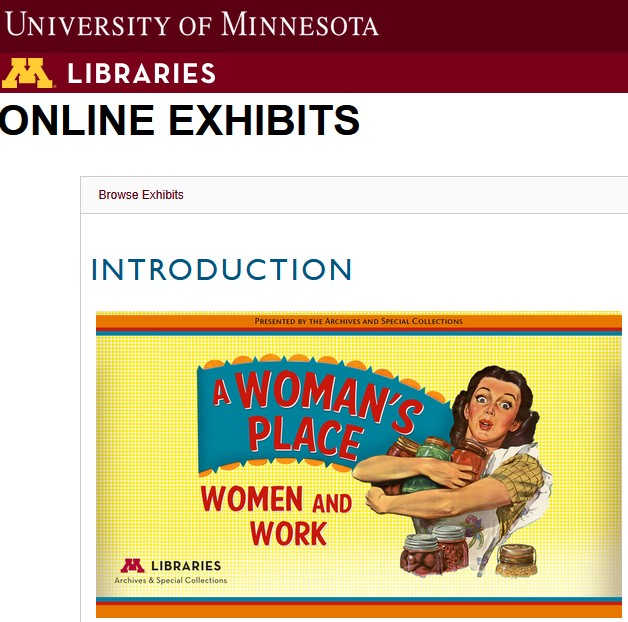
This online exhibit features many digitized items available for research on the topic of women and work, paid and unpaid. While curating this exhibit, we worked to amplify diverse voices and experiences, and document many kinds of working women, including enslaved women. It is important to acknowledge that some of the documents in the exhibit include words, images, and ideas that are outdated or offensive. The University of Minnesota Libraries presents these original documents unaltered as part of the historical record of past beliefs and/or assumptions.
digitized materials in an online essay
Museum/Exhibits
Tours
Maps
Digital Projects
Organizations
Sites
Film/Video
Audio/Interview
Podcast/Program
Text/Document
Image
Graphs/Data
Timeline
Southwest
West
Midwest
Southeast
Northeast
Mexico
Canada
Global
Books
Teaching
Lectures
Digital Archives
Journals
Bibliographies
Topic Intro