


Explore thousands of items. Use clickable links under collections and library for broad categories. Search by keyword (including topic,city, state.) Limit by time period, type of item, region. See our search tips page for more assistance.
Collections
Library
Type
Region
Coverage:
-
Published:
-

University of Montana
This is a collection of stand-alone interviews pulled together by Archives and Special Collections around the topic of unions and labor in Montana. The collection includes interviews with railroad employees, miners, Civilian Conservation Corps [CCC] workers, and union members. These interviews were conducted from 1979 to 1994. The original interviews are held at Archives and Special Collections, Mansfield Library, University of Montana-Missoula.
This collection includes 10 interviews. There are more concerning immigrants and other topics at https://scholarworks.umt.edu/oral_histories/
12 oral histories from Scholarworks, range of occupations
University of New Mexico
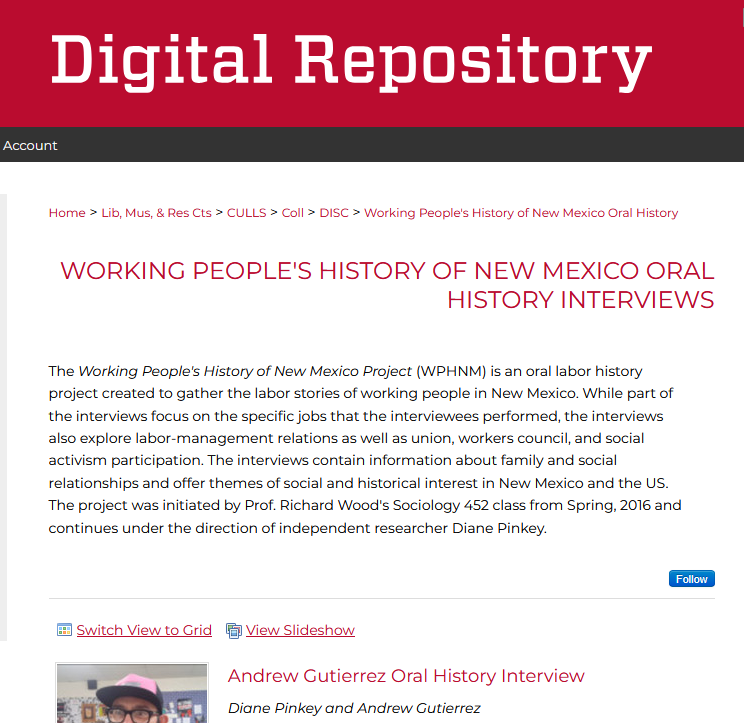
The Working People's History of New Mexico Project (WPHNM) is an oral labor history project created to gather the labor stories of working people in New Mexico. While part of the interviews focus on the specific jobs that the interviewees performed, the interviews also explore labor-management relations as well as union, workers council, and social activism participation. The interviews contain information about family and social relationships and offer themes of social and historical interest in New Mexico and the US. The project was initiated by Prof. Richard Wood's Sociology 452 class from Spring, 2016 and continues under the direction of independent researcher Diane Pinkey.
a dozen interviews conducted by students of union members and officials in New Mexico

University of Pittsburgh
Court and Investigation Documents. Site has some incorret background. Fannie Sellins, who helped to organize thousands of steel and iron workers in western Pennsylvania's Alle-Kiski Valley was murdered just before the 1919 steel strike began. Fannie was born into a Irish immigrant family, lived in the Irish community in St. Louis and when widowed, supported her children in a clothing factory and helped organize Local # 67 of the United Garment Workers. Her union activities brought Sellins to West Virginia for a boycott campaign, where she became involved in with miners and refused to obey an injunction to not deliver food to the strikers, landing her in jail for 6 months.Sellins moved to the Alle-Kiski valley in 1916, where she sought to overcome racial and ethnic divides by working with families. Armed company guards outside the Allegheny Coal and Coke company mine in Brackenridge on August 26, 1919 murdered Fnnie Sellins and miner Joseph [Strzelecki]. The Steel Strike and anti-radicalism made it impossible to bring justice, and the murderers escaped justice. A coroner's jury and a trial in 1923 ended in the acquittal of two men accused of her murder."
Documents from investigation of the brutal murder of Sellins, a union organizer
University of Pittsburgh
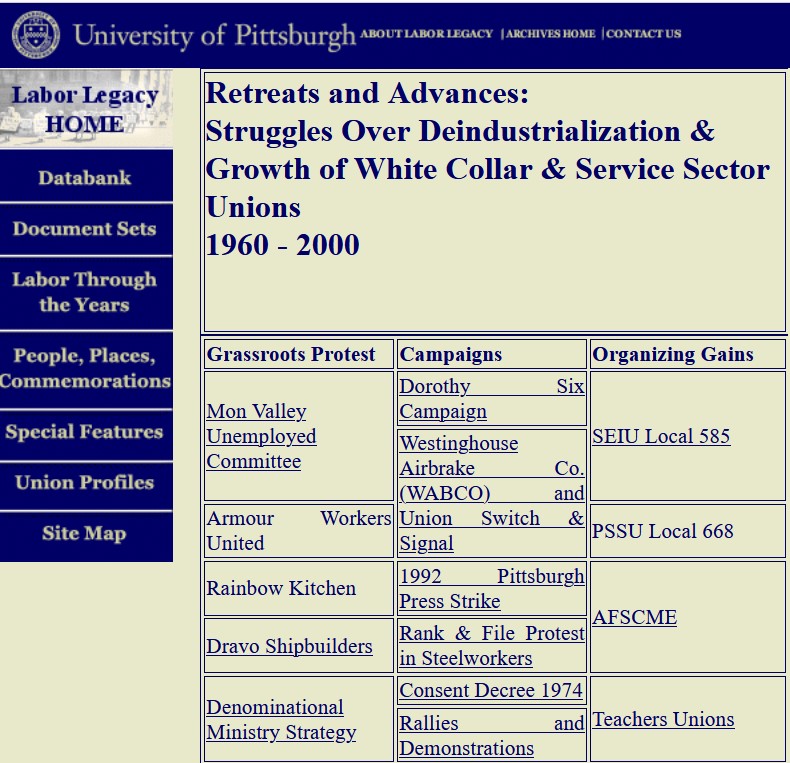
Retreats and Advances: Struggles Over Deindustrialization & Growth of White Collar & Service Sector Unions, 1960 - 2000 (Labor Legacy, University of Pittsburgh): Labor Legacy's collection of links to sources on grassroots protest, campaigns, and organizing gains focused on the themes of deindustrialization, and the growth of white collar and service sectors unions in the mid- to late-twentieth century.
collection of links to sources on grassroots protest, campaigns, and organizing gains

University of Pittsburgh
A newspaper article and a cartoon offering "Some hints for women in the mills for getting through the verbal abuse" they often faced in addition to poor pay and beneficiary shortcomings.
A newspaper article and a cartoon offering "Some hints for women in the mills for getting through the verbal abuse"
University of Pittsburgh
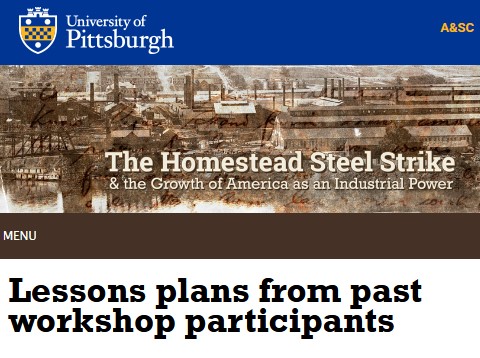
Seeks to provide teachers with a full accounting of the circumstances that led to the Battle of Homestead and what its lasting impact has been in the United States. Over 20 labor-related lesson plans from teachers from across the US in this grant-funded effort to build knowledge of Homestead. Samples of lesson plans include "Why Do Workers Unionize?" and many others are union-themed, or concern specific strikes such as the 1919 steel strike. Another lesson plan is titled Carrie Furnace Yesterday and Today which has extensive maps of the area and shows mill production as well as how the remnants became a place for building connections with community artists. We have not had a chance to review all of these materials, but they seem like sound teaching guides.
over 20 lesson plans from active teachers about various aspects of the Homestead steel Strike of 1892, a pivotal moment in US labor history

University of Richmond
Redlining was the practice of categorically denying access to mortgages not just to individuals but to whole neighborhoods. Between 1935 and 1940, an agency of the federal government, the Home Owners' Loan Corporation, adopted the private discrimination that was part of the banking and real estate industry and developed maps that graded the "residential security" of thousands of American neighborhoods.
By "security," they meant the relative security or riskiness of those areas for banks, saving and loans, and other lenders who made mortgages.
For each of these cities, they produced maps showing those grades. Neighborhoods they deemed "best" and safe investments were given a grade of A and colored green. Those that were deemed "hazardous" were given a grade of "D" and colored red.
In most cases they also generated an "area description" for each of these neighborhoods providing descriptions of the houses, the sales and rental history, and of the residents.
If those residents were African Americans or, to a lesser extent, immigrants or Jews, HOLC deemed them a threat to the stability of home values and described their presence as an "infiltration."
Redlining was legal and practiced for decades. It dramatically affected the relative wealth—as well as the health—of different racial groups in America. Its impact is still with us today.
maps of redlining, with lesson plans

University of Tennessee-Chattanooga, United States Pipe and Foundry Company
two digital collections of photographs and documents detailing the labor and manufacturing history of Chattanooga.The Wheland Foundry and United States Pipe and Foundry photographs digital collection contains 189 items.The Dixie Mercerizing Company photographs digital collection contains 26 items. https://digital-collections.library.utc.edu/digital/collection/p16877coll48
Wheland Foundry closed in 2002, followed four years later by U.S. Pipe and Foundry’s Chattanooga property. Dixie Mercerizing Company is now known as The Dixie Group.https://digital-collections.library.utc.edu/digital/collection/p16877coll45
Dates for the images in both collections range from 1875 to 1976, with the bulk falling around the 1950s. Images are primarily photographs, along with three booklets and the draft of a booklet; a 1930 newsletter for employees living in the Dixie Mercerizing Company’s mill village, Lupton City; and a 1928 reference letter for a former Dixie Mercerizing employee.
100s of photos of Chattanooga manufacturing workers
University of Virginia
Main K-12 Lesson Objectives:
- Become familiar with 18th century runaway slave ads
- Develop strategies for confronting and decoding unfamiliar words
- Identify unfamiliar words and use strategies to decode
A University of Virginia lesson plan designed to help K-12 students learn about primary source research by exploring runaway slave ads and focusing on potentially unfamiliar lanaguage and spelling norms in them.

University of Washington
The 83 day strike that closed West Coast ports in May, June, and July of 1934 did more than secure a victory for the striking longshoremen. It launched the modern labor movement in the western United States.
Forged in the violence and determination of those eighty-three days, was a powerful union that would later rename itself the International Longshoremen and Warehousemen Union (ILWU) and take the lead in creating a CIO presence on the West Coast, helping to launch a dozen other unions.
Forged too was a powerful rivalry between the ILWU and the International Brotherhood of Teamsters. Allies in 1934, the two unions would battle for supremacy on the West Coast for the next two decades, with sharply contrasting visions: the left-wing ILWU-CIO versus the conservative IBT-AFL.
This special section explores the history and impact of the Great Strike, focusing especially on events in the Puget Sound ports. Historians have paid more attention to San Francisco where the dock strike turned into a three-day General Strike that brought the city to a standstill and encouraged federal intervention. Events in Seattle, Tacoma, Everett, and other Puget Sound ports were only slightly less dramatic and no less pivotal. Without the total solidarity that kept every port closed to shipping the 1934 strike would have failed.
A digital collection of resources pertaining to the 1934 Longshormen's Strike
University of Washington
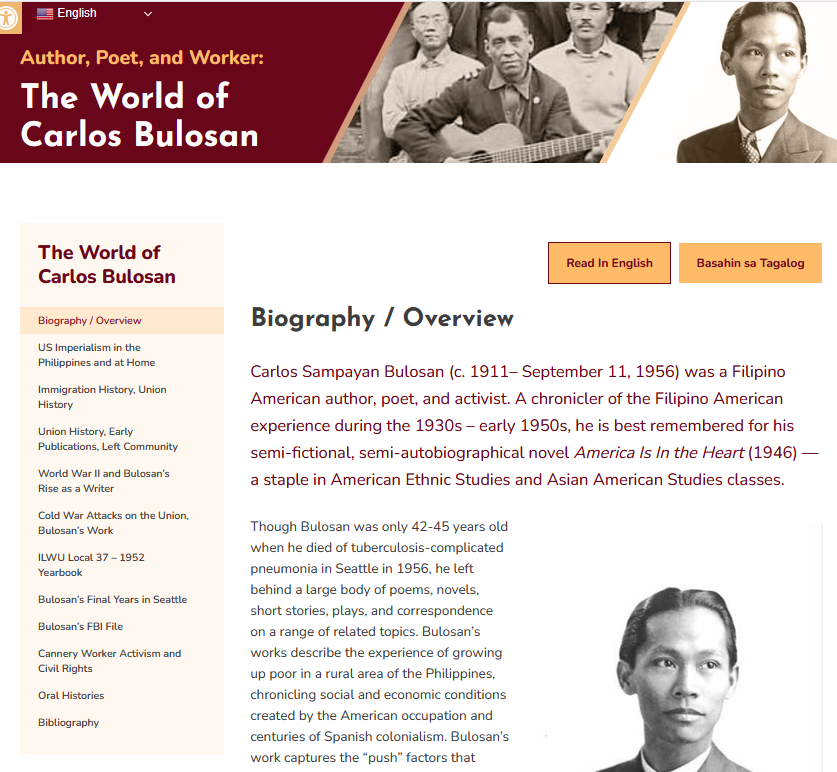
Explore the digital version of LAW’s exhibit dedicated to Carlos Bulosan,(c. 1911– September 11, 1956) a prominent Filipino American labor activist, writer, and poet. Delve into the world of Carlos Bulosan and discover the labor, activist, and ethnic communities that shaped his remarkable life and work.
This exhibit examines Bulosan and the many overlapping communities of which he was a part. As a labor organizer and a self-consciously radical writer, deeply interested in anti-colonial political struggles ongoing in the Philippines, Bulosan was hounded by the FBI. Blacklisted, often in poor health, and unable to work, he lived much of his life in poverty. Nevertheless, a large circle of friends, including radical activists and authors, members of the cannery workers union (ILWU Local 37), and others supported him. These communities recognized the importance of his contributions, and made his work possible.
The exhibit begins with the American occupation of the Philippines, which shaped Bulosan’s childhood, his family's economic prospects, his high school education, and his ultimate arrival in Seattle in 1930. It traces his harrowing years in the Great Depression and the larger immigration context and history, the formation of the cannery workers' union in response to the economic and social climate, his involvement in radical left-wing labor and literary circles, to his breakthrough success as a best-selling novelist during World War II.
Then the exhibit moves on to Seattle, where Bulosan spent the last half-decade of his life until his untimely passing in 1956. Here the exhibit shows Bulosan’s work for the Filipino cannery workers union, his growing concern with Philippine anti-colonial struggles, and the larger radical community of friends and comrades that sustained him. The exhibit also displays selections from his extensive FBI file. Finally, the exhibit illustrates Bulosan’s legacy, taking a look at the many people who have been inspired by his words and deeds.
Table of Contents
Biography and Overview
US Imperlialism in the Phillipines and at Home
Immigration History, Union History
Union History, Early Publications, Left Community
World War II and Bulosan's Rise as a Writer
Cold War Attacks on the Union, Bulosan's Work
ILWU Local 37 - 1952 Yearbook
Bulosan's Final Years in Seattle
Bulosan's FBI File
Cannery Worker Activism and Civil Rights
Exhibit Bibliography
A digital exhibit about Carlos Sampayan Bulosan, who chronicled the Filipino American experience during the 1930s - early 1950s, and is best remembered for his semi-fictional, semi-autobiographical novel America Is In the Heart (1946)

University of Washington
Digitized copies of Cannery Workers News, Cannery Courier, and also an issue of Truth, a newspaper published by the rival Seafood Workers Union (AFL). See https://depts.washington.edu/dock/photos_canneries.shtml
Seattle Cannery workers newspapers digitized
University of Washington
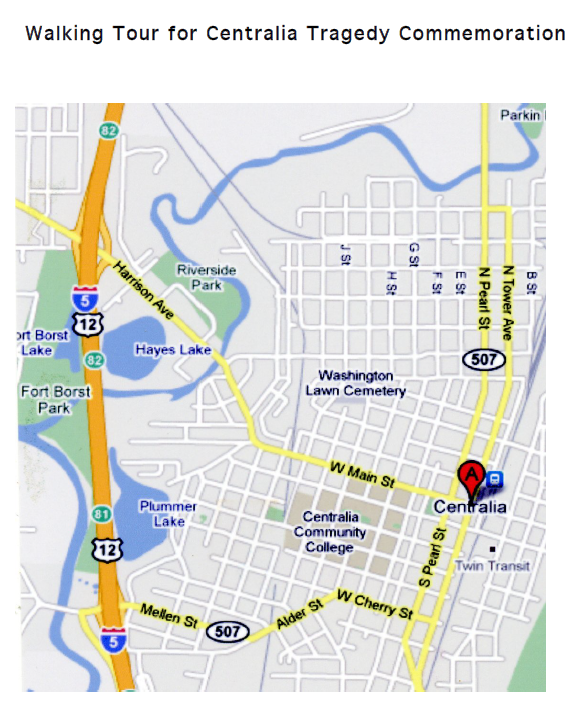
This tour map gives a basic guide to site. It was used for a tour event but the tours are no longer operating. Suggest using alongside the Centralia Massacre 10 part on-line history here: https://www.tlmlabor.org/index.cfm?zone=/unionactive/view_page.cfm&page=The20Centralia20Massacre20Part201 The Centralia Massacre of 1919 was a violent clash in Centralia, Washington, during an Armistice Day parade between the American Legion and the Industrial Workers of the World (IWW). It began when legionnaires marched to IWW's hall, and a gun battle that left four Legionaires dead and many wounded. Afterwards, vigilantes abducted imprisoned union member and WWI veteran, Wesley Everest, and lynched him.
A walking tour of the traumatic conflict and trial and lynching in the aftermath of WWI
University of Washington
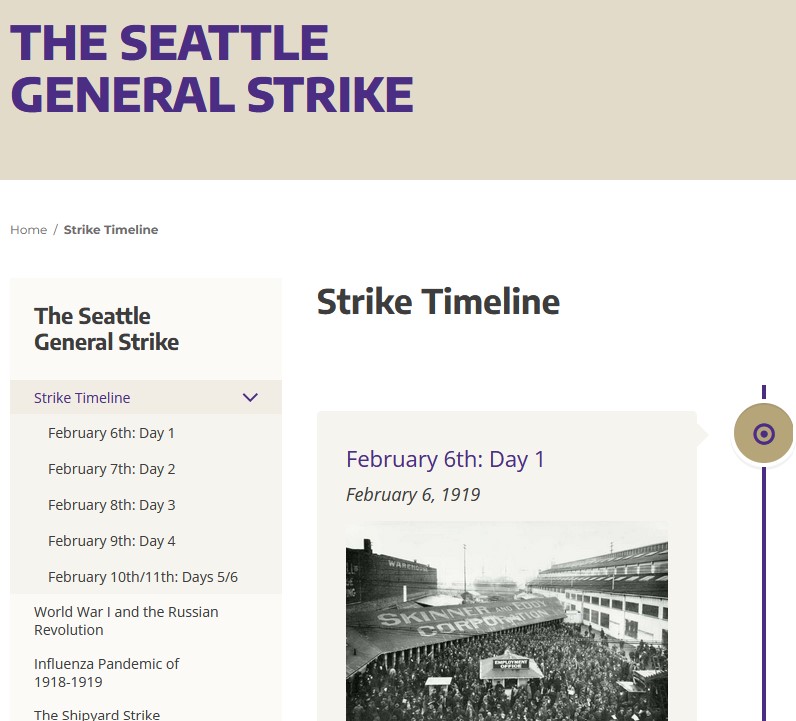
timeline of the Seattle General Strike, 1919
chronological listing of key events

University of Washington
The Labor Archives of Washington, a division of University of Washington Libraries, houses immense collections of IWW photographs, documents, and oral histories. Nearly 500 can be viewed here. Clicking on an image will take you to each collection.
A research portal linking visitors to nearly 500 IWW-related primary sources held in the University of Washington Libraries' Labor Archives.
University of Washington
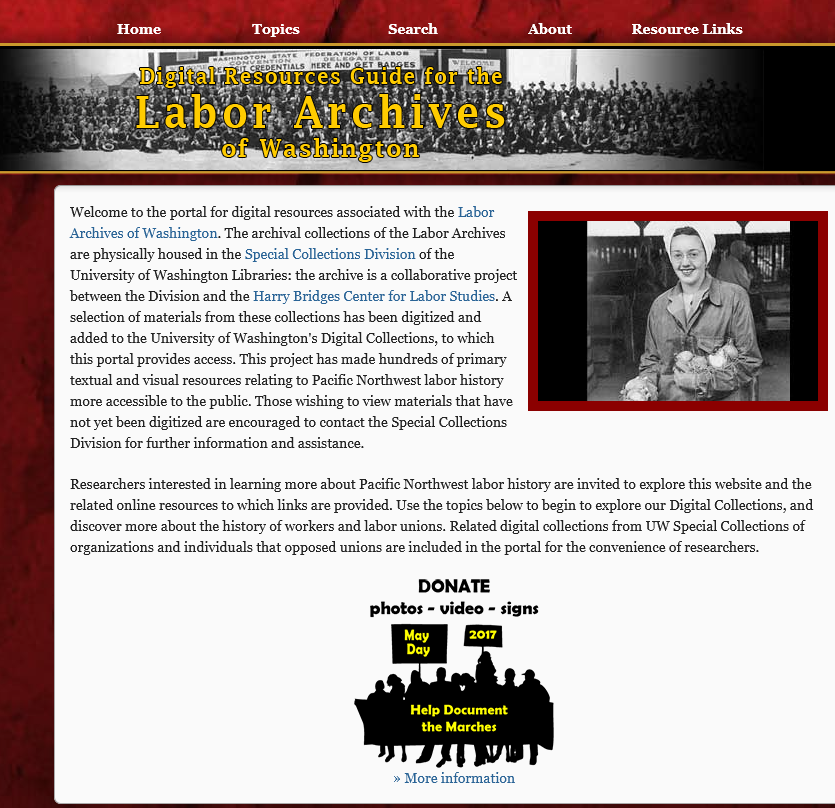
Includes links to several sets of digital resources hosted by the archives. We have the separate listings in our links listing, but this is a portal to all of these digital materials in one link:
The I.W.W. in the Pacific Northwest
The Industrial Workers of the World is an international union that was created in 1905, and rapidly found success recruiting members in the Pacific Northwest. In the 1910s and 1920s, I.W.W. members (often called "Wobblies") were identified with the more radical aims of the organized labor movement in the region. This radical reputation led to violence against the I.W.W., most infamously in the Everett Massacre of 1916 and the Centralia Massacre of 1919. more...
The Seattle General Strike and its Aftermath
The Seattle General Strike in February of 1919 was a six day work stoppage by tens of thousands of workers. It was proposed and carried out by the Central Labor Council of Seattle, an arm of the American Federation of Labor, with the support of many local unions. The events of the strike were used nationwide to alarm citizens about the rise of "Bolshevism", and in its aftermath the city's labor unions wrestled with the question of why the strike had failed to achieve their aims. more...
Anti-Labor Reactions and Labor Espionage
The organization of workers in the Pacific Northwest in the 1910s and 1920s was seen as a threat to the interests of the businesses employing them and the surrounding community. Anti-labor organizations then formed to oppose the labor unions, which they often did with the help of paid labor spies, who infiltrated union meetings in order to supply local businesses with inside information. more...
Labor and the New Deal
The New Deal in the 1930s had a profound effect on the lives and work of many in the Pacific Northwest. New Deal programs from the Civilian Conservation Corps to the Civil Works Administration gave people employment all across the region in cities, farms and forests. Major building projects like the Grand Coulee Dam created opportunities for thousands of workers. more...
Fair Trade not Free: Labor in the Modern Era
Organized labor, which had such a profound effect on the Northwest during the first half of the 20th century, has remained a significant presence in the region throughout the rest of that century and up to today. Labor activism was revived by the civil rights movements of the 1960s and 1970s, and concerns about the impact of globalization boiled over into the streets of Seattle during the WTO's conference in 1999. more...
Cannery Worker Unionism
For much of its existence, the Cannery Workers and Farm Laborers Union Local 7 (now Inlandboatmen's Union of the Pacific, Region 37) has been comprised of mainly Filipino American and Asian American members and officers. Union members played significant political and social roles in the community and many were authors or editors who documented their work and immigration experiences. Because of the union's integral part in the work and social lives of the Filipino American and Asian American community of the Pacific Coast, the organization's records document the labor history and ethnic, industrial, and cultural history of the region. more...
SeaTac/Seattle Minimum Wage History Project
This digital web archive documents the stories of those involved with the historic SeaTac and Seattle minimum wage campaigns of 2013-2014 (also called the 15 Now movement). Audio and video oral history interviews and transcriptions, photographs, archived websites, and digitized documents show the struggle of coalitions of workers, union officers and members, nonprofits, and faith organizations to win the new minimum wage and other important protections. The stories of others involved in the campaigns including politicians, business people, and opponents are included here as well. Visit the website
Correll
Richard V. "Dick" Correll (1904-1990), described as "one of the leading masters of printmaking in the West", was best known for his powerful black and white linoleum cuts, etchings and woodblock prints. His themes ranged from landscapes, animals and agricultural scenes, harbors and ships, and music and dance to those which reflected his lifelong concern with political and social issues. more...
A webpage hosting several links to digital resources on labor history at the University of Washington
University of Washington
This exhibit explores the history and impact of the Industrial Workers of the World (IWW) through a rich collection of photographs. Showcasing images of labor struggles, activism, and daily life, the collection provides a compelling visual narrative of the IWW’s role in the labor movement. Visitors can engage with the historical context behind these photographs, gaining insight into the experiences and resilience of workers who fought for economic and social justice.
Colorado Mine Strike, 1927-1928
Everett Massacre, 1916
Seattle General Strike, 1919
San Pedro, 1923-1924
San Diego Free Speech Fight, 1912
Centralia Tragedy 1919
Raids on IWW Headquarters and Halls
Industrial Workers of the World Song Book
Clearwater Lumber Strike, 1936
Posters, Signs, and Postcards,
Ephemera
Books for research and further readings
Arthur Boose
Elizabeth Gurley Flynn
Frank Hastings
Joe Hill
Frank Little
Enrique Flores Magón
Katie Phar
A powerful collection of images and posters,signs, songbooks and epheera as well as a bibliography of Pacific Northwest materials of the Wobblies

University of Washington
An ongoing and expanding collection devoted to the workers in the Pacific Northwest from the 1880s to the 1940s. Many occupations and industries are represented including the logging and lumber industry, shipping, fisheries, oystering,canning and agriculture.
Industries and Occupations is an ongoing digital collection of photographs documenting the workers of the Pacific Northwest and Alaska, primarily from the 1880s to the 1940s. Included are images of the logging and lumber industry, shipping, fisheries, oystering and canning, agriculture, blacksmithing, bridge building and road construction, coal and gold mining. The activities of photographers at work, linotype operators and fur trappers are also represented. Because we will be on occasion adding new images to the digital collection, the database will be updated periodically.In addition, our cataloging staff will continue to supplement the metadata attached to each image as new research alters the descriptive records.
An ongoing and expanding collection devoted to the workers in the Pacific Northwest from the 1880s to the 1940s.

University of Washington
"Transcripts of interviews with activists who built the union in the 1930s and 1940s, including Antonio Rodrigo, Bruno Tapang, Carlos Malla, Gerald Laigo, Josefa Barrazona, Paul Tabayoyan, Perry Woodall, Roman and Hazel Simbe, Sinsorso and Fell Ordona, Santiago (Jim) Beltran. And also Filipino community builders Rufina Clemente Jenkins, Francesca Robinson, and Fred Cordova. FANHS Collection." -description from https://depts.washington.edu/dock/photos_canneries.shtml
Transcripts of interviews with activists who built the Filipino Canner Union in Seattle

University of Washington
The protests against the World Trade Organization that rocked Seattle, Washington in late 1999 were an incredibly significant moment in the history of popular protests. Not only did the protestors succeed in disrupting the meetings of the world's most influential trade-governing bodies, but the event drew together incredibly diverse constituencies that represented a wide range of interests, many of which would seem to be incompatible at first light.
The ways these organizations worked together to orchestrate the protest events, which took months of planning, will be the subject of popular and academic research for many years to come. The WTO History Project, a joint effort of several programs at the University of Washington - the Harry Bridges Center for Labor Studies, the Center for Communication and Civic Engagement, the Digital Initiatives project and the University of Washington Libraries Special Collections division of the University Libraries – seeks to make a wide array of resources available to researchers and the interested public via the Internet.
Our unique collection of interviews with protest organizers and participants sheds light on the behind-the-scenes cooperative (and sometimes contentious) relationships among social movement organizations involved in the protests. While many additional materials may be physically examined at the Labor Archives of Washington, University of Washington Libraries Special Collections, we have selected for electronic access from the collection some materials which are most illustrative of the diversity of the protests and which most represent the intense mobilization that made the events so dramatic. Our collection, donated by a great number of generous individuals, seeks to be representative of the diversity of interests that participated in the protests while paying special attention to the role played by organized Labor in these historic events.
The main page for the University of Washington-based project that is designed to preserve and record the history of the 1999 World Trade Organization protests in Seattle, Washington.

University of Washington
Labor organizing in Eastern Washington did not emerge in a vacuum. Former Yakima Valley child farm workers that were upwardly mobile, including Tomás Villanueva and Martín Yañez, emerged as the leadership of the UFW of Washington. They were greatly influenced in the 1970s by the Chicano Movement. Several of the initial union presidents actually volunteered for Cesár E. Chavez’s United Farmworkers of America in organizing campaigns in California prior to beginning their tenure in the Yakima Valley. Moreover, cultural activism played a crucial role in making brown farm worker youth proud to be themselves. In Granger, WA, radio KDNA was brought to the airwaves of the Yakima Valley in 1979 by Ricardo García, Julio Cesar Guerrero, Rosa Ramon and Daniel Robleski. Also important were La Escuelita, a farm worker youth empowerment program, and Teatro del Piojo, made up of poets and artists from the west side of Washington State including Tomás Ybarra Frausto, Antonia Castañeda, Frank Martinez, and Blanca Estrella. These efforts would pay off in building a farm worker consciousness after the United Farm Workers of Washington was formed.
Even before Chicano farm workers organized in rural Washington in the 1970s, the rumblings of farm labor activism had made its presence known throughout the early 20th Century. The Industrial Workers of the World fought for farm laborers in the mid-1910s and 1930s, efforts that included the most notable farm labor dispute outside of California with the Battle at Congdon Orchards in 1933. During World War II, Mexican Braceros who arrived to the Pacific Northwest as part of a bi-national labor program went on strike in response to institutional neglect, poor working conditions, and low pay. Likewise, during this period in the 1930s and 1940s, Filipino farm workers organized for better conditions at work sites both in Western and Eastern Washington.
A digital collection covering history of farm labor agitation in Washington State from the 1910s to the 2010s.

University of Washington
Highlights from Labor Archives of Washington, focusing on bricklayers, roofers, sign painters, and electrical workers.
YWCA Study of Nontraditional Work for Women in Seattle-1978 in Seattle-King county, includes data regarding women employed
Apprenticeships and Training Programs for Women
Advocating for Women in the Workplace including Coalition of Labor Union Women, Child Care and Violence issues of women in the trades
MECHANICA Program Photographs of Women Working, ca. 1970s
Summer School for Trade Union Women, 1987-Present
Nancy Mason and Oregon Tradeswomen, Inc.-Portland, Oregon IBEW union apprenticeship program
A digital exhibit covering the struggles of women to become part of the skilled construction trades in the state of Washington
University of Washington Libraries
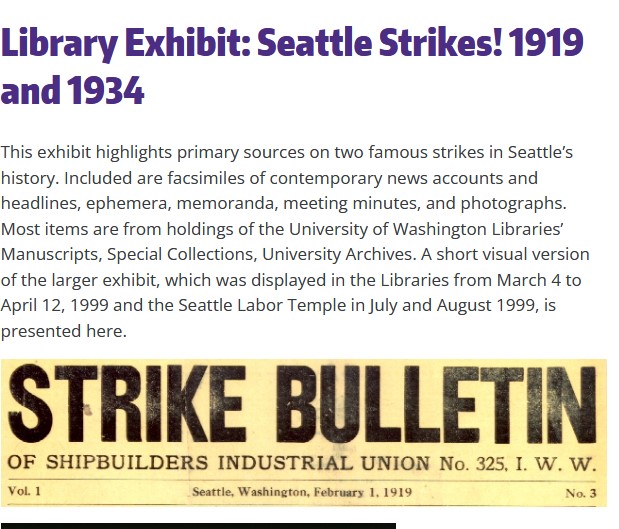
This exhibit highlights primary sources on two famous strikes in Seattle’s history. Included are facsimiles of contemporary news accounts and headlines, ephemera, memoranda, meeting minutes, and photographs. Most items are from holdings of the University of Washington Libraries’ Manuscripts, Special Collections, University Archives. A short visual version of the larger exhibit, which was displayed in the Libraries from March 4 to April 12, 1999 and the Seattle Labor Temple in July and August 1999, is presented here.
Sections on:
Chronology of the Seattle General Strike
1919: A Year of Strikes in the Canadian West
Labor Art in the Puget Sound
Bibliography of Seattle Strikes
Links to Related Sites
A library exhibit featuring several primary documents from the Seattle strikes of 1919 and 1934 including art and timeline
University of Washington Libraries Digital Dollection
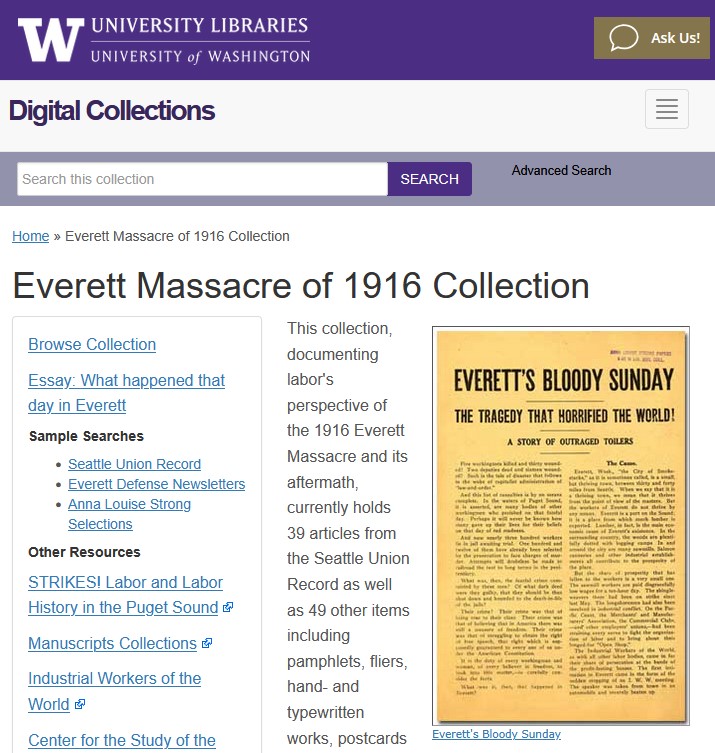
This collection, documenting labor's perspective of the 1916 Everett Massacre and its aftermath, currently holds 39 articles from the Seattle Union Record as well as 49 other items including pamphlets, fliers, hand- and typewritten works, postcards and a photograph.
A digital collection of resources pertaining to the Everett Massacre of 1916.

University of Washington Libraries Special Collections
The rising power and influence of organized labor in the 1910s prompted a response from other groups who saw this trend as a threat. During World War I, both the government and business interests opposed labor’s use of its primary weapon – the threat of the strike – on the grounds of patriotism during a time of war. After the war ended, when the Seattle general strike erupted in part as a response to that wartime dynamic, businesses strengthened their opposition to organized labor, and sought to use new tools in their attempts to prevent labor from achieving its aims. Once the United States had entered World War I, the military's need for lumber skyrocketed—especially spruce, which was used to construct airplanes. When labor unrest in the Pacific Northwest logging industry slowed production, the U.S. Army established the Spruce Production Division, which would send thousands of soldiers into logging camps to limit unionizing activity and help ensure a steady supply of lumber. These efforts were bolstered by the creation of the Loyal Legion of Loggers and Lumbermen, an organization conceived of by Colonel Brice P. Disque, the Spruce Division's commanding officer. The Loyal Legion was not a union—it was an alliance between loggers and employers designed to combat the pressure to unionize, and was particularly aimed at limiting the influence of the Industrial Workers of the World. The U.W.'s Digital Collections provide access to photographs and documents relating to the creation and activities of the Spruce Production Division, as well as documents describing the creation and activities of the Loyal Legion of Loggers and Lumbermen. The largest and most formal of the attempts to unify Seattle’s business interests was an organization called the Associated Industries of Seattle. Founded immediately after the General Strike in 1919, the Associated Industries was the first group to advocate for the "open shop" – an approach they called the "American Plan" – and became the model for similar organizations nationwide. The U.W.'s digital collections include speeches, articles and correspondence written from the perspective of the Associated Industries, giving their impressions concerning events in Seattle and the true intentions of the labor movement. In order to be successful in preventing organized labor from achieving their goals, some local businessmen chose to employ spies to infiltrate labor organizations, particularly the Central Labor Council of Seattle. The U.W.'s digital collections present a large selection of labor spy reports from inside the Seattle labor movement in 1919 and 1920, primarily from two spies (Agents #17 and #106) employed by Broussais Beck, the manager of the Bon Marche, a downtown department store. Beck's spies were successful in winning the confidence of many prominent labor leaders – Agent #17, in fact, was chosen to assist in the auditing of a labor union's financial records – and their reports provide an outsider's perspective on the personalities and conflicts at the heart of organized labor’s work in Seattle.
digital archive of the US army-created Spruce Production Division, Loyal Legion of Loggers and Lumbermen.
Museum/Exhibits
Tours
Maps
Digital Projects
Organizations
Sites
Film/Video
Audio/Interview
Podcast/Program
Text/Document
Image
Graphs/Data
Timeline
Southwest
West
Midwest
Southeast
Northeast
Mexico
Canada
Global
Books
Teaching
Lectures
Digital Archives
Journals
Bibliographies
Topic Intro