


Explore thousands of items. Use clickable links under collections and library for broad categories. Search by keyword (including topic,city, state.) Limit by time period, type of item, region. See our search tips page for more assistance.
Collections
Library
Type
Region
Coverage:
-
Published:
-

University of Washington Libraries Special Collections
selected union correspondece, flyers, brochures and pamphlets, meeting minutes, resolutions, and annual reports from the 1930s through the 1950s. These records document the history and the business of union officers and members as they organized, bargained, negotiated, and administered their contract with employers. This segment also illustrates the elections of union officers, relationships between the union and other labor organizations, and the relationship between members and officers of the organization.
The Cannery Workers and Farm Laborers Union, Local 7 Photographs include over 200 photographs documenting union meetings, events, portraits of union officers and members--primarily from the 1930s-1950s. Photos dating from the 1970s chronicle the role of the union and its members in the Asian American activism and community organizing in Seattle, including images of rallies, demonstrations, parades, and community events in the International District. The photos illustrate discriminatory labor and housing conditions in Alaskan canneries that were key evidence in civil rights lawsuits against the canneries by the Alaska Cannery Workers Association.
Community History
Another group of family photographs from the Filipino American community can be found in the Chris Mensalvas and Silme Domingo Family Photograph Collection.
The Apolonio K. Buyagawan Interviews are a group of oral history interviews with members of the Seattle Filipino American community recording their experiences as workers, immigrants, and community members.
Potenciano Parin Columna Papers chronicle Columna's career as the first and Filipino American pilot and his subsequent service overseas during World War II. Columna was also a long-term member of the Caballeros de Dimas-Alang, a fraternal organization in the Filipino community and filled many important leadership roles. When Carlos Bulosan, a noted Filipino novelist, poet and labor activist, was ill with tuberculosis and receiving treatment at the Los Angeles County Sanitarium, Columna and the Caballeros raised funds to help cover Bulosan's medical costs and try to send Bulosan back to the Philippines to recover. Columna also acted as the manager of The Luau, a Polynesian restaurant in Beverly Hills where he frequently hired Filipino immigrants, often for their first jobs in the United States. He acted as a benefactor for several Filipino students as they made their way through college, continuing to be an important leader in the Los Angeles Filipino community until his death on January 7, 1997.
Caballeros de Dimas-Alang Photographs contain images of events and members of the Filipino American fraternal organization which filled many important leadership roles in the community.
selected papers of the The Cannery Workers and Farm Laborers Union from the 1930s through the 1950s.

University of Washington Libraries Special Collections
Founded in 1933 as the Cannery Workers and Farm Laborers Union, Local 18257 of the American Federation of Labor (AFL), it represented Alaska salmon cannery workers and farm workers. In 1937, the union became Cannery Workers and Farm Laborers Union, Local 7 of the United Cannery, Agricultural, Packing, and Allied Workers of America of the Congress of Industrial Organziations (CIO). In 1945, Local 7 became affiliated with the Food, Tobacco, and Agricultural Workers of America (CIO). In 1951 the union became Local 37 of International Longshoremen's and Warehousemen's Union, and ca. 1987 it became Region 37 of IBU/ILWU. The membership historically was Filipino American cannery workers.
140 items , 1933-1977 from this Alaska canneries union

University of Washington Libraries Special Collections
digitized images of Cannery Workers and Farm Laborers Union, Local 7 photographs. PH Coll 1044
digitized images of Cannery Workers and Farm Laborers Union

University of Washington Libraries Special Collections
The Industrial Workers of the World played a prominent role in other, less violent labor disputes throughout the region, and therefore many documents referencing the I.W.W. appear in the U.W.'s collection, the Pacific Northwest Historical Documents Database. Some of these documents are I.W.W. local charters, as well as letters and manuscripts written from a viewpoint sympathetic to the I.W.W., by individuals involved in organized labor in Washington.
104 items from IWW posters and pamphlets University of Washington Special Collections
University of Washington Libraries Special Collections
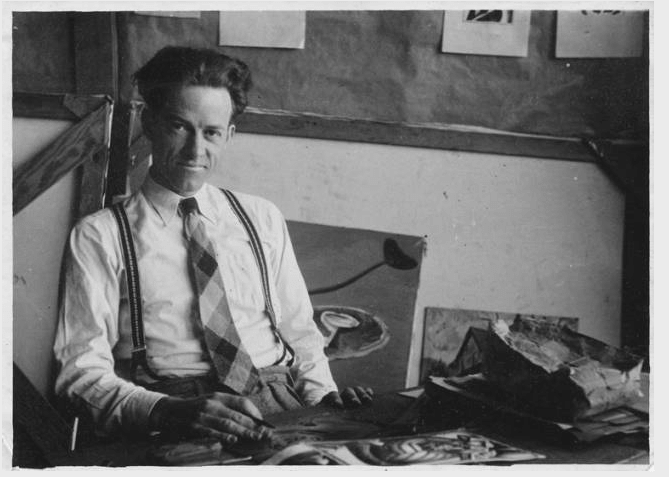
This digital exhibit showcases the work of Richard V. “Dick” Correll (1904–1990), a master printmaker known for his striking black-and-white linoleum cuts, etchings, and woodblock prints. Correll’s art captures themes ranging from nature and everyday life to powerful depictions of labor struggles and social justice movements. His work reflects a lifelong commitment to activism and the fight for workers’ rights, making this collection a compelling tribute to the intersection of art and advocacy.
This digital exhibit showcases the work of Richard V. “Dick” Correll (1904–1990), a master printmaker known for his striking black-and-white linoleum cuts, etchings, and woodblock prints.

University of Washington Libraries Special Collections
During the 1960s and 1970s, the activists who agitated for civil rights and freedoms turned a part of their attention to continuing the work of the labor movement. The U.W. makes available, in its digital collection of Vietnam War Era Ephemera, examples of posters, fliers, and pamphlets distributed in Seattle that advocated workers' rights. The primary emphasis of these documents is on the importance of boycotting non-union produce to support migrant farm workers, and the work of Cesar Chavez to organize these workers. Some materials focus on the use of the 1919 general strike as inspiration for activism, and on continued efforts by some groups to advocate for a more radical labor movement to oppose capitalism and the interests of corporations.
In late 1999, Seattle hosted a meeting of the World Trade Organization (WTO), an international organization of nations that seeks to regulate and encourage international trade. At the time, concerns were increasing about the WTO’s influence, particularly about the impact of globalization and the expansion of international trade on workers, both here in the United States and overseas in impoverished nations. As a result, an unexpectedly large number of protesters gathered in the streets of Seattle between November 29th and December 3rd, leading to clashes with local police, who attempted to drive the crowds out of the “no-protest zones” with pepper spray, tear gas, and rubber bullets. The U.W.’s digital collection, entitled the WTO Seattle Collection, presents hundreds of documents – fliers and leaflets distributed by protesters, interviews conducted after the protests with those involved, and photographs of the demonstrations.
posters, fliers, and pamphlets that advocated workers' rights from 1960s to battle of Seattle
University of Washington Libraries Special Collections
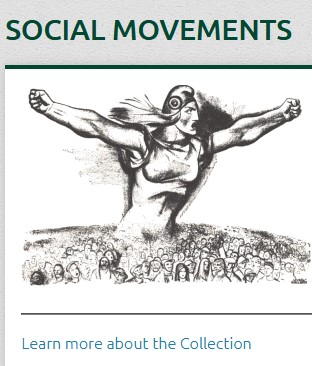
The Social Movements Collection consists of books, leaflets, pamphlets, brochures, and periodicals about the labor movement in the United States as well as global radical political movements, including anarchism, communism, and fascism. The bulk of this collection was acquired by the University of Hawaii at Manoa Library in 1966 from Eugene Bechtold, a bookseller and former instructor at the Chicago Workers' School. Mr. Bechtold began collecting this material in the 1920s; also included are items from the collection of John Reineke. There are approximately 4,200 items and many of them are very fragile. UHM Preservation Department initiated conservation of the collection in 2004 to ensure access to and preservation of this significant resource.
4,200 items pamphlets, brochures, and periodicals about the labor movement in the United States as well as global radical political movements, including anarchism, communism, and fascism.

University of Washington Libraries Special Collections
"The Industrial Workers of the World is an international union that was founded in Chicago in 1905, and reached its height of influence in the United States in the 1910s and 1920s. Above all, the I.W.W. was devoted to the principle of "One Big Union"; the idea that all workers should be united in a single organization in order to place maximum pressure on their employers.
While the I.W.W. was successful in recruiting in many places throughout the country, its influence was most widespread in the Pacific Northwest, as can be seen in the Digital Collections material spotlighted below: Tensions surrounding the Shingle Weavers' Union strike in Everett, Washington became heightened in the summer of 1916 when organizers from the I.W.W. arrived in the town to support the strikers and demand free speech. The opposition to the I.W.W. became increasingly violent, ultimately boiling over in a deadly episode on November 5, 1916, known as the Everett Massacre, in which five I.W.W. members and two sheriff's deputies were killed.
The U.W.'s collection, The Everett Massacre of 1916, displays news clippings, printed ephemera, handwritten documents, and photographs connected with the Everett Massacre and the resulting arrests and murder trial for the 74 I.W.W. members charged in connection with the event. Some citizens of Centralia, Washington assaulted I.W.W. members (often called "Wobblies") and destroyed their meeting hall in 1918, setting the stage for a new confrontation in 1919 when the new I.W.W. hall was completed. During a parade on Armistice Day, November 11, 1919, members of the American Legion attacked the new hall, which the I.W.W. members defended. At the end of what became known as the Centralia Tragedy, four Legionnaires were dead, one man had been lynched, and ten Wobblies were on trial for murder.
The U.W.'s collection, The Centralia Tragedy Collection, displays news clippings, printed reports and ephemera, and photographs connected with the Centralia Tragedy, particularly the attempts by the I.W.W. to defend itself against the charge of violence by explaining the history of anti-I.W.W. violence in Centralia and by clarifying facts about the event that had been distorted by media nationwide.
Another collection, the Pacific Northwest Historical Documents Database, also contains documents relating to the Centralia Tragedy, primarily the reports of labor spies about the impact of the events in Centralia on the labor movement in Seattle. The Industrial Workers of the World played a prominent role in other, less violent labor disputes throughout the region, and therefore many documents referencing the I.W.W. appear in the U.W.'s collection, the Pacific Northwest Historical Documents Database. Some of these documents are I.W.W. local charters, as well as letters and manuscripts written from a viewpoint sympathetic to the I.W.W., by individuals involved in organized labor in Washington. In addition, our digital collection contains dozens of photographs, from the entire IWW Photograh Collection. More frequently, however, these are documents from the papers of individuals and organizations opposed to the I.W.W.: the reports of labor spies employed by the Bon Marche's store manager, Broussais Beck, and the materials they gathered as evidence, along with the private and public statements of other men allied against the Wobblies."
Single webpage hosting links to various collections at the University of Washington concerning the IWW. We have also listed these collections separately

University of Washington Libraries Special Collections
The Seattle General Strike was a city-wide work stoppage by more than 65,000 workers from February 6 to 11, 1919. 110 unions affiliated with the Seattle Labor Council—representing about 20% of Seattle’s population—went out on strike. It was supported in solidarity by large numbers of non-union members and non-wage workers as well. Women, children, and relatives of families with union members supported the strikers. Japanese American labor organizations—though excluded from membership in the largely white US labor movement at the time—chose to honor and participate in the strike alongside their fellow unionists.
Strike Timeline
World War I and the Russian Revolution
Influenza Pandemic of 1918-1919
The Shipyard Strike
The Black Community
The Seattle Union Record and its 28 Year Run
Labor and Seattle’s Environment
Ole Hanson: From Progressive Candidate to “Law and Order” Mayor
Politics of the Seattle Labor Movement
The Industrial Workers of the World
Workers of Color
Cartoons & Illustrations, Poetry, and Songs in the Labor Movement
Anna Louise Strong: Journalist, Poet, and Radical Activist
Working-Class Women of the Seattle Labor Movement, 1900-1920
Women-Led Unions of the Seattle Labor Movement, 1900-1920
Centralia Tragedy/Trial
The Aftermath
Bibliography
Online exhibit is an excellent introduction to the Seattle General Strike.and also covers related topics such as politics of the labor movement, Centralia Tragedy of 1919

University of Washington Library
The Industrial Workers of the World (IWW), sometimes known as the Wobblies, is a radical labor organization that was most active from 1900 to the 1930s. This collection of pamphlets, leaflets and letters, originally held by the now defunct I.W.W. Seattle Office, focuses on the Centralia Tragedy of 1919 in Centralia, Washington. The event is also known as the Armistice Day Riot and the Centralia Massacre, a term coined not largely adopted by the labor movement and social justice advocates because it suggest a one-sided confrontation, when in fact both sides were armed. The material for this database was drawn from a collection in the University of Washington Libraries Special Collections Division entitled, Industrial Workers of the World. Seattle Office, Accession No. 0544-001. Not all the material from this collection was included in this database.
About the Database
The material for this database was drawn from a collection entitled, Industrial Workers of the World. Seattle Office, Accession No. 0544-001, which resides in the UW Libraries Special Collections Division. Not all the material from this collection was included in this database. The material was scanned in grayscale using a Microtek Scanmaker 9600L and saved in .jpg format. Some manipulation of the images was done to present the clearest possible digital image. The scanned images were then linked with descriptive data using Content. The information for the Centralia Tragedy Collection was researched and prepared by the UW Libraries Special Collections and Cataloging staff in 2001.
A research portal and database linking visitors to the University of Washington's 1919 Centralia Tragedy Collection; also known as the Armistice Day Riot and the Centralia Massacre, the event featured armed conflict between IWW activists and disguised members of the American Legion.
University of Washington Library
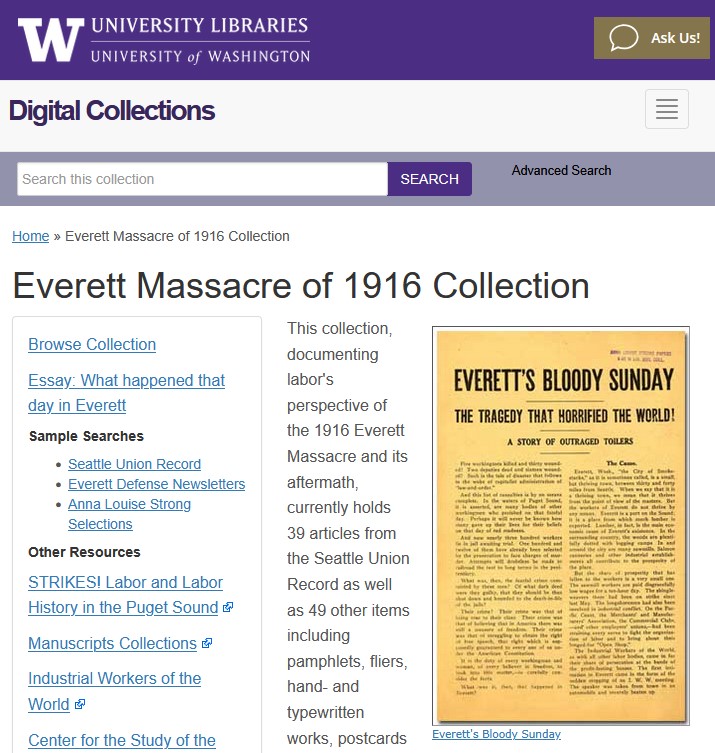
This collection, documenting labor's perspective of the 1916 Everett Massacre and its aftermath, currently holds 39 articles from the Seattle Union Record as well as 49 other items including pamphlets, fliers, hand- and typewritten works, postcards and a photograph. From the page:
Historical Background
The November 5, 1916 Massacre was a culmination of labor trouble which had been brewing for 6 months. On May 1, 1916 the Everett Shingle Weavers Union went on strike. The Industrial Workers of the World (I.W.W.) were not involved when the strike began. The strike was settled quickly, in favor of the mill owners, at all but one mill. This is when the I.W.W. became involved, and this is when the trouble began. (narrative continues at site_)
This database represents a sample of the regional labor-related materials the University Libraries holds. The premier collections of materials concerning the Everett Massacre are held in public libraries such as the Everett Public Library, and in local historical societies and museums. This "seed" collection was funded through an LSTA grant from the Washington State Library Digital Imaging Initiative.
Materials for this database of 110 items https://digitalcollections.lib.washington.edu/digital/collection/pnwlabor/search were selected from the Seattle Union Record and the University of Washington Libraries Special Collections Division holdings by Carla Rickerson and Theresa Mudrock. Materials were selected to provide in-depth labor coverage of both the event and of the following trial. Laura Lins served as project lead. Flatbed scanning was done on a Microtek ScanMaker 9600XL scanner by Laura Lins, Heather Johnson, Jane McFarlane and Julie Moede. Digital photography was done with an Olympus C-2000 Zoom camera by Laura Lins and Heather Johnson. Photoshopping, cataloging and arrangement of all items was done by Heather Johnson and Laura Lins, with assistance from Marsha Maguire and Allen Maberry. Research was done by Heather Johnson.
Everett massacre based on 39 articles from the Seattle Union Record as well as 49 other items including pamphlets, fliers, hand- and typewritten works, postcards and a photograph.

University of Washington Library
In 1925, Colorado mine owners responded to an economic downturn by reducing wages. As the harsh winter of 1927-1928 set in, coal miners initiated a strike, demanding better wages and improved working conditions. The IWW, known for its history in organizing miners during previous mining conflicts, played a pivotal role in supporting the striking workers. However, mine owners took an aggressive stance and hired armed men to assault the IWW's Trinidad, Colorado union hall and Walsenburg branch halls. This attack in Walsenburg resulted in a shooting incident, leaving its mark on the unfolding events.
Within the IWW Photograph Collection, there are images of the victims of these confrontations. The captions written on the back of these photographs provide poignant insights into the gravity of the situation, conveying the struggles and sacrifices faced by those involved in this pivotal labor dispute.
Interpretive exhibit examining the historical and cultural context of the the Industrial Workers of the World Photograph Collection at the Labor Archives of Washington, University of Washington Libraries Special Collections.
University of Washington Special Collections, Harry Bridges Center for Labor Studies
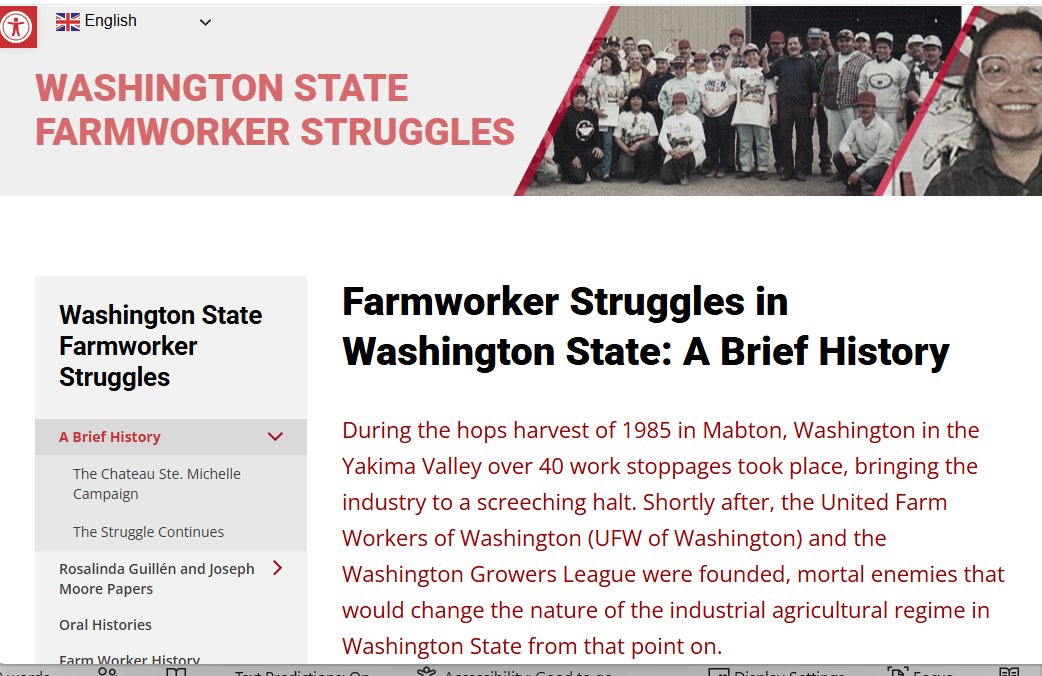
This digital booklet was produced for the second annual Friends of the Labor Archives event, “Preserving Solidarity Forever,” at the University of Washington Seattle. The event showcases the efforts of the Labor Archives of Washington, a joint project of the University of Washington Special Collections and the Harry Bridges Center for Labor Studies. Speakers included Rosalinda Guillén; Julio Romero, Former President, United Farm Workers of Washington State; Ramon Torres, President of Familias Unidas por la Justicia; and Jeff Johnson, President of the Washington State Labor Council, AFL-CIO.
A Brief History
The Chateau Ste. Michelle Campaign
The Struggle Continues
Rosalinda Guillén and Joseph Moore Papers
Oral Histories
A digital booklet that provides an introduction, starting from the 1980s Yakima Valley strikes of 1985
Upton Sinclair, History Matters
In 1904, in the midst of a bitter stockyard strike, socialist writer Upton Sinclair’s two-month visit to Chicago’s “Packingtown” area provided him with a wealth of material that he turned into his best-selling novel, The Jungle. The book is best known for revealing the unsanitary process by which animals became meat products. Yet Sinclair’s primary concern was not with the goods that were produced, but with the workers who produced them. Throughout the book, as in this chapter, he described with great accuracy the horrifying physical conditions under which immigrant packing plant workers and their families worked and lived, portraying the collapse of immigrant culture under the relentless pressure of industrial capitalism. Despite his sympathies, as a middle-class reformer Sinclair was oblivious to the vibrancy of immigrant communities beyond the reach of bosses, where immigrants found solidarity and hope. Sinclair’s graphic descriptions of how meat products were manufactured were an important factor in the subsequent passage of the federal Pure Food and Drug and Meat Inspection Act in 1906. Sinclair later commented about the effect of his novel: "I aimed at the public’s heart and by accident hit its stomach."
(teaching document) A passage from chapter nine of Upton Sinclair's famed book The Jungle, which demonstrates his central focus on the plight of workers in the Chicago meatpacking industry.
Utah Phillips
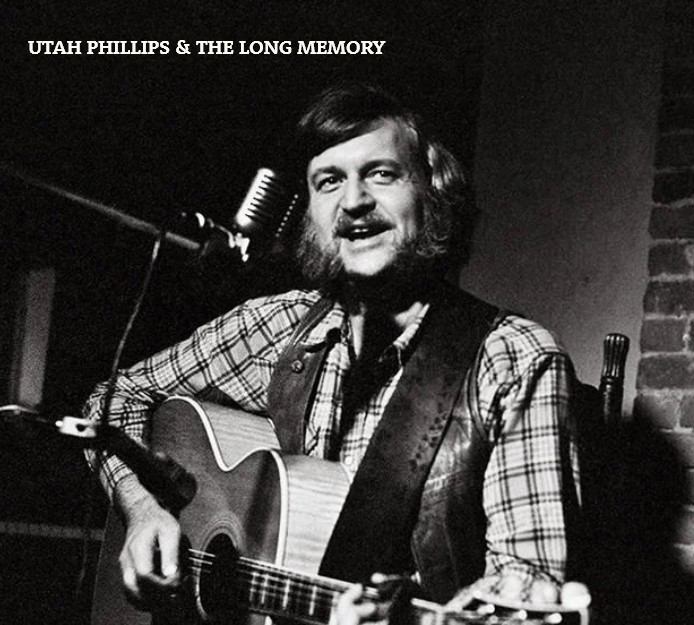
Folk musician. "Yes, the long memory is the most radical idea in this country. It is the loss of that long memory which deprives our people of that connective flow of thoughts and events that clarifies our vision, not of where we're going, but where we want to go."Bruce "Utah" Phillips 1935 - 2008
Was an American labor organizer, storyteller, poet and the "Golden Voice of the Great Southwest". He described the struggles of labor unions and the power of direct action, self-identifying as an anarchist.
Phillips was born in Cleveland, OH. to Edwin Deroger Phillips and Frances Kathleen Coates. His father, Edwin Phillips, was a labor organizer, and his parents' activism influenced much of his life's work. Phillips was a card-carrying member of the Industrial Workers of the World (Wobblies) headquartered in Chicago, Illinois. His parents divorced and his mother remarried. Phillips was adopted by his stepfather, Syd Cohen, at the age of five. Cohen managed the Hippodrome Theater in Cleveland, one of the last vaudeville houses in the city. Cohen moved the family to Salt Lake City, Utah, where he managed the Lyric Theater, another vaudeville house. Phillips attributes his early exposure to vaudeville through his stepfather as being an important influence on his later career.
A digital exhibit on a notable folk singer whose music is still relevant. His mission was to ensure that a long memory of labor struggles lived on in culture

Uusi Kotimaa
The origins of the Minnesota Finnish-language newspaper the Uusi Kotimaa (“The New Homeland”) are unclear. Finnish immigrant August Nylund apparently established the newspaper in Minneapolis sometime between 1880 and 1882, but they all agree that it moved to New York Mills in Ottertail County in 1884. The Uusi Kotimaa started out as a four-page weekly printed in a Fraktur Finnish font. It was a conservative newspaper that included articles about religion. The Uusi Kotimaa changed its editorial focus several times over the years, and it soon became one of the leading Finnish-language newspapers in the United States.
Finnish immigrants began to arrive in southern Minnesota in 1864. Settlement shifted to central part of the state, and after 1880, with the development of mining, to Minnesota’s “Iron Range.” Finnish families moving to central-western Minnesota in the 1870s settled around New York Mills in Otter Tail County, a region known for lumber and later for farming and the dairy industry. By the 1890s, Finnish settlements spread to the nearby towns of Sebeka and Menahga (Wadena County) and Wolf Lake or Susijärvi(Becker County). New York Mills was considered a “Finntown” with its full complement of Finnish churches, businesses, and cooperatives. An article “A Finnish Settlement in Minnesota” in the March 1889 issue of the magazine The Northwest, describes a Finnish population of 4,000 in New York Mills and the surrounding region of Otter Tail, Wadena, and Becker counties.
In 1888, August Nylund moved the Uusi Kotimaa to Astoria, Oregon, seeking a larger Finnish readership and more financial support. J.W. (Johan Wilhelm) Lähde, a Lutheran pastor in the Augustana Synod and the editor of the Uusi Kotimaa, bought the paper’s type and printing press and started a new weekly, the Amerikan Suometar (“American Finn”). However, by 1890 Nylund had returned to New York Mills and reestablished the Uusi Kotimaa, absorbing the Suometar. Lähde resumed his position as editor. August Nylund died on December 12, 1892, and his sons, Felix and August Ferdinand, continued to publish the paper. Lähde remained editor until 1894 when he left New York Mills. The Uusi Kotimaa then continued under a succession of editors, including Felix Nylund, until Lähde returned around 1900.
By 1896, the subscription list of the Uusi Kotimaa was 4,120. The paper boasted of its appeal to advertisers, noting that its large readership extended to 38 states. By 1916, the paper’s circulation had grown to 9,000. At that time, Uusi Kotimaa was considered independent Republican, reporting on national, international, and Finnish news. It also provided coverage of Finnish communities throughout the region, obituary notices, and advertisements.
In 1919, Nylund sold the Uusi Kotimaa to the People’s Voice Cooperative Publishing Company, subsidized by the Nonpartisan League. At that time the paper’s political orientation became extremely radical. Lähde left the paper in 1921. He had previously expressed the view that the Uusi Kotimaa should not be a party organ, but instead impartially report the news.
In 1923, Finnish-Americans in the Communist Party purchased the Uusi Kotimaa and a well-known party member, K. E. Heikkinen, became its editor. Thereafter, the Uusi Kotimaa became a radical farmer-labor publication with national and local news and topical articles following the Communist Party’s line. Its focus gradually shifted to promoting the interests of industrial workers, although one page of content in each issue remained geared toward farmers.
In 1931, Uusi Kotimaa moved to Superior, Wisconsin, where it was published weekly by Työmies Kustannusyhtiö (Työmies Publishing Company). Facing financial difficulties, the paper ceased publication around 1934. The Minnesotan Uutiset (“Minnesota News”), another Finnish-language newspaper based in New York Mills, published an “obituary” for the Uusi Kotimaa, observing that its service to the Finnish community in New York Mills and throughout the United States had been “far reaching and of great value.”
Finnish newspaper, radical after 1919, Non-Partisan League

Valley Labor Report
Weekly radio broadcast. Simultaneous with the live radio broadcast, THE VALLEY LABOR REPORT livestreams (with video) on YouTube, including 1-2 hours of extra content after the radio broadcast ends at 11:00 AM CST. Following the livestream, the show is then edited into individual clips which are released on YouTube every weekday.Supplemental to the main show, TVLR co-host Adam Keller solo-hosts SHOP TALK exclusively on YouTube, covering topics such as labor history, labor activism, and Unions 101 education.
Weekly radio broadcast.

Vanesa Ribas
University of California Press (2015)
In this gutsy, eye-opening examination of the lives of workers in the New South, Vanesa Ribas, working alongside mostly Latino/a and native-born African American laborers for sixteen months, takes us inside the contemporary American slaughterhouse. Ribas, a native Spanish speaker, occupies an insider/outsider status there, enabling her to capture vividly the oppressive exploitation experienced by her fellow workers. She showcases the particular vulnerabilities faced by immigrant workers—a constant looming threat of deportation, reluctance to seek medical attention, and family separation—as she also illuminates how workers find connection and moments of pleasure during their grueling shifts. Bringing to the fore the words, ideas, and struggles of the workers themselves, On The Line underlines how deep racial tensions permeate the factory, as an overwhelmingly minority workforce is subject to white dominance. Compulsively readable, this extraordinary ethnography makes a powerful case for greater labor protection, especially for our nation’s most vulnerable workers.
Introduction : lives on the line : carving out a new South
All roads lead from Olancho to Swine's : the making of a Latino working class in the American South
The meanings of moyo : the transnational roots of shop floor racial talk
"Painted black" : oppressive exploitation and racialized resentment
The value of being negro, the cost of being hispano : "disposability" and the challenges for cross-racial solidarity in the workplace
Black, white, and Latino bosses : how the composition of the authority structure mediates perceptions of privilege and the experience of subordination
Exclusion or ambivalence? : explaining African American's boundary work
Conclusion : prismatic engagement : Latino/a and African American workers' encounters in a Southern meatpacking plant
takes us inside the contemporary American slaughterhouse

Vanessa May
The University of North Carolina Press (2011)
Through an analysis of women's reform, domestic worker activism, and cultural values attached to public and private space, this book explains how and why domestic workers, the largest category of working women before 1940, were excluded from labour protections that formed the foundation of the US welfare state.
Looking at the debate over domestic service from both sides of the class divide, it assesses middle-class women's reform programmes as well as household workers' efforts to determine their own working conditions
Book explains how and why domestic workers were excluded from labor protections that formed the foundation of the US welfare state
Venture Smith, History Matters
Free labor provided possibilities for emancipation for some enslaved people. The most industrious and the most skilled of the enslaved could take greater advantage of these opportunities.
Venture Smith had been born in the 1720s, the son of a West African prince who named him Broteer Furro. Slave traders captured him at the age of six, spirited him away to the coast, and transported him to a life of enslavement in Long Island and eastern Connecticut. After several changes of ownership, he was able to purchase his freedom by his labors at the age of 31.
Those labors, along with his entrepreneurial activities such as fishing, working on a whaler, and agricultural activities, made possible the purchase of his son, daughter, and wife’s liberty. Near the end of the 18th century he related his life history to Elisha Niles, a schoolteacher and Revolutionary war veteran.
Published in 1798, A Narrative of the Life and Adventures of Venture, a Native of Africa: But Resident above Sixty Years in the United States of America, Related by Himself recounted his successful negotiation of the slavery economy and recognition of free labor as the key to a free identity.
The account of Venture Smith, a former slave by 1750s who freed his son, daughter, and wife Elisha Niles, to whom he also relayed his account of life, free labor, and identity.

Venus Green
Duke University Press (2001)
Addresses the convergence of race, gender, and technology in the telephone industry. This title shows how, as technology changed from a manual process to a computerised one, sexual and racial stereotypes enabled management to manipulate both the workers and the workplace.
Addresses the convergence of race, gender, and technology in the telephone industry.

Verdigris Project
Butte Montana interviews conducted 2017-2021
The Verdigris Project oral history collection preserves the memory of Butte, Montana’s bygone neighborhoods, underground mines, and industrial might. Our goal was to preserve these stories for future generations, including the family members of the narrators, but also researchers and historians who might make use of these materials for future projects. The living memory of underground mining in Butte is fading away, but these recordings preserve that memory. We gathered these oral histories to help us remember what Butte once was and better understand how it continues to change.
Many of these oral history recordings concern the practice of underground mining in Butte, Montana, although the collection is not limited to that subject. When Butte was an industrial center-point in the Rocky Mountains, it had all the services of a thriving metropolis. Many of our interviews concern work that was tangential to mining, such as the service industry professions that depended on a multitude of miners for business. Building on the earlier oral history work of historians like Teresa Jordan and Mary Murphy, our project picks up where they left off. In Jordan’s ‘Is There Life After Copper?’ project, she interviewed numerous miners right after the closure of the underground mines in the early 1980s. Our project looks at Butte’s decline and redevelopment since that period, including the age of Superfund and recent efforts to preserve and redevelop the historic central business district (Uptown Butte).
Though our collection is largely an autobiographical account of each narrator’s life, all of these recordings place the narrator in the context of Butte’s century-long struggle for survival since the city’s peak in 1917. Each interview asks the narrator to consider Butte’s role in the larger economy of the State of Montana and the global commodities market. Each narrator then explains how they understand Butte’s significance in their own way, often through the lens of their career, be it as a miner, lawyer, waitress, teacher, etc.
interviews about work and life in Butte, Montana copper mines, Anaconda

Verónica Martínez-Matsuda
University of Pennsylvania Press (2020)
Migrant Citizenship examines the Farm Security Administration's Migratory Labor Camp Program and its impact on diverse farmworker families across the United States. Verónica Martínez-Matsuda reveals how these camps operated beyond their economic function, helping migrants secure their full political and social participation as citizens
examines the Farm Security Administration's Migratory Labor Camp Program and its impact on diverse farmworker families across the United States.

Vicki Ruíz
University of New Mexico Press (1987)
Women have been the mainstay of the grueling, seasonal canning industry for over a century. This book is their collective biography--a history of their family and work lives, and of their union. Out of the labor militancy of the 1930s emerged the United Cannery, Agricultural, Packing, and Allied Workers of America (UCAPAWA). Quickly it became the seventh largest CIO affiliate and a rare success story of women in unions. Thousands of Mexican and Mexican-American women working in canneries in southern California established effective, democratic trade union locals run by local members. These rank-and-file activists skillfully managed union affairs, including negotiating such benefits as maternity leave, company-provided day care, and paid vacations--in some cases better benefits than they enjoy today. But by 1951, UCAPAWA lay in ruins--a victim of red baiting in the McCarthy era and of brutal takeover tactics by the International Brotherhood of Teamsters.
Women have been the mainstay of the canning industry for over a century, this book is their collective biography.

Victor Devinatz
Victor Devinatz, a management theorist and labor historian, to discuss the formation of the Trade Union Unity League (TUUL), its successes and failures, and the role it played in the development of the labor movement. We focus on its emergence from the end of the Trade Union Education League (TUEL), its relationship between bottom-up initiative and Comintern direction in the shift toward dual unionism; CPUSA’s three-pronged strategy of constructing the TUUL, building an opposition within the American Federation of Labor, and working with independent unions; the united front from below policy; and the transition toward the Popular Front and the formation of the Congress of Industrial Unions (CIO) after the mass strikes of 1934.
A podcast that discuss the formation, life, and importance of the Trade Union Unity League.