


Explore thousands of items. Use clickable links under collections and library for broad categories. Search by keyword (including topic,city, state.) Limit by time period, type of item, region. See our search tips page for more assistance.
Collections
Library
Type
Region
Coverage:
-
Published:
-

Victor Silverman
University of Illinois Press (2000)
Capturing a moment in history when American and UK unions seemed about to join with their Soviet counterparts to create a world unified by its workers, this title presents the social, cultural, and ideological currents that generated worldwide support among workers for a union international and the pull of national interests that subverted it.
presents the social, cultural, and ideological currents that generated worldwide support among workers for a union international.
Victoria Charlotte Hattam
Princeton University Press (1993)
Why has labor played a more limited role in national politics in the United States than it has in other advanced industrial societies? Victoria Hattam demonstrates that voluntarism, as American labor’s policy was known, was the American Federation of Labor’s strategic response to the structure of the American state, particularly to the influence of American courts. The AFL’s strategic calculation was not universal, however. As Hattam shows, the Working Men's parties in the 1820s and the Knights of Labor in the 1870s and 1880s were more successful than the AFL in establishing cooperative relations with the American state. This book reveals the competing ideologies and acts of interpretation that produced these variations in state-labor relations
demonstrates that voluntarism, was the American Federation of Labor’s strategic response to the structure of the American state, particularly to the influence of American courts.
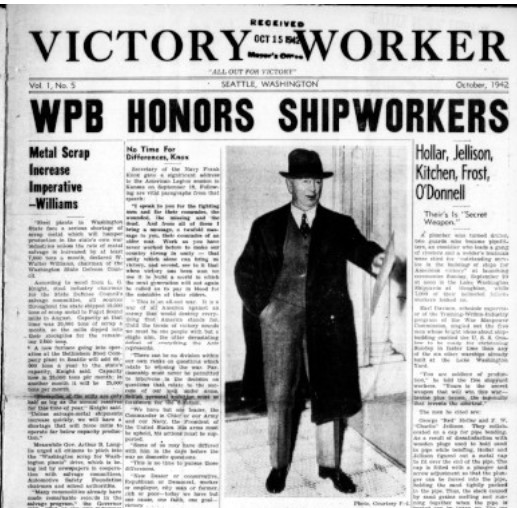
Victory Worker
The Victory Worker (1942-43) was published and edited by Harry Washington Hargood in Seattle, Washington. He was a local businessman, with relatively little experience in newspapers. he Victory Worker changed owners with the August 20, 1943 issue with a new publisher, E.S. Willis, and editor, Jeanette Testu focused on women's wages for a few issues
Seattle, Washington World War II paper

Vilja Hulden
University of Illinois Press (2023)
From the 1880s through the 1920s, American labor endured an ongoing assault on worker's rights by open shop campaigns organized by employers.
Vilja Hulden delves into the decades-long effort to not only counter but discredit labor's attempts to exercise its own power. The employer-invented term closed shop was a potent rhetorical tool that shifted public opinion from concerns about inequality and dangerous working conditions to a belief that unions trampled an individual's right to work.
As Hulden shows, employers used different methods to conduct closed-shop campaigns. Conciliators assumed a pose of benevolent cooperation while hardliners like the National Association of Manufacturers condemned the closed shop and used financial and social networks to lobby government, purchase newspaper space, and place sympathizers in politics. Employers did not always get what they wanted. But their superior ability to exercise power strengthened an anti-labor agenda that showed a remarkable consistency in its tactics and goals over a fifty-year period"
This book is essential to understand the decades-long employer (National Association of Manufacturers) effort to not only counter but discredit labor's attempts to exercise its own power
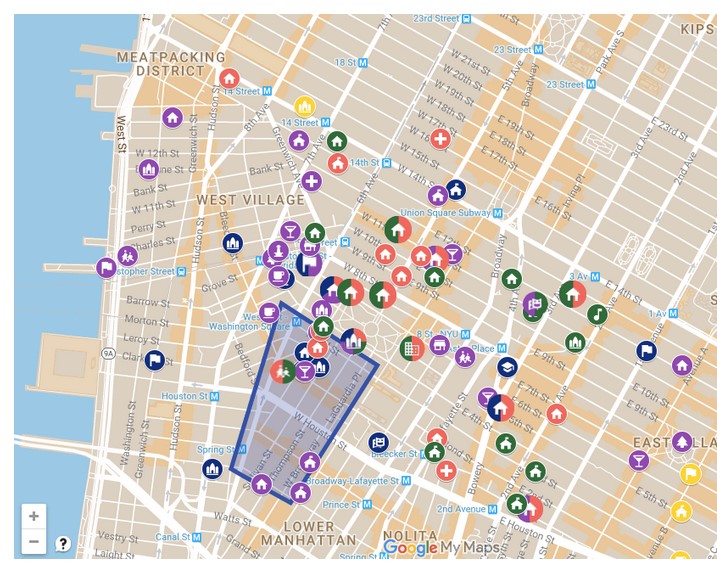
Village Preservation
Some of the most important events and most prominent figures in the labor movement bear strong connections to the Village and East Village. Without these courageous individuals, or the events connected to them, we might never have had fair wages, better working conditions, or the right to collective bargaining. Below are a few standout homes and locations from our Civil Rights and Social Justice Map that highlight some of these pioneering individuals and impactful events from labor history in our midst.
List of labor history sites in Greenwich Village New York, and stories

Vincent DiGirolamo
Oxford University Press (2019)
From Benjamin Franklin to Ragged Dick to Jack Kelly, hero of the Disney musical Newsies, newsboys have long intrigued Americans as symbols of struggle and achievement. But what do we really know about the children who hawked and delivered newspapers in American cities and towns? Who were they? What was their life like? And how important was their work to the development of a free press, the survival of poor families, and the shaping of their own attitudes, values and beliefs?
Crying the News: A History of America's Newsboys offers an epic retelling of the American experience from the perspective of its most unshushable creation. It is the first book to place newsboys at the center of American history, analyzing their inseparable role as economic actors and cultural symbols in the creation of print capitalism, popular democracy, and national character. DiGirolamo's sweeping narrative traces the shifting fortunes of these "little merchants" over a century of war and peace, prosperity and depression, exploitation and reform, chronicling their exploits in every region of the country, as well as on the railroads that linked them. While the book focuses mainly on boys in the trade, it also examines the experience of girls and grown-ups, the elderly and disabled, blacks and whites, immigrants and natives.
Based on a wealth of primary sources, Crying the News uncovers the existence of scores of newsboy strikes and protests. The book reveals the central role of newsboys in the development of corporate welfare schemes, scientific management practices, and employee liability laws. It argues that the newspaper industry exerted a formative yet overlooked influence on working-class youth that is essential to our understanding of American childhood, labor, journalism, and capitalism.
The first book to place newsboys at the center of American history, analyzing their inseparable role as economic actors and cultural symbols in the creation of print capitalism, popular democracy, and national character.
Vincent DiGirolamo
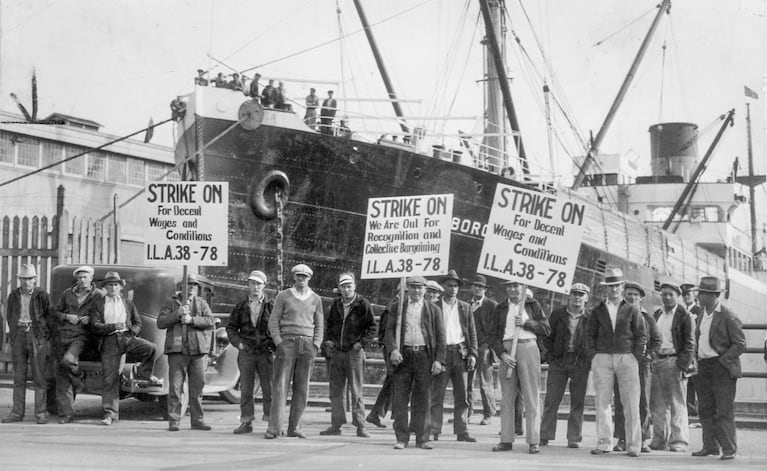
This module invites an intensive study of the 1934 Pacific Coast waterfront strike and the documentary record it produced as a way to explore the broader social, political, economic, and cultural tensions of the New Deal era.
This module is designed to be adaptable for use in U.S. history survey courses as well as in more specialized courses in
labor studies, California history, or the 1930s. Extensive bibliography
Overview
Although union activity usually grinds to a halt during periods of mass unemployment, picket lines were as common as bread lines in 1934. A million and a half workers took part in some two thousand strikes that year. They were emboldened by Section 7(a) of the National Industrial Recovery Act, which guaranteed workers the right to form unions and bargain collectively over wages, hours, and conditions. The Act was part of President Franklin Roosevelt's liberal
New Deal policies, but many employers saw it as a step toward Communism and brazenly resisted it. They waged murderous campaigns against farm workers in California, autoworkers in Toledo, truck drivers in Minneapolis, and textile workers throughout the country.
This was the backdrop of a monumental showdown between ship owners and longshoremen on the West Coast. On May 9, 1934, 32,000 dockworkers in San Francisco, Los Angeles, Portland, Seattle, and other ports refused to load and unload ships under hiring and job conditions they deemed intolerable. They objected to the dreaded "shape up," where kickbacks and favoritism determined who got work; to "speed ups" that made accidents and injuries common occurrences; to brutal shifts that lasted twelve, twenty-four, and even thirty-six hours for no extra pay; and to the phony company union that permitted these abuses.
Shippers tried to bring in non-union workers, but the strikers fought back. For two and a half months they battled bosses,
"goons", police, red-baiters, and the National Guard, sparking an extraordinary four-day general, or sympathy, strike of all
workers in San Francisco. Was the Revolution at hand? Was Roosevelt to blame? Where would this labor upsurge lead?
Objectives
This module invites an intensive study of the 1934 Pacific Coast waterfront strike and the documentary record it produced
as a way to explore the broader social, political, economic, and cultural tensions of the New Deal era. It has five
objectives:
1. To convey the drama of the strike as a breaking story with contested causes and unforeseen consequences.
2. To stimulate an analysis of issues and events from a variety of perspectives.
3. To provide an opportunity to investigate the rise of organized labor and spread of industrial democracy as both a
response and a spur to Roosevelt's New Deal.
4. To encourage a reconsideration of the role of "reds" and red-baiters, women and minorities, and artists and
musicians, as well as rank and file union members.
5. To offer a structured way to interrogate and utilize primary sources.
Educational tool for teaching that includes links to primary documents. Designed for advanced classes, but elements are excellent to pull for other levels
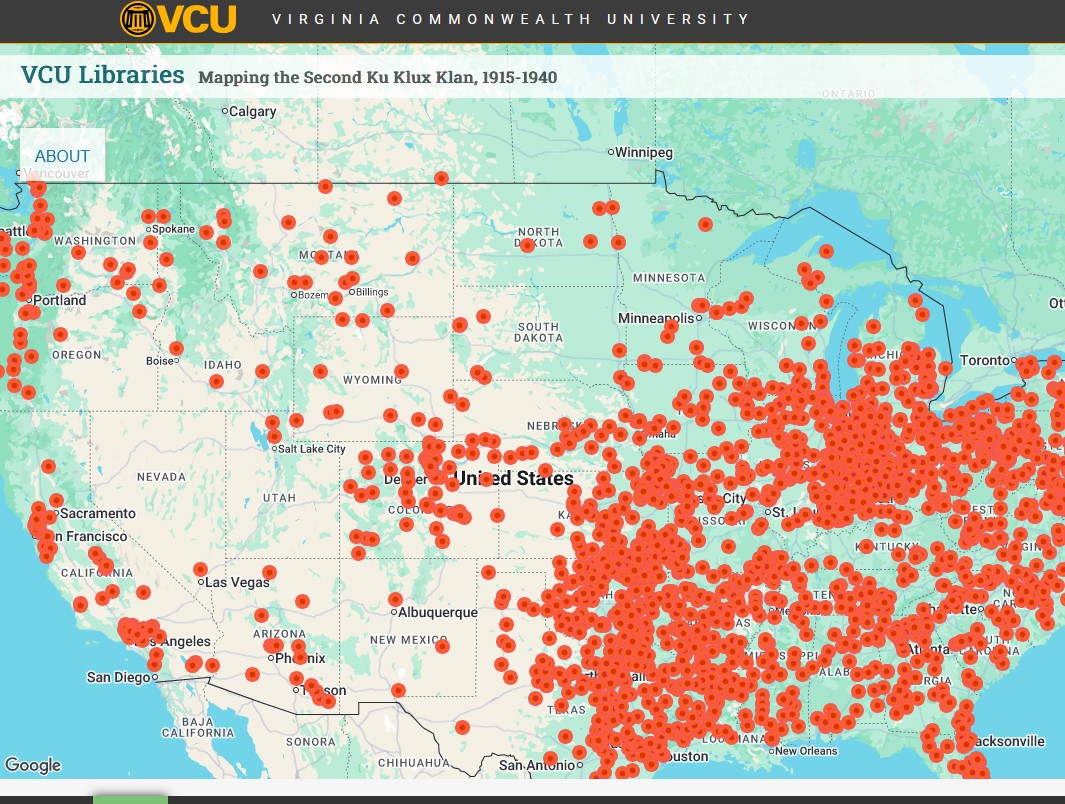
Virginia Commonwealth
Mapping the Klan is a rough timeline of the rise of the second Ku Klux Klan between 1915 and 1940. Each red dot shows a local unit or "Klavern." The official numbers for each Klavern indicate a basic chronology for the chartering of the Klaverns, and they also reveal patterns of Klan organizing.
This map invites you to learn about the second Klan in your area and across the U.S. and to study the courage of those who opposed the Klan.
An interactive map documenting the rise of the Second Ku Klux Klan

Virginia Wright-Peterson
Minnesota Historical Society Press (2020)
During World War II, women in Minnesota-like women across the country-made bold, unconventional, and important contributions to the war effort.
They enlisted in all branches of the military and worked for the military as civilians. They labored in factories, mines, and shipyards. They were also tireless peace activists, and they worked to relocate interned Japanese American citizens and European refugees. They served as cryptologists, journalists, pilots, riveters, factory workers, nurses, entertainers, and spies.
This rich chronological account relates dramatic stories of women discovering their own potential in a time of national need, surprising themselves and others-and setting the roots of second-wave feminism.
This rich chronological account relates dramatic stories of women discovering their own potential in a time of national need.

Virtual Jamestown
These are the indenture contracts of William Buckland (contract dated 1755) and Richard Lowther (contract dated 1627), two men who traveled to the New World in different centuries. The contracts detailed the type of labor they performed, the length of their servitude, who they were indentured to, and etc.
Two sample indenture contracts provided online by Virtual Jamestown.

Visit Kewanee, Kaylee White
In 1913-1914, 25-year-old Anna Klobuchar Clemenc ("Big Annie") of Calumet, MI spearheaded a labor movement to improve the working conditions for miners. This movement became known as the Copper Country Strike of 1913-1914. Follow along as we take you on a tour through historic Calumet, MI, retracing "Big Annie's" footsteps.
Tour the copper country from the perspective of a woman activist
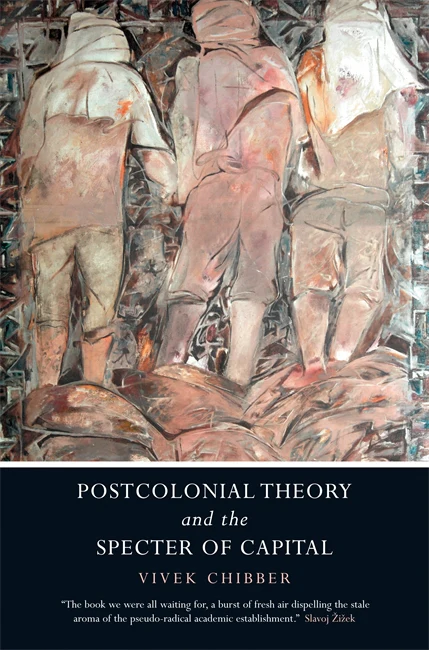
Vivek Chibber
Verso (2013)
Postcolonial theory has become enormously influential as a framework for understanding the Global South. It is also a school of thought popular because of its rejection of the supposedly universalizing categories of the Enlightenment. In this devastating critique, mounted on behalf of the radical Enlightenment tradition, Vivek Chibber offers the most comprehensive response yet to postcolonial theory. Focusing on the hugely popular Subaltern Studies project, Chibber shows that its foundational arguments are based on a series of analytical and historical misapprehensions. He demonstrates that it is possible to affirm a universalizing theory without succumbing to Eurocentrism or reductionism.
A defense of Marxist thought against postcolonial scholarship, arguing that capitalism and class hold universal elements across culture

Vivek Chibber
Harvard University Press (2022)
Chibber shows that it is possible to accommodate the main arguments from the cultural turn within a robust materialist framework: one can agree that the making of meaning plays an important role in social agency, while still recognizing the fundamental power of class structure and class formation. Chibber vindicates classical materialism by demonstrating that it in fact accounts for phenomena cultural theorists thought it was powerless to explain. But he also shows that aspects of class are indeed centrally affected by cultural factors. The Class Matrix does not seek to displace culture from the analysis of modern capitalism. Rather, in prose of exemplary clarity, Chibber gives culture its due alongside what Marx called “the dull compulsion of economic relations.”
A theoretical text which argues that cultural and social frameworks can be integrated into a materialist analysis of class

Voice of Labor
New Jersey Labor-Socialist Paper. Limited number of issues available
New Jersey labor paper
Voice of Labor
THE VOICE OF LABOR / NEW JERSEY LEADER (Camden, NJ — c. 1911 to 1917) Camden, New Jersey, located across the Delaware River from Philadelphia, was an industrial city of about 100,000 people in the first decades of the 20th Century. While the history of the socialist and labor movement in such major urban centers as New York City and Philadelphia is frequently studied and more or less well-known, the few surviving issues of The Voice of Labor and its successor, the New Jersey Leader, both published in Camden, provide evidence of the existence of a vital socialist movement in this and other small cities of the industrial Northeast during the Debsian era of the Socialist Party.
New Jersey labor paper
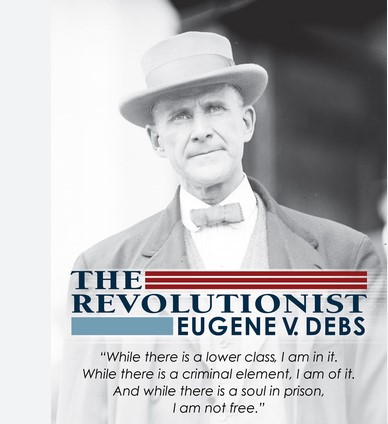
WFYI, Eugene V. Debs Foundation
WFYI’s documentary, The Revolutionist: Eugene V. Debs, tells the story of this Hoosier’s life. Born in Terre Haute in 1855, Eugene Debs emerged as a divisive figure when he led the nationwide Pullman Strike in 1894. Seeking an alternative way for workers to gain power, he helped establish the Socialist Party in the United States and ran as its candidate for president five times. His campaign across the country drew massive crowds, and his oratory tested the limits of the First Amendment. When he spoke out against America’s involvement in World War I, the Supreme Court upheld a guilty verdict that sentenced him to ten years in prison for violating the Espionage Act. From his cell, he ran for president for the final time, garnering nearly a million votes…and sparking a national conversation about the right to free speech. Has a viewing guide with Teaching elements at https://www.wfyi.org/files/file/The%20Revolutionist%20Discussion%20Guide.pdf
2019 film on Debs produced by Indiana PBS station
WFYI, Eugene V. Debs Foundation
companion teaching/discussion guide to the film by the same name
companion guide to the film on Debs
WPA, History Matters
The Beuschers Remember the Great Depression in Dubuque, Iowa by David Shannon: Before the Great Depression of the 1930’s the Beuschers—he was a sixty-two-year-old railroad worker; she was the mother of their eleven children—had been fairly prosperous: they owned their home and had several life-insurance policies serving as savings. But by the time the Works Progress Administration (WPA) interviewed them in 1937, their lives had dramatically changed: the father had lost his railroad job and the mother was taking in sewing.
This interview summary, published by the WPA, showed how they struggled to make ends meet during The Great Depression.
A WPA interview with the Beuscher family
WPA, History Matters
Created in 1935, the Works Progress Administration (WPA) provided hope and employment for millions of unemployed workers and studied the human toll of the depression. One such study—a series of WPA-conducted interviews with Dubuque, Iowa families—found that middle-class Americans particularly felt the sting and shame of unemployment caused by the depression.
In this interview, the Donners discussed the closing of their family-owned printing business in Chicago during tough times. Returning to live with Mrs. Donner’s family in Dubuque in 1934, Mr. Donner remained unemployed for over a year before landing a job as a timekeeper on a WPA project, earning less than one-third his previous income.
A WPA interview with the Donner Family
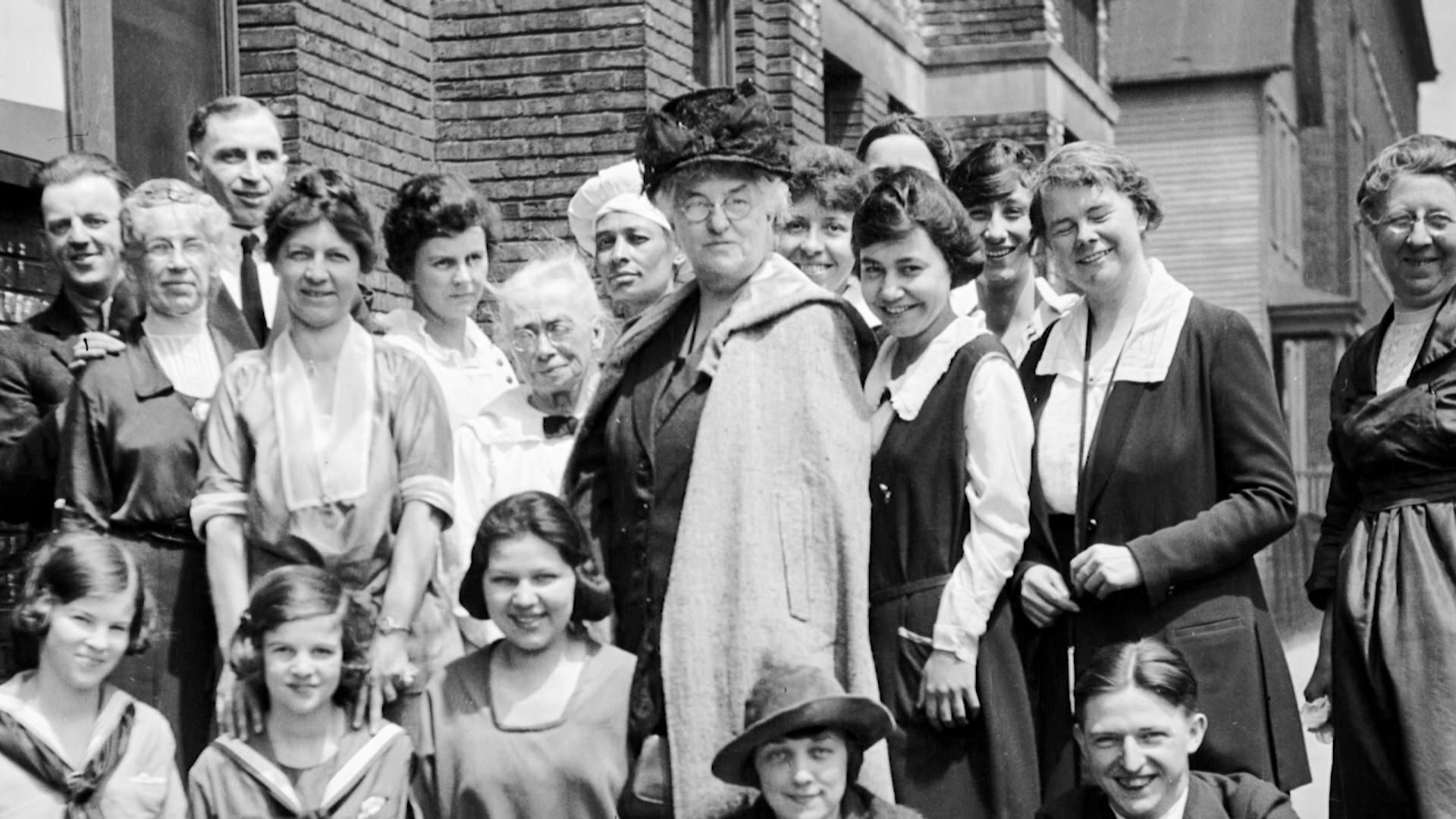
WTTW
digital essay Dealing with unsafe working conditions and unhealthy living conditions in the Back of the Yards neighborhood, the workers of the Union Stockyards found an unlikely advocate in a woman who became known as the “The Garbage Lady” and the “godmother” of environmental justice. From the late-nineteenth century into the early-twentieth, a woman from a privileged background named Mary McDowell led a crusade for environmental justice that would improve the lives of the immigrants among whom she lived.
an introduction to the connection between workers issues and environmental pollution
WTTW
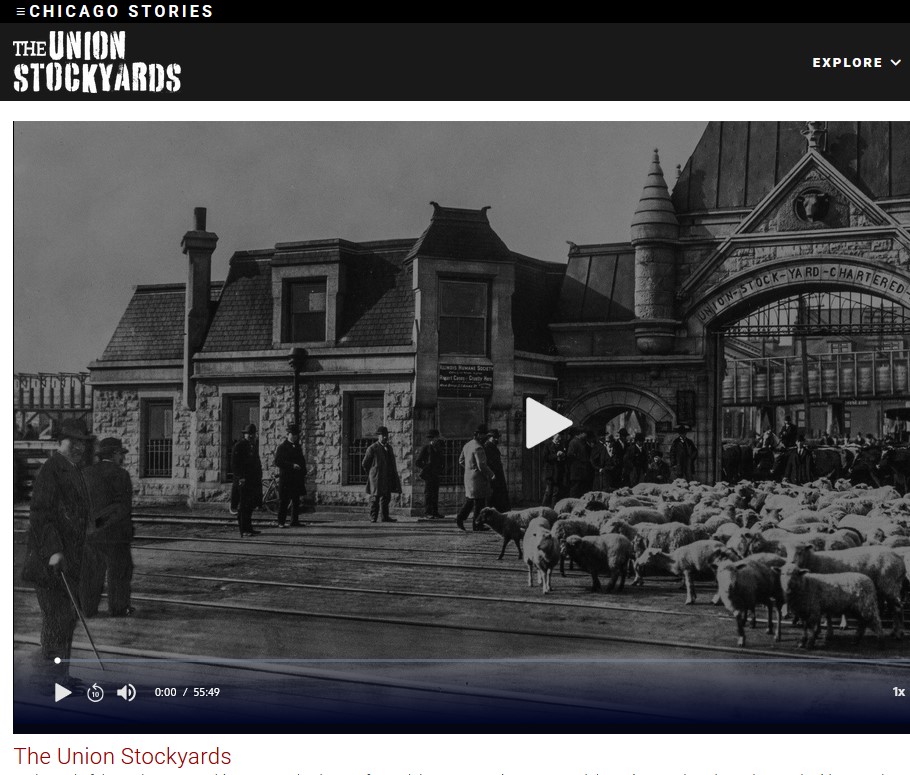
At the end of the 19th century, Chicago completely transformed the way Americans eat, and the Union Stockyards on the South Side were the center of that revolution. Experience the sights, sounds, and awful smells of the Union Stockyards and the complex of meat factories next to it, known as Packingtown. Features historians Dominic Pacyga
55 minute documentary on the history of the union stockyards, focuse on the worker
WTTW-Chicago
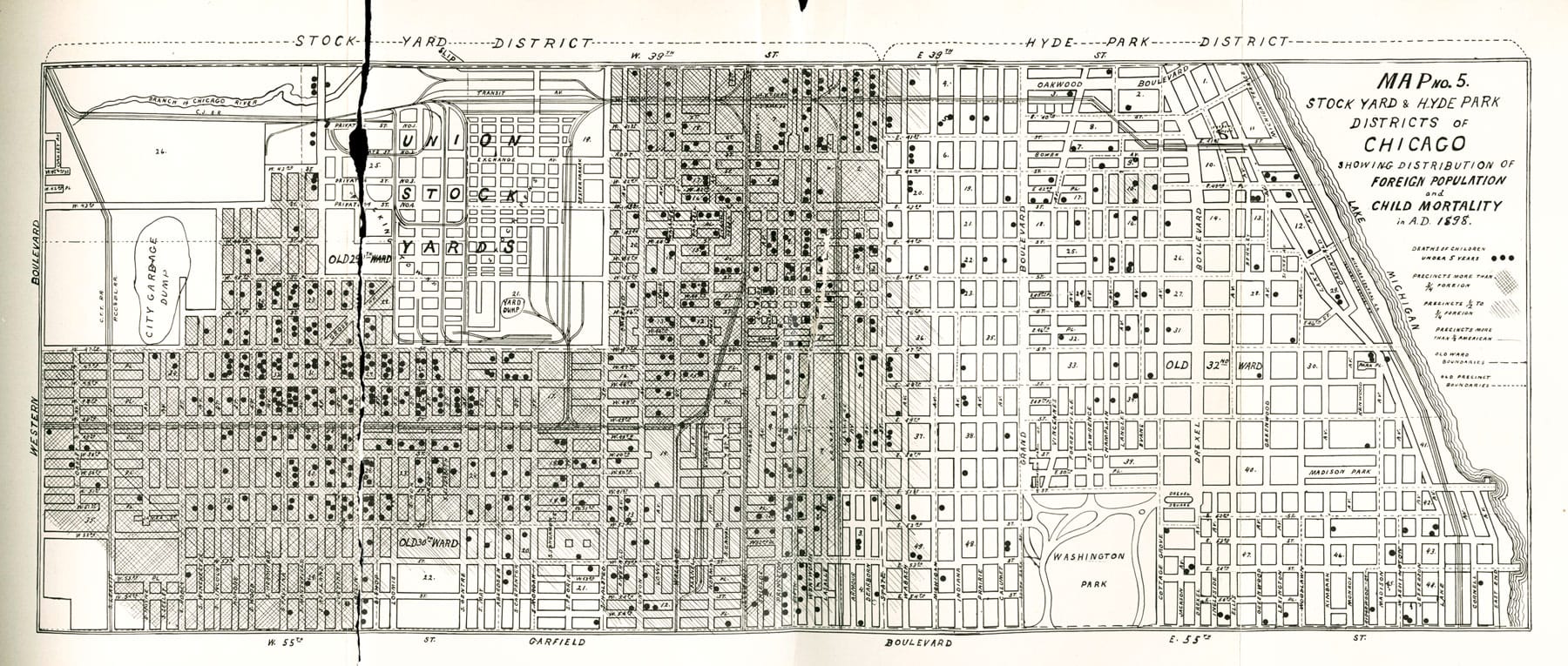
Stockyards of Chicago showing mortality 1898 and immigrant population. See accompanying story at https://www.wttw.com/chicago-stories/union-stockyards/the-union-stockyards-a-story-of-american-capitalism
A map of the Back of the Yards (packinghouse) neighborhood depicting the area as it was in 1898.
WTTW-Chicago
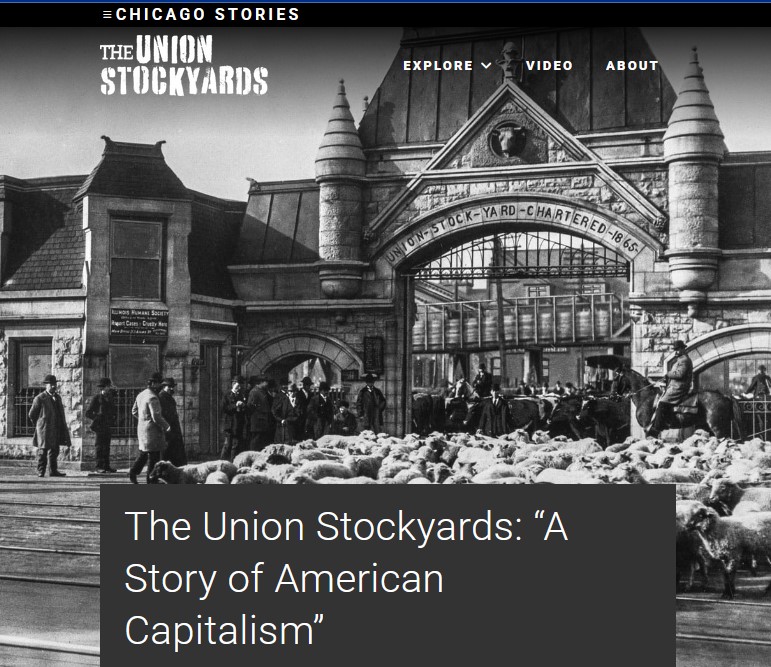
A multi-media introduction to the topic, exhibit in 2 parts
The Union Stockyards: “A Story of American Capitalism”
Mary McDowell and the Fight for Environmental Justice for Back of the Yards
A short survey of dangers and workers lives

Walter D. Kamphoefner
Cornell University Press (1991)
Collection of over 350 German immigrant letters composed by one individual or family group
Collection of over 350 German immigrant letters composed by one individual or family group
Walter Fink, History Matters
The often violent labor struggles of the early 20th century engendered deep concern at all levels of society and led to a series of governmental investigations, including the federal Commission on Industrial Relations, appointed in 1913. The commission was in the midst of taking testimony from owners, workers, and reformers in dozens of industrial communities around the country when a coal strike broke out in southern Colorado. On Easter night, 1914, three women and eleven children were killed at a mining encampment in Ludlow, Colorado.The United Mine Workers of America, the union that represented the striking Colorado miners, quickly printed and sold (for 25 cents) thousands of copies of a pamphlet (excerpted here) entitled The Ludlow Massacre by Walter Fink, director of publicity of UMWA District 15. In addition to providing a dramatic retelling of the events leading up to the tragedy, the title of the pamphlet became the commonly accepted term for the event.
The title of the pamphlet became the commonly accepted term for the event.
Museum/Exhibits
Tours
Maps
Digital Projects
Organizations
Sites
Film/Video
Audio/Interview
Podcast/Program
Text/Document
Image
Graphs/Data
Timeline
Southwest
West
Midwest
Southeast
Northeast
Mexico
Canada
Global
Books
Teaching
Lectures
Digital Archives
Journals
Bibliographies
Topic Intro