


Explore thousands of items. Use clickable links under collections and library for broad categories. Search by keyword (including topic,city, state.) Limit by time period, type of item, region. See our search tips page for more assistance.
Collections
Library
Type
Region
Coverage:
-
Published:
-
Walter H. Fink
Williamson-Hafner (1914)
A firsthand, politically motivated, recollection of Ludlow Massacre. Fink recounts several tragic and horrific episodes of the short lived gunfight between miners and company-hired militiamen.
A firsthand, politically motivated, recollection of the 1914 Ludlow Massacre

Walter Johnson
Basic Books (2020)
From an award-winning historian, a groundbreaking portrait of pervasive exploitation and radical resistance in America, told through the turbulent history of St. Louis. From Lewis and Clark's 1804 expedition to the 2014 uprising in Ferguson, American history has been made in St. Louis. And as Walter Johnson shows in this searing book, the city exemplifies how imperialism, racism, and capitalism have persistently entwined to corrupt the nation's past. St. Louis was a staging post for Indian removal and imperial expansion, and its wealth grew on the backs of its poor black residents, from slavery through redlining and urban renewal. But it was once also America's most radical city, home to anti-capitalist immigrants, the Civil War's first general emancipation, and the nation's first general strike -- a legacy of resistance that endures. A blistering history of a city's rise and decline, The Broken Heart of America will forever change how we think about the United States."--|c Provided by publisher
portrait of pervasive exploitation and radical resistance in America, told through the turbulent history of St. Louis

Walter Johnson, Eric Foner, Richard Follett
Johns Hopkins University Press (2011)
President Abraham Lincoln freed millions of slaves in the South in 1863, rescuing them, as history tells us, from a brutal and inhuman existence and making the promise of freedom and equal rights. This is a moment to celebrate and honor, to be sure, but what of the darker, more troubling side of this story?
Slavery's Ghost explores the dire, debilitating, sometimes crushing effects of slavery on race relations in American history. In three conceptually wide-ranging and provocative essays, the authors assess the meaning of freedom for enslaved and free Americans in the decades before and after the Civil War. They ask important and challenging questions: How did slaves and freedpeople respond to the promise and reality of emancipation? How committed were white southerners to the principle of racial subjugation? And in what ways can we best interpret the actions of enslaved and free Americans during slavery and Reconstruction?
Collectively, these essays offer fresh approaches to questions of local political power, the determinants of individual choices, and the discourse that shaped and defined the history of black freedom. Written by three prominent historians of the period, Slavery's Ghost forces readers to think critically about the way we study the past, the depth of racial prejudice, and how African Americans won and lost their freedom in nineteenth-century America"--Publisher's description
Explores the dire, debilitating, sometimes crushing effects of slavery on race relations in American history. In three conceptually wide-ranging and provocative essays, the authors assess the meaning of freedom for enslaved and free Americans in the decades before and after the Civil War.

Walter P. Reuther Library,
General Background: On May 2, 1968, 4,000 workers at the Chrysler Dodge Main plant in Hamtramck, Michigan staged a wildcat strike to protest working conditions and the racist practices of manufacturers, who they claimed deliberately assigned blacks and other minorities to work the most dangerous jobs in the factory, and prevented them the opportunity to acquire better-paying positions.
What emerged from the Dodge Main strike was the creation of the Dodge Revolutionary Union Movement (DRUM) founded by General Gordon Baker, Mike Hamlin, John Watson, Ron March and others, all of whom had previously been active in various radical and civil rights organizations. Following DRUM, black workers formed similar groups at other automobile plants, including FRUM at Ford, ELRUM at the Eldon Avenue Chrysler plant and JARUM at the Jefferson Avenue plant. In 1969, the League of Revolutionary Black Workers (LRBW) was formed as the central organization under which the various RUM groups would be united.
In addition to their criticisms of manufacturers, members of the League charged leaders of the United Auto Workers (UAW) – one of the most influential labor unions in the twentieth century – with being unresponsive to the concerns of black workers and obstinate in allowing blacks into the union’s leadership structure. Furthermore, League members condemned the UAW for its capitulation to corporate interests after World War II – that is, prioritizing profits over workers’ power and conditions.
To make their demands heard, League members used several tactics, including wildcat strikes and publishing plant newsletters detailing specific grievances. During the 1968-69 academic year, Watson and Hamlin became editors of The South End, Wayne State University’s student newspaper.
In 1971, the League of Revolutionary Black Workers disbanded, due largely to a combination of factional infighting and FBI repression. For teachers: This set of documents and exercises is designed for 9-12 grade students. These sets can be used to fulfill Common Core Standards CCSS.ELA-Literacy RH.11-12(1-10) and RH.9.10(1-10).
A History or Social Studies course should plan to spend 2-3 class sessions working through this unit, though teachers may find it appropriate to mix and match the material provided depending on existing curriculum and readings.
Students will develop critical thinking skills, compare various perspectives, and practice interrogating primary sources related to the social and political life of 1960s.
Lesson #1 – Create an issue-driven Newspaper (50 minutes)
Background: During the 1968-69 school year, John Watson and Mike Hamlin became editors of Wayne State University’s student newspaper, The South End. Both were heavily involved in the Dodge Revolutionary Union Movement and sought to use their new editorial power to shift the paper’s focus from a university-centered publication to one that represented exploited working class people more broadly. Watson’s first editorial appeared in September 1968 and stated, “The South End returns to Wayne State with the intention of promoting the interests of impoverished, oppressed, exploited, and powerless victims of white, racist monopoly capitalism and imperialism.”
With the shift in tone and direction of the paper, The South End staff faced immense institutional pushback, specifically from then Wayne State President William Keast. As a result, the staff made some concessions to appease Keast, such as vowing not print obscene language, to avoid being shut down by the university. However, Watson, Hamlin and Nick Medvecky, who was in charge of printing the daily paper, made it clear that the politics of The South End would not change.
Objective: Through an analysis of an issue of The South End from the 1968-69 school year, students will gain a better understanding of the various topics covered by the paper, and get a glimpse of what was happening in the world during this time from the perspectives of the paper’s editors and staff writers. Students should keep in mind the role media plays in helping a movement gain momentum.
Instructions: Start by examining an issue of The South End during the time Hamlin and Watson were editors. Ask students to consider the following questions: What kind of articles do you see? Do you notice anything about the design? Who do you think is the intended audience? When was the issue published? Why do you think it was important for them to have the paper as a resource? How can this method of communicating be effective?
After the discussion, put students in groups of 3-4 and have them create their own newspaper featuring articles about contemporary issues they are passionate about. Have them choose one editor (if this becomes a point of contention, the instructor should choose), followed by three staff writers. Everyone in the group should confer to determine the design of the paper, its editorial stance and what kind of issues are going to be covered, as well as the intended audience. For the sake of time, have students create headlines to indicate what issues will be covered. Upon completion, have each editor present their papers to the rest of the class.
Potential Homework Assignment: Read Detroit: I Do Mind Dying by Dan Georgakas and Marvin Surkin, Chapter 3, We Will Take the Hard Line
This lesson is designed to introduce students to the history of the League of Revolutionary Black Workers through close examination of a set of archival documents. The purpose of these assignments is to give students the opportunity to interpret history from first-hand accounts of materials produced by League members themselves.

Walter Speck
This 1937 WPA mural by Walter Speck captures scenes from the automotive industry in Michigan, finally moved to Reuther Library, Wayne State University “The first in a series of murals depicting the history of labor in general and the Auto Workers Union in particular has been completed at the West Side local of the United Auto Workers Union. This marks the first time a mural has been used to decorate an auto worker local union headquarters. The mural, which was done by Walter Speck, a noted artist, was authorized by the membership of the West Side Local 174 of which Walter Reuther is president and is located in the auditorium of the building. The photo shows Walter Speck completing the mural. On the left is the portion of the mural that tells the story of the Ford Riot and also shows Reuther and Frankensteen, who were beaten up at that time. In the background recent strikes are also portrayed while the right shows two huge figures symbolizing the relation of the auto worker to the CIO.”
a 1930s mural that has been saved
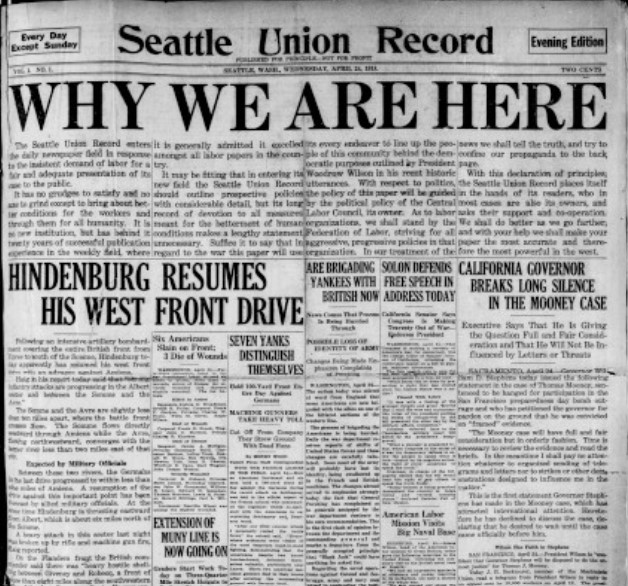
Washington Digital Newspapers
Newspaper of the Central Labor Council of Seattle and Vicinity, 1918-1928. The paper has only been digitized for these years. For a guide to 1912-1914 see https://depts.washington.edu/labhist/laborpress/Union_Record_1912-1914.htm; for 1900-1928 see https://depts.washington.edu/labhist/laborpress/Union_Record_1900-1928.htm
digitized newspaper of Central Labor Council, Seattle

Washington Digital Newspapers
The Grays Harbor timber region, including the towns of Aberdeen, Hoquiam, and Cosmopolis, was a hotbed of radical labor activity early in the 20th century. Workers endured long hours, low pay, and frequent injuries, many fatal, making them receptive to organizations such as the Industrial Workers of the World (IWW) and the Socialist Party of America. These organizations advocated more far-reaching social changes than those promoted by traditional trade unions, represented by the American Federation of Labor (AFL) nationally and the Washington State Federation of Labor at the state level. IWW members were central to the November 1911 to January 1912 fight against an Aberdeen ordinance severely curtailing street speaking, and a Grays Harbor lumber strike from March to May 1912. Members of the more conservative AFL-affiliated local unions were represented on both sides during these fights; some supported the striking workers while others sided with authorities and mill operators, a few even aiding efforts to intimidate or deport IWW members and strikers.
As early as July 1912, an AFL affiliated labor paper, the Hoquiam Free Press, was publishing on Grays Harbor. By 1915, the Southwest Washington Labor Press was the representative paper for AFL affiliated trade unionists in the area. Copies of the Southwest Washington Labor Press and its predecessors during these turbulent early years are sadly unavailable to shed light on what stance the paper may have taken on the conflicts that so closely preceded its birth.
The Southwest Washington Labor Press consisted largely of syndicated columns from the International Labor News Service with contributions from the managing editors and the board of directors. Editorship of the Press passed between several union newspaper men, including from Alfred E. Wolters to Louis Calvin Hinman on May 23, 1924, and to Jesse H. Godfrey with the September 4, 1925 issue. The board was a mix of representatives from the Aberdeen and Hoquiam local labor councils. The colophon boasted the Press was "Owned and controlled by Organized Labor. Official Organ of Aberdeen Central Labor Council, Hoquiam Trades and Labor Council and the Washington State Federation of Labor."
Published weekly on Fridays, each issue consisted of local and international stories, entertainment news, and health advice, and they usually included a cartoon and an infographic related to the news of the week or to seasonal changes to the labor landscape. Editorials published under the section headers "By the Way" and "The Cherry Tree" appeared intermittently throughout the mid-1920s. "By the Way" was first published February 22, 1924 with the caption "comment and criticism about things doing in the world." The section featured multiple short pieces on varying topics, including the unfolding Teapot Dome scandal, the Communist Party (which the paper opposed), child labor conditions, and the lack of African American representation in textbooks. "By the Way" even reports of the Navy shooting whales, concluding "there are plenty of means of affording warships target practice without killing helpless monsters of the deep." Appearing a few years later, "The Cherry Tree" featured longer discussions on a single topic, ranging from conscription of capital and labor during wartime, to the importance of wages for workers commensurate with the wealth they create, to realism in art and entertainment.
From efforts to pass an anti-child labor amendment to court cases about prison labor and prisoner leasing, the national labor agenda presented in the Press focused on the institutions of organized labor and their fight with the institutions of capital. Locally, support for the typographical workers, stereotypers, electrotypers, and mailers of the William Randolph Hearst owned Seattle Post-Intelligencer (P-I) appeared on the pages of the Press during contentious negotiations with the paper's owners in 1924 and 1925. In keeping with the AFL's support of public power on the national level, the paper backed the Wynooche [sic] Power Project for the creation of an Aberdeen municipal power system. The Press took the stance that a local utility project would support the growing population of Grays Harbor County; the editorial argued that funding it by selling bonds would put the power, very literally, in the hands of the people. Voters approved the project in a June 29, 1926 special election.
The influence of labor-conscious engagement in local economies carried through to the advertisements and classifieds. Each week, with the assurance that "the merchants whose advertisements appear in our columns are wide-awake, progressive business men entitled to your support," the Press devoted ample page space to ads. This included a full page "Hoquiam-Aberdeen Classified Directory Labor's Friends" with a list of labor-friendly businesses, contact information for specific labor unions, and prominent "Do Not Patronize" lists compiled by the Aberdeen and Hoquiam councils. The guarantee also covered political ads, as demonstrated by those for local elections in the latter half of 1926.
digitized Grays Harbor Washington labor newspaper

Washington Digital Newspapers
Successor to the Northwest Worker. The Commonwealth, an Everett, Washington, Socialist weekly, found itself deep in debt after only three years of publication. Business manager Katherine Hodgins was able to make the paper economically viable enough to pay its current bills and retire some of its debt after she took over leadership in January 1914, but debt collectors confiscated the Commonwealth's assets at the end of March. Encouraged by Hodgins' ultimately unsuccessful efforts, the Socialists of Snohomish County decided to launch a new paper, the Washington Socialist. This paper lasted until June 1915, when it was renamed the Northwest Worker. Frequent name changes reflected continued financial pressures and the attempt to broaden the geographic reach of the paper, thereby increasing subscription income. Maynard Shipley served as editor until April 1916 when Henry W. Watts took over his duties. To reflect the new interest in cooperatives, the paper changed its name to Co-operative News in October 1917. The leadership, ownership, and content of the papers were generally consistent from title to title. They served as promotional and educational instruments for the Socialist Party, reporting on national, state and local party events and issues. Peter Husby, an attorney who had previously contributed the "Free Legal Advice" column, was the last person to serve as editor. For anther account see https://depts.washington.edu/labhist/laborpress/CoopNews.htm
Important events covered by these papers include wars in Mexico and Europe, labor strife in the West, and elections. In August 1914 a Socialist (James M. Salter) was elected Commissioner of Public Works, the highest office ever held by a Socialist in Everett. The “Everett Massacre,” an armed confrontation between local authorities and members of the Industrial Workers of the World, took place on November 5, 1916, and was covered in the Northwest Worker. Notably absent from the paper were reports of internal strife within the Socialist Party, which editor Shipley felt would divide the radical community.
The Co-operative News was published until at least June 1918. The last surviving issues are filled with predictions of newspaper’s impending doom based on the government’s suppression of Socialist and radical publications taking place throughout the nation under the authority of the federal Espionage Act of 1917, as amended in April 1918.
digitized Everett, Washington newspaper

Washington Digital Newspapers
"The work of The Commonwealth will not be done until the day the true commonwealth in which all are in possession of that which is truly their own is established. The Commonwealth will continue to call upon the people early and late, to rise and claim that which is their own." Thus proclaimed the Everett Commonwealth at its debut on February 4, 1911.
First edited by O.L. Anderson, this four-column, eight-page weekly entered into the fractious debates typical of the Washington State's multiplying Socialist factions. Editors came and went in quick succession, the most notable being Anna Agnes Maley (September 1911-May 1912). Having written for one of the most important Socialist periodicals in the country----The Appeal to Reason, Maley had made her mark nationally through her support for political and women's rights before coming to Washington State. The Commonwealth’s coverage of notable national and international events expanded under her hand, without a reduction in the detailed reports on Socialist activities around the state.
With the Presidential election of 1912 on the horizon and with Eugene V. Debs leading the Socialist ticket, Maley left the paper in order to run for governor, the first woman and first Socialist to do so in the state. The Commonwealth covered the run-up to the election in considerable depth, publishing Debs' speech in Everett along with other campaign news. Maley came in third in the race for governor, taking a respectable 12 percent of the vote.
The Commonwealth continued under six more editors, including Maynard Shipley, a graduate of Stanford University and former editor of the World of Oakland, California-- the oldest Socialist newspaper on the West Coast. Believing that the constant squabbling among factions damaged the Socialist cause, Shipley refused to publish stories about the infighting. He tried to maintain high standards of journalism in the Commonwealth, increasing the use of photographs and the depth of news coverage.
Several significant figures in the national and international Socialist movement contributed to the Commonwealth including Gordon Nye, Fred D. Warren, George D. Herron, and Debs himself. The paper advocated strongly for freedom of expression, universal suffrage, industrial unionism, and the single tax. It also supported the Industrial Workers of the World and helped the Washington State Socialist Party to push organized labor toward the left. Despite constant efforts to increase its subscription base, the paper struggled financially and went into receivership in March 1914. The final issue of the Commonwealth appeared on April 9, 1914, and the paper’s assets were sold to the Socialist Party of Snohomish County. The Commonwealth’s demise brought about the birth of a new paper, the Washington Socialist.
digitized Everett, Washington socialist newspaper, labor stories covered.

Washington Digital Newspapers
The Labor Journal was the official paper of the Everett Trades Council, the Central Labor Council of Everett, and the local chapter of the American Federation of Labor (AFL). Originally published in 1891 as an annual newsletter, the Labor Journal quickly became the vehicle for Progressive politics and labor news in Everett and the surrounding region. In 1905, future Washington state senator, John E. Campbell became business manager of the Journal, partnering with editor and part-owner Ernest P. Marsh. By 1909, the duo published the paper weekly and kept union members and the general public informed about labor issues and perspectives. Many saw the Journal as an alternative to the daily and weekly papers which were often unsympathetic to the interest of workers. By focusing on issues relevant to local unions, the Journal enjoyed a readership in the thousands. Campbell was elected state senator in 1912 and authored the eight-hour workday bill for Washington women. Marsh became president of the Washington State Federation of Labor in 1913, an office he held until 1918. In 1917, Marsh was appointed by Woodrow Wilson to the President’s Mediation Commission, a body which he directed from 1943 to 1949.
digitized Everett, Washington newspaper of the labor movement

Washington Digital Newspapers
The Commonwealth, an Everett, Washington, Socialist weekly, found itself deep in debt after only three years of publication. Business manager Katherine Hodgins was able to make the paper economically viable enough to pay its current bills and retire some of its debt after she took over leadership in January 1914, but debt collectors confiscated the Commonwealth's assets at the end of March. Encouraged by Hodgins' ultimately unsuccessful efforts, the Socialists of Snohomish County decided to launch a new paper, the Washington Socialist. This paper lasted until June 1915, when it was renamed the Northwest Worker. Frequent name changes reflected continued financial pressures and the attempt to broaden the geographic reach of the paper, thereby increasing subscription income. Maynard Shipley served as editor until April 1916 when Henry W. Watts took over his duties. To reflect the new interest in cooperatives, the paper changed its name to Co-operative News in October 1917. The leadership, ownership, and content of the papers were generally consistent from title to title. They served as promotional and educational instruments for the Socialist Party, reporting on national, state and local party events and issues. Peter Husby, an attorney who had previously contributed the "Free Legal Advice" column, was the last person to serve as editor.
Important events covered by these papers include wars in Mexico and Europe, labor strife in the West, and elections. In August 1914 a Socialist (James M. Salter) was elected Commissioner of Public Works, the highest office ever held by a Socialist in Everett. The “Everett Massacre,” an armed confrontation between local authorities and members of the Industrial Workers of the World, took place on November 5, 1916, and was covered in the Northwest Worker. Notably absent from the paper were reports of internal strife within the Socialist Party, which editor Shipley felt would divide the radical community.
The Co-operative News was published until at least June 1918. The last surviving issues are filled with predictions of newspaper’s impending doom based on the government’s suppression of Socialist and radical publications taking place throughout the nation under the authority of the federal Espionage Act of 1917, as amended in April 1918.
digitized Everett, Washington newspaper

Washington Digital Newspapers
The Commonwealth, an Everett, Washington, Socialist weekly, found itself deep in debt after only three years of publication. Business manager Katherine Hodgins was able to make the paper economically viable enough to pay its current bills and retire some of its debt after she took over leadership in January 1914, but debt collectors confiscated the Commonwealth's assets at the end of March. Encouraged by Hodgins' ultimately unsuccessful efforts, the Socialists of Snohomish County decided to launch a new paper, the Washington Socialist. This paper lasted until June 1915, when it was renamed the Northwest Worker. Frequent name changes reflected continued financial pressures and the attempt to broaden the geographic reach of the paper, thereby increasing subscription income. Maynard Shipley served as editor until April 1916 when Henry W. Watts took over his duties. To reflect the new interest in cooperatives, the paper changed its name to Co-operative News in October 1917. The leadership, ownership, and content of the papers were generally consistent from title to title. They served as promotional and educational instruments for the Socialist Party, reporting on national, state and local party events and issues. Peter Husby, an attorney who had previously contributed the "Free Legal Advice" column, was the last person to serve as editor.
Important events covered by these papers include wars in Mexico and Europe, labor strife in the West, and elections. In August 1914 a Socialist (James M. Salter) was elected Commissioner of Public Works, the highest office ever held by a Socialist in Everett. The “Everett Massacre,” an armed confrontation between local authorities and members of the Industrial Workers of the World, took place on November 5, 1916, and was covered in the Northwest Worker. Notably absent from the paper were reports of internal strife within the Socialist Party, which editor Shipley felt would divide the radical community.
The Co-operative News was published until at least June 1918. The last surviving issues are filled with predictions of newspaper’s impending doom based on the government’s suppression of Socialist and radical publications taking place throughout the nation under the authority of the federal Espionage Act of 1917, as amended in April 1918.
digitized Everett, Washington socialist newspaper
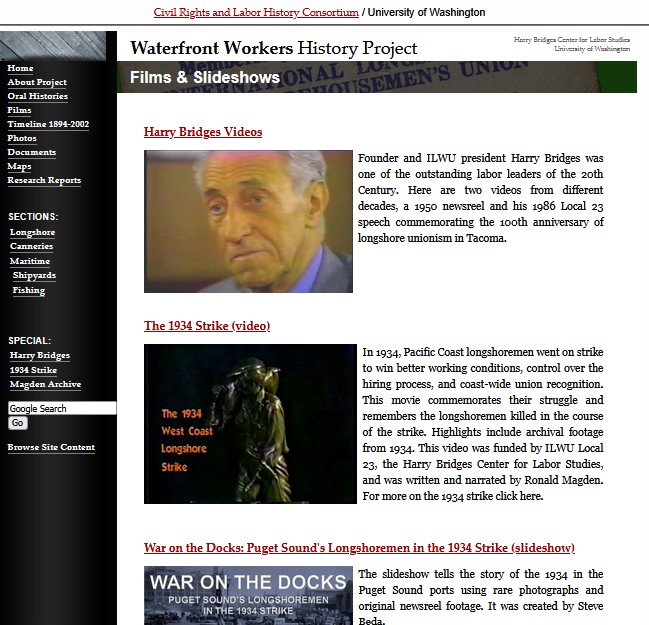
Waterfront Workers History Project
12 minute film written and narrated by Ron Magden and Harry Bridges speaks: two videos
Videos pertaining to the 1934 Longshoremen's Strike, a critical turning point in labor history.
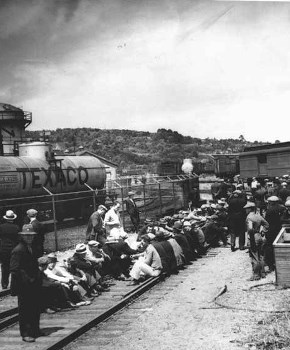
Waterfront Workers History Project
Visit Washington's collections of ILWU and Longshore Workers photographs, more than 400 images.
Several collections of photographs of the 1934 Longshoremen's Strike, a critical turning point in US labor history

Waterfront Workers History Project
Here are collections of historical newspapers and documents, all of them digitzed and fully readable.
Collections of publications pertaining to the 1934 Longshormen's Strike.
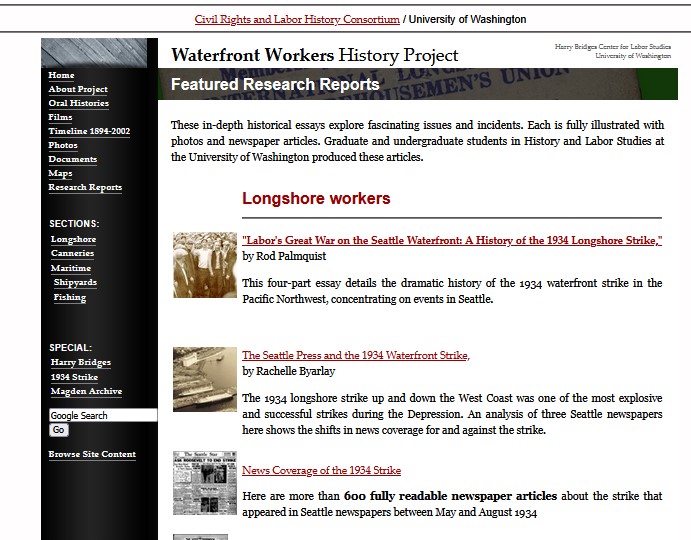
Waterfront Workers History Project
These in-depth historical essays explore fascinating issues and incidents. Each is fully illustrated with photos and newspaper articles.
Graduate and undergraduate students in History and Labor Studies at the University of Washington produced these articles.
They cover the following subjects:
Longshore workers
"Labor's Great War on the Seattle Waterfront: A History of the 1934 Longshore Strike," by Rod Palmquist
This four-part essay details the dramatic history of the 1934 waterfront strike in the Pacific Northwest, concentrating on events in Seattle.
The Seattle Press and the 1934 Waterfront Strike, by Rachelle Byarlay
The 1934 longshore strike up and down the West Coast was one of the most explosive and successful strikes during the Depression. An analysis of three Seattle newspapers here shows the shifts in news coverage for and against the strike.
News Coverage of the 1934 Strike
Here are more than 600 fully readable newspaper articles about the strike that appeared in Seattle newspapers between May and August 1934
The 1936 Pacific Maritime Workers Strike By Annika Tuohey
The 1936 Pacific Coast Maritime Workers’ Strike was a pivotal moment in American labor history. After a 99-day struggle, maritime unions walked away from the strike with a number of gains, but the most important result was the creation of the ILWU.
The 1948 Waterfront Strike : Solidifying the ILWUBy Ashley Lindsay
The 1948 strike was a surprising victory for the ILWU. Defying the Taft-Harley Act and the red-baiting strategy of employers, the union secured its future. This award winning essay is the most complete account of the strike.
The 1971 ILWU Strike : 130 Days to Victory By Ashley Lindsay
The story of the longest strike ever conducted by the ILWU
News Coverage of the 1971 Longshore Strike
Here are more than 160 fully readable newspaper articles about the strike the longest strike ever conducted by the ILWU.
The Pacific Coast Longshoremen,by Kristen Ebeling
The Longshoremen began one year after the 1934 longshore strike, as the official newspaper of the International Longshoremen's Association.
Black Longshoreman: The Frank Jenkins Story,by Megan Elston
-Frank Jenkins was one of the first non-white members of the ILWU, and advocated for increased civil rights within the labor movement.
Cannery Workers
-- The Murders of Virgil Duyungan and Aurelio Simon and the Filipino Cannery Workers' Union, by Nicole Dade
In 1936, two leaders of the Filipino Cannery Workers' and Farm Labor Union were shot to death, weakening the union but also providing the fragmented Filipino community with a cause to unite behind.
-- Cannery Worker's and Farm Laborer's Union 1933-1939: Their Strength in Unity,
by Crystal Fresco
Organized in 1933, the union represented "Alaskeros," the men who shipped out each spring to work in the Salmon canneries of Alaska. This essay narrates the dramatic early years of CWFLU which much later became Local 37 of the ILWU.
-- "The Local 7/Local 37 Story: Filipino-American Cannery Unionism in Seattle 1940-1959"
by Micah Ellison
This essay explores the critical middle period as the union negotiated the 1940s and 1950s, dealing with deportation threats, internal turmoil, but also consolidating and becoming a critical resource for Filipino-American communities on the West Coast.
-- Victorio Velasco, Pioneer Filipino American Journalist, by Erik Luthy
Velasco was the central figure in Filipino American journalism in the Northwest. This paper traces his political evolution toward progressive politics.
-- Philippine-American Chronicle,
by Rache Stotts-Johnson
The Chronicle was the paper of the Filipino-led cannery workers' union, as well as a source of progressive news for the Filipino and labor communities in Seattle.
Maritime Workers
Maritime Workers and Their Unions
By Michael Reagan
Sailors and other seafaring workers built some of the earlier and most unions on the West Coast. Here are historic photos and short articles about the Sailors Union of the Pacific, Marine Cooks and Stewards, and Marine Engineers Benevolent Association.
Desegregating a Maritime Union: the Marine Cooks and Stewards.
by George Robertson'
Details the struggle to desegregate a union that by the late 1940s promoted gay rights as well as civil rights.
Jerry Tyler and Labor Radio: An Activist Life
by Leo Baunach
Maritime worker, labor activist, and radio personality, Jerry Tyler was the radio voice of organized labor in Seattle and the Pacific Northwest. He is most remembered as the host of Reports from Labor, a popular radio show in the Seattle area which ran from 1948 to 1950.
Seattle's CIO Radio: Reports from Labor
by Leo Baunach
Reports from Labor was a fifteen-minute, biweekly labor radio show that aired in Seattle between July 1948 and October 1950, making it a rare pro-labor voice during difficult times for working people and progressive politics. This essay details the history of the program and includes complete audio recordings of key shows.
Revels Cayton: African American Communist and Labor Activist, by Sarah Falconer
A leader of the Marine Cooks and Stewards union, Revels Cayton was the most prominent African American communist, labor leader, and activist in the Northwest during the 1930s and 1940s.
Fishing Workers
The International Fishermen and Allied Workers of America: Organizing Precarious Workers in the CIO Era
by Leo Baunach
This award winning five-part essay details the history of the CIO union that organized fishermen and cannery workers from Alaska to San Diego. By the late 1940s IFAWA represented over a third of the West Coast workforce. It was the largest and most successful fisherman’s union in American history.
Shipyard Workers
The Ship Scalers Union and Seattle’s Racial Progressivism in the 20th Century
by Adam Farley
The Ship Scalers Union helped pioneer civil rights unionism in the Northwest. By the end of World War II half the members were African Americans and the union had become a force for progressive racial politicals and leftwing activism.
Seattle's Shipyards on the Eve of the 1919 General Strike
by Patterson Webb
A strike by 30,000 shipyard workers set up the General Strike of 1919. This essay examines labor issues in the shipyards in the year before the strike. It includes a database of 142 digitized newspaper articles about shipyard workers from Seattle newspapers in 1918.
A collection of research papers written at the University of Washington on a range of subjects from longshoremen, cannery workers, maritime workers, fishermen's unions and more
Waterfront Workers History Project
A digital collection of oral histories from people involved in the 1934 Longshoremen's Strike.
A digital collection of oral histories from people involved in the 1934 Longshoremen's Strike.
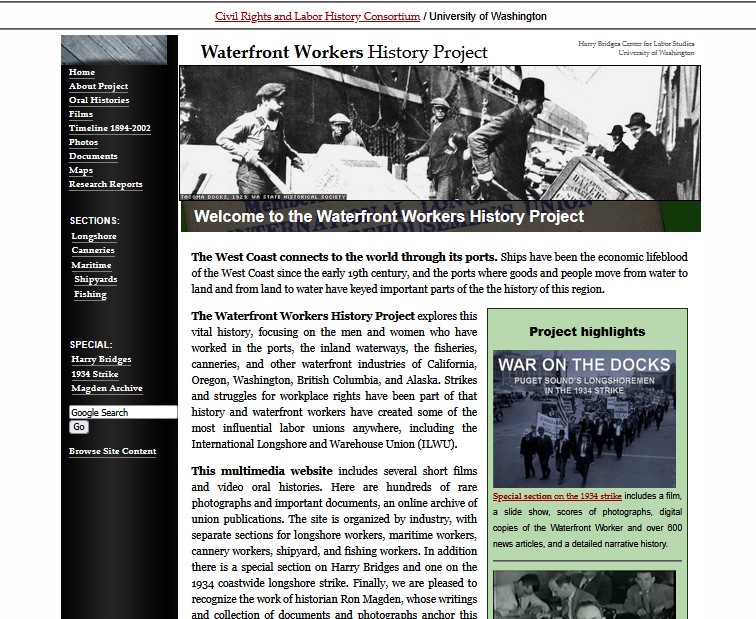
Waterfront Workers History Project
This multimedia website includes several short films and video oral histories. Here are hundreds of rare photographs and important documents, an online archive of union publications. The site is organized by industry, with separate sections for longshore workers, maritime workers, cannery workers, shipyard, and fishing workers. In addition there is a special section on Harry Bridges and one on the 1934 coastwide longshore strike. Much of this is available through the work of historian Ron Magden, whose writings and collection of documents and photographs were used for the project. From this page, you can access photo archives, documents and publications, inclduing hte Waterfront Worker (1932-1936), 600 newspaper articles from the 1934 waterfront strike, Cannery Workers and Farm Laborers Union, films and other newsreels, oral histories and video memories, historian Ronald Magden archives, fishery workers materials, and much more.
A digital collection of resources pertaining to the International Longshoremen and Warehouse Workers and other unions

Waterfront Workers History Project
over 30 photographs of Alaska cannery workers
A selection of cannery worker images from Alaska
Waterfront Workers History Project, Blaine Holien
This timeline offers an overview of significant events in the history of longshore and warehouse workers in Puget Sound, primarily Tacoma and Seattle. It was complied by Blaine Holien, who served as an intern to the Harry Bridges Center Winter 2010. It uses information from two books by historian Ronald Magden: The Working Longshoremen and A history of Seattle Waterfront Workers, 1884-1934.
A timeline of significant events pertaining to Longshoremen.
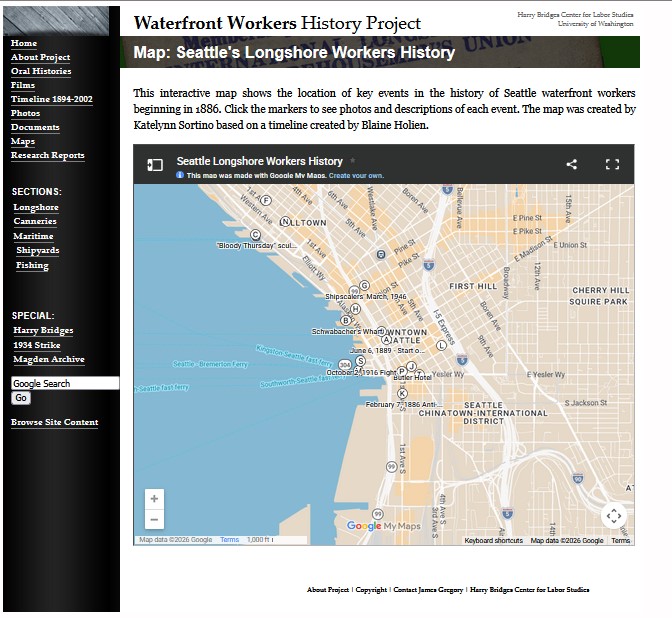
Waterfront Workers History Project, Blaine Holien, Katelynn Sortino
This interactive map shows the location of key events in the history of Seattle waterfront workers beginning in 1886. Click the markers to see photos and descriptions of each event. The map was created by Katelynn Sortino based on a timeline created by Blaine Holien.
Interactive map of significan events of Longshore Workers in Seattle.

Waterfront Workers History Project, Blaine Holien, Ron Magden
This special section explores the history of the cannery union activism and the Seattle Filipino-American community. The links above and below include video oral histories with activists of two different generations, research essays that detail the history of the union, and several collection of rare photographs, documents, and digitize newspapers.
history of the cannery union, Seattle area
Waterfront Workers History Project, Blaine Holien, Ron Magden
Timeline Puget Sound longshore and warehouse workers, esp. Tacoma and Seattle, Ronald Magden. Part of Waterfront Workers History Project, University of Washington
Timeline from Puget Sound Washington waterfront workers

Waterfront Workers History Project, Leo Baunach
This five-part essay details the history of the CIO union that organized fishermen and cannery workers from Alaska to San Diego. By the late 1940s IFAWA represented over a third of the West Coast workforce. It was the largest and most successful fisherman’s union in American history. THis is the story of the rise and fall of this CIO union in this region.
history of the CIO union that organized fishermen and cannery workers from Alaska to San Diego

Wendy Warren
Liveright Publishing Corporations-Norton (2016)
Wendy Warren links the growth of the northern colonies to the Atlantic slave trade, demonstrating how New England's economy derived its vitality from the profusion of slave-trading ships coursing through its ports. Warren documents how Indians were systematically sold into slavery in the West Indies and reveals how colonial families like the Winthrops were motivated not only by religious freedom but also by their slave-trading investments. New England Bound punctures the myth of a shining 'City on a Hill, ' forcefully demonstrating that the history of American slavery can no longer confine itself to the nineteenth-century South
how colonial families like the Winthrops were motivated not only by religious freedom but also by their slave-trading investments
Museum/Exhibits
Tours
Maps
Digital Projects
Organizations
Sites
Film/Video
Audio/Interview
Podcast/Program
Text/Document
Image
Graphs/Data
Timeline
Southwest
West
Midwest
Southeast
Northeast
Mexico
Canada
Global
Books
Teaching
Lectures
Digital Archives
Journals
Bibliographies
Topic Intro