


Explore thousands of items. Use clickable links under collections and library for broad categories. Search by keyword (including topic,city, state.) Limit by time period, type of item, region. See our search tips page for more assistance.
Collections
Library
Type
Region
Coverage:
-
Published:
-
Working Class Studies Association
Working-Class Studies aims to focus both broadly and intimately on working-class lives, cultures, politics, economics, and social movements. The Working-Class Studies Association formed in 2003 to further this goal. We are an international group dedicated to developing working-class studies as a field within higher education and public discourse.
As captured in the “Studies” part of our title, the WCSA’s core is in the academy and the teaching professions where members come from a variety of roles and disciplines. But since our founding, we have fostered connections with our communities, especially activists and independent artists and scholars.
Aspiring to work alongside other fields like Women & Gender, Race & Ethnic, and Labor Studies, we entertain a wide variety of definitions and perspectives on working-class lives with an insistent focus on actual lived experience. We also value interdisciplinarity and the connections that can arise when working across boundaries.
The Working-Class Studies Association supports scholarship, teaching, art, and activism related to working-class life and cultures.

Working Women's History Project
WWHP researched, wrote, and produced dramas about historical Chicago women who had made significant contributions on behalf of working people. These were performed at our own galas, in schools, colleges, at other public venues, for labor unions, and on CAN TV. For some we wrote curricula to assist classroom teachers whose students attended productions.
dramas about historical Chicago women who had made significant contributions on behalf of working people.

Workmen's Advocate
Socialist Labor Party newspaper, New Haven Connecticut
Connecticut Labor newspaper

World Museum of Mining
The World Museum of Mining was founded in 1963 when the close of Butte’s mining heyday was less than two decades away. In the end, Butte experienced a century of hard-rock mining and earned the reputation of being home to one of the world’s most productive copper mines of all time. The Museum exists to preserve the enduring history of Butte and the legacy of its rich mining and cultural heritage.
The World Museum of Mining is one of the few museums in the world located on an actual mine yard, the Orphan Girl Mine. With 50 exhibit buildings, countless artifacts, and 66 primary exhibits in the mine yard, visitors can spend a couple of hours to an entire day lost in the unfolding story.
By walking the streets of Hell Roarin’ Gulch and venturing to the depths of the Orphan Girl Mine, you can almost see their blackened faces and hear their exhausted sighs at the conclusion of the workday.
The main webpage for the World Museum of Mining, which is based in the historically significant mining community of Butte, Montana.
Youngstown Historical Center of Industry & Labor
Known locally as the "Steel Museum," YHCIL documents the rise and fall of the steel industry in Youngstown and the Mahoning Valley.
Our exhibits combine artifacts, videotaped interviews and full-scale recreations of the places where steelworkers lived and worked, in a tribute to the men and women who forged a way of life from iron and steel for almost two centuries.
The Gallery features hundreds of photographs representing labor, immigration and urban history. Objects on display range from workers’ tools and clothing to hundreds of photographs, some more than 30 feet long. Life-sized scenes—including a mill’s locker room, part of a company-built house, and a blooming mill, where steel ingots were shaped for further processing—help visitors understand steelmaking and the lives of steelworkers.
Museum focuses on the rise and fall of the steel industry in Youngstown and Ohio's Mahoning Valley.

Youngstown State University
18 collections, as well as teaching resources on from early in the 19th century through recent years, the Mahoning Valley has drawn new migrants and immigrants seeking economic opportunities and new homes. As those families settled in the area, they created the diverse cultural mix of our present day community. They brought new languages, religious traditions, recipes, viewpoints, and artistic talents to the area. Since the mid-19th century, migrants and immigrants have left their mark here in the Mahoning Valley in many ways, from the onion domes of eastern European churches to delicatessen favorites and Brier Hill pizza to the jazz and blues music of African Americans. More recent arrivals from Puerto Rico, the middle east, and various parts of Asia have added to our cultural mix, bringing new foods and new traditions. We can trace the experience of immigration and migration through family stories, preserved in letters, diaries, photographs, documents, and other materials. The memories held in these materials are of interest not only to local families but also to scholars and students who want to understand the history of immigration and migration, work, language, and the community.
Steel Valley Voices collects and shares the stories and memories of the Youngstown area’s diverse communities. This digital archive makes letters, documents, photographs, and other materials available to anyone with an interest in Mahoning Valley history and culture.

Yugoslav Socialist Federation
In 1905, Frank Petric and Joze Zavertnik began publishing in Chicago Glas Svobode (“Voice of Freedom”), a socialist newspaper intended for Slovene workers in the United States. A year later Petric and Zavertnik left the Svobode to publish Proletarec under the South Slavic Workers Publishing Co., becoming the first editors of a paper aimed at promoting socialism and the cultural values of the Slovenian population.
Proletarec served the interests of the Slovenian members of the Yugoslav Socialist Federation (YSF), a political and cultural organization composed of Serbs, Croats, and other Slavic immigrants. Based in Chicago, Proletarec began circulation in January of 1906 as a monthly publication with only 100 subscribers. In 1908, Proletarec became a weekly publication under the direction of Ivan Molek, who acquired the position of editor-in-chief the previous year. In 1907, Proletarec increased its readership by publishing an additional section in Croatian, which effectively extended its ability to reach the Croat members of the YSF. Proletarec‘s conscious efforts to maintain and extend readership to immigrant Slovene socialists continued throughout its history.
Proletarec experimented with publishing a magazine format from 1918 to 1929, but reverted to newspaper format on April 4, 1929. Also on that date, the newspaper released the following statement: “Our aim: Education, organisation, cooperation, Commonwealth… Proletarec will publish regularly one or more pages of English reading matter for the benefit of our American born Slovene and other Yugoslav friends. This is especially for our youth.” Printing in English enabled Proletarec to expand its readership to include second-generation Slovenian Americans. In re-centering their audience to a new generation, Proletarec began to focus on sustaining elements of Slovene culture through fraternal organizations, dances, and organized concerts.
By 1930, Proletarec had almost 3,000 subscribers spanning three generations, the majority of whom lived in Pennsylvania, Ohio, Illinois, Minnesota, Kansas, Wisconsin, and New York. Outside of the United States, Proletarec had subscribers in Mexico City and in Slovenia, making it an international publication. Throughout its history, Proletarec seemed to have almost as many editors as it did subscribers. Following Molek’s retirement in 1912, Leo Zakrajsek took over for a brief stint before he left the paper in 1913 due to a disagreement with Joze Zavertnik. The latter held the position of editor until 1916, at which point he left to edit another Slovenian-American newspaper, Prosveta (“Enlightenment”). Upon returning to Slovenia in 1916, Etbin Kristan took over for Zavertnik and held the position of editor until 1920. Frank Zaitz then took over editing Proletarec until it ceased publication in 1952.
Proletarec served the interests of the Slovenian members of the Yugoslav Socialist Federation (YSF), a political and cultural organization composed of Serbs, Croats, and other Slavic immigrants.

Yuri Herrera, Lisa Hill
And Other Stories (2020)
On March 10, 1920, in Pachuca, Mexico, the Compañía de Santa Gertrudis -- the largest employer in the region, and a subsidiary of the United States Smelting, Refining and Mining Company -- may have committed murder. The alert was first raised at six in the morning: a fire was tearing through the El Bordo mine. After a brief evacuation, the mouths of the shafts were sealed. Company representatives hastened to assert that "no more than ten" men remained inside the mineshafts, and that all ten were most certainly dead. Yet when the mine was opened six days later, the death toll was not ten, but eighty-seven. And there were seven survivors. A century later, acclaimed novelist Yuri Herrera has reconstructed a workers' tragedy at once globally resonant and deeply personal: Pachuca is his hometown. His work is an act of restitution for the victims and their families, bringing his full force of evocation to bear on the injustices that suffocated this horrific event into silence."-- Amazon.com summary
cclaimed novelist Yuri Herrera has reconstructed a workers' tragedy at once globally resonant and deeply personal: Pachuca is his hometown.

Zach Sell
The University of North Carolina Press (2020)
In the mid-nineteenth century, U.S. slavery was characterized by relentless expansion and unrelenting exportation, not only of commodities but also of ideas. Zach Sell traces U.S. slavery's significance to colonial land-based dispossessions on a global scale, showing how slavery molded the United States as an empire-state while other imperial powers looked to it as a model for their own colonial projects.
traces U.S. slavery's significance to colonial land-based dispossessions on a global scale, showing how slavery molded the United States as an empire-state while other imperial powers looked to it as a model for their own colonial projects.

Zachary J. Violette
Univ Of Minnesota Press (2019)
A reexamination of working-class architecture in late nineteenth-century urban America As the multifamily building type that often symbolized urban squalor, tenements are familiar but poorly understood, frequently recognized only in terms of the housing reform movement embraced by the American-born elite in the late nineteenth century.
This book reexamines urban America's tenement buildings of this period, centering on the immigrant neighborhoods of New York and Boston. Zachary J. Violette focuses on what he calls the "decorated tenement," a wave of new buildings constructed by immigrant builders and architects who remade the slum landscapes of the Lower East Side of Manhattan and the North and West Ends of Boston in the late nineteenth century.
These buildings' highly ornamental facades became the target of predominantly upper-class and Anglo-Saxon housing reformers, who viewed the facades as garish wrappings that often hid what they assumed were exploitative and brutal living conditions. Drawing on research and fieldwork of more than three thousand extant tenement buildings, Violette uses ornament as an entry point to reconsider the role of tenement architects and builders (many of whom had deep roots in immigrant communities) in improving housing for the working poor.
Utilizing specially commissioned contem-porary photography, and many never-before-published historical images, The Decorated Tenement complicates monolithic notions of architectural taste and housing standards while broadening our understanding of the diversity of cultural and economic positions of those responsible for shaping American architecture and urban landscapes. Winner of the International Society of Place, Landscape, and Culture Fred B. Kniffen Award
working-class architecture in late nineteenth-century urban America
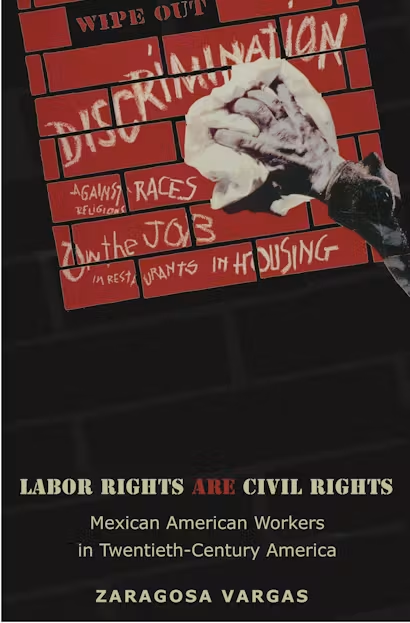
Zaragosa Vargas
Princeton University Press (2005)
"Labor Rights Are Civil Rights paints a multifaceted portrait of the complexities and contours of the Mexican American struggle for equality from the 1930s to the postwar era." "Drawing on extensive archival research, Vargas focuses on the large Mexican American communities in Texas, Colorado, and California. As he explains, the Great Depression heightened the struggles of Spanish-speaking blue-collar workers, and employers began to define citizenship to exclude Mexicans from political rights and erect barriers to resistance. Mexican Americans faced hostility and repatriation."--Jacket
paints a multifaceted portrait of the complexities and contours of the Mexican American struggle for equality.
Zaragosa Vargas
University of California Press (1993)
This study of the employment of Mexicans as labourers in the USA between World War I and the Great Depression relates the social and economic experiences of the Mexican workers. It describes the roles of women, the Catholic church and labour unions.
Foreword / Mario T. Garcia
Introduction: Coming to Work in Detroit
1. Mexican Migration to the Midwest
2. Mexicans in Working-Class Detroit, 1918-1921
3. Mexicans and Factory Work in the 1920s
4. Life in the Mexican Colonies of the Midwest
5. Detroit Mexicans in the Great Depression
Conclusion: Reinterpreting the History of Mexican Industrial Workers
relates the social and economic experiences of Mexican workers and describes the roles of women, the Catholic church and labor unions.

Zeese Papanikolas
University of Nebraska Press (1991)
Louis Tikas was a union organizer killed in the battle between striking coal miners and state militia in Ludlow, Colorado, in 1914. In Buried Unsung he stands for a whole generation of immigrant workers who, in the years before World War I, found themselves caught between the realities of industrial America and their aspirations for a better life.
An emotional Biography of Louis Tikas, a Greek miner and strike leader during the Ludlow Massacre

Zinn Education
Dozens of labor-themed teaching materials and teaching units from Kindergarden to college
Examples: <a href="https://www.zinnedproject.org/materials/homestead-strike"><u>Homestead, 1892</u></a>
Varied materials and lesson plans for introducing issues of labor history to stuents

Zinn Education Project
The films listed here are ones that can help students gain insights into how the world works. Many of these also alert students to how individuals and social movements have tried to make life better. Of course, there are many more that are not included here. One criterion for selection was that the resources be relatively easily accessed by U.S. teachers, and that we know that teachers have had success using them with students. However, teachers should be aware that this requirement biases these “Films with a Conscience” in favor of filmmakers and videographers from so-called developed countries, who have more access to distribution channels here. We are sure that we’ve missed countless other worthy films, and we hope Zinn Education Project supporters bring some of these to our attention. Not only are we interested in suggestions for films not included here, but for strategies for how to use them — in the classroom as well as in the era of the pandemic, when we attempt social justice teaching at a distance.
An article detailing films that help students understand how the world works, with a focus on how individuals and movements have sought social justice.

anonymous, History Matters
Although publicists for late nineteenth-century corporations celebrated their “efficiency” and the “science” of management, their employees did not always join the celebration. What looked like careful and disciplined management from one perspective might be viewed as petty tyranny from below. Some workers directed their anger to the very top of the corporations. An anonymous author, writing in the Brotherhood of Locomotive Firemen’s Monthly Magazine in 1878, claimed that these “ten commandments” were "written down in the Statute-Books of Railroad Officials and idle Monopolists, and Jay Gould Aristocrats."
Source: Brotherhood of Locomotive Firemen’s Monthly Magazine II (December 1877): 15–16.
An anonymous 1878 essay in the Brotherhood of Locomotive Firemen's Monthly Magazine, where the author detail the "ten commandments" for working-class folks.

health care, steel, Pittsburgh, Pennsylvania, care work, caregivers, reproductive labor, United Steelworkers, USW, Blue Cross, Deindustrialization, Rust Belt America, Collective bargaining benefitsSocial citizenshipMedicare and Medicaid (1965)
Harvard University Press (2023)
Pittsburgh was once synonymous with steel, but today most of its mills are gone. Like so many places across the United States, a city that was a center of blue-collar manufacturing is now dominated by health care, which employs more Americans than any other industry. Gabriel Winant takes us inside the Rust Belt to show how America's cities have weathered new economic realities.As steelworkers and their families grew older, they required more health care. Even as the industrial economy contracted sharply, the care economy thrived. But unlike their blue-collar predecessors, home health aides and hospital staff work unpredictable hours for low pay. Today health care workers--mostly women and people of color--are on the front lines of our most pressing crises, yet we have been slow to appreciate that they are the face of our twenty-first-century workforce. The Next Shift offers unique insights into how we got here and what could happen next
shows how American Rust Belt cities have changed over time, giving them a present character away from industry.
no author
Some occupational names were self-explanatory such as a blacksmith, locksmith, and gunsmith. Of course there were also occupations with names that are recognizable today - coroner, bookkeeper, barber, cabinet-maker, weaver, baker, brick-layer, accountant, printer and musician.
A-Z listing of colonial era occupations with a short description
“Brutus”, History Matters
The urban workplace changed dramatically in the early decades of the nineteenth century. The American Revolution, with its rampant egalitarianism, dissolved much of the paternalistic control once wielded by fathers, masters and other authority figures, as the anonymous author “Old Apprentice” made clear in his set of three letters to the New York Observer in 1826. But significant blame for this erosion rested with the manufacturers themselves. Eager to seize upon new markets with expanded production, they divided up tasks to produce cheaper clothing or shoes. Semiskilled and unskilled women and children performed this labor rather than apprentices or other workingmen of the traditional artisanal system. These changes also dissolved the traditional residential patterns, pushing working men out into the housing market. A loss of reciprocity and responsibility occurred on both sides.
Anonymous excerpts from "Old Apprentice," who expressed his discontent with the collapse of the master-apprentice system through three letters to the New York Observer in 1826.
“Brutus”History Matters
A petition by enslaved people that was sent to the then newly established House of Representatives for the State of Massachusetts not too long before slavery was abolished there. The colonists’ revolutionary struggle against British political authority also raised issues about equality and human rights at home. Enslaved people throughout the colonies seized upon the rhetoric of liberty and equality to point out the contradiction of fighting Great Britain over principles not fully followed by the colonies themselves; they also appealed to Christian precepts. Scores of petitions flooded the newly established state legislatures. This one, submitted to the Massachusetts General Court in 1777, linked the cause of American freedom with the struggle of African Americans for liberty. Several lawsuits seeking freedom were successful. When Quok Walker sued for his freedom and back wages in 1781, the Massachusetts Chief Justice ruled that his enslavement violated the new state constitution’s statement that “men are born free and Equal.” His case effectively ended slavery in Massachusetts and other New England states.
A petition by enslaved people that was sent to the then newly established House of Representatives for the State of Massachusetts not too long before slavery was abolished there.
Museum/Exhibits
Tours
Maps
Digital Projects
Organizations
Sites
Film/Video
Audio/Interview
Podcast/Program
Text/Document
Image
Graphs/Data
Timeline
Southwest
West
Midwest
Southeast
Northeast
Mexico
Canada
Global
Books
Teaching
Lectures
Digital Archives
Journals
Bibliographies
Topic Intro