


Collections
Library
Type
Region
Coverage:
-
Published:
-
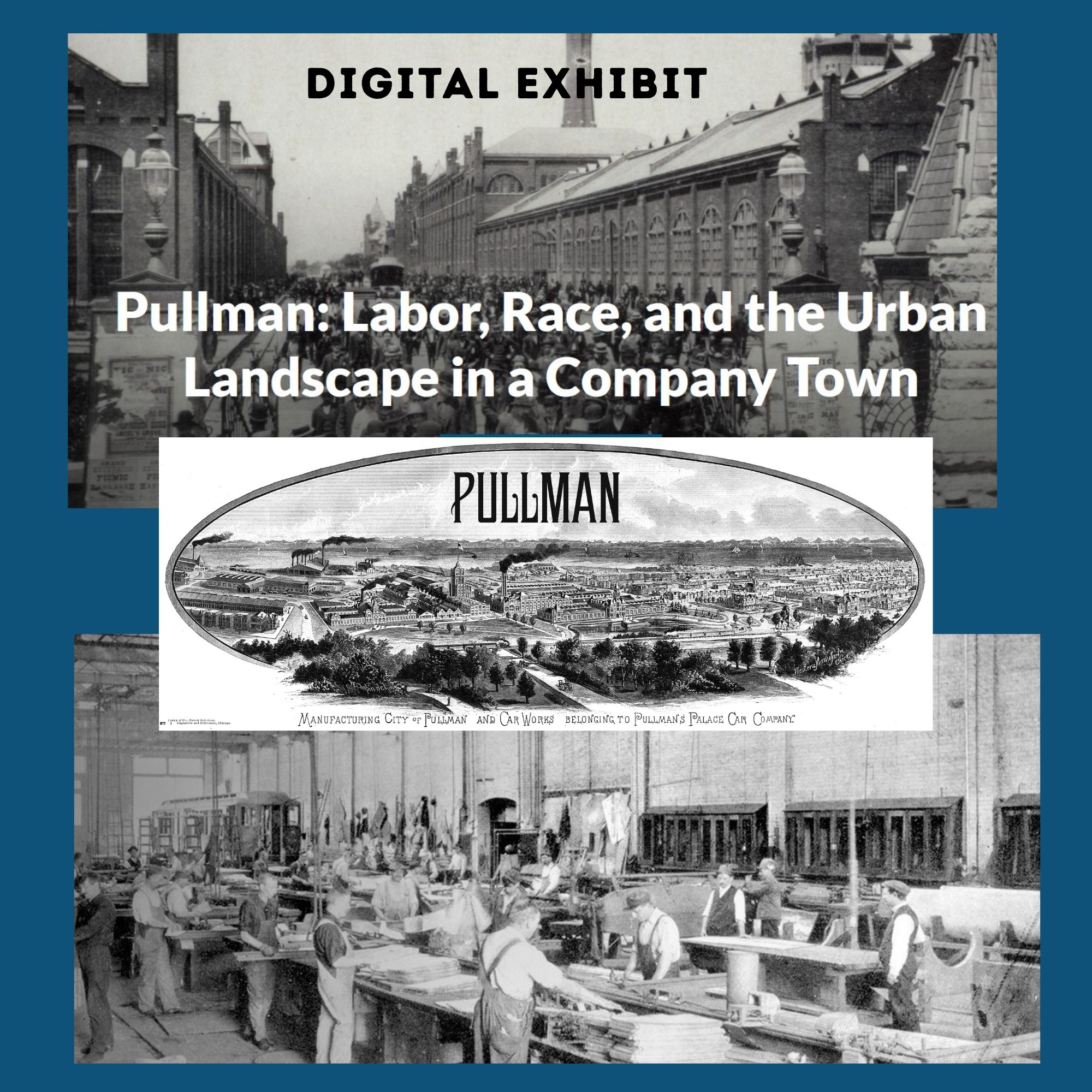
Christopher D. Cantwell, Newberry Library
This website tells the story of Pullman in all of its complexity, from the company town from which it began to the vibrant inner-city neighborhood it remains today. It situates Pullman within a broad narrative, exploring how the neighborhood illuminates the centrality of labor, race, and urban development in the history of industrial America. In each of the sections, you will find a variety of primary sources that chart Pullman’s history. Through photographs, illustrations, published texts, and manuscript sources, you will be able to explore the urban conditions that led to Pullman’s creation; company founder George M. Pullman’s vision for the community; working people’s response to the company’s vision; and the ongoing efforts by Pullman’s current residents to preserve their community. Every exhibit page provides a brief introduction to the materials, but the website is intended to be interactive. We encourage you to explore the documents as a researcher and arrive at your own history of Pullman. For as we hope this site suggests, Pullman has many histories, many stories.
Contents
In the City
In the Town
In the Shops
On the Trains
In the Neighborhood
Selected Bibliography
Web Resources
About
Acknowledgements
Copyright and Permissions
This digital exhibit tells the story of Pullman, IL through photographs, illustrations, published texts, and manuscript sources
Christopher Hayes
In July 1964, after a white police officer shot and killed an African American teenage boy, unrest broke out in Harlem and then Bedford-Stuyvesant. Protests rose up to call for an end to police brutality and the unequal treatment of Black people in a city that viewed itself as liberal. A week of upheaval ensued, including looting and property damage as well as widespread police violence, in what would be the first of the 1960s urban uprisings. Christopher Hayes examines the causes and consequences of the uprisings, from the city's history of racial segregation in education, housing, and employment to the ways in which the police both neglected and exploited Black neighborhoods. While the national civil rights movement was securing substantial victories in the 1950s and 1960s, Black New Yorkers saw little or uneven progress. Faced with a lack of economic opportunities, pervasive discrimination, and worsening quality of life, they felt a growing sense of disenchantment with the promises of city leaders. Turning to the aftermath of the uprising, Hayes demonstrates that the city's power structure continued its refusal to address structural racism. In the most direct local outcome, a broad, interracial coalition of activists called for civilian review of complaints against the police. The NYPD's rank and file fought this demand bitterly, further inflaming racial tensions. The story of the uprisings and what happened next reveals the white backlash against civil rights in the north and crystallizes the limits of liberalism. Drawing on a range of archives, this book provides a vivid portrait of postwar New York City, a new perspective on the civil rights era, and a timely analysis of deeply entrenched racial inequalities"-- Provided by publisher
sophisticated account of an overlooked aspect of Appalachia's labor history and a key piece of context for Americans' current concern with the status of "essential workers,"
Christopher L. Tomlins
This book presents a fundamental reinterpretation of law and politics in America between 1790 and 1850, the crucial period of the Republic's early growth and its movement toward industrialism. It is the most detailed study yet available of the intellectual and institutional processes that created the foundation categories framing all the basic legal relationships involving working people
presents a fundamental reinterpretation of law and politics in America between 1790 and 1850.
Christopher L. Tomlins
This 1985 book offers a critical examination of the impact of the National Labor Relations Act on American unions. Tomlins examines both the laws from the late nineteenth century and the history of the act's passage. He shows how public policy confined labour's role in the American economy and the problems faced by unions that stem from these laws.
Editor's preface;
Preface; Part I. The Legitimacy of the Labor Union: Introduction: 'Labor's ultimatum to the public';
1. The corporate political economy;
2. Law, labor, and ideology;
3. From conspiracy to collective bargaining;
Part II. Labor and the Liberal State: Introduction: 'Who bears the business risks';
4. The New Deal collective bargaining policy;
5. A legal discourse;
6. Utopians and technocrats;
Part III. 'Lie Down Like Good Dogs': Introduction: responsible unionism;
7. The road to Taft–Hartley;
8. The Taft–Hartley Act;
9. The state and the unions;
Bibliographical essay; Index.
offers a critical examination of the impact of the National Labor Relations Act on American unions.
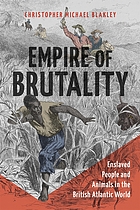
Christopher Michael Blakley
Christopher Blakley's Empire of Brutality is a human-animal history of slaving and slavery in the Atlantic World between the end of the seventeenth century and the abolition of the Atlantic trade in 1808. His multidisciplinary study examines how varied relationships between enslaved people and animals led to the dehumanization and racialization of people of African descent in the Americas. Blakley discusses the role of animal exchanges among slavers in West Africa, the knowledge and curiosity of enslaved specimen collectors in the Atlantic world, regimes of labor on Caribbean and Chesapeake plantations, and the forms of resistance that enslaved people engaged in by injuring, killing, stealing, and thinking about animals. His analysis provides a better understanding of why enslaved people emphasized in their writing how slaveholders compared them to animals, suggesting that critiques of slavery as dehumanizing by people of African descent were to a marked degree the result of these material human-animal networks and linkages. Blakley's study brings together disparate geographies-including the castle trade in Atlantic Africa, slave depots in New Spain, and plantations in the British Caribbean and Chesapeake worlds-to build on the emerging literature of human-animal studies and new scholarship in early American environmental history. His work is among the first to approach human-animal networks under slavery systematically and comprehensively. It makes a significant contribution by historicizing human-animal relations produced by Atlantic-wide networks of slavery. It also provides an analysis of these linkages that, over time, led to the racialization and dehumanization of people of African descent as animal-like subjects. In this way, his work offers an important environmental and material basis for the rich scholarship on the ideological and intellectual origins of race and racism. It also illuminates the divergent affective responses of enslaved people towards animals ranging from curiosity to disgust and empathy"-- Provided by publisher
examines how varied relationships between enslaved people and animals led to the dehumanization and racialization of people of African descent in the Americas as well as how it impacted the slave trade
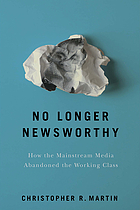
Christopher R. Martin
Until the recent political shift pushed workers back into the media spotlight, the mainstream media had largely ignored this significant part of American society in favor of the moneyed "upscale" consumer for more than four decades. Christopher R. Martin now reveals why and how the media lost sight of the American working class and the effects of it doing so.
The damning indictment of the mainstream media that flows through No Longer Newsworthy is a wakeup call about the critical role of the media in telling news stories about labor unions, workers, and working-class readers. As Martin charts the decline of labor reporting from the late 1960s onwards, he reveals the shift in news coverage as the mainstream media abandoned labor in favor of consumer and business interests. When newspapers, especially, wrote off working-class readers as useless for their business model, the American worker became invisible. In No Longer Newsworthy, Martin covers this shift in focus, the loss of political voice for the working class, and the emergence of a more conservative media in the form of Christian television, talk radio, Fox News, and conservative websites.
Now, with our fractured society and news media, Martin offers the mainstream media recommendations for how to push back against right-wing media and once again embrace the working class as critical to its audience and its democratic function.
how workers in the U.S. have been invisible for decades because the mainstream news media lost sight of the American working class
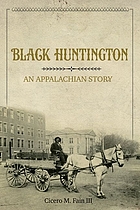
Cicero M. Fain
This project explores the experiences of black migrants and residents in Huntington, West Virginia, during the late nineteenth and early twentieth centuries. Founded as a transshipment station by financier Collis P. Huntington for the Chesapeake and Ohio Railroad in 1871, Huntington grew from a nondescript village to the state's most populated city, with the second largest black population in the state, by 1930. Its burgeoning economy and comparatively tolerant racial climate attracted increasing numbers of black migrants drawn to the socio-cultural and economic opportunities for African Americans not found further south: opportunities deriving both from railroad development and from Huntington's attendant rise as a commercial, manufacturing, and industrial center. Yet, by the early twentieth-century black aspirations became increasingly constrained as white Huntingtonians embraced and implemented the tenets of Jim Crowism.
Fain documents the purposeful nature of black agency in the migratory process, the consolidation of Huntington's black working-class, and Afro-Huntingtonians' adaptive techniques and strategies--the strength of kin and social networks, gainful employment, institutional development, property acquisition, and legal challenges--used to confront the manifestations of segregation in an evolving urban-industrial southern environment.
While Fain argues that race, not class, served as the primary operative feature of the Afro-Huntingtonian experience, he documents the development of class fissures within black Huntington, particularly as the rise of a professional class during the late-nineteenth and early twentieth century challenged the status quo of white Huntingtonians and complicated black aspirations"-- Provided by publisher
Explores the experiences of black migrants and residents in Huntington, WV, during the rise of Jim Crow and the development of a class divide within the black community

Cigar Makers International Union
Cigarmakers Journal 1897-1972
A full run of the official journal of the Cigarmaker's Intl. Union, an important early union
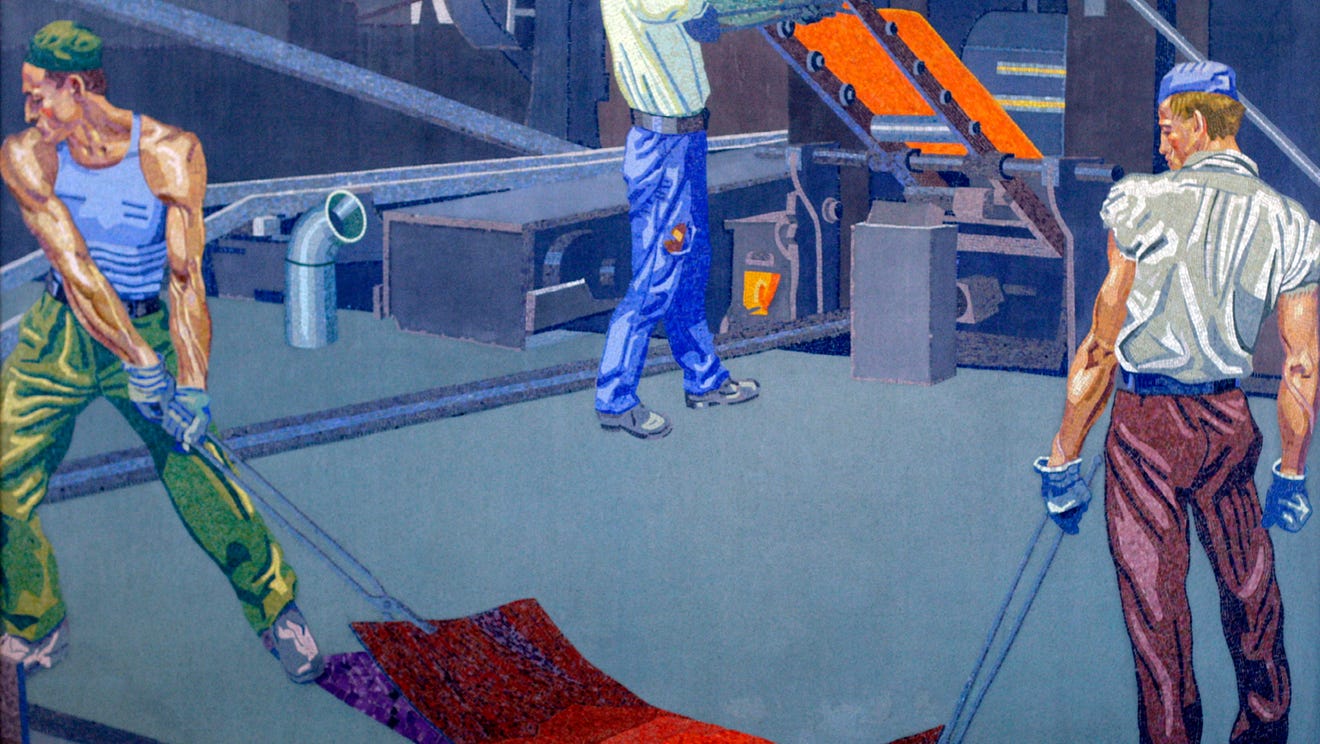
Cincinnati Labor History
This resource guide provides materials for those interested in learning more about the labor and working class history of Cincinnati and the state of Ohio. This guide includes links to digitized newspapers and other primary source documents, archives housing Cincinnati and Ohio labor history materials, popular and academic articles, books, videos, and experiential learning opportunities such as walking tours. The materials included in this guide will be interesting and useful to casual learners as well as serious students and researchers of Cincinnati labor and working class history. Prominent themes in the resources listed include labor as it relates to race and ethnicity, gender, culture and politics, urbanism, architecture and historic preservation, and Ohio state and U.S. national history. Cincinnati, Ohio has a rich history as a city located along the Ohio River. Before the abolition of slavery in the U.S., it was an important stop along the Underground Railroad given its location along the Kentucky-Ohio border. Its river-side location also fueled its industrialization at a time when the steamboat provided one of the best means for transporting goods to other cities. In the mid- to late-19th century, Cincinnati became known for its production of candles, soap, leather, beer, and packaged meat, and later for its heavy metal and machine production. Cincinnati's growing workforce during the late-19th and early-20th centuries hailed from across Europe (including Germany, Ireland, Italy, Poland, and Russia), and also included freed slaves (and later ex-sharecroppers) and white Appalachians migrating from the American South.
This resource guide provides materials for those interested in learning more about the labor and working class history of Cincinnati and the state of Ohio.
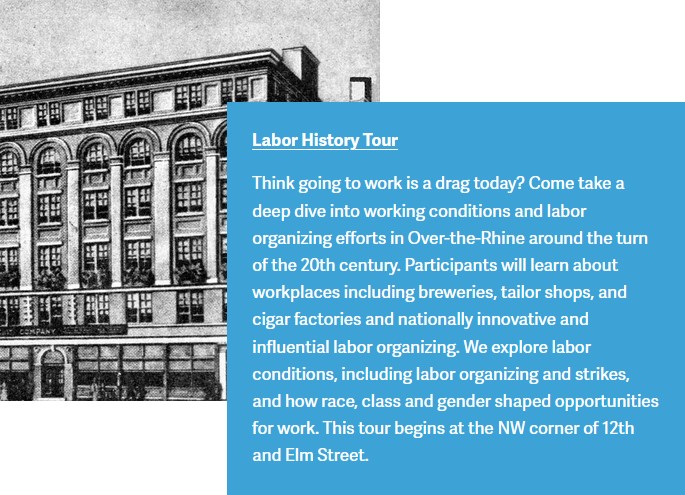
Cincinnati Labor History
"Come take a deep dive into working conditions and labor organizing efforts in Over-the-Rhine around the turn of the 20th century.
Participants will visit workplaces including breweries, a woodworking shop, a tailor shop, and a cigar-making factory."
Cincinnati, Ohio has a rich history as a city located along the Ohio River.
Before the abolition of slavery in the U.S., it was an important stop along the Underground Railroad given its location along the Kentucky-Ohio border. Its river-side location also fueled its industrialization at a time when the steamboat provided one of the best means for transporting goods to other cities.
In the mid- to late-19th century, Cincinnati became known for its production of candles, soap, leather, beer, and packaged meat, and later for its heavy metal and machine production.
Cincinnati's growing workforce during the late-19th and early-20th centuries hailed from across Europe (including Germany, Ireland, Italy, Poland, and Russia), and also included freed slaves (and later ex-sharecroppers) and white Appalachians migrating from the American South.
THe site has archives and digitized materials as well
A digital project hosting links to Cincinnati labor history sites and documents
Cindy Hahamovitch
From South Africa in the nineteenth century to Hong Kong today, nations around the world, including the United States, have turned to guestworker programs to manage migration. These temporary labor recruitment systems represented a state-brokered compromise between employers who wanted foreign workers and those who feared rising numbers of immigrants. Unlike immigrants, guestworkers couldn't settle, bring their families, or become citizens, and they had few rights. Indeed, instead of creating a manageable form of migration, guestworker programs created an especially vulnerable class of labor
How guestworker programs created an especially vulnerable class of labor
Cindy Hahamovitch
In 1933 Congress granted American labourers the right of collective bargaining, but farmorkers got no New Deal. This account of migrant farmworkers along the Atlantic coast shows how growers enlisted the aid of the state in an effort to keep their fields well stocked with labour.
shows how growers enlisted the aid of the state in an effort to keep their fields well stocked with labour.
Civil Rights & Labor History Consortium, James Gregory
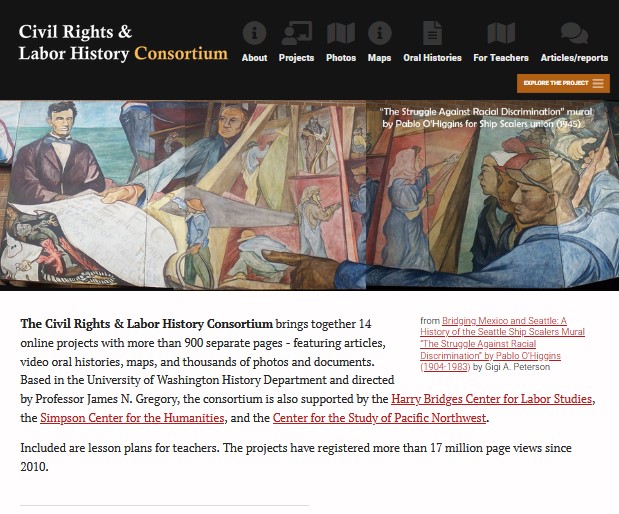
This page is a gateway to a consortium of civil rights and labor history projects directed by Professor James N. Gregory at the University of Washington and supported by the Harry Bridges Center for Labor Studies, the Simpson Center for the Humanities, and the Center for the Study of Pacific Northwest. The thirteen projects bring together maps, films, slide shows, nearly one hundred video oral history interviews, and several thousand photographs, documents, and digitized newspaper articles. Included are lesson plans for teachers. The projects also feature several hundred essays about important issues, events, and people, some researched and written by undergraduate and graduate students at the University of Washington.
They are:
the Seattle Civil Rights and Labor History Project;
Mapping American Social Movements Project
Great Depression in Washington State Project
Racial Restrictive Covenant Project - Washington State;
the Industrial Workers of the World History Project;
the Seattle General Strike Project;
Strikes! Labor History Encyclopedia for the Pacific Northwest;
Mapping Washington Labor and Civil Rights History
Communism in Washington State
- History and Memory Project;
the Waterfront Workers History Project;
Antiwar and Radical History Project--Pacific Northwest;
Upton Sinclair's End Poverty in California Campaign;
the Labor Press Project;
and America's Great Migrations.
A gateway to thirteen civil rights and labor history projects that bring together a vast range of primary and secondary source materials from the University of Washington and several outside collections.
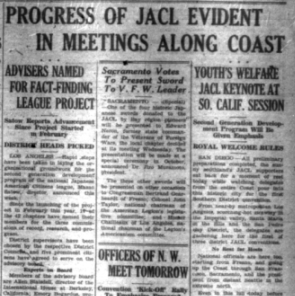
Civil Rights and Labor History Consortium
Seattle has been home to hundreds of newspapers in the last century and a half, some of them daily newspapers that have sought a large readership among the city’s dominant populations, many of them weeklies or monthlies that have tried to represent minority communities. University of Washington Library collections include at least twenty different newspapers representing Seattle’s African American community, eighteen representing the Filipino American community, five Japanese American, several Chinese American, four German American, three Jewish, two Italian American, seven Swedish, Norwegian, or Danish American newspapers. Some of these newspapers were successful and long lived, others published for only a short while. They varied also in tone and purpose. But all played some role in helping their particular community negotiate relationships with the dominant society.
This page is a gateway to learning more about Seattle’s ethnic newspapers and their communities. The reports that follow were produced by students in advanced History and Labor Studies classes at the University of Washington. Each is accompanied by digitized copies of pages and articles from the newspapers.
Here, you will find 17 links to resources hosted by The Seattle Civil Rights & Labor History Project's website, including newspapers, maps, visuals, and teaching resources. Each link is labeled and numbered to match a description below.
Japanese-American Courier, 1937-1940 (by Mark Morzol): http://depts.washington.edu/civilr/news_Courier.htm The Japanese-American Courier was the first Japanese-American newspaper published entirely in English in the United States. A weekly publication serving the Japanese-American community of the greater Seattle area, the Courier was founded in 1928 by James Y. Sakamoto. After establishing a loyal local base, the Courier expanded publication to include the entire West Coast, launching district offices in three California cities while becoming the largest English-language Japanese newspaper in the United States. The newspaper ceased operations on April 24, 1942, just before the U.S. Government forced the entire Japanese-American community into internment camps during World War II.1 This report focuses on the years 1937 to 1940. The Courier was circulated under the banner, “For Truth, Justice and Tolerance”2 and addressed a wide range of local, national, and international topics, including Americanism, national politics, Japanese news, Japanese-American Citizens League (JACL) events, education, and economics. Aimed primarily at an audience of Nisei, or second-generation Japanese-Americans, the Courier also included sports scores, advertisements, occasional classified ads, and more rarely, cartoons.
The Northwest Enterprise: Social and Racial Equality in 1938 (by Kelly Connors): http://depts.washington.edu/civilr/news_NWEnterprise1938 .htm The Northwest Enterprise was a weekly newspaper published in Seattle and read by African Americans throughout the Pacific Northwest. It was founded in 1920 by William H. Wilson, who edited the paper until 1935. The last issue of the newspaper appeared in 1952. The Northwest Enterprise generally reflected the opinions of middle-class African Americans. It often took moderate or conservative positions on issues such as religion, social norms, and labor, but was always an outspoken critic of inequality and a source of organization and strength for local African American communities. This essay surveys Northwest Enterprise coverage from the year 1938 and finds that during this time the paper’s traditional focus on justice and equality and its ties to the NAACP remained strong, highlighted by the paper’s coverage of the Berry Lawson police brutality case. In addition, the essay surveys other sections of the paper in 1938, including regular features such as “Pot Likker,” “Social Notes,” and “With the Churches.”
The Northwest Enterprise, Cold War Years, 1947-1949, (by Grace Taylor) http://depts.washington.edu/civilr/news_NWEnterprise47.htm : “A Newspaper the People Read, Love & Respect:” this slogan boldly declared the Northwest Enterprise’s importance in Seattle’s African American community on the front page of every issue. The _Enterprise_was, as Quintard Taylor writes, “the most widely known Seattle black business, and arguably the most successful.” Published from 1920 through 1952, the paper circulated throughout the Pacific Northwest and had readers in Oregon, Idaho, and Montana, in addition to Washington State.
Wiliam H. Wilson founded the NW Enterprise in 1920 and edited the weekly until 1935. Under his guidance the newspaper was a strong voice for the African American community and for broader issues of racial justice. An early leader of the NAACP, Wilson and his newspaper attacked segregation and led campaigns against police brutality. The paper retained its activist tone under the sequence of editors who managed it in the late 1930s. In 1939, drug store owner Edward I. Robinson purchased the Enterprise. Under his leadership, the paper achieved one of its proudest moments in 1942 when it led the successful campaign to force Boeing to begin hiring African Americans. This report examines the newspaper a few year later, during the early Cold War.
For the entire three-year span examined here, 1947-1949, the editor and publisher was E.I. Robinson. Consequently, the overall tone and style of the paper remained fairly consistent throughout the period. It was published weekly, usually on a Wednesday, and consisted of 5-7 pages of world, national, and local news targeted at a middle-class African American audience, as well as editorials, social and church related events, and advertisements for local businesses. The Northwest Enterprise, at least in the late 1940s, tended to take a relatively conservative position, particularly when it came to issues of religion, business and labor, politics, and social norms. However, the newspaper’s opportunistic stance towards, for example, national political parties, indicates that in Seattle the black community’s allegiance was first and foremost to whatever or whomever was perceived to further ‘the negro race.’ The topics the paper covered, the tone of the editorials, and even the advertisements all provide clues as to what the black community of Seattle was concerned with, proud of, and purchasing in the post-World War II economic boom.
Racial Equality Bulletin, The Christian Friends for Racial Equality, 1951-1953, (by Brooklyn Gregorich): http://depts.washington.edu/civilr/news-racialequality.htm “In the present world crisis, brotherhood is not optional.”
-Racial Equality Bulletin, February, 1952
"The quotation above summarizes the basic philosophy behind the creation of the Racial Equality Bulletin. Published by the Christian Friends for Racial Equality (CFRE), the paper asserted that brotherhood, or the coming together of people, was integral to the fight against racism. The articles and the community events organized by the Racial Equality Bulletin reveal that the CFRE believed that racism and discrimination could be overcome through love, education, and a better understanding of other cultures. The paper not only delivered news on the national civil rights movement, but also served as a social events resource, helping to coordinate numerous activities and events, from square dancing to educational forums on the Jewish faith and interracial picnics. It also strove to be inclusive by recognizing the accomplishments of people from various ethnic backgrounds from around the Seattle community. Central to all of this was the influence of the Christian faith, which was pervasive throughout the paper. In fact, the opening line of the Bulletin’s statement of purpose referred to the religious motivation behind the group’s involvement in the fight for racial equality:"
[Text continues at link...]
Afro American Journal, Black Power and Education, 1968-1969 (by Doug Blair): http://depts.washington.edu/civilr/news_blair.htm The Afro American Journal was published in Seattle from November 1967 to December 1972, and during that time was the most militant weekly newspaper to serve the black community. Supporting the principles of black power, the paper gave space to the Black Panther Party, the Nation of Islam, and other activist groups. The Afro American Journal promoted community self-determination and had strong ties with the Black Culture Center while featuring extensive advertisements from black owned and operated businesses within the Central District.
The Filipino Forum, The Founding Years, 1928-1930 (by Mark Mabanag) http://depts.washington.edu/civilr/news-mabanag.htm : The Filipino Forum was a bi-weekly newspaper published in Seattle from 1928 to 1969 and edited throughout that time by Victorio Velasco. Billed as the “Independent Organ of Filipinos in the Pacific Northwest,” the newspaper presented articles and stories relevant to the growing Filipino community in Seattle and surrounding areas. This report focuses on the founding years, 1928-1930. Early issues of the newspaper dealt with topics ranging from nationalism, the Philippines’ struggle for independence from American rule, the prejudices experienced by Filipinos in the United States as well as in their homeland, to labor unionism. The Forum also published news from the Philippines (“Philippine News in Brief”), from Filipinos from around the Puget Sound and United States (“Bremerton News,” “Here and There,” “News from Minnesota,” and “News from Pullman”), as well as local society news, Filipino poetry in English and Filipino (“Filipiniana”), wit and humor, and good number of advertisements.
Victorio Velasco, Pioneer of Filipino-American Journalism (by Erik Luthy): http://depts.washington.edu/civilr/victorio_velasco.htm "When Seattle’s Filipino American community began to develop in the 1920s, one notable characteristic was the heavy use of journalism and writing. In the decades that followed, the community was responsible for the publication of countless journals and newspapers. These publications focused on numerous topics, from labor issues to daily gossip to politics to international issues of concern to the local Filipino population. Through journalism, Seattle’s Filipino Americans strengthened their community, explored identity, and organized to overcome obstacles."
[Text continues at link...]
The Jewish Transcript, 1924-1926 (by Rachael Blanchard): http://depts.washington.edu/civilr/news-blanchard.htm Calling itself “the Voice of Jewish Washington,” The Jewish Transcript has served the Jewish community for more than eighty years. This essay explores the very early history of the weekly newspaper. Today the newspaper publishes under the name: Jewish Transcript News.
The Jewish Voice of the Pacific Coast, 1915-1916 (by Kate E. Marshall): http://depts.washington.edu/civilr/news-marshall.htm The Jewish Voice of the Pacific Coast was published weekly from October 1915 to October 1919. Although the paper purported to cover the entire Northwest, much of the Northwest coverage devoted attention to events in Seattle, Washington. Other cities in Washington— including Spokane, Aberdeen, Tacoma, and Gray’s Harbor— along Vancouver and Victoria, British Colombia. and some Alaskan towns all received occasional coverage. The paper was reported a great deal of news from beyond the Northwest: each issue included articles of national scope as well as a digest of international news of interest to the Jewish community.
Stories with recurring coverage in the first year of the paper included articles about World War I; the state of Jewish populations in Western Europe and Russia; Zionism; and the place of Jewish populations in the American immigrant experience. Confounding stereotypes of the Jewish immigrant as politically radical, very little coverage was devoted to articles focusing on labor movements, working class issues, or detailing discrimination faced by Jews—although one story discussed below is notable both for its coverage of this issue as well as for its coverage of an issue of local importance.
The Jewish Voice’s lack of labor movement stories may have reflected the interests of the paper’s targeted audience. The paper focused on local social and entertainment events, and national and international political news. As a weekly, the paper was probably not the sole source of news for its readers; however as WWI intensified, the paper may have offered a unique and valuable perspective. The growth of the paper, the spread of the war, and the expansion of war-related coverage are all linked temporally, if not commercially. Overall, the paper projected the image of a prosperous and secure Jewish community in Seattle, and one deeply engaged with events beyond the Northwest.
The Real American, “A National Paper for Indians and their Friends” Plummer): http://depts.washington.edu/civilr/news_plummer.htm (by Erin Plummer) : The Real American was a weekly paper by published by Hugh Howell in the small coastal town of Hoquiam, Washington. Published between 1922 and 1924(?), the stated purpose of the paper was to serve as a “National paper for Indians and their Friends.” The pages of the newspaper carried a wide-range of content, including news about local cultural events, the national struggle of Native Americans, and numerous advertisements. Little is known about Hugh Howell, the editor, but articles from the newspaper suggest he was a member of a local tribe, as were the rest of the four members of the editorial staff. Erin Plummer’s paper argues The Real American advanced a pan-Indian agenda, by connecting and informing local Indians in Western Washington with national news about native struggle. In addition to this political content, throughout the 1924 editions, the paper focused heavily on local cultural events, particularly a local beauty contest. Some of these articles have been included on this page.
Quileute Independent and Quileute Chieftain, 1908-1910 (by Heather McKimmie) http://depts.washington.edu/civilr/news_mckimmie.htm : The Quileute Independent began publication in 1908 in La Push, Washington. Its editor, W.H. Hudson was a member of the Quileute tribe who had attended Chemawa Indian School, near Salem, Oregon. The next year the newspaper changed its name to the Quileute Chieftain with Hudson continuing as editor. Six issues of the combined newspaper are available on microfilm at the University of Washington Library
World War II and Japanese Internment in the Seattle Star (by Rochelle Krona): http://depts.washington.edu/civilr/news_seattle_star.htm “Oust Seattle Enemy Aliens” read the Seattle Star’s front-page headline on February 16th, 1942. It was just over two months since the surprise attack on Pearl Harbor and the outbreak of war with Japan, and local sentiment ran high against local Japanese and Japanese-American residents. The Seattle Star, a popular daily newspaper published from 1889-1947, provides an excellent window into the question of how such strong anti-Japanese sentiment arose in the months between the attack on Pearl Harbor and the issue of Executive Order 9066, which established the federal wartime internment camps. This essay examines the Seattle Star from December 1941 through February 1942, focusing on the Star’s reaction to key events such as the bombing of Pearl Harbor and the issue of Executive Order 9066 and, in particular, on the paper’s hostile and sometimes racist portrayal of native Japanese and Japanese-Americans, especially after the paper was sold in January 1942. By analyzing letters to the editor during these months, this approach also allows us to discover the local non-Japanese population’s views on the war and the idea of internment.
The Internment of Japanese Americans as reported by Seattle Area Weekly Newspapers (by Luke Colasurdo): http://depts.washington.edu/civilr/news_colasurdo.htm "On December 7, 1941 Japan bombed Pearl Harbor, thrusting the United States into both war and a state of hysteria. By the dawn of Monday December 8th, the FBI had arrested hundreds of Japanese immigrants, many of whom would spend the duration of the war in jail. These arrests would foreshadow the plight of Japanese Americans on the West Coast for the next five years."
[Text continues at link...]
Perceptions of Race in the Seattle Union Record (by Chad Seabury): https://depts.washington.edu/labhist/strike/seabury.shtml "The construction of race in the United States has been a long process of redefining and reaffirming the ideas of whiteness and citizenship. This racialized form of thinking was by no means a forgone conclusion from the creation of our country, but was a thought process that was created and perpetuated over hundreds of years, continuing through today. The process of organizing labor was certainly not immune to these habits of perception. In fact, by studying union newspapers such as the Seattle Union Record, we can clearly see a reflection of racial thinking (at times even a propagation of the legacy) inherent in the ways and actions of unions and their organizers. In taking on this subject it is important to remember that my intention is not to paint a picture of racist Seattle unions, or to generalize that they are in some way bad. What I will do is show first, how, as much as any group, they were victims of prevailing early twentieth century thought, and second that organized labor took on this persona often in contradiction to their preaching."
[Text continues at link...]
Seattle's Race and Segregation Story in Maps 1920-2020 (by James Gregory): http://depts.washington.edu/civilr/segregation_maps.htm "For most of its history, Seattle was a tightly segregated city, fully committed to white supremacy and the separation or exclusion of those considered not white. Here we map the neighborhood-by-neighborhood distributions of African Americans, Asian Americans, Native Americans, Latinos, and Whites across nine decades. Scroll down to view maps with short summaries of decade- by-decade changes. We also provide interactive maps and data that allow you to see the population mix of each neighborhood and filter for particular populations."
[Text continues at link...]
Civil Rights & Labor History Consortium Photo and Document Gallery: https://depts.washington.edu/labpics/zenPhoto/ More than 5,000 photos and documents from the Civil Rights & Labor History Consortium, University of Washington.
The Seattle Civil Rights and Labor History Project Teaching Resources: http://depts.washington.edu/civilr/teachers.htm The Seattle Civil Rights and Labor History Project is being taught in many classrooms at all levels from middle schools to the University of Washington. We have a great set of resources for educators, including short films, powerpoint slide shows, primary source document sets, maps, photo collections, oral history selections. We also have a growing collection of ready-to-use lesson plans that offer exciting in-class and out of class assignments.
The University of Washington-hosted website for the Seattle Civil Rights & Labor History Project, which centralizes 15 newspapers (and counting) alongisde maps, visuals, and teaching resources.
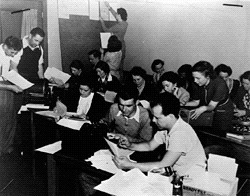
Civil Rights and Labor History Consortium, Karla Kelling Sclater
This site brings together information about the history and ongoing influence of newspapers and periodicals published by unions, labor councils, and radical organizations in the Pacific Northwest. Labor newspapers have been a critical part of American labor movements since the early 19th century and an equally critical, if largely unacknowledged, part of the history of American journalism. Today more than a hundred periodicals serve the labor movement. Thousands more have done so in the past." Here, you will find 35 links to the resources hosted by the Labor Press Project, mostly Pacific Northwest radical and labor newspapers, but also historical and geographical essays, breakdowns of factions in the Socialist Party between 1900 and 1917, and a brief history of the labor press in the U.S. Pacific Northwest. Each link is labeled and numbered to match a description below.
LABOR NEWSPAPERS
Aero Mechanic
APWU News
Bellingham Labor News
Guild Daily
Industrial Worker
International Woodworker
Pacific Longshoreman
Portland Labor Press
Scanner
Seattle Union Record
1900-1928
Seattle Union Record
1912-1914
Third Rail
Timber Worker
Washington State Teacher
Washington Teamster
RADICAL NEWSPAPERS
The Agitator
Discontent: Mother of Progress
People's Advocate
Seattle Socialist
Socialist World
Socialist Voice
Socialist Herald
Tacoma Truth/ Socialist Worker
Everett Commonwealth
Commonwealth Builder
Northwest Worker
Co-op News
The Party Builder
Vanguard/ Unemployed Citizen
Voice of Action
Washington New Dealer
Washington Socialist
Socialist Party factions 1900-1917
The Labor and Radical Press, 1820-the Present (report by Karla Kelling Sclater): https://depts.washington.edu/labhist/laborpress/Kelling.htm Denied access to established newspapers, the burgeoning labor movement of the late 1820s and early 1830s launched newspapers to provide a forum for working men's voices. Born in antagonism to both merchant capitalists and the mainstream press, labor leaders in Philadelphia and New York published the Mechanics Free Press and the Working Man's Advocate, criticizing corrupt politics and demanding that capitalists and politicians alike reckon with working-class men as citizens and the "blood, bone, and sinew" of the market place. Early labor papers commanded political and social recognition, calling for reduced working hours, public education, and the abolishment of debtors' prisons.",,,,
Aero Mechanic - International Association of Machinists, Seattle, WA, 1939-present (report by Julian Laserna): https://depts.washington.edu/labhist/laborpress/AeroMechanic.htm The production workers at Boeing Company have been reading the Aero Mechanic for over sixty years. The voice of Local 751 of the International Association of Machinists, the newspaper was founded in 1939 and has been published ever since. In 1973 its name changed to the 751 Aero Mechanic. This report focuses on its early years. ....
Seattle APWU News, Seattle, WA, 1972-1991 (report by Jacqueline Hailey): https://depts.washington.edu/labhist/laborpress/APWU_news.htm "In the Seattle area, postal workers came together to form a union in the early 1900s: Local 28 of the National Federation of Postal Office Clerks. On July 1, 1971, the NFPOC merged with the United Federation of Postal Clerks, the National Postal Union, the National Association of Post Office and General Service Maintenance Employees, the National Association of Special Delivery Messengers forming the American Postal Workers Union. This union became the largest postal union in the world."
Bellingham Labor News Bellingham Central Labor Council. It was published weekly until 1968 when it merged with other Northwest labor newspapers to become the Northwest Washington Labor News." https://depts.washington.edu/labhist/laborpress/Bellingham_Labor_News.htm
Guild Daily, Seattle, WA, 1936 (report by Erika Marquez): https://depts.washington.edu/labhist/laborpress/GuildDaily.htm The striking employees of the Seattle Post Intelligencer, produced The Guild Daily during the 105 day strike against the Hearst owned newspaper in 1936. An informational paper that provided news about all over the world as well as coverage of the strike, the Guild Daily built a circulation that reached 60,000 and captured an important segment of the Seattle newspaper market.
Industrial Worker, Spokane & Seattle, WA, 1909-1931 (report by Chris Perry and Victoria Thorpe): https://depts.washington.edu/labhist/laborpress/Industrial_Worker.htm The Industrial Worker has been an official newspaper of the Industrial Workers of the World for more than one hundred years. Published first in Spokane, then in Seattle, it remained for more than two decades the voice of the IWW in the Pacific Northwest. In 1931, the newspaper moved to Chicago and continues from that location today.
International Woodworker, Seattle, WA & Portland, OR, 1942-1987 (report by Bryan Schnase): https://depts.washington.edu/labhist/laborpress/International_Woodworker.htm The International Woodworker succeeded The Timber Worker as the official publication of International Woodworkers of America. The paper lasted for 45 years, providing union news, current events, editorials, safety reports, and accident reports (a major issue in the logging and timber industry). It started as a weekly periodical, then went to bi-monthly by the 1960s, and ended being a once-a-month publication by the end of the 1970’s.
Pacific Coast Longshoreman, San Francisco, CA, 1935-1937 (report by Kristin Ebeling): https://depts.washington.edu/labhist/laborpress/Pacific_Longshoreman.htm The Pacific Coast Longshoreman was the official publication of the International Longshoremen’s Association’s (ILA) Pacific Coast District, which represented dock workers up and down the West Coast.
Portland Labor Press, Portland, OR, 1900-1915 (report by Kristin Peasley): https://depts.washington.edu/labhist/laborpress/PortlandLabor.htm The Portland Labor Press is the oldest continuously published labor newspaper in the Pacific Northwest. Founded in 1900 as the "official publication for the Central Labor Council of Portland and vicinity and the Oregon State Federation of Labor," it changed its name in 1915 to the Oregon Labor Press and in 1986 to the Northwest Labor Press. This report focuses on the years between 1905 and 1915.
The Scanner, Seattle, WA, 1968-1992 (report by Victoria M. Troisi): https://depts.washington.edu/labhist/laborpress/Scanner.htm The Scanner was published by the King County Labor Council and was to be distributed to the members of the 138 affiliated locals of the council. The paper started as a bi-weekly publication on August 30, 1968. It switched to a monthly publication within a few years. The paper started out as an eight page publication and remained that way.
Seattle Union Record, Seattle, WA, 1900-1928 (report by Natalia Salinas-Aguila): https://depts.washington.edu/labhist/laborpress/Union_Record_1900-1928.htm The Seattle Union Record is the most famous of Seattle's labor newspapers. It was in circulation for 28 years, first published as a weekly in 1900, then becoming a daily newspaper in 1918. Owned by the Central Labor Council of Seattle, it played a key role in the 1919 General Strike. Through most of its existence it was edited by Harry B. Ault.
Seattle Union Record, Seattle, WA, 1912-1914 (report by Josh Kaplan): https://depts.washington.edu/labhist/laborpress/Union_Record_1912-1914.htm "The Seattle Union Record was a major Seattle area labor newspaper of the early twentieth century. With a publication run of nearly thirty years, the paper was a voice of labor during a dynamic period of Seattle’s labor history. Published by the Seattle Central Labor Council (and its predecessor, the Western Central Labor Union, until 1905), the Union Record was a full coverage newspaper, not merely a newsletter of the CLC. The paper’s broad coverage of local, national, and international events provides insight into the attitudes of Seattle’s working people and helps us understand the world they lived in."
Third Rail: Local 27 Seattle Fire Fighter's Union, Seattle, WA, 1992-present (report by Steven Bergquist): https://depts.washington.edu/labhist/laborpress/ThirdRail.htm The Third Rail is a monthly publication for the local 27 Seattle Fire Fighter's union. The Third Rail has served as a spotlight on issues both locally and nationally revolving around fire fighting issues and retirement benefits. Heavily involved in political campaigns and openly showing support of certain candidates, mainly democratic, this paper provides a local view of the state government's handling of fire fighter issues. The City of Seattle Fire Department (or SFD) has produced many influential members of the State Union as well as placing one individual currently on the International Union board. Local 27 represents over 950 men and women of the Seattle Fire Department.
Timber Worker, Aberdeen & Seattle, WA, 1935-1942 (report by Geraldine Carroll and Michael Moe): https://depts.washington.edu/labhist/laborpress/TimberWorker.htm The Timber Worker, the publication of the Federation of Woodworkers, was the precursor of the International Woodworker, the official newspaper of the International Woodworkers of America. The paper stated its official policy as "devoted to the interests of the workers in the lumber industry and to promoting working class solidarity." Born in 1935 in the midst of a strike, the paper developed from the voice of a local community of Aberdeen, Washington, to that of the international union. Its primary focus was local union news, but, even in its early days, the paper weighed in on national and international news, class consciousness, communism in unions, and the division between the AFL and CIO.v
The Washington State Teacher, Seattle, WA, 1937-1968 (report by Trevor Sargent): https://depts.washington.edu/labhist/laborpress/WashingtonStateTeacher.htm The Washington State Teacher was the official organ of the Washington State Federation of Teachers (WSFT), which was allied with the American Federation of Teachers (AFT) and the American Federation of Labor (AFL). As a result, the paper had a two-fold objective: to strive for the betterment of public education and to advance the organized labor movement. This report focuses on the publication from October–November 1945 until January 1951.
Link XVI - Washington Teamster, Seattle, WA, 1937-present (report by Carol Daniels): https://depts.washington.edu/labhist/laborpress/WashingtonTeamster.htm "The Washington Teamster is the voice of the International Brotherhood of Teamsters, Chauffeurs and Warehousemen, and Helpers, Joint Council 28 located in Seattle, Washington. It circulates free to members of Joint 28 locals. Founded as a monthly newspaper in 1937, it became a weekly publication some time in 1941 and continues as a weekly today, published each Friday. In its early years, it did not list a publisher or editor other than the Joint Council 28, President Dave Beck, and Secretary Frank Brewster. There were few bylines with featured articles and editorials. During this time, the paper’s circulation was about 25,000."
The Agitator, Home, WA, 1910-1912 (report by Heather Gorgura): https://depts.washington.edu/labhist/laborpress/Agitator.htm The Agitator was published by members of the anarchist colony of Home, in the state of Washington. Editor Jay Fox made the bimonthly tabloid into a lively journal advocating a blend of libertarian ideas and revolutionary industrial unionism. Free speech, sexual freedom, modern rational education, and support for the IWW were among its provocative concerns.
Discontent: Mother of Progress, LakeBay, WA, 1898-1902 (report by Amanda Rankin): https://depts.washington.edu/labhist/laborpress/Discontent.htm Discontent: Mother of Progress was the second in a sequence of publications edited by members of the anarchist colony at Home, Washington, near Tacoma.
The People’s Advocate, Chehalis, WA, 1892-1900 (report by Jayne Muir): https://depts.washington.edu/labhist/laborpress/Peoples_Advocate.htm People's Advocate was a weekly newspaper published on Fridays in Chehalis, Lewis county, Washington. Affiliated with the People's party, this publication began as the official paper for the Farmers Alliance and Industrial Union local.
Seattle Socialist: The Workingman’s Paper, Seattle, WA, 1900-1910 (report by Gordon Black): https://depts.washington.edu/labhist/laborpress/Seattle_Socialist.htm For ten years, this weekly newspaper was the strongest voice for socialism in the Pacific Northwest. Edited by Hermon Titus, The Socialist was acerbic, witty, and often sectarian. The Socialist Educational Union was incorporated in Washington on September 16, 1900 under the terms of Chapter 193 of the state’s codes governing “social, charitable and other associations.” Its main purpose was the publishing of The Socialist newspaper launched the previous month. One of the articles of incorporation specified that only members of the Social Democrat Party could serve on the board of the Socialist Educational Union. The newspaper came out weekly for most of its existence, (supplemented by occasional daily editions) and contained a mixture of articles explaining the nature of socialism, anti-capitalism rhetoric, platforms for local election races, news of socialism victories in the US and Europe, guest articles by well known socialists, such as Eugene Debs and Upton Sinclair, as well as essays on socialist virtues. The newspaper also frequently attacked its press rivals in Seattle, as well as political rivals within the socialism movement. It provided wide coverage of news of interest to its audience – strikes, free speech efforts and the famous Haywood trial in Idaho. Throughout its 10 years, The Socialist used cartoons to lampoon capitalism and issues it perceived as anathema to socialism. For a brief period, it even sub-titled itself as a “cartoon weekly.” The educational union owned its own press operation, The Trustee Printing Company in Seattle, which it bought to avoid paying “capitalist printing companies.” A founding member of the educational union that published the newspaper was a physician, Hermon Titus.
Socialist World, Seattle, WA, 1916-1917 (report by Gary Siebel): https://depts.washington.edu/labhist/laborpress/Socialist_World.htm The Socialist World was the official organ of the Socialist Party of King County, Washington. It was one of two papers born as a result of the ideological split and demise of it’s progenitor, The Herald. The Socialist World (SW) sallied forth on Friday, July 14, 1916. The other half of that split, The Commonwealth, first appeared two weeks later. The SW was produced by a committee of The Socialist Party of King County. The ideology throughout the less than one year life of the paper can be summed up simply as: Eugene Debs good, Samuel Gompers and craft unionism very bad; Karl Marx good, capitalism very bad. Extreme loyalty to the Socialist Party doctrine very good, party "treason" very bad. Articles and propaganda maintained the Party line. Socialist Party presidential candidates for 1916, Benson and Kirkpatrick, and L. Katterfeld for governor, were vigorously promoted.
Socialist Voice, Seattle, WA, 1911-1912 (report by Jordan Shay): https://depts.washington.edu/labhist/laborpress/Socialist_Voice.htm The So cialist Voice was the second in a sequence of Socialist Party newspapers published in Seattle.
Link XXIII - Socialist Herald/The Herald, Seattle, WA, 1915-1916 (report by Kaira Veckaktins): Veckaktins): https://depts.washington.edu/labhist/laborpress/Socialist_Herald.htm The Socialist Herald/The Herald is in the middle of a string of Socialist newspapers based in Seattle in the first two decades of the 20th century. It followed the Socialist Voice and preceded the Socialist World . In early 1916 the paper turned away from the Socialist Party and affiliated with the Nonpartisan League of Washington.
Truth and Socialist Worker, Tacoma, WA, 1913-1914 (report by Stephanie Curwick): https://depts.washington.edu/labhist/laborpress/Truth.htm Socialist papers of the Tacoma, Washington area, "TRUTH" & "The Socialist Worker" were lively left-wing papers that called for the "revolution and emancipation of labor from its brutal slavery." These militant socialist papers were critical in exposing problems that capitalism had reaped upon labor.
Commonwealth, Everett, WA, 1911-1914 (report by Frederick Bird): https://depts.washington.edu/labhist/laborpress/newcommonwealth.htm The Commonwealth was a socialist weekly newspaper published in Everett, Washington between January 1911 and April 1914. Subtitled the "Official Paper of the Socialist Party of Washington," the Commonwealth served as a promotional and educational medium for the party, reporting locally and statewide on internal Socialist Party events and issues. While carrying state, national and international news and commentary selected from other publications, it also contained significant quantities of locally produced coverage on the development and controversies of the Socialist Party in Washington and of the events leading up to and following the national presidential election of 1912. Three of the Commonwealth’s seven editors would go on to various degrees of success in other careers, including one who ran as the Socialist candidate for governor of Washington, one who may have became a Communist Party functionary and movie producer, and one who went on to distinguished himself nationally as an intellectual and author.
Washington Commonwealth Builder/Washington Commonwealth, Seattle, WA, 1934-1937 (report by Jessica Dunahoo): https://depts.washington.edu/labhist/laborpress/CommonwealthBuilder.htm The Washington Commonwealth Builder and the Washington Commonwealth were the first of a series of names given to a weekly paper issued by the Washington Commonwealth Federation, a leftwing group active in Washington State in the 1930s and 1940s. Employment, democracy, freedom of speech, and general social welfare were primary issues focused on by the paper. “Production for use” and not for profit was the rallying cry and a central theme repeated again and again throughout the paper’s formative years.
Northwest Worker, Everett, WA, 1915-1917 (report by Frederick Bird): https://depts.washington.edu/labhist/laborpress/NWWorker.htm The Northwest Worker was the third of four consecutive Socialist weekly newspapers published in Everett, Washington between February 1911 and June 1918. Local news coverage in the Northwest Worker’s 27-month run focused on the unsuccessful reelection campaign of a Socialist city commissioner, on the paper’s never-ending financial struggles, and on the escalating labor turmoil in Everett, leading up to and following the infamous “Everett Massacre” of November 5, 1916. And, as with all the newspapers in this series, the Northwest Worker served as a promotional, educational and informational medium for the Socialist Party, reporting on international, national, state and local Socialist Party events and issues. Regardless of the periodic name changes, all four newspapers in the series were essentially the same publication. The papers’ major leaders, ownership, volunteers, business address (after December 1912) and even the mailing permit remained the same.
Co-operative News, Everett, WA, 1917-1918 (report by Frederick Bird): https://depts.washington.edu/labhist/laborpress/CoopNews.htm The Co-operative News was the fourth and last of a consecutive series of Socialist weekly newspapers published in Everett, Washington between February 1911 and June 1918. The Co-operative News succeeded its predecessor, The Northwest Worker, in October 1917 and lasted until at least June 20,1918—the last edition contained by the University of Washington’s microfilm collection. That last edition (of which two of four pages are missing) and the editions preceding it are filled with predictions of newspaper’s impending doom (Appendix B) based on the federal government’s on-going suppression of other Socialist and radical publications taking place throughout the nation under the authority of the federal Espionage Act of 1917, as amended in April 1918 (Appendix E). As with all its predecessors--The Commonwealth (1911-1914), The Washington Socialist (1914-1915), and The Northwest Worker (1915-1917), the Co-operative News served as a promotional and educational instrument for the Socialist Party, reporting on national, state and local Socialist Party events and issues. However, in a shift of emphasis reflected by the publication’s new name, the Co-operative News featured extensive coverage of the growing cooperative movement. Throughout this seven-and-a-half-year progression, the publication’s major leaders, ownership (as can be best determined), volunteers, business address and even the mailing permit remained the same.
Party Builder, Everett, WA, 1914-1919 (report by Scott Livingston): https://depts.washington.edu/labhist/laborpress/Party_Builder.htm An internal newsletter for the Socialist Party of Washington State. Contains listings of monthly dues, financial statements for the state party, and minutes from the state party’s executive committee meetings. Also contains limited local and international news and commentary regarding Socialist Party issues.
Vanguard & Unemployed Citizen, Seattle, WA, 1930-1933 (report by Erick Eigner): https://depts.washington.edu/labhist/laborpress/Vanguard.htm Published by the left-wing Seattle Labor College, The Vanguard became the voice of Seattle's army of unemployed during the early 1930s. It helped launch the Unemployed Citizens League in 1931 and gained considerable influence as thousands joined the UCL's self-help projects and joined in the organization's demands for funds and services for the unemployed. The weekly changed its name to the Unemployed Citizen in 1933.
Voice of Action, Seattle, WA, 1933-1936 (report by Christine B. Davies): https://depts.washington.edu/labhist/laborpress/VoiceofAction.htm The Voice of Action is a radical labor newspaper that was published weekly in Seattle from March 1933 until October 1936. Although the Voice of Action was loyal to the Communist Party, this was rarely ever discussed. Instead, the general focus was on issues of forced labor, unemployment, labor politics, racism, the plight of the small farmer, and the crises of the poverty-stricken from starvation to forced eviction from their homes. Each issue of the Voice of Action was brimming with information in the form of much local, some national, and a little international news relating mainly to the aforementioned issues. This paper served as a source of news that could not be found in any other publications in this area during this period.
Washington New Dealer, Seattle, WA, 1938-1942 (report by Joshua Stecker): https://depts.washington.edu/labhist/laborpress/NewDealer.htm "The 1930s were a turbulent time in Washington State and around the nation. The United States was slowly emerging from the Great Depression, due in part to the aggressive relief programs and legislative reforms proposed by President Franklin Delano Roosevelt, collectively referred to as the "New Deal." Many Americans rallied around these ideas and organized to show their support. In Washington State, the reform-minded public found its voice in a left-wing weekly newspaper, the Washington New Dealer."
Washington Socialist, Everett, WA, 1914-1915 (report by Frederick Bird): https://depts.washington.edu/labhist/laborpress/wasocialist.htm The Washington Socialist was the second of four consecutive Socialist weekly newspapers published in Everett, Washington between January 1911 and June 1918. The Washington Socialist evolved in April 1914 from its financially pressed predecessor, The Commonwealth, and lasted until June 1915, when it was renamed The Northwest Worker. These name changes were attempts to broaden the newspaper’s geographic and financial base of support. Throughout this progression, the ownership, major leaders, volunteers and often the editors remained the same. Maynard Shipley, the editor throughout most of this period (1913 – 1916), was a dominant personality. As with the Commonwealth and the subsequent Northwest Worker, the Washington Socialist served as a promotional and educational instrument for the Socialist Party, reporting on national, state and local Socialist Party events and issues.
Squabbling Socialists in Washington State: A Guide to Factions and Newspapers, 1900-1917 (by Gary Siebel): https://depts.washington.edu/labhist/laborpress/squabbling.htm "Washington State was still young in 1900 and thought to be fertile ground by many Americans for a society built from scratch upon principles of socialism. At the 1897 convention of the Brotherhood of the Co-operative Commonwealth in Ruskin, Tennessee, it was suggested that socialists should move en masse to capture 1901 Washington State elections. Thus, colonies such as Home, and Equality, Washington, were carved out of thick forests by socialists eager for a fresh start."
Philippine-American Chronicle, Seattle, WA, 1935-1936 (report by Rache Stotts-Johnson): https://depts.washington.edu/labhist/laborpress/Philippine-American_Chronicle.htm "The Philippine-American Chronicle was a biweekly newspaper published in Seattle from 1935 – 1936. Although its motto was "For Truth Freedom and Justice We Champion the Cause of Labor," the paper covered labor as well as non-labor issues. Labor issues related mainly to the Cannery Workers and Farm Laborers’ Union Local No. 18257 and its attempts at securing higher wages and better working conditions for laborers. National labor news was mainly composed of American Federation of Labor news. General national and international news, local society news, poetry, wit and humor sections, and numerous advertisements were also a part of the paper. The paper provides information on the Filipino labor movement in the Pacific Northwest, but at the same time provides insight into the daily lives of Filipino laborers and their experiences in the Seattle area.
A vast resource website discussing 35 labor and radical newspapers that were or are active in the Pacific Northwest.

Clara Mejia Orta
Voces from La Planta is a digital project that "centers the voices of meatpacking workers across California, Minnesota, Kansas, Colorado, Mississippi, and Washington. Workers whose labor sustains the nation, yet whose lives are too often made invisible.
The meatpacking industry has been built on extraction: of labor, of bodies, and of communities. For over a century, companies have generated enormous profits by relying on a workforce that is deliberately made vulnerable and disposable. What is often
described as “stability” in these regions has, for many, meant instability, exploitation, and exclusion.
This oral history project challenges that narrative.
Here, workers speak and fight back. In doing so they demonstrate unwavering resilience and hope for a better future for their families. These oral histories document migration journeys, unsafe workplaces, surveillance immigration enforcement, displacement, organizing, joy and love. Through their testimonios we witness resistance, organizing, care, and a desire to build community across difference while fighting for dignity and respect on the line.
As you explore the website and engage with the art we ask you to carry these testimonios with you. To question the systems that make meatpacking labor invisible, and to consider your role within them. What would it mean to stand in solidarity with the workers whose stories you have encountered here?
interviews conducted beginning SUmmer 2021 in meatpacking communities of Los Angeles, Kansas, Washington, Minnesota, and Mississippi.
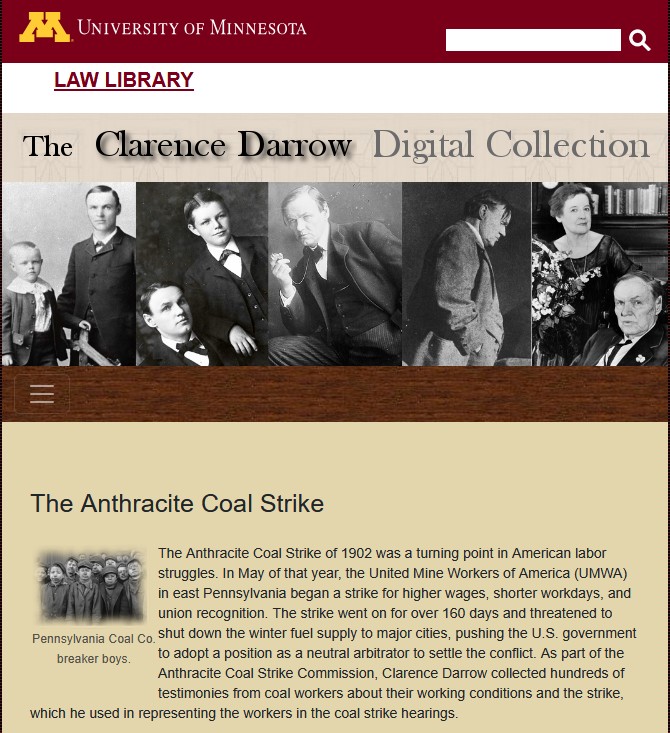
Clarence Darrow Papers
he Anthracite Coal Strike of 1902 was a turning point in American labor struggles. In May of that year, the United Mine Workers of America (UMWA) in east Pennsylvania began a strike for higher wages, shorter workdays, and union recognition. The strike went on for over 160 days and threatened to shut down the winter fuel supply to major cities, pushing the U.S. government to adopt a position as a neutral arbitrator to settle the conflict. As part of the Anthracite Coal Strike Commission, Clarence Darrow collected hundreds of testimonies from coal workers about their working conditions and the strike, which he used in representing the workers in the coal strike hearings.
There are many images and documents and letters in this collection by the lawyer who led the labor side of the anthracite coal strike commission of 1902
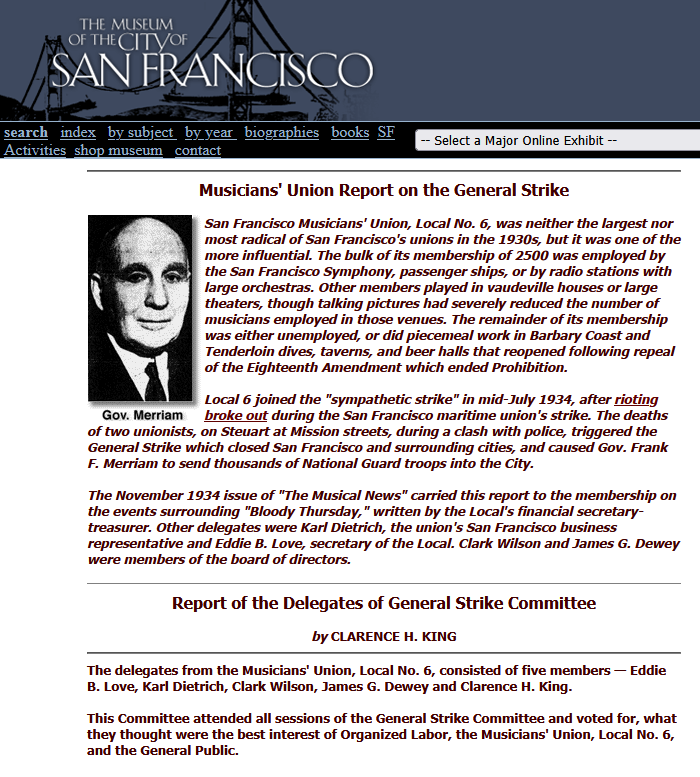
Clarence H. King
The November 1934 issue of "The Musical News" carried this report to the membership on the events surrounding "Bloody Thursday," written by the Local's financial secretary-treasurer. Other delegates were Karl Dietrich, the union's San Francisco business representative and Eddie B. Love, secretary of the Local. Clark Wilson and James G. Dewey were members of the board of directors.
Sympathetic report from an unaffiliated musicians union on the San Francisco strike of 1934
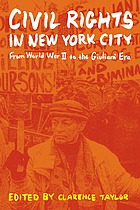
Clarence Taylor
Civil Rights in New York City' challenges conventional works on the civil rights movement that usually contend that the civil rights movement started in 1954. Instead, this volume begins by examining the effort by a communist-led union during World War II to push a civil rights agenda
This volume contends that the Civil Rights movement started much earlier to 1954, documenting a movement during World War II
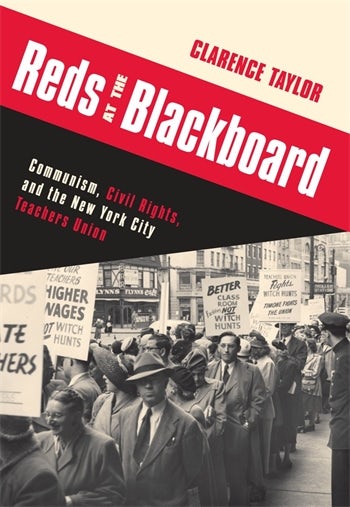
Clarence Taylor
The New York City Teachers Union shares a deep history with the American left, having participated in some of its most explosive battles. Established in 1916, the union maintained an early, unofficial partnership with the American Communist Party, winning key union positions and advocating a number of Party goals. Clarence Taylor recounts this pivotal relationship and the backlash it created, as the union threw its support behind controversial policies and rights movements. Taylor's research reaffirms the party's close ties with the unionyet it also makes clear that the organization was anything but a puppet of Communist power.
Reds at the Blackboard showcases the rise of a unique type of unionism that would later dominate the organizational efforts behind civil rights, academic freedom, and the empowerment of blacks and Latinos. Through its affiliation with the Communist Party, the union pioneered what would later become social movement unionism, solidifying ties with labor groups, black and Latino parents, and civil rights organizations to acquire greater school and community resources. It also militantly fought to improve working conditions for teachers while championing broader social concerns. For the first time, Taylor reveals the union's early growth and the somewhat illegal attempts by the Board of Education to eradicate the group. He describes how the infamous Red Squad and other undercover agents worked with the board to bring down the union and how the union and its opponents wrestled with charges of anti-Semitism.
showcases the rise of a unique type of unionism that would later dominate the organizational efforts behind civil rights, academic freedom, and the empowerment of blacks and Latinos
Clarivate's Alexander Street
Women and Social Movements in the United States,1600-2000 is a resource for students and scholars of U.S. history and U.S. women's history. Organized around the history of women in social movements in the U.S. between 1600 and 2000, this collection seeks to advance scholarly debates and understanding about U.S. women’s history generally and at the same time make those insights accessible to teachers and students at universities, colleges, and high schools. The collection currently includes 124 document projects and archives with more than 5,100 documents and 175,000 pages of additional full-text documents, written by 2,800 primary authors. It also includes book, film, and website reviews, notes from the archives, and teaching tools.Those subscribing to this collection can access the online version of Notable American Women and the database on Commissions on the Status of Women. Some of the materials are available from behind the paywall, but most are paywalled and only accessible for subscribing libraries.
A portal to several teaching resources developed by Clarivate's Alexander Street, which contains lesson plans, syllabi, document projects, and teaching guides on the experiences of women in the United States over several centuries, thematic foci, and subject matters. Some are available for free. Most behind a paywall unless you have access through a library.
Claudia Strauss
Drawing on the evocative stories of unemployed Americans from a wide range of occupations, from day laborers to corporate managers, both immigrant and native-born, Strauss shows that the standard cultural description of workaholics driven by a Puritan work ethic homogenizes diverse work motivations"-- Provided by publisher
Multiple meanings of work in the United States
Two Protestant work ethics (living to work or working diligently)
Working to live well
Working to just live
Gendered meanings of unemployment
Good-enough occupations and "fun" jobs
A post-pandemic update and the future of work
shows that the standard cultural description of workaholics driven by a Puritan work ethic homogenizes diverse work motivations"
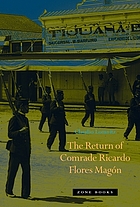
Claudio Lomnitz
A tale, never before told, of anarchy, cooperation, and betrayal at the margins of the Mexican revolution. "Lomnitz chronicles a transnational history of struggle involving exiled Mexicans, U.S. citizens, and Mexican Americans. In chronicling the activities of Ricardo's transnational inner circle, Lomnitz explores how the eventual imprisonment of Ricardo and other members of the Mexican junta was part of a U.S. federal government purge to stop communists and anarchist from radicalizing the U.S. public, including Mexican American workers. Throughout the book, Lomnitz also explores Mexican liberal political philosophies distinguishing the different traditions held by various revolutionary factions."-review
anarchists and cross-border organizing in early 20th century
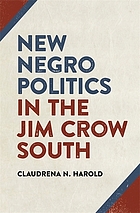
Claudrena Harold, Bryant Simon, Jane Dailey
"New Negro Politics in the Jim Crow South" narrates the story of New Negro political culture from the perspective of the black South. It details how the development and maturation of New Negro politics and thought was shaped not only by New York-based intellectuals and revolutionary transformations in Europe, but also by people, ideas, and organizations rooted in the South. Harold's aim is not to devalue the importance of the North or Europe during this period of black political and cultural renaissance. Instead, her probe into some of the critical events and developments below the Mason-Dixon-Line sharpen our vision of how many black activists, along with particular segments of the white American Left, arrived at certain theoretical conclusions and political choices regarding the politics of race, challenges to capitalist political economy, and alternative visions of nation. The book considers southern black political movements during a period dominated by the study of the urban North (and specifically the Harlem Renaissance). Focusing on Garveyites, A. Philip Randolph's militant unionists, and black anti-imperialist protest groups, among others, Harold argues that the South was a largely overlooked "incubator of black protest activity" between World War I and the Great Depression."--Provided by publisher
Focusing on Garveyites, A. Philip Randolph's militant unionists, and black anti-imperialist protest groups

Clayton D. Laurie, Ronald H. Cole
The Role of Federal Military Forces in Domestic Disorders, 1877-1945, the second of three volumes on the history of Army domestic support operations, encompasses a tumultuous era--the rise of industrial America, with attendant social dislocation and strife, as well as the appearance of racial tensions caused by civil rights legislation intended to benefit African Americans.
Clayton D. Laurie and Ronald H. Cole trace the evolution of the Army's role and its adherence to law while conducting these often unpopular operations, starting with the first major U.S. Army intervention in a labor dispute, the Great Railway Strike of 1877, and concluding with the War Department seizures of strike-plagued industries during World War II. As Laurie and Cole reveal, the national leadership began to rely on Army units as a peacekeeping constabulary of first resort, not only to enforce federal authority but also to aid local and state officials in maintaining law and order, in protecting lives and property, and in preserving social and political stability. The Army responded promptly and decisively to potentially destabilizing social and political unrest, serving as a bulwark against seemingly sinister forces of anarchy and chaos. Given the significant geopolitical turmoil in this more unpredictable world marked by long-simmering ethnic, religious, territorial, and economic disputes, Laurie's and Cole's volume offers important lessons, especially the value of highly disciplined and trained Soldiers, careful operational and logistical planning, flexibility, and initiative at the lowest levels of command. Those planning and commanding today's irregular operations will benefit from studying this work
trace the evolution of the Army's role and its adherence to law while conducting labor interventions, starting the Great Railway Strike of 1877, and concluding with the War Department seizures of strike-plagued industries during World War II.
Museum/Exhibits
Tours
Maps
Digital Projects
Organizations
Sites
Film/Video
Audio/Interview
Podcast/Program
Text/Document
Image
Graphs/Data
Timeline
Southwest
West
Midwest
Southeast
Northeast
Mexico
Canada
Global
Books
Teaching
Lectures
Digital Archives
Journals
Bibliographies
Topic Intro