


Collections
Library
Type
Region
Coverage:
-
Published:
-
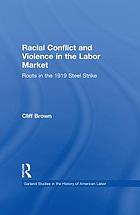
Cliff Brown
This book focuses on community-level race relations during the 1919 Steel Strike, when intense job competition contributed to racial conflict among the nation's steel workers. As the Great Migration brought thousands of black workers to northern cities, their lower labor costs generated racially split labor markets in the industrial sector. Further, the discriminatory policies of labor unions forced many blacks to serve as strike breakers during periods of class conflict. As a result, the migration heightened racial conflict and undercut important union organizing initiatives.
The 1919 Steel Strike illustrates how racial divisions crippled many American unions, a pattern that helps to explain the demise of organized labor during the 1920s. No previous studies of the 1919 Steel Strike have systematically compared community processes to determine how local events shaped the strike's outcome. Despite the failure of the 1919 Steel Strike, the varied experiences of workers in different communities reveal much about the causes of racial conflict and the possibilities of interracial solidarity. This study finds that patterns of black migration, local government repression of labor, the organizational strength of local unions, and employers' efforts to inflame racial tension all help to explain community-level variation in interracial solidarity and conflict. (Ph. D. dissertation, Emory University, 1996; revised with new preface)
Chapter 1 Introduction;
Chapter 2 Union Militancy and Workers' Control; Chapter
3 Northern Labor Markets and the Great Migration;
Chapter 4 The 1919 Steel Strike;
Chapter 5 Analyses of Strikebreaking, Solidarity, and Racial Violence;
Chapter 6 Interracial Solidarity in the New Deal Years;
community-level race relations during the 1919 Steel Strike
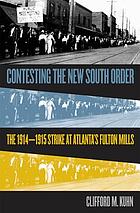
Cliff Kuhn
The 1914-1915 strike at Atlanta's Fulton Mills was an important episode in the development of the New South. In this account, Clifford Kuhn demonstrates how its story sheds light on the industrialization, urbanization, and modernization of the region. He draws on a wide range of sources.
demonstrates how the Fulto Mill's strike sheds light on the industrialization, urbanization, and modernization of the region
Coal Creek Miners Museum
On display at the Coal Creek Miners Museum is the rich history of the miners that lived, worked and died in Coal Creek, Fraterville and Briceville, Tennessee.
You will learn how the “free” miners fought against the convict lease system which ultimately ended the system in the southern states. You will also hear about a community that not only survived one mining disaster but two that killed almost every man in the community and young boys too.
The story of this tenacious community reveals the courageous spirit of our forefathers. Over the years, the area was devastated by two coal mine explosions, killing 300 miners and boys in all. The Coal Creek War of the 1890s, an armed labor uprising over the move to put state convicts to work in mines, is now taught in history lessons.
rich history of the miners that lived, worked and died in Coal Creek, Fraterville and Briceville, Tennessee.
Coal Creek Miners Museum
After the Civil War, prisons in the South overflowed. Southern states enactedvthe "convict lease system" which turned prisoners from liabilities into assets by leasing
them to work in mines, plantations, and railroads. There were only three ways out of the convict labor system: escape, self-mutilation, or death.
In 1877, business owners and politicians started using convict laborers to replace striking mine workers to crush labor unrest. Prison and labor reform movements
of the time saw no end in sight for this cruel institution.
Then, free miners from Coal Creek found a solution by going to war with the State of Tennessee from 1891 to 1892.
Tennessee ended its convict lease system and the rest of the South soon followed suit.
Many of the miners who survived the Coal Creek War, died in mine disasters at the Fraterville Mine in 1902 and the Cross Mountain Mine in 1911. These disasters, which killed 300 men and boys in Coal Creek, helped raise public awareness of the dangers of mining.
Safety reforms, brought about in response to these disasters and others, have helped save thousands of lives in mines throughout this country.
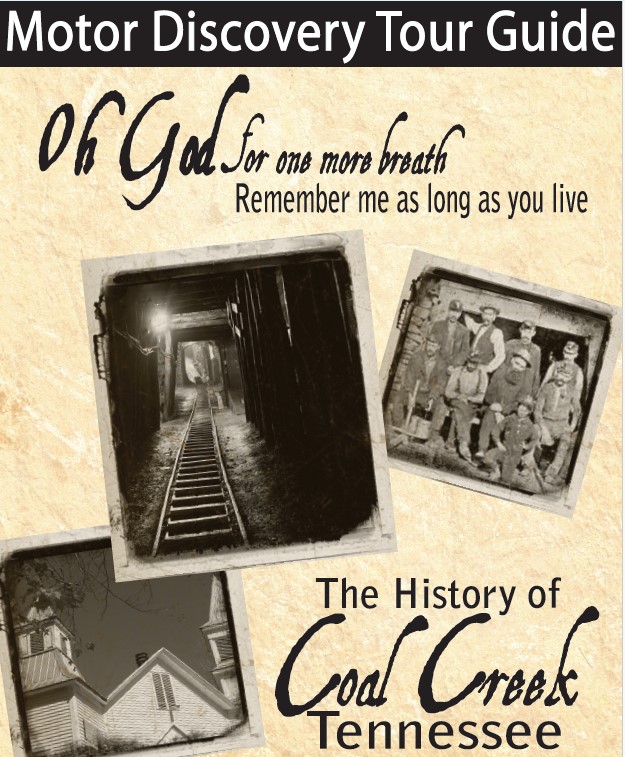
Relive the history and explore the scenic mountains and streams of Coal Creek by traveling the new Motor Discovery Trail. The trail is free, provided by efforts of the Boy Scouts of America, the American Society of Civil Engineers, Trout Unlimited, the Coal Creek Watershed Foundation, local residents, and students.
2 dozen sites with brief historical references and clear map of the prison and free labor in the area.

Coal Town Museum, Indiana State University
The Coal Town and Railroad Museum at Main and Vine streets in Clinton, Indiana, is owned and operated by Little Italy Festival Town, Inc. (LIFT). Displays include artifacts, information, and well over 100 photographs. It is a local history museum focusing on the coal and railroad industry, immigration, and cultural development from ca. 1850 to ca. 1960. The museum is housed in the recently renovated 1904 Chicago & Eastern Illinois railroad depot.
Materials from the Coal Town and Railroad Museum in Clinton, Indiana. Displays include artifacts, information, and well over 100 photographs.
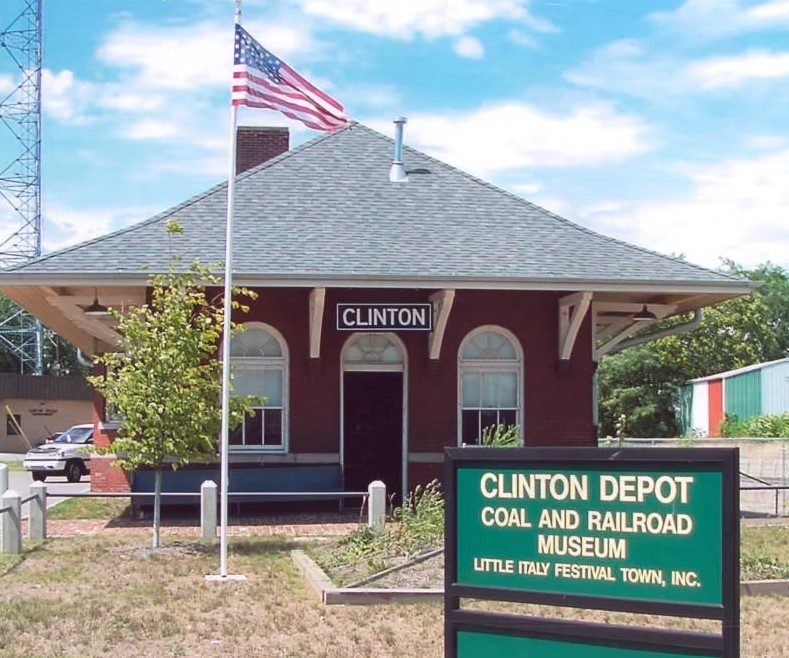
Coal Town and Railroad Museum
The Coal Town and Railroad Museum in Clinton, Indiana, showcases the rich history of the region's coal mining industry and its impact on the community. Visitors can explore exhibits that detail the town's mining heritage, featuring artifacts, photographs, and documents highlighting the lives of miners and their families. It offers an immersive experience, providing insights into the industrial past of Clinton and its ties to coal mining and railroad history in the region.
The Coal Town Museum contains displays including a model coal mine, actual video footage taken in Big Oak Coal Mine, pictures and artifacts to show how men would work in the mines.
The Railroad Museum displays pictures, memorabilia and artifacts of the local railroad.
In 2002, MSI Construction of Clinton, completed the historical renovation of the Clinton Chicago & Eastern Illinois Passenger Depot.
Constructed 1910 in the Renaissance Revival/Craftsman style is located at 227 Vine Street in Clinton. It is a contributing building within the Clinton Downtown Commercial Historic District which was listed in the National Register of Historic Places in 2000 under Criterion A. The one-story brick building features a foundation of ranged field stone, rock faced with a natural cement mortar. Its windows are round arched with fanlights. Inside, the building included men’s and women’s waiting rooms, the station master’s office, telegrapher’s post, restrooms, separated from the passenger baggage area.
Coal Town and Railroad Museum in Clinton, Indiana
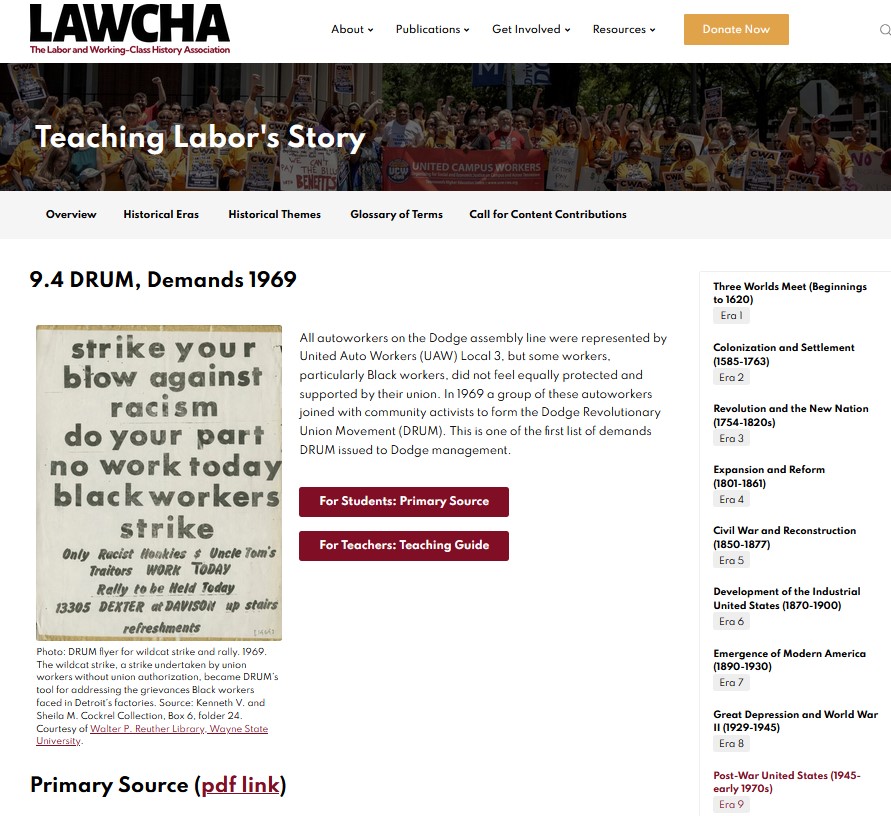
Coleen Diane Holloway, Teaching Labor's Story
The Dodge Revolutionary Union Movement (DRUM) was a grassroots community organization in Detroit Michigan. They sought to address issues of safety and inequity between Black and White workers. They argued for an alternative organiazation to the UAW. This document connects labor militancy to Black revolutionary thought that rose at the time. The demands resmble the Black Panther Party's ten-point program. The demands stress hiring and promotion, replacing specific personnel, racist practices, protecting activists at the workplace.
A teaching guide facilitates good discussion of the document.
In 1969 a group of Detroit ara Black autoworkers joined with community activists to form the Dodge Revolutionary Union Movement (DRUM). This is one of the first list of demands DRUM issued to Dodge management.
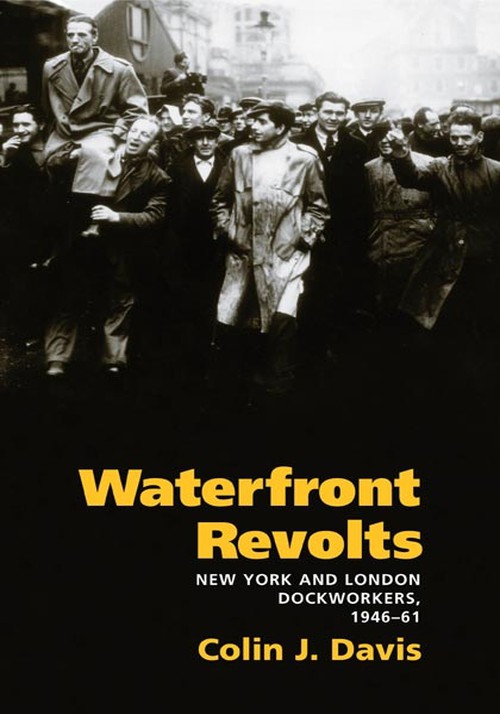
Colin J. Davis
"During the decade that followed the end of World War II, dockworkers in New York City and London undertook a series of militant revolts against their employers, their governments, and their union leaderships. In this innovative comparative study, Colin J. Davis explores the dynamics of work and work stoppage along these two pivotal waterfronts. He identifies the structural and cultural forces that lay behind the emergence of rank-and-file dockworker movements, enabling workers to challenge union hierarchies and to wring concessions from national governments."
identifies the structural and cultural forces that lay behind the emergence of rank-and-file dockworker movements in New York and London.

Colleen Doody
Detroit's Cold War locates the roots of American conservatism in a city that was a nexus of labor and industry in postwar America. Drawing on meticulous archival research focusing on Detroit, Colleen Doody shows how conflict over business values and opposition to labor, anticommunism, racial animosity, and religion led to the development of a conservative ethos in the aftermath of World War II. Using Detroit--with its large population of African-American and Catholic immigrant workers, strong union presence, and starkly segregated urban landscape--as a case study, Doody articulates a nuanced understanding of anticommunism during the Red Scare. Looking beyond national politics, she focuses on key debates occurring at the local level among a wide variety of common citizens. In examining this city's social and political fabric, Doody illustrates that domestic anticommunism was a cohesive, multifaceted ideology that arose less from Soviet ideological incursion than from tensions within the American public.
Using Detroit as a case study, this book articulates a nuanced understanding of anticommunism during the Red Scare.
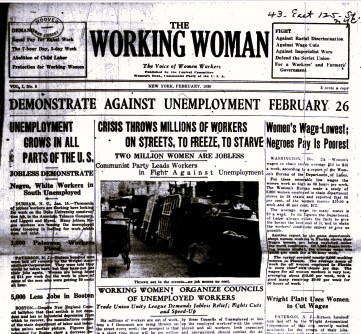
Communist Party
Published by the Communist Party USA Central Committee Women's Department from 1929 to 1935 when it was incorporated into The Woman Today publication. These issues are all scanned from microfilm.
Significant coverage of mining and other strikes of this period, as well as consideration of subjects of women's role

Communist Party, The Daily Worker
The Daily Worker was created for Communist Party USA members in 1921. The paper was originally titled the Worker, centered in Chicago and marketed as a weekly newspaper for the first three years of its existence. It then moved to New York City and carried out a pre-planned expansion into a daily broadsheet with a new name, Daily Worker. Publication under this new title lasted from 1924 to 1958. The Daily Worker was primarily focused on issues relating to organized labor.
In the January 13, 1924 edition, the first under their new name, the paper declared, “Now, in this first issue of The Daily Worker, we join hands with the comrades of the Communist International in declaring that the Daily is but ‘The forerunner of more revolutionary dailies in other parts of the country.'” Most articles covered events that involved collective labor action, including crackdowns by business owners, strikes, and other forms of collective bargaining.
Like other Communist Party USA-backed newspapers of the time, the Daily Worker was supportive of the Civil Rights movement. It fought continual legal battles for freedom of speech and freedom of the press to prevent being shut down. The Daily Worker firmly opposed McCarthyism. American law enforcement and intelligence agencies heavily infiltrated the Daily Worker‘s contributor and subscriber bases. Its pages were surveilled to gather information about the Communist Party USA.
Firmly Stalinist in its outlook for most of its period of publication, the Daily Worker struggled to keep together after the death of the Soviet leader. A further cause of division was the Soviet crackdown on the Hungarian uprising of 1956. In the November 5, 1956 edition, editor John Gates wrote, “The action of Soviet troops in Hungary does not advance but retards the development of socialism because socialism cannot be imposed on a country by force.” Many Communists were upset by the Daily Worker‘s editorial stance that the crackdown was unjustified. The Daily Worker subsequently moved towards Social Democrat political alignment and away from Soviet policies.
The American Communist party membership was deeply divided by the Soviet response to the Hungarian uprising and Soviet premier Nikita Khrushchev’s de-Stalinization policies. Subscriptions plummeted below sustainable levels. The Daily Worker also refused to place advertisements within its pages like other capitalist papers used for financial stability. The lack of ad revenue meant that the paper was vulnerable to funding losses from subscriptions and support from the official communist party.
As the Communist Party USA fractured ideologically, their finances suffered. The party withdrew financial support from the Daily Worker in an attempt to cut costs. The final edition was released on January 13, 1958. The Daily Worker editorial board explained in their cover article that “Overwhelming was the financial burden on a shrinking Left-Wing movement beset by internal difficulties.” In its own obituary, the editorial board noted proudly that the Daily Worker was “the longest-lived English language radical daily newspaper in the United States.”
Between 1925 – 1934 the Daily Worker published two different editions: a “National” and “New York” or “Final City” edition. Most editions represented here are the “New York” edition.
Significant coverage of strikes and racial justice issues in this paper of the Communist Party

Congress of Industrial Organizations, University of Maryland-College Park
Digitized Labor Periodicals from University of Maryland, College Park
newspaper of the Congress of Indusrial Organizations
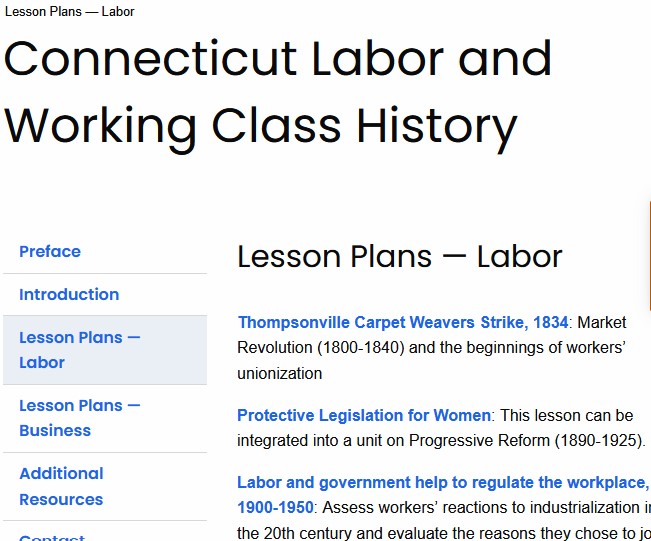
Connecticut Department of Education
Full Lesson Plans —on labor history including:
Thompsonville Carpet Weavers Strike, 1834: Market Revolution (1800-1840) and the beginnings of workers’ unionization
Protective Legislation for Women: This lesson can be integrated into a unit on Progressive Reform (1890-1925).
Labor and government help to regulate the workplace, 1900-1950: Assess workers’ reactions to industrialization in the 20th century and evaluate the reasons they chose to join together and go on strike and join a union.
Employment for African Americans in the 1940s and 1950s: Hartford’s G. Fox Department Store: Students will think about the connections between government policy and workplaces.
What was it like to work tobacco? This topic can be integrated into unit on business and labor; on Great Society programs, on immigration and migration from 1950 to 1980.
Innovation in Connecticut: This topic can be integrated into unit on industrialization/innovation in late 19th century for Grade 8 or Grade 10.
Child Labor: This topic can be integrated into unit on innovation and capitalism in 20th century in a grade 8 or 10 classroom.
Webpage containing links to lesson plans covering 19th and 20th century Connecticut labor history
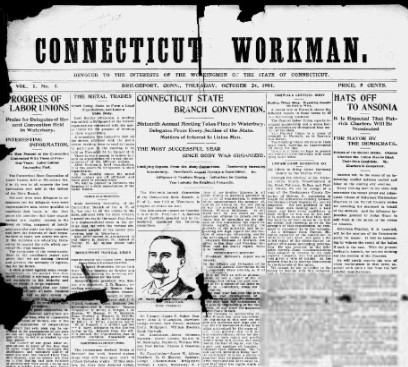
Connecticut Workman
only 1 issue from 1901
Connecticut Labor newspaper

Connie Field
Possible discussion questions that might accompany this film include: What type of work did the women do before the war, and how did it change after? How were the real stories told by the women different than the propaganda of big business and/or the American government? How did the images of women change before, during, and after the war? How did these women struggle for a better life? How did these women during the war have more freedom? How was the war used to add meaning to their lives? What benefits were there from taking up “men’s” jobs?
A documentary about the experiences of women who went to work during World War II.
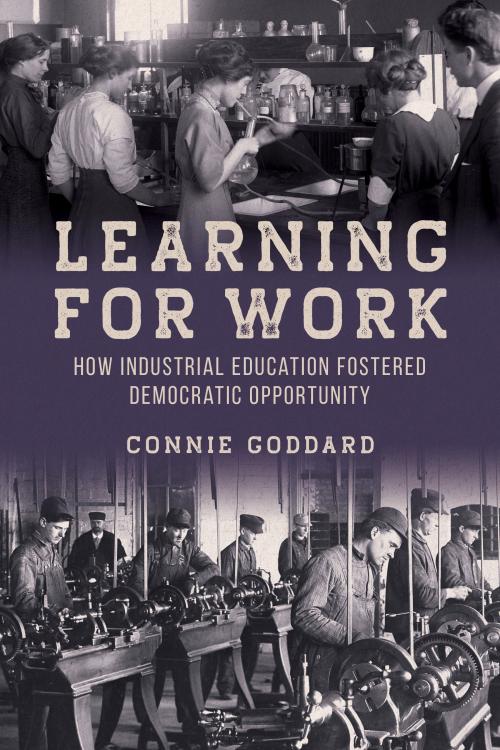
Connie Goddard
Founded in 1883 on Chicago's south side, the Chicago Manual Training School (CMTS) was a short-lived but influential institution dedicated to teaching practical skills to students. Connie Goddard uses the CMTS as a door into America's early era of industrial education and the transformative idea of "learning to do." Rooting her account in John Dewey's ideas, Goddard moves from early supporters of the union of learning and labor to the interconnected histories of CMTS, New Jersey's Black-oriented Manual Training and Industrial School for Colored Youth (MTIS), North Dakota's white-oriented Manual Training School, and other institutions. Goddard also analyzes the work of movement figures like Jonathan Baldwin Turner and Theodore Weld, cofounders of an influential group dedicated to promoting industrial education; Chicagoan Ella Flagg Young, one of Dewey's influences and an overlooked advocate for vocational education; and Dewey himself, an important thinker in industrial education who nonetheless neglected CMTS when he oversaw it at the University of Chicago. An absorbing merger of history and storytelling, Learning for Work looks at the people who shaped industrial education while offering a provocative vision of realizing its potential today"-- Provided by publisher
uses the CMTS as a door into America's early era of industrial education and the transformative idea of "learning to do."
Coppertown USA Mining Museum
This mining museum is an introduction to the fascinating story of the copper country and America's first real mining boom. A Heritage Site of the Keweenaw National Historical Park.
Open June - September.Michigan's Copper Industry began thousands of years ago when ancient miners chipped away at exposed veins of pure copper with huge hammerstones. Tools and techniques of mining advanced considerably in the centuries that followed and Coppertown's Mining Museum traces the evolution of miners and mining people with a series of tasteful exhibits designed for the family. Other remnants abound. The site of the first mineral rush in the USA, the Keweenaw Peninsula, saw it's last copper mine close in 1968.
The main webpage of the Coppertown USA Mining Museum, a Michigan-based organization that hosts physical and online exhibits of copper mining in the Keweenaw Peninsula.

Coreen Derifield
"Following World War II, women living in small towns and farms all across the Midwest, woke every morning, packed their lunches, and headed out for a long day of work in a nearby factory. Many of these women never envisioned themselves as industrial workers, but the political and economic changes to the region after World War II opened new opportunities and experiences for hundreds of women throughout the Midwest.
How does the stereotypical image of the Midwestern farm wife making apple pie in her kitchen find herself working for wages by trimming rubber for tires in the nearby factory? Understanding these discordant images drives this investigation into the demographic shift of women out of the traditional female role of housekeeping and into industrial wage work. How did this transition into industrial work affect their sense of self? How did it change the dynamic of their families and communities?
While it may be a seemingly mundane decision women and their families made in working for wages outside of the home, it caused tremendous change within families and women's roles in the home. These small alterations in daily life rippled throughout Midwestern culture and society, even changing the landscape of the small towns into decentralized industrial centers. This book explores this subtle yet fundamental shift of women in rural areas and small towns who ventured into an industrial workplace and who began earning their own wages and supporting their families"-- Provided by publisher
Introduction
The Industrial Development of Iowa
Out of the Home and Into the Workplace
The Crucible of the Workplace
Negotiating Gender Roles in the Union
An Education in Workplace Rights
Encounters with Feminism
Epilogue
The story of the rural women who worked in factories and shaped factory and union culture in Iowa.

Cornell University Library
Barbara Mayer Wertheimer (1926-September 23, 1983) was an American labor historian and labor organizer from the 1940s through the early 1980s.
From 1947 to 1948 Ms. Wertheimer was an organizer and acting education director for the Amalgamated Clothing Workers of America. She worked briefly for the American Labor Education Service and then from 1961 to 1966 as a consultant for the New York State Division of Housing and Community Renewal. In 1966 Ms. Wertheimer joined the New York State School of Industrial and Labor Relations at Cornell University. While at Cornell she was a senior extension associate, director of the Trade Union Women’s Studies program, and, from 1977 on, an associate professor and director of the Institute for Women and Work, which she cofounded. Ms. Wertheimer remained at Cornell until her death in 1983.
Ms. Wertheimer is well known for her monograph “We Were There: The Story of Working Women in America” (1977).
This collection consists mostly of research materials for a monograph she was working on at the time of her death. The tentative title for this book was “Our Century, Our Time” and was to be about working women in America from 1914 to 1983.
Cornell University Library
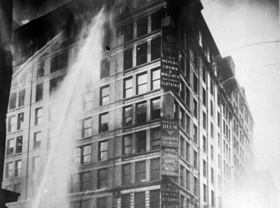
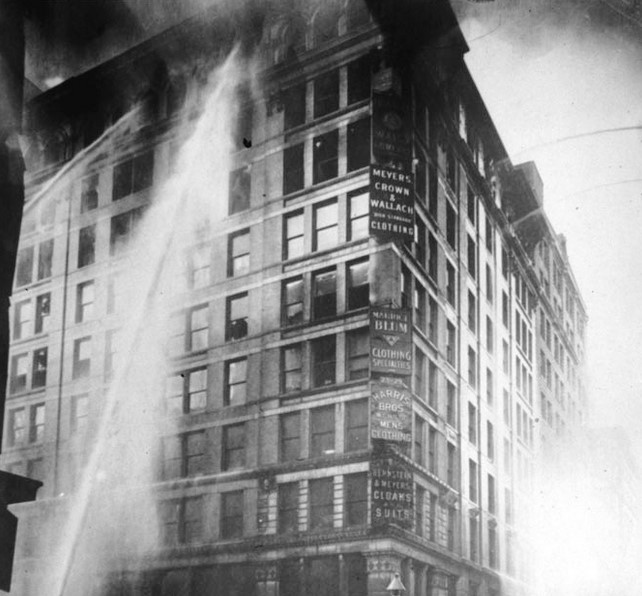
The Triangle Shirtwaist Factory fire in the Greenwich Village neighborhood of Manhattan, New York City, on Saturday, March 25, 1911, was the deadliest industrial disaster in the history of the city, and one of the deadliest in U.S. history. The fire caused the deaths of 146 garment workers – 123 women and girls and 23 men – who died from the fire, smoke inhalation, falling, or jumping to their deaths. Most of the victims were recent Italian or Jewish immigrant women and girls.
Because the doors to the stairwells and exits were locked, a common practice at the time to prevent workers from taking unauthorized breaks and to reduce theft, many of the workers could not escape from the burning building and jumped from the high windows. There were no sprinklers in the building. The fire led to legislation requiring improved factory safety standards and helped spur the growth of the International Ladies' Garment Workers' Union (ILGWU), which fought for better working conditions for sweatshop workers.
An old site with much digitized materials on the fire that caused death and outrage
Cornell University Library
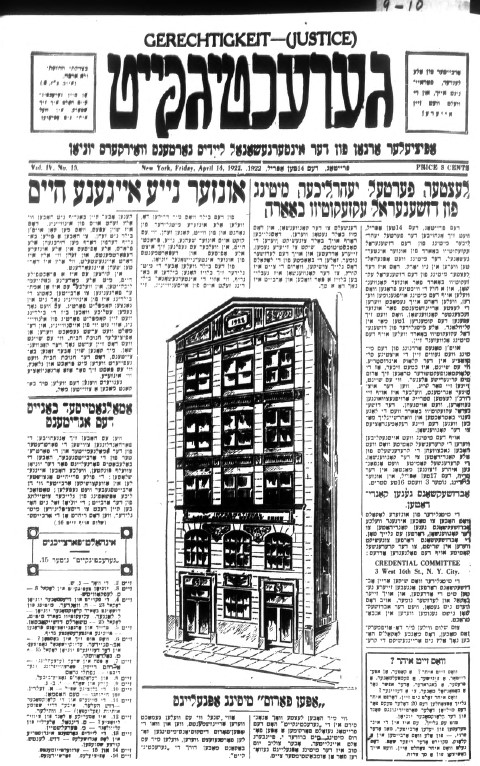
Justice was the official publication of the International Ladies’ Garment Workers’ Union ILGWU from 1919 to 1995. Editions of Justice were published in English, Italian, Spanish, and Yiddish. When compared side by side, the content of some of these different editions of Justice shows significant differences. Gerechtigkeit was the Yiddish-language edition of Justice. Searchable by Issue Date, author, Title, subject, type; 1919-1995
Yiddish-language edition of Justice, the official publication of the ILGWU
Cornell University Library
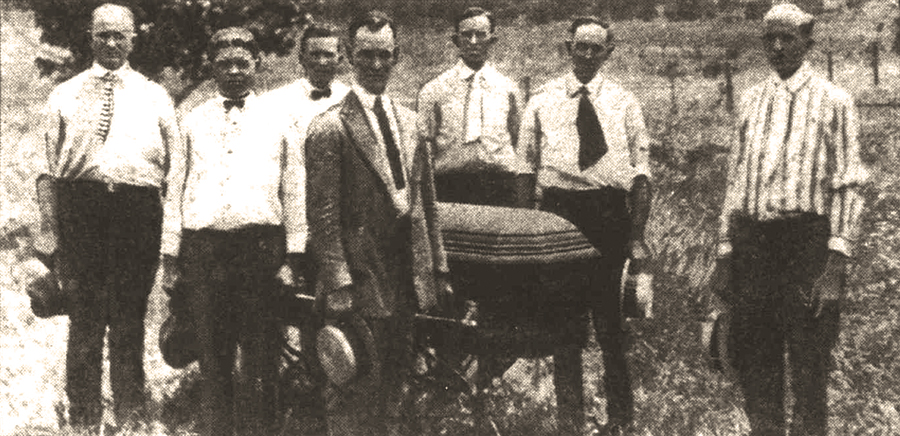
The so-called Herrin Massacre took place on June 22, 1922 in Herrin, Illinois, during a strike called by the United Mine Workers of America At the end of a gun battle between strikebreakers, company guards, and striking miners, a group of men who had surrendered to the strikers were assaulted, followed as they were fleeing, and murdered. In the end, nineteen men were dead. UMWA president John Lewis denied responsibility for the attack, and local courts acquitted the miners who had been indicted for the murders. However, the State of Illinois established an investigating committee to ascertain the facts. The proceedings lasted from April 4 to May 19, 1923.
PLEASE NOTE: Only excerpts of the investigating committee’s proceedings have survived, on a microfilm whose provenance is unknown. Various sections of the proceedings have their own numeration system, and the microfilm does not provide information on the section/date to which the pages refer to. The digital files made available here were generated in exactly the same sequence as found in the microfilm. Each digital file consists of approximately 100 images of text, and should be read in sequence. Given the poor quality of the original, full-text searches are not always reliable. Searchable by Issue Date, author, title subject, type.
Herrin Massacre was one of the most dramatic incidents in US labor history. In 1922, miner communities near Herrin retaliated against strikebreakers and mine guards resulting in many deaths.
Cornell University Library
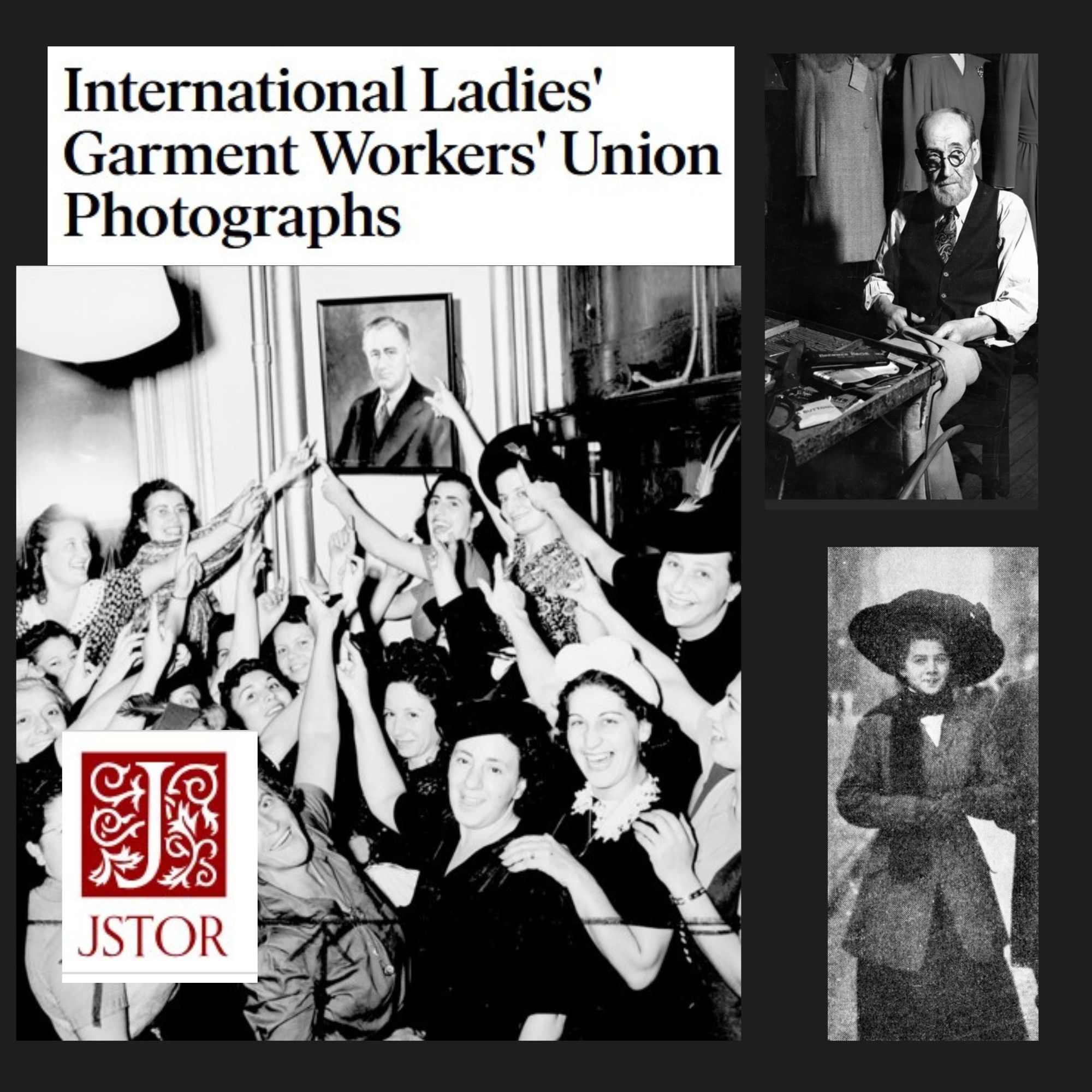
Founded in 1900, the International Ladies' Garment Workers' Union (ILGWU) grew in scope, size, and influence to become a powerful force in American organized labor. Representing workers in the women's garment industry, the ILGWU worked to improve the working and living conditions of its members. Photographs document the workers, the industry, the shops, and factories, as well as the union, its leadership, members, and activities.
1077 images/documents digitized ILGWU ranging from 1900-1985. You must create a free JSTOR account to access
Cornell University Library
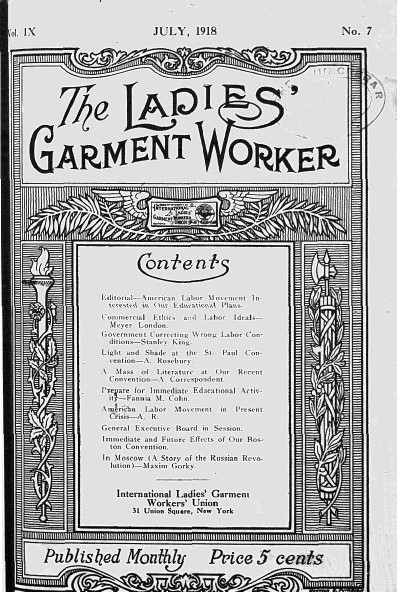
First published in April 1910, The Ladies’ Garment Worker was the official publication of the International Ladies’ Garment Workers’ Union (ILGWU) through 1918. The journal appeared monthly and included sections in English, Italian, and Yiddish. The Ladies’ Garment Worker was discontinued at the end of 1918 and replaced in January of 1919 by the new weekly journal of the ILGWU, Justice. Searchable by Issue Date, author, Title, Subject Type. 104 issues
official publication of the International Ladies Garment Workers Union
Cornell University Library
The full-text of the transcripts of the 1911 criminal trial against the owners of the Triangle Waist factory in New York City is part of a larger Web site, which should be visited to obtain full background information on the fire that caused the owners to be prosecuted and on the trial itself. Please visit Triangle Factory Fire.
For the story of the discovery of the transcripts, please see: Discovery of the Transcripts
For an introduction to the trial, see Introduction
For a list of witnesses, see List of Witnesses
The full-text of the transcripts of the 1911 criminal trial against the owners of the Triangle Waist factory