


Collections
Library
Type
Region
Coverage:
-
Published:
-

Al Norte: Agricultural Workers in the Great Lakes Region, 1917–1970
Dennis Nodin Valdez
Dennis Valdés’ account of the history and struggles of the farmworkers, Mexicans and Puerto Ricans, in the Great Lakes shows these sugarbeet workers and their class struggles in the mid twentieth century. Michigan, Ohio, and Indiana migrant farm labor has a richer history than usually depicted, and yet the author is critical of the AFL and the CIO efforts to organize the agricultural laborers in the region. Deals with government policy, repatriation, welfare strategies, Bracero and extensive depictions of the miserable working conditions in the beet fields.
Miserable conditions and resistance in the beet fields of Michigan, Indiana, Ohio in the mid 20th century. Focuses “on the class struggle between capitalist employers and seasonal farmworkers.”
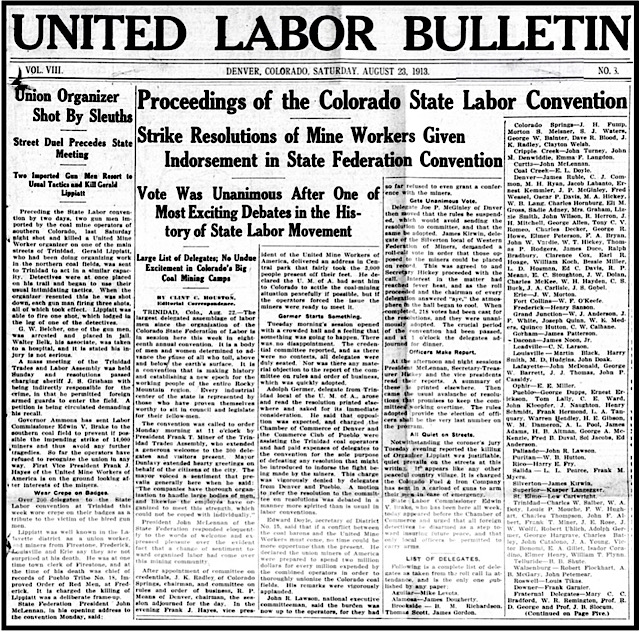
Denver Labor Bulletin, Chronicling America
preceded by United Labor Bulletin Established in 1905, the United Labor Bulletin was the official publication of the United Label League, No.1, and "the only official organ endorsed and owned by organized labor in Denver." The newspaper was not listed in N.W. Ayer & Son's American Newspaper Annual and Directory until 1914, under the editorship of James A. Conkle, who appears to have taken the position as early as 1910. In July 1913, Conkle sold the Bulletin to the United Labor Bulletin Printing and Publishing Company, a corporation founded by Clint C. Houston, F.R. Bishop, and Fred Wessel
United Labor Bulletin was the official publication of the United Label League, No.1, and "the only official organ endorsed and owned by organized labor in Denver."
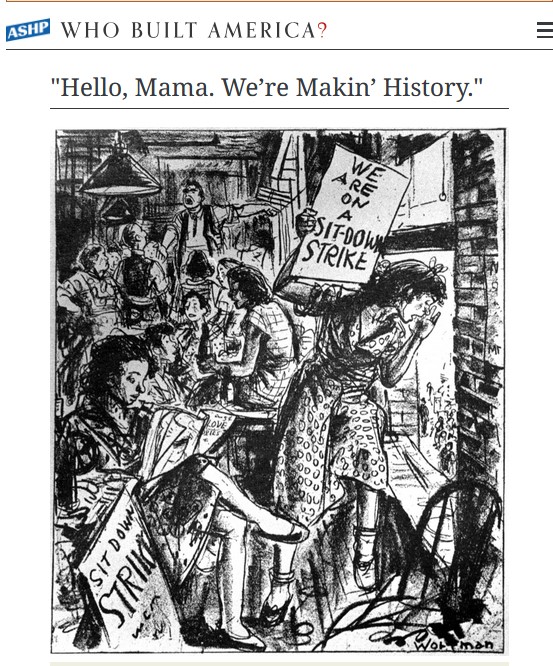
Denys Wortman, History Matters
When the United Automobile Workers won a six week sit-down strike in 1937 against General Motors, the largest corporation in the United States, a fever of organization and a sense of empowerment spread throughout working-class communities in the Northeast and Midwest. That year, 5 million workers took part in some kind of industrial action, and nearly 3 million joined a union. Denys Wortman’s cartoon in the March 25, 1937 New York World-Telegram captures the excitement and sense of power felt by many working men and working women when they participated in militant labor action.
A cartoon on sit-down wave of 1937
Department of Defense
- Department of Defense. Department of the Army. Office of the Chief Signal Officer. (09/18/1947 - 02/28/1964) - 1946 - Reel 1, a man, sans his right arm, sits on his bed, reads a pamphlet on handicapped workers, visits a vocational rehabilitation office, talks with a counselor, is examined by a doctor, takes manual dexterity tests, and watches men operate machines. Reel 2, disabled men operate welding machines and work on watches. Printed statements from employers praise handicapped workers. Disabled women operate sewing machines, type, and answer telephones. - Copied by Tim Vollmer
Department of Defense film encouraging employment of disabled men and women
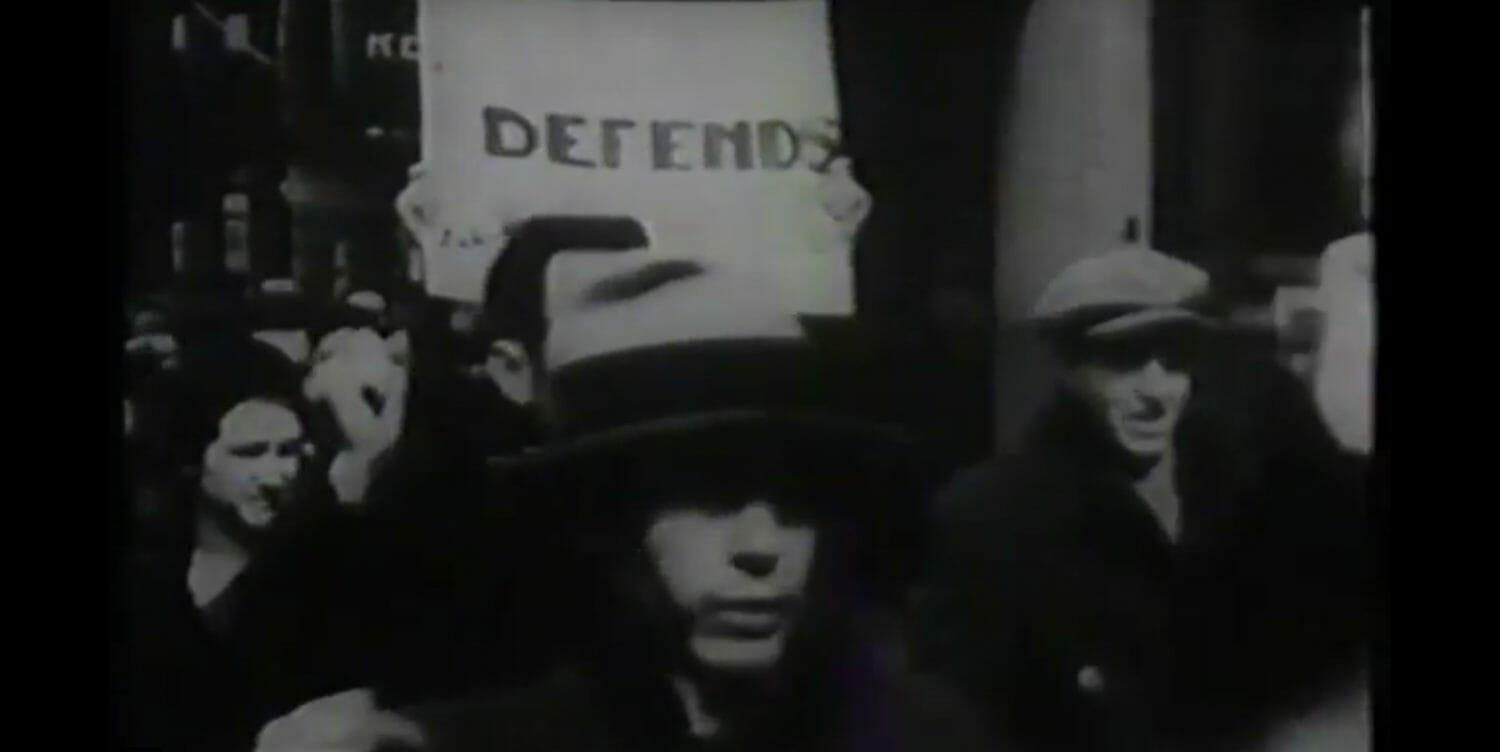
Detroit, New York Film, Photo League, Workers International Relief
The only known film record of the mass march and meeting held in Detroit on Feb. 4, 1932, against hunger and unemployment. Also shows the dramatic demonstration by workers at the Ford auto plant in River Rouge, Michigan in March of 1932, which ended with a violent attack by Dearborn police and Ford Company guards on the crowd with clubs, tear gas and guns which killed four young men. These deaths set off a wave of protest across the country
Ford Hunger March, 1932
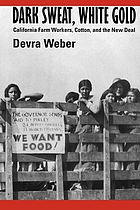
Devra Weber
In her incisive analysis of the shaping of California's agricultural work force, Devra Weber shows how the cultural background of Mexican and, later, Anglo-American workers, combined with the structure of capitalist cotton production and New Deal politics, forging a new form of labor relations. She pays particular attention to Mexican field workers and their organized struggles, including the famous strikes of 1933.Weber's perceptive examination of the relationships between economic structure, human agency, and the state, as well as her discussions of the crucial role of women in both Mexican and Anglo working-class life, make her book a valuable contribution to labor, agriculture, Chicano, Mexican, and California history
shows how the cultural background of Mexican and, later, Anglo-American workers, combined with the structure of capitalist cotton production and New Deal politics, forging a new form of labor relations.

DiMarcos family, History Matters
The New Deal launched a series of federal employment programs, including the Works Progress Administration (WPA), which not only provided jobs but also initiated many important studies of the depression�s human toll. One such study, published by the WPA Division of Research in 1939, included transcripts of interviews by WPA workers with Dubuque, Iowa, families. The DiMarcos interview revealed that the disabled faced a double challenge during the depression: finding employment while competing for scarce jobs with the able-bodied. The DiMarcos, a deaf couple with a small child, recall in their own words (because they were deaf they had to write responses to the WPA interviewer’s questions), the struggles they endured during six years of unemployment.
Experience of deaf couple who wrote of their experiences in the Great Depression
Diana D’Amico Pawlewicz
Historically, Americans of all stripes have concurred that teachers were essential to the success of the public schools and nation. However, they have also concurred that public school teachers were to blame for the failures of the schools and identified professionalization as a panacea. In Blaming Teachers, Diana D'Amico Pawlewicz reveals that historical professionalization reforms subverted public school teachers' professional legitimacy. Superficially, professionalism connotes authority, expertise, and status. Professionalization for teachers never unfolded this way; rather, it was a policy process fueled by blame where others identified teachers' shortcomings. Policymakers, school leaders, and others understood professionalization measures for teachers as efficient ways to bolster the growing bureaucratic order of the public schools through regulation and standardization. Beginning in the mid-nineteenth century with the rise of municipal public school systems and reaching into the 1980s, Blaming Teachers traces the history of professionalization policies and the discourses of blame that sustained them"-- Provided by publisher
reveals that historical professionalization reforms subverted public school teachers' professional legitimacy.
Diana K. Johnson
In the fall of 1999, the World Trade Organization (WTO) prepared to hold its biennial Ministerial Conference in Seattle. The event culminated in five days of chaotic political protest that would later be known as the Battle in Seattle. The convergence represented the pinnacle of decades of organizing among workers of color in the Pacific Northwest, yet the images and memory of what happened centered around assertive black bloc protest tactics deployed by a largely white core of activists whose message and goals were painted by media coverage as disorganized and incoherent. This insightful history takes readers beyond the Battle in Seattle and offers a wider view of the organizing campaigns that marked the last half of the twentieth century"-- Provided by publisher
takes readers beyond the Battle in Seattle and offers a wider view of the organizing campaigns that marked the last half of the twentieth century

Dianne Kelley
The Red Taylorist traces the adult life and works of Walter Polakov, focusing on his socialist scientific management ideals and the ways these were constrained by conventionality in the USA in the first half of twentieth century. Tracing Polakov's activities and achievements, this book explores the contradictions of a prolific writer, socialist engineer and scientific management ideologue in the decades until his death in 1948. Written from a management history scholarly perspective, it presents a unique and detailed viewpoint. There have been no prior biographies on Polakov, and very few on his fellow scientific managers, consulting engineers, or like-minded public intellectuals. Moreover, perceptions of scientific management or Taylorism have tended to emphasise the negative impacts on workers, whereas Polakov's socialist commitment suggests a much more nuanced approach.
traces the adult life and works of Russian-American writer Walter Polakov

Diego Rivera
Detroit Institute of Arts. Visit the "Detroit Industry" frescos of famed muralist and socialist, Diego Rivera. Detroit Institute of Arts; 5200 Woodward Ave, Detroit. "The two main panels on the North and South walls depict laborers working at Ford Motor Company's River Rouge Plant. Other panels depict advances made in various scientific fields, such as medicine and new technology. The series of murals, taken as a whole, expresses the idea that all actions and ideas are one."
At the Detroit Institute of Art, these murals are stunning
Diego Rivera
a one hour program explaining the famous murals at Detroit Institute of Arts
a video interpreting the Detroit industry murals created by Diego Rivera
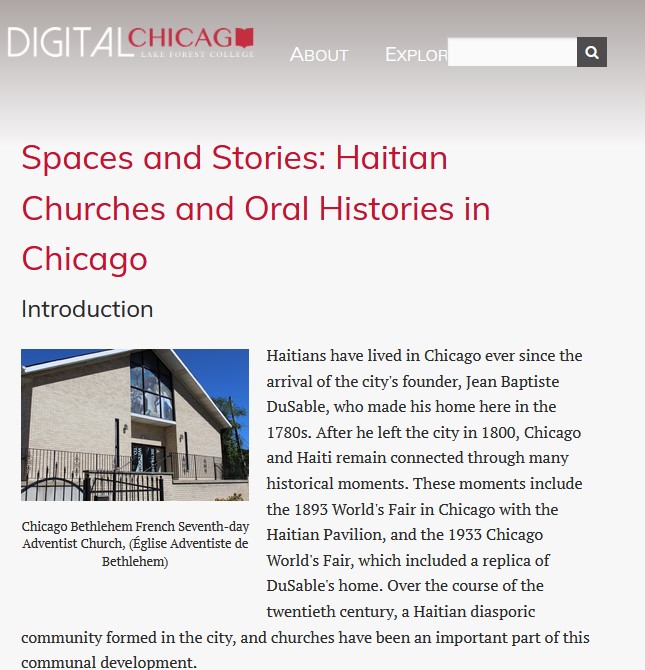
Digital Chicago HIstory
This project maps the Haitian church community in Chicago, locating 13 churches that serve the Haitian community and offering a brief historical overview of each church. A timeline illustrates the longstanding connections between Haiti and Chicago, and an overview of Haitian religious traditions contextualizes the snapshots of several oral history interviews completed for this project.
A Digital Chicago (Lake Forest College) on Haitian migrant communities in Chicago, specifically aimed at preserving the religious history of Haitian worshippers in the city.
Digital Chicago, Lake Forest College
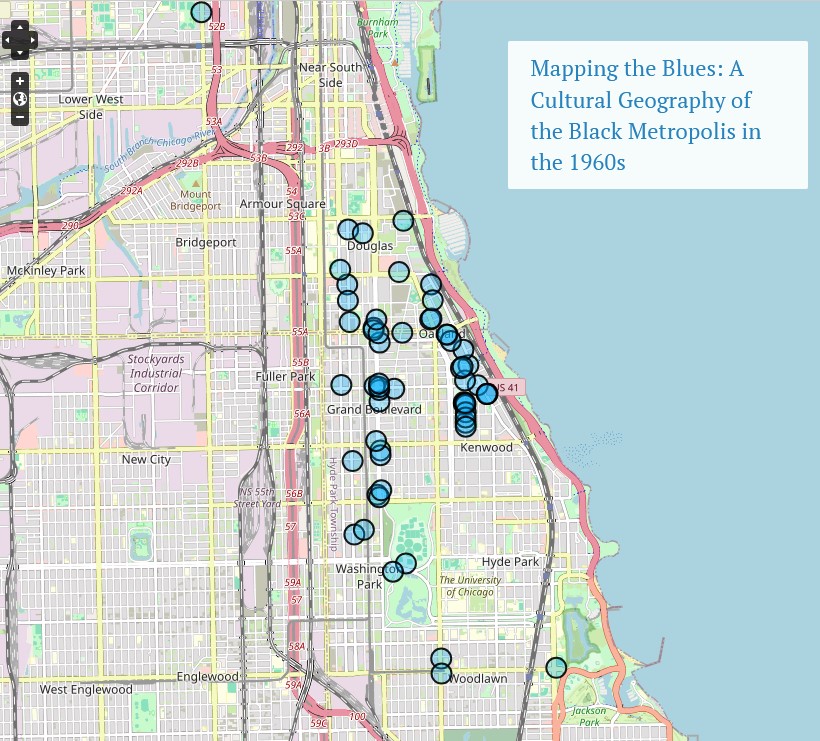
Using the photographic archive of Raeburn Flerlage at the Chicago History Museum, "Mapping the Blues" by Brian McCammack combines images of blues performances and Chicago's built environment to reveal a new dimension of black Chicagoans' cultural geography in the midst of a massive wave of migration and the emerging urban crisis.
A Cultural Geography of the Black Metropolis in the 1960s.
Digital Chicago, Lake Forest College
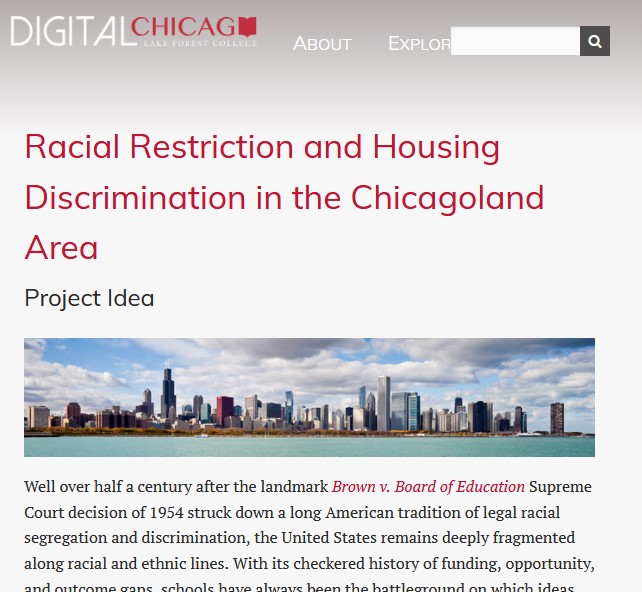
The "Racial Restriction and Housing Discrimination in the Chicagoland Area" Project documents the history of racial restrictive covenants in Cook County, Illinois, seeking to unearth artifacts of this history and link them to related housing discrimination tactics, such as redlining, panic peddling, and blockbusting. The documentary evidence, shown in an interactive map and timeline, presents a new view of this troubling and relevant history.
This project investigates and documents the history of one such housing discrimination strategy, racial restrictive covenants in Cook County, Illinois, focusing on a timeline and interactive map tracing this history.
Digital Cleveland
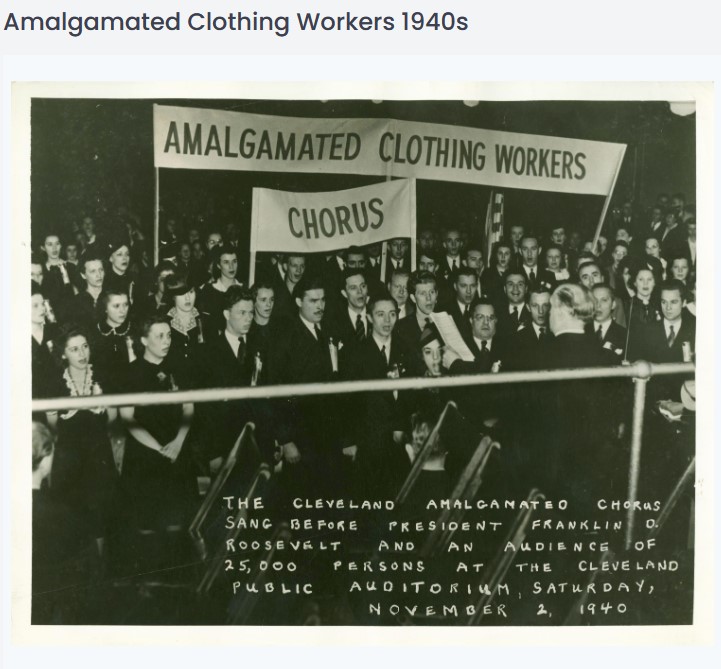
23 digital photos of labor unions in Cleveland
23 digital photos of labor unions in Cleveland Ohio, 1920-1950
Digital Library of Georgia
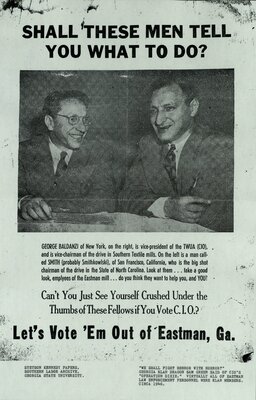
Connected to Exhibit, Fighting for Freedom: Labor and Civil Rihgts in the American South, Teacher Resources allow fuller exploration of the role of the AFL-CIO and unions in the struggle.
Classroom activities, primary sources, discussion questions and teachers guide introduces AFL-CIO and civil rights movement to students
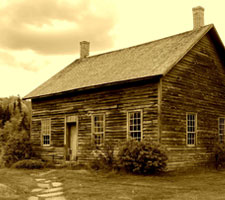
Digital Library on American Slavery
The Digital Library on American Slavery (DLAS) is an expanding resource compiling independent collections focused upon race and slavery in the American South, made searchable through a single, simple interface. DLAS houses tens of thousands of records relating to all 15 slave states and Washington, D.C. as well as a number of northern states. DLAS contains detailed personal information about over 100 thousand individuals, including enslaved people, enslavers, free people of color, and more.
The goal of the Digital Library on American Slavery is to bring together and make freely accessible public records related to enslavement, with an emphasis upon the names and stories of the enslaved. DLAS strives to be a documentation project, not an interpretive effort. The team works with researchers to make data sets available for personal research.
Each project housed within DLAS includes a data dictionary and user guide tailored to that data set or type of record. A detailed history of each project is also available.
Included documents and datasets
Court petitions (The Race and Slavery Petitions Project)
The Race and Slavery Petitions Project is based upon the research data of Dr. Loren Schweninger and offers data extracted from eighteenth and nineteenth-century documents and processed over a period of eighteen years. The project contains detailed information on about 150,000 individuals extracted from 2,975 legislative petitions and 14,512 county court petitions, as well as from a wide range of related documents, including wills, inventories, deeds, bills of sale, depositions, court proceedings, and amended petitions among others. Buried in these documents are the names and other data on roughly 80,000 enslaved people, 8,000 free people of color, and 62,000 whites, both enslavers and not.
Runaway slave notices (The N.C. Runaway Slave Advertisements Project)
This project provides online access to all known runaway slave advertisements (more than 5000 items) published in North Carolina newspapers from 1751 to 1865. These brief ads provide a glimpse into the social, economic, and cultural world of the American slave system and the specific experience within North Carolina. The project includes digital images, full-text transcripts, and descriptive metadata, as well as contextual essays and an annotated bibliography.
Slave deeds (People Not Property)
People Not Property is a unique, centralized database of bills of sales from across over 20 North Carolina counties, Washington DC, and other states. The project indexes the names of enslaved people from across the state, and includes robust metadata, images, and searchable indexes. This is an ongoing effort, and the project will continue to expand to other counties across North Carolina as well as into other states and districts.
Court petitions, Runaway slave notices, Slave deeds (People Not Property)
Digital North Carolina
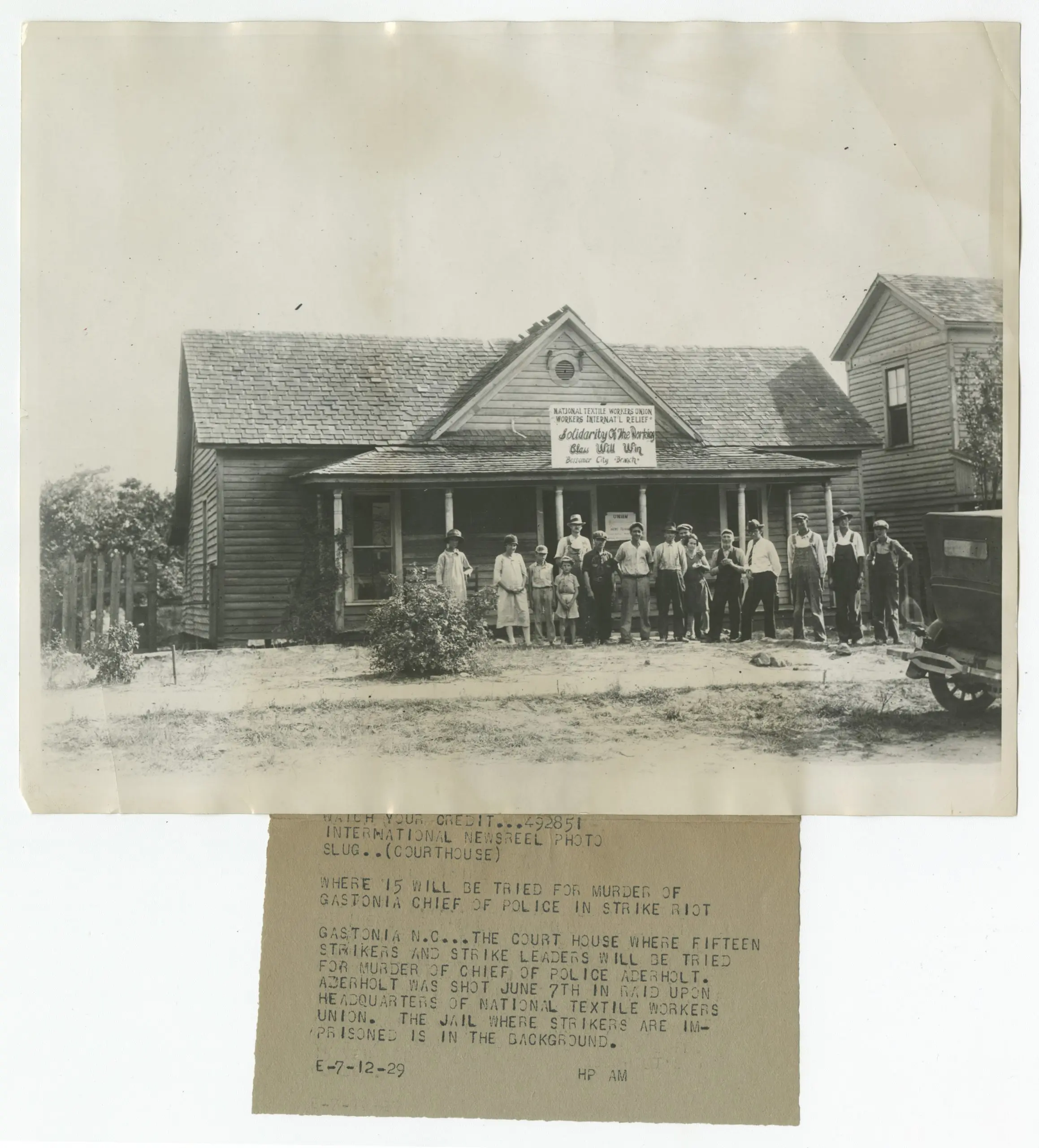
There are many labor documents in this consortium digital archive, from 1836-1950, acquired from a variety of institutions across the state of North Carolina. Entering the word labor in the search engine results in over 10000 hits. Using more specific items, such as Gastonia Textile Strike, will also yield some rewards.
searchable database with many items related to labor issues in North Carolina
Digital Pitt
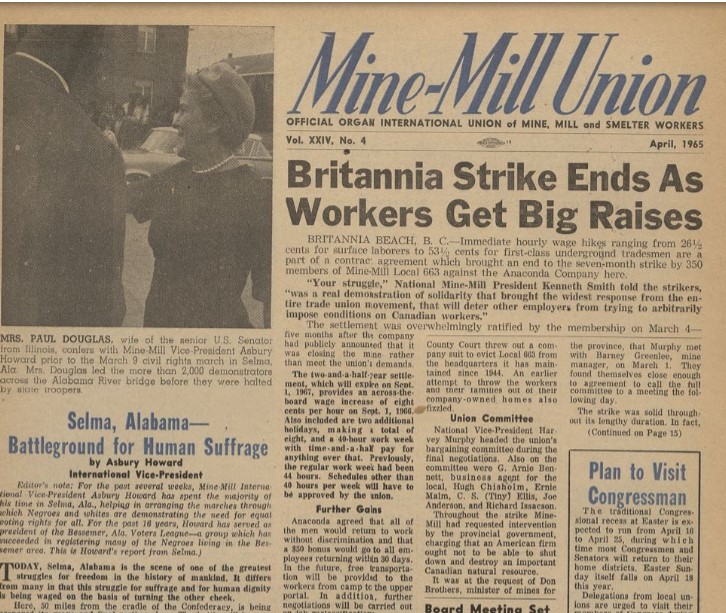
significant number of issues of this left-wing CIO newspaper, 1939-1950s
mine-mill smelter workers CIO newspaper, IUMMSW, Mine Mill

Digital Pitt, Archives of Industrial Society, University of Pittsburgh
In 1926, the privately operated Bethlehem Mines Corporation Police Department began to patrol the coal fields of Washington, Indiana and Westmoreland County that were under the ownership of the Ellsworth Collieries and the Bethlehem Mines Corporation. In 1926, this proved an especially sensitive task, since the United Mine Workers of America had recently been driven from the Ellsworth Co. mines in Marianna, Cokeburg, Ellsworth, and Acme and the company had brought in non-union miners to work those fields. This report, reprinted in total from a collection that contains additional reports going up to 1935, gives a startling and realistic glimpse of the warfare between company and union in the bituminous coal fields of Southwestern Pennsylvania.
Source: AIS 78:13 Bethlehem Mines Corp. Police Dept. Reports, 1926-1930, 1932-1935; Box 6573.
Primary source report covering the extent to which the Bethlehem Mines Corp. privately policed the Pennsylvania coalfields

Digital Pitt, Archives of Industrial Society, University of Pittsburgh
Info and ephemera of Carpenters, Operating Engineers, Laborers' District Council, Union Labor Temple Sheet Metal Workers, Ironworkers of Western Pennsylvania, from the holdings of the Archives Research Center
Info and ephemera of building trades unions in Western Pennsylvania
Digital Pitt, Archives of Industrial Society, University of Pittsburgh
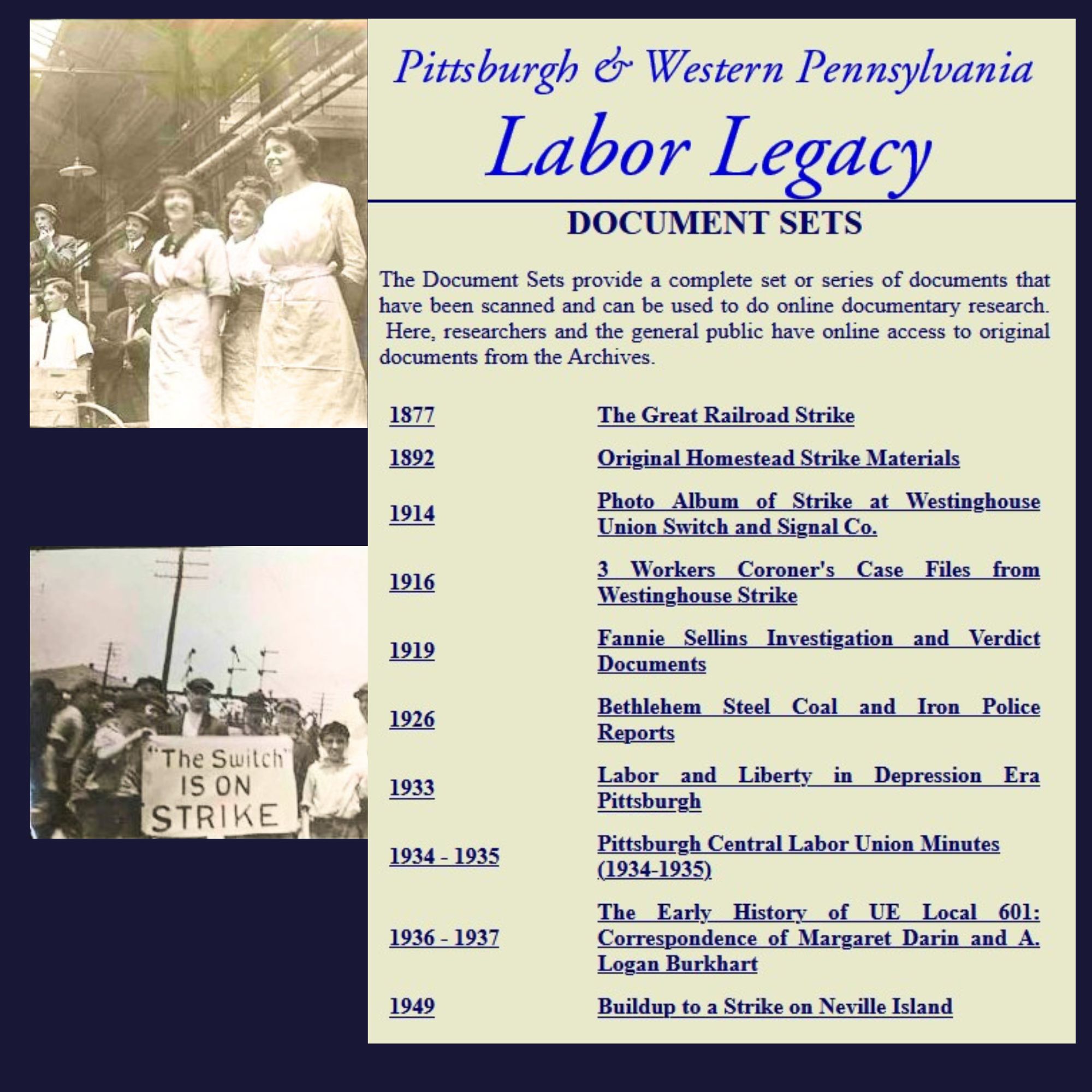
Topics with document sets include:
1877 The Great Railroad Strike
1892 Original Homestead Strike Materials
1914 Photo Album of Strike at Westinghouse Union Switch and Signal Co.
1916 3 Workers Coroner's Case Files from Westinghouse Strike
1919 Fannie Sellins Investigation and Verdict Documents
1926 Bethlehem Steel Coal and Iron Police Reports
1933 Labor and Liberty in Depression Era Pittsburgh
1934 - 1935 Pittsburgh Central Labor Union Minutes
1936 - 1937 The Early History of UE Local 601: Correspondence of Margaret Darin and A. Logan Burkhart
1949 Buildup to a Strike on Neville Island
A range of digitized or copied material on labor topics from Archives of Indusrial Society, University of Pittsburgh
Digital Pitt, Archives of Industrial Society, University of Pittsburgh
includes reports on Repression of Civil Liberties 1923 and 1934 workers accident information, strikes in 1894, 1901, 1919, Steelworkers Organizing, and other items
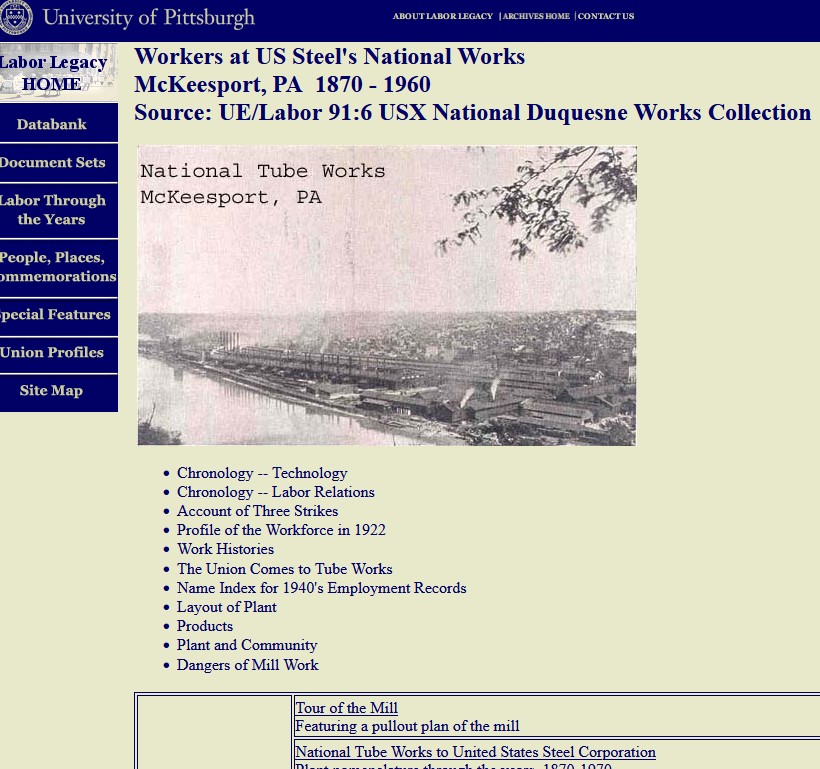
Documents and media from US steel's national plant, digitized and hyperlinked
Digital Pitt, United Electrical Radio and Machine Workers, ULS Pittsburgh
What's online? This collection contains all of the issues of the UE News, the official newspaper of the United Electrical, Radio and Machine Workers of America (UE), from the newspaper’s founding in 1939 through 2010. These issues document the rise of the union, UE efforts during World War II, its struggles with McCarthyism, the union’s evolution as the country’s economy deindustrialized, and much more. BROWSE ALL ISSUES HERE
Also included in this collection are photographs representing the activities, officers, and members of the UE in Pittsburgh area from about 1936 to 1959. Major local unions, such as UE Local 601 (Westinghouse, East Pittsburgh) and UE Local 610 (Westinghouse Airbrake in Wilmerding and Union Switch and Signal in Swissvale), are represented. These locals were part of UE District Six, which, in its aggregate, included all of the UE locals in Western Pennsylvania and northern West Virginia.
Images were selected that illustrate huge wartime rallies during World War II, the 1946 Strike wave, the political culture of CIO unions like UE, and the contests for power that weakened the union and fragmented the labor movement during the Cold War.
over 1900 digitized records, inclding UE News, issues include McCarthyism, CIO, World War II, great cartoons, photographs, automation, surplus value, women workers, civil rights
Museum/Exhibits
Tours
Maps
Digital Projects
Organizations
Sites
Film/Video
Audio/Interview
Podcast/Program
Text/Document
Image
Graphs/Data
Timeline
Southwest
West
Midwest
Southeast
Northeast
Mexico
Canada
Global
Books
Teaching
Lectures
Digital Archives
Journals
Bibliographies
Topic Intro