


Collections
Library
Type
Region
Coverage:
-
Published:
-
Digital Public Library of America
There are many worker and labor union hits in this site which collates materials digitized by other libraries.
DPLA's platform makes millions of materials from libraries, archives, museums, and other cultural institutions across the country available to all in a one-stop discovery experience.
A site that collates digitized materials from a range of sources across the US.

Digital Public Library of America
over 1760 items from the Digital Public Library of America, collected mostly from Georgia State University files
research materials related to IUMMSW
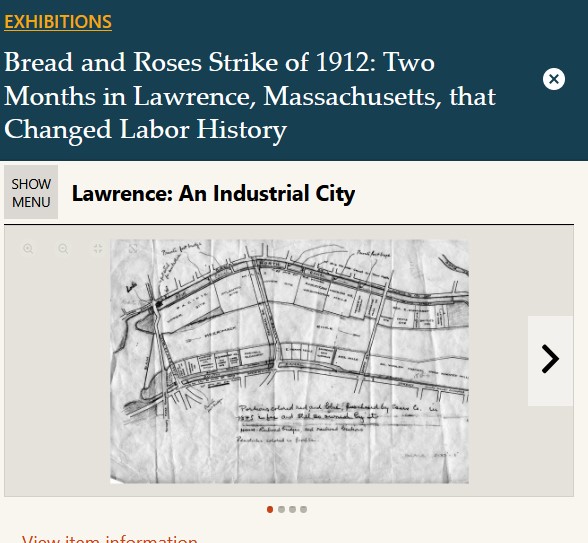
Digital Public Library of America, Lawrence History Center
A brief digital exhibit on the "Bread and Roses" Strike, 1912, The Lawrence, Massachusetts strike is referred to as the “Bread and Roses” strike and “The Strike for Three Loaves." The first known source to do so was a 1916 labor anthology, The Cry for Justice: An Anthology of the Literature of Social Protest by Upton Sinclair. Prior to that, the slogan, used as the title of a 1911 poem by James Oppenheim, had been attributed to ‘Chicago Women Trade Unionists.’ It has also been attributed to socialist union organizer Rose Schneiderman.
Lawrence: An Industrial City
Introduction
Lawrence Transforms
A Mill City Overnight
A City of Weavers and Wool
A Worker's Life
Introduction
Working Conditions
Living Conditions
In Darkened Homes
Statistics
Food and Wages
The Strike
Introduction
Provocations
The Strike Begins
A Call to Action
A Community Responds
The Militia are Called In
Strike Leaders Arrested
The Strikers and their Allies and Adversaries
Introduction
The Workers
Father James T. O'Reilly
Elizabeth Gurley Flynn
John Breen
The Mill Owners
Joseph Caruso, Joseph Ettor, and Arturo Giovannitti
The Committee of Ten
Mobilizing Beyond Lawrence
Introduction
The Children as Strikers
The Children's Exodus
Colleges and the Strike
The Strike Ends, A Legacy is Born
Introduction
The Aftermath
For God and Country
Remembering the Fallen
Multi-part digital exhibit of the Lawrence, Massachusetts Bread and Rose Strike of 1912, led by the Industrial Workers of the World, composed of immigrants speaking 59 languages
Dionicio Nodín Valdés
Puerto Rico, Hawai'i, and California share the experiences of conquest and annexation to the United States in the nineteenth century and mass organizational struggles by rural workers in the twentieth. Organized Agriculture and the Labor Movement before the UFW offers a comparative examination of those struggles, which were the era's longest and most protracted campaigns by agricultural workers, supported by organized labor, to establish a collective presence and realize the fruits of democracy.
Dionicio Nodín Valdés examines critical links between the earlier conquests and the later organizing campaigns while he corrects a number of popular misconceptions about agriculture, farmworkers, and organized labor. He shows that agricultural workers have engaged in continuous efforts to gain a place in the institutional life of the nation, that unions succeeded before the United Farm Workers and César Chávez, and that the labor movement played a major role in those efforts.
He also offers a window into understanding crucial limitations of institutional democracy in the United States, and demonstrates that the widespread lack of participation in the nation's institutions by agricultural workers has not been due to a lack of volition, but rather to employers' continuous efforts to prevent worker empowerment.
Organized Agriculture and the Labor Movement before the UFW demonstrates how employers benefitted not only from power and wealth, but also from imperialism in both its domestic and international manifestations. It also demonstrates how workers at times successfully overcame growers' advantages, although they were ultimately unable to sustain movements and gain a permanent institutional presence in Puerto Rico and California
how employers benefitted not only from power and wealth, but also from imperialism in both its domestic and international manifestations

Dipesh Chakrabarty
First published in 2000, Dipesh Chakrabarty’s influential Provincializing Europe addresses the mythical figure of Europe that is often taken to be the original site of modernity in many histories of capitalist transition in non-Western countries. This imaginary Europe, Dipesh Chakrabarty argues, is built into the social sciences. The very idea of historicizing carries with it some peculiarly European assumptions about disenchanted space, secular time, and sovereignty. Measured against such mythical standards, capitalist transition in the third world has often seemed either incomplete or lacking. Provincializing Europe proposes that every case of transition to capitalism is a case of translation as well—a translation of existing worlds and their thought—categories into the categories and self-understandings of capitalist modernity. Now featuring a new preface in which Chakrabarty responds to his critics, this book globalizes European thought by exploring how it may be renewed both for and from the margins.
Denaturalizes European historical thought by provincializing the European transition to Capitalism

Directing - Stewart Bird, Peter Gessner, Rene Lichtman
Produced in association with the League of Black Revolutionary Workers, this film spotlights black Detroit factory workers and the critical role Black workers play in traditional systems and helping us all imagine more radical ones.
A film produced alongside members of the Detroit LRBW, which depicts the struggles of factory workers in the city.
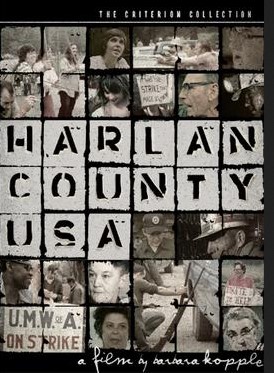
Directing, Production - Barbara Kopple
Harlan County, USA is a 1976 documentary film covering the "Brookside Strike", an effort of 180 coal miners and their wives against the Duke Power Company-owned Eastover Coal Company's Brookside Mine and Prep Plant in Harlan County, southeast Kentucky in 1973. It won the Oscar for Best Documentary at the 49th Academy Awards.
This film chronicles the bitter and violent struggle waged by coal miners during a strike in 1973 in Eastern Kentucky against the Eastover Mining Company. The story focuses on the miners and their families' fight for decent living standards in an area where many still live in shacks with no indoor plumbing and work at jobs with little security and dangerous conditions.Consider pairing this film with the "Where Do You Stand? Stories from an American Mill" study guide, which gives students a chance to consider the implications of modern union formation, globalization, and local history.
A documentary on the 1973 Brookside Strike by coal miners in Harlan County, Kentucky who struck against Duke Power Company for improved working conditions and higher pay after contract negotiations faltered.

Directing, production - John, Roy Boulting; Script - Frank Harvey; Youtube Contributor - "Klokline Cinema"
Consider pairing I'm All Right, Jack with the following reading about the film’s connection with labor and comparisons with The Organizer: "I’m All Right Jack and The Organizer: Bread and Roses and a Lot of Laughs" by Michael Sragow.
A film portraying the story of a man caught between management and labor.
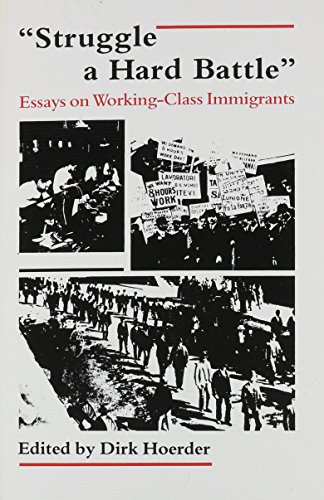
Dirk Hoerder
anthology 1986 https://archive.org/details/strugglehardbatt00hoer
Front cover image for "Struggle a hard battle" : essays on working-class immigrants
a collection of essays written on the experience of working class immigrants.

Dirk Hoerder
Introduction: American labor history in the United States and Europe / Dirk Hoerder
Workers, scholars, militancy: Strikes and economics, working-class insurgency and the birth of labor historiography in the 1880s / Bruno Cartosio.
W.E.B. Du Bois and the proletariat in Black reconstruction / Ferruccio Gambino.
Workers' self-organization and resistance in the 1877 strikes / Marianne Debouzy.
"Reefs of roast beef," the American worker's standard of living in comparative perspective / Peter R. Shergold
Organization: The Socialist and the working class in New York, 1890-96 / Hubert Perrier.
The parameters of craft consciousness, the social outlook of the skilled worker, 1890-1920 / Andrew Dawson.
The German immigrant working class of Chicago, 1875-90 / Hartmut Keil.
Yugoslav immigrants in the U.S. labor movement, 1880-1920 / Ivan Čizmić
Immigrants: Unestablished Irishmen, new immigrants and industrial America, 1870-1910 / David N. Doyle.
Strikes and political radicalism in Sweden and emigration to the United States / Lars-Göran Tedebrand.
Political mobilization of the workers, the case of the Worcester Swedes / Sune Åkerman and Hans Norman. For or against Americanization? The case of the Finnish immigrant radicals / Auvo Kostiainen
A collection of essays on labor history in Europe and America, conducted by European scholars.
Dirk Hoerder
This collection of essays revises and broadens scholarly assumptions about the history of migration in search of work. The book begins with a critique of current concepts in migration history and a general survey of European labor migration from the 1820s to the 1920s. The following section discusses important emigration and immigration countries and examines in detail the problems of internal European migration in the nineteenth and early twentieth centuries. The author then focuses on the acculturation of labor migrants on both sides of the Atlantic. The final section of this work tackles the much neglected question of return migration. A bibliographic essay, as well as numerous graphs, maps, and illustrations, supplement this collection of essays.
revises and broadens scholarly assumptions about the history of migration in search of work.
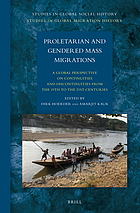
Dirk Hoerder
This book connects the 19th- and 20th-century labor migrations and migration systems in global transcultural perspective. It emphasizes macro-regional internal continuities or discontinuities and interactions between and within macro-regions. The essays look at migrant workers experiences in constraining frames and the options they seize or constraints they circumvent. It traces the development from 19th-century proletarian migrations to industries and plantations across the globe to 20th- and 21st-century domestics and caregiver migrations. It integrates male and female migration and shows how women have always been present in mass migrations. Studies on historical development over time are supplemented by case studies on present migrations in Asia and from Asia. A systems approach is combined with human agency perspectives
traces the development from 19th-century proletarian migrations to industries and plantations across the globe to 20th- and 21st-century domestics and caregiver migrations.
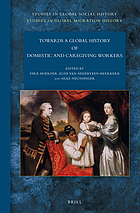
Dirk Hoerder, Elise van Nederveen Meerkerk, Silke Neunsinger
"Domestic and caregiving work has been at the core of human existence throughout history. Poorly paid or even unpaid, this work has been assigned to women in most societes and occasionally to men often as enslaved, indentures, 'adopted' workers. Societies and states set the discriminatory rules, those employed develop strategies of resistance or self-protection (Part One). While some use domestic service as training for their own future independent households, others are confined to it for life and try to avoid damage to their identities (Part Two). Employment conditions are even worse in colonizer-colonized dichotomies, in which the subalternized have to run the households of administrators who believe they are running an empire (Part Three). A team of international scholars addresses these issues globally with a deep historical background. Contributors are: Ally Shireen, Eileen Boris, Dana Cooper, Jennifer Fish, David R. Goodman, Mary Gene De Guzman, Jaira Harrington, Victoria Haskins, Dirk Hoerder, Elizabeth Hordge-Freeman, Majda Hrženjak, Elizabeth Hutchison, Dimitris Kalantzopoulos, Bela Kashyap, Marta Kindler, Anna Kordasiewicz, Ms Lokesh, Sabrina Marchetti, Robyn Pariser, Jessica Richter, Magaly Rodríguez García, Raffaella Sarti, Adéla Souralová, Yukari Takai, and Andrew Urban"--Provided by publisher
addresses the issues of state, agency, and domestic service in colonizer frames globally in historical perspectives.
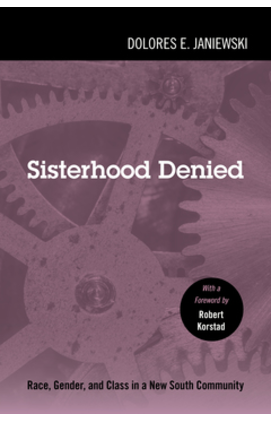
Dolores E. Janiewski
Available for download at https://tupress.temple.edu/open-access/labor-studies/sisterhood-denied (pdf) Traces the movement of black and white women between 1880 and 1940 from tobacco fields in the North Carolina Piedmont into Durham's textile, tobacco, and hosiery factories. This book tells the story of the New South as it was experienced by the women who contributed to the region's wealth while remaining poor themselves
tells the story of the New South as it was experienced by the women who contributed to the region's wealth while remaining poor themselves.
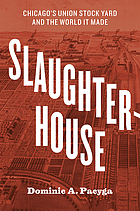
Dominic A. Pacyga
On the South Side to tour the Union Stock Yard, people got a firsthand look at Chicago's industrial prowess as they witnessed cattle, hogs, and sheep disassembled with breathtaking efficiency. At their height, the kill floors employed 50,000 workers and processed six hundred animals an hour, an astonishing spectacle of industrialized death. Pacyga chronicles the rise and fall of an industrial district that, for better or worse, served as the public face of Chicago for decades. He takes readers through the packinghouses as only an insider can, covering the rough and toxic life inside the plants and their lasting effects on the world outside. He shows how the yards shaped the surrounding neighborhoods; looks at the Yard's sometimes volatile role in the city's race and labor relations; and traces its decades of mechanized innovations
Preface: confronting the modern in Chicago's Square Mile
Spectacle: facing the modern world
Genesis: from swamp to industrial giant
Working in the yards: the move to the modern
"Success comes to those who hustle wisely": the emergence of the greatest livestock market in the world
Slaughterhouse blues: the decline and fall of the Union Stock Yard
Innovate for efficiency, though with less stench: the square mile after the Union Stock Yard
the rough and toxic life inside the plants and their lasting effects on the world outside
Dominic D. Wells
Analyzes the expansion and restriction of public sector collective bargaining rights in the United States over a 50 year period. Grounded in research on the policy process and labor unions, this book argues that the politics of restriction are different from the politics of expansion
Analyzes the expansion and restriction of public sector collective bargaining rights in the United States over a 50 year period.
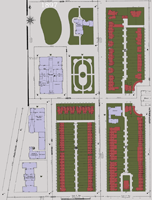
Dominic Pacyga
A collection of maps, images, documents, census,other archives about George Pullman, the town of Pullman, the houses and facades, the company, and the conflicts. There is an index sitemap that brings to light the scope of the wealth of information in this website.There are multiple maps and topics covered in this extensive collection https://www.pullman-museum.org/sitemap.html
A collection of maps, images, documents, census,other archives
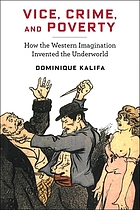
Dominique Kalifa, Sarah Maza
Prostitutes, criminals, and the sordid, dangerous places they inhabit have always been with us. Yet there has not always been an "underworld," or what the French call "les bas-fonds." This expression, which appeared in most western languages in the 19th century, reveals a new way of looking at these social ills and raises a key historical question: why did the century that gave us positivism, industry, democratization, and mass culture name--and thus reframe--its view of its social margins?
This book explores this imaginary. It shows how the underworld came into being in the shattered Europe of the 19th century, born of a tradition in which biblical symbols-Sodom, Gomorrah, Babylon-intermingled with the "bad poor" of Christian lore and images of modern roguery like the Cour des Miracles. It decodes the construction of a worldview that has never ceased to fascinate us. For while it connotes things that are real-poverty, crime, and transgressions of all sorts-the "underworld" also constitutes an imaginary that expresses our fears, our anxieties, our desires. In representing the nether regions of our society-its "accursed share" so to speak-it also provides a route of symbolic and social escape.
Although many of its components still exist or have been readapted to new contexts, the specific combination that arose in connection with the 19th century underworld gradually faded away in the 20th century. The welfare states established in the wake of the Second World War left very little room for it. And yet, while the contexts have changed, both the debates on issues related to the "underclass" and the images in contemporary cinema and steampunk culture reveal that the shadow of the underworld still lurks all around us"-- Provided by publisher
how the underworld came into being
Donald F. Tibbs
This book uses the landmark case Jones v. North Carolina Prisoners' Labor Union to examine the strategies of prison inmates using race and radicalism to inspire the formation of an inmate labor union
the formation of an inmate labor union

Donald F. Tingley, ed.
Essays which span the entirety of Illinois history both chronologically and thematically.
Essays which span the entirety of Illinois history both chronologically and thematically, some deal with labor history
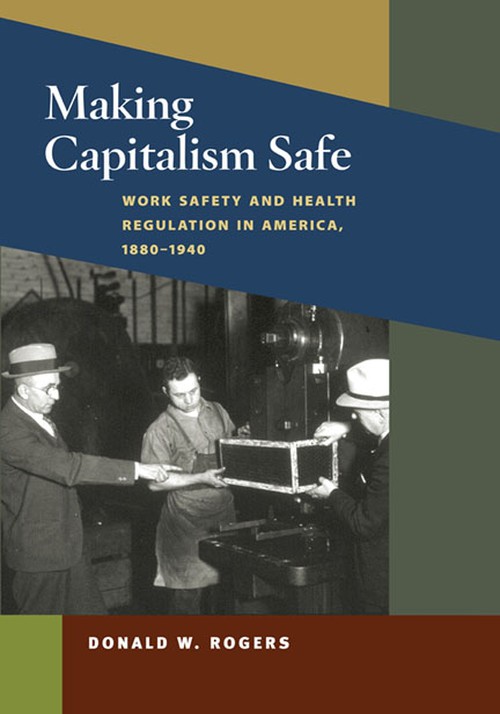
Donald W. Rogers
Workplaces in the United States are safer today than they were 120 years ago. In this book, Donald W. Rogers attributes this improvement partly to the development in the Progressive Era of surprisingly strong state-level work safety and health regulatory agencies, a patchwork of commissions and labor departments that advanced safety law from common-law negligence to the modern system of administrative regulation.
Centering on the most important of these state agencies, the Wisconsin Industrial Commission, Rogers examines how Wisconsin's program operated in practice, what its results were, and how it compared to protective labor law arrangements in Ohio, California, New York, Illinois, and Alabama. He illuminates the achievements of these agencies, including their integration of workers compensation and commission regulation (two bedrocks of modern occupational safety law), as well as their establishment of worker-employer advisory committees, administrative safety codes, a "safety first" ethic, and "prevailing good practices" in modernizing firms. He also reveals the mixed success that these bodies met in their code enforcement efforts and industrial health initiatives.
Rogers shows how safety commissions reconciled technological progress with industrial efficiency, justice, and stability. Connecting this history to the creation of the Occupational Safety and Health Administration in 1970, Making Capitalism Safe will revise historical understandings of state regulation, compensation insurance, and labor law politics--issues that remain pressing in our time.
A broad, historical appraisal of the evolution of work safety and health regulation in the U.S.
Donald W. Rogers
The 1939 Supreme Court decision Hague v. CIO was a constitutional milestone that strengthened the right of Americans, including labor organizers, to assemble and speak in public places. Donald W. Rogers eschews the prevailing view of the case as a morality play pitting Jersey City, New Jersey, political boss Frank Hague against the Committee for Industrial Organization (CIO) and allied civil libertarian groups. Instead, he draws on a wide range of archives and evidence to re-evaluate Hague v. CIO from the ground up. Rogers's review of the case from district court to the Supreme Court illuminates the trial proceedings and provides perspectives from both sides. As he shows, the economic, political, and legal restructuring of the 1930s refined constitutional rights as much as the court case did. The final decision also revealed that assembly and speech rights change according to how judges and lawmakers act within the circumstances of a given moment
eschews the prevailing view of the case as a morality play pitting Jersey City, New Jersey, political boss Frank Hague against the Committee for Industrial Organization (CIO) and allied civil libertarian groups.
Donna Haverty-Stacke
This title explores the life of Grace Holmes Carlson, a Catholic, a socialist, and a feminist"-- Provided by publisher haverty-Stacke examines Grace Holmes Carlson’s commitment to revolutionary Marxism and Catholicism in her life-long battles against social and economic inequality. Holmes Carlson lived in Minneapolis and faced prosecution under the Smith Act in 1941 but left the Socialist Workers Party in 1952. Randi Storch recently interviewed Haverty-Stacke about the book Interview at https://lawcha.org/2022/06/08/haverty-stacke-grace-holmes-carlson/
Grace Holmes Carlson, a Catholic, a socialist, and a feminist
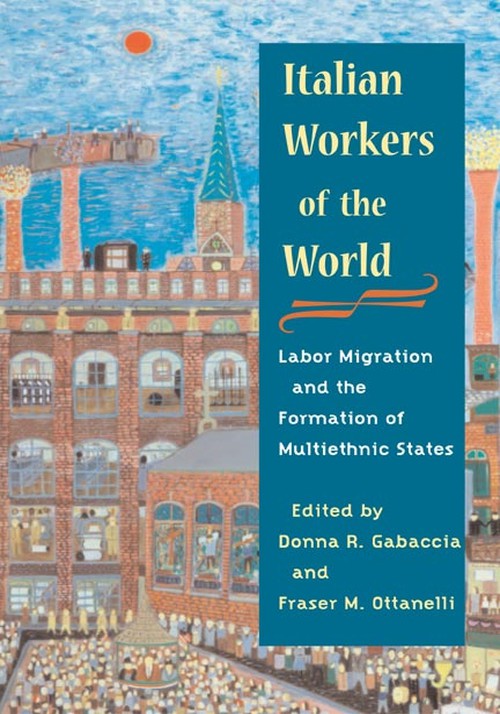
Donna R. Gabaccia
In Italian Workers of the World, a distinguished roster of contributors examines how the reception of immigrants in their new countries shaped their sense of national identity and shaped the multiethnic states where they settled. Argentina and Brazil welcomed Italian migrants as a civilizing influence, and these immigrant workers played an instrumental part in establishing and leading movements committed to labor internationalism. In the United States, by contrast, the American Federation of Labor's hostility to socialism, internationalism, and unskilled laborers fueled distrust and xenophobia that steered Italian immigrants into ethnically mixed unions like radical Industrial Workers of the World. Essays also focus on specific topics ranging from the work of republican Garibaldians in South America to antifascist currents among Italian migrants in France and the United States, and from a 1912 textile strike in Lawrence, Massachusetts, to Mussolini's invasion of Ethiopia.
examines how the reception of Italian immigrants in their new countries shaped their sense of national identity.
Donna R. Gabaccia
This ambitious and theoretically innovative overview examines the social, cultural and economic integration of Italian migrants. It explores their complex identity and their relationship with their homeland.
Introduction
1. Before Italians: Making Italian culture at home and abroad
2. Making Italians at home and abroad, 1790-1893
3. Workers of the World, 1870-1914
4. Transnationalism as a way of working-class life
5. Nationalism and internationalism in Italy's proletarian diasporas, 1870 - 1914
6. Nation, empire and diaspora: Fascism and its opponents
7. Postwar Italy: from sending to receiving Nation
8. Civilta italiana and the making of multi-ethnic nations
examines the social, cultural and economic integration of Italian migrants and their relationship with their homeland.