
Collections
Library
Type
Region
Coverage:
-
Published:
-
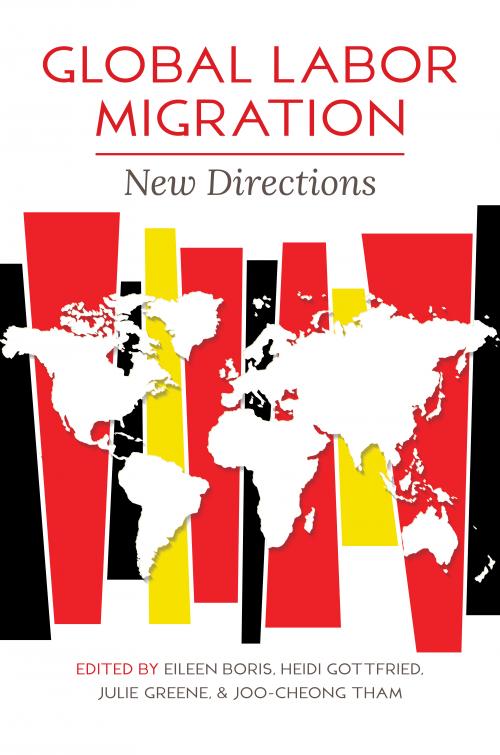
Eileen Boris, Heidi Gottfried, Julie Greene, Joo-Cheong Tham
Around the world, hundreds of millions of labor migrants endure exploitation, lack of basic rights, and institutionalized discrimination and marginalization. What factors created a system that forces this huge and growing mass of human beings to toil as an institutional and judicial lower caste? In what ways did labor migrants shape their living and working conditions in the past, and what opportunities exist for them today? Global Labor Migration presents new multidisciplinary, transregional perspectives on issues surrounding global labor migration. The essays go beyond disciplinary boundaries, with sociologists, ethnographers, legal scholars, and historians contributing research that extends comparison among and within world regions. Looking at migrant workers from the late nineteenth century to the present day, the contributors illustrate the need for broader perspectives that study labor migration over longer timeframes and from wider geographic areas. The result is a unique, much-needed collection that delves into one of the world's most pressing issues, generates scholarly dialogue, and proposes cutting-edge research agendas and methods"-- Provided by publisher
Looking at migrant workers from the late nineteenth century to the present day, the contributors illustrate the need for broader perspectives that study labor migration over longer timeframes and from wider geographic areas.
Eileen Boris, Jennifer Klein
Introduction: Making the private public
Neither nurses nor maids
Rehabilitative missions
Caring for the great society
Welfare wars, seventies style
"Take us out of slavery"
"The union is us"
"We were the invisible workforce"
Epilogue: Challenging care
Afterword: State power and the fate of home care organizing
rethinks both the history of the American welfare state from the perspective of care work and chronicles how home care workers eventually became one of the most vibrant forces in the American labor movement.
Eileen Boris, Nelson Lichtenstein
This text, designed for courses in US labor history or the history of American workers, presents a carefully selected group of readings that allow students to evaluate primary sources, test the interpretations of distinguished historians, and draw their own conclusions. Major Problems in the History of American Workers follows the proven Major Problems format, with 14-15 chapters per volume, a combination of documents and essays, chapter introductions, headnotes, and suggested readings.
designed for courses in US labor history, presents a carefully selected group of readings that allow students to evaluate primary sources
Eileen Boris,Cynthia R. Daniels
Homework clarifies the past and present of home-based labor using case studies which offer a rich portrait of homework. The authors recognize that we must examine the influence of gender, race, and class to fully comprehend the history of homework -- taken from back cover
clarifies the past and present of home-based labor using case studies which offer a rich portrait of homework.
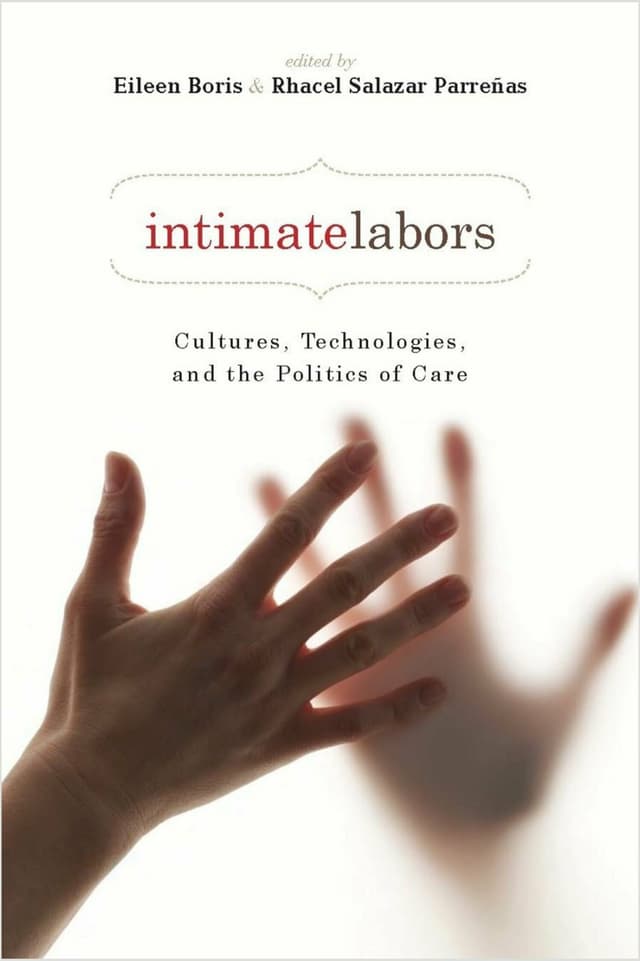
Eileen BorisRhacel Salazar Parreñas
This essay collection represents a stellar interdisciplinary contribution to research on work shaped by personal and emotional interaction. The essays embody the best quality of the work they explore--a thoughtful and discerning sensitivity to human need."-- --Book Jacket
Technologies of caring labor : from objects to affect / Ariel Ducey
The transmission of care : affective economies and Indian call centers / Kalindi Vora
Foreign and domestic : adoption, immigration, and privatization / Laura Briggs
Selling genes, selling gender : egg agencies, sperm banks, and the medical market in genetic material / Rene Almeling
Gender labor : transmen, femmes, and collective work of transgression / Jane Ward
Traveling cultures of servitude : loyalty and betrayal in New York and Kolkata / Seemin Qayum and Raka Ray
My reward is not money : deep alliances and the end of life care among Mexicana workers and their wards / Maria de la Luz Ibarra
Cultures of flirtation : sex and the moral boundaries of Filipina migrant hostesses in Tokyo / Rhacel Parreñas
Bounded authenticity and the commerce of sex / Elizabeth Bernstein
Economies of emotion, familiarity, fantasy, and desire : emotional labor in Ho Chi Minh City's sex industry / Kimberly Kay Hoang
Making home care : law and social policy in the U.S. welfare state / Eileen Boris and Jennifer Klein
Power, intimacy, and contestation : Dorothy Bolden and domestic worker organizing in Atlanta in the 1960s / Premilla Nadasen
Manicuring intimacies : inequality and resistance in nail salon work / Millian Kang
But who will care for the children? : organizing child care providers in the wake of welfare reform / Ellen Reese
Sex and (evacuation from) the city : the moral and legal regulation of sex workers in Vancouver's West End, 1975-1985 / Becki Ross
Caring everywhere / Viviana Zelizer
More intimate unions / Dorothy Sue Cobble
takes a close look at carework, domestic work, and sex work in everyday life and illuminates the juncture where money and intimacy meet.
Eileen J. Suárez Findlay
We Are Left without a Father Here is a transnational history of working people's struggles and a gendered analysis of populism and colonialism in mid-twentieth-century Puerto Rico. At its core are the thousands of agricultural workers who, at the behest of the Puerto Rican government, migrated to Michigan in 1950 to work in the state's sugar beet fields. The men expected to earn enough income to finally become successful breadwinners and fathers. To their dismay, the men encountered abysmal working conditions and pay. The migrant workers in Michigan and their wives in Puerto Rico soon exploded in protest. Chronicling the protests, the surprising alliances that they created, and the Puerto Rican government's response, Eileen J. Suárez Findlay explains that notions of fatherhood and domesticity were central to Puerto Rican populist politics. Patriarchal ideals shaped citizens' understandings of themselves, their relationship to Puerto Rican leaders and the state, as well as the meanings they ascribed to U.S. colonialism. Findlay argues that the motivations and strategies for transnational labor migrations, colonial policies, and worker solidarities are all deeply gendered."--Publisher's description
a transnational history of working people's struggles and a gendered analysis of populism and colonialism in mid-twentieth-century Puerto Rico
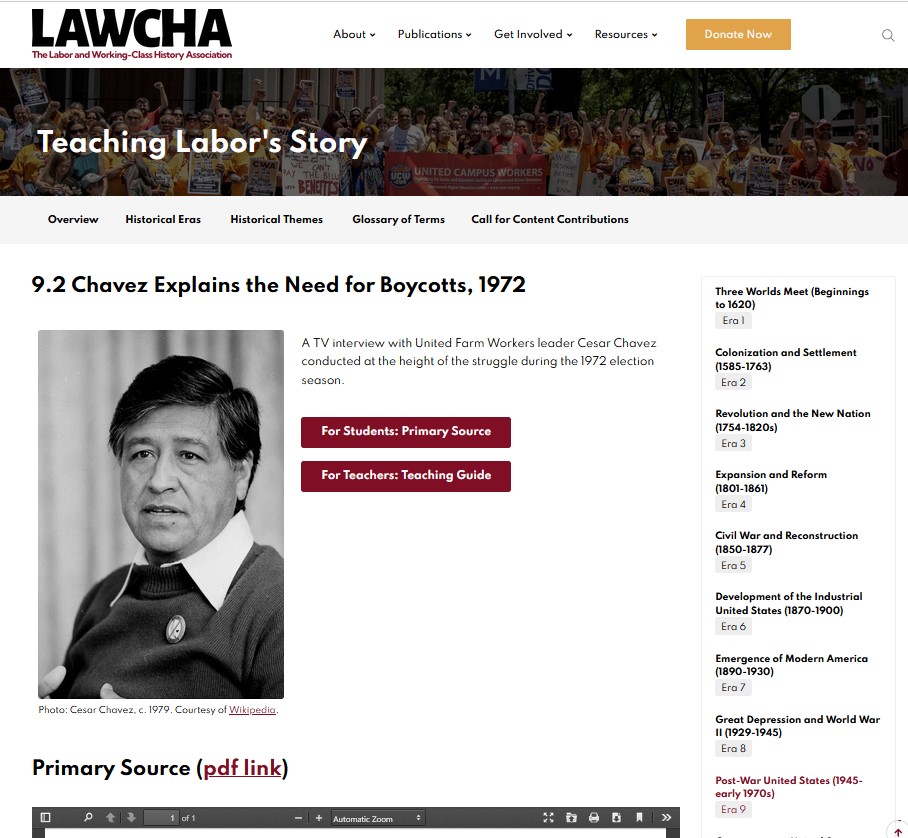
Eladio B. Bobadilla, Teaching Labor's Story
This news clip is from an interview with United Farm Workers [UFW] leader Cesar Chavez on the San Francisco Bay Area public TV station, KQED. It has an extensive teaching guide for teaching the clip.
The interview took place during therun-up to statewide and national elections that would be held the first week of November. Cesar Chavez, founder and long-time leader of the United Farm Workers [UFW] union,was a familiar name and faceatthe time of this interview. The second speaker,George McGovern, was also well known. He was a U.S. Senator from South Dakota and,most importantly, the Democratic Party candidate for U.S. President.Viewers would have been well aware of the upcoming election and trying to decide how to vote on the statewide ballot measure, Proposition 22. Proposition 22 wasmodeled on a recently passed Arizona law; if passed it would outlawsome of the UFW’s primary organizing strategies, including contacting workers in the fields, picketing growers and retailers, and calling for consumer boycotts.
A TV interview with United Farm Workers leader Cesar Chavez conducted at the height of the struggle during the 1972 election season. Teaching Guide included.

Elfido López, History Matters
The arrival of the railroad in the Southwest in the early 1870s transformed the area’s economy and the lives of its residents. Long-time Mexican residents of the area were quickly drawn into the region’s expanding wage economy. In this selection from his handwritten memoir from 1937 Elfido López recalled his childhood on his family’s modest homestead and his father’s decision to move the family to a small railroad town, and a life of wages, in southern Colorado in 1876.
A selection from the 1937 handwritten memoir of Elfido López, whose father moved their family from a homestead to waged lives in a small Colorado railroad town.
Eli Cook
How did Americans come to quantify their society's progress and well-being in units of money? In today's GDP-run world, prices are the standard measure of not only our goods and commodities but our environment, our communities, our nation, even our self-worth. The Pricing of Progress traces the long history of how and why we moderns adopted the monetizing values and valuations of capitalism as an indicator of human prosperity while losing sight of earlier social and moral metrics that did not put a price on everyday life.
Cook roots the rise of economic indicators in the emergence of modern capitalism and the contested history of English enclosure, Caribbean slavery, American industrialization, economic thought, and corporate power. He explores how the maximization of market production became the chief objective of American economic and social policy.
We see how distinctly capitalist quantification techniques used to manage or invest in railroad corporations, textile factories, real estate holdings, or cotton plantations escaped the confines of the business world and seeped into every nook and cranny of society. As economic elites quantified the nation as a for-profit, capitalized investment, the progress of its inhabitants, free or enslaved, came to be valued according to their moneymaking abilities. Today as in the nineteenth century, political struggles rage over who gets to determine the statistical yardsticks used to gauge the "health" of our economy and nation. The Pricing of Progress helps us grasp the limits and dangers of entrusting economic indicators to measure social welfare and moral goals.-- Provided by publisher
How did Americans come to quantify their society's progress and well-being in units of money?
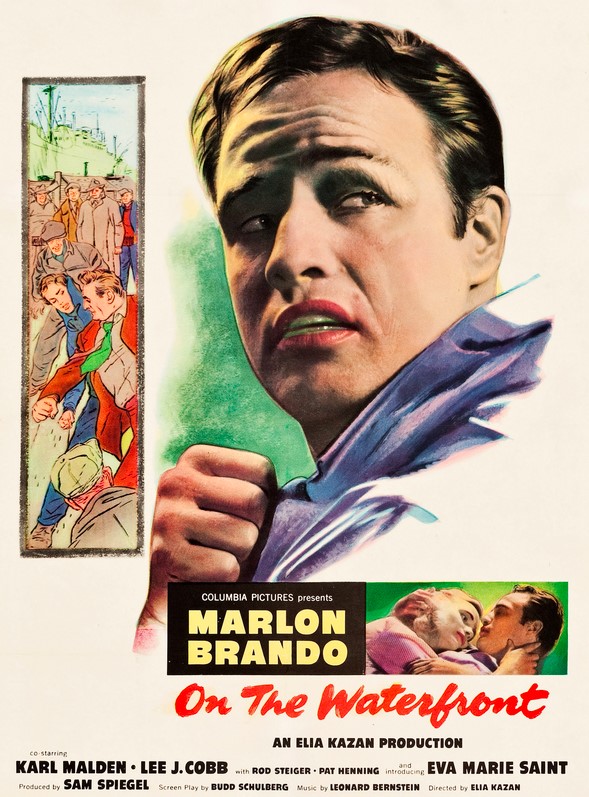
Elia Kazan
organized crime’s control of a longshoreman’s union in New York during the 1950s. Heroes break the community’s code of silence to stand up to the gangsters and expose the murder of a friend. The script was adapted from “Crime on the Waterfront,” a Pulitzer prize-winning newspaper expose written by Terry Malcom and published in the New York Sun. The director, Elia Kazan is famously attempting to justify his testimony befor the House UnAmerican Activities Committee, where he betrayed long friendships.
From John Bodnar, Working Class Hollywood:
In On the Waterfront, dishonest practices by hoods who extort kickbacks for jobs is finally eliminated
by the heroic action of Terry Malloy, Brando’s character, who decides
to break a code of silence that pervades his culture and inform police
on such illegal practices. Scholars ever since have interpreted this act as
a symbolic defense of Kazan’s own act of naming Hollywood subversives
in front of the House Un-American Activities Committee in 1952.
The origins of the story itself
go back to Kazan’s collaboration with Arthur Miller on another project of
waterfront workers that sought to expose the way they were victimized
and the efforts of some of them to resist the methods of racketeers. Malloy
is also much more complex than a mere informer. He is a working
male in postwar culture struggling with both the hand society has dealt
him and his inner emotions. He is both violent and tender, victim and
hero, and as such he is inscribed by the contesting cultural discourses of
cynicism and hope that may have been as influential in molding the postwar
world as those that focused intently on communism and capitalism.
If he stood as a rationale for informing, he also exemplified the difficulties
of finding a way out of a turbulent world and of living without any
real expectations of material improvement.
In preparing to film the story in 1953, Kazan prepared notes for Brando
that told the actor to consider Malloy the opposite of Kowalski. Kazan
A film based on the New York Sun expose written by investigative journalist Malcolm Johnson; the film portrays organized crime intereference in a New York longshoreman union and violence against its members.
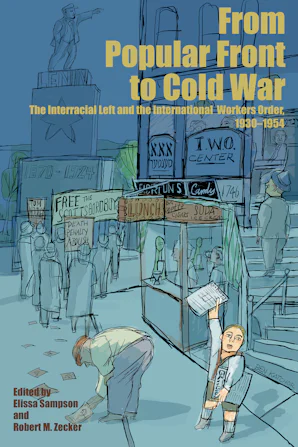
Elissa Sampson, Robert M. Zecker
From Popular Front to Cold War tells the story of the International Workers Order (IWO), an organization founded in 1930 to provide life, burial, and health insurance to its members. But as the essays gathered by Elissa Sampson and Robert M. Zecker, eds. make clear, the IWO broadened its mission to promote interracial solidarity, support labor unions, combat racism and antisemitism, and champion progressive social programs from the Great Depression into the postwar era.
At its height, the IWO had almost two hundred thousand members drawn from a broad ethnic and racial spectrum of the working class—Jews, Blacks, Poles, Slovaks, Italians, Hispanics, and others. It operated summer camps, published foreign-language newspapers, and supported a wide range of cultural activities. An early advocate for the United States' entry into World War II, the IWO was also ahead of its time in championing the nascent civil rights movement. After the war, it was declared a subversive organization due to its ties to the Communist Party and disbanded in 1954, though its legacy as a model for working-class cooperation across racial and ethnic differences endures to this day.
Contributors: Felicia Bevel, Paul Buhle, Matthew Calihman, Annabel Gottfried Cohen, Dylan Kaufman-Obstler, Paul C. Mishler, Ben Ratskoff, Elissa Sampson, Henry Srebrnik, Lauren B. Strauss, Nerina Visacovsky, Jennifer Young, Robert M. Zecker
1. Forging Jewish Unity in Wartime Platforms
2. The Jewish Workers University: Yiddish Communist Education
3. Portrait of a Radical: June Gordon, the Emma Lazarus Clubs, and Communist Jewish Women's Activism 1920-1970
4. A Tale of Two Revisions: The Color Line and the Jewish Problem, From Galicia to Dougherty County
5. Langston Hughes and the International Workers Order
6. Staging the Interracial Left: Paul Robeson, Black Artistry and the International Workers Order
7. Fighting for Black Rights Through the Fraternal Arena: Louise Thompson Patterson in the International Workers Order
8. Di progressive: YKUF in Argentina and South America
9. A Constellation of One's Own: Canadian Jewish Communists & their Mass Organizations
10. "Dancing at Two Weddings": Radical Jewish Artists and their Relationship to Yiddishkayt from the Popular Front to the Post-War Era
11. "We'll stay here 'til the fascist tomb is made" – the IWO and the International Brigade
12. "A Fraternal Order Sentenced to Death":: The Legal Persecution of the International Workers Order
13. From Many Roots, One Tree: Jews and the Origins of Multi-Ethnic Communism in the U.S., 1921-1972
An early advocate for the United States' entry into World War II, the IWO was also ahead of its time in championing the nascent civil rights movement.
Elizabeth A. Fones-Wolf
The post-World War II years in the United States were marked by the business community's efforts to discredit New Deal liberalism and undermine the power and legitimacy of organized labor.
In Selling Free Enterprise, Elizabeth Fones-Wolf describes how conservative business leaders strove to reorient workers away from their loyalties to organized labor and government, teaching that prosperity could be achieved through reliance on individual initiative, increased productivity, and the protection of personal liberty. Based on research in a wide variety of business and labor sources, this detailed account shows how business permeated every aspect of American life, including factories, schools, churches, and community institutions.
shows how business permeated every aspect of American life, including factories, schools, churches, and community institutions.
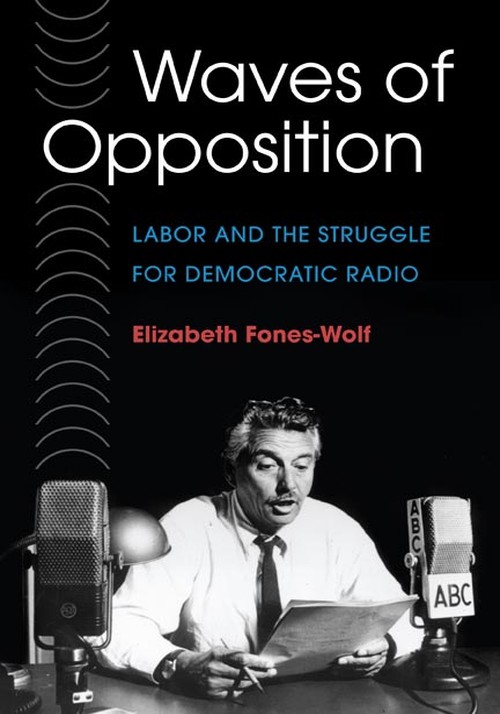
Elizabeth A. Fones-Wolf
Describes and analyzes the battles over the powerful medium of radio, which helped spark the massive upsurge of organized labor during the Depression. Organized chronologically, this work explores the advent of local labor radio stations such as WCFL and WEVD, labor's anti-censorship campaigns, and unionist experiments with early FM broadcasting.Putting class on the air : initial forays into labor and business broadcasting
Labor radio : a catalyst for social change in Depression-era America
Codes of silence : censoring labor on the airwaves
"The air belongs to the people" : breaking the NAB code
Protecting listeners' rights : radio reform, 1945-48
Competing voices : business and labor in local postwar broadcasting
Union voices in a "wilderness of conservatism."
the battles over the powerful medium of radio, which helped spark the massive upsurge of organized labor during the Depression.
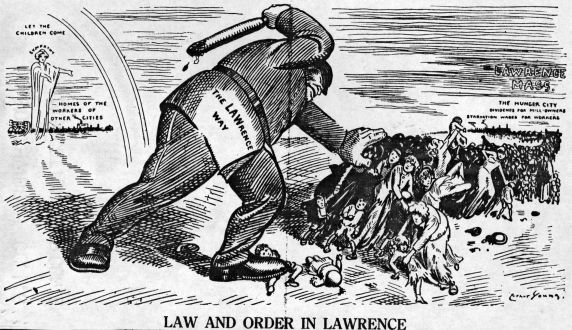
Elizabeth Clemens
This essay links to multiple images and materials in the Reuther Library, including photos, documents digitally available. https://reuther.wayne.edu/taxonomy/term/12 To understand the importance of the strike one must understand the conditions of the time. Lawrence, Massachusetts was an immigrant city, with the majority of its population being foreign born. Workers from Eastern Europe, the Middle East, Italy, Germany, Portugal and French Canada packed into Lawrence’s crowded slums. The average wage of $8.76 per week was consumed by housing costs, which were the highest on the East Coast. The life expectancy for workers and their families was among the worst in the nation. A study by a Lawrence physician, Dr. Elizabeth Shapleigh, determined that 36 out of 100 workers in the Lawrence mills died by the age of 25 and 50% of the children born to workers died before the age of six. Over 50% of the workers in the mills were women and children, working out of financial necessity.The Reuther Library has numerous resources that document the events of the Lawrence Textile Strike. Within the IWW Records one will find, among other treasures, transcripts from the trials of Ettor and Giovannitti as well as a final report on the strike. For the IWW’s account of the strike as it happened, consult their newspaper Solidarity, which is available on microfilm for research use. For a look at the strike through the eyes of one of its organizers, the William E. Trautmann Papers provide a unique view of the events. The papers of the journalist and social critic Mary Heaton Vorse examine both the Lawrence Strike and the topic of child labor in the United States. An arresting, firsthand account of the evacuation of the children, conditions in Lawrence under Marshall Law and the leading personalities of the strike is found within Ms. Vorse’s memoir “A Footnote to Folly,” whose chapter on the Lawrence Strike originally appeared as an article in Harpers Weekly. Another perspective can be found in the papers of Matilda Robbins, a writer and organizer for the IWW from 1912 until her death in 1963. To better understand the working conditions in the textile mills at the turn of the last century, stills from photographer Lewis Hine are available by appointment. Finally, the IWW web gallery has a number of images from the event.
A digital essay introducing the Lawrence strike, with links to some digital photos
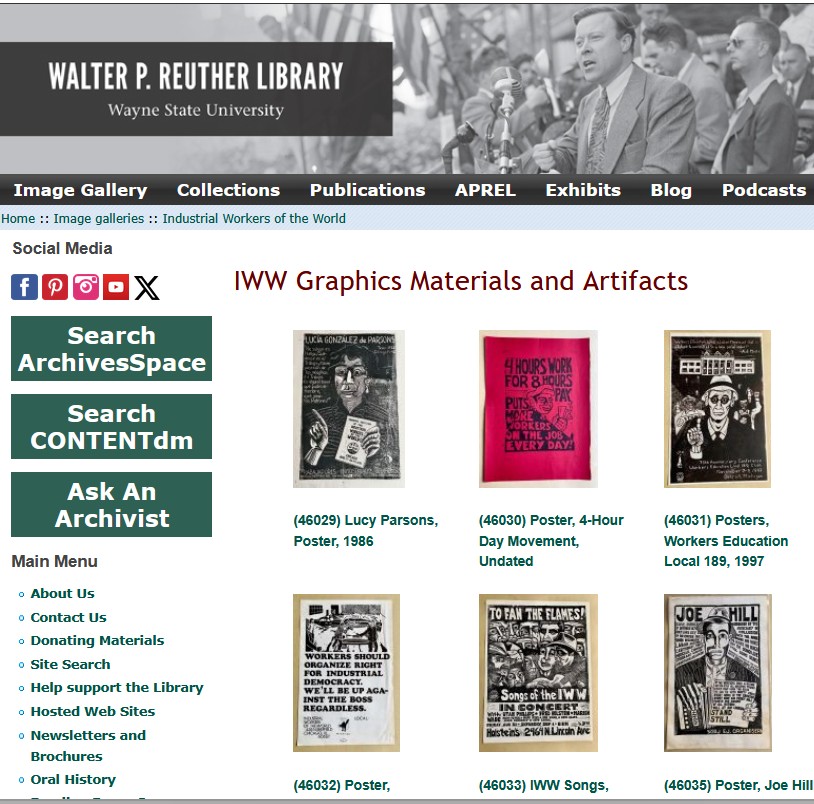
Elizabeth Clemens, Reuther Library
Snapshots of select graphic materials and artifacts from the Industrial Workers of the World (IWW) Audio-Visual Materials. Includes posters, sheet music, textiles, and objects.
Snapshots of select graphic materials and artifacts from the Industrial Workers of the World
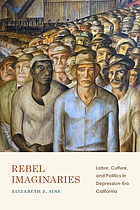
Elizabeth E. Sine
Amid the global catastrophe of the Great Depression, California became a wellspring for some of the era's most inventive and imaginative political movements. As devastation deepened worldwide, the multiracial laboring populations who formed the basis of California's economy gave rise to an oppositional culture that challenged the modes of racialism, nationalism, and rationalism that guided modernization during preceding decades. From the upsurge of rural agricultural strike activity in 1930 to the acceleration of urban defense mobilization upon U.S. entry into the Second World War in 1941, Rebel Imaginaries tells the story of that oppositional culture's emergence, examines its major contours, and illuminates how it impacted the lives of those involved.
tells the story of an oppositional culture's emergence, examines its major contours, and illuminates how it impacted the lives of those involved
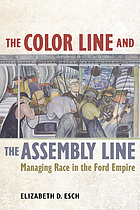
Elizabeth Esch
The Color Line and the Assembly Line tells a new story of the impact of mass production on society. Global corporations based originally in the United States have played a part in making gender and race everywhere. Focusing on Ford Motor Company's rise to become the largest, richest, and most influential corporation in the world, The Color Line and the Assembly Line takes on the traditional story of Fordism. Contrary to popular thought, the assembly line was perfectly compatible with all manner of racial practice in the United States, Brazil, and South Africa. Each country's distinct racial hierarchies in the 1920s and 1930s informed Ford's often divisive labor processes. Confirming racism as an essential component in the creation of global capitalism, Elizabeth Esch also adds an important new lesson showing how local patterns gave capitalism its distinctive features"--Provided by publisher
Integrates analysis of global racial hierarchies into the history of the assembly line, and the rise of the Ford Motor Co.
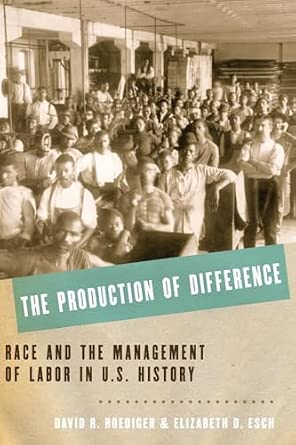
Elizabeth Esch, David R. Roediger
"In this eye-opening book, David Roediger and Elizabeth Esch offer a radically new way of understanding the history of management in the United States, placing race, migration, and empire at the center of what has sometimes been narrowly seen as a search for efficiency and economy. Ranging from the antebellum period to the coming of the Great Depression, the book examines the extensive literature slave masters produced on how to manage and "develop" slaves; explores what was perhaps the greatest managerial feat in U.S. history, the building of the transcontinental railroad, which pitted Chinese and Irish work gangs against each other; and concludes by looking at how these strategies survive today in the management of hard, low-paying, dangerous jobs in agriculture, military support, and meatpacking. Roediger and Esch convey what slaves, immigrants, and all working people were up against as the objects of managerial control. Managers explicitly ranked racial groups, both in terms of which labor they were best suited for and their relative value compared to others. The authors show how whites relied on such alleged racial knowledge to manage and believed that the "lesser races" could only benefit from their tutelage. These views wove together managerial strategies and white supremacy not only ideologically but practically, every day at workplaces. Even in factories governed by scientific management, the impulse to play races against each other, and to slot workers into jobs categorized by race, constituted powerful management tools used to enforce discipline, lower wages, keep workers on dangerous jobs, and undermine solidarity."--Publisher's description
examines the extensive literature slave masters produced on how to manage and "develop" slaves; explores what was perhaps the greatest managerial feat in U.S. history, the building of the transcontinental railroad.

Elizabeth Faue
Elizabeth Faue traces the transformation of the American labor movement from community forms of solidarity to bureaucratic unionism. Arguing that gender is central to understanding this shift, Faue explores women’s involvement in labor and political organizations and the role of gender and family ideology in shaping unionism in the twentieth century. Her study of Minneapolis, the site of the important 1934 trucking strike, has broad implications for labor history as a whole. Initially the labor movement rooted itself in community organizations and networks in which women were active, both as members and as leaders. This community orientation reclaimed family, relief, and education as political ground for a labor movement seeking to re-establish itself after the losses of the 1920s. But as the depression deepened, women — perceived as threats to men seeking work — lost their places in union leadership, in working-class culture, and on labor’s political agenda. When unions exchanged a community orientation for a focus on the workplace and on national politics, they lost the power to recruit and involve women members, even after World War II prompted large numbers of women to enter the work force. In a pathbreaking analysis, Faue explores how the iconography and language of labor reflected ideas about gender. The depiction of work and the worker as male; the reliance on sport, military, and familial metaphors for solidarity; and the ideas of women’s place — these all reinforced the representation of labor solidarity as masculine during a time of increasing female participation in the labor force. Although the language of labor as male was not new in the depression, the crisis of wage-earning — as a crisis of masculinity — helped to give psychological power to male dominance in the labor culture. By the end of the war, women no longer occupied a central position in organized labor but a peripheral one.
Traces the transformation of the American labor movement from community forms of solidarity to modern bureaucratic unionism, arguing that gender is central to understanding this shift.
Elizabeth Faue
"Elizabeth Faue reconsiders the varied strains of the labor movement, situating them within the context of rapidly transforming twentieth-century American society to show how these efforts have formed a political and social movement that has shaped the trajectory of American life. Rethinking the American Labor Movement is indispensable reading for scholars and students interested in American labor in the twentieth century and in the interplay between labor, wealth, and power."
Origins of Modern Trade Unionism
Insurgent Labor, 1905-1922
Rebuilding the Movement, 1922-1945
Stability and Retreat, 1945-1960: Labor's "Men of Power," the Cold War, and the State
Lost Opportunities, 1961-1981: Labor, New Social Movements, and Economic Change
Labor's Strengths and Weaknesses, 1981-Present
Conclusion: The Legacy of Labor in American Politics.
reconsiders the labor movement, situating them within the context of transforming twentieth-century American society to show how these efforts have formed a political and social movement that has shaped the trajectory of American life.

Elizabeth Fones-Wolf, Ken Fones-Wolf
In 1946, the Congress of Industrial Organizations (CIO) undertook Operation Dixie, an initiative to recruit industrial workers in the American South. Elizabeth and Ken Fones-Wolf plumb rarely used archival sources and rich oral histories to explore the CIO's fraught encounter with the evangelical Protestantism and religious culture of southern whites.
The authors' nuanced look at working-class religion reveals how laborers across the surprisingly wide evangelical spectrum interpreted their lives through their faith. Factors like conscience, community need, and lived experience led individual preachers to become union activists and mill villagers to defy the foreman and minister alike to listen to organizers. As the authors show, however, all sides enlisted belief in the battle. In the end, the inability of northern organizers to overcome the suspicion with which many evangelicals viewed modernity played a key role in Operation Dixie's failure, with repercussions for labor and liberalism that are still being felt today.
Identifying the role of the sacred in the struggle for southern economic justice, and placing class as a central aspect in southern religion, Struggle for the Soul of the Postwar South provides new understandings of how whites in the region wrestled with the options available to them during a crucial period of change and possibility.
Religion's role in the ill-fated struggle to unionize white workers in the South

Elizabeth Grennan Browning
The untold history of how Chicago served as an important site of innovation in environmental thought as America transitioned to modern, industrial capitalism. In Nature's Laboratory, Elizabeth Grennan Browning argues that Chicago--a city characterized by rapid growth, severe labor unrest, and its position as a gateway to the West--offers the clearest lens for analyzing the history of the intellectual divide between countryside and city in the United States at the end of the nineteenth century. By examining both the material and intellectual underpinnings of Gilded Age and Progressive Era environmental theories, Browning shows how Chicago served as an urban laboratory where public intellectuals and industrial workers experimented with various strains of environmental thinking to resolve conflicts between capital and labor, between citizens and their governments, and between immigrants and long-term residents. Chicago, she argues, became the taproot of two intellectual strands of American environmentalism, both emerging in the late nineteenth century: first, the conservation movement and the discipline of ecology; and second, the sociological and anthropological study of human societies as "natural" communities where human behavior was shaped in part by environmental conditions. Integrating environmental, labor, and intellectual history, Nature's Laboratory turns to the workplace to explore the surprising ways in which the natural environment and ideas about nature made their way into factories and offices--places that appeared the most removed from the natural world within the modernizing city. As industrialization, urbanization, and immigration transformed Chicago into a microcosm of the nation's transition to modern, industrial capitalism, environmental thought became a protean tool that everyone from anarchists and industrial workers to social scientists and business managers looked to in order to stake their claims within the democratic capitalist order. Across political and class divides, Chicagoans puzzled over what relationship the city should have with nature in order to advance as a modern nation. Browning shows how historical understandings of the complex interconnections between human nature and the natural world both reinforced and empowered resistance against the stratification of social and political power in the city"-- Provided by publisher
argues that Chicago--a city characterized by rapid growth, severe labor unrest, and its position as a gateway to the West--offers the clearest lens for analyzing the history of the intellectual divide between countryside and city in the United States at the end of the nineteenth century.
Elizabeth Jameson
At the turn of the century, Colorado's Cripple Creek District captured the national imagination with the extraordinary wealth of its gold mines and the unquestionable strength of the militant Western Federation of Miners. In All That Glitters, Elizabeth Jameson tells the better-than-fiction story of Cripple Creek, the scene in 1894 of one of radical labor's most stunning victories and in 1903-4 of one of its most crushing defeats. Jameson's sources include working-class oral histories, the Victor and Cripple Creek Daily Press, published by thirty-four of the local labor unions, and the 1900 manuscript census. She connects unions with lodges and fraternal associations, ethnic identity, families, households, and partisan politics. Through these ties, she probes the differences in age, skill, gender, marital status, and ethnicity that strained working-class unity and contributed to the fall of labor in Cripple Creek. Jameson's book will be required reading for western, ethnic, and working-class historians seeking an alternative interpretation of western mining struggles that emphasizes class, gender, and multiple sources of social identity
probes the differences in age, skill, gender, marital status, and ethnicity that strained working-class unity and contributed to the fall of labor in Cripple Creek.

Elizabeth McKillen
In this intellectually ambitious study, Elizabeth McKillen explores the significance of Wilsonian internationalism for workers and the influence of American labor in both shaping and undermining the foreign policies and war mobilization efforts of Woodrow Wilson's administration. During his presidency, Wilson contended with strong anti-imperialist and antiwar currents that coursed through the U.S. labor movement as well as revolutionary upheavals and labor unrest abroad that undermined his diplomatic initiatives. McKillen highlights the major fault lines that emerged within labor circles as Wilson pursued his agenda in the context of Mexican and European revolutions, World War I, and the Versailles Peace Conference.
McKillen's spotlight falls particularly on the American Federation of Labor, whose leadership collaborated extensively with Wilson, assisting with propaganda, policy, and diplomacy. AFL founder Samuel Gompers eventually served as an advisor to the Wilson administration at Versailles and played a leading role in shaping the peace treaty's labor provisions and constructing the International Labor Organization. At the same time, McKillen asserts, other labor groups (and even sub-groups within the AFL) vehemently opposed Wilsonian internationalism. Abroad, the Wilsonian vision faced challenges from both European labor moderates and communists. Among U.S. groups, particularly effective opposition came from the U.S. Socialist Party, which framed the debate over democratic control of industry as an anti-war and anti-imperialist issue. Irish Americans and German Americans, spurred by European labor leaders and seeking support for revolution in their homelands, also joined sides against Wilson, as did the IWW and left-leaning African American and women workers.
Even as the AFL leadership toiled on Wilson's behalf, a shifting coterie of these oppositional groups mounted sophisticated critiques. They deconstructed propaganda, staged strikes, and built surprising political alliances; ultimately, they undermined Wilson's agenda to the point that he was unable to realize some of his dearest international ambitions. As McKillen shows, the choice to collaborate with or resist US foreign policy remained an important one for labor throughout the twentieth century. In fact, it continues to resonate today in debates over the global economy, wars in Iraq and Afghanistan, and the impact of US policies on workers at home and abroad.
Labor's contentious response to Woodrow Wilson's international agenda

Elizabeth Quinlan
All miners and smelter workers know the folly of going on strike when their employer holds a stockpile. In 1958 the International Nickel Company had enough nickel on hand to guarantee sales for at least six months. Despite this, fourteen thousand miners and smeltermen in Sudbury, Ontario, downed their tools and struck against the corporate titan of the mining industry.
Standing Up to Big Nickel is a comprehensive portrait of a pivotal strike by the International Union of Mine, Mill, and Smelter Workers, a union that has inspired exceptional levels of solidarity among its members. The Cold War and the resulting instabilities in the Canadian labour movement form the backdrop to Elizabeth Quinlan’s engrossing analysis. The union straddled the line, she shows, between its historical commitment to working-class struggle and the newly restrictive legal landscape of the postwar era. Retrospective accounts by surviving union members, leaders, family, and community members bring to life the history of a distinctive group of workers who sweated over smelter furnaces and toiled underground in perilous conditions.
Quinlan traces the events before, during, and after one of Canada’s greatest strikes in both magnitude and duration. Featuring biographical sketches and scenes based on archival and documentary data, Standing Up to Big Nickel captures an intensely dramatic juncture in Canadian labour history.
Table of Contents
Figures vii
Preface ix
Acknowledgments xix
1 A Mining Industry on the Rise 3
2 Union Advances in the Mining Camps of Northern Ontario 13
3 Building a Working-Class Culture and Establishing a Canadian Identity 29
4 Inco and Mine Mill Come to the Bargaining Table 42
5 Bargaining Breaks Down 58
6 On Strike – Respect Our Picket Line 78
7 “Any Goddamn Fool Can Call a Strike; the Secret Is to Get a Settlement” 100
8 The “Damn Devil’s Brew” 127
9 The Significance of the Inco Strike 145
Notes 153
Select Bibliography 189
Index 197
a pivotal strike by the International Union of Mine, Mill, and Smelter Workers
Museum/Exhibits
Tours
Maps
Digital Projects
Organizations
Sites
Film/Video
Audio/Interview
Podcast/Program
Text/Document
Image
Graphs/Data
Timeline
Southwest
West
Midwest
Southeast
Northeast
Mexico
Canada
Global
Books
Teaching
Lectures
Digital Archives
Journals
Bibliographies
Topic Intro