


Collections
Library
Type
Region
Coverage:
-
Published:
-
Eric Arnesen
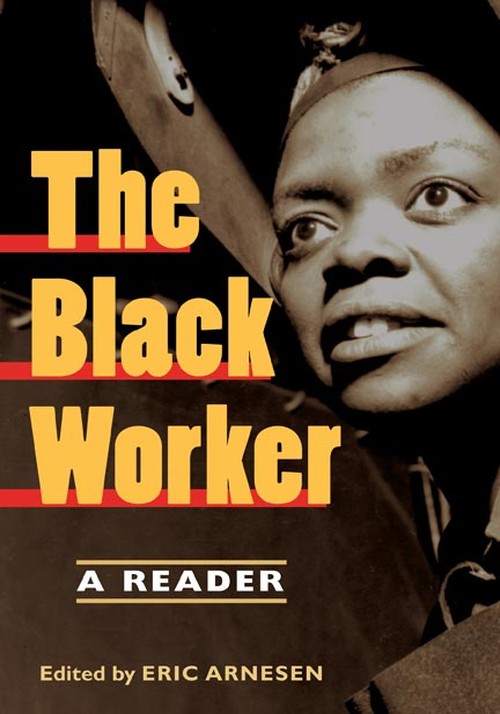
Contains eleven essays that address issues faced by African-American workers since the late-nineteenth century, such as economic insecurity, the rise and fall of NAACP, and the civil rights movement.
Long before the modern civil rights movement of the 1950s and 1960s made a frontal assault on the reigning segregationist order, African American workers had to struggle against both their employers and fellow white workers. Because their efforts to secure their workplace rights pitted them against the broader structures of racial oppression, their activism constituted nothing less than a form of civil rights struggle.
Uniting the latest scholarship on race, labor, and civil rights, The Black Worker aims to establish the richness of the African American working-class experience, and the indisputable role of black workers in shaping the politics and history of labor and race in the United States.
To capture the complexity of African Americans’ experiences in the workplace, this reader examines workers engaged in a wide array of jobs, including sharecropping, coal mining, domestic service, longshoring, automobile manufacturing, tobacco processing, railroading, prostitution, lumbering, and municipal employment. The essays’ subjects include black migration, strikebreaking, black conservatism, gender, and the multiple forms of employment discrimination in the South and North. Other contributions deal explicitly with state policy and black workers during the transition from slavery to freedom, World Wars I and II, and the 1960s.
The variety of challenges made by these workers, both quiet and overt, served as clear reminders to the supporters of white supremacy that, despite their best efforts through violence, fraud, and the law, as long as they insisted on racial inequality, the “race question” would never be fully resolved.
CONTRIBUTORS: Eric Arnesen, Beth Tompkins Bates, Cynthia M. Blair, Tera W. Hunter, William Powell Jones, Brian Kelly, Robert Korstad, Nelson Lichtenstein, Joseph A. McCartin, Steven A. Reich, Leslie A. Schwalm, Nan Elizabeth Woodruff
eleven essays that address issues faced by African-American workers since the late-nineteenth century.
Eric Arnesen
Assembles biographical stories of famous leaders and unknown activists, covering the 18th century up to 1970. Relates to enslaved artisans, interracial unionism, immigration, Jewish radicalism and gender, the New Black Politics, reverse migration in World War II, the United Farm Workers Union, etc
Mary Hale and Ann Edmonds : gender, women's work, and health in colonial Massachusetts / Rebecca Tannenbaum
-- Gabriel's conspiracy and the lives of enslaved artisans in Richmond, Virginia / James Sidbury --
Sarah Bagley : laboring for life / Terry Murphy
-- Beeswax Taylor and the forgotten legacy of labor insurgency in gilded age America / Paul Krause
-- William R. Riley and the limits of interracial unionism in the late nineteenth century South / Karin Shapiro
-- Eugene Debs : from conservative unionist to American socialist / Colin Davis
-- Pauline Newman : immigration, Jewish radicalism, and gender / Annelise Orleck
-- Karl Yoneda : radical organizing and Asian American labor / Chris Friday
-- "With God on our side" : James Evans, religion, and working-class protest in the new South / Bryant Simon
-- A. Philip Randolph : labor and the new black politics / Eric Arnesen -
- The unusual journey of Vernon Lawhorn, Thomas James Buchner, and the Green brothers : reverse migration in World War II / Risa Goluboff
-- "My own life's worth" : Dolores Huerta and the United Farm Workers Union / Margaret Rose -
- Walter Reuther and the promise of modern America / Kevin Boyle.
Assembles biographical stories of famous leaders and unknown activists.
Eric Arnesen
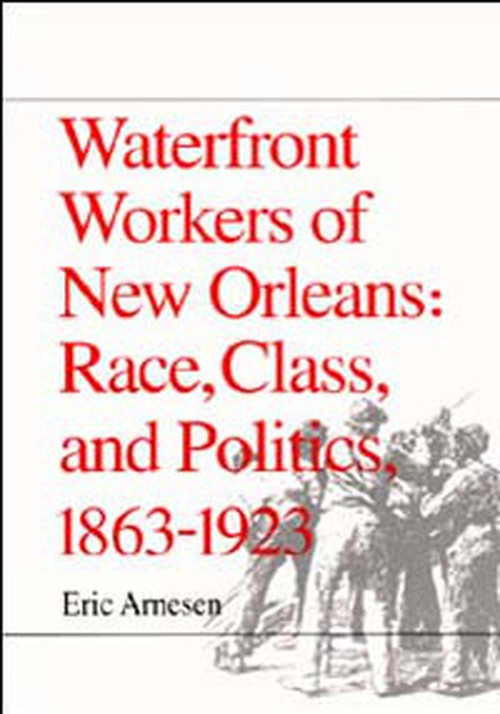
Eric Arnesen examines the diverse group of 10,000 to 15,000 cotton screwmen, longshoremen, cotton and round freight teamsters, cotton yardmen, railroad freight handlers, and Mississippi River roustabouts that formed the backbone of the Crescent City's trade and economic life. These workers forged a degree of inter-racial unity that defied white supremacist, anti-labor political climate to achieve genuine unity in struggle, even as they maintained separate locals. They created bi-racial union federations such as the waterfront workers’ Cotton Men’s Executive Council, whichl shared out jobs among black and white workers and black and white delegates negotiated jointly with the employers to maintain uniform work rules and rates.Given that Louisiana politics, which were deeply reactionary. New Orleans General strike of 1892 and another major strike in 1907 as turning points
Frontmatter
1. The Remaking of a Union State: Labor and Politics in the Early Reconstruction Era (page 3)
2. "Raising an Arm in Defense of their Cause:" The Emergence of the Labor Question (page 34)
3. Testing the Limits: Politics, Race and the Labor Movement (page 74)
4. Turning Points: Biracial Unions in the Age of Segregation, 1893-1901 (page 119)
5. To Rule or Ruin: The Struggle for Control in the Early Twentieth Century (page 160)
6. The Search for Stability: The Crisis of Labor Relations in the Era of the First World War (page 204)
Epilogue (page 253)
the extraordinary attempt at solidarity in the labor movement in the South's most reactionary state
Eric Arnesen, Julie Greene, Bruce Laurie, eds
anthology in honor of David Montgomery
Preface xi Introduction 1 Julie Greene, Bruce Laurie, and Eric Arnesen
Part 1: Politics and the State 1. Land and Freedom: The New York Anti-Rent Wars and the Construction of Free Labor in the Antebellum North 19 Reeve Huston
2. The "Fair Field" of the "Middle Ground": Abolitionism, Labor Reform, and the Making of an Antislavery Bloc in Antebellum Masschusetts 45 Bruce Laurie
3. Dinner-Pail Politics: Employers, Workers, and Partisan Culture in the Progressive Era 71 Julie Greene
4. Class Wars: Frank Walsh, the Reformers, and the Crisis of Progressivism 97 Shelton Stromquist
5. The Workers' State: Municipal Policy, Class, and Taxes in the Early Depression 125 Cecelia F. Bucki
Part 2: Class and Culture
6. "Work That Body": African-American Women, Work, and Leisure in Atlanta and the New South 153 Tera W. Hunter
7. Mobilizing Community: Migrant Workers and the Politics of Labor Mobility in the North American West, 1900-1920 175 Gunther Peck
8. Popular Narrative and Working-Class Identity: Alexander Irvine's Early Twentieth-Century Literary Adventures 201 Kathryn J. Oberdeck
9. Making a Church Home: African-American Migrants, Religion, and Working-Class Activism 230 Kimberley L. Phillips
Part 3: Labor Activism and Workers' Organizations
10. "To Sit among Men": Skill, Gender, and Craft Unionism in the Early American Federation of Labor 259 Ileen A. DeVault
11. Charting an Independent Course: African-American Railroad Workers in the World War 1 Era 284 Eric Arnesen
12. Boring from Within and Without: William Z. Foster, the Trade Union Educational League, and American Communism in the 1920s 209 James R. Barrett
13. The Dynamics of "Americanization": The Croatian Fraternal Union between the Wars, 1920s-30s 340 Peter Rachleff Contributors 363 Index 367
These thirteen essays delve into subjects like migrant labor, religion, ethnicity, agricultural history, and gender.
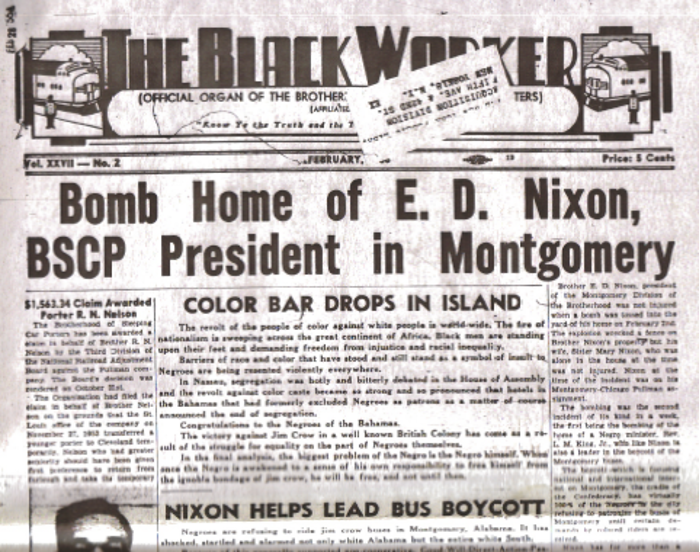
Eric Arnesen, Teamsters
"Anyone familiar with the labor movement today knows that organized labor is a heterogeneous group – African Americans, Latinos, Asians and Asian Americans, whites, men and women, citizens and undocumented workers all make up the ranks of the unions affiliated with Change to Win and the AFL-CIO. There is no question that the American labor force is characterized by unprecedented diversity – and, not surprisingly, organized labor is as well. In recent years, the labor movement has come to embrace and, to an unprecedented degree, champion racial and gender equality, often putting it at the forefront of movements for equality and civil rights in the United States. And that connection – labor and civil rights – has deep historical roots."
[Text continues at link...]
An International Brotherhood of Teamsters-sponsored article on the relationship between the civil rights and labor movements in the United States.
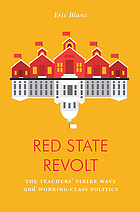
Eric Blanc
An indispensable window into the changing shape of the American working class and American politics After nearly four decades of labour quiescence, the US was hit by a wave of strikes in early 2018. Educators in Oklahoma, Arizona and beyond walked off their jobs to demand increased school funding and better pay. Confounding all expectations, these actions erupted in Republican-dominated states with weak unions, bans on public sector strikes, and electorates that voted for Trump in 2016. With similar movements now emerging in California, Colorado, North Carolina, and Massachusetts, there is no sign that this upsurge will be short-lived. Red State Revolt is a compelling analysis of the emergence and development of this historic strike wave written with an eye to extracting its main strategic lessons for educators, labour activists, and radicals across the country"-- Provided by publisher
The emergence and development of the historic 2018 Teachers strike waves
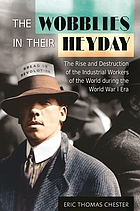
Eric Chester
During World War I, the Industrial Workers of the World (IWW) rose to prominence as an effective, militant union and then was destroyed by a devastating campaign of repression launched by the federal government. This book documents the rise and fall of this important industrial labor organization. The Industrial Workers of the World--or "Wobblies," as they were known--included legendary figures from U.S. labor history. Joe Hill, "Big Bill" Haywood, and Elizabeth Gurley Flynn have become a part of American popular folklore. In this book, author Eric T. Chester shows just how dynamic a force the IWW was during its heyday during World War I, and how determined the federal government was to crush this union--a campaign of repression that remains unique in U.S. history. This work utilizes a wide array of archival sources, many of them never used before, thereby giving readers a clearer view and better understanding of what actually happened. The book leads with an examination of the three key events in the history of the IWW: the Wheatfield, CA, confrontation; the Bisbee, AZ, deportation; and the strike of copper miners in Butte, MT. The second part of the book deconstructs the IWW's responses to World War I, the coordinated attack by the federal government upon the union, and how the union unraveled under this attack."
the rise and fall of this important industrial labor organization
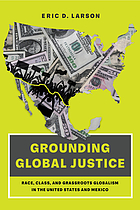
Eric D. Larson
The rise of Trumpism and the Covid-19 pandemic have galvanized debates about globalization. Eric D. Larson presents a timely look at the last time the concept spurred unruly agitation: the late twentieth century. Offering a transnational history of the emergence of the global justice movement in the United States and Mexico, he considers how popular organizations laid the foundations for this ""movement of movements.""
Part I: (In)visibilizing empire: ambivalent nationalism and the origins of global justice
Food sovereignty : the origins of an idea
Ambivalent nationalism : food sovereignty in Mexico's age of NAFTA
The specter of U.S. decline : ambivalent Americanism and the Jobs with Justice coalition in the 1980s
Part II: Racism and global justice in a multicultural age
Against Coca-Colonization : neoliberal multiculturalism and indigenous insurgency in Southern Mexico
Obscuring empire : color-blind anticorporatism and the 1999 World Trade Organization protests in Seattle
Invisibilizing immigration : color-blind anticorporatism and the 1999 World Trade Organization protests in Seattle
Part III: Two protests: global justice in the twenty-first century
"Localizing" global justice : class, nation, and the Jobs with Justice coalition after Seattle
The WTO is back : UNORCA, the Vía Campesina, and the struggle over agriculture in Cancún
The radical road to Cancún : anarchism and autonomy for the popular indigenous council of Oaxaca-Ricardo Flores Magón
Epilogue
transnational history of the emergence of the global justice movement in the United States and Mexico,
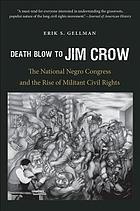
Eric Gelman
Annotation During the Great Depression, black intellectuals, labor organizers, and artists formed the National Negro Congress (NNC) to demand a "second emancipation" in America. Over the next decade, the NNC and its offshoot, the Southern Negro Youth Congress, sought to coordinate and catalyze local antiracist activism into a national movement to undermine the Jim Crow system of racial and economic exploitation. In this pioneering study, Erik S. Gellman shows how the NNC agitated for the first-class citizenship of African Americans and all members of the working class, establishing civil rights as necessary for reinvigorating American democracy.Much more than just a precursor to the 1960s civil rights movement, this activism created the most militant interracial freedom movement since Reconstruction, one that sought to empower the American labor movement to make demands on industrialists, white supremacists, and the state as never before. By focusing on the complex alliances between unions, civic groups, and the Communist Party in five geographic regions, Gellman explains how the NNC and its allies developed and implemented creative grassroots strategies to weaken Jim Crow, if not deal it the "death blow" they sought
shows how the NNC agitated for the first-class citizenship of African Americans and all members of the working class.
Eric Jon Fure-Slocum, Claire Goldstene, eds
In the United States today, almost three-quarters of the people teaching in two- and four-year colleges and universities work as contingent faculty. They share the hardships endemic in the gig economy: lack of job security and health care, professional disrespect, and poverty wages that require them to juggle multiple jobs. This collection draws on a wide range of perspectives to examine the realities of the contingent faculty system through the lens of labor history. Essayists investigate structural changes that have caused the use of contingent faculty to skyrocket and illuminate how precarity shapes day-to-day experiences in the academic workplace. Other essays delve into the ways contingent faculty engage in collective action and other means to resist austerity measures, improve their working conditions, and instigate reforms in higher education. By challenging contingency, this volume issues a clear call to reclaim higher education's public purpose. Interdisciplinary in approach and multifaceted in perspective, Contingent Faculty and the Remaking of Higher Education surveys the adjunct system and its costs"-- Provided by publisher
Anthology-By challenging contingency, this volume issues a clear call to reclaim higher education's public purpose
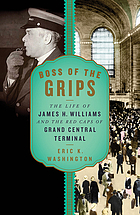
Eric K. Washington
A long-overdue biography of the head of Grand Central Terminal's Red Caps, who flourished in the cultural nexus of Harlem and American railroads. In a feat of remarkable research and timely reclamation, Eric K. Washington uncovers the nearly forgotten life of James H. Williams (1878-1948), the chief porter of Grand Central Terminal's Red Caps--a multitude of Harlem-based black men whom he organized into the essential labor force of America's most august railroad station.
Washington reveals that despite the highly racialized and often exploitative nature of the work, the Red Cap was a highly coveted job for college-bound black men determined to join New York's bourgeoning middle class. Examining the deeply intertwined subjects of class, labor, and African American history, Washington chronicles Williams's life, showing how the enterprising son of freed slaves successfully navigated the segregated world of the northern metropolis, and in so doing ultimately achieved financial and social influence. With this biography, Williams must now be considered, along with Cornelius Vanderbilt and Jacqueline Onassis, one of the great heroes of Grand Central's storied past"-- Provided by publisher
deeply intertwined subjects of class, labor, and African American history
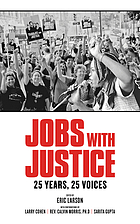
Eric Larson, Larry Cohen, Rev Calvin Morris, Sarita Gupta
Through a series of interviews and essays, this compendium gives voice to the community, labor, immigrant, student, and faith activists that have built Jobs with Justice (JwJ). The book speaks on both the core principles of the organization for workers' rights and the experiences since its founding in 1987. Though the discussion reflects on the last 25 years of the JwJ coalition, it also looks openly and optimistically at the next 25. It includes the perspectives of longtime national leaders, like founder Larry Cohen, newcomers like Ai-Jen Po
core principles of the organization for workers' rights and the experiences since its founding in 198

Eric Medlin
During the twentieth century, three industries dominated the economy of North Carolina. Tobacco and textiles are well-known and well-studied, being the subject of books, movies, and articles over the past century. But at its height, the furniture industry was nearly as large and influential as these two concerns.
Furniture companies employed thousands of workers and shaped towns and local life from Hickory to Goldsboro. The industry has been almost entirely ignored by the historical profession, until now.
Sawdust in Your Pockets: A History of the North Carolina Furniture Industry is the first survey of the entire furniture industry from its cabinetmaking beginnings to its digital present. The author, Raleigh history instructor Eric Medlin, shows how the industry transitioned from high-quality, individual pieces to the affordable, mass-produced furniture of High Point and Thomasville in the late 19th century.
Then, he traces the ups and downs of the industry as it reaches its mid-century peak, a time when North Carolina became the largest furniture-producing state in the country. Mr. Medlin discusses how globalization, competition, and consolidation all provided severe challenges for the industry in the late 20th century and how its businesses, workers, and professionals have all survived and even thrived to this day"-- Provided by publisher
first survey of the entire furniture industry from its cabinetmaking beginnings to its digital present
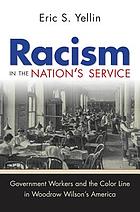
Eric Steven Yellin
Between the 1880s and 1910s, thousands of African Americans passed civil service exams and became employed in the executive offices of the federal government. However, by 1920, promotions to well-paying federal jobs had nearly vanished for black workers. Eric S. Yellin argues that the Wilson administration’s successful 1913 drive to segregate the federal government was a pivotal episode in the age of progressive politics. Yellin investigates how the enactment of this policy, based on Progressives' demands for whiteness in government, imposed a color line on American opportunity and implicated Washington in the economic limitation of African Americans for decades to come.
Using vivid accounts of the struggles and protests of African American government employees, Yellin reveals the racism at the heart of the era’s reform politics. He illuminates the nineteenth-century world of black professional labor and social mobility in Washington, D.C., and uncovers the Wilson administration’s progressive justifications for unraveling that world. From the hopeful days following emancipation to the white-supremacist “normalcy” of the 1920s, Yellin traces the competing political ideas, politicians, and ordinary government workers who created “federal segregation.”
Wilson administration's successful 1913 drive to segregate the federal government was a pivotal episode in the age of progressive politics.
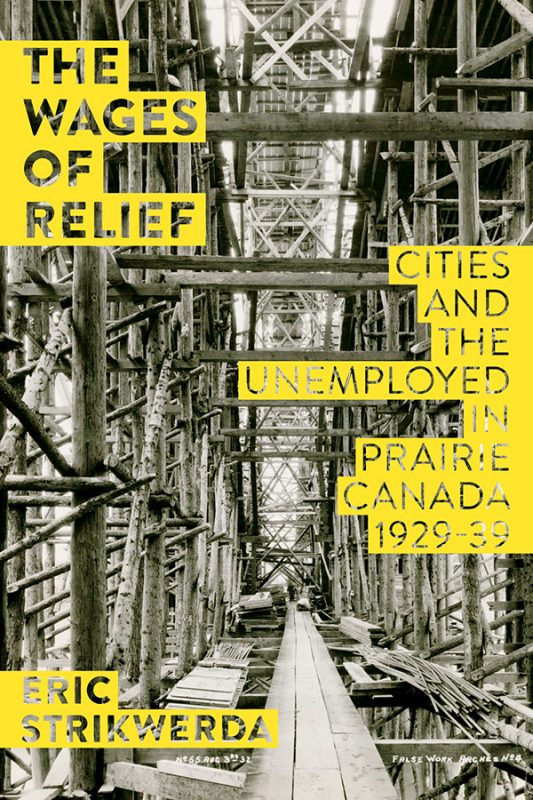
Eric Strikwerda
In the early part of the Dirty Thirties, the Canadian prairie city was a relatively safe haven. Having faced recession before the Great War and then again in the early 1920s, municipalities already had relief apparatuses in place to deal with poverty and unemployment. Until 1933, responsibilty for the care of the urban poor remained with local governments, but when the farms failed that year, and the Depression deepened, western Canadian cities suffered tremendously. Recognizing the severity of the crisis, the national government intervened. Evolving federal programs and policies took over responsibility for the delivery of relief to the single unemployed, while the government simultaneously withdrew financing for all public works projects. Setting municipal relief administrations of the 1930s within a wider literature on welfare and urban poor relief, Strikwerda highlights the legacy on which relief policymakers relied in determining policy directions, as well as the experiences of the individuals and families who depended on relief for their survival. Focusing on three prairie cities—Edmonton, Saskatoon, and Winnipeg—Strikwerda argues that municipal officials used their power to set policy to address what they perceived to be the most serious threats to the social order stemming from the economic crisis. By analyzing the differing ways in which local relief programs treated married and single men, he also explores important gendered dynamics at work in the response of city administrators to the social and economic upheaval of the Depression. Probing the mindset of local elites struggling in extraordinary circumstances, The Wages of Relief describes the enduring impact of the policy changes made in the 1930s in the direction of a broad, national approach to unemployment—an approach that ushered in Canada’s modern welfare system.
Wages of Relief explores what local responsibility for relief actually meant in Winnipeg, Saskatoon and Edmonton during the Great Depression
Eric V. Meeks, Patricia Nelson Limerick
Borders cut through not just places but also relationships, politics, economics, and cultures. Eric V. Meeks examines how ethno-racial categories and identities such as Indian, Mexican, and Anglo crystallized in Arizona's borderlands between 1880 and 1980. South-central Arizona is home to many ethnic groups, including Mexican Americans, Mexican immigrants, and semi-Hispanicized indigenous groups such as Yaquis and Tohono O'odham. Kinship and cultural ties between these diverse groups were altered and ethnic boundaries were deepened by the influx of Euro-Americans, the development of an industrial economy, and incorporation into the U.S. nation-state. Old ethnic and interethnic ties changed and became more difficult to sustain when Euro-Americans arrived in the region and imposed ideologies and government policies that constructed starker racial boundaries. As Arizona began to take its place in the national economy of the United States, primarily through mining and industrial agriculture, ethnic Mexican and Native American communities struggled to define their own identities. They sometimes stressed their status as the region's original inhabitants, sometimes as workers, sometimes as U.S. citizens, and sometimes as members of their own separate nations. In the process, they often challenged the racial order imposed on them by the dominant class. Appealing to broad audiences, this book links the construction of racial categories and ethnic identities to the larger process of nation-state building along the U.S.-Mexico border, and illustrates how ethnicity can both bring people together and drive them apart
examines how ethno-racial categories and identities such as Indian, Mexican, and Anglo crystallized in Arizona's borderlands.

Erik Loomis
Lowell Mill Girls Strike (Massachusetts, 1830–40)
Slaves on Strike (The Confederacy, 1861–65)
The Eight-Hour Day Strikes (Chicago, 1886)
The Anthracite Strike (Pennsylvania, 1902)
The Bread and Roses Strike (Massachusetts, 1912)
The Flint Sit-Down Strike (Michigan, 1937)
The Oakland General Strike (California, 1946)
Lordstown (Ohio, 1972)
Air Traffic Controllers (1981)
Justice for Janitors (Los Angeles, 1990)
message is about the hard struggles of workers to make gains
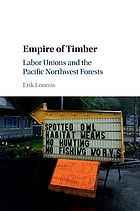
Erik Loomis
The battles to protect ancient forests and spotted owls in the Northwest splashed across the evening news in the 1980s and early 1990s. Empire of Timber re-examines this history to demonstrate that workers used their unions to fight for a healthy workplace environment and sustainable logging practices that would allow themselves and future generations the chance to both work and play in the forests. Examining labor organizations from the Industrial Workers of the World in the 1910s to unions in the 1980s, Empire of Timber shows that conventional narratives of workers opposing environmental protection are far too simplistic and often ignore the long histories of natural resource industry workers attempting to protect their health and their futures from the impact of industrial logging. Today, when workers fear that environmental restrictions threaten their jobs, learning the history of alliances between unions and environmentalists can build those conversations in the present."--Publisher's website
shows that conventional narratives of workers opposing environmental protection are far too simplistic and often ignore the long histories of natural resource industry workers
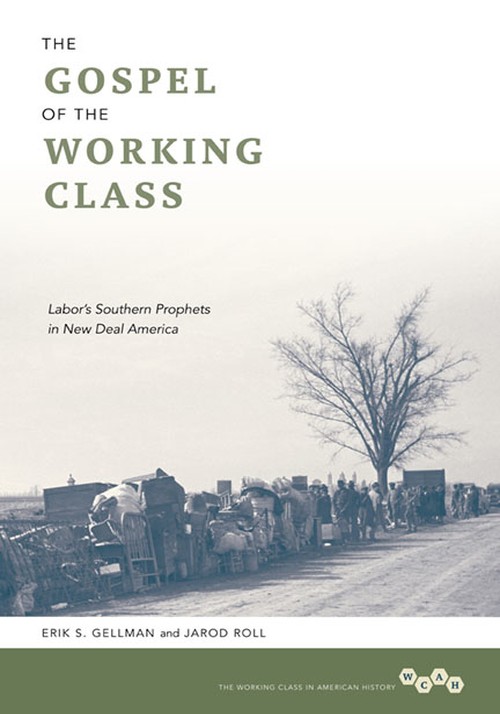
Erik S, Gellman, Jarod Roll
How two southern ministers preached and practiced a vision of a more democratic America. Whitfield and Williams used Christianity as an organizing tool to bring ordinary men and women into the Southern Tenant Farmers Union and the Congress of Industrial Organizations. The study is a model for labor historians as well as frustrated progressives, for how to look at both the past as well as the present. Until recently, labor historians have regarded religion as a pox on the House of Labor, refusing to listen to what our subjects were trying to tell us. Gellman and Roll have a different approach, one that is useful for looking at the past. .. to reveal how Christian faith was a basic, organizing force that galvanized the dispossessed to take action to remedy poverty and racism. We see how Whitfield and Williams understood scripture and used it to reform society. -Beth Thompson Bates
How two southern ministers preached and practiced a vision of a more democratic America
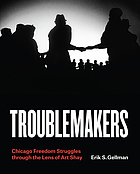
Erik S. Gellman, Art Shay
What does democracy look like? And when should we cause trouble to pursue it? Troublemakers fuses photography and history to demonstrate how racial and economic inequality gave rise to a decades-long struggle for justice in one American city.
In dialogue with 275 of Art Shay's photographs, Erik S. Gellman takes a new look at major developments in postwar US history: the Second Great Migration, "white flight," and neighborhood and street conflicts, as well as shifting party politics and the growth of the carceral state. The result is a visual and written history that complicates - and even upends - the morality tales and popular memory of postwar freedom struggles. Shay himself was a "troublemaker," seeking to unsettle society by illuminating truths that many middle-class, white, media, political, and businesspeople pretended did not exist. Shay served as a navigator in the US Army Air Forces during World War II, then took a position as a writer for Life Magazine.
But soon after his 1948 move to Chicago, he decided to become a freelance photographer. Shay wandered the city photographing whatever caught his eye - and much did. His lens captured everything from private moments of rebellion to era-defining public movements, as he sought to understand the creative and destructive energies that propelled freedom struggles in the Windy City. Shay illuminated the pain and ecstasy that sprung up from the streets of Chicago, while Gellman reveals their collective impact on the urban fabric and on our national narrative. This collaboration offers a fresh and timely look at how social conflict can shape a city - and may even inspire us to make trouble today
In dialogue with 275 of Art Shay's photographs, Erik S. Gellman takes a new look at major developments in postwar US history
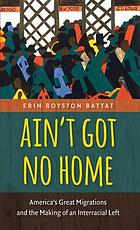
Erin Battat
Most scholarship on the mass migrations of African Americans and southern whites during and after the Great Depression treats those migrations as separate phenomena, strictly divided along racial lines. In this engaging interdisciplinary work, Erin Royston Battat argues instead that we should understand these Depression-era migrations as interconnected responses to the capitalist collapse and political upheavals of the early twentieth century. During the 1930s and 1940s, Battat shows, writers and artists of both races created migration stories specifically to bolster the black-white Left alliance. Defying rigid critical categories, Battat considers a wide variety of media, including literary classics by John Steinbeck and Ann Petry, "lost" novels by Sanora Babb and William Attaway, hobo novellas, images of migrant women by Dorothea Lange and Elizabeth Catlett, popular songs, and histories and ethnographies of migrant shipyard workers. This vibrant rereading and recovering of the period's literary and visual culture expands our understanding of the migration narrative by uniting the political and aesthetic goals of the black and white literary Left and illuminating the striking interrelationship between American populism and civil rights."-- Provided by publisher
Depression-era migrations as interconnected responses to the capitalist collapse and political upheavals of the early twentieth century; focused on music, literature, images
Erin Hatton
Everyone knows that work in America is not what it used to be. Layoffs, outsourcing, contingent work, disappearing career ladders ;these are the new workplace realities for an increasing number of people. But why? In The Temp Economy, Erin Hatton takes one of the best-known icons of the new economy, the temp industry, and finds that it is more than just a symbol of this degradation of work. The temp industry itself played an active role in this decline, and not just for temps. Industry leaders started by inventing the "Kelly Girl," exploiting 1950s gender stereoty
The origins and development of temporary labor
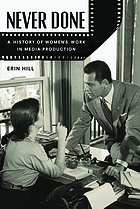
Erin Hill
Never Done introduces generations of women who worked behind the scenes in the film industry-from dressmakers to secretaries to script readers. Challenging the dismissive characterization of these women as merely menial workers, media historian Erin Hill shows how their labor required considerable technical and interpersonal skills. As it pores through rare archives and integrates the firsthand accounts of women employed in the film industry, this book gives a voice to women whose work was indispensable yet largely invisible
shows how their labor required considerable technical and interpersonal skills

Ernest Crosby
In February 1899, British novelist and poet Rudyard Kipling wrote a poem entitled “The White Man’s Burden: The United States and The Philippine Islands.” In this poem, Kipling urged the U.S. to take up the “burden” of empire, as had Britain and other European nations. Theodore Roosevelt, soon to become vice-president and then president, copied the poem and sent it to his friend, Senator Henry Cabot Lodge, commenting that it was “rather poor poetry, but good sense from the expansion point of view.” Not everyone was as favorably impressed. Poet Ernest Crosby penned a parody of Kipling’s work, “The Real White Man’s Burden,” and published it in his 1902 collection of poems Swords and Plowshares. Crosby also wrote a satirical, anti-imperialist novel, Captain Jinks, Hero, that parodied the career of General Frederick Funston, the man who had captured Philippine leader Emilio Aguinaldo in 1901.
Poet Ernest Crosby penned a parody of Kipling’s work, “The Real White Man’s Burden,” in 1902
Ernest Hagen, History Matters
The most visible signs of industrialization in mid nineteenth-century America occurred in mushrooming factory towns such as Lowell, Massachusetts, but changes in manufacturing also took place in metropolises like New York City. Waves of immigrants entered the port cities ’small workshops, sites of intense craft activity. Cabinetmaking resisted mechanization and unskilled labor because the trade required intricate work on complex pieces of furniture. In his unpublished memoir German immigrant Ernst Hagen recalled that many of the leading names in nineteenth-century furniture, well represented today in museum collections, presided over large shops of toiling workers. Some employed over two hundred hands. The post-Civil War rise of western factories disrupted this urban system; skilled workers either found other employment or were relegated to margins of the trade such as repair work.
clips from the personal memoir of German immigrant Ernst Hagen, who was a cabinetmaker in mid-nineteenth-century New York City and who witnessed the transition from one industrial system to another. Shows how big name nineteenth-century furniture, well represented today in museum collections, presided over large shops of toiling workers.
Museum/Exhibits
Tours
Maps
Digital Projects
Organizations
Sites
Film/Video
Audio/Interview
Podcast/Program
Text/Document
Image
Graphs/Data
Timeline
Southwest
West
Midwest
Southeast
Northeast
Mexico
Canada
Global
Books
Teaching
Lectures
Digital Archives
Journals
Bibliographies
Topic Intro