


Collections
Library
Type
Region
Coverage:
-
Published:
-
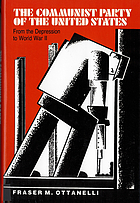
Fraser M. Ottanelli
The author provides an overview of the communists during the designated time period or to generally educate a new history or political science student
provides an overview of the communists during the designated time period or to generally educate a new history or political science student.

Fred Fedeli History Matters
The advent of “talkies”in the early 20th century had an impact felt far from Hollywood. Immigrants made up a significant portion of the movie-going audience during the silent film era because the lack of (English) speech beckoned immigrants unable to comprehend the many facets of American life: a picture that didn’t talk was particularly appealing to people who didn’t speak or read English. In this oral history, recorded by Roy Rosenzweig in 1978, Italian immigrant Fred Fedeli recalled his experiences owning and operating a movie theater in an immigrant working-class neighborhood of Worcester, Massachusetts.
A brief, three-minute oral history of Fred Fredeli's experiences as an Italian immigrant to the United States, recorded by Roy Rosenzweig in 1978.
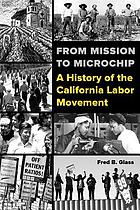
Fred Glass
While other states face declining union enrollment rates and the rollback of workers' rights, California unions are embracing working immigrants, and voters are protecting core worker rights. What's the difference? California has held an exceptional place in the imagination of Americans and immigrants since the Gold Rush, which saw the first of many waves of working people moving to the state to find work. From Mission to Microchip unearths the hidden stories of these people throughout California's history. The difficult task of the state's labor movement has been to overcome perceived barriers such as race, national origin, and language to unite newcomers and natives in their shared interest. As chronicled in this comprehensive history, workers have creatively used collective bargaining, politics, strikes, and varied organizing strategies to find common ground among California's diverse communities and achieve a measure of economic fairness and social justice. This is an indispensable book for students and scholars of labor history and history of the West, as well as labor activists and organizers."
unearths the hidden stories of those involved in California's labor movement from the gold rush to the modern day

Fred Quivik, Story of Butte
Butte’s historical identity is as much linked to a single corporate entity, The Anaconda Company, as is the identity of any city in the United States. For a century, the company was by far the largest employer in Butte, and for much of that time it dominated the political life of the entire state of Montana as well. Butte’s cultural landscape still embodies many facets of the central role the company played in the city’s history (see the Headframes of Butte and Mining Technologies tours). This tour focuses on buildings – business blocks and residences – that represent non-mining facets of The Anaconda Company’s important presence in Butte. In another entry this group has a tour of labor organizer Frank Little and his murder, and fits it into the landscape of Butte and Anaconda. In other words, these 2 go together.
14 sites including labor history perspectives of Anaconda copper company in Butte, Montana
Fred R. Harris, History Matters
President Lyndon Johnson formed an 11-member National Advisory Commission on Civil Disorders in July 1967 to explain the riots that plagued cities each summer since 1964 and to provide recommendations for the future. The Commission’s 1968 report, informally known as the Kerner Report, concluded that the nation was “moving toward two societies, one black, one white—separate and unequal.” Unless conditions were remedied, the Commission warned, the country faced a “system of ’apartheid’” in its major cities. The Kerner report delivered an indictment of “white society” for isolating and neglecting African Americans and urged legislation to promote racial integration and to enrich slums—primarily through the creation of jobs, job training programs, and decent housing. President Johnson, however, rejected the recommendations. In April 1968, one month after the release of the Kerner report, rioting broke out in more than 100 cities following the assassination of civil rights leader Martin Luther King, Jr. In the following statements to a joint Congressional committee, two Commission members summarized their findings and recommended the creation of jobs. In 1998, 30 years after the Kerner Report, Harris co-authored a study that found the racial divide had grown in the ensuing years with inner-city unemployment at crisis levels. Opposing voices argued that the Commission’s prediction of separate societies failed to materialize due to a marked increase in the number of African Americans living in suburbs.
The transcript of a discussion of race relations and civil unrest in the 1960s U.S. amongst members of President Lyndon Johnson's "Kerner Commission," with testimony from Fred R. Harris.
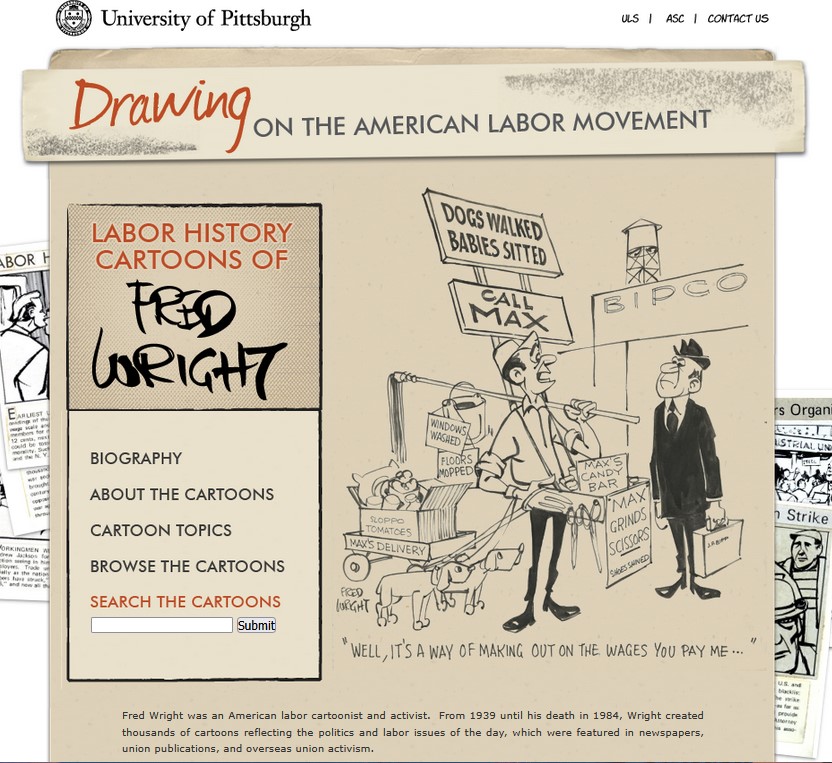
Fred Wright
Fred Wright was an American labor cartoonist and activist. From 1939 until his death in 1984, Wright created thousands of cartoons reflecting the politics and labor issues of the day, which were featured in newspapers, union publications, and overseas union activism.
He was employed by the United Electrical, Radio, and Machine Workers of America (UE) for nearly thirty-five years and was the only cartoonist at that time to be employed by a specific union. As the UE staff cartoonist, Wright illustrated their newspaper, the UE News, as well as various other union publications. Many subjects, including satirical cartoons about managers, automation, mechanization, speed-up, technology, capitalism, surplus value, civil rights, women, equal pay, labor and politics.
This Web site focuses specifically on the series of 177 "Labor History" cartoons created by Wright. This series was featured in the UE News from 1956-1961 and again in the 1970s. The Labor History series is part of the Fred Wright Papers, 1953-1986 (UE 13), which belongs to the United Electrical, Radio, and Machine Workers of America (UE) collection held by the Archives Service Center at the University of Pittsburgh.
American labor cartoonist and activist. From 1939 until his death in 1984
Frederic Remington, History Matters
In 1894, a strike at the Pullman Palace Car Company spread across the nation as the American Railway Union organized a national boycott and strike against all trains hauling Pullman cars. Strikers were met with the full force of company and government might. Thirty-four people were killed in two weeks of clashes between troops and workers across the nation.
An ardent admirer of the military, artist-reporter Frederic Remington displayed no sympathy for the Pullman strikers in his reports for Harper’s Weekly. Endorsing suppression, Remington described the strikers as a “malodorous crowd of foreign trash” talking "Hungarian or Polack, or whatever the stuff is."
artist-reporter Frederic Remington displayed no sympathy for the Pullman strikers in his reports for Harper’s Weekly
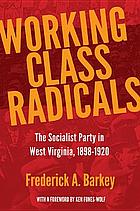
Frederick A. Barkey
"Working Class Radicals: The Socialist Party in West Virginia, 1898-1920 examines the rise and fall of organized socialism in West Virginia through an exploration of the demographics of membership, oral interview material gathered in the 1960s from party members, and the collapse of the party in the wake of the Paint Creek-Cabin Creek coal-mining strike of 1912." "The first local branch of the West Virginia Socialist Party was established in Wheeling in 1901, and by 1914, several thousand West Virginians were dues-paying members of local branches. By 1910, local Socialists began to elect candidates to office and in 1912, more than 15,000 West Virginian voters cast their ballots for Socialist presidential candidate Eugene Debs. The progress that West Virginia socialists achieved on the electoral front was a reflection of the party's strategy of increasing class-consciousness by working with existing unions to build the power of the labor movement." "The party appealed to a fairly broad cross section of wage earners and its steady growth also owed much to the fact that many members of the middle class were attracted to the cause. Several factors combined to send the party into rapid decline, most importantly deep fissures between class and craft factions of the party and 1915 legislation making third party political participation difficult. Working Class Radicals offers insight into the various internal and external forces that doomed the party and serves as a cautionary tale to contemporary political leaders and organizers." -- Book Cover
examines the rise and fall of organized socialism in West Virginia, as well as the successful organizational strategies the Socialist Party utilized
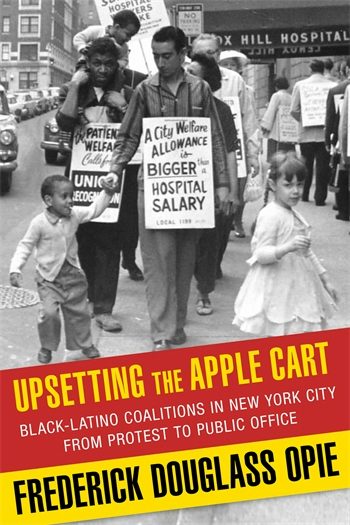
Frederick Douglass Opie
Upsetting the Apple Cart looks at the history of black-Latino coalitions in New York City from 1959 to 1989. In those years, African American and Latino Progressives organized, mobilized, and transformed neighborhoods, workplaces, university campuses, and representative government in the nation's urban capital. The book makes new contributions to our understanding of protest movements and strikes in the 1960s and 1970s and reveals the little-known role of left-of-center organizations in New York City politics as well as the influence of Jesse Jackson's 1984 and 1988 presidential campaigns on
history of black-Latino coalitions in New York City from 1959 to 1989
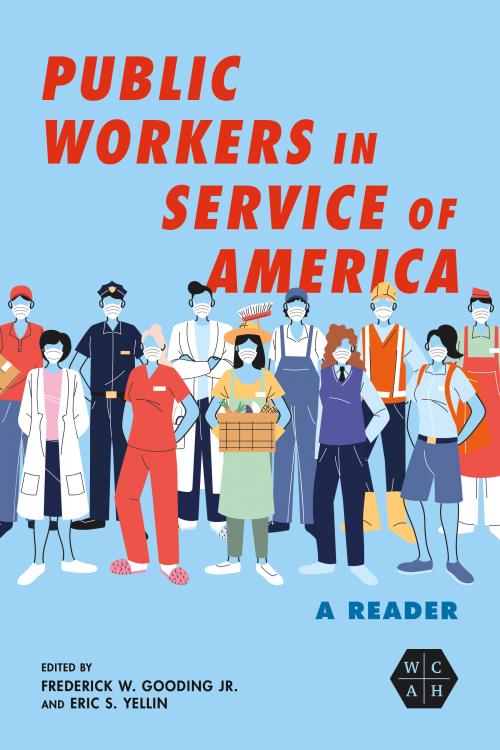
Frederick W. Gooding Jr., Eric S. Yellin
From white-collar executives to mail carriers, public workers meet the needs of the entire nation. Frederick W. Gooding Jr. and Eric S. Yellin edit a collection of new research on this understudied workforce.
Part One begins in the late nineteenth- and early twentieth century to explore how questions of race, class, and gender shaped public workers, their workplaces, and their place in American democracy.
In Part Two, essayists examine race and gender discrimination while revealing the subtle contemporary forms of marginalization that keep Black men and Black and white women underpaid and overlooked for promotion. The historic labor actions detailed in Part Three illuminate how city employees organized not only for better pay and working conditions but to seek recognition from city officials, the public, and the national labor movement.
Part Four focuses on nurses and teachers to address the thorny question of whether certain groups deserve premium pay for their irreplaceable work and sacrifices or if serving the greater good is a reward unto itself.
Contributors: Eileen Boris, Cathleen D. Cahill, Frederick W. Gooding Jr., William P. Jones, Francis Ryan, Jon Shelton, Joseph E. Slater, Katherine Turk, Eric S. Yellin, and Amy Zanoni"--
Foreword Joseph A. McCartin . . . . . . . . . . . . . . . . . . .ix
Acknowledgments. . . . . . . . . . . . . . . . . . . . . . . . . . xv
A Note on Language . . . . . . . . . . . . . . . . . . . . . . . .xvii
Introduction Frederick W. Gooding Jr. and Eric S. Yellin . . . . 1
PART I: THE POLITICS OF PUBLIC WORK AT
THE DAWN OF THE TWENTIETH CENTURY
1. Gender and Politics among Federal Indian Service
Employees, 1880–1930 Cathleen D. Cahill. . . . . . . . . . . . .17
2. The Spoils as Reparations Eric S. Yellin . . . . . . . . . . . . . 36
PART II: GOOD GOVERNMENT JOBS FOR WHOM?
3. Dead End Job? Black Public Workers Struggle to
See Light of Day Frederick W. Gooding Jr. . . . . . . . . . . . 63
4. “We’re the Backbone of This City”: Women and
Gender in Public Work Katherine Turk . . . . . . . . . . . . . 85
PART III: ORGANIZING PUBLIC WORKERS
5. Police Unions and Public Sector
Labor Law and Policy Joseph E. Slater. . . . . . . . . . . . . . 109
6. The Road to Memphis: Southern Sanitation Workers
and the Transformation of Public Employee Unionism
in the Postwar United States William P. Jones . . . . . . . . . 130
7. “They Won’t Work for a Cop of Any Kind”: The 1970
Sanitation Slowdown and the Struggle for Black
Independent Politics in Philadelphia Francis Ryan . . . . . . 149
PART IV: PUBLIC WORKERS IN THE NEOLIBERAL AGE
8. Sick-Ins, Feed-Ins, Heal-Ins, and Strikes: Labor
Organizing at Chicago’s Public Hospital in the 1960s
and Its Legacy for the 1970s Amy Zanoni . . . . . . . . . . . . 177
9. The Meaning of Teachers’ Labor in American Education:
Change, Challenge, and Resistance Jon Shelton . . . . . . . .209
Afterword Eileen Boris . . . . . . . . . . . . . . . . . . . . . . 231
Contributors . . . . . . . . . . . . . . . . . . . . . . . . . . . . . 237
Index . . . . . . . . . . . . . . . . . . . . . . . . . . . . . . . . . 239
collection of essays by leading scholars explore how questions of race, class, and gender shaped public workers, their workplaces, and their place in American democracy from the late nineteenth through the 20th century
Freedmen and Southern Society Project
This brief chronology, adapted from the version published in Free at Last: A Documentary History of Slavery, Freedom, and the Civil War, lists important events in the history of emancipation during the Civil War. Unless otherwise specified, all entries pertain to the Union rather than the Confederacy.
Timeline of emancipation during the Civil War

Frontier Films, Roert Stebbis, Eugene Hill, Jay Leyda, Elia Kazan, William Watts
Documentary celebrating the work of the Highlander Folk School, a progressive adult education center founded in 1932 in the mountain community of Monteagle, Tennessee.In 1937, after local organizers had been killed and kidnapped, The most successful independent Popular Front film of the period.People of the Cumberland demonstrates how education and the labor movement can transform an impoverished mining region and bring hope to its people.
Production Co.: Frontier Films. Directors: Robert Stebbins [Sidney Meyers], Eugene Hill [Jay Leyda], Elia Kazan, William Watts. Writers: Erskine Caldwell, David Wolff [Ben Maddow]. Camera: Ralph Steiner. Music: Alex North, Earl Robinson, Elie Siegmeister. Sound Editor: Helen Van Dongen. Narrator: Richard Blaine. Transfer Note: Scanned from a 16mm print held by the Library of Congress.
Running Time: 21 minutes.
Resources: Association of Documentary Film Producers, Living Films: A Catalog of Documentary Films and Their Makers (New York: Association of Documentary Film Producers, 1940), 46; Educational Film Catalog, comps. Dorothy E. Cook and Eva Rahbek-Smith (New York: H.W. Wilson Co., 1943), 351; William Alexander, Film on the Left: American Documentary Film from 1931 to 1942 (Princeton, NJ: Princeton University Press, 1981), 174–85; Charles Wolfe, “Straight Shots and Crooked Plots,” in Lovers of Cinema: The First American Film Avant-Garde, 1919–1945, ed. Jan-Christopher Horak (Madison, WI: University of Wisconsin Press, 1995), 253–56.
21 minute pro-labor film of the Popular Front/Great Depression era. Scenes of Great Depression conditions, organizing and repression are features of one of the first major labor documentaries of the ear.
Fung-Yea Huang
Chapter 1 Introduction; Chapter 2 Female Immigration, Selectivity, and Settlement; Chapter 3 Immigration Policy, Family Reunification, and National Origin; Chapter 4 Research Design; Chapter 5 Sources of Data and Imputations; Chapter 6 Results and Discussion; Chapter 7 Summary and Conclusion;
describes migration patterns and compares the labor market adaptation experiences of women who migrated with their families and women who migrated independently.
G William Domhoff
It is commonly accepted that America saw the rise of liberalism in the wake of the New Deal, especially during the three decades after World War II. Based on new archival research, G. William Domhoff reveals this period instead as one of increasing corporate dominance in government affairs, affecting the fate of American workers up to the present day.
While FDRs New Deal brought sweeping legislation, the tide turned quickly after 1938. From that year onward nearly every major new economic law passed by Congress showed the mark of corporate dominance. The influential Committee for Economic Development was a guiding force for presidential administrations and congressional leaders. Domhoff accessibly portrays documents of the Committees vital influence in the halls of government, supported by his interviews with several of its key employees and trustees.
In terms of economic influence, liberalism was on a long steady decline, despite two decades of post-war growing equality. Ironically, it was the successes of the civil rights, feminist, environmental, and gay-lesbian movementsnot a new corporate mobilizationthat led to the final defeat of the liberal-labor alliance after 1968. These cultural successes generated just enough backlash to turn whites toward the Republican Party. It then became possible for the corporate community to solve its emerging economic and political problems through the offshore manufacturing and high interest rates that killed off inflation and the power of unions
the corporate dominance of the New Deal order
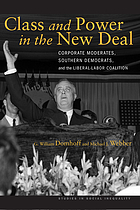
G. William Domhoff, Michael J. Webber
Class and Power in the New Deal provides a new perspective on the origins and implementation of the three most important policies that emerged during the New Deal—the Agricultural Adjustment Act, the National Labor Relations Act, and the Social Security Act. It reveals how Northern corporate moderates, representing some of the largest fortunes and biggest companies of that era, proposed all three major initiatives and explores why there were no viable alternatives put forward by the opposition.
More generally, this book analyzes the seeming paradox of policy support and political opposition. The authors seek to demonstrate the superiority of class dominance theory over other perspectives—historical institutionalism, Marxism, and protest-disruption theory—in explaining the origins and development of these three policy initiatives. Domhoff and Webber draw on extensive new archival research to develop a fresh interpretation of this seminal period of American government and social policy development.
new perspective on the origins and implementation of the three most important policies that emerged during the New Dea
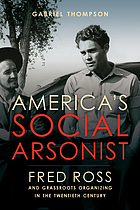
Gabriel Thompson
Raised by conservative parents who hoped he would "stay with his own kind," Fred Ross instead became one of the most influential community organizers in American history. His activism began alongside Dust Bowl migrants, where he managed the same labor camp that inspired John Steinbeck's The Grapes of Wrath.
During World War II, Ross worked for the release of interned Japanese Americans, and after the war, he dedicated his life to building the political power of Latinos across California. Labor organizing in this country was forever changed when Ross knocked on the door of a young Cesar Chavez and encouraged him to become an organizer.
Until now there has been no biography of Fred Ross, a man who believed a good organizer was supposed to fade into the crowd as others stepped forward. In America's Social Arsonist, Gabriel Thompson provides a full picture of this complicated and driven man, recovering a forgotten chapter of American history and providing vital lessons for organizers today."--Jacket
one of the most influential community organizers in American history
Gabriel Winant
Pittsburgh was once synonymous with steel, but today most of its mills are gone. Like so many places across the United States, a city that was a center of blue-collar manufacturing is now dominated by health care, which employs more Americans than any other industry. Gabriel Winant takes us inside the Rust Belt to show how America's cities have weathered new economic realities.As steelworkers and their families grew older, they required more health care. Even as the industrial economy contracted sharply, the care economy thrived. But unlike their blue-collar predecessors, home health aides and hospital staff work unpredictable hours for low pay. Today health care workers--mostly women and people of color--are on the front lines of our most pressing crises, yet we have been slow to appreciate that they are the face of our twenty-first-century workforce. The Next Shift offers unique insights into how we got here and what could happen next
shows how American Rust Belt cities have changed over time, giving them a present character away from industry.
Gail Fowler Mohanty
Develops several themes important to understanding the social, cultural and economic implications of industrialization. This volume centers on the growth of handloom weaving in response to the introduction of water powered spinning. It views this change from the perspectives of mechanics, technological limitations, and characteristics of weaving.
rowth of handloom weaving in response to the introduction of water powered spinning
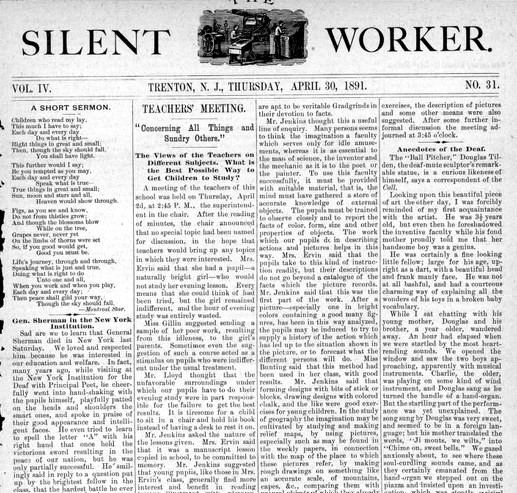
Gallaudet, National Association for the Deaf
The Silent Worker was a newspaper published in the United States serving the deaf community. Originally published in 1888 as the Deaf Mute Times, the paper was renamed that year to The Silent Worker. The paper was published monthly from fall through spring by the New Jersey School for the Deaf] The silent Worker published articles, primarily written by deaf authors, highlighting the abilities and achievements of the deaf community, particularly in industry.
During the early 20th century, when most school administrations were transitioning away from the use of American Sign Language in favor of the oral method of instruction, the silent worker generally advocated a dissenting view. The publication ceased in June 1929 following the dismissal of its editor, George Porter. --information from Wikipedia
published articles, primarily written by deaf authors, highlighting the abilities and achievements of the deaf community, particularly in industry.
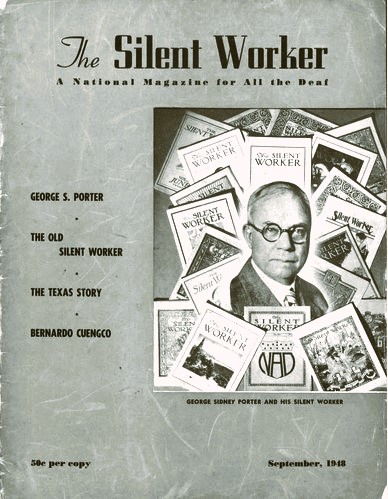
Gallaudet, New Jersey School for the Deaf
This is a new edition of a newspaper from Gallaudet from 1948-1966. The Silent Worker was a newspaper published in the United States serving the deaf community. Originally published in 1888 as the Deaf Mute Times, the paper was renamed that year to The Silent Worker. The paper was published monthly from fall through spring by the New Jersey School for the Deaf] The silent Worker published articles, primarily written by deaf authors, highlighting the abilities and achievements of the deaf community, particularly in industry.
During the early 20th century, when most school administrations were transitioning away from the use of American Sign Language in favor of the oral method of instruction, the silent worker generally advocated a dissenting view. The publication ceased in June 1929 following the dismissal of its editor, George Porter.
A new edition of the Silent Worker published articles, primarily written by deaf authors, many focused on the abilities and achievements of the deaf community, particularly in industry.ed by the National Association for the Deaf from 1948 to 1966.
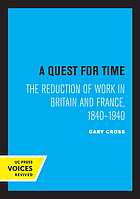
Gary Cross
This title is part of UC Press's Voices Revived program, which commemorates University of California Press's mission to seek out and cultivate the brightest minds and give them voice, reach, and impact. Drawing on a backlist dating to 1893, Voices Revived makes high-quality, peer-reviewed scholarship accessible once again using print-on-demand technology. This title was originally published in 1989
A study of how time and work have interacted in the workplace as industrialism advanced in Europe.
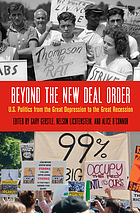
Gary Gerstle
"Beyond the New Deal Order offers a historicized analysis of the degree to which the original understanding of that order still holds. The unifying thematic among the essays lies not in their subject matter - politics, political economy, social thought, and legal scholarship are all well represented - but in a quest to bring fresh twenty-first-century perspective to the historic meaning and significance of an extended New Deal moment. Along the way, the contributors to this volume also ascertain the degree to which that old order itself has been displaced or even overthrown by a different, more market-centered reform logic that became the basis of shifting electoral and policy coalitions in the 1970s and beyond. Various contributors identify elements of a distinctively new order arising from the political economic, ideological, institutional, and electoral currents of post 1970s politics"--Introduction / Gary Gerstle, Nelson Lichtenstein, and Alice O'Connor
Part I. The nature and limits of New Deal reform. From the labor question to the Piketty moment : a journey through the New Deal order / Romain Huret and Jean-Christian Vinel ; State building from the bottom up : the New Deal and beyond / Meg Jacobs ; The making of "liberal" Republicans during the New Deal order / Kristoffer Smemo ; The unexpected endurance of the New Deal order : liberalism in the age of Reagan / Julian Zelizer
Part II. Intersections of race, class, and gender. To live decently : New Deal labor standards, feminized work, and the fight for worker dignity / Eileen Boris ; Rights in the New Deal order and beyond / Sophia Z. Lee ; Containing Keynesianism in an age of civil rights : Jim Crow monetary policy and the struggle for guaranteed jobs, 1957-1979 / David Stein
Part III. A New Order takes shape. Market politics in an age of automation / Angus Burgin ; Regulation and the collapse of the New Deal order, or How I learned to stop worrying and love the market / Reuel Schiller ; Environmental law and the end of the New Deal order / Paul Sabin ; The rise and fall of internationalism during (and after) the New Deal order / Michael Kazin ; An embattled New Deal legacy : public sector unionism and the struggle for a progressive order / Joe McCartin ; In search of "forgotten" America / Alice O'Connor
Part IV. Coda. America's neoliberal order / Gary Gerstle
a historicized analysis of the degree to which the original understanding of the New Deal Order still holds.
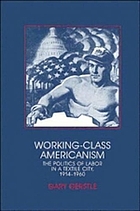
Gary Gerstle
"In this classic interpretation of the 1930s rise of industrial unionism, Gary Gerstle challenges the popular historical notion that American workers' embrace of "Americanism" and other patriotic sentiments in the post-World War I years indicated their fundamental political conservatism. He argues that Americanism was a complex, even contradictory, language of nationalism that lent itself to a wide variety of ideological constructions in the years between World War I and the onset of the Cold War. Using the rich and textured material left behind by New England's most powerful textile union--the Independent Textile Union of Woonsocket, Rhode Island--Gerstle uncovers for the first time a more varied and more radical working-class discourse"-INTRODUCTION 3
CHAPTER 1 Theodore Roosevelt's Racialized Nation, 1890-1900 14
A History of the American Race 17
War, Renewal, and the Problem of the Smoked Yankee 25
CHAPTER 2 Civic Nationalism and Its Contradictions, 1890-1917 44
True Americanism 47
Racial Dilemmas 59
The New Nationalism 65
CHAPTER 3 Hardening the Boundaries of the Nation, 1917-1929 81
War and Discipline 83
Keeping Pure the Blood of America 95
Civic Nationalism in the New Racial Regime 115
Aborting the New Nationalism 122
CHAPTER 4 The Rooseveltian Nation Ascendant, 1930-1940 128
A Kinder and Gentler Nation Builder 131
Radicalizing the Civic Nationalist Creed 139
Conservative Counterattack 156
The Survival of Racialized Nationalism 162
CHAPTER 5 Good War, Race War, 1941-1945 187
The Good War 189
Race War 201
Something Drastic Should Be Done
The Military's Hidden Race War 210
Combat and White Male Comradeship 220
CHAPTER 6 The Cold War, Anticommunism, and Nation in Flux, 1946-1960 238
War, Repression, and Nation Building 241
The Red Scare and the Decline of Racial Nationalism 246
Racial Nationalism Redux: The Case of Immigration Reform 256
CHAPTER 7 Civil Rights, White Resistance, and Black Nationalism, 1960-1968 268
Civil Rights and Civic Nationalism 270
I Question America
The Crisis in Atlantic City 286
Speaking as a Victim of This American System 295
CHAPTER 8 Vietnam, Cultural Revolt, and the Collapse of the Rooseveltian Nation, 1968-1975 311
A Catastrophic War 313
The Spread of Anti-Americanism and the Revolt against Assimilation 327
The Collapse of the Rooseveltian Nation 342
EPILOGUE Beyond the Rooseveltian Nation, 1975-2000 347
Varieties of Multiculturalism 349
A Springtime of Hope
Ronald Reagan and the Nationalist Renaissance 357
Reviving the Liberal Nation 365
Notes 375
Index 439
argues that Americanism was a complex, language of nationalism that lent itself to a wide variety of ideological constructions
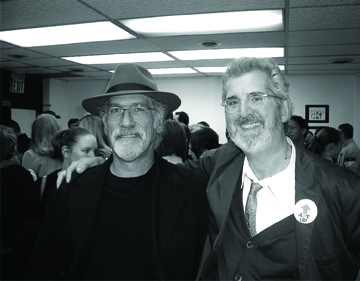
Gary Huck, Mike Konopacki
Gary Huck retired as the political cartoonist for the United Electrical, Radio and Machine Workers of America (UE), in 2015. Gary succeeded the great Fred Wright after Fred’s death in 1984. Mike Konopacki, graduated from the University of Wisconsin in 1974 with a Bachelor of Arts degree in Political Science. He began labor cartooning for the Madison Press Connection, a local daily created by striking newspaper workers in 1978. In 1983 he and Gary Huck created Huck/Konopacki Labor Cartoons, syndicating their cartoons to the labor press in the U.S. and Canada.Huck and Konopacki’s original cartoons are in the permanent collection of New York University’s Tamiment Institute Library & Robert F. Wagner Labor Archives.
An archive of older site is at https://www.solidarity.com/hkcartoons/
Where Art and Politics are no Stranger --two of the most accomplished labor cartoonists
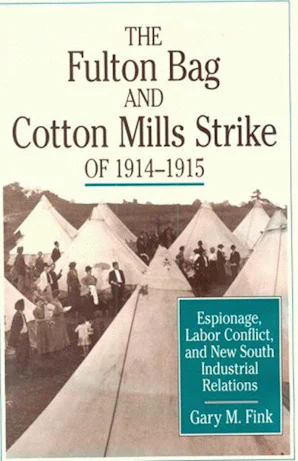
Gary M. Fink
Mill operatives walked off their jobs at Atlanta's Fulton Bag and Cotton Mills complex in the spring of 1914, initiating a strike that involved not only the class conflict inherent in a labor-management dispute, but also ethnic confrontations, gender divisions, social and economic reforms, regional and sectional differences, and the textile industry's rendition of the gospel of efficiency.
The year-long strike that followed was singularly well documented, partly by the reports of labor spies paid by management to gather information about striking employees and disrupt union organizing activities. Closely following dramatic confrontations in the northeastern textile industry, the Fulton Bag strike attracted national attention, drawing teams of investigators from the United States Department of Labor and from the United States Commission on Industrial Relations. Their reports are further supplemented by an unusually detailed photographic record, as both sides sought to exploit the camera to win the country's sympathy.
In this richly documented volume, Gary M. Fink asks why unionism failed and why industrialists in southern textiles behaved as they did. He suggests that southern textile manufacturers believed that they existed on the brink of economic ruin. The insecurities bred by that assumption, combined with their fervent belief in private property rights, dictated a specific approach to industrial relations.
1. Jacob Elsas: Builder and Benefactor
2. Oscar Elsas and the Evolution of an Industrial Relations Policy
3. Walkout: Causes and Conditions
4. Organizing the Strike
5. Through the Eyes of Spies
6. Tents and Spies: A War of Attrition
7. Why the Strike Was Lost
suggests that southern textile manufacturers believed that they existed on the brink of economic ruin the insecurities bred by that assumption, dictated a specific approach to industrial relations.
Museum/Exhibits
Tours
Maps
Digital Projects
Organizations
Sites
Film/Video
Audio/Interview
Podcast/Program
Text/Document
Image
Graphs/Data
Timeline
Southwest
West
Midwest
Southeast
Northeast
Mexico
Canada
Global
Books
Teaching
Lectures
Digital Archives
Journals
Bibliographies
Topic Intro