


Collections
Library
Type
Region
Coverage:
-
Published:
-
Gayle Olson-Raymer
Uses Zinn reader for teaching activity. IN most of our textbooks, the 1920s and the 1930s are the most mythologized years of the twentieth century. While it is true that 1920s were a “roaring” good time for some people, it is equally true that the decade was bleak for many others. The reality is that the 1920s was a decade of sharp contrasts, in which social liberalism was counterbalanced by social conservatism, conspicuous consumer consumption was also characterized by materialistic excess, and corporations and skilled workers became increasingly prosperous at the same time that unskilled workers and farmers plunged into poverty and despair. There were plenty of social, political, and economic warning signs that all was not well, but those in power ignored them until the economic realities exploded into the stock market crash and the Great Depression. The 1930s are also mythologized in our traditional discussions of the era. Indeed, while we see the government come to the aid of many Americans during this period, we must also note that Franklin Delano Roosevelt’s (FDR) New Deal largely focused on recovery and relief measures — measures that helped corporations, labor unions, and organized farm groups, but did little to meet the needs of ordinary hard-working Americans. As Howard Zinn points out, FDR made the Depression bearable for some, but he did not make it go away. When our students listen carefully to the voices from the 1920s and 1930s, they hear tragic stories of desperate and angry people who have experienced broken dreams and hearts, have been dispossessed of all they hold dear, and have resisted conservative government responses at a time when radical measures were needed. And when they hear these voices, our students break through the mythology of the era and gain a more balanced understanding of these troubled times.
A lesson plan that pushes students to reconsider mythologized narratives of the 1920s and 1930s by asking them to hear the "tragic stories of desparate and angry people" who lived through the era.
Geert Van Goethem, Robert Anthony Waters
Following World War II, the AFL-CIO pursued an ambitious international agenda. To its leaders, the imperatives of saving Western Europe from Stalinism, rolling back Soviet gains in Eastern Europe, containing Communism around the world, throwing off the shackles of colonialism, and overcoming "uneven development" justified extraordinary measures.
They sought to protect international labor while fostering American-style "business unionism," which used collective bargaining and strikes to capture a greater share of the capitalist system's economic pie. At the same time, they believed that thwarting Communist designs on local organizations was a prerequisite to cultivating free labor movements and creating prosperity for the world's workers - and battling Communism often meant working in conjunction with the US government, including even the Central Intelligence Agency.
This sweeping state-of-the-field collection brings together contributions from leading diplomatic, labor, and transnational historians to explore and assess the AFL-CIO's successes, challenges, and inevitable compromises as it pursued these varied initiatives during the Cold War era
Foreword; Marcel van der Linden Introduction; Robert Anthony Waters, Jr. and Geert van Goethem
PART I: The Global Activism of a National Trade Union 1. From Dollars to Deeds: Exploring the sources of Active Interventionism, 1934-1945; Geert van Goethem 2. The American Federation of Labor's Cold War Campaign against 'slave Labor' at the United Nations; Quenby Olmsted Hughes 3. Marred by Dissimulation: The AFL-CIO, the Women's Committee, and Transnational Labor Relations; Yevette Richards
PART II: Not Very Diplomatic Ambassadors: Working to Defeat Communism in Europe
4. The AFL and CIO between 'Crusade' and Pluralism in Italy, 1944-1963; Alessandro Brogi
5. The Influence of the American Federation of Labor on the Force Ouvrière, 1944-1954; Barrett Dower
6. AFL-CIO Support for Solidarity: Moral, Political, Financial; Eric Chenoweth
PART III: Heavy-handed or Subtle? America's Labor Ambassadors in Latin America and the Caribbean
7. Reforming Latin American Labor: The AFL-CIO and Latin America's Cold War; Dustin Walcher
8. The AFL-CIO and ORIT in Latin America's Andean Region, 1950s-1960s; Magaly Rodríguez García
9. More Subtle than We Knew: The AFL in the British Caribbean; Robert Anthony Waters, Jr.
10. 'Democracy and Freedom' in Brazilian Trade Unionism during the Civil-Military Dictatorship: The Activities of the American Institute for Free Labor Development; Larissa Rosa Corrêa
11. Chilean Workers and the U.S. Labor Movement: From Solidarity to Intervention, 1950s-1970s; Angela Vergara
PART IV: Behaving like Ambassadors: The AFL-CIO in Africa and Asia
12. Irving Brown and ICFTU Labor Diplomacy during Algeria's Struggle for Independence, 1954-1962; Mathilde von Bülow
13. 'We will follow a nationalist policy; but we will never be neutral' – American Labor and Neutralism in Cold War Africa, 1957-1962; John C. Stoner
14. 'Free Labor Versus Slave Labor': Free Trade Unionism and the Challenge of War-torn Asia; Edmund F. Wehrle, Jr.
PART V Conclusion: Transnational Labor Politics in the Global Cold War; Federico Romero
Traces AFL-CIO priorities: saving Western Europe from Stalinism, rolling back Soviet gains in Eastern Europe, containing Communism around the world, throwing off the shackles of colonialism, and overcoming "uneven development" justified extraordinary measures.
General William T. Sherman
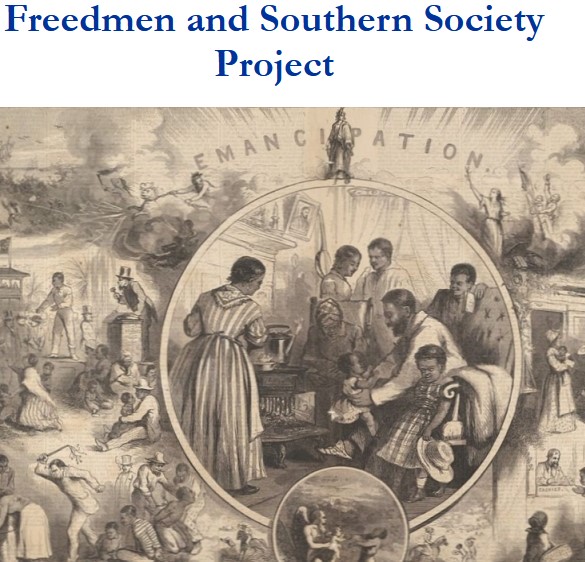
The field orders issued by General William T. Sherman that came after his "March to the Sea"; the orders allowed for the seizure of 400,000 acres along the coastline from Florida to South Carolina to be parceled and settled by free and formerly enslaved black people.
Special Field Orders, No. 15, Headquarters Military Division of the Mississippi, 16 Jan. 1865, Orders & Circulars, series 44, Adjutant General's Office, Record Group 94, National Archives.
Genna Duplisea, The CLIO
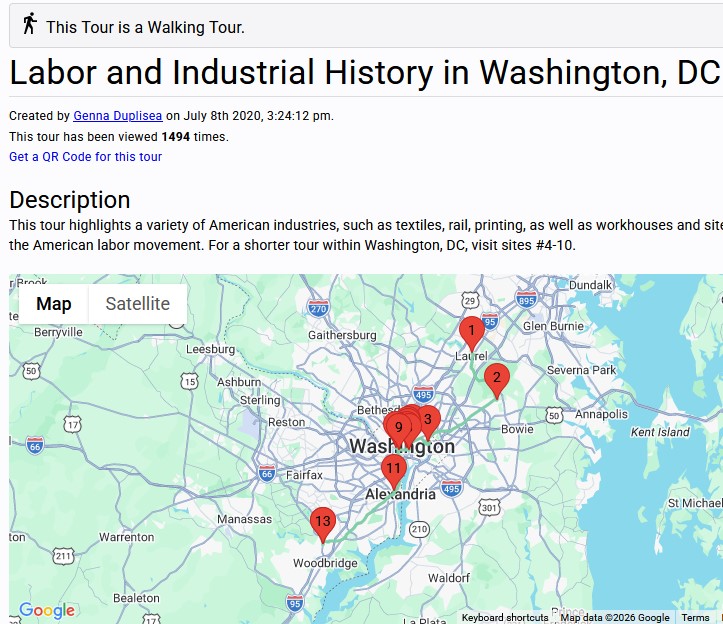
This walking tour highlights a variety of American industries, such as textiles, rail, printing, as well as workhouses and sites relevant to the American labor movement. For a shorter tour within Washington, DC, visit sites #4-10.
13 sites, with an abbreviated version available
Genna Duplisea, The CLIO
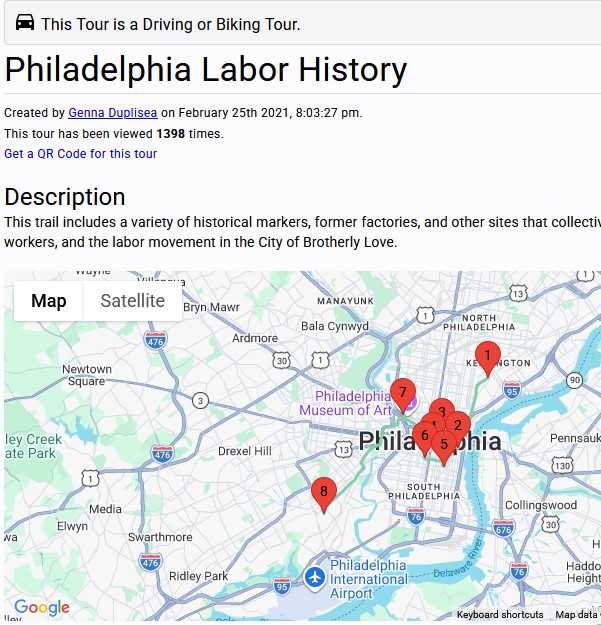
This trail includes 8 sites, including a variety of historical markers, former factories, and other sites that collectively share the history of unions, workers, and the labor movement in the City of Brotherly Love. Includes Founding of the Knights of Labor, Mechanics Union of Trade Associations, Heywood Chair Factory, New Century Guild, House of Industry Site, Hotel Brotherwood, Fairmount Dam and Water Works, Phuiladelphias Labor Monument.
This trail includes a variety of historical markers, former factories, and other sites that collectively share the history of unions, workers, and the labor movement in the City of Brotherly Love. Roughly 1869-1950
Genora Dollinger, History is a Weapon
Genora Johnson was born in Kalamazoo, Michigan, but the family residence was in Flint. She became a socialist at age 16, and in 1931 she joined the newly organized Flint chapter of the Socialist Party.
Her militant actions during the Flint sit-down strike of 1936-37 were the subject of two award winning documentaries: The Great Sit-Down Strike, made by the British Broadcasting Corporation, and the Academy Award-nominated documentary, With Babies and Banners: The Story of the Women's Emergency Brigade. However, I believe Genora's contribution to the strike has not been fully acknowledged for a number of reasons, including the fact that she never wrote her own account of the strike.
Genora Dollinger, a Socialist Party member and leader of Women's Emergency Brigade, gives an account of the Flint Sit-Down Strike

George Alsop
Lord Baltimore established the colony of Maryland in the upper part of Chesapeake Bay in the early 1630s as a refuge for his fellow Catholics. Baltimore’s plans for a feudal system with labor performed by tenant farmers, along with many of the colonists' other high expectations, proved impossible to establish. The tobacco boom and offers of free land to Protestant and Catholic alike drew thousands of English immigrants to Virginia and Maryland. Over three quarters of the migrants to the seventeenth-century Chesapeake arrived as indentured servants, financing their passage by signing indentures, or contracts, for four to seven years labor. Most had agricultural backgrounds and were also fleeing poverty and unemployment in England. George Alsop was one such indentured servant, probably with experience as an artisan or mechanic. He offered an account that boasted of the favorable situation for servants, especially women, to counter other writers who compared conditions in the Chesapeake to slavery.
Written by indentured servant George Alsop and tellingly entitled The necessariness of Servitude proved, with the common usage of Servants in Mary-Land, together with their Priviledges, this account of life in the Maryland colony's Chesapeake Bay casts conditions in a favorable light, particularly where they concern the labor of women.
George Henry Evans
Editor’s Note: This declaration was authored in December 1829 by George Henry Evans, a ‘Jacksonian Democratic’ who condemned slavery and who railed against land monopolies, since he believed this practice prevented the realization of a democracy that represented equally all the people, rather than just the landed elite. Evans founded the first labor-centered newspaper, The Working Man’s Advocate, and was a prominent member of the short-lived progressive Working Men’s Party (members were called ‘Workies’), which publicly supported causes such as reduced working hours, state-funded public education, universal male suffrage, and protection from incarceration in debtors’ prisons. Evans borrows liberally from the version of the July 4, 1776 Declaration — he puts in quotes the sections of the Declaration that he adapts for his own document — and also from Marx.
George Henry Evans' adaption of the American Declaration of Independence and Karl Marx into a document that sheds light on what many New York workers saw as important changes and reforms in the 1820s.
George Martin, History Matters
The cowboy of Western mythology rode the range during the heyday of the long cattle drives in the l860s and 1870s. Despite the individualism emphasized in myth, most cowhands were employees of Eastern and European capitalists who raised cattle as a corporate enterprise to serve a growing appetite for beef in the U.S. Cowboys were overworked hired hands who rode in freezing wind and rain or roasted in the Texas sun; searched for lost cattle; mended fences; ate monotonous and bad food; and suffered stampedes, quicksand, blizzards, floods, and drought. The work was hard, dangerous, and often lonely; pay averaged from $25 to $40 a month. Many became cowboys for lack of other job opportunities; one of every three cowboys was an African American or Mexican. Reminiscing in the 1930s for an interviewer from the Federal Writers Project, cowboy George Martin recalled the tough work, rough conditions, and long days required to keep up with the demands of cattle raising in Texas.
A Cowboy recalls the tough work, rough conditions, and long days required to keep up with the demands of cattle raising in Texas.
George McNeill
full text of the 1892 book The Labor Movement, or, the Problem of To-Day, or George E. McNeill's early, groundbreaking study of the American labor movement.
full text of George E. McNeill's The Labor Movement.
George McNeill
In February 1899, British novelist and poet Rudyard Kipling wrote a poem entitled “The White Man’s Burden: The United States and The Philippine Islands.” In this poem, Kipling urged the U.S. to take up the “burden” of empire, as had Britain and other European nations. Theodore Roosevelt, soon to become vice-president and then president, described it as “rather poor poetry, but good sense from the expansion point of view.” Not everyone was as favorably impressed as Roosevelt. In one of many parodies of “The White Man’s Burden” from the time, labor editor George McNeill penned the satirical “Poor Man’s Burden,” published in March, 1899.
one of many parodies of the famous poem “The White Man’s Burden” from workers' perspective
George McNeill, History Matters
In order to challenge the emphasis on extreme economic individualism espoused by Gilded Age industrialists and laissez-faire theorists in the late 19th century, labor writers drew on diverse historical and religious traditions.
Massachusetts labor reformer George McNeill, for example, found in early Pilgrim life and thought the roots of a rejected American tradition of commonwealth and cooperative activity that he thought should be rekindled.
In this 1884 piece published in the Cigar Makers' Official Journal, McNeill invoked the tradition of cooperative living that sustained the Pilgrims in the 1600s in New England as a role model for modern relations between labor and capital.
(teaching document) An 1884 article that George McNeill published in the Cigar Makers' Official Journal characterizing 1600s Pilgrims and their "cooperative living" model as a solution to the modern divisions between labor and capital.

George Meany Labor Archive, Hornbake Library
Full-length films from AFL-CIO audiovisual Collection are now available on YouTube Channel; 24 films cover a wide range of issues centered around the intersection between the labor movement and struggles for social and economic justice
Full-length films from AFL-CIO Audiovisual Collection

George Milkulvich, History Matters
In the dramatic 1919 steel strike, 350,000 workers walked off their jobs and crippled the industry. The U.S. Senate Committee on Education and Labor set out to investigate the strike while it was still in progress. In his testimony before the committee, George Milkulvich, an immigrant from the Croatian region of Dalmatia (along the eastern shore of the Adriatic Sea), gave a straightforward explanation of what he was striking for—“better treatment.”
Transcribed testimoney of a Croatian immigrant over reasons for 1919 Steel Strike.
George Pullman, History Matters
For workers at the Pullman Palace Car Company in the 1890s, home was the company town of Pullman, Illinois, and rent was deducted from their wages. While owner George Pullman touted it as a model town, the men and women who labored there during the 1893 depression endured starvation wages, deplorable living and working conditions, and, worst of all, Pullman’s paternalistic control over all aspects of their lives. Workers appealed to the American Railway Union (ARU), which organized a nationwide strike and boycott against Pullman. In this open letter in the Chicago Herald in June 1894, as the strike began, Pullman explained his motives for cutting wages during the economic depression of 1893.
Pullman explained his motives for cutting wages during the economic depression of 1893.
George Robert Twelve Hewes, History Matters
George Robert Twelve Hewes, a Boston shoemaker, participated in many of the key events of the Revolutionary crisis. Over half a century later, Hewes described his experiences to James Hawkes. When Parliament passed the Tea Act in 1773, colonists refused to allow cargoes of tea to be unloaded. In the evening of December 16, with Hewes leading one group, the colonists dressed in “the costume of a Indian.” They boarded the ships in Boston harbor and dropped the tea overboard. Hewes’ account shed light on how resistance became revolution. The“Boston Tea Party,” as it became known in the 19th century, became a powerful symbol of the Revolution. And Hewes, artisan and ordinary citizen, was celebrated as a venerable veteran of the struggle for Independence.
George Robert Twelve Hewes recollection of the Boston Tea Party as relayed in writing by James Hawkes; Hewes was a Boston shoemaker who participated in dumping the tea and was celebrated for his role, but was also present at the earlier Boston Massacre.
George Robert Twelve Hewes, History Matters
Beginning in the mid-1760s, colonists began taking to the streets in Boston and other port cities. Crowds of artisans and laborers joined the elite in protesting British policies, although their differing points of view revealed the divisions within colonial society.
Protests mounted in 1767 when Britain passed the Townsend Act, which included a series of unpopular taxes. In Boston, resentment and tension also grew over the presence of British troops, quartered in town to discourage demonstrations, who were also looking for jobs.
A private seeking work at a ropemakers’ establishment sparked a confrontation on Boston’s King Street. When some in the crowd pelted the assembled British soldiers, the troops opened fire; five colonists were killed and six wounded. George Robert Twelves Hewes, a Boston shoemaker, participated in many of the key events of the Revolutionary crisis. Over half a century later, Hewes told James Hawkes about his presence at the Boston Massacre and the Boston Tea Party.
George Robert Twelve Hewes recollection of the Boston Massacre as relayed in writing by James Hawkes; Hewes was a Boston shoemaker who was present at the Massacre and participated in the Boston Tea Party seven years later.

George S. McGovern, Leonard H. Guttridge
The Great Coalfield War is the most complete and carefully documented account of the more-than-year-long strike by the United Mineworkers' Union to gain recognition from stubborn anti-union operators who were joined by political, judicial, media, law enforcement, and other powerful interests in the Colorado industrial establishment.
The bravery, hardship, and deaths suffered by the miners and their families moved millions of Americans to unprecedented sympathy for the efforts of organized labor and led President Wilson to order federal troops to restore law and order. Though action shifted to Washington and a congressional investigation, it would take years before Colorado's coal miners gained union protection.
A full account of the 1913-1914 Ludlow strike, and the ensuing battle between miners and militia.
.jpg)
George Schilling
George Schilling was the leading organizer of the effort to pardon the Haymarket anarchists. Though he did this, and was widely thought to be an anarchist himself, this letter shows clearly that he held deeply opposing beliefs to the rhetoric which justified violence, or sought to induce revolution. It is a letter to Lucy Parsons, the widow of Lucy Parsons. Parsons had just returned from delivering a fiery speech at the mining town of Spring Valley, Illinois, a coal mining town (just west of LaSalle-Peru around Highway 39 and Highway 80 intersections in Illinois) where anarchist views flourished among the miners in the 1890s. Those miners continued to experience the use of police force to break strikes.
(teaching document) George Schilling chastises Lucy Parsons
George Swetnam, History Matters
Workers sang during strikes not only to state their beliefs and goals, but because singing helped bind workers together. The Homestead strike of 1892 even had its own Homestead Strike Songster, and the story of the strike can be traced in the lyrics of the following four songs. “The Homestead Strike” explained that Carnegie’s efforts to “lower our wages” was the basic cause of the strike. “The Fort That Frick Built” described Homestead manager Henry Frick’s transformation of the mill on the eve of the strike into a fortress with barbed-wire fences. The death of nine strikers was chronicled in “Father Was Killed by the Pinkerton Men.” And “Song of a Strike,” written by George Swetnam, retrospectively commemorated the Homestead strikers' courage in defending their homes and their jobs against the overwhelming might of the Carnegie Steel Company and their hired "bum detectives."
Songs from the Homestead battles

Georgia State University
The AFL-CIO established the Southeast Division of its Civil Rights Department in 1965, part of an enhanced focus on civil rights issues prompted by the passage of the 1964 Civil Rights Act. Led by longtime labor organizer E.T. “Al” Kehrer, the Southeast Division worked to promote minority membership in unions, education and training programs aimed at minority groups, anti-discrimination work within unions, and voter registration. It collaborated closely with many other labor and civil rights organizations, such as the A. Philip Randolph Institute and the National Urban League.
Between 1973 and 1989, the Southeast Division made seven donations of materials to the GSU Southern Labor Archives. These include correspondence, print materials and publications by the AFL-CIO and other organizations, administrative records, photographs, and audio recordings, as well as the personal papers of E.T. Kehrer. Copyright to the items in this collection is held by various entities. Rights information, if known, is specified in the item’s description.
AFL-CIO Civil Rights Department Southern Region records (L1973-05)
Collection L1973-05 was the first collection to be donated to GSU. It consists of one box of correspondence between E. T. Kehrer and representatives of a variety of labor and civil rights organizations, and one box of mixed publications, press releases, internal documents, and other print materials. The collection represents the early engagement of the AFL-CIO with civil rights activism and related political issues, including the contentious 1968 Presidential election.
AFL-CIO Civil Rights Department Southern Office records (L1983-26)
Collection L1983-26 represents the growth of the Southeast Division during the mid-1970s. The collection includes six series that cover three major areas: correspondence of E. T. Kehrer with national and state AFL-CIO officials; correspondence and documents related to job training programs for minority and women workers; and subject files on various individuals, organizations, and projects. Notable are records of engagement between the Southeast Division and the A. Philip Randolph Institute, a major Black labor organization, as well as the Martin Luther King, Jr., Center for Nonviolent Social Change.
AFL-CIO Civil Rights Department Southeastern Office records (L1985-16)
The materials in Collection L1985-16 represent detailed records of major collaborative projects of the Southeast Division. The collection’s 14 series include records of the partnership between the AFL-CIO and the American Red Cross to employ union facilities for coastal disaster relief; correspondence and organizing materials for the boycott of textile manufacturer J. P. Stevens and Co.; materials from a Georgia Council for the Arts and Humanities initiative to promote traditional Appalachian crafts education; and records from E. T. Kehrer’s term as a board member of the Joint Council on Economic Education.
AFL-CIO Civil Rights Department Southern Office records (L1986-01)
Collection L1986-01 consists primarily of correspondence, with a relatively small portion of documents compared to other collections of the Southeast Division records. Its major components include correspondence between E. T. Kehrer and AFL-CIO officials, several folders of official AFL-CIO statements, and correspondence between Kehrer and organizations like the A. Philip Randolph Institute and the National Urban League. Much of this collection relates to the efforts of labor and civil rights organizations to adjust to the political conditions of the Reagan administration in the 1980s.
AFL-CIO Civil Rights Department Southeastern Region records (L1988-22)
Collection 1988-22 has a wide-ranging subject file series as well as a series of correspondence between E. T. Kehrer and AFL-CIO officials and many records of conferences and educational events organized by the AFL-CIO, A. Philip Randolph Institute, and National Urban League.
AFL-CIO Southern Area Civil Rights Department records (L1989-17)
Collection L1989-17 contains the remaining records held by the Southeast Division at the time of its closure. It includes extensive AFL-CIO correspondence and files, most notably unique records on the Division’s role in affirmative action programs for large federal civil engineering projects, its participation in the Equal Employment Opportunity Commission’s workplace discrimination reporting initiatives, and E. T. Kehrer’s political organizing activities.
E. T. Kehrer papers
The Southeast Division Civil Rights Department records have been digitized through the project Advancing Workers’ Rights in the American South, which is supported by a Hidden Collections grant awarded to GSU and the University of Maryland from the Council on Library and InformationResources (CLIR). The University of Maryland digitized the Civil Rights Department records from the National AFL-CIO office; they can be accessed here. The papers have been united and will be available to be viewed together within the Civil Rights Digital Library in October 2023. This grant program is made possible by funding from the Mellon Foundation.
Digitized correspondence, print materials and publications by the AFL-CIO and other organizations, administrative records, photographs, and audio recordings, as well as the personal papers of E.T. Kehrer.
Georgia State University
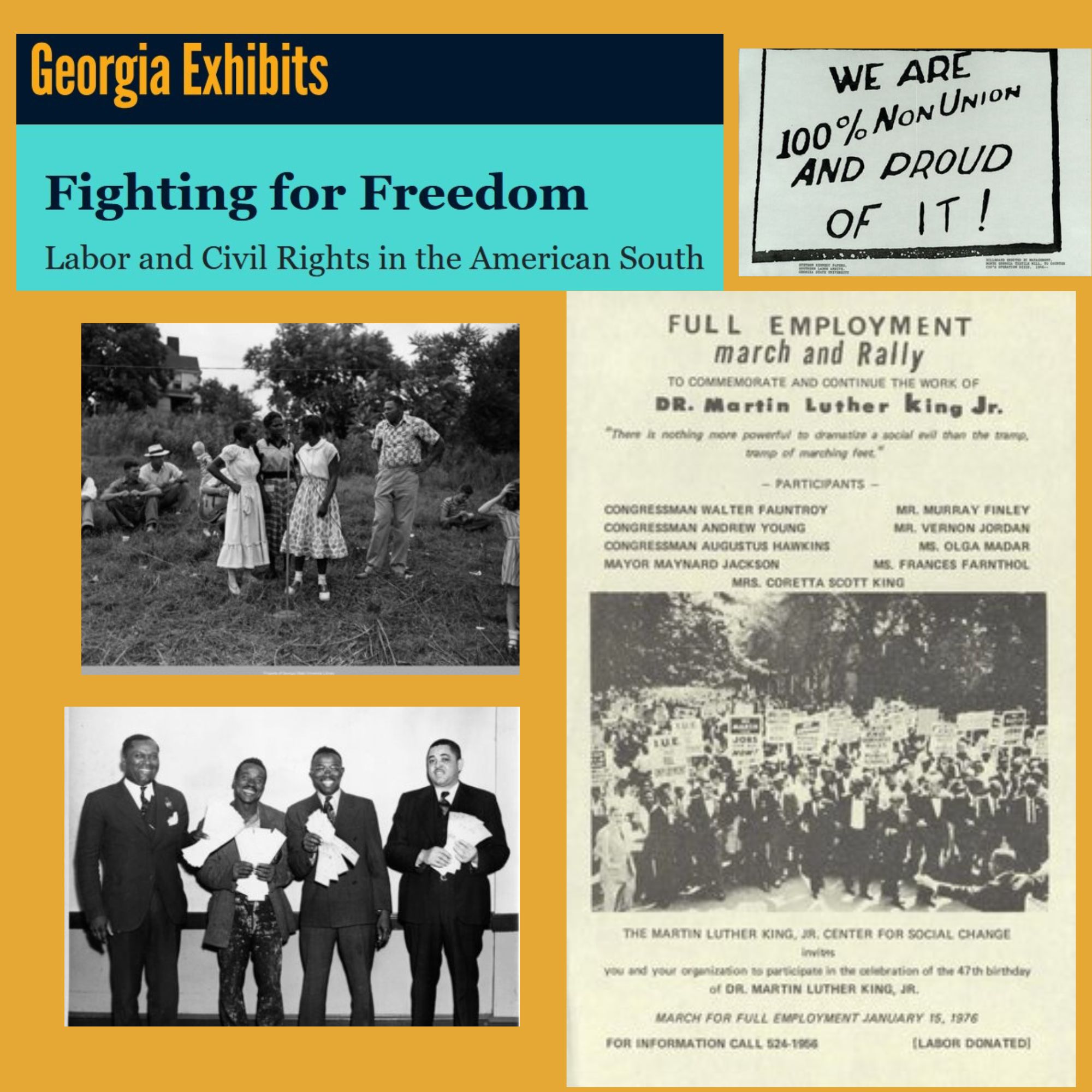
Throughout the twentieth century, organized labor and civil rights organizations fought for the advancement of working-class Americans. These social movements frequently combined strategies, such as strikes, marches, and boycotts, to bring about progressive change. But the opportunistic racism of politicians and employers throughout the anti-union South continually sabotaged their efforts. Activists found it nearly impossible to organize within poor white working communities, where employers incited white workers to abuse Black co-workers rather than protest their own working conditions. As a result, despite grassroots and large-scale efforts, much of the South remained segregated and nonunionized. This exhibit explores the intersection of civil rights and organized labor in the American South through the lens of AFL-CIO, which was formed after the organization’s merger in 1955 to enforce its new non-discrimination policy. The exhibit is made possible by the Council on Library and Information Resources’ Hidden Collections Grant and displays material from Georgia State University, the University of Maryland, and other Digital Library of Georgia collections. By examining the department’s conflicts and struggles over the twentieth century, this project hopes to shed light on an unsung, indispensable force in American history.
Sections:
The Pre-Civil Rights Era: 1920-1955
The Civil Rights Movement: 1956-1969
Post-Civil Rights: 1970-1976
Conclusion: The AFL-CIO
Teacher Resources:
Primary Source Set
Topic Overview
Teachers' Guide
Classroom Activities
Primary Source Analysis
Additional Resources: NGE Articles
Additional Resources: Primary Sources
Additional Resources: Secondary Sources
An exhibit with documents and teacher resources that connect Labor and Civil Rights in the American South
Georgia State University Library
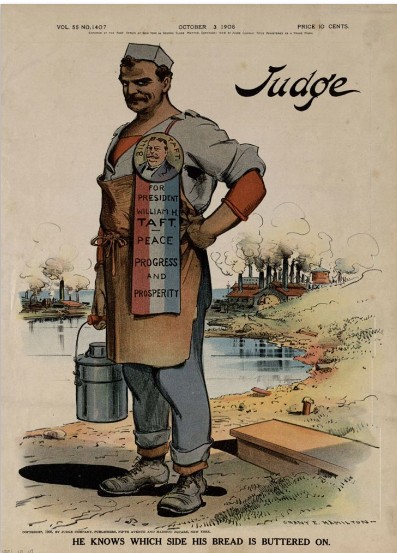
156 Broadsides and art from 1860-1910
Depicting :
Labor movement (64)
Labor unions (33)
Strikes and lockouts (27)
working class (22)
monopolies (14)
capitalism (11)
Cotton trade (11)
African American agricultural laborers (10)
Labor leaders (9)
Riots (9)
TYPE:
clippings (information artifacts) (156)
engravings (prints) (74)
lithographic engravings (prints) (54)
photoengravings (prints) (1)
photomechanical prints (1)
by:
Nast, Thomas, 1840-1902 (24)
Keppler, Joseph Ferdinand, 1838-1894 (10)
Opper, Frederick Burr, 1857-1937 (8)
Rogers, W. A. (William Allen), 1854-1931 (8)
Taylor, Charles Jay, 1855-1929 (8)
Ehrhart, S. D. (Samuel D.), approximately 1862-1937 (5)
Hamilton, Grant E. (5)
Bradley, Horace (4)
Dalrymple, Louis, 1866-1905 (4)
Frenzeny, Paul (4)
Gillam, Bernhard, 1856-1896 (4)
Gillam, F. Victor, 1858?-1920 (4)
Snyder, W. P. (3)
Tavernier, Jules, 1844-1889 (3)
Alexander, John White, 1856-1915 (2)
Bunnell, C. (2)
Burridge, Walter (2)
Davidson, J. O. (2)
Keppler, Udo J., 1872-1956 (2)
Ogden, Henry Alexander, 1856-1936 (2)
Shults, A. B. (Albert B.), 1868-1913 (2)
Waud, William, -1878 (2)
Abbey, Edwin Austin, 1852-1911 (1)
Beatty, John W. (John Wesley), 1851-1924 (1)
Becker, Joseph, 1841-1910 (1)
Beeson, Jacob (1)
Berghaus, Albert, active 1869-1880 (1)
Durkin, John, 1868-1903 (1)
George F. Cram Company (1)
Graetz, F. (Friedrich), approximately 1840-approximately 1913 (1)
Griffing, C. M. (1)
Hurst, Hal, 1865-1938 (1)
Hyde, John N. (1)
Kemble, E. W. (Edward Windsor), 1861-1933 (1)
Koehler, Robert, 1850-1917 (1)
Lewis, Robert (1)
MacDonald, J. (1)
Mente, Charles (1)
Pughe, J. S. (John S.), 1870-1909 (1)
Ryder, J. F. (James Fitzallan), 1826-1904 (1)
Schell, Frederic B. (1)
Sears, A. T. (1)
Sears, C. (1)
Sheppard, William Ludwell, 1833-1912 (1)
Taylor, James E., 1839-1901 (1)
Thulstrup, Thure de, 1848-1930 (1)
Wales, James Albert, 1852-1886 (1)
Young, Art, 1866-1943 (1)
Zimmerman, Eugene, 1862-1935 (1)
Broadsides and art related to labor politics
Georgia State University Library
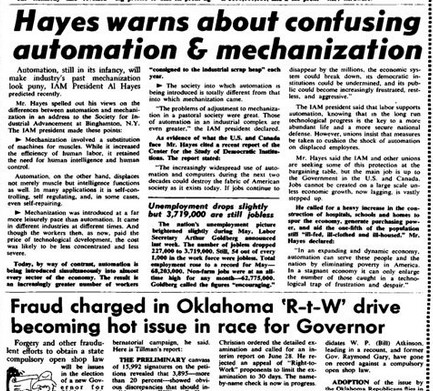
This is a search in a robust set of digitized archives where the word automation is listed. Try automated in the search box as well. There are many hits from the International Association of Machinists, whose records have been partly digitized.
hundreds of items from the search term automation in this large colleciton,

Georgia State University Library
The Eastern Air Lines Digital Collection brings together content that represents different aspects of Eastern’s legendary history: labor, management, public relations, mediation, corporate culture, marketing, media coverage, and operations.
hundreds of files from labor and management documenting labor and other issues at the company
Film/Video
Audio/Interview
Podcast/Program
Text/Document
Image
Graphs/Data
Timeline
Southwest
West
Midwest
Southeast
Northeast
Mexico
Canada
Global