


Collections
Library
Type
Region
Coverage:
-
Published:
-
Harry Everet Drobish
This collection of 63 photographic prints of various sizes documents migrant labor camps in California. The photographs were taken in 1935-1936, many likely by Harry Everett Drobish. Included are photographs of groups and buildings at the Arvin Migratory Labor Camp and other camps in Kern County, California. Also included are photographs of Hooverville in Sacramento, some taken by the California State Emergency Relief Administration. Printed and handwritten captions found on or below the photographs are reprinted in the container listing.
63 photographic prints of various sizes documents migrant labor camps in California.
Harry L. Katz
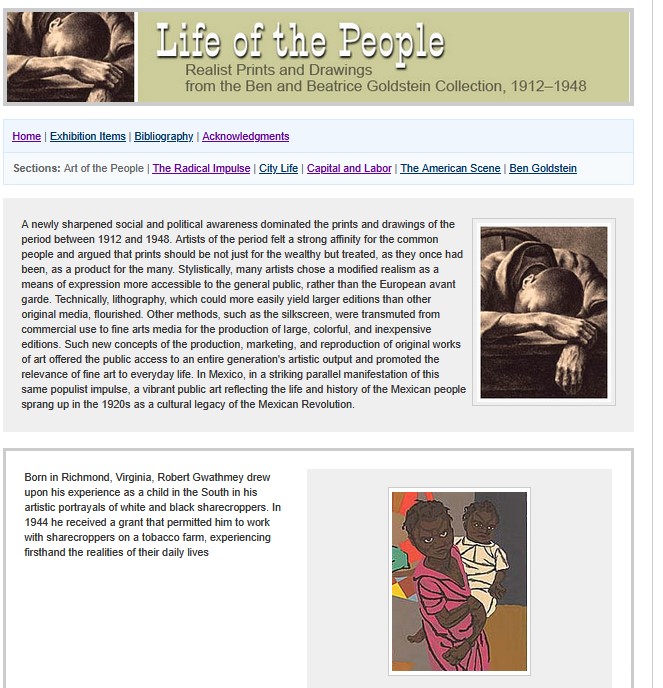
A newly sharpened social and political awareness dominated the prints and drawings of the period between 1912 and 1948. Artists of the period felt a strong affinity for the common people and argued that prints should be not just for the wealthy but treated, as they once had been, as a product for the many. Stylistically, many artists chose a modified realism as a means of expression more accessible to the general public, rather than the European avant garde. Technically, lithography, which could more easily yield larger editions than other original media, flourished. Other methods, such as the silkscreen, were transmuted from commercial use to fine arts media for the production of large, colorful, and inexpensive editions. Such new concepts of the production, marketing, and reproduction of original works of art offered the public access to an entire generation's artistic output and promoted the relevance of fine art to everyday life. In Mexico, in a striking parallel manifestation of this same populist impulse, a vibrant public art reflecting the life and history of the Mexican people sprang up in the 1920s as a cultural legacy of the Mexican Revolution.
Digital exhibition of artworks from the Ben and Beatrice Goldstein collection, curated in this exhibit to focus on the division between capital and labor from the Gilded Age to the onset of the Great Depression.
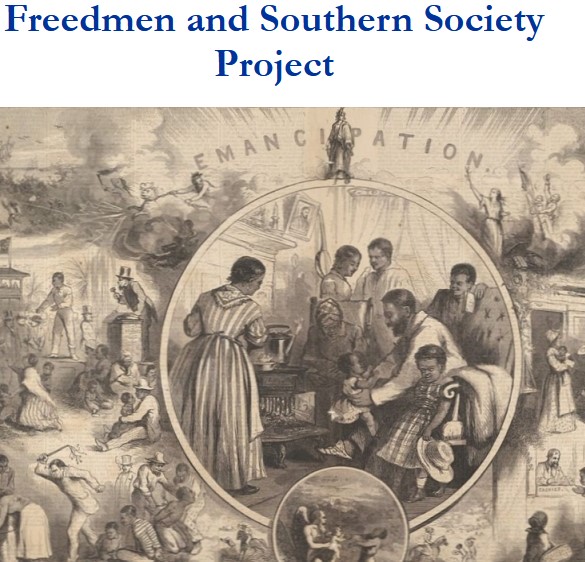
Harry McMillan before the American Freedmen's Inquiry Commission,
Testifying before a War Department commission that was investigating the condition and prospects of ex-slaves, Harry McMillan discussed his people's lives in bondage and their aspirations in freedom.
The testimony of Harry McMillan before the American Freedmen's Inquiry on the conditions slaves and ex-slaves faced.

Hartford Labor
only one issue so far of this newspaper
One issue of an 1894 labor newspaper from Hartford Connecticut
Hartmut Keil
"This anthology of documents is ... resulting from the work of the Chicago Project on the social history of German workers from 1850 to 1910"--With this mass of original documents, Keil and Jentz have conveyed the lost world of Chicago's German working class. They have drawn out the language, imagery, and aspirations of a major ethnic group within the context of a city then on the threshold of becoming a great industrial center. Relying on the scholarly initiatives of the "new social historians," the editors, by their illuminating headnotes and shrewd choices, re-create both the residual and oppositional culture, the latter taking the form of May Day parades, commemorations of Haymarket, etc. Their work will advance ethnic and labor historical scholarship; a model for other such studies.
A collection of primary sources about the German working class in Chicago.
Hartmut Keil
A collection of essays detailing the lives of German immigrants in Chicago.
A collection of essays detailing the lives of German immigrants in Chicago.
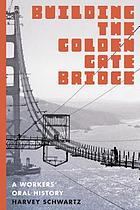
Harvey Schwartz
Moving beyond the familiar accounts of politics and the achievements of celebrity engineers and designers, Building the Golden Gate Bridge is the first book to primarily feature the voices of the workers themselves. This is the story of survivors who vividly recall the hardships, hazards, and victories of constructing the landmark span during the Great Depression. Labor historian Harvey Schwartz has compiled oral histories of nine workers who helped build the celebrated bridge. Their powerful recollections chronicle the technical details of construction, the grueling physical conditions they endured, the small pleasures they enjoyed, and the gruesome accidents some workers suffered. The result is an evocation of working-class life and culture in a bygone era. Most of the bridge builders were men of European descent, many of them the sons of immigrants. Schwartz also interviewed women: two nurses who cared for the injured and tolerated their antics, the wife of one 1930s builder, and an African American ironworker who toiled on the bridge in later years. These powerful stories are accompanied by stunning photographs of the bridge under construction. An homage to both the American worker and the quintessential San Francisco landmark, Building the Golden Gate Bridge expands our understanding of Depression-era labor and California history and makes a unique contribution to the literature of this iconic span
oral histories of nine workers who helped build the celebrated bridge
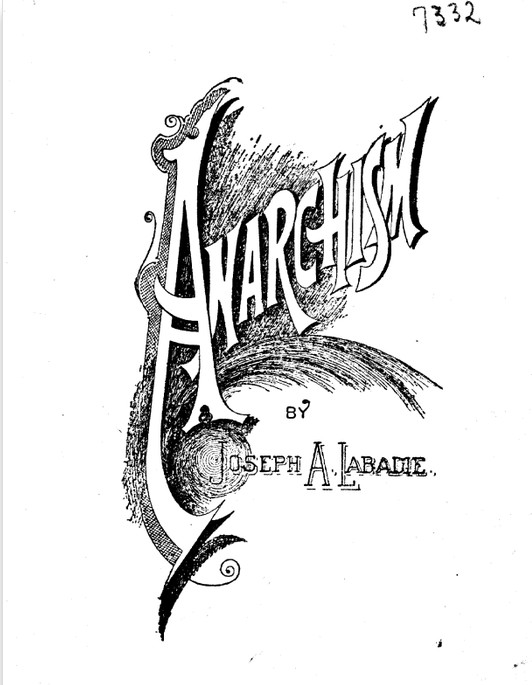
Hathi Trust, Labadie Collection
The HathiTrust-Labadie Collection contains nearly 1,500 materials collected from various anarchist writers, groups, and organizations that were active around the world in the nineteenth and twentieth centuries, with the bulk of the material coming from the United States.
Most of the collection was printed in English, but there are also hundreds of pamphlets printed in German, Italian, French, and Spanish.
here are also some materials printed in Dutch, Polish, Esperanto, Russian, Yiddish, Chinese, Portuguese, Romani, Czech, Hungarian, Lithuanian, and finally Swedish.
HathiTrust's holdings from the Labadie Collection, specifically featuring materials related to the history of anarchism in the United States.
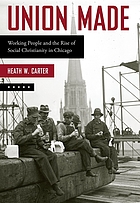
Heath W. Carter
Carter advances a new interpretation of the origins of American Social Christianity. While historians have often attributed the rise of the Social Gospel to middle-class ministers, seminary professors, and social reformers, he places working people at the very center of the story. Leading readers into the thick of late-19th-century Chicago's tumultuous history, Carter shows that countless working-class believers participated in the heated debates over the implications of Christianity for industrializing society, often with as much fervor as they did in other contests over wages and the length of the workday
shows that countless working-class believers participated in the heated debates over the implications of Christianity for industrializing society.
Heather Berg
Every porn scene is a record of people at work. But on-camera labor is only the beginning of the story. Part labor history, part ethnography illuminating the lives of the performers who work in the medium, 'Porn Work' takes readers behind the scenes to explore what porn performers think of their work and how they intervene to hack it. It tells a story of crafty workers, faltering managers, and shifting solidarities"-- Provided by publisher
Part labor history, part ethnography, illuminating the lives and thoughts of the performers who work in the Porn industry
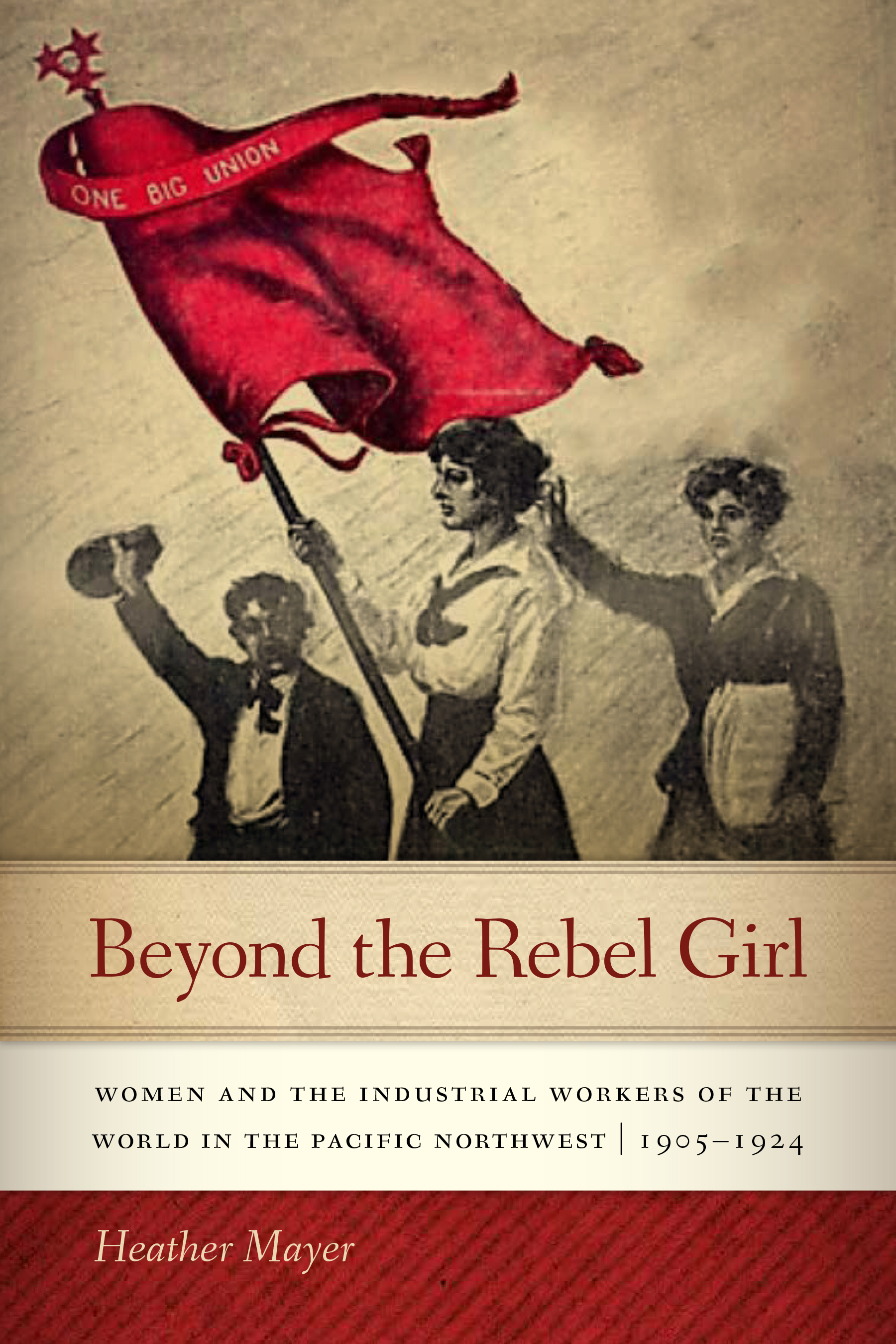
Heather Mayer
More than a century after their founding in 1905, the Industrial Workers of the World—or Wobblies as they are commonly known—remain a popular subject for study and discussion among students of labor history and social justice. They are often portrayed as lovable underdogs, with their songs and cartoons, generally irreverent attitude, and stalwart courage in the face of systemic persecution from vigilantes, law enforcement, and government officials.
In Beyond the Rebel Girl, historian Heather Mayer questions the well-worn vision of Wobblies as young, single, male, itinerant workers. While such workers formed a large portion of the membership, they weren’t the whole picture. In small towns across the Northwest, and in the larger cities of Seattle, Portland, and Spokane, women played an integral role in Wobbly life. Single women, but also families—husband and wife Wobbly teams—played important roles in some of the biggest fights for justice. IWW halls in these Northwest cities often functioned as community centers, with family-friendly events and entertainment.
Women were drawn to the IWW for its radical vision, inclusionary policies, birth control advocacy, and emphasis on freedom of choice in marriage. The IWW also offered women an avenue for activism that wasn’t focused primarily on the fight for suffrage. Beyond the Rebel Girl deepens our understanding of how the IWW functioned and how the union supported women in their fight for birth control, sexual emancipation, and better labor conditions, all while facing persecution at the local, state, and federal levels.
Integrates women into larger histories of the Industrial Workers of the World
Helen J. Knowles
Tells the story behind the US Supreme Court's 1937 decision in West Coast Hotel v. Parrish upholding Washington State's minimum wage law for women; illuminates the lives of those involved in the litigation and reveals the case's impact on local, state, and national levels" -- Provided by publisher
Tells the story behind the US Supreme Court's 1937 decision in West Coast Hotel v. Parrish upholding Washington State's minimum wage law for women.

Helen Marot
Helen Marot's early history of the Industrial Workers of the World, American Labor Unions. Marot's main goal is not impartiality, but rather to "intepret each one of these organizations as it interprets itself" while noting the criticisms made by each group of one another. Some major organizations covered in the book include the American Federation of Labor, the Industrial Workers of the World, and the Railroad Brotherhoods. The book is organized both thematically and by organization as follows: Chapter I: Philanthropy and Labor Unions; Chapter II: American Federation of Labor; Chatper III: The Railroad Brotherhoods; Chapter IV: Industrial Workers of the World; Chapter V: Organization of Women; Chapter VI: Industrial and Trade Organization; Chapter VII: Sympathetic Strike Action; Chapter VIII: Union Recognition and the Union Shop; Chapter IX: The Union Label; Chapter X: The Boycott; Chapter XI: Arbitration; Chapter XII: Legislation and the Unions; Chapter XIII: The Conflict between Labor and the Courts; Chapter XIV: Violence; Chapter XV: Strikes and Violence; Chapter XVI: Sabotage; Chapter XVII: Limitation of Output; Chapter XVIII: Scientific Management; Chapter XIX: Labor in Politics; and Chapter XX: Direct Action.
Internet Archive (full text): https://archive.org/details/americanlaboruni00maro/page/n1/mode/1up
Here, links to the full text of American Labor Unions, Helen Marot's 1913 book that desrcibes the history of several major U.S. labor organizations.

Henry Bell
The red flag: there is no symbol, perhaps other than the crucifix and the crescent moon, that so many people have lived and died for. A standard of hope and resistance to millions, and of terror and tyranny to many. But why is the red flag red? How did it come to represent the workers against the propertied class? And how did it travel the world?
In Henry Bell’s lively account, we journey around the globe and back through history, tracing the lineage of the red flag as both a material object and a symbol. The book explores the triumphs and disasters of the flag’s history, its designers and makers, heroes and villains, and the utopias and wastelands that have kept the red flag flying.
From its martial beginnings in Rome and France, to the raising of a blood stained flag at the Merthyr Rising and the arrival of the red flag at the Paris Commune; from the jungles of north-eastern India to the factories of Cuba; Red Threads explores how this symbol of working class power first came to be held aloft in the hands of revolutionaries; who raises it today; and its meaning for the future.
explores how the red flag came to be such an important symbol of labor radicalism
Henry Blake, History Matters
In some ways, emancipation and Reconstruction broke the power of white southern planters over their labor force. Freedpeople negotiated with planters over how the land would be cultivated and how they would be compensated. African-American families worked small plots independently, sometimes obtaining land for cash or, more commonly, for a fixed share of the year’s crop; this latter practice was known as sharecropping. By 1870, sharecropping was the dominant means by which African Americans could gain access to land in the South. Still, freedpeople desired independent proprietorship. In this interview, African-American farmer Henry Blake recalls how black land ownership became an elusive goal as unequal power relations between white and black hardened and the Ku Klux Klan’s terrorist campaigns increased. Blake’s narrative and many others were recorded during an ambitious New Deal (1936–38) program of interviews with ex-slaves. Despite unfamiliar interviewers and distant memories, these first person accounts are an unparalleled resource.
A Federal Writer's Project interview of African-American farmer Henry Blake where he recalls the black aspirations to land ownership, unequal power relations, and the Ku Klux Klan's terror campaigns.
Henry Frick, History Matters
During the 1892 strike at the Homestead Steel Works, plant manager Henry Clay Frick attempted to defeat the strikers forcibly by hiring three hundred armed agents of the notorious Pinkerton Detective Agency. The strikers fought back, and, after casualties and deaths on both sides, the Pinkertons surrendered. In the aftermath of the Pinkerton debacle, Frick spoke with a reporter for the Pittsburgh Post. He laid out his implacable opposition to dealing with the union, his belief that the Pennsylvania governor should send in troops, and his goal of reducing wages at the plant, the central issue in the conflict. Frick argued that the Homestead owners were not allowed to reap the fruits of their investment because of workers' inordinately high wage scales. The union, on the other hand, claimed that the cost of producing steel at Homestead was well below the industry standard, in large measure because the Homestead workers had cooperated in the recent mechanization of the plant.
Primary source document in which plant manager Henry Frick defends his militarized, and violent, policy toward the Homestead strikers
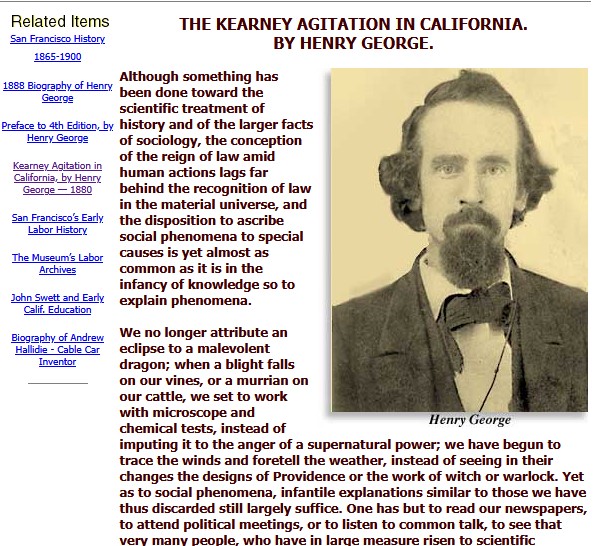
Henry George
The Museum of the City of San Francisco's page on Henry George's writings about the "Kearney Agitation," or when Irish American labor leader Denis Kearney set about riling up nativist sentiment against Chinese labor during the 1877 Railway Strikes.
Part I: http://www.sfmuseum.org/hist9/hgeorge3.html
Part II: http://www.sfmuseum.org/hist9/hgeorge3a.html
Henry George's historical article on Irish leader Denis Kearney's stirring of anti-Chinese sentiments
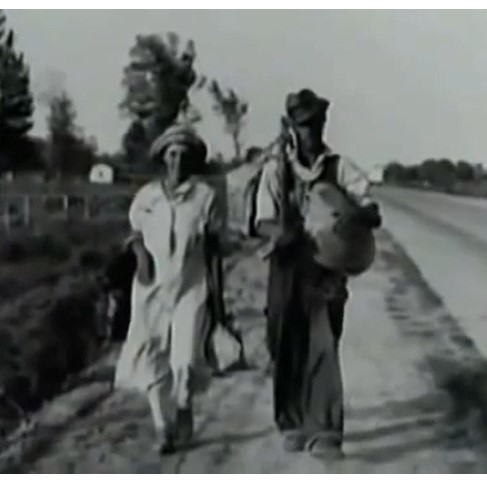
Henry Hampton, Dante James, Blackside
60 minute documentary, Episode 5 of teh Great Depression series, from 1993 ; In the American democracy of the 1930s two visions of liberty collided as working
men and women battled landowners and factory managers for the right to join a union. On the tenant farms and in the steel factories working people asserted
their citizenship in the midst of great economic turmoil and a tide of government reform.
Men and women battled landowners and factory managers for the right to join a union. On the tenant farms and in the steel factories working people asserted
their citizenship in the midst of great economic turmoil and a tide of government reform. It contrasts this southern drive with the more successful steelworkers drive in steel in the North, though it stresses the violence of organizing in both North and South, concluding with the Memorial Day Massacre of 1937
A film portraying Depression-era tenant farmers and sharecroppers struggles with landowners and steelworkers and their employers over the right to unionize throught the Southern Tenant Farmers' Union (STFU).
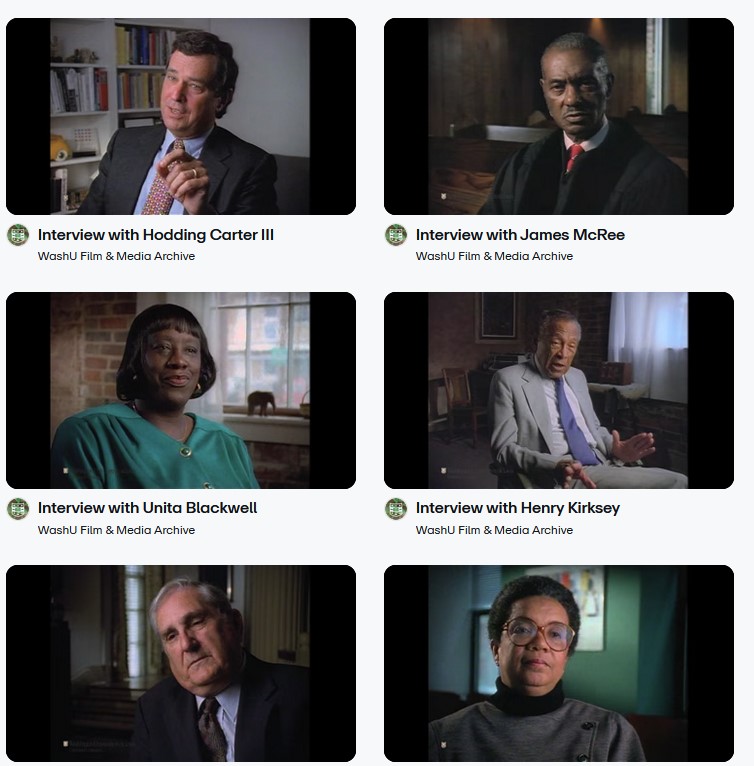
Henry Hampton, Washington University
America’s War on Poverty was originally broadcast in 1995 as a five-part series on PBS. The documentary was created by Blackside, Inc., and covers events that took place after President Johnson declared an “unconditional war on poverty.”
The full interviews from the 1995 PBS documentary focused on Lyndon B. Johnson's war on poverty

Henry Hampton, Washington University
Originally debuting on PBS stations in 1993, The Great Depression was a 7-part series that met with critical acclaim, winning an Emmy for writing and an Alfred I. duPont–Columbia University Award. The series was advised by James Green, labor historian, so many of these deal with critical moments of labor history in the United States in this period. Subjects include the Southern Tenant Farmers Union, Textile strike of 1934, Aliquippa and Chicago Struggles against Little Steel, including the Memorial Day Massacre, unemployment protests, Henry Ford, Ford Hunger March, Each video and transcript represents the entire interview conducted by Blackside, Inc., including portions that did not appear in the final program. For more information, please contact the Film & Media Archive.
These interviews are part of the Henry Hampton Collection housed at the Film & Media Archive at WashU Libraries. Visit the Film & Media Archive’s Henry Hampton Collection to see more.
The full interviews of the subjects of the Great Depression series, a seminal 1990s series by the great documentarian Henry Hampton, have a lot of labor-oriented subjects
Henry Louis Gates, PBS
In the 360 years between 1500 and the end of the slave trade in the 1860s, at least 12 million Africans were forcibly taken to the Americas - then known as the "New World" to European settlers. This largest forced migration in human history relocated some 50 ethnic and linguistic groups.Only a small portion of the enslaved - less than half a million - were sent to North America. The majority went to South America and the Caribbean. In the mid-1600s, Africans outnumbered Europeans in nascent cities such as Mexico City, Havana and Lima.
A five chapter PBS presentation on the history of African-American migration, with scholar Henry Louis Gates, Jr.
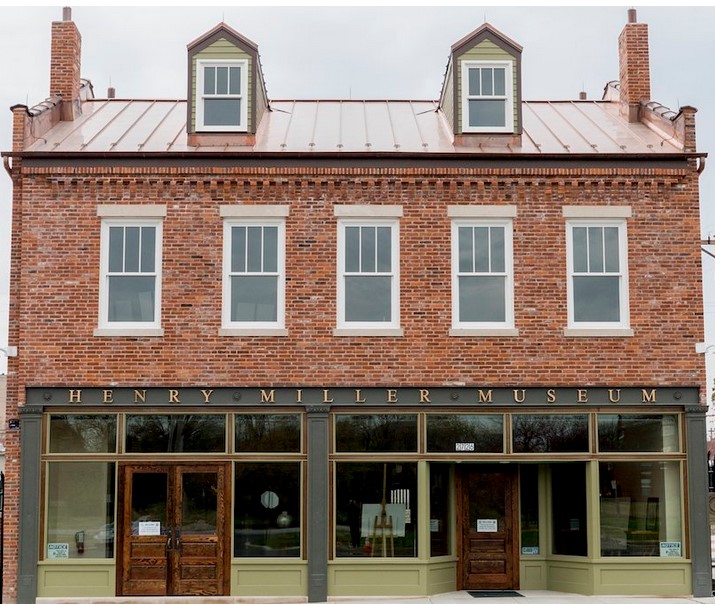
Henry Miller Museum
In 1891, a traveling lineman, Henry Miller, organized the founding convention of what would become the International Brotherhood of Electrical Workers at the St. Louis boarding house he lived in at the time. Today, that boarding house houses the Henry Miller Museum honoring the IBEW’s founders and history.
This museum is at the site of the boardinghouse where the IBEW was born
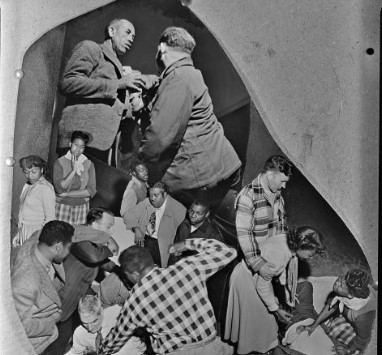
Henry P. Anderson, San Fracisco State University Library
Henry P. Anderson conducted research on the Bracero Program and these are rich resources from his collection. Includes images, digitized meeting recordings, and other rich materials. OVer 800 items
over 800 items in a collection about the Bracero program

Herbert G. Gutman
Many Pasts: Readings in American Social History, 1600-1876, Volume I, edited by Herbert G. Gutman and Gregory S. Kealey,
consists of four broad sections:
The Colonial World, 1600-1763;
Independence and the New Nation, 1763-1815;
The Beginnings of a New Society, 1815-1843;
The New Society and the Changing Old Society, 1843-1876. Among the contributors to Volume I: Edmund S. Morgan, Nancy Oestreich Lurie, Richard B. Morris, Pauline Maier, Sidney W. Mintz, Allan Kulikoff, San Bass Warner, Alfred Young, Gerald Mullin, Norman Ware, Edward Pessen, Caroline Ware, Carroll Smith-Rosenberg, John F. C. Harrison, Alice H. Bauer, Charles Hirschfeld, Avery Craven, Gunter Barth, David Montgomery, W. E. B. Dubois, Joel Williamson. This collection of readings focuses on these objectives: to acquaint the reader with historians whose writings in American social history directly or indirectly explore critical intersections of culture and society; to supplement in basic ways the traditional political emphasis in American history courses; to illustrate how different methods of historical inquiry have been used by historians to spotlight important but often neglected aspects of the American past. It also focuses on ALL the ethnic and racial groups in America as well as on the varied social classes. The editors emphasize the structure of American Society, how it has changed, and how those changes were experienced and interpreted by Americans of varied social classes
Multivolume textbook that introduces the reader to important writers and topics in labor history.
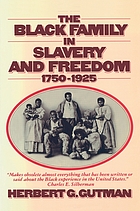
Herbert G. Gutman
Describes the many generations of the Black families on the Good Hope Plantation in South Carolina
Describes the many generations of the Black families on the Good Hope Plantation in South Carolina
Film/Video
Audio/Interview
Podcast/Program
Text/Document
Image
Graphs/Data
Timeline
Southwest
West
Midwest
Southeast
Northeast
Mexico
Canada
Global
Books
Teaching
Lectures
Digital Archives
Journals
Bibliographies
Topic Intro