


Collections
Library
Type
Region
Coverage:
-
Published:
-

History Matters
Charles Woodmason, a newly ordained Anglican minister, left the comforts of Charleston, South Carolina, in 1761 to travel for six years in the Carolina backcountry as an itinerant minister, seeking to bring the established church to areas where it had not taken hold. He also became a fierce partisan of the Regulator movement, a frontier rebellion attempting to obtain a greater voice and fairer claims for backcountry residents who resented the monopolization of power by the coastal leaders. Although Woodmason was hostile toward the colony’s elite for their lack of concern over the political and especially religious life of the frontier, the British migrant held traditional beliefs about morality and social order. He was appalled by the immoral and irreligious behavior rampant on the frontier, as he made clear in this selection from his journal of 1768.
Writings from Charles Woodmason, a leader in the Regulator movment who traveled the Carolinas and recorded his thoughts and perspective on the rampant "immorality" he witnessed there.
History Matters
Between 1800 and 1840, improved transportation networks and larger markets altered the way goods were produced, as workshops and factories became larger and fewer goods were produced by household labor. Another effect of growing industrialization was social stratification, as some master craftsmen became businessmen while their journeymen lost their independence and became wage workers. This illustration from the 1841 novel The Career of Puffer Hopkins caricatured the growing distinction between masters and journeymen. The master tailor’s prosperous outfit, stance, and fancy business address (New York’s Broadway) sharply contrasted with the journeyman’s wretched appearance and workshop-home.
An illustration from the 1841 novel The Career of Puffer Hopkins that satirizes the increasingly unequal relationship between masters and journeymen workers in the 1840s.
History Matters
While white southerners briefly considered the idea of emancipating slaves in the years following the American Revolution, by the early-nineteenth century that sentiment had been replaced by a systematic campaign to restrict possibilities for emancipation. After the Nat Turner rebellion of 1832, whites viewed the presence of free blacks among the slave population as dangerous and began to limit their rights. The growth of the southern free black population slowed in the second quarter of the nineteenth century and became concentrated in urban areas where they worked as manual laborers, domestics, and artisans. In this 1863 interview, Washington Spradling, 63, the son of an overseer, described how he purchased his family’s freedom yet still faced growing restrictions under Kentucky laws that severely hampered free blacks’ movements and efforts to achieve justice. Samuel Gridley Howe, an abolitionist and educator of the blind, interviewed Spradling for the American Freedmen’s Inquiry Commission, a body created to make recommendations about the plight of freedmen after the war.
An American Freedman's Inquiry Commission interview between Samuel Gridley Howe (abolitionist and educator of blind folks) and Washington Spradling who described how Kentucky laws against free black people hampered his opportunities and ability to move freely.
History Matters
Early nineteenth-century workers followed traditional workshop practices with a limited pace and intensity to their labor. Breaks for drink and food punctuated the workday in these recollections of a ship’s captain of a New York City shipyard from 1835 (published in George McNeill’s late nineteenth-century history of the labor movement). However, employers challenged these customs with the goal of obtaining greater efficiency and profit. Mechanics and artisans responded collectively by organized strikes or “turnouts.” Despite the obstacles of planning these early collective actions, the ship carpenters ’strike for a ten-hour day proved successful in the mid-1830s. Even as new manufacturing complexes rose in Lowell and other factory towns, work patterns remained irregular in many trades; some craftsmen faced a growing division of labor and accompanying loss of independence. Irregular hours and unemployment always loomed, while cold winters would thrust many of those working outdoors out of work for the harshest season.
A recollective account of what might be called "early" collective, organized actions by workers in American cities such as New York, Philadelphia, Baltimore, and Boston; this includes insight on strikes for ten-hour work days, and "turnouts" to defend traditional labor rights to breaks, "cake time," or even regular work hours. Educators might consider pairing this excerpt with historian E.P. Thompson's famous articles "The Moral Economy," and/or "Time, work-discipline and industrial capitalism."
History Matters
Anti-Asian agitation characterized politics in the American West, particularly labor politics, in the late-19th century. Labor leaders like Denis Kearney and H. L. Knight of California’s Workingmen’s Party often resorted to popular racist arguments to justify the exclusion of Chinese immigrants. In this 1878 address, Kearney and Knight described the Chinese as a race of “cheap working slaves” who undercut American living standards and thus should be banished from America’s shores. While rare, some in the labor movement challenged the racist appeals of leaders like Kearney and Knight.
Denis Kearney's 1878 address to the California Workingmen's Party, specifically highlighting the popular racism and nativism that ran through general and labro politics in late-nineteenth-century California and the West.
History Matters
Planters in early seventeenth-century Virginia had bountiful amounts of land and a profitable crop in tobacco, but they needed labor to till their fields. They faced resistance from the local Indian people and were unable to enslave them, so they recruited poor English adults as servants. These young men and women signed indentures, or contracts, for four to seven year terms of work in exchange for their passage to North America. Richard Frethorne came to Jamestown colony in 1623 as an indentured servant. In this letter dated March 20, 1623, written just three months after his entry into the colony, he described the death and disease all around him. Two thirds of his fellow shipmates had died since their arrival. Those without capital suffered particularly precarious situations with the lack of supplies and loss of leaders. Frethorne pleaded with his parents to redeem (buy out) his indenture.
A letter from Jamestown colonist Richard Frethorne describing the dire situation he and many others faced on the journey and upon arrival - extreme wealth inequality, death, disease, poor working conditions, etc.
History Matters
Starting in the mid-19th century, industrial methods of producing goods began to overtake the small-scale methods of artisans and apprentices. The artisanal ideal of independence was eroded by the replacement of craft work by machine work, strict new work rules, and the growth of child labor. For miners and some other workers, the prevalence of store pay (wages paid only as credit), scrip wages (money redeemable only by the company), and company stores intensified their dependence on employers. If company stores lacked the items that miners wanted, they had no alternative but to do without. In these three excerpts from the Ohio Bureau of Labor Statistics First Annual Report in 1878, miners complained about the stranglehold that company-owned stores, scrip wages, and store pay had on the welfare and independence of coal and iron ore workers in the Buckeye State.
Excerpts from the Ohio Bureau of Labor Statistics First Annual Report (1878) that focus on the plight of miners who lived through the transition from craft, artisanal work to industrialized, strictly controlled machine work.
History Matters
In the years after the Revolution many immigrants to the United States were political radicals, including John Doyle’s father, who participated in the Irish Republican revolt against Great Britain in 1798 and later emigrated to Philadelphia. Like John Doyle, the author of this letter, many migrants brought craft skills and looked for work in the workshops and manufacturies of the new nation. When Doyle crossed the Atlantic in 1818 he quickly learned that small-scale entrepreneurship was more lucrative than sticking with his printing trade. Later immigration swelled as some two million Irish came to the United States between 1820 and 1860. The catastrophic Irish Potato Famine of 1845–49 sent hundreds of thousands (250,000 in 1851 alone) to disembark in cities where they faced economic hardships and ethnic discrimination.
A letter from John Doyle, an Irish immigrant to America who crossed the Atlantic in 1818, notably a few decades before the Great Hunger helped cause unprecedented waves of migration through the second half of the nineteenth century.
History Matters
This illustration from an 1855 publication, The Crisis; or, the Enemies of America Unmasked, depicted a labor demonstration in New York’s City Hall Park demanding relief for the unemployed during the 1854–55 panic. Both Germans and Irish took part in the demonstration. The Crisis's presentation of “foreign” labor demonstraters was meant to alarm readers who shared its “nativist,” anti-immigrant position. This wood engraving was one of the few images of organized working-class action published before the Civil War.
An illustration of the 1855 labor demonstration that took place in New York's City Hall Park, focusing specifically on the role that "foreign" German and Irish immigrants had in it.
History Matters
At the close of the American Revolution the British ignored their Indian allies and ceded all British lands from the Atlantic coast to the Mississippi River to the new United States. Increasing numbers of settlers in the Ohio Valley often skirmished with the many woodland Indian peoples who stayed on their ancestral lands. President Washington sent the first of three armies into the region in 1790. When the first two expeditions failed, Washington turned to General Anthony Wayne. After his victory in the Battle of Fallen Timbers in 1795, Wayne staged an elaborate ceremony at Fort Greenville to recognize American sovereignty over the land and his paternalistic authority over the Indians. Little Turtle, a Miami leader integral to the first two Indian victories, balked at Wayne’s terms and was the last Indian participant to agree to cede two thirds of northern Ohio and southeastern Indiana. In exchange, the Americans agreed to Indian occupancy of the remaining lands. But this agreement was not to last for long.
A transcript of an interaction beteen Miami Chief Little Turtle and General Anthony Wayne after the 1795 Battle of Fallen Timbers, when Wayne staged a ceremony including the defeated Native Americans to assert his authority, while Chief Little Turtle held out against his adversary's terms.
History Matters
After the War for Independence small-scale industrial activity spread throughout the northeastern states. Saw and grist mills had long been features of colonial life, processing local wood and grain for the rural population.
In 1790 Samuel Slater, an English immigrant, set up machines for spinning cotton yarn in Pawtucket Falls, Rhode Island. New England’s abundant water power drove many small textile mills. Family labor was very important in those early mills as small children often tended the machines while their parents wove the yarn into cloth.
Hiram Munger worked in a small cotton factory in Massachusetts. Born into a family with scant means, Munger only worked in a textile mill for a short while, but when he recorded his autobiography forty years later he remembered the experience vividly. Hiram Munger worked at a series of manual occupations most of his life, eventually becoming an itinerant Methodist lay preacher.
Excerpts from the memoir of Hiram Munger, manual labor and itinerant Methodist preacher who spent most of his life as a manual laborer.
History Matters
Early nineteenth-century cities experienced enormous growth. New York’s population tripled after 1810, numbering over 312,000 by 1840. As the population exploded, the gap between rich and poor also deepened. Writing in a British periodical in 1845, “A Working Man” described changes in the urban workplace and also in residential and leisure patterns. Recounting his family’s emigration to America in 1825–35, he emphasized emigrants’ enormously high expectations and frequently ensuing disappointments. While work was plentiful, the pace was brutal and hours long. With its congested thoroughfares and colorful vistas, the city made a vivid impression upon residents and visitors alike. While residents could boast of an abundance of fruit and other items in the markets, the city’s unstructured growth also resulted in rampant disease and filthy streets. “A Working Man” was struck by the city’s youthful population, but also by the low esteem reserved for old age.
An 1846 article written by "A Working Man" in the British Knight's Penny Magazine, where the author describes life in New York City during the 1830s, a period of intense population growth and economic expansion.
History Matters
Mary Ballou and her husband ran a boarding house in the gold mining town of Negro Bar, California. While most of the “Forty-niners” who rushed to California went to pan gold, others, like Ballou and her husband, went to reap high profits by providing services to the miners. Ballou’s letter to her son, written in 1852, evoked the rough housing, violence, and high prices (from which the Ballous profited) in California during the gold rush. She also described the limited number of women among the flood of male miners, and how important they were to each other for companionship and consolation. Ballou’s references to “the States” are an expression of how far from home California must have felt since California was a state�it had been admitted to the union in 1850.
An 1852 letter between Mary Ballou and her son that reveals how many service workers made a living during the California gold rush, specifically where their business concerned violence and high prices for goods and services.
History Matters
The struggle against Great Britain in the years leading up to the War for Independence promoted an expansion of popular participation in politics. Popular pamphlets,urban demonstrations, and voluntary associations such as the Sons of Liberty gave voice to the sentiments of ordinary men and women. In May 1770 an anonymous author named “Brutus”—believed to be the New York City merchant and Son of Liberty Alexander McDougall—addressed his fellow citizens and urged them to reject the claims of leading merchants or “Mercantile Dons,” as he labeled them, to decide unilaterally issues of great political and economic concern. Two years earlier, some merchants had organized boycotts against certain products imported from Great Britain (a strategy known as nonimportation) to resist British taxation measures aimed at the rebellious Americans. And these merchants regarded the decision to resume trade as their decision alone to make. But Brutus disagreed, and responded with this single-sheet broadside.
A single sheet broadside anonymously authored by "Brutus" that demonstrates increasing popular participation in politics through the years leading up to the War for Independence and the American Revolution.
History Matters
In folklore the black nursemaid was seen as a dutiful, self-sacrificing black woman who loved her white family and its children every bit as much as her own. Yet the popular images of the loyal, contented black nursemaid, or “mammy,” were unfortunately far from the reality for the African-American women who worked in these homes. In 1912 the Independent printed this quasi-autobiographical account of servant life, as related by an African-American domestic worker, which dispelled the comforting “mammy” myth.
A 1912 Independent article offering an African-American worker's perspective on the "mammy" myth.
History Matters
The burgeoning textile mills in Lowell, Massachusetts, brought increasing competition among the owners and declining conditions for the workers. In the 1830s the women working in the mills turned to economic protests and collective action; their “turn outs” or strikes proved unsuccessful in combating the wage cuts. In the 1840s mill workers turned to political organization as they mounted annual petition campaigns calling on the state legislature to limit the hours of labor within the mills. These campaigns reached their height in 1845 and 1846, when 2,000 and 5,000 operatives respectively signed petitions. to reduce the hours of labor in the mills. Women operatives organized the Lowell Female Labor Reform Association in 1845. An important part of the campaign was their periodical The Voice of Industry. Another publication, Factory Tracts, was part of their effort to expose conditions in the mills and advocate a ten hour day. Male mechanics and other workers in industrial communities joined the Lowell women operatives' campaign.
Working Conditions in the Lowell Mills, Justification for strike
History Matters
Excerpts from Hearings on Job Discrimination Against Women, 1970
During World War II, a number of states passed legislation to combat salary inequities suffered by women workers. Many unions also adopted standards to insure that female employees received the same salaries as males who performed similar jobs.
The Equal Pay Act of 1963, the first Federal legislation guaranteeing equal pay for equal work, prohibited firms engaged in interstate commerce from paying workers according to wage rates determined by sex. The following year, Title VII of the landmark Civil Rights Act of 1964 further prevented sex discrimination in employment. Many jobs traditionally identified as women’s work, however, continued to pay lower salaries than those historically classified as jobs for men.
The following studies included in testimony to a 1970 Congressional hearing investigating employment discrimination against women presented a statistical snapshot of women workers. The battle for equal pay for work of comparable worth emerged as the “issue of the eighties,” in the words of Eleanor Holmes Norton, chairwoman of the Equal Employment Opportunity Commission (EEOC).
By the end of the 1980s, the EEOC had initiated lawsuits against more than 40 states for employment discrimination. More than 1,700 localities passed legislation to address pay inequity.
Source: Congress, House, Committee on Education and Labor, Discrimination Against Women,, 91st Congress, 2d Session (Washington, DC: U.S. Government Printing Office, 1970).
present a statistical snapshot of women workers during World War II
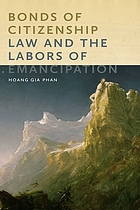
Hoang Gia Phan
The author argues that in the age of Emancipation the cultural attributes of free personhood became identified with the legal rights and privileges of the citizen, and that individual freedom thus became identified with the nation-state. He situates the emergence of American citizenship and the American novel within the context of Atlantic slavery and Anglo-American legal culture, placing early American texts by Hector St. John de Crévecœur, Benjamin Franklin, and Charles Brockden Brown alongside Black Atlantic texts by Ottobah Cugoano and Olaudah Equiano. Beginning with a revisionary reading of the Constitution's "slavery clauses," the author recovers indentured servitude as a transitional form of labor bondage that helped define the key terms of modern U.S. citizenship: mobility, volition, and contract. This book demonstrates how citizenship and civic culture were transformed by antebellum debates over slavery, free labor, and national Union, while analyzing the writings of Frederick Douglass and Herman Melville alongside a wide-ranging archive of lesser-known antebellum legal and literary texts in the context of changing conceptions of constitutionalism, property, and contract. Situated at the nexus of literary criticism, legal studies, and labor history, this book challenges the founding fiction of a pro-slavery Constitution central to American letters and legal culture. -- Publisher's website
n the age of Emancipation the cultural attributes of free personhood became identified with the legal rights and privileges of the citizen
Homestead Workers, History Matters
SWOC, steelworkers,
A document containing the reasons for unionization of the Homestead Steel Workers in 1936.
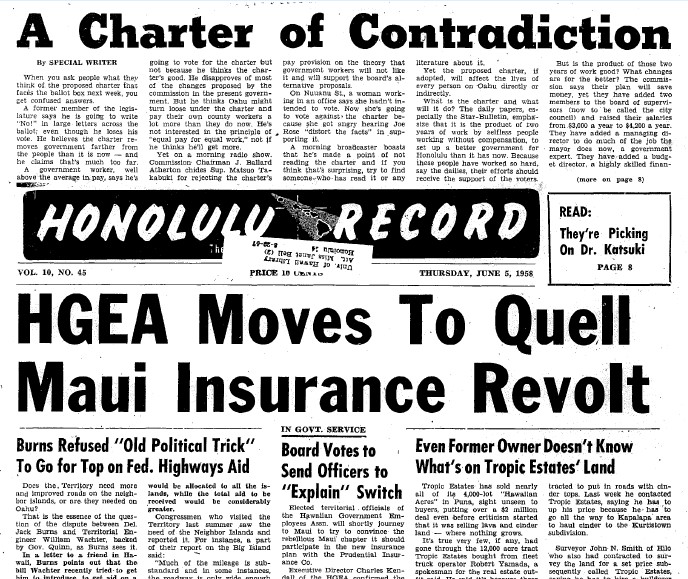
Honolulu Record
5000 pages of text, a chronicle of the worker perspective and labor movement of Hawaii;
In 1948, Koji Ariyoshi, a social activist, published a labor focused newspaper called the Honolulu Record. Founded to promote social change, Koji wanted to present another view on local and world issues, especially issues that affected the working class people of Hawaii.
The Center for Labor understands the importance of this type of resource when researching historical events. Believing in multi-media approach, the Center hopes to re-tell the stories in a manner that brings them to life. With a gracious donation from the Arthur Rutledge Endowment and a grant from the Hawaii Council for the Humanities, the Center is able to provide the public with this digitization project
5000 pages of text, a chronicle of the worker perspective and labor movement of Hawaii; A vital source for understanding Honolulu workers struggles 1948-1958
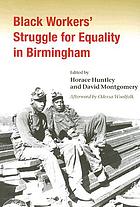
Horace Huntley
This is a book of 17 annotated interviews of participants in the Civil Rights Movement in Birmingham region wl of heavy industry in the South and a domain of ruthlessly enforced segregation. It also had a long history of both industrial and craft unions, and large numbers of black workers were active union members. Experiences with sharecropping, migration to the city and adjacent mining towns, police brutality, and their tireless personal and collective efforts to improve their lives and those of their children
interviews vary in length from 4-24 pages; 4 are of women; varying occupations.
a set of annotated interviews of participants in the Civil Rights Movement undertaken by the Birmingham Civil Rights Institute.
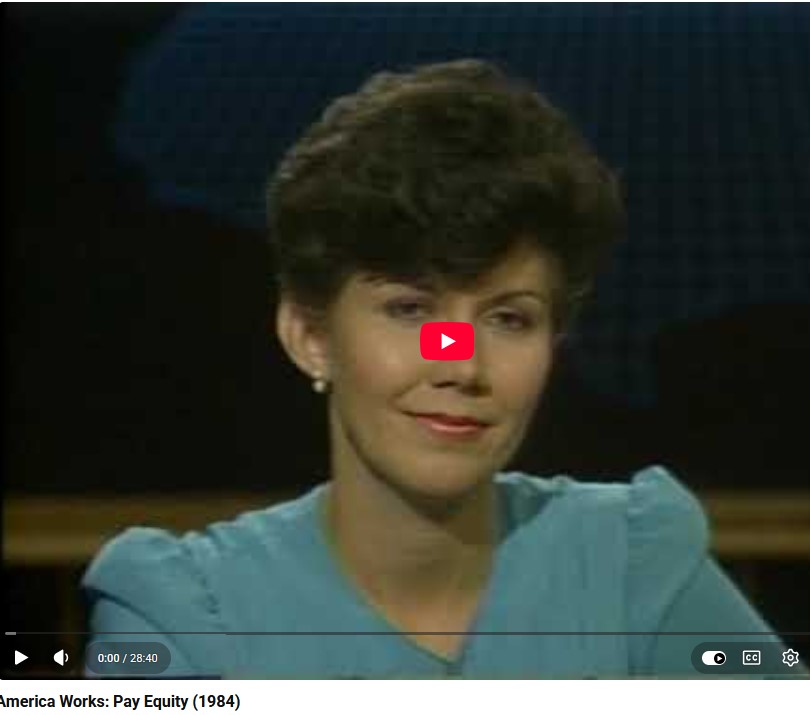
Hornbake Library University of Maryland
Lynda Clendenning, a librarian at the University of Maryland, leads a group of clerical workers in their fight to earn salaries equal to those of male workers in comparable jobs. A discussion of this issue takes place between Attorney Virgil Day, Joy Ann Grune, and host Marie Torrie. Part of "America Works" series.
A documentary focusing on the efforts of female workes to gain equal wages for university staff in Maryland.

Hornbake Library University of Maryland
This film, from the AFL-CIO Labor Films collection, documents the alliance between the labor and environmental movements. The film was produced by Terri Addabbo for the AFL-CIO Industrial Union Department. Digitized and edited as part of the 2017 exhibit, “For Liberty, Justice, and Equality: Unions Making History in America.”
A documentary exploring the alliances and overlaps between the labor and environmental justice movements.
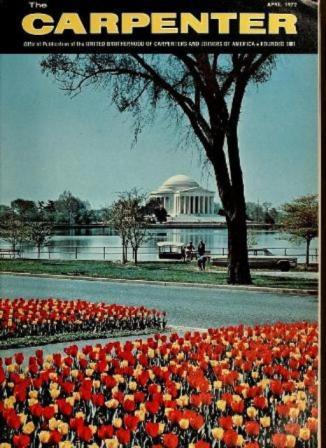
Hornbake Library, United Brotherhood of Carpenters, Joiners of America
The Carpenter , now known as the Carpenter Magazine, was originally a monthly publication produced by the UBCJA to inform all dues-paying members of newsworthy events within the union. In 1990, The Carpenter became a bi-monthly publication and it is now published four times a year. Each issue may be downloaded as an Adobe PDF file and may be searched individually for names and events. Although only the issues from 1881-1989 are currently available online, the archives also holds issues from 1990-present. Those issues that are not available online can be viewed in the Maryland Room of Hornbake Library.
108 volumes of the Carpenter, the official organ of the United Bro. of Carpenters

Howard Brick, Christopher Phelps
Radicals in America offers the first complete and continuous history of left-wing social movements in the United States from the Second World War to the present. The book traces the full panoply of radical activist causes--socialism, Communism, the labor movement, anarchism, pacifism, anti-racism, women's rights, LGBT liberation, ecology, indigenous rights, and world social justice--in ways that show how successive generations join currents of dissent, face setbacks and political repression, and generate new challenges to the status quo, even in periods when conservatism appears to push protest to the margins of American society"-- Provided by publisher
A complete and continuous history of left-wing social movements in the United States from the Second World War to the present.
Museum/Exhibits
Tours
Maps
Digital Projects
Organizations
Sites
Film/Video
Audio/Interview
Podcast/Program
Text/Document
Image
Graphs/Data
Timeline
Southwest
West
Midwest
Southeast
Northeast
Mexico
Canada
Global
Books
Teaching
Lectures
Digital Archives
Journals
Bibliographies
Topic Intro