


Collections
Library
Type
Region
Coverage:
-
Published:
-
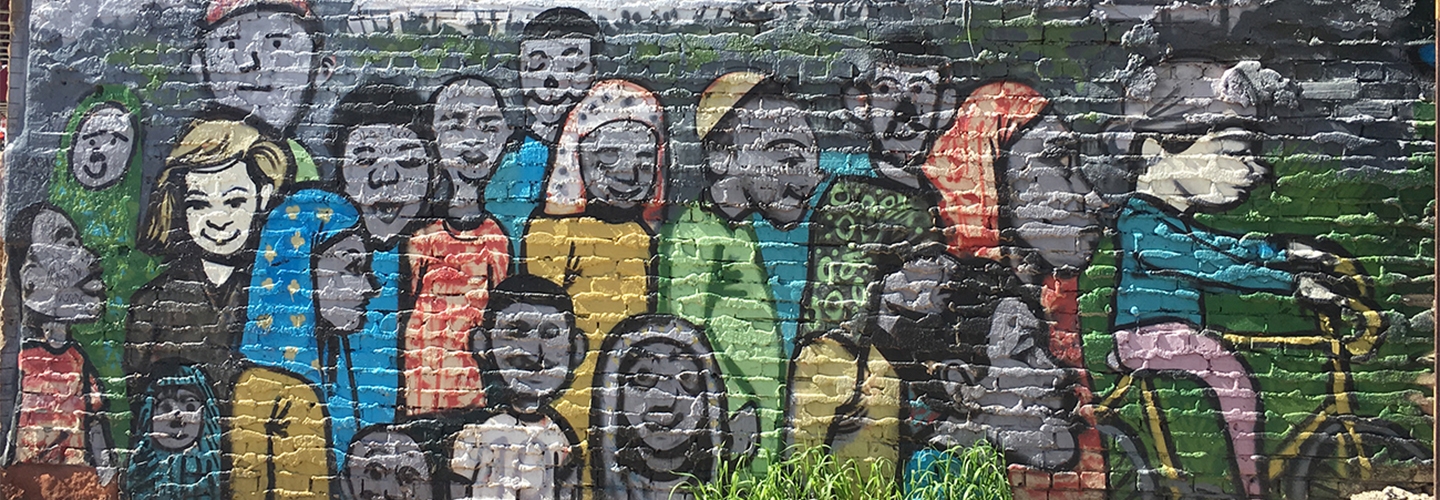
Immigration History Research Center
Here, you will find eight links to the Immigration History Research Center's (IHRC) resources for researching histories of North American migration and immigration to the U.S. Founded in 1965, the IHRC aims to transform the way in which we understand immigration in the past and present. Along with its partner, the IHRC Archives, it is the oldest and largest interdisciplinary research center and archives devoted to preserving and understanding immigrant and refugee life in North America.
Link I - IHRC Main Page: https://cla.umn.edu/ihrc
Link II - IHRC Research: https://cla.umn.edu/ihrc/research
Link III - IHRC Public Programs: https://cla.umn.edu/ihrc/public-programs
Link IV - IHRC Immigrant Stories: https://cla.umn.edu/ihrc/immigrant-stories
Link V - IHRC Teaching: https://cla.umn.edu/ihrc/teaching-0
Link VI - IHRC Grants and Fellowships: https://cla.umn.edu/ihrc/grants-fellowships
Link VII - IHRC News & Events: https://cla.umn.edu/ihrc/news-events
Link VIII - Immigration History Research Center Archives: https://www.lib.umn.edu/collections/special/ihrca
The University of Minnesota's Immigration History Research Center, which promotes interdisciplinary research on immigrant and refugee life in the Global Midwest and all of North America.

Immigration History Research Center
The 2016 presidential election brought a great deal of attention to immigration and immigrants in American society. Much of this debate perpetuated harmful stereotypes, dangerously stoked fears about outsiders, and echoed a nativist rhetoric that many believed had disappeared from public discourse. The debate also ignored how current discussions are deeply rooted in century-long conversations about who is allowed into the country and what it means to be an American. Indeed, anti-immigrant rhetoric and immigrant surveillance, detention, and deportation have been a defining feature of American politics and state and federal policy since the 19th century.
Essential topics, readings, and multimedia that provide historical context to current debates over immigration reform, integration, and citizenship.
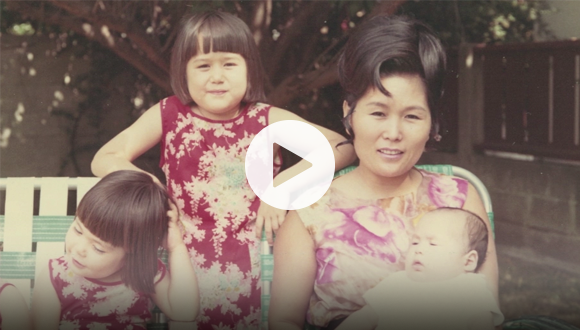
Immigration History Research Center
The U.S. Midwest is an especially important site to study immigration in local/global contexts. In recent decades, increases in international and secondary migration have transformed the region. From 2000-2010, Latinos accounted for 60.7% of the population growth in the Midwest and 27.8% of growth in Minnesota. The Twin Cities of Minneapolis and St. Paul alone are home to some of the country’s largest populations of Hmong and Somali refugees as well as American Indians living in an urban area. But there are many other groups here as well, including Eritreans, Ethiopians, Tibetans, Lao, and Cambodians.
A bibliography for those using the Immigration History Research Center's resources and archives for exploring the history of the Global Midwest.
Indiana State
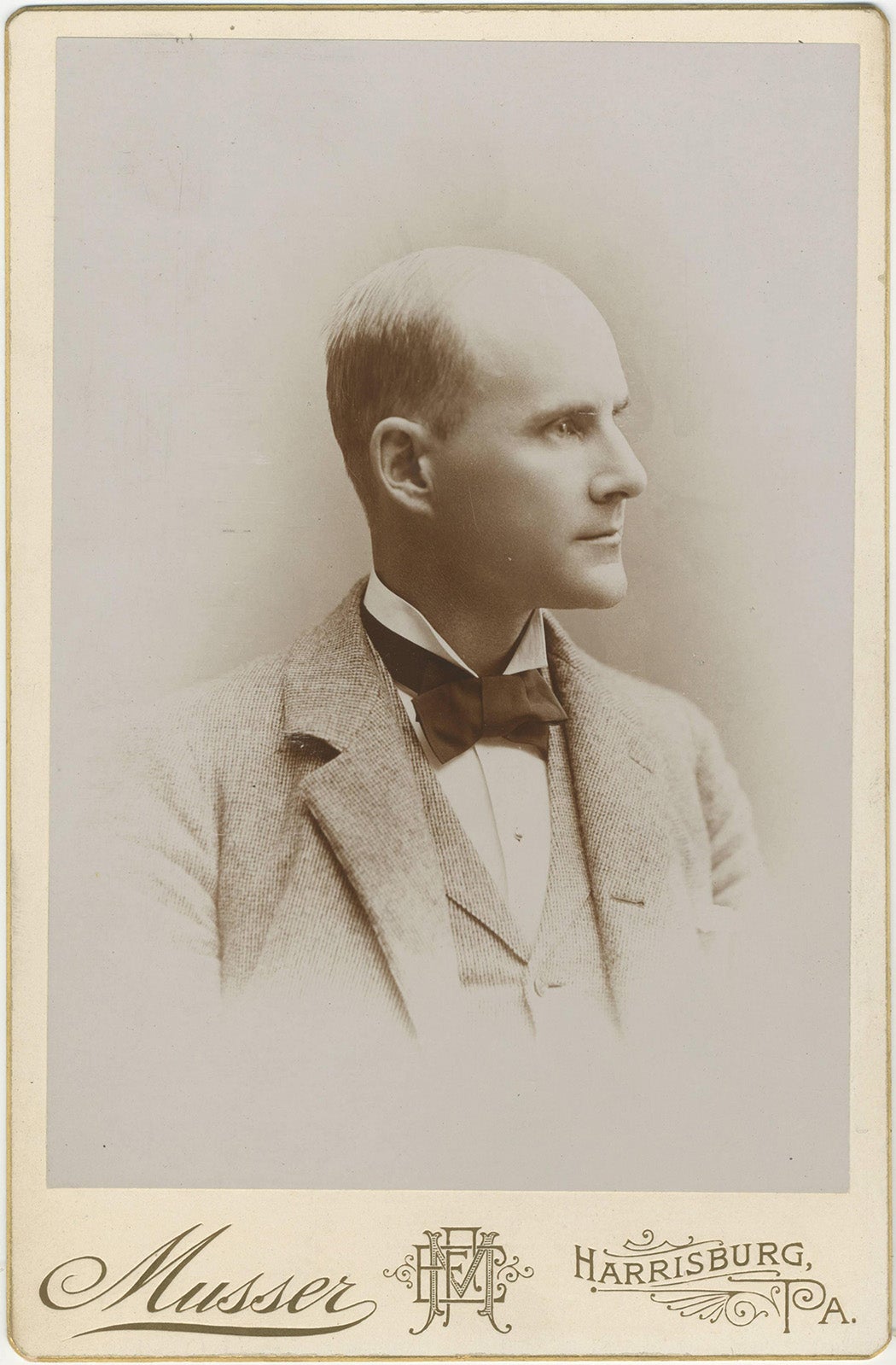
Eugene V. Debs Correspondence Collection contains more than 6,000 letters, typescripts, and manuscripts of nearly 1,700 individuals, including Eugene and his brother, Theodore Debs, written between 1874 and 1977. Marguerite Debs Cooper, the daughter of Theodore Debs, made an initial gift of the correspondence in her possession to Indiana State University in 1967. The collection started with letters, telegrams, typescripts, and manuscripts donated by Debs’s niece, Marguerite Debs Cooper, in 1967. Her father (Eugene’s brother, Theodore) worked for years as Eugene’s assistant and secretary. Many other items have been added to the collection since. https://daily.jstor.org/in-the-debs-archive/ describes in more detail.
Digital archive of 4800 letters, reports, photos, and other ephemera from the Debs collection

Indiana State Library
This search engine, Indiana Memory, provides access to digital items and collections related to labor issues in Indiana libraries, archives, museums, and other cultural institutions. Includes digitized books, manuscripts, photographs, newspapers, maps, and other media. This link provides a starting point for exploring labor-related search items, such as union delegate ribbons, newspapers, etc. There are numerous items related to strikes, lockouts, political issues
An Indiana Memory archive containing over 300,000 entries and numerous separate source collections pertaining to a wide variety of Indiana- and Midwest-related historical topics.
Indiana State Library
newspaper of the Fort Wayne United Electrical Workers, for part of 1943
Limited number of issues from one year (1943) of the newspaper of the Fort Wayne, Indiana United Electrical Workers, for part of 1943

Indiana State University
The Eugene V. Debs Correspondence Collection contains more than 6,000 letters, typescripts, and manuscripts of nearly 1,700 individuals, including Eugene and his brother, Theodore Debs, written between 1874 and 1977. Marguerite Debs Cooper, the daughter of Theodore Debs, made an initial gift of the correspondence in her possession to Indiana State University in 1967.
Indiana State University's collection of 6,000 letters, typescripts, and manuscripts that are relevant to the life of Eugene V. Debs, dated between 1874 and 1977.
Indiana State University
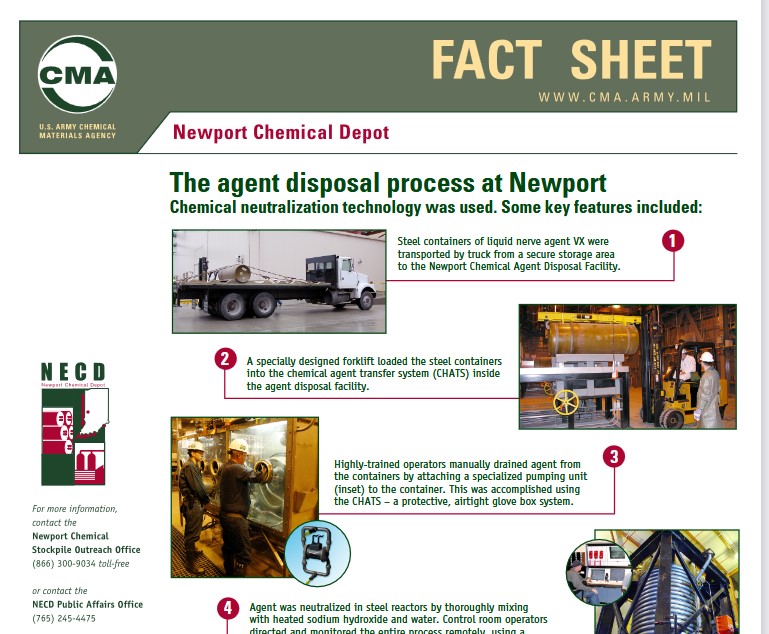
The Newport Chemical Depot (NECD) is a government owned-contractor operated facility, operated by the Mason and Hanger Corporation, a subsidiary of Day and and Zimmermann, since 1986. Located west of Indiana Highway 63 near Newport, Ind., the depot consists of approximately 7,000 acres. It is operated under the command of the U. S. Army Chemical Materials Agency (CMA). Originally authorized Nov.14, 1941, as the Wabash River Ordnance Works (WROW), NECD's mission has siginificantly changed over time: from the production of RDX, heavy water, VX and TNT, to storage of the VX stockpile, and eventually the neutralization of chemical agent VX. In addition to those missions, NECD's mission also encompasses environmental compliance and stewardship and maintaining plant facilities.
Photos and materials relating to the Newport Chemical Depot near Newport, Indiana.

Indiana Tribune
At the time of the 1870 U.S. Census, Hoosier enumerators counted 78,060 German-born residents in Indiana, accounting for 4.6 percent of the state’s total population. In Marion County, with Indianapolis as county seat, the German-born population was 6,536, over 9 percent of the residents. German-speaking publishers in Indianapolis established several newspapers to serve these immigrants including the pro-Republican Freie Presse von Indiana (1853-66), the Indiana Deutsche Zeitung (1874-77), and two pro-Democratic organs–the Indiana Volksblatt (1848-75) and the Täglicher Telegraph (1865-1907).
In August 1878, Louis D. Hild established a new pro-Republican, German-language, four-page weekly titled the Indiana Tribüne. The Tribüne’s circulation of 800 lagged behind that of its chief competitor, theTelegraph, which had 3,200 subscribers. Several owners bought and sold the Tribüne in its first few years, before the Tribüne Company acquired it in April 1882, and under its management the newspaper prospered. The Tribüne had expanded to eight pages in 1881, and the new publishers added a four-page daily edition in 1882. By 1885, the Tribüne reported a daily circulation of 3,000 against the Telegraph’s 2,460. However, the Telegraph still claimed higher circulation for its weekly edition, the Indiana Volksblatt und Wȍchentlicher Telegraph, 4,420 to 3,500.
Mirroring the rise of the labor movement in Gilded Age America, the Tribüne began to shift its political allegiance in the mid-1880s. In 1886, the publishers declared the Tribüne “the only German daily workingman’s paper published in Indiana.” By 1888, the newspaper changed its editorial position from pro-Republican to pro-Labor. Circulation numbers remained steady during this time with a reported 3,548 daily editions and 4,112 weekly editions circulating in 1894. The Tribüne remained pro-Labor through 1894, when it claimed to be independent.
The 1900s brought many changes and challenges to the Tribüne. The publishers expanded the weekly edition to 12 pages in 1900, and in 1902 they increased the daily to eight pages. Circulation of the weekly edition, which had remained in the low to mid 4,000s throughout the 1890s, spiked to 7,031 by 1902. After 20 years of operation, the Tribüne Company sold the paper to its chief competitor, the Gutenberg Company, publishers of the Telegraph, in March 1902. The two papers continued to be issued separately as morning (Telegraph) and evening (Tribüne) editions, along with a separately titled Sunday edition, the Indianapolis Spottvogel. In 1907, the Tribüne’s circulation was at 4,100 while the Telegraph was at 4,980 issues. On March 7, 1907, the publishers combined the two titles into a single daily edition titled the Indianapolis Telegraph und Tribüne, which had a circulation of 10,785 in its first year and maintained that level through the next decade. The German-born population of Marion County was 8,304 in 1910, and the high circulation figures for the Telegraph und Tribüne suggest that the newspaper had a readership beyond Indianapolis and among the many American-born descendants of German immigrants who continued to use their ancestral language. The Gutenberg Company, like other German-American businesses and citizens, faced growing anti-German sentiments with the advent of World War I, and the publishers silenced their presses on June 1, 1918.
In 1886, the publishers declared the Tribüne “the only German daily workingman’s paper published in Indiana.”

Indiana University of Pennsylvania
324 items digitized, from artifacts, to newspaper broadsides, leaflets
324 items digitized, from artifacts, to newspaper broadsides, leaflets

Indiana University of Pennsylvania
A timeline specific to the rich labor history of Central Pennsylvania, 1816-1933
A timeline specific to the rich labor history of Central Pennsylvania, 1816-1933
Indiana University of Pennsylvania University Museum
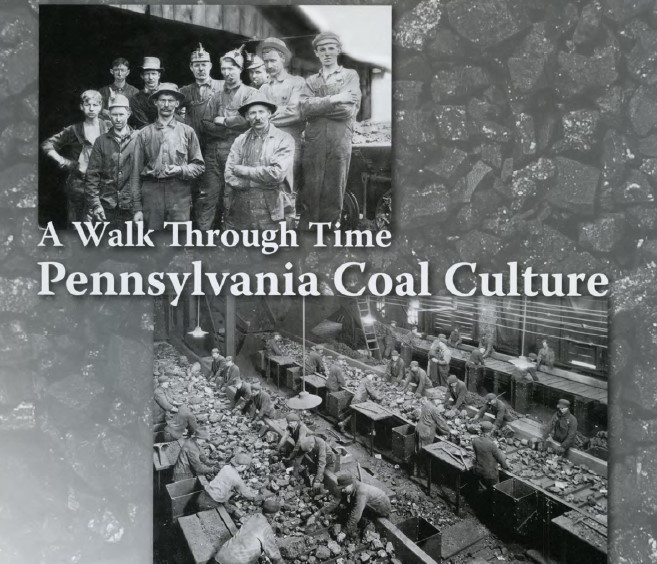
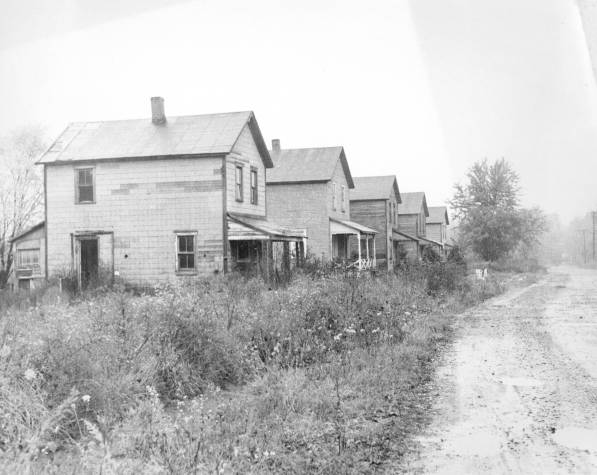
Harrison Wick and Rhonda Yeager, Curators. In fall 2009, the Indiana University of Pennsylvania, University Museum presented A Walk Through Time: Pennsylvania Coal Culture, co-curated by Harrison Wick and Rhonda Yeager. The exhibit documented bituminous coal mining and living in company towns in western Pennsylvania.
The University Museum exhibit catalog features many essays, photographs, and oral history interviews about western Pennsylvania coal culture.
Exhibit catalog for a museum exhibit on Pennsylvania Coal towns
Indiana University of Pennsylvania, Irwin M. Marcus, Eileen Moutjoy, Beth O'Leary, Theresa McDevitt, Ron Zuzemchak, Margaret M. Mulrooney, Susan Ferrandiz, Mildred Allen Beik
Downloadable papers, some with linked primary sources, on Bituminous Coal mining Life in Western Pennsylvania
Arthur Gleason and the Anglo-American Workers' Education by Dr. Irwin M. Marcus, Professor Emeritus, IUP History Department
Recreation in the Coal Fields: The Case of Baseball by Dr. James P. Dougherty,IUP Sociology Department
Clara Johnson: Labor Educator by Dr. Irwin M. Marcus
Unveiling of marker recalls mine disaster that killed 44 at Clymer No. 1 by Eileen Mountjoy
Clymer Looking Back by Eileen Mountjoy
The Coal Strike of 1919 in Indiana County and its Aftermath by Dr. Irwin Marcus, Eileen Mountjoy, and Beth O'Leary
The CBC Community of Commodore: A New Kind of Coal Town by Eileen Mountjoy. Built in 1919, Commodore was the last company town built in Indiana County, Pennsylvania.
Common Lives of Uncommon Strength: The Women of the Coal and Coke Era of Southwestern Pennsylvania, 1880-1970. A book about the experience of women in coal mining towns by Pamela Seighman and Elaine DeFrank of the Coal and Coke Heritage Center, Penn State University Fayette, Uniontown, Pennsylvania.
The Ernest Grays and the Summer of 1935 by Dr. Theresa McDevitt, IUP Libraries. This article talks about the African American baseball team in the coal company town of Ernest, Pennsylvania.
The Ernest Mine Disaster of 1916 by Eileen Mountjoy
The Ernest Mining Plant by Eileen Mountjoy
Ernest: Life in a Mining Town by Eileen Mountjoy
Ethnicity in the Coal Fields by Dr. James P. Dougherty
Fiddlin' Joe Yesolivich by Eileen Mountjoy
Frank Crosswaith: Orator, Activist, and Socialist by Dr. Irwin M. Marcus
History of Coke by Eileen Mountjoy. Talks about how coke was made from bituminous coal for use by the steel industry in Johnstown and Pittsburgh.
The Company Town of Iselin by Eileen Mountjoy
The Iselin Family by Eileen Mountjoy
Jesse Holmes: Academic and Activist by Dr. Irwin M. Marcus
Heilwood: The Early History of a Western Pennsylvania Coal Mining Town by Ron Zuzemchak
Judge Jonathan Langham by Dr. Irwin M. Marcus, Dr. James P. Dougherty, and Eileen Mountjoy
A Legacy of Coal: The Coal Company Towns of Southwestern Pennsylvania by Margaret M. Mulrooney, Historic American Buildings Survey & Historic American Engineering Record, America's Industrial Heritage Project
A Life of Hard Work: Archie George by Eileen Mountjoy. Born in Bakerton, in Cambria County, in 1913, Archie George (Francis A. George) narrated this story in 1977 shortly before his death.
Louis Goaziou and the Coal Strike of 1894 in Hastings, Pennsylvania by Dr. Irwin M. Marcus
The Company Town of Lucerne by Eileen Mountjoy
Lucius Waterman Robinsom: A Dominating Figure by Eileen Mountjoy
Mary Harris "Mother" Jones, (1837-1930): American labor and community organizer, member of the Industrial Workers of the World, and prominent socialist.
McIntyre, a company town owned by Rochester & Pittsburgh Coal Company, by Susan Ferrandiz
Mining Injuries and Fatalities in Berwind-White Coal Mining Company Mines
Race and Ethnicity in the Northern Fields: The Early 20th Century - A Case Study by Dr. James P. Dougherty
Remembering the 1906 Strike for Union in Windber, Pennsylvania selected readings compiled by Mildred Allen Beik (see Manuscript Group 127)
The Company Town of Sagamore by Eileen Mountjoy
Shanktown Mine Explosion in 1924 by Herb Gleditsch
Spraggers, Sunshine Lamps: Now Part of Industry's Past by Eileen Mountjoy
Activism among coal miners in Sykesville, Pennsylvania in 1924-1943 (audio presentation) by Dr. Irwin M. Marcus
That Magnificent Fight For Unionism by Eileen Mountjoy
UMWA Marker Honors Mine Workers by Eileen Mountjoy
To Organize the Unorganized by Eileen Mountjoy
The Company Town of Whiskey Run by Eileen Mountjoy
William Lockyer and the Coal Strike of 1894 by Dr. Irwin M. Marcus
The Windber Miners' Strike for Union, 1922-1923 - coal miners went on strike in Windber, Pennsylvania.
A Woman's Day: Work and Worry by Eileen Mountjoy
Downloadable papers and lesson plans, some primary sources, bibliography on Bituminous Coal mining Life in Western Pennsylvania
Industrial Workers of th World
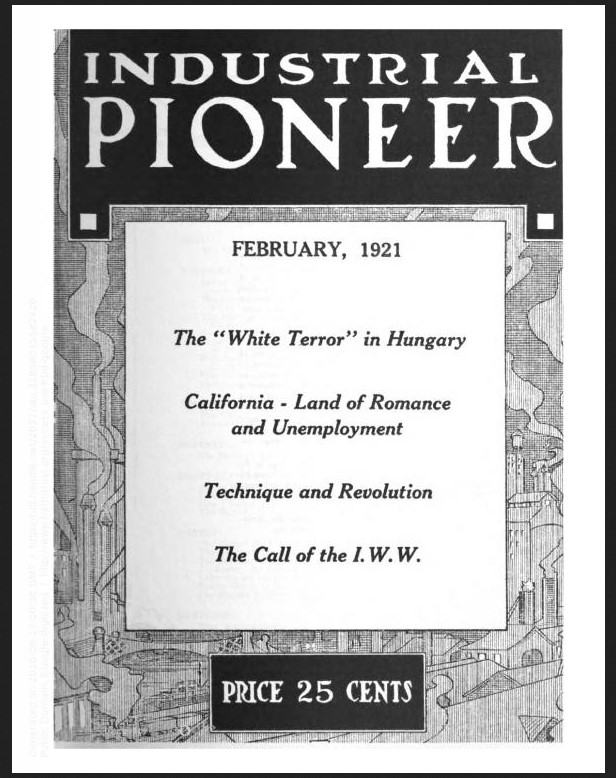
The Industrial Pioneer was a monthly publication of the Industrial Workers of the World (IWW). It was published in Chicago by the general executive board of the IWW from 1921 to 1926, under various editors. The precursor of the Industrial Pioneer was the One Big Union Monthly. The editor of One Big Union Monthly, John Sandgren, used his position to wage war on the Communists in the IWW. When his editorials became too sectarian, the IWW replaced him as editor in 1931, and changed the name of the publication to the Industrial Pioneer. The new editor was a Communist, however, and this alienated the non-Communist majority of IWW members. He was removed as editor in 1922.
monthly publication of the Industrial Workers of the World (IWW), digitized

Industrial Workers of th World, Michael Hargis
Originally titled, 95 Years of Revolutionary Industrial Unionism, by Michael Hargis—featured in Anarcho Syndicalist Review, #27 and #28.
80 hallmarks of IWW history
Industrial Workers of the World
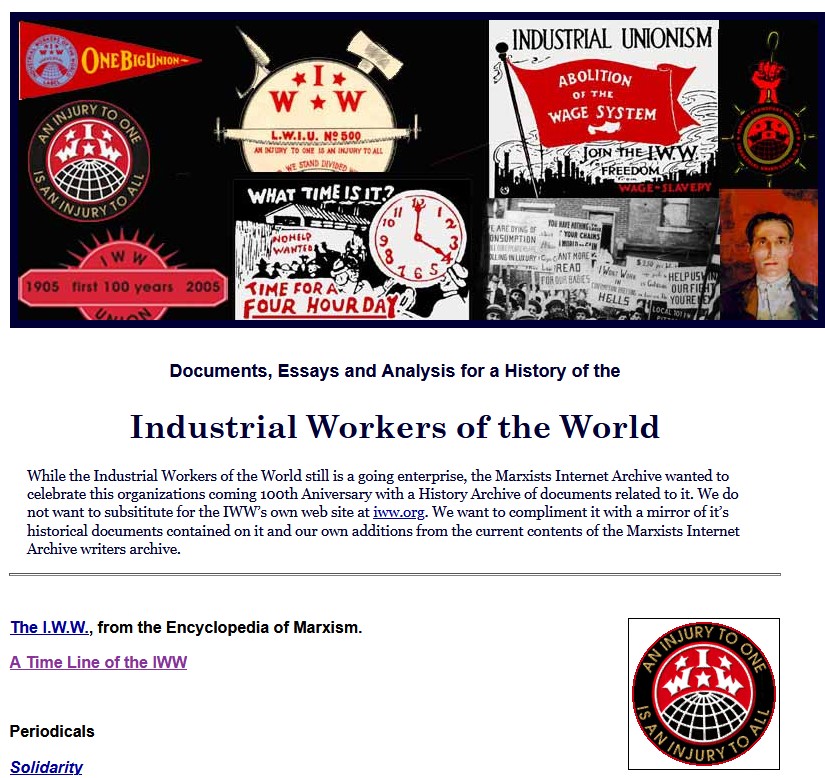
a History Archive of documents related to the IWW including newspapers and conventions
Digitized archive, collection of materials with links to study IWW
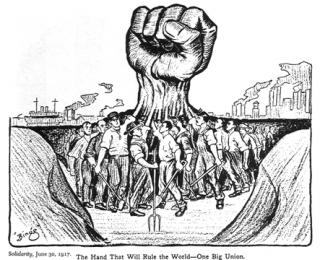
Industrial Workers of the World
cartoons about and by the Industrial Workers of the World
over 100 cartoons from moments in IWW history

Industrial Workers of the World
Documents by the IWW
Documents by Judi Bari
Documents by Paul Brissenden
Documents by James P. Cannon
Documents by Ralph Chaplin
Documents by Noam Chomsky
Documents by James Connolly
Documents by Eugene V. Debs
Documents by Daniel DeLeon
Documents by Sam Dolgoff
Documents by Justus Ebert
Documents by Greg Jackson
Documents by Joseph Ettor
Documents by Elizabeth Gurley Flynn
Documents by William Z Foster
Documents by John Reimann
Documents by Jonathan Christiansen
Documents by Juan Conatz
Documents by Luther "Butch" Gaylord
One Big Union Monthly
Documents by William "Big Bill" Haywood
Documents by Mary Harris "Mother" Jones
Documents by Jason Justice
Documents by Helen Keller
Documents by James Kennedy
Documents by Gilbert Mers
Documents by William Meyers
Documents by Arthur J. Miller
Documents by Walter T. Nef
Documents by Lucy Parsons
Documents by Grover H. Perry
Documents by James Rowan
Documents by Vincent Saint John
Documents by Tom Scribner
Documents by Abner Woodruff
Documents by IWW Branches
Documents by Jane Street
Documents by Walker C. Smith
Documents by William E. Trautmann
Miscellaneous Documents
A collection of materials and essays on the IWW

Industrial Workers of the World
Searchable digitized, The newspaper of the IWW was first printed in journal format in Joliet, Illinois, beginning in January 1906, incorporating "The Voice of Labor," the newspaper from the former American Labor Union which had joined the IWW, and "International Metal Worker." It was edited by A. S. Edwards, and early contributors include Eugene V. Debs, Jack London, Daniel DeLeon, Bill Haywood, and J. H. Walsh, along with poetry by Covington Hall. When the group led by ousted President Charles Sherman retained physical control over the paper after the union's 1906 Convention, and continued publication under that name for a few months (before giving up the ghost), the IWW instead issued the Industrial Union Bulletin for several years. A.S. Edwards was elected editor of the Bulletin in 1906.[1] The second series of the Industrial Worker commenced in 1909 in Spokane, Washington, and has continued to this day, with only one major interruption, during the period of 1913-1916. In the early years, it was printed weekly and mainly circulated west of the Mississippi, while the IWW's "Official Eastern Organ" was Solidarity published in New Castle, Pennsylvania and later, Cleveland, which continued until it merged with the Industrial Worker in Chicago in the 1930s.
The Spokane paper was the birthplace of the comic strip character Mr. Block, later commemorated in a Joe Hill song. The Industrial Worker usually ran four pages, with an annual eight page May Day issue reflecting on gains of the labor movement in the previous year. Circulation fell off due to the repression of the IWW during and after the First World War, reflecting a decline in the influence of radical unionism more generally.
Digitized collection of the official paper of the IWW
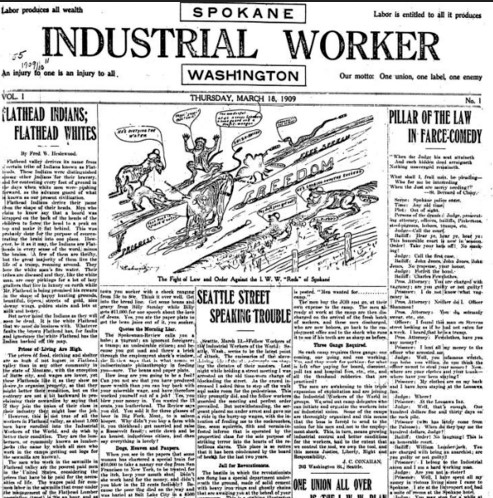
Industrial Workers of the World
Newspaper of the Industrial Workers of the World; The newspaper was first printed in journal format in Joliet, Illinois, beginning in January 1906, incorporating The Voice of Labor, the newspaper from the former American Labor Union which had joined the IWW, and International Metal Worker.
It was edited by A. S. Edwards, and early contributors include Eugene V. Debs, Jack London, Daniel DeLeon, Bill Haywood, and J. H. Walsh, along with poetry by Covington Hall.
When the group led by ousted President Charles Sherman retained physical control over the paper after the union’s 1906 Convention, and continued publication under that name for a few months (before giving up the ghost), the IWW instead issued the Industrial Union Bulletin for several years and is reproduced here.
A.S. Edwards was elected editor of the Bulletin in 1906. The second series of the Industrial Worker commenced in 1909 in Spokane, Washington, and has continued to this day, with only one major interruption, during the period of 1913-1916.
In the early years, it was printed weekly and mainly circulated west of the Mississippi, while the IWW’s "Official Eastern Organ" was Solidarity published in New Castle, Pennsylvania and later, Cleveland, which continued until it merged with the Industrial Worker in Chicago in the 1930s.
digitized Industrial Workers of the World newspaper
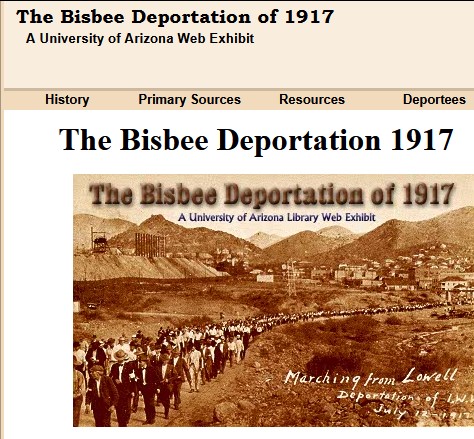
Industrial Workers of the World
18 March 1909 - 21 August 1913 (227 issues)
digitized Industrial Workers of the World newspaper
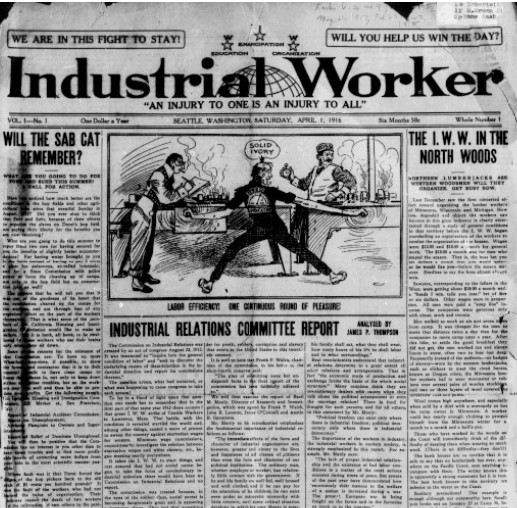
Industrial Workers of the World
Newspaper of the Industrial Workers of the World from Washington Digital Newspapers, 1907-1931. Published from Seattle, Washington
digitized Industrial Workers of the World newspaper
Industrial Workers of the World
The IWW has a very rich and colorful history (with as many cultural traditions as we have political contributions to the class struggle) and it continues to have a vibrant organization and culture today. This is an old site which has been archived. use the search term in the search bar: "Everett Massacre"
A digital collection hosted by the IWW.
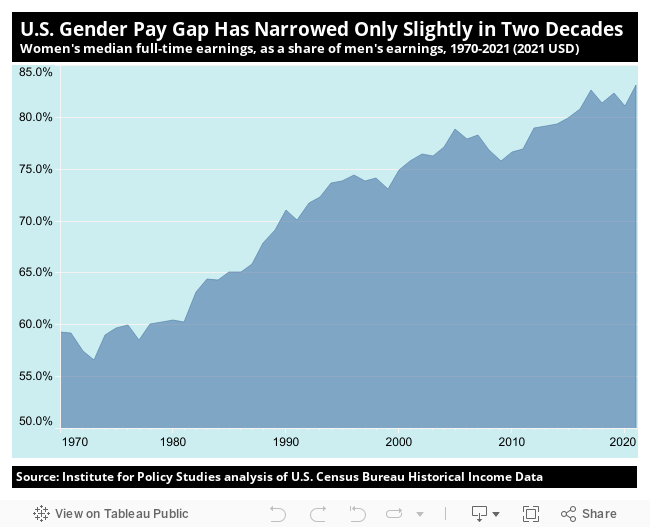
Inequality.org
In the United States, the income gap between the rich and everyone else has been growing markedly, by every major statistical measure, for more than 30 years.
Income Inequality
Wage Inequality
Racial Income Inequality
CEO-Worker Pay Gaps
income inequality charts and graphs
International Association of Machinists
publications of the International Association of Machinists 1889-2004
Digitized newspapers from the International Association of Machinists
Museum/Exhibits
Tours
Maps
Digital Projects
Organizations
Sites
Film/Video
Audio/Interview
Podcast/Program
Text/Document
Image
Graphs/Data
Timeline
Southwest
West
Midwest
Southeast
Northeast
Mexico
Canada
Global
Books
Teaching
Lectures
Digital Archives
Journals
Bibliographies
Topic Intro