


Collections
Library
Type
Region
Coverage:
-
Published:
-
Jade Metzger, Walter Reuther Library Wayne State University
For Teachers: In Michigan, 3rd grade social studies students are encouraged to learn "public discourse, decision making and citizen involvement"1 using the Michigan's history, government, and public policy issues as examples [C1-C3]. These learned histories are expected to translate to 4th grade discussions on national civics [C5]. Often, for children 8-11 years old, it can be a struggle to connect these events to their own lives and the lives of their families.
The goal of this proposed lesson plan is to utilize resources at the Walther P. Reuther Library Archives to connect Michigan's labor movement history with children between 3rd and 5th grade. Below, we offer pictures, documents, contextual information, web resources, and possible activities to illustrate these connections. The hope is that these activities can act as launching points for how children can better understand their important role in the Michigan and U.S. labor movement.
Background:
Children have had a precarious role historically in labor movements around the world, and U.S. and Michigan's own history is no different! Prior to the industrial revolution, children traditionally worked on family farms. Others learned trades and skills from their parents, relatives, patrons, or community. For example, if someone had the last name “Baker” it was probably because that was their family business – to bake! My last name, Metzger, means ‘butcher’ in German. If I was born in a German town circa 1700s, I probably would have been trained to be a town’s meat cutter from a very early age.
However, all of this is heavily dependent and when, where, and whom in history we are discussing. A child’s gender, race, class, or caste would determine if they were laborers and how they were compensated for their efforts. Indeed, the definition of who did and did not count as a child has not remained static throughout history. For example, in the U.S. black slave children were expected to work long hours as servants, cooks, and field hands with no compensation. These children, boys and girls alike, were viewed as tools rather than humans. Girls from farming families worked alongside their brother when needed. Girls from farming communities were also expected to learn how to prepare food and repair clothing, a chore many boys were not expected to learn. These are just two examples from Western history – consider the demographic population of your own class when considering how you might choose to frame this discussion.
After the industrial revolution, children who could not stay with relatives nor attend school, accompanied their parents to textile mills, coal mines, and industrial sites, where they could be put to work. The working conditions were often dangerous, and the compensation was meager. Some children were maimed; others died. Many of the first labor unions were formed to protect children from these harms.
Child labor still fuels whole parts of the globe today. Children are still working in textile factories and on industrial farms. Many children in the U.S. are eager to enter into the work force and take positions as soon as they can. However, we now have strict laws in the U.S. to govern the hours, wages, and working conditions of children, due in part to the labor movement's efforts.
We want to encourage instructors to see the Reuther Library as resource for their classrooms and for children to see themselves reflected in history. Thus, these lessons were designed to connect children directly to historical events during the early labor movement, putting both U.S. and Michigan history at the center of these conversations. Encourage children to hypothesize about the documents and use their observation skills to find answers.
If your class has access to computers, you might allow students to use the gallery portion of this lesson. If not, consider printing out these resources for use in your classroom.
This lesson was contributed by Jade Metzger, a recipient of the NextGen Humanities grant.
The goal of this proposed lesson plan is to utilize resources at the Walther P. Reuther Library Archives to connect Michigan's labor movement history with children between 3rd and 5th grade.
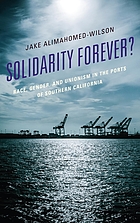
Jake Alimahomed-Wilson
Drawing on in-depth interviews, archived oral histories, and ethnographic observation, this book highlights the struggle of a key group of Black and women longshore workers who fought against and struggled with racism and sexism in the ports of Southern California. It sheds light on the complex ways that inequality-and its resistance-operates in the labor movement
Chapter 1: Solidarity Forever?
Chapter 2: The Story of a UnionChapter
3: Racial Formation of the Ports of Southern California
Chapter 4: Suing the Union
Chapter 5: Is Discrimination a Weapon of the Boss…or the Union Local?
Chapter 6: “Union Men” and the Crisis of Masculinity on the Docks
Chapter 7: Breaking the “Steel Ceiling”: Working Class Women Resisting Sexism and Racism in the Union (co-authored by Sabrina Alimahomed-Wilson)
Chapter 8: Redefining SolidarityAppendix I: Race and Gender Breakdown: Southern California ILWU (2005)Appendix II: Oral Histories
highlights the struggle of a key group of Black and women longshore workers who fought against and struggled with racism and sexism in the ports of Southern California.
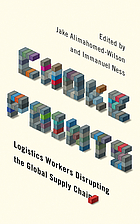
Jake Alimahomed-Wilson, Immanuel Ness
This book looks at case studies across the world to uncover a network of resistance by these workers who, despite their importance, often face vast exploitation and economic violence. Covering action including wildcat strikes, organized blockades and boycotts, the author's explore diverse case studies ranging from dockworkers in South China and Chile to logistics sector workers in Southern California and Turkey"--Back cover
Introduction:
Forging Workers’ Resistance Across the
Global Supply Chain – Jake Alimahomed-Wilson and Immanuel Ness
PART I – Building Labor Power and Solidarity Across the World’s Choke Points
1. Labor and Social Movements’ Strategic Usage of the Global Commodity Chain Structure – Elizabeth A. Sowers, Paul S. Ciccantell, and David A. Smith
2. Across the Chain: Labor and Conflicts in the European Maritime Logistics Sector – Andrea Bottalico
3. Durban Dockers, Labor Internationalism, and Pan-Africanism – Peter Cole
PART II – Disruptions: Logistics Workers Resisting Exploitation
4. Worker Militancy and Strikes in China’s Docks – Bai Ruixue and Au Loong Yu
5. “Work Hard, Make History”: Oppression and Resistance in Inland Southern California’s Warehouse and Distribution Industry – Ellen Reese and Jason Struna
6. Stop Treating Us Like Dogs! Workers Organizing Resistance at Amazon in Poland – Amazon workers and supporters
7. Decolonizing Logistics: Palestinian Truckers on the Occupied Supply Chain – Jake Alimahomed-Wilson and Spencer Louis Potiker
PART III – Neoliberalism and the Global Transformation of Ports
8. Decoding the Transition in the Ports of Mumbai – Johnson Abhishek Minz
9. Back to Piraeus: Precarity for All! – Dimitris Parsanoglou and Carolin Philipp
10. Contested Logistics? Neoliberal Modernization and Resistance in the Port City of Valparaíso – Jorge Budrovich Sáez and Hernán Cuevas Valenzuela
11. Logistics Workers’ Struggles in Turkey: Neoliberalism and Counterstrategies – Çağatay Edgücan Şahin and Pekin Bengisu Tepe
PART IV – New Organizing Strategies for the Global Supply Chain
12. “The Drivers Who Move This Country Can Also Stop It”: The Struggle of Tanker Drivers in Indonesia – Abu Mufakhir, Alfian Al’ayubby Pelu, and Fahmi Panimbang
13. Lessons Learned from Eight Years of Experimental Organizing in Southern California’s Logistics Sector – Sheheryar Kaoosji
14. Struggles and Grassroots Organizing in an Extended European Choke Point – Carlotta Benvegnù and Niccolò Cuppini
15. Beyond the Waterfront: Maintaining and Expanding Worker Power in the Maritime Supply Chain – Peter Olney
Contributor Biographies
Index
Covering action including wildcat strikes, organized blockades and boycotts,
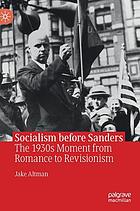
Jake Altman
The early years of the twentieth century are often thought of as socialism's first heyday in the United States, when the Socialist Party won elections across the country and Eugene Debs ran for president from a prison cell, winning more than 900,000 votes. Less well-known is the socialist revival of the 1930s. Radicalized by the contradiction of crushing poverty and unimaginable wealth that existed side by side during the Great Depression, socialists built institutions, organized the unemployed, extended aid to the labor movement, developed local political movements, and built networks that would remain active in the struggle against injustice throughout the twentieth century. Jake Altman brings this overlooked moment in the history of the American left into focus, highlighting the leadership of women, the development of the Highlander Folk School and Soviet House, and the shift from revolutionary rhetoric to pragmatic reform by the close of the decade. As another socialist revival takes shape today, this book lays the groundwork for a more nuanced history of the movement in the United States.-- Provided by publisher
Reveals the largely unknown upsurge in participation in Socialist organizations during the Great Depression
Jake Gehrlein
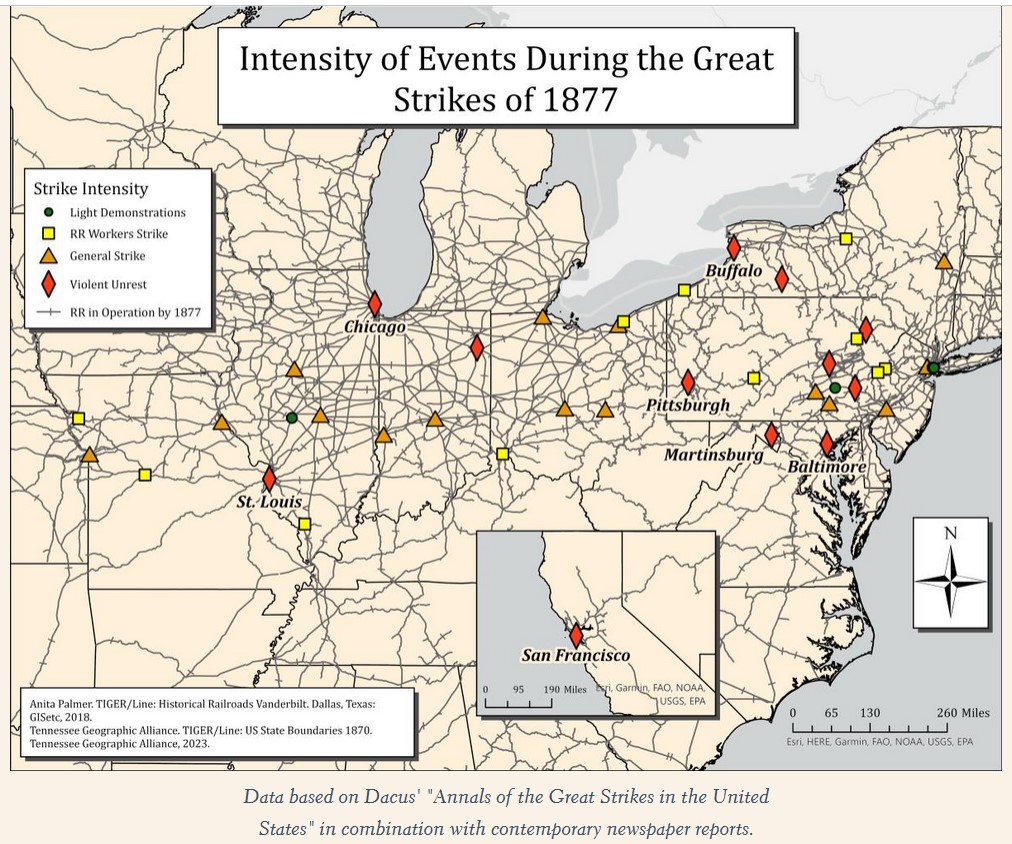
A storymap focused mainly on Pittsburgh, with some additional content from other major cities and visuals of 1877 rail system
A storymap of wave of national strikes in 1877, mostly focused on Pittsburgh
Jake Rosenfeld
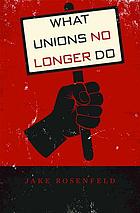
The consequences of labor's decline: curtailed advocacy for better working conditions, weakened support for immigrants' economic assimilation, and ineffectiveness in addressing wage stagnation among African-Americans. In short, unions are no longer instrumental in combating inequality in our economy and our politics, and the result is a sharp decline in the prospects of American workers and their families
From workers' wages to presidential elections, labor unions once exerted tremendous clout in American life. In the immediate post-World War II era, one in three workers belonged to a union. The fraction now is close to one in five, and just one in ten in the private sector. The only thing big about Big Labor today is the scope of its problems. While many studies have explained the causes of this decline, What Unions No Longer Do shows the broad repercussions of labor's collapse for the American economy and polity. Organized labor was not just a minor player during the middle decades of the twentieth century, Jake Rosenfeld asserts. For generations it was the core institution fighting for economic and political equality in the United States. Unions leveraged their bargaining power to deliver benefits to workers while shaping cultural understandings of fairness in the workplace. What Unions No Longer Do details the consequences of labor's decline, including poorer working conditions, less economic assimilation for immigrants, and wage stagnation among African-Americans. In short, unions are no longer instrumental in combating inequality in our economy and our politics, resulting in a sharp decline in the prospects of American workers and their families.
General Notes
Description based upon print version of record.
Front matter -- Contents -- Introduction -- 1 The Collapse of Organized Labor in the United States -- 2 Government Is Not the Answer -- 3 Wages and Inequality -- 4 Strikes -- 5 The Timing Was Terrible -- 6 Justice for Janitors? -- 7 The Ballot Box -- 8 The Past as Prologue -- Appendix -- Notes -- References -- Acknowledgments -- Index
the consequences of labor's decline
Jake S. Friedman
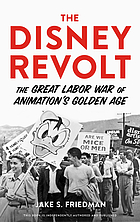
Soon after the birth of Mickey Mouse, one animator raised Walt Disney Productions far beyond Walt's expectations. That animator, Art Babbitt, also led a union war that almost destroyed the company. Using never-before-seen research from previously lost records, including conversation transcripts from within the studio walls, author and historian Jake S. Friedman reveals the details behind the labor dispute that changed animation and Hollywood forever.
reveals the details behind the labor dispute that changed animation and Hollywood forever.
James A. Gross
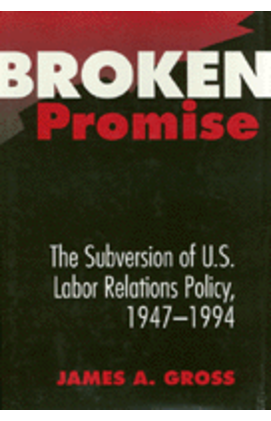
Examines the process of government regulation of workplace labour-management relations since the passage of the Taft-Hartley Act in 1947. Focuses on the National Labor Relations Board (NLRB) and demonstrates how labour policy can be made without legislative changes through presidential appointments to the NLRB. Analyses how the NLRB's policy making has been influenced by the president, the Congress, the Supreme Court, public opinion, resistance by organized employers, the political and economic strategies of organized labour, and the ideological dispositions of NLRB appointees
Examines the process of government regulation of workplace labour-management relations since the passage of the Taft-Hartley Act in 1947.
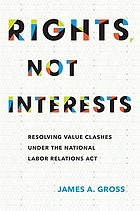
James A. Gross
This provocative book by the leading historian of the National Labor Relations Board offers a reexamination of the NLRB and the National Labor Relations Act (NLRA) by applying internationally accepted human rights principles as standards for judgment. These new standards challenge every orthodoxy in U.S. labor law and labor relations. James A. Gross argues that the NLRA was and remains at its core a workers' rights statute.Gross shows how value clashes and choices between those who interpret the NLRA as a workers' rights statute and those who contend that the NLRA seeks only a "balance" between the economic interests of labor and management have been major influences in the evolution of the board and the law. Gross contends, contrary to many who would write its obituary, that the NLRA is not dead. Instead he concludes with a call for visionary thinking, which would include, for example, considering the U.S. Constitution as a source of workers' rights. Rights, Not Interests will appeal to labor activists and those who are trying to reform our labor laws as well as scholars and students of management, human resources, and industrial relations
From Wagner to Taft-Hartley : from rights to interests
Conflicting statutory purposes : conflicting values
The Gould Board : conflicting agendas
Gould Board decisions and workers' rights
The Battista Board : individual not collective rights
The Liebman Board : the NLRA at its heart a human rights law
shows how value clashes and choices between two camps of NLRA thought formed the modern board and law.
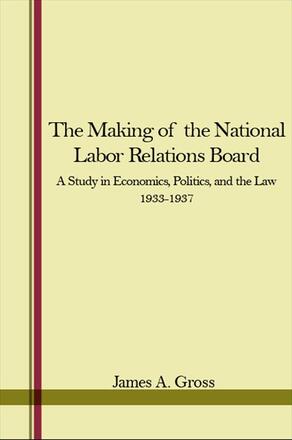
James A. Gross
Definitive study of the NLRB as an administrative agency which became one of the most important political and legal developments in the last century as it influenced the growth of a national labor policy and the use of administrative processes and legal methods in U.S. labor relations. Fifty in-depth oral history interviews with individuals prominent in the history of NLRB supplement data from NLRB files and the National Archives.
study of the NLRB as an administrative agency which became one of the most important political and legal developments in the last century.
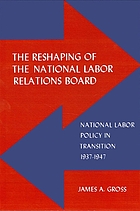
James A. Gross
In this volume, covering the years 1937–1947, James A. Gross describes and analyzes the NLRB's vigorous and uncompromising enforcement of the Wagner Act and the intense political pressure to which the Board was subjected as a consequence. He identifies and examines the forces that succeeded in pressuring the NLRB out of its essential role in the making of U.S. labor policy. This is the story of the transformation of the NLRB from an expert administrative agency that played a major role in the making of labor policy, into an insecure, politically sensitive agency preoccupied with its own survival and reduced to deciding marginal issues.
describes and analyzes the NLRB's vigorous enforcement of the Wagner Act and the political pressure to which the Board was subjected as a consequence.
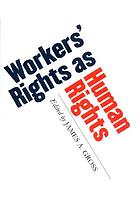
James A. Gross
Provides a new perspective on the assessment of U.S. labour relations law by using human rights principles as standards for judgment. Presents recommendations for what should and can be done to bring U.S. labour law into conformity with international human rights standards
1. A Long Overdue Beginning: The Promotion and Protection of Workers' Rights as Human Rights 1
James A. Gross
2. Workers' Freedom of Association in the United States: The Gap between Ideals and Practice 23
Lance Compa
3. Closing the Gap between International Law and U.S. Labor Law 53
Lee Swepston
4. Risks and Rights: The Case for Occupational Safety and Health as a Core Worker Right 78
Emily A. Spieler
5. A Pragmatic Assessment from the Employers' Perspective 118
Edward E. Potter
6. U.S. Labor Law Serves Us Well 136
Thomas ß. Moorhead
7. Voice for All: Why the Right to Refrain from Collective Bargaining Is No Right at All 142
Roy J. Adams
8. "An Injury to One . . .": Transnational Labor Solidarity and the Role of Domestic Law 160
James Atleson
9. "All Religions Believe in Justice": Reflections on Faith Community Support for Worker Organizing 183
Linda A. Lotz
10. Grasshopper Power 203
Reverend Jim Lewis
Notes 219
List of Contributors 259
Index 265
Provides a new perspective on the assessment of U.S. labour relations law by using human rights principles as standards for judgment.
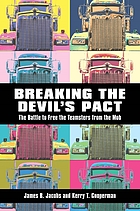
James B. Jacobs, Kerry Cooperman
In 1988, despite powerful Congressional opposition, U.S. Attorney Rudy Giuliani brought a massive civil racketeering (RICO) suit against the leaders of the behemoth International Brotherhood of Teamsters (IBT) and more than two dozen Cosa Nostra (LCN) leaders.
Intending to land a fatal blow to the mafia, Giuliani asserted that the union and organized-crime defendants had formed a devil's pact. He charged the IBT leaders with allowing their organized-crime cronies to use the union as a profit center in exchange for the mobsters' political support and a share of the spoils of corruption. On the eve of what would have been one of the most explosive trials in organized-crime and labor history, the Department of Justice and the Teamsters settled.
Book traces the fascinating history of U.S. v. IBT, beginning with Giuliani's controversial lawsuit and continuing with in-depth analysis of the ups and downs of an unprecedented remedial effort involving the Department of Justice, the federal courts, the court-appointed officers (including former FBI and CIA director William Webster and former U.S. attorney general Benjamin Civiletti), and the IBT itself. Now more than 22 years old and spanning over 5 election cycles, U.S. v. IBT is the most important labor case in the last half century, one of the most significant organized crime cases of all time, and one of the most ambitious judicial organizational reform efforts in U.S. history. is a penetrating examination of the potential and limits of court-supervised organizational reform in the context of systemic corruption and racketeering"-- Provided by publisher
RICO (Racketeering) act used against Teamsters, beginning in 1988, one of the most significant cases of its time
James Birney, JSTOR
1,788 items-Materials gathered by James Birney in the course of his anti-slavery labors and items gathered by William Birney while preparing a biography of his father. Over the years the collection has been augmented and now includes both anti- and pro-slavery material, printed speeches, African colonization, politics and campaign biographies, and black education.17
includes both anti- and pro-slavery material, printed speeches, African colonization, politics and campaign biographies, and black education.
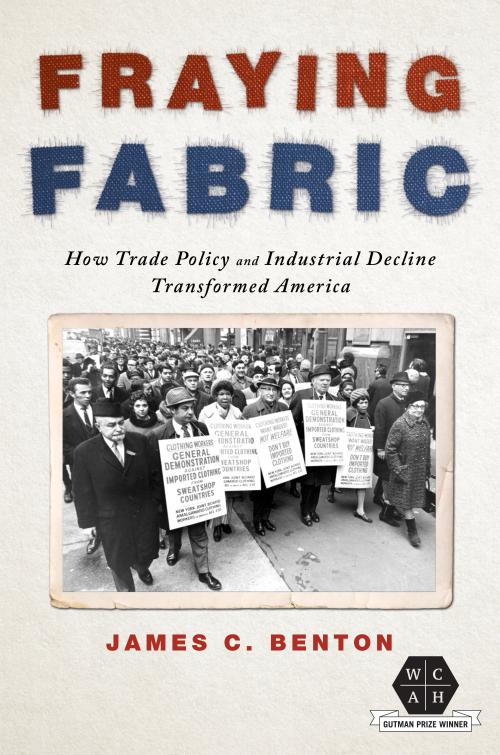
James C. Benton
The decline of the U.S. textile and apparel industries between the 1940s and 1970s helped lay the groundwork for the twenty-first century's potent economic populism in America. J
ames C. Benton looks at how shortsighted trade and economic policy by labor, business, and government undermined an employment sector that once employed millions and supported countless communities. Starting in the 1930s, Benton examines how the New Deal combined promoting trade with weakening worker rights. He then moves to the ineffective attempts to aid textile and apparel workers even as imports surged, the 1974 pivot by policymakers and big business to institute lowered trade barriers, and the deindustrialization and economic devastation that followed. Throughout, Benton provides the often-overlooked views of workers, executives, and federal officials who instituted the United States' policy framework in the 1930s and guided it through the ensuing decades. Compelling and comprehensive, Fraying Fabric explains what happened to textile and apparel manufacturing and how it played a role in today's politics of anger"-- Provided by publisher
looks at how shortsighted trade and economic policy by labor, business, and government undermined an employment sector that once employed millions and supported countless communities.
James C. Foster
The Impact of Labor on the Development of the Southwest
I. The Western Federation of Miners
The WFM and Mine-Mill in Historical Perspective
The WFM Experience in Alaska and Arizona, 1902-1908 - James C. Foster
An Inquiry into the Fall of the WFM and Summary of the WFM Codebook - James C. Foster
The Rise of the Mine-Mill Union In Southwestern Copper - D. H. Dinwoodie
II. The Industrial Workers of the World
The Western Wobblies
The IWW and the Mid-Continent Oil Field - Earl Bruce White
The Bisbee Deportation - James Byrkit
III. The Rise of Unionized Farm Workers
The United Farm Workers of America
Little Known Farm Labor History - H. L. Mitchell
Racial Divisions and Agricultural Labor Organizing in Hawaii - Edward D. Beechert
Farm Labor: New Forks in Old Trails - Art Carstens
IV. Mexican Labor, North and South of the Border
Mexican Labor and the American Southwest
The Struggle for Independent Unions in Mexico, 1854-1931 - John M. Hart
The Historiography of a Myth - Rodney Anderson
Mexican Migrant Workers in the United States - David Maciel
V. Labor and Politics
Politics and the Western Labor Movement
Labor Politics, Hayden Style - Paul Mandel
Anti-Labor Politics in Texas, 1941-1957 - George N. Green
The Tragic Purge of 1948—A Personal Recollection - Monsignor Charles O. Rice
Index
The WFM and Mine-Mill in Historical Perspective
The WFM Experience in Alaska and Arizona, 1902-1908 - James C. Foster
An Inquiry into the Fall of the WFM and Summary of the WFM Codebook - James C. Foster
The Rise of the Mine-Mill Union In Southwestern Copper - D. H. Dinwoodie
II. The Industrial Workers of the World
The Western Wobblies
The IWW and the Mid-Continent Oil Field - Earl Bruce White
The Bisbee Deportation - James Byrkit
III. The Rise of Unionized Farm Workers
The United Farm Workers of America
Little Known Farm Labor History - H. L. Mitchell
Racial Divisions and Agricultural Labor Organizing in Hawaii - Edward D. Beechert
Farm Labor: New Forks in Old Trails - Art Carstens
IV. Mexican Labor, North and South of the Border
Mexican Labor and the American Southwest
The Struggle for Independent Unions in Mexico, 1854-1931 - John M. Hart
The Historiography of a Myth - Rodney Anderson
Mexican Migrant Workers in the United States - David Maciel
V. Labor and Politics
Politics and the Western Labor Movement
Labor Politics, Hayden Style - Paul Mandel
Anti-Labor Politics in Texas, 1941-1957 - George N. Green
The Tragic Purge of 1948—A Personal Recollection - Monsignor Charles O. Rice
Index
A collection of essays that focuses on radical labor in the American west.
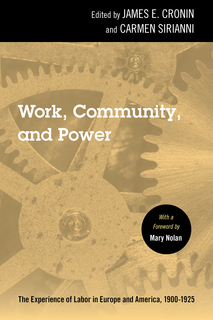
James Cronin
The first quarter of the twentieth century was perhaps the most dramatic and consequential period for the international working class. Corporate control was consolidated and centralized. The workplace began to be extensively reorganized by Taylorist and later Fordist methods. Revolutions, factory occupations, and new forms of workers' control and industrial democracy followed in the wake of World War I. Revolutionary industrial unionism challenged previous organizations, and new communist parties contended with Social Democracy for the political allegiance of the working classes. In this crucible of struggle and social transformation, many of the most influential political and social theories were forged: not only those of Lenin and Kautsky, but also Gramsci and Lukacs, Korsch and Austro-Maxism, Michel and Weber. The meaning of both democracy and socialism has remained contested ever since. The comparative and case studies in this collection offer a major reinterpretation of this crucial period in working class history in the United States, Europe, and Soviet Russia. They combine recent interests of historians and social scientists in the labor process, social history "from the bottom up," the mobilization of social movements, the world system and international state competition with more traditional concerns about organization, theory and politics
A collection of studies of early 20th century labor ideology.
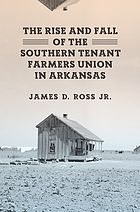
James D. Ross Jr
Founded in eastern Arkansas during the Great Depression, the Southern Tenant Farmers Union (STFU) has long fascinated historians, who have emphasized its biracial membership and the socialist convictions of its leaders, while attributing its demise to external factors, such as the mechanization of agriculture, the repression of wealthy planters, and the indifference of New Dealers. However, as James Ross notes in this compelling revisionist history, such accounts have largely ignored the perspective of the actual sharecroppers and other tenant farmers who made up the union’s rank and file.
Drawing on a rich trove of letters that STFU members wrote to union leaders, government officials, and others, Ross shows that internal divisions were just as significant—if not more so—as outside causes in the union’s ultimate failure. Most important, the STFU’s fatal flaw was the yawning gap between the worldviews of its leadership and those of its members. Ross describes how, early on, STFU secretary H. L. Mitchell promoted the union as one involving many voices—sometimes in harmony, sometimes in discord—but later pushed a more simplified narrative of a few people doing most of the union’s work. Struck by this significant change, Ross explores what the actual goals of the rank and file were and what union membership meant to them. “While the white leaders may have expressed a commitment to racial justice, white members often did not,” he writes. “While the union’s socialist and communist leaders may have hoped for cooperative land ownership, the members often did not.” Above all, the poor farmers who made up the membership wanted their immediate needs for food and shelter met, and they wanted to own their own land and thus determine their own futures. Moreover, while the leadership often took its inspiration from Marx, the membership’s worldview was shaped by fundamentalist, Pentecostal Christianity.
In portraying such tensions and how they factored into the union’s implosion, Ross not only offers a more nuanced view of the STFU, he also makes a powerful new contribution to our understanding of the Depression-era South.
explores what the actual goals of the rank and file were and what union membership meant to them

James D. Walsh
Fascinating and groundbreaking: a talented young journalist goes undercover to work as a casino labor-union organizer in Florida in this rare, smart look at the ongoing struggle between the haves and the have-nots. Salting is a simple concept--get hired at a non-union company, do the job you were hired to do, and, with the help of organizers on the outside, unionize your coworkers from the inside. James Walsh spent almost three years as a "salt" in two casinos in South Florida, working as a buffet server and a bartender. Neither his employers at the casinos nor the union knew about Walsh's intentions to write about his experience. Now he reveals little-known truths about how unions fight to organize workers in the service industries, the vigorous corporate opposition against them, and how workers are caught in the battle. During his time as an undercover worker, Walsh witnessed the oddities of casino culture, the cultish nature of labor organizing, and surprising details of service industry employment. His revelations show the ferocious conflict between large service corporations and their hourly wage employees, who are hanging onto economic survival by their fingernails. The hotel and service union Walsh worked with employs young, college-educated activists and learning how salts use their skills to great success or failure is riveting. Walsh transports us directly to the hot, humid backroom of the Miami casino and shows how it feels to be grilled by a union organizer as to whether you have enough grit for the job. A clear-eyed and fascinating portrait of labor-organizing, Playing Against the House explores the trials of day-to-day life for the working poor to its effects on the middle class and the face of twenty-first century union busting in unprecedented detail"-- Provided by publisher
the role of a labor organizer who SALTed the workplace

James Gilbert Cassedy
The records of the National Archives and Records Administration (NARA) have been, and will remain, indispensable to the study of African American labor history. Thirty NARA record groups (approximately 19,711 cubic feet of documentary material) document the activities of federal agencies whose core missions pertained to labor and labor management relations. There are also many other record groups that contain material of interest to students of American labor history even though they document the activities of federal agencies whose primary concern was not the resolution of labor disputes or the control of labor management relations. Locating records that document the role of African Americans in American labor history can be difficult because the federal agencies and offices that created these records arranged their indexes and files by name of institutions such as the name of the company or the name of the union involved in a controversy. This overview briefly traces the growth of black labor relations and provides an introduction to the research value of several NARA record groups.
An article detailing the holdings of the National Archives and Records Administration and their relevance to African-American labor history.
James Gregory
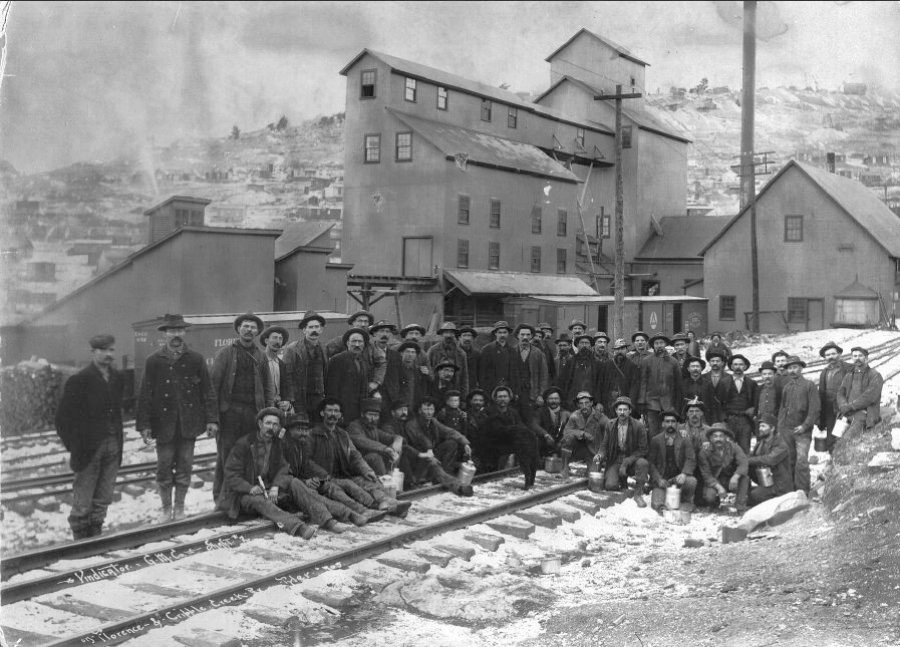
An introduction to labor history in the West
introduction to labor history in the West
James Gregory
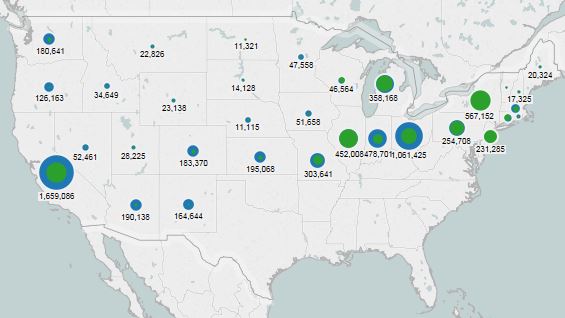
An estimated 28 million Black, White, Latino, Asian, and Native American southerners left the region in the 20th century, joining in the great migrations we call the Southern Diaspora. Many, especially Black migrants, settled in the big cities of the North and West. This page accompanies the main pages of the Southern Diaspora section. These interactive maps and charts show decade by decade the number of southerners living in northern and western metropolitan areas (central cities and surrounding country). Filter by racial categories
interactive maps and charts show decade by decade the number of southerners living in northern and western metropolitan areas (central cities and surrounding country).
James Gregory
Illinois, like other midwestern states, experienced rapid population growth through migration in the 19th century and much slower growth since then. Recording a population of 851,000 in 1850, the state doubled its numbers by 1860, doubled again by 1880, and again before 1910. It has taken a century to double the 1910 total.
graphs and maps of Illinois migrations
James Gregory
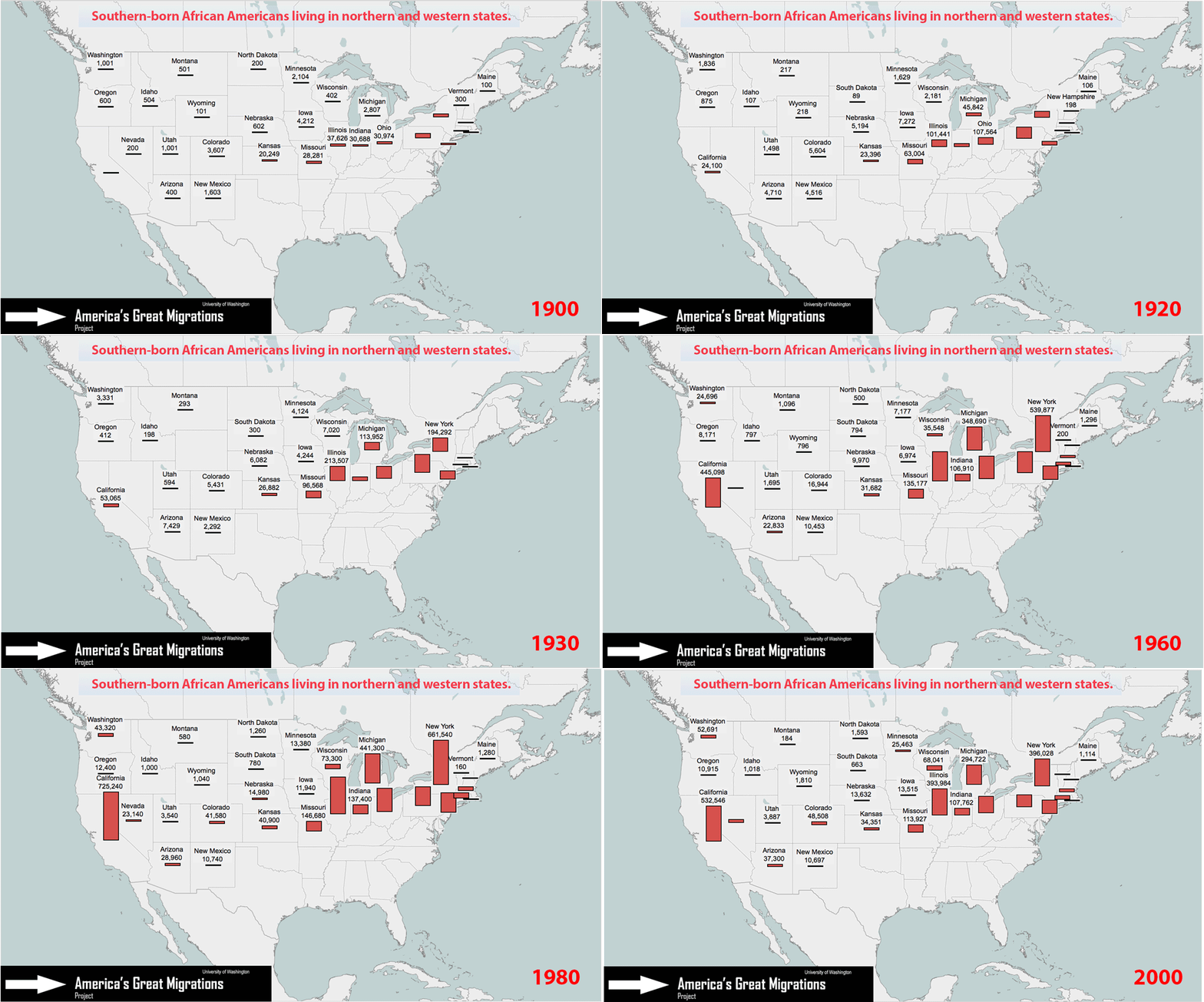
This is part 2 of the sequence on the Black Great Migration out of the South. It follows a short introduction to the several Black migrations. The interactive maps and data tables below provide detailed information about the movement of African Americans out of the South from 1900-2000. Use them to investigate volumes and directions. The first map reveals decade-by-decade the number of southerners living in northern and western states. Select a state of origin and see where people went. Another map shows similar data for each metropolitan area where Black southerners settled. A third allows us to highlight a northern or western state and see which southern states contributed the most migrants. Or start with a southern state and see where its people went. Finally an interactive table provides the data behind these visualizations
interactive maps and data tables below provide detailed information about the movement of African Americans out of the South from 1900-2000.
James Gregory
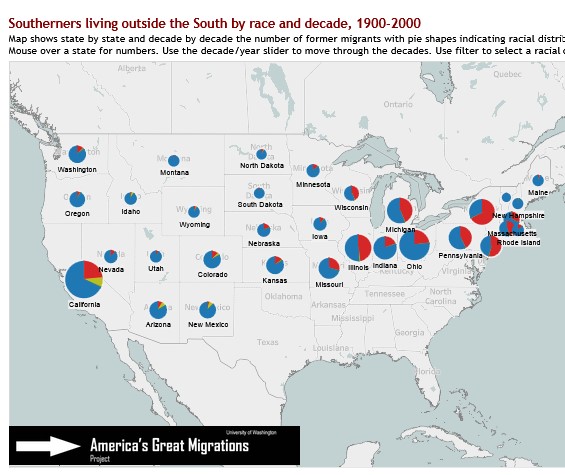
Here are interactive maps and charts that show various dimensions of the great migrations out of the South. They show decade by decade the number of southerners living in northern and western states. Select a state of origin and see where people went. Or select a state of residence and see the states of origin. Filter or compare by racial categories. The maps are hosted by Tableau Public. If slow, refresh the page.
interactive maps and charts that show various dimensions of the great migrations out of the South
Museum/Exhibits
Tours
Maps
Digital Projects
Organizations
Sites
Film/Video
Audio/Interview
Podcast/Program
Text/Document
Image
Graphs/Data
Timeline
Southwest
West
Midwest
Southeast
Northeast
Mexico
Canada
Global
Books
Teaching
Lectures
Digital Archives
Journals
Bibliographies
Topic Intro