


Collections
Library
Type
Region
Coverage:
-
Published:
-
James Gregory
Americans have always been a moving people, coming from other places, moving to new places. Not only has the nation long attracted people from beyond its borders, it also claims high rates of internal migration. Here are interactive graphics and maps that allow us to track the changing population of each state decade-by-decade since 1850. Select a state and see where people were born, both other countries and other states, filter by race. We have more detail on separate pages for Alabama, Alaska, Arizona, California, Colorado, Florida, Georgia, Illinois, Michigan, New York, North Carolina, Oregon, Texas, Virginia, Utah, Washington. This visualization tool is hosted by Tableau Public and may take a few seconds to respond. If slow, refresh the page.
interactive graphics and maps that allow us to track the changing population of 16 states decade-by-decade since 1850.
James Gregory
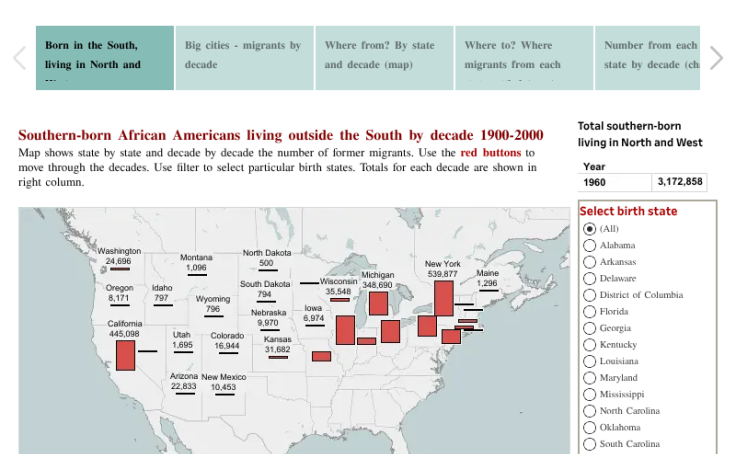
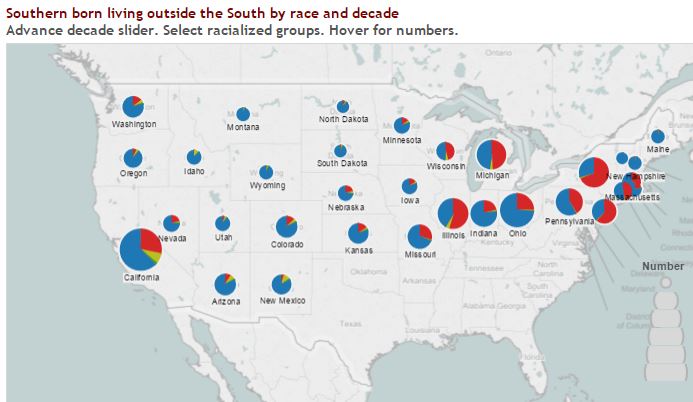
interactive maps and charts that show various dimensions of the great migrations out of the South. They show decade by decade the number of southerners living in northern and western states. Select a state of origin and see where people went. Or select a state of residence and see the states of origin. Filter or compare by racial categories.
a short essay and portal to mapping

James Gregory
The southern exodus and its impact on American life
Between 1900 and the 1970s, twenty million southerners migrated north and west. Weaving together for the first time the histories of these black and white migrants, James Gregory traces their paths and experiences in a comprehensive new study that demonstrates how this regional diaspora reshaped America by “southernizing” communities and transforming important cultural and political institutions.
Challenging the image of the migrants as helpless and poor, Gregory shows how both black and white southerners used their new surroundings to become agents of change. Combining personal stories with cultural, political, and demographic analysis, he argues that the migrants helped create both the modern civil rights movement and modern conservatism. They spurred changes in American religion, notably modern evangelical Protestantism, and in popular culture, including the development of blues, jazz, and country music.
In a sweeping account that pioneers new understandings of the impact of mass migrations, Gregory recasts the history of twentieth-century America. He demonstrates that the southern diaspora was crucial to transformations in the relationship between American regions, in the politics of race and class, and in the roles of religion, the media, and culture.
History that shows how both black and white working-class southerners used their new northern surroundings to become agents of change in religion, culture, and politics

James Gregory
Here are the locations of eight shack towns that housed homeless people in the Seattle area in the 1930s. The largest, known as "Hooverville," was on Elliot Bay near the present site of Qwest stadium. Click to see this interactive google map and accompanying photos and descriptions of each site. https://depts.washington.edu/depress/Unemployed_Citizens_League.shtml Map: Unemployed Citizens League Branches, Seattle
Hoovervilles in Seattle: Map and Photoshttps://depts.washington.edu/depress/map_UCL.shtml
Here are the locations of eight shack towns that housed homeless people in the Seattle area in the 1930s. The largest, known as "Hooverville," was on Elliot Bay near the present site of Qwest stadium. Click the markers to see photos and descriptions of each site. See https://depts.washington.edu/depress/hooverville_map.shtml
interactive google map and accompanying photos and descriptions of each site.
James Gregory, America's Great Migrations Project
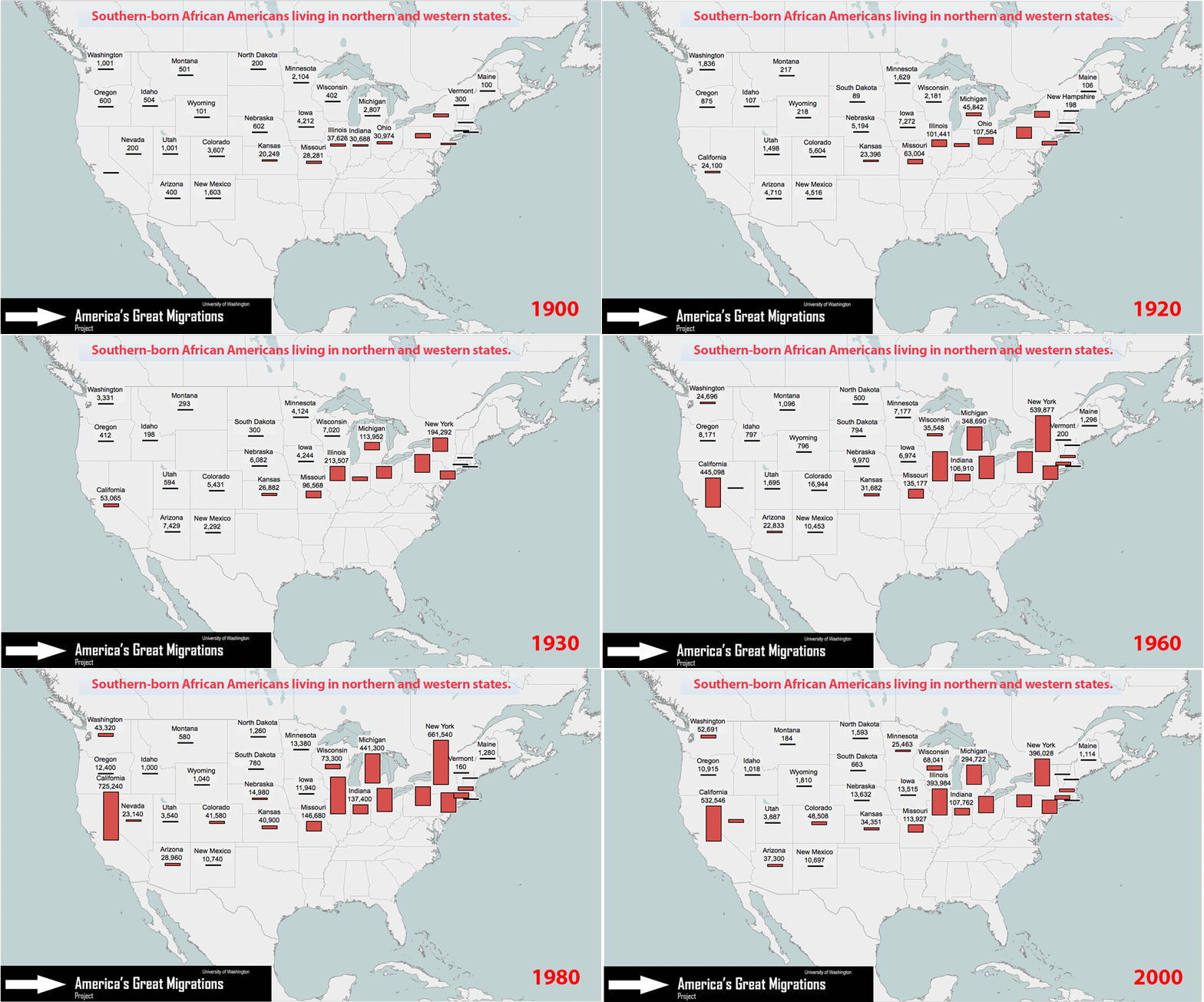
"This project explores a number of consequential migrations--Great Migrations--that helped reshape culture, politics, or economic structures.
It has six units. . . (with) interactive maps, charts, and data:
(1) the Great Migration of African Americans out of the South 1900-2000; the reverse migration to the South 1970-2020; state by state Black migration histories
(2) the enormously consequential migrations of Latinx Americans, both from Latin America and inside the US (1850-2017);
(3) the diaspora of whites from the South to northern and western states;
(4) the Dust Bowl migration to California from Oklahoma and neighboring states in the 1930s.
(5) In addition, we provide migration histories for all fifty states showing decade-by-decade from 1850-2017 where residents have come from."
This site is based on published and unpublished work by James Gregory, Professor of History, University of Washington. It is part of the Civil Rights and Labor History Consortium of public history projects directed by Professor Gregory at the University of Washington.
The main page for the America's Great Migrations Project, led by University of Washington Professor James Gregory; the project covers six major migrations in American history, and also offers state-specific migration histories for California, Florida, Illinois, New York, Texas, Washington, Arizona, Colorado, Virginia, Alabama, Alaska, and Oregon.
James Gregory, America's Great Migrations Project
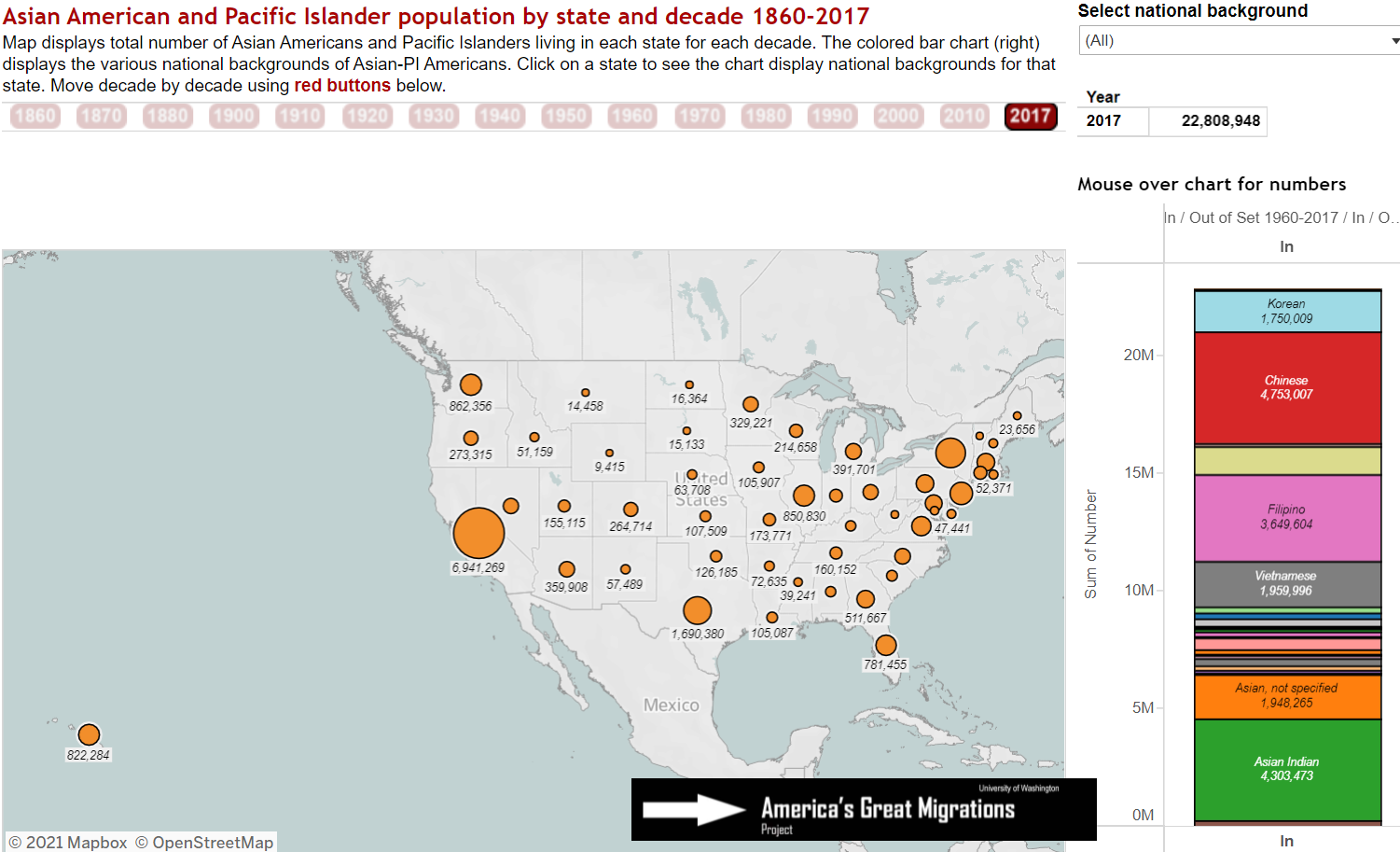
This page introduces the history of Asian and Pacific Islanders migration to the United States and between states - a sequence of consequential migrations that have transformed the US. This introductory page leads to a set of interactive maps, charts, and tables found on the Mapping Asian American and Pacific Islander Migrations page. Those visualizations allow us to separately track the migration history of people from many nations in Asia and the Pacific. We also highlight the importance of internal migration by showing state of birth and state of residence for the millions of American born persons of Asian heritage.
A research portal linking visitors to the America's Great Migrations Project's section on Asian American and Pacific Islander migrations, complete with an introductory essay by project director James Gregory and links to six maps, charts, and tables that visualize the movements of people he describes.
James Gregory, America's Great Migrations Project
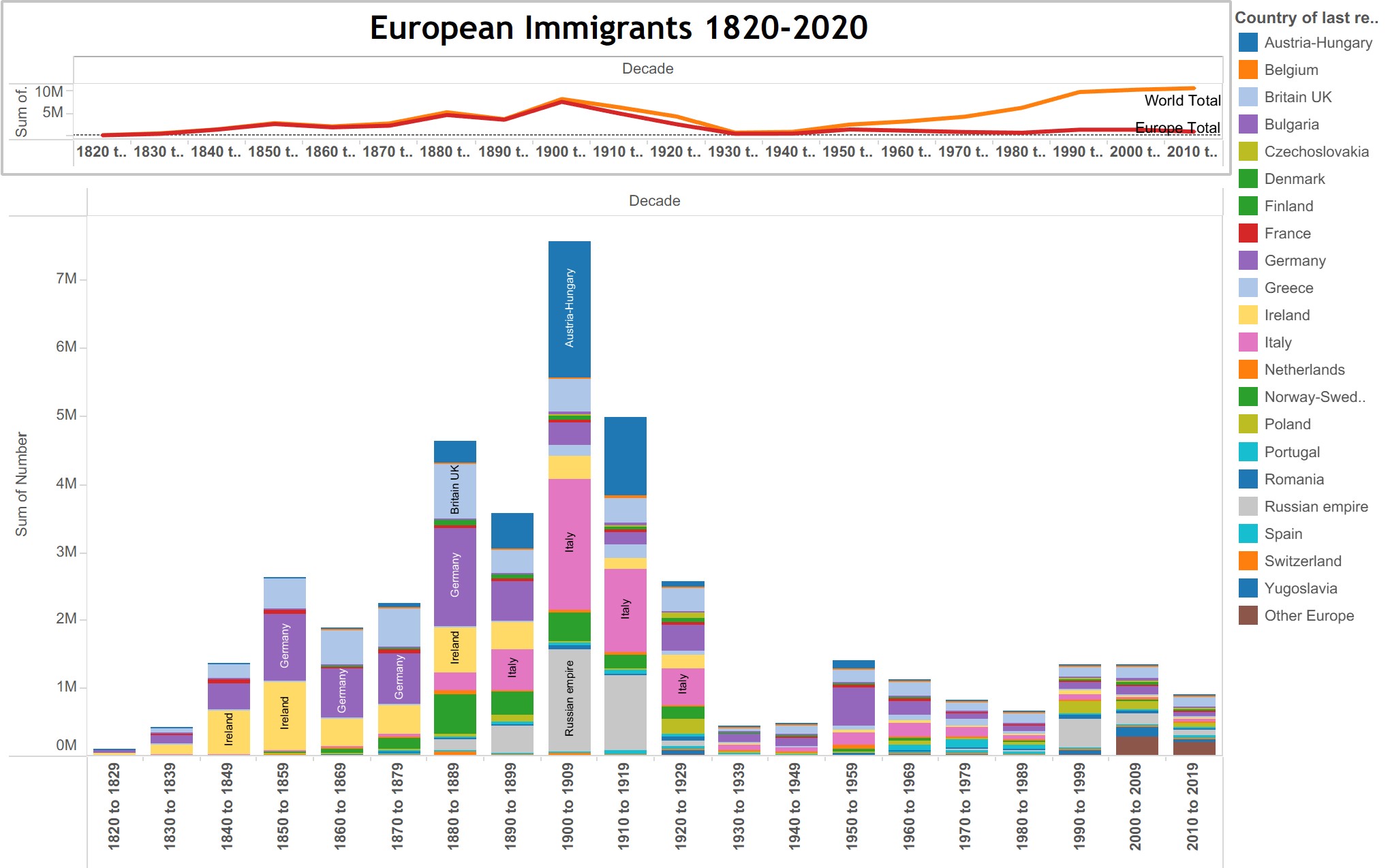
"This page introduces the history of European immigration--one of the "great migrations" that have transformed America. It utilizes the interactive maps, charts, and tables found on the Mapping European Immigration and Ancestry page. Those visualizations allow us to separately track the migration history of people from every part of Europe since 1820. We also report on the state-to-state population of persons born in Europe and separately on census information on ancestry. GO TO MAPPING PAGE"
European immigration introduction and the great migration that have transformed them
James Gregory, America's Great Migrations Project
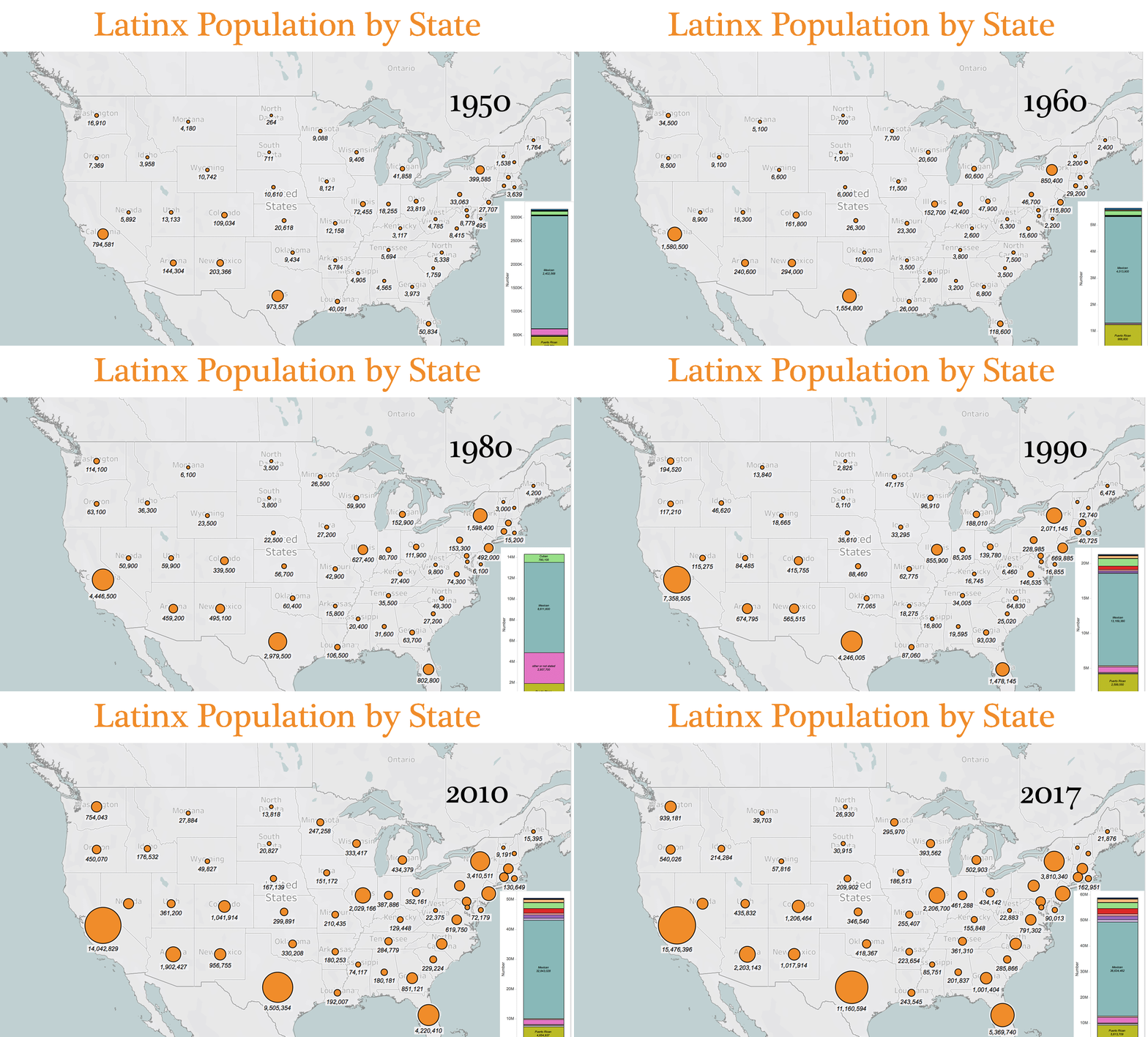
This page introduces the history of Latinx migration--a sequence of "great migrations" that have transformed the Americas-- and accompanies the interactive maps, charts, and tables found on the Mapping the Latinx Great Migrations page. Those visualizations allow us to separately track the migration history of people from every nation in Latin America. We can also explore internal migration. Most Latinx Americans, now and in every decade since 1850, were born in the United States, and their relocations have been consequential, especially the northward relocations of Tejanos and other Southwesterners.
See the Maps at Mapping the Latinx Great Migrations
A research portal linking visitors to the America's Great Migrations Project's section on Latinx/a/o migrations, complete with an illustrated introductory essay by project director James Gregory and six maps, charts, and tables visualizing the movements of people he describes.
James Gregory, America's Great Migrations Project
"These maps reveal the migration history of Asian Americans and Pacific Islanders both into the United States and from state to state within US borders. Filters allow you to separately track the migrations of people from many nations. Because these are based on US census data they are incomplete and subject to the definitions and categories that the Census Bureau imposes each decade.:
links to six maps, charts, and tables that visualize the movements of people he describes.

James Gregory, America's Great Migrations Project
This is part 2 of the sequence on the European immigration. It follows Part 1 short essay which explains the history and geography of this world changing migration.
Here we track European immigrants and European ancestries by country of origin using three kinds of data.
(1) Ship passenger records and federal immigration tallies, 1820-2020;
(2) Census counts of birthplaces 1850-2023; and census counts of declared ancestry 1980-2023.
Filters allow you to specify countries of origin and select particular states to see birthplace and ancestry distributions.
.
European immigrants and European ancestries by country of origin using three kinds of data.
(1) Ship passenger records and federal immigration tallies, 1820-2020;
(2) Census counts of birthplaces 1850-2023; and census counts of declared ancestry 1980-2023.
Filters allow you to specify countries of origin and select particular states to see birthplace and ancestry distributions.
James Gregory, America's Great Migrations Project
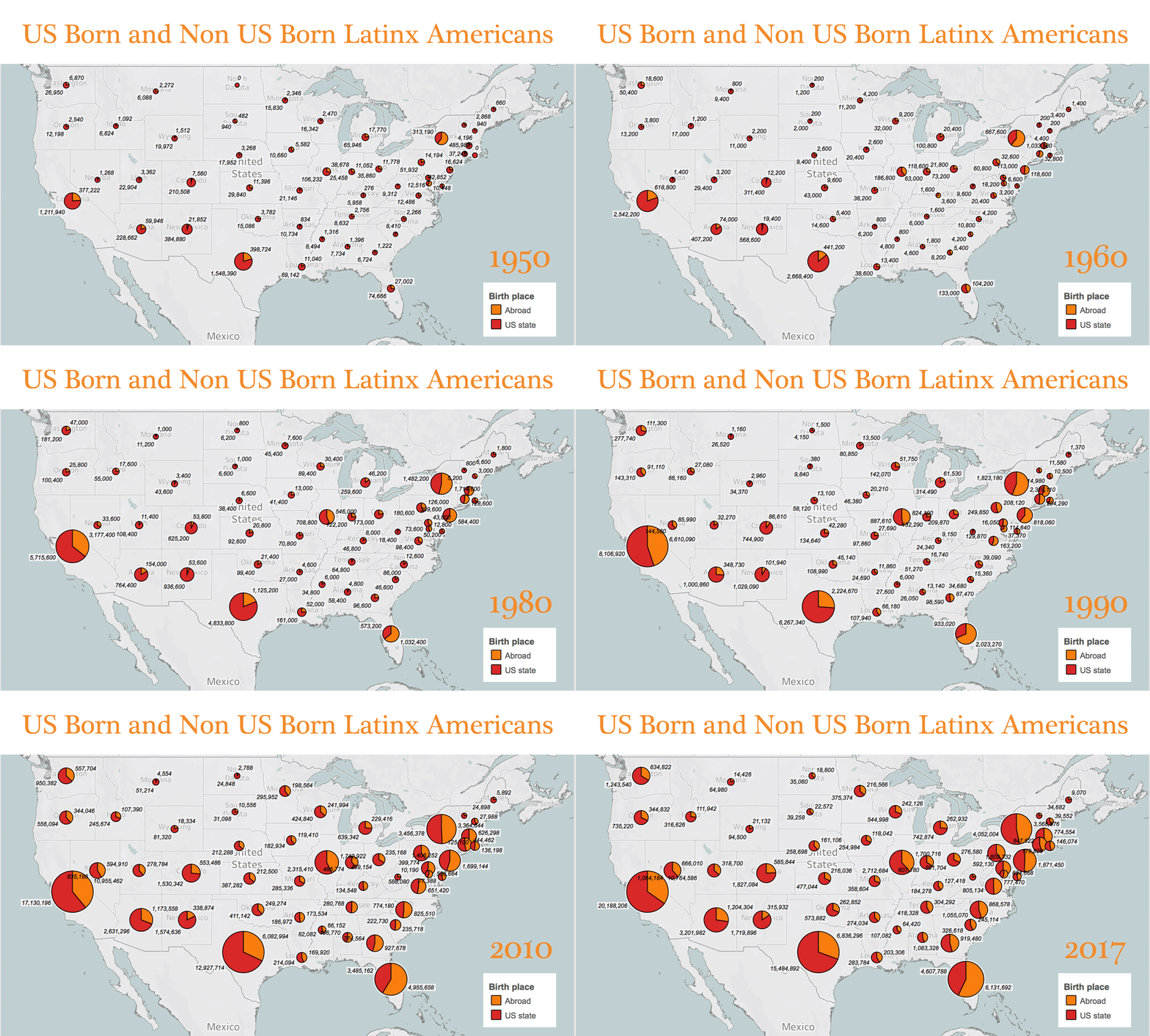
Here are six maps and charts that allow you to explore the history of Latinx migration both into the United States and within its borders.Map shows the number of Latinx Americans born in each Latin American nation. The map numbers do not include US born of the same heritage.
1) US born and those born abroad for each national heritage. Click red buttons to move through the decades.
2)Latinx population showing national backgrounds by state and decade
3)US born and non US born Latinx Americans 1850-2022
4)Latinx Americans living in the US who were born outside the 50 states by decade 1850-2022.
5) Latinx population in United States by decade
six maps and charts that allow you to explore the history of Latinx migration both into the United States and within its borders.

James Gregory, America's Great Migrations Project
Americans have always been a moving people, coming from other places, moving to new places. Not only has the nation long attracted people from beyond its borders, it also claims high rates of internal migration. Here are interactive graphics and maps that allow us to track the changing population of each state decade-by-decade since 1850. Select a state and see where people were born, both other countries and other states, filter by race. Be advised that the America's Great Migration Project also has more detail on separate pages for California, Florida, Illinois, Texas, New York, Virginia, Alabama, Alaska, Arizona, Colorado, Oregon, Utah, Washington.
Four visualizations of American migrations from the mid-nineteenth century to the present, selectable by birthplaces both in and outside the U.S.
James Gregory, America's Great Migrations Project
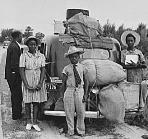
The press called them Dust Bowl refugees, although actually few came from the area devastated by dust storms. Instead they came from a broad area encompassing four southern plains states: Oklahoma, Texas, Arkansas, and Missouri. More than half a million left the region in the 1930s, mostly heading for California. In a decade when migration rates dropped nationwide, the families leaving the southern plains attracted a great deal of attention. Even before John Steinbeck translated the experience into one of the classic American novels of the twentieth century, the migration had become a media event, tracked by journalists, documented by photographers like Dorothea Lange. Here are resources for exploring the Dust Bowl migration of the 1930s and the longer story of migration between the southern plans and the West Coast.
A research portal to essays and four maps detailing the history and geography of the Dustbowl migrations to California, when refugees fled devastating dust storms in 1930s Oklahoma, Texas, Arkansas, and Missouri.
James Gregory, America's Great Migrations Project
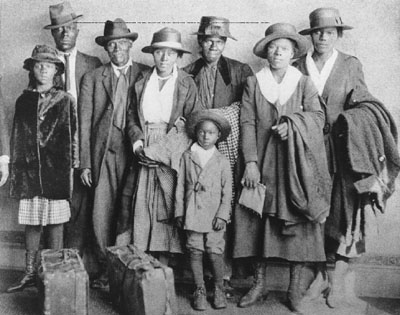
Over the course of the 20th century, more than seven million African Americans left homes in the South to resettle in northern and western states. Historians have long described this exodus as the Great Migration, great not just because of the numbers of people who moved but also because of the social and political consequences. Once a people of the South, Black Americans became increasingly part of the big cities of all regions and in those urban settings steadily gained political and cultural influence. The Great Migration was thus key to the struggles and accomplishments of the long civil rights movement. This page introduces resources for exploring the Great Migration, including several sets of interactive maps and tables showing where people settled and where they came from decade by decade.
Map-Migration from South 1900-2000
Map-Reverse Migration to South 1970-2022
Map-State to State Migration 1850-2020
A research portal linking visitors to the America's Great Migrations Project's section on black and African American migrations, including fifteen different statistical visualizations.
James Gregory, America's Great Migrations Project
For as long as there has been something called the American South, southerners in significant numbers have been leaving. The region itself expanded through migration as white southerners in the early 1800s carved out new states for cotton and slavery. Others moved to places that today are understood to be regionally separate from the South. White out-migration grew especially heavy in the two decades after the Civil War, with many leaving for farming opportunities and others heading for the Norths big cities—New York, Philadelphia, Boston, and Chicago— where the nation's commerce concentrated. Census takers at the end of the century counted over one million southern-born whites living outside their birth region.
A research portal linking visitors to the America's Great Migrations Project's section on the Souther disapora, which includes black, white, and Latinx/a/o migrations. Includes an introductory essay by project director James Gregory, links to six maps and charts, and links to excerpts from Professor Gregory's book on the subject.
James Gregory, America's Great Migrations Project
The Southern Diaspora may have been the most momentous American population movement of the twentieth century. Between 1900 and 1980 more than 20 million southerners left their home region looking for jobs in the cities, suburbs, and farms of the North and West. Most visible were the African American southerners whose migration transformed urban America and set the stage for important changes in racial understandings and the rights of people of color. White southern migrants outnumbered black migrants and in some settings were almost as controversial. Called "hillbillies" in the North and "Okies" out West, the whites faced challenges different than most Americans who move across state lines. This site introduces the history of the Southern Diaspora and serves as a companion to the prize-winning book by James N. Gregory, The Southern Diaspora: How The Great Migrations of Black and White Southerners Transformed America (University of North Carolina Press, 2005). Historians usually separate the stories of the Great Migration of black southerners from the Dust Bowl and Appalachian migrations of whites. The Southern Diaspora brings them together to show the connections and differences. Here you will find information about the experiences of migrating southerners of both races. You will also find information on the impact and legacy of the dual migrations.
A companion website to a book by the America's Great Migrations Project director James N. Gregory, which covers the history of southerners who left their birth/home region for the U.S. North and West.

James Gregory, IWW History Project
Digitized access to conventions, and other sources for the study of the IWW -link broken
A bibliography detailing primary and secondary source material that is relevant to the history of the IWW.
James Gregory, Mapping American Social Movements
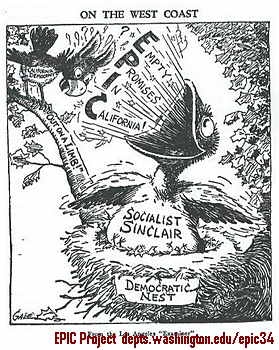
Some of the most inventive and persuasive political cartoons of the 20th century were directed at Upton Sinclair and his End Poverty in California plan. Sinclair's long and colorful record as a crusader for radical causes and the utopian dimensions of the EPIC plan made easy targets for newspaper cartoonists. Sinclair compiled some of the best of the Anti-EPIC cartoons in his book, I, Candidate for Governor of California: And How I Got Licked. Here are 33 of them.
A collection of political cartoons targeted at Upton Sinclair for his 1934 gubernatorial bid, which was centered on his EPIC campaign.

James Gregory, Mapping American Social Movements
A bibliography detailing key primary and secondary source materials for those wishing to investigate Upton Sinclair's 1934 EPIC Campaign beyond what can be found on the Upton Sinclair's End Poverty in California Campaign Project website.
A bibliography containing primary and secondary sources for Upton Sinclair's 1934 campaign for California Governor.
James Gregory, Mapping American Social Movements
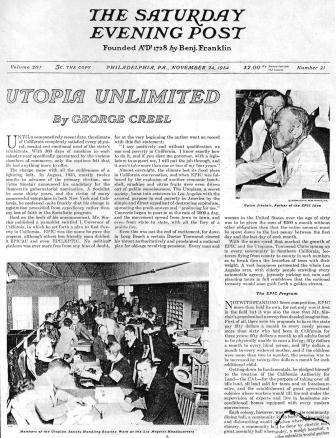
From August through November 1934, EPIC was covered in newspapers and magazines across the country, earning story after story and almost as many political cartoons. Here is a sample of articles from influential news magazines and newspapers.
Seventeen examples of national news coverage on Upton Sinclair's 1934 California gubernatorial bid and his EPIC campaign, including articles from Literary Digest, The Nation, New Republic, Christian Century, and Saturday Evening Post.
James Gregory, Mapping American Social Movements
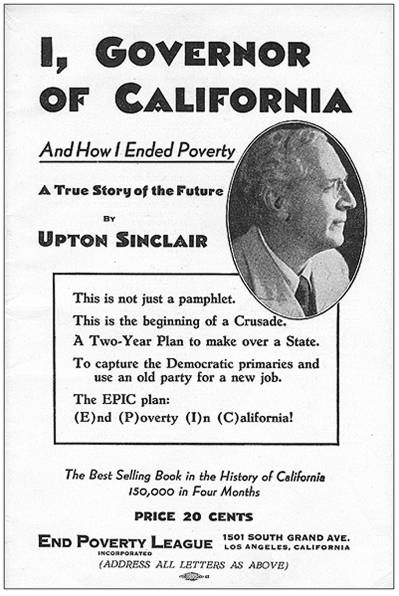
Here are examples of campaign literature for and against 1934 California gubernatorial candidate Upton Sinclair.
A collection of pro- and anti-Upton Sinclair pamphlets, periodicals, and other examples of campaign literature.
James Gregory, Mapping American Social Movements
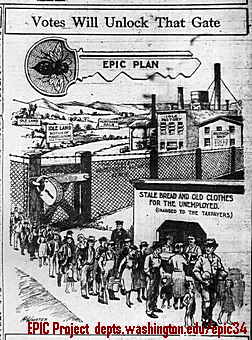
Political cartoons were essential to the EPIC campaign, just as they were to the opposition campaign. Newspaper readers in the 1930s counted on political cartoons to deliver incisive, ascerbic satrie, hard hitting messages, as well as attractive graphics. With so many journalists out of work, EPIC was able to draw on the talents of several cartoonists. Here is a selection of cartoons from EPIC News in 1934. Be sure to also see the anti-Sinclair cartoons assembled by EPIC Campaign Project participants.
A collection of political cartoons that were created to help Upton Sinclair's EPIC campaign and 1934 gubernatorial bid in California.
James Gregory, Mapping American Social Movements
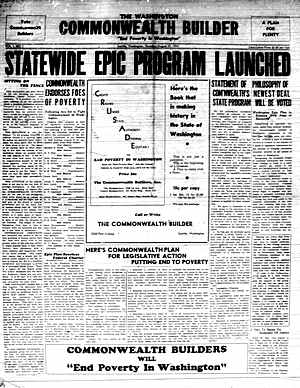
The EPIC movement spread outside California, especially along the West Coast. In Washington State, the EPIW campaign was ultimately more successful than the California campaign. EPIW elected a number of candidates in 1934, including a US Senator.
A research portal (linking visitors to several essays on the Washington Commonwealth Federation and its impact on Washington politics) accompanied by a brief introductory essay detailing the history of the EPIW campaign, which spawned from Upton Sinclair's California-based EPIC campaign.

James Gregory, Mapping American Social Movements
This essay details the campaign and its consequences. It was initially published as the introduction to the reprint edition of Upton Sinclair, I Candidate for Governor of California and How I Got Licked, published by University of California Press, 1994.
An essay by EPIC Campaign Project director James Gregory which introduces readers to the history of the campaign, beginning with Upton Sinclair's publication, I, Candidate for Governor, And How I Got Licked.
James Gregory, Mapping American Social Movements
Here you will find detailed accounts and a wealth of primary sources, including political cartoons, newspaper and magazine articles, campaign pamphlets, pages from Upton Sinclair's Epic News (the campaign newspaper), and Upton Sinclair's writing during and after the campaign. "Upton Sinclair's 1934 campaign for governor of California has been called "the Campaign of the Century." One of the most dramatic and influential contests in California history, it helped change the political landscape of the nation. This project explores the campaign and the End Poverty in California (EPIC) program that captured international attention in 1934. Here you will find detailed accounts and a wealth of primary sources, including political cartoons, newspaper and magazine articles, campaign pamphlets, pages from Upton Sinclair's Epic News (the campaign newspaper), and Upton Sinclair's writing during and after the campaign."
A research portal to the resources collected by participants in the Upton Sinclair's End Poverty in California (EPIC) Campaign project, which uses primary sources to explore the EPIC's international impact.