


Collections
Library
Type
Region
Coverage:
-
Published:
-
Jon Shelton, Teaching Labor's Story
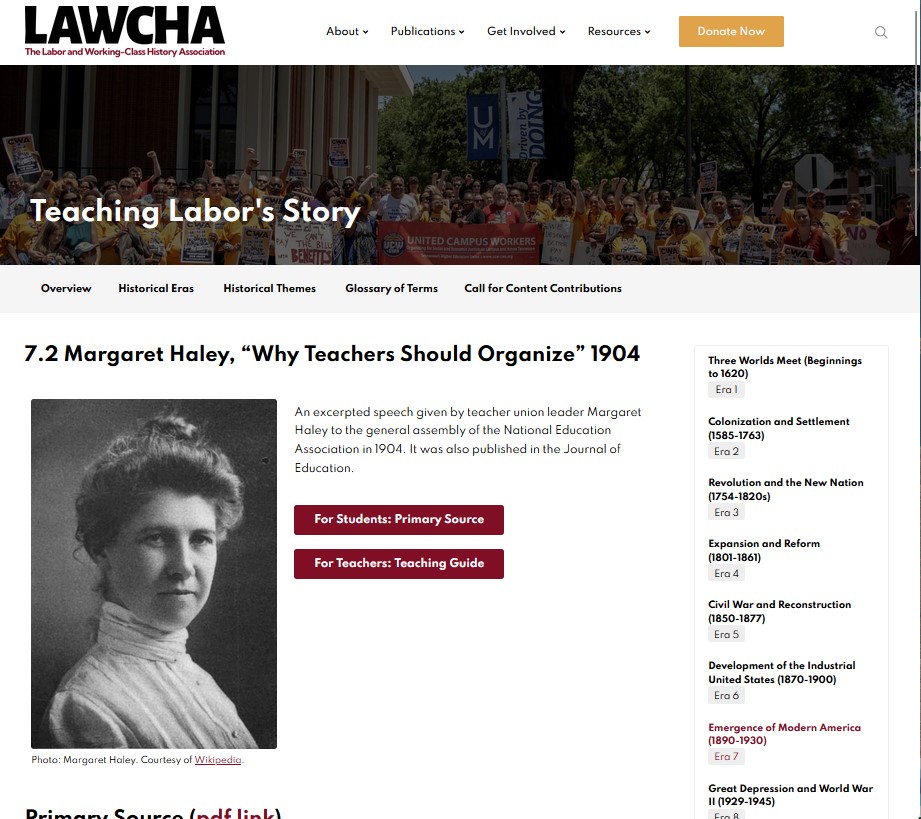
Margaret Haley, sixth grade teacher and Vice Presidentof thefirst teacher union in the US (theChicago Teachers’ Federation),gave this speech at the National Education Association conventionin St. Louis, Missouri, July 1, 1904.At the time, the NEA was not a union. The NEA was dedicated to advancing the cause of public education. Its members included teachers and administrators from around the country. Haley’s speech was also published in the Journal of Education. Includes Teaching Guide (pdf link)
Excerpts from a speech given by teacher union leader Margaret Haley to the general assembly of the National Education Association in 1904. It was also published in the Journal of Education
Jonathan Cutler
The movement for a shorter workweek that once defined the labor movement in the United States was largely displaced by the new corporatist structure of organized labor in the post-New Deal era. Labor's Time examines the changes that occurred within organized labor and traces their influence on the decline of the shorter hours movement. Focusing on the internal union politics of the influential United Automobile Workers and Local 600, its chapter at Henry Ford's massive River Rouge factory, Jonathan Cutler demonstrates how an all-but-forgotten interracial movement for a shorter workweek during the 1950s and 1960s became a casualty of an increasingly top-heavy union bureaucracy that lost touch with the desires, fears, and aspirations of rank and file workers and dug its own grave in the process. Jonathan Cutler examines the political context in which the shorter hours movement emerged within Local 600 in the 1940s, then chronicles the attempts by Walter Reuther, the head of the UAW, to suppress it. Cutler also reviews the role the Communist Party played in the controversy. Finally, he documents the UAW response to rank and file pressure for a shorter workweek, and how the local's own organizational flaws allowed Reuther and the national union to wrest control from the dissidents
examines the changes that occurred within organized labor and traces their influence on the decline of the shorter hours movement.
Jonathan Rees
The first all-primary source reader in labor history published in nearly one hundred years, "The Voice of the People" presents excerpts from fifty-four primary sources to blend labor history’s traditional focus on the growth of a union movement with windows into all aspects of workers lives -- their workplaces, their unions, their home lives and their culture -- the engaging selections mirroring the great diversity of the American workforce from the colonial era to the present. Arranged into four parts, each of which begins with an original overview of the corresponding period in American history, this unique compilation of edited documents -- each of which is preceded by a contextual introduction -- offers students the opportunity to explore for themselves how specific events as well as general trends in American labor history affected real people, whether farm laborers, slaves, servants, mill hands, prostitutes, assembly-line workers, office temps, fast-food employees, or union leaders. -- From product description
presents excerpts from fifty-four primary sources on laborers, unions, and the relationship between workers and the workplace.

Jose Gros, History Matters
In order to challenge the emphasis on extreme economic individualism espoused by Gilded Age industrialists and laissez-faire theorists, labor writers drew on diverse historical and religious traditions. Jose Gros, writing in The Carpenter in 1895, turned to religious traditions, specifically the biblical parable of Cain and Abel. Gros used the parable’s central question—“Am I my brother’s keeper?”—to criticize economic individualism and make the case for cooperation and brotherhood.
Source: Jose Gros, “Cain,” The Carpenter, 15 (May 1895): 12.
An 1895 article written by Jose Gros published in The Carpenter, where the author uses the story of Cain and Abel as an analogy to criticize economic individualism.
Joseph A. McCartin
In August 1981, the Professional Air Traffic Controllers Organization (PATCO) called an illegal strike. The new president, Ronald Reagan, fired the strikers, establishing a reputation for both decisiveness and hostility to organized labor.
As Joseph A. McCartin writes, the strike was the culmination of two decades of escalating conflict between controllers and the government that stemmed from the high-pressure nature of the job and the controllers' inability to negotiate with their employer over vital issues.
PATCO's fall not only ushered in a long period of labor decline; it also served as a harbinger of the campaign against public sector unions that now roils American politics."--Jacket
air traffic controllers battled Ronald Reagan's anti-union agenda in 1981
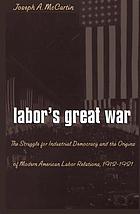
Joseph A. McCartin
In his comprehensive look at labor issues during the decade of the Great War, McCartin explores the political, economic, and social forces that gave rise to this conflict and shows how rising labor militancy and the sudden erosion of managerial control in wartime workplaces combined to create an industrial crisis.
explores the political, economic, and social forces that gave rise to conflict and shows how rising labor militancy and the sudden erosion of managerial control in wartime workplaces combined to create an industrial crisis.
Joseph Cahill, History Matters
Although publicists for the Gilded Age corporations celebrated efficiency and the science of management, their employees did not always join the celebration. What looked like careful and disciplined management from one perspective was often viewed as petty tyranny from below. While some workers assailed upper management for this abuse others experienced the tyranny more directly in their day-to-day work lives. In this transcript taken from testimony before the U. S. House of Representatives in the late 1880s, Joseph P. Cahill, a worker in the freight department of the Philadelphia and Reading Railroad Company, described the petty tyrannies inflicted on workingmen by the company dispatcher.
The late-1880s testimony of Philadelphia and Reading railroad worker Joseph P. Cahill before the House of Representatives, focusing on "petty tyrannies" that employers visited on workers.
Joseph E. Slater
From the dawn of the twentieth century to the early 1960s, public-sector unions generally had no legal right to strike, bargain, or arbitrate, and government workers could be fired simply for joining a union. Public Workers is the first book to analyze why public-sector labor law evolved as it did, separate from and much more restrictive than private-sector labor law, and what effect this law had on public-sector unions, organized labor as a whole, and by extension all of American politics. Joseph E. Slater shows how public-sector unions survived, represented their members, and set the stage for the most remarkable growth of worker organization in American history. Slater examines the battles of public-sector unions in the workplace, courts, and political arena, from the infamous Boston police strike of 1919, to teachers in Seattle fighting a yellow-dog rule, to the BSEIU in the 1930s representing public-sector janitors, to the fate of the powerful Transit Workers Union after New York City purchased the subways, to the long struggle by AFSCME that produced the nation's first public-sector labor law in Wisconsin in 1959. Slater introduces readers to a determined and often-ignored segment of the union movement and expands our knowledge of working men and women, the institutions they formed, and the organizational obstacles they faced
first book to analyze why public-sector labor law evolved as it did

Joseph Fish, History Matters
Steelworker Joseph Fish Speaks on the 1919 Steel Strike (History Matters): In the dramatic 1919 steel strike, 350,000 workers walked off their jobs and crippled the industry. The U.S. Senate Committee on Education and Labor set out to investigate the strike while it was still in progress. In his testimony before the committee, Homestead, Pennsylvania, steelworker Joseph Fish described conditions in the steel mills as good and maintained that only “one or two” Americans have joined the strike. This document is useful for showing how the workforce was divided along ethnic lines
This document is useful for showing how the workforce was divided along ethnic lines
Joseph McDonnell, History Matters
Labor leaders like Denis Kearney and H. L. Knight of California’s Workingmen’s Party often resorted to popular racist arguments to justify the exclusion of Chinese immigrants. In an 1878 address, Kearney and Knight described the Chinese as a race of “cheap working slaves” who undercut American living standards and thus should be banished from America’s shores. A few American labor leaders, mostly in the radical and socialist wing of the movement, were more sympathetic. In this 1878 editorial in the Labor Standard attacking demands for Chinese workers to be deported, Irish-born socialist Joseph McDonnell reminded readers that the arrival of virtually every ethnic group in America had been met with the same “intolerant, silly and shameful cry” of “Go home!” Though voices like McDonnell’s were exceptional, they serve as reminders that some late nineteenth-century white Americans were able to pierce the veil of prejudice that men like Kearney and Knight erected against Asian immigrants.
(teaching document) Joseph McDonnell reminded readers that the arrival of virtually every ethnic group in America had been met with the same “intolerant, silly and shameful cry” of “Go home!”
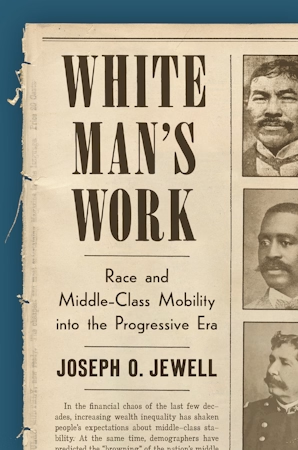
Joseph O. Jewell
In the financial chaos of the last few decades, increasing wealth inequality has shaken people's expectations about middle-class stability. At the same time, demographers have predicted the 'browning' of the nation's middle class-once considered a de facto 'white' category-over the next twenty years as the country becomes increasingly racially diverse. In this book, Joseph O. Jewell takes us back to the turn of the twentieth century to show how evidence of middle-class mobility among Black, Mexican American, and Chinese men generated both new anxieties and varieties of backlash among white populations. Blending cultural history and historical sociology, Jewell chronicles the continually evolving narratives that linked whiteness with middle-class mobility and middle-class manhood. In doing so, Jewell addresses a key issue in the historical sociology of race: how racialized groups demarcate, defend, and alter social positions in overlapping hierarchies of race, class, and gender. New racist narratives about non-white men occupying middle-class occupations emerged in cities across the nation at the turn of the century. These stories helped to shore up white supremacy in the face of far-reaching changes to the nation's racialized economic order"-- Provided by publisher
how racialized groups demarcate, defend, and alter social positions in overlapping hierarchies of race, class, and gender.
Joseph-François Lafitau, History Matters
Indian people of the Eastern Woodlands (northeastern North America) followed a seasonal schedule of hunting, fishing, gathering wild food, and the cultivation of crops. They relied upon cultivated crops such as corn, beans, and squash for much of their food. Men primarily provided the meat and fish, while women were responsible for supplying cultivated vegetables along with wild berries, nuts, and fruit. While men helped clear the fields, women did the planting, weeding, and harvesting in the warm months.
Many European observers remarked upon what they saw as drudgery inflicted upon Indian women. However, Joseph-François Lafitau, a Jesuit missionary and writer, was also a keen ethnographic observer of the details of Iroquois life. In this account, he noted the similarities between farm women’s work in Europe and among the Iroquois.
Source: Joseph-François Lafitau, Customs of the American Indians Compared with the Customs of Primitive Times, ed. and trans. William N. Fenton and Elizabeth I. Moore, 2 vols (Toronto,: The Champlain Society, 1974–77), 2: 47, 54–55.
gendered labor work among Native Americans
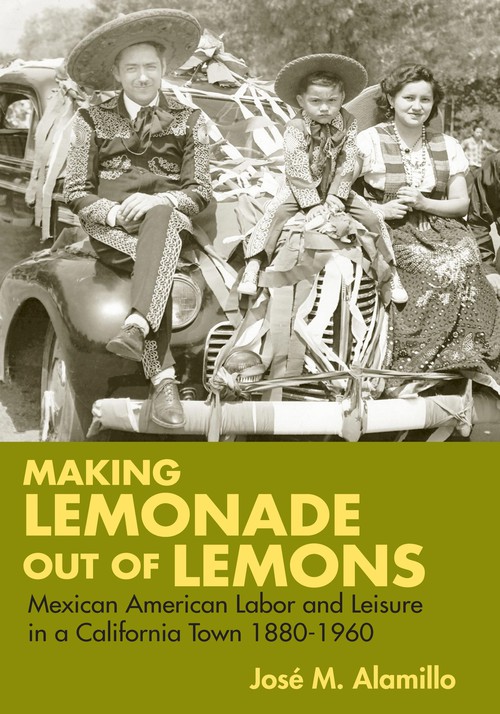
José M. Alamillo
"Out of the "lemons" handed to Mexican American workers in Corona, California - low pay, segregated schooling, inadequate housing, and racial discrimination - Mexican men and women made "lemonade" by transforming leisure spaces such as pool halls, movie theaters, baseball games, festivals, and churches into politicized spaces where workers voiced their grievances, debated strategies for advancement, and built solidarity. Using oral history interviews, extensive citrus company records, and his own experiences in Corona, Jose Alamillo argues that Mexican Americans helped lay the groundwork for civil rights struggles and electoral campaigns in the post-World War II era. Book jacket."--BOOK JACKET
argues that Mexican Americans helped lay the groundwork for civil rights struggles and electoral campaigns in the post-World War II era.
Josh Lauer
"This volume offers a crucial and long overdue historical intervention in the study of modern surveillance and capitalism in the United States. At a basic level, it historicizes what has been taken as unprecedented, revealing a deep logic to surveillance as a mode of rationalization, bureaucratization, and social control traceable to the late eighteenth century forward.
The chapters in this book highlight a variety of surveillance practices that predate computers and miniaturized electronics-from the disciplinary control of enslaved labor, to the management of customer service staff, to the solicitous scrutiny of hotel guests before 1950. Many of the chapters illustrate the power of written records-account books, lists, and reports-as technologies of control, monitoring, and investigation.
By historicizing modern surveillance, this volume shows how post-9/11 surveillant practices and contemporary digital platforms are elaborations, rather than breaks, from the past. Though surveillance themes are often implicit in historical studies, as in the fields of labor history and the history of civil rights, the chapters in this collection make such themes explicit and central to the story of American capitalism"-- Provided by publisher
reveals a deep logic to surveillance as a mode of rationalization, bureaucratization, and social control traceable to the late eighteenth century forward.
Josh Pearl, History Matters
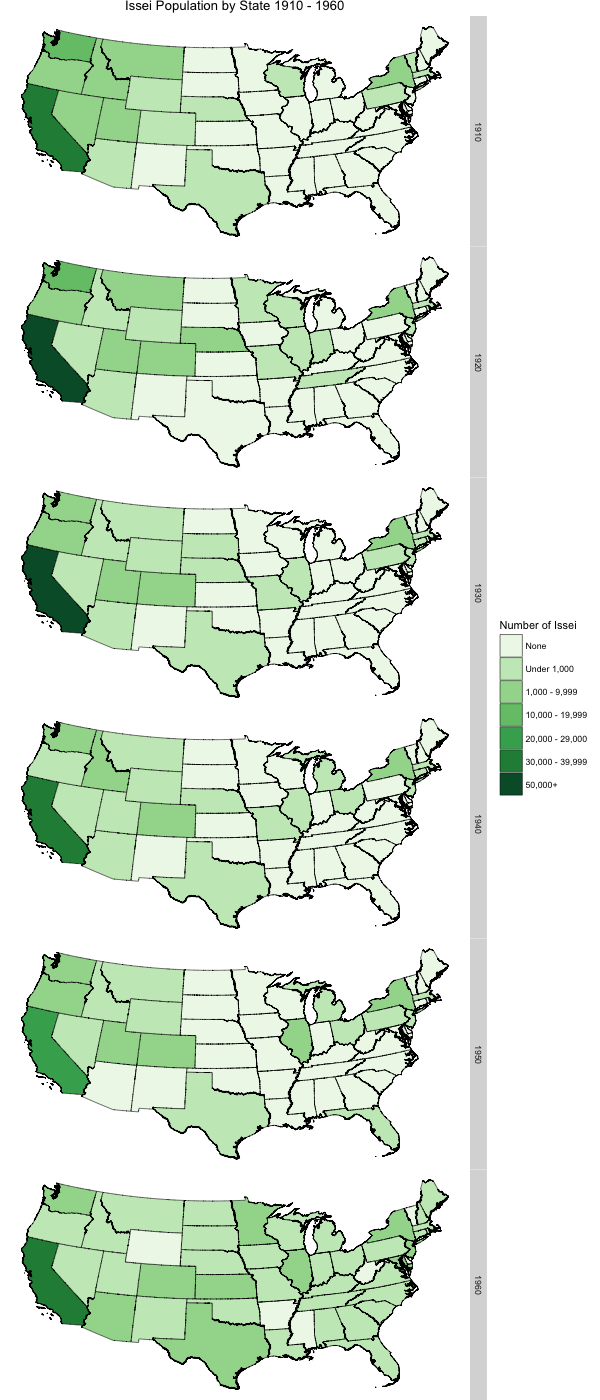
Japanese immigration to Pacific states began in the 1880s after anti-Chinese legislation led to a shortage of cheap labor. Labor recruiters for factories, rail roads, mining camps, fisheries and plantations looked to Japan to recruit cheap labor from abroad (Takaki 180). The rising Japanese population led to the Census Bureau creating a “Japanese” category for race, distinct from the “Chinese” race and subsequent anti-Japanese legislation was passed in the United States.
Anti-Japanese sentiments culminated with Executive Order 9066 in 1942–3 months after the Japanese attack on Pearl Harbor. The order interned Japanese Americans, including those who were citizens, in camps primarily located in Mountain and MidWest states. Executive Order 9066 did not intern Japanese Americans in Hawaii.
I will analyze how the internment of Japanese Americans affected their migration patterns across the United States. I will also analyze how the citizenship status (the Nisei) of Japanese Americans affected their migration.
An article presenting and contextualizing immigration data on Japanese movement eastward across the United States.
Joshua Freeman
From the founding of New Amsterdam until today, working people have helped create and re-create the City of New York through their struggles. Starting with artisans and slaves in colonial New York and ranging all the way to twenty-first-century gig-economy workers, this book tells the story of New York's labor history anew. City of Workers, City of Struggle brings together essays by leading historians of New York and a wealth of illustrations, offering rich descriptions of work, daily life, and political struggle. It recounts how workers have developed formal and informal groups not only to advance their own interests but also to pursue a vision of what the city should be like and whom it should be for. The book goes beyond the largely white, male wage workers in mainstream labor organizations who have dominated the history of labor movements to look at enslaved people, indentured servants, domestic workers, sex workers, day laborers, and others who have had to fight not only their masters and employers but also labor groups that often excluded them. Through their stories--how they fought for inclusion or developed their own ways to advance - it recenters labor history for contemporary struggles. City of Workers, City of Struggle offers the definitive account of the four-hundred-year history of efforts by New York workers to improve their lives and their communities. 00Exhibition: In association with the exhibition City of Workers, City of Struggle: How Labor Movements Changed New York at the Museum of the City of New York (From May 1, 2019)
offers the definitive account of the four-hundred-year history of efforts by New York workers to improve their lives and their communities.
Joshua Benjamin Freeman
In a major work of scholarship that is also wonderfully accessible, celebrated historian Joshua B. Freeman tells the story of the factory and examines how it has reflected both our dreams and our nightmares of industrialization and social change.
He whisks readers from the textile mills in England that powered the Industrial Revolution and the factory towns of New England to the colossal steel and car plants of twentieth-century America, Eastern Europe, and the Soviet Union and on to today's behemoths making sneakers, toys, and cellphones in China and Vietnam.
Behemoth tells the grand story of global industry from the Industrial Revolution to the present. It is a magisterial work on factories and the people whose labor made them run. And it offers a piercing perspective on how factories have shaped our societies and the challenges we face now
Introduction
"Like Minerva from the brain of Jupiter" : the invention of the factory
"The living light" : New England textiles and visions of utopia
"The progress of civilization" : industrial exhibitions, steelmaking, and the price of Prometheanism
"I worship factories" : Fordism, labor, and the romance of the giant factory
"Communism is Soviet power plus the electrification of the whole country" : crash industrialization in the Soviet Union
"Common requirements of industrialization" : Cold War mass production
"Foxconn City" : giant factories in China and Vietnam
Conclusion
a magisterial work on factories and the people whose labor made them run and it offers a piercing perspective on how factories have shaped our societies and the challenges we face now
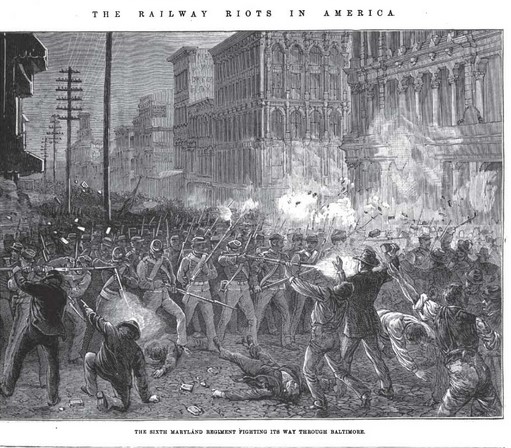
Joshua Brown, Who Built America?, American Social History Project
How do news images of events such as a strike or uprising shape viewers’ understanding of what happened? Examination of the leading images of 1877 railroad strikes and Great Uprising, by a leading historian of the era, with accompanying reflection questions for students.
A teaching module investigating how the media covered the strike waves of 1877
Joshua D. Rothman
In The Ledger and the Chain, prize-winning historian Joshua D. Rothman tells the disturbing story of the Franklin and Armfield company and the men who built it into the largest and most powerful slave trading company in the United States. In so doing, he reveals the central importance of the domestic slave trade to the development of American capitalism and the expansion of the American nation.
Few slave traders were more successful than Isaac Franklin, John Armfield, and Rice Ballard, who ran Franklin and Armfield, and none were more influential. Drawing on source material from more than thirty archives in a dozen states, Rothman follows the three traders through their first meetings, the rise of their firm, and its eventual dissolution.
Responsible for selling between 8,000 and 12,000 slaves from the Upper South to Deep South plantations over a period of eight years in the 1830s, they ran an extensive and innovative operation, with offices in New Orleans and Alexandria in Louisiana and Natchez in Mississippi. They advertised widely, borrowed heavily from bankers and other creditors, extended long term credit to their buyers, and had ships built to take slaves from Virginia down to New Orleans. Slavers are often misremembered as pariahs of more cultivated society, but as Rothman argues, the men who perpetrated the slave trade were respected members of prominent social and business communities and understood themselves as patriotic Americans. By tracing the lives and careers of the nation's most notorious slave traders, The Ledger and the Chain shows how their business skills and remorseless violence together made the malevolent entrepreneurialism of the slave trade. And it reveals how this horrific, ubiquitous trade in human beings shaped a growing nation and corrupted it in ways still powerfully felt today" -- Provided by publisher
-- The Ledger and the Chain is a gripping story of human traffickers as labor allocators in the American South at a pivotal time. It focuses on how a constellation of white businesspeople—principally John Armfield, Rice C. Ballard, and Isaac Franklin—bought, transported, jailed, and sold ten thousand of their African-descended fellow Americans and how their firm, Franklin & Armfield, exemplified American capitalism of the early nineteenth century. The title points to the marriage of the bland business technology of the ledger and the bloody violence of the chain. The juxtaposition unravels a seeming contradiction between capitalism and slavery. The book's subjects put the capitalist virtues of social trust, investment, optimism, and creative problem-solving into the service of incarcerating, raping, deracinating, and forcing the labor of thousands of Black Americans, killing many along the way.
the disturbing story of the Franklin and Armfield company and the men who built it into the largest and most powerful slave trading company
Joshua D. Wolff
This work chronicles the rise of Western Union Telegraph from the early years of telecommunications to its apogee as the first corporation to monopolize an industry on a national scale. The battles over Western Union's monopoly illuminate the fierce tensions over the rising power of corporations after the Civil War and the reshaping of the American political economy.
chronicles the rise of Western Union Telegraph from the early years of telecommunications to its apogee as the first corporation to monopolize an industry on a national scale.
Joshua Freeman
A compelling look at the movements and developments that propelled America to world dominance beginning in 1945 and moving through McCarthyism and Vietnam, from the Great Society to Morning in America
A compelling look at the movements and developments that propelled America to world dominance from 1945 to Morning in America

Joshua Freeman
This history of New York transit workers from the Great Depression to the monumental 1966 transit strike shows how, through collective action, the men and women who operated the world's largest transit system brought about a virtual revolution in their daily lives. Joshua Freeman's detailed descriptions of both transit work and transit workers, and his full account of the formation and development of the Transport Workers Union provide new insight into the nature of modern industrial unionism. Freeman pays particular attention to the role of Communists and veterans of the Irish Republican Armyincluding TWU president Michael J. Quillin organizing and leading the union, as well as to the Catholic labor activists who were the principal union dissidents. Freeman also explores the intense political struggles over the New York transit system. He links the TWU's pioneering role in public sector unionism to worker militancy and the union's deep involvement in New York politics. His portrait of Fiorello La Guardia's determined opposition to the TWU belies La Guardia's pro-labor reputation. By combining social and political history with the study of collective bargaining, In Transit makes a major contribution to the history of American labor, radicalism, and urban politics. Now with a new epilogue that frames the history of the union in the context of labor’s revival and recent changes in TWU’s leadership, In Transit is an intimate portrait of the politics of mass transit and public sector unionism, and one of the most detailed reconstructions to date of the social processes of industrial unionism. This book will appeal to anyone interested in New York City's subways, politics, history, and labor.
A History of New York transit workers from the Great Depression to the monumental 1966 transit strike
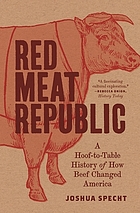
Joshua Specht
By the late nineteenth century, Americans rich and poor had come to expect high-quality fresh beef with almost every meal. Beef production in the United States had gone from small-scale, localized operations to a highly centralized industry spanning the country, with cattle bred on ranches in the rural West, slaughtered in Chicago, and consumed in the nation's rapidly growing cities. Red Meat Republic tells the remarkable story of the violent conflict over who would reap the benefits of this new industry and who would bear its heavy costs. Joshua Specht puts people at the heart of his story--the big cattle ranchers who helped to drive the nation's westward expansion, the meatpackers who created a radically new kind of industrialized slaughterhouse, and the stockyard workers who were subjected to the shocking and unsanitary conditions described by Upton Sinclair in his novel The Jungle. Specht brings to life a turbulent era marked by Indian wars, Chicago labor unrest, and food riots in the streets of New York. He shows how the enduring success of the cattle-beef complex--centralized, low cost, and meatpacker dominated - was a consequence of the meatpackers' ability to make their interests overlap with those of a hungry public, while the interests of struggling ranchers, desperate workers, and bankrupt butchers took a backseat. America - and the American table - would never be the same again. A compelling and unfailingly enjoyable read, Red Meat Republic reveals the complex history of exploitation and innovation behind the food we consume today."--Page 2 of cover
brings to life a turbulent era marked by Indian wars, Chicago labor unrest, and food riots in the streets of New York.
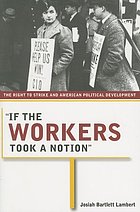
Josiah Bartlett Lambert
Once a fundamental civic right, strikes are now constrained and contested. In an unusual and thought-provoking history, Josiah Bartlett Lambert shows how the ability to strike was transformed from a fundamental right that made the citizenship of working people possible into a conditional and commercialized function. Arguing that the executive branch, rather than the judicial branch, was initially responsible for the shift in attitudes about the necessity for strikes and that the rise of liberalism has contributed to the erosion of strikers' rights, Lambert analyzes this transformation in relation to American political thought. His narrative begins before the Civil War and takes the reader through the permanent striker replacement issue and the alienation of workplace-based collective action from community-based collective action during the 1960s
"An inevitable and irresistible conflict" : The strange case of the disappearing American strike
"Something of freedom is yet to come" : The early American labor movement and the right to strike
"A nation of mock citizens" : The new American state and the right to strike, 1877-1895
"The very instruments of democracy are often used to oppress them" : The right to strike during the progressive era
"Let the toilers assemble" : The new deal and the modern liberal right to strike
"Get down to the type of job you're supposed to be doing" : World War II and the labor management relations act
"Let us stand with a greater determination" : The National Labor Relations Act and the bifurcation of collective action in the 1960s
"Playing hardball" : Permanent striker replacements and the limits of industrial justice
"We deplore strikes because of the inconvenience" : Modern American liberalism and the right to strike
"Something of slavery still remains" : The right to strike as a citizenship right
shows how the ability to strike was transformed from a fundamental right into a conditional and commercialized function.
Josiah McC Heyman
Traces the development over the past hundred years of the urban working class in northern Sonora. Drawing on an extensive collection of life histories, Heyman describes what has happened to families over several generations as people have left the countryside to work for American-owned companies in northern Sonora or to cross the border to find other employment.TABLE OF CONTENTS
Cover
Title Page
Copyright
Dedication
Contents
List of Illustrations
Acknowledgments
1. Introduction
2. Historical Synopsis of Northeastern Sonora and the U.S.–Mexican Border, 1886–1986
3. The Formative Working Class in the Mine Period, 1886–1949
4. Alternative Forms in the Mine Period, 1886–1949
5. Uprooting and Transformations at the Border, 1929–1967
6. Agua Prieta in the Maquiladora Period, 1967–1986
7. A Border Working Class
Notes
Bibliography
Index
About the Author
Traces the development over the past hundred years of the urban working class in northern Sonora
Museum/Exhibits
Tours
Maps
Digital Projects
Organizations
Sites
Film/Video
Audio/Interview
Podcast/Program
Text/Document
Image
Graphs/Data
Timeline
Southwest
West
Midwest
Southeast
Northeast
Mexico
Canada
Global
Books
Teaching
Lectures
Digital Archives
Journals
Bibliographies
Topic Intro