


Collections
Library
Type
Region
Coverage:
-
Published:
-
Kelly Therese Pollack
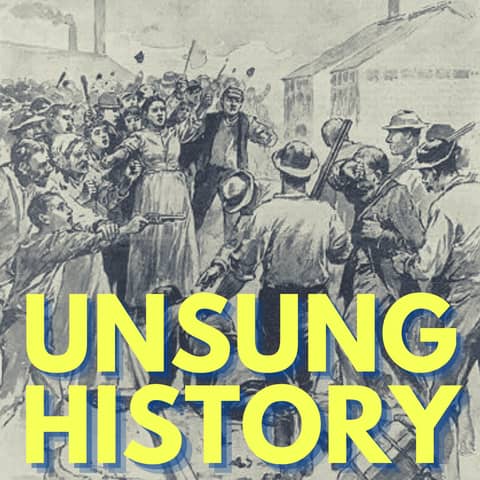
There are a select number labelled "labor history" from this podcast, which generally interviews scholars about their work. But there are others in the longer list that many labor historians would categorize as labor history. Unsung History tells the stories in American history that will have you saying, "wait, why didn't I know that?" Focusing on the lives of women, people of color, immigrants, laborers, religious minorities, enslaved people, and Indigenous communities, each episode of Unsung History starts with a background narrative telling the who, what, when, and where, followed by an interview with an expert on the subject who answers the why and how.
shows tagged labor history from this podcast
Ken Fones-Wolf
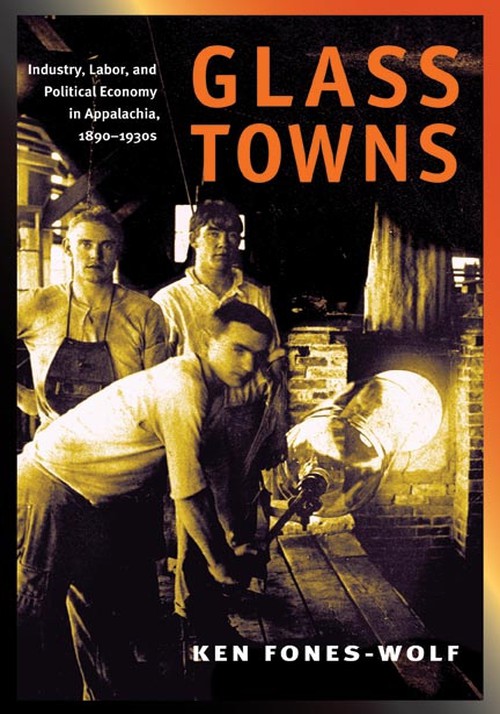
One of the central questions facing scholars of Appalachia concerns how a region so rich in natural resources could end up a symbol of poverty. Typical culprits include absentee landowners, reactionary coal operators, stubborn mountaineers, and greedy politicians. In a deft combination of labor and business history, Glass Towns complicates these answers by examining the glass industry's potential to improve West Virginia's political economy by establishing a base of value-added manufacturing to complement the state's abundance of coal, oil, timber, and natural gas. Through case studies of glass production hubs in Clarksburg, Moundsville, and Fairmont (producing window, tableware, and bottle glass, respectively), Ken Fones-Wolf looks closely at the impact of industry on local populations and immigrant craftsmen. He also examines patterns of global industrial restructuring, the ways workers reshaped workplace culture and political action, and employer strategies for responding to global competition, unreliable markets, and growing labor costs at the end of the nineteenth century
looks closely at the impact of the glass industry on local populations and immigrant craftsmen.

Ken Fones-Wolf
Traces the interaction of religion and the labor movement in Philadelphia in the late nineteenth and early twentieth centuries. Exploring the ways that Protestantism mediated between the dominant and working-class versions of American society, this work examines the ambiguity of Christianity as a social force in class conflict.
Traces the interaction of religion and the labor movement in Philadelphia in the late nineteenth and early twentieth centuries.
Ken Fones-Wolf
Anthology Offers an understanding of how immigrant laborers and their communitites shaped the region's history.
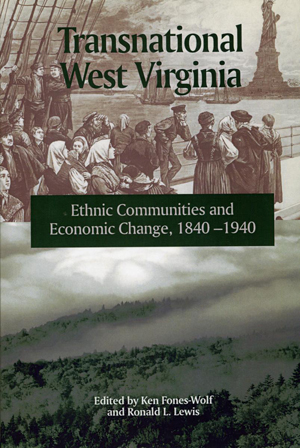
West Virginia is one of the most homogeneous states in the nation, with among the lowest ratios of foreign-born and minority populations among the states. But as this collection of historical studies demonstrates, this state was built by successive waves of immigrant labors, from the antebellum railroad builders to the twentieth-century coal miners. Transnational West Virginia offers a new understanding of how laborers and their communities shape a region’s history.
Transnational West Virginia includes essays and studies on immigrant networks, such as Irish workers along the B&O Railroad, Wheeling Germans in the Civil War era, Swiss immigration to West Virginia, and European Jews in Southern West Virginia.
This work also covers Belgian glassworkers in West Virginia, black migration to Southern West Virginia, Italians in the Upper Kanawha Valley, Italian immigration to Marion County, Wheeling Iron and the Welsh, West Virginia and immigrant labor to 1920, Monongalia miners between the World Wars, and West Virginia rubber workers in Akron. Transnational West Virginia is the first volume in the West Virginia and Appalachia series.
Introduction: Networks Large and Small
Section I: Antebellum Roots
Matthew Mason, “Paddy vs. Paddy: Labor Unrest and Provincial Identities along the Baltimore and Ohio Railroad, 1849–1951”
Ken Fones-Wolf, “Caught between Revolutions: Wheeling Germans in the Civil War Era”
Section II: Niche Communities
Elizabeth Cometti, “Swiss Immigration to West Virginia, 1864–1884: A Case Study”
Deborah R. Weiner, “From Shtetl to Coalfield: The Migration of East European Jews to Southern West Virginia”
Ken Fones-Wolf, “Craft, Ethnicity, and Identity: Belgian Glassworkers in West Virginia, 1898–1940”
Section III: Immigrant Coal Miners
Joe William Trotter Jr., “Black Migration to Southern West Virginia”
Frederick A. Barkey, “‘Here Come the Boomer ‘Talys’: Italian Immigrants and Industrial Conflict in the Upper Kanawha Valley, 1903–1917”
William B. Klaus, “Uneven Americanization: Italian Immigration to Marion County, 1900–1925”
Section IV: Representations of Ethnic Work Communities
Anne Kelley Knowles, “Wheeling Iron and the Welsh: A Geographical Reading of Life in the Iron Mills”
Kenneth R. Bailey, “Strange Tongues: West Virginia and Immigrant Labor to 1920”
Ronald L. Lewis, “Americanizing Immigrant Coal Miners in Northern West Virginia: Monongalia County Between the World Wars”
Epilogue: Leaving West Virginia
Susan Johnson, “West Virginia Rubber Workers in Akron”
About the Contributors
Index
Offers an understanding of how immigrant laborers and their communitites shaped the region's history.

Ken Ross & Louis V. Galdieri
1913 Massacre follows singer/songwriter Arlo Guthrie to the town of Calumet, a once-thriving mining town on Michigan’s Upper Peninsula still haunted by the tragic events that inspired Woody Guthrie’s ballad, ‘1913 Massacre.’
On December 24, 1913, the striking copper miners of Calumet were gathered with their wives and children for a holiday party at the Italian Hall. After the festivities had begun, someone — to this day, no one knows who — yelled Fire!
Despite efforts to keep the Hall under control, panic took hold of the crowd. The miners, their wives and children made a mad rush for the stairs. In the ensuing chaos, seventy-four people were crushed and suffocated to death on the stairway. Fifty-nine of the dead were children. There was no fire.
In the version of events that found its way into Woody Guthrie’s song, the “copper-boss thug-men” had plotted to yell Fire! and were holding the door of Italian Hall shut, so that the miners and their families could not escape.
The town itself is still divided over exactly what happened. And no one can explain why they tore down the Italian Hall in 1984.
1913 Massacre captures the last living witnesses of the 1913 tragedy and reconstructs Calumet’s past from individual memories, family legends and songs, tracing the legacy of the tragedy to the present day, when the town –out of work, out of money, out of luck — still struggles to come to terms with this painful episode from its past.
1913 Massacre follows singer/songwriter Arlo Guthrie to the town of Calumet, a once-thriving mining town on Michigan’s Upper Peninsula still haunted by the tragic events that inspired Woody Guthrie’s ballad, ‘1913 Massacre.’
Kenneth C. Barnes
On January 15, 1923, a crowd of more than a thousand angry men assembled in Harrison, Arkansas, near the headquarters of the M&NA Railroad, which ran through the heart of the Ozark Mountains. The mob was prepared to use any measure necessary to end the strike of railroad employees that had dragged on for nearly two years, endangering livelihoods and businesses in an area with few other means of transportation. Supported by local officials, the mob terrorized strikers and sympathizers--many were stripped and beaten, and one man was lynched, hanged from the railroad bridge south of town. Over the next several days, similar riots broke out in other towns along the M&NA line, including Leslie and Heber Springs. This violence effectively brought to a close one of the longest rail strikes in American history--the only one, in fact, ended by a mob uprising. In Mob Rule in the Ozarks, Kenneth C. Barnes documents how the M&NA Railroad strike reflected some of the major economic concerns that preoccupied the United States in the wake of World War I, and created a rupture within communities of the Ozarks that would take years to heal. The conflict also foreshadowed, for both the region and the country, the pendulum's swing back to moneyed interests, away from Progressive Era gains for labor. Poignantly for Barnes, who sees parallels between this historic struggle and present-day political tensions, the strike revealed the fragile line between civil order and mob rule
How a mob of community members and local officials terrorized railroad strikers, ending the 2 year strike in 1923

Kenneth Casebeer
In more than twenty chapters and interludes, American Labor Struggles and Law Histories narrates the collective actions of workers and how those actions intersected with and were impacted by law, courts, and the police, from a slave revolt in 1712 in New York City and the first casualties in the American Revolution to contemporary actions such as supply chain pressures on Walmart. New chapters include tying together the West and East Coast organizing drives of the CIO in 1935, present-day issues affecting Wisconsin public workers, and efforts to resist wage theft.Organization as criminal conspiracy
Contents:
Organization as criminal conspiracy
-- The homestead lockout, the Pinkertons, and the militia
-- Industrial unions, the Pullman strike, injunctions, and in re Debs (1895)
-- The racial division in the labor movement -- The IWW, western radicalism, and deportation
-- Open shops -- Textiles and vigilantes in Gastonia
-- Distinctly American radicalism in the Depression -- Union and unemployed together in mass movement
-- Organization of a company town
-- Sit-downs
-- The duty to obey : sit-down at sea, or mutiny?
-- "Public ... since time immemorial" : the labor history of Hague v. CIO
-- Slowdowns and worker control
-- Public workers strike and racial justice
-- Plant closing -
- Communities on strike
-- Market fragmentation : service workers in the home
-- Contracting out and low-wage, immigrant worker voice
-- Plant occupation in a corporate campaign
-- Disappearing public services
-- Walmart : big box and supply chains
-- Wage theft : low-income workers and community centers.
Narrates the collective actions of workers and how those actions intersected with and were impacted by law, courts, and the police
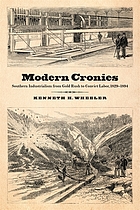
Kenneth H. Wheeler
Modern Cronies traces how various industrialists, thrown together by the effects of the southern gold rush, shaped the development of the southeastern United States. Existing historical scholarship treats the gold rush, as a self-contained blip that-aside from the horrors of Cherokee Removal (admittedly no small thing) and a supply of miners to California in 1849-had no other widespread effects. In fact, the southern gold rush was a significant force in regional and national history. The pressure brought by the gold rush for Cherokee Removal opened the path of the Western & Atlantic Railroad, the catalyst for the development of both Atlanta and Chattanooga, Tennessee. Iron makers, attracted by the gold rush, built the most elaborate iron-making operations in the Deep South near this railroad, in Georgia's Etowah Valley; some of these iron makers became the industrial talent in the fledgling postbellum city of Birmingham, Alabama. This book explicates the networks of associations and interconnections across these varied industries in a way that newly interprets the development of the southeastern United States. Modern Cronies also reconsiders the meaning of Joseph E. Brown, Georgia's influential Civil War governor, political heavyweight, and wealthy industrialist. Brown was nurtured in the Etowah Valley by people who celebrated mining, industrialization, banking, land speculation, and railroading as a path to a prosperous future. Kenneth H. Wheeler explains Brown's familial, religious, and social ties to these people; clarifies the origins of Brown's interest in convict labor; and illustrates how he used knowledge and connections acquired in the gold rush to enrich himself. After the Civil War Brown, aided by his sons, dominated and modeled a vigorous crony capitalism with far-reaching implications
traces how various industrialists, thrown together by the effects of the southern gold rush, shaped the development of the southeastern United States.
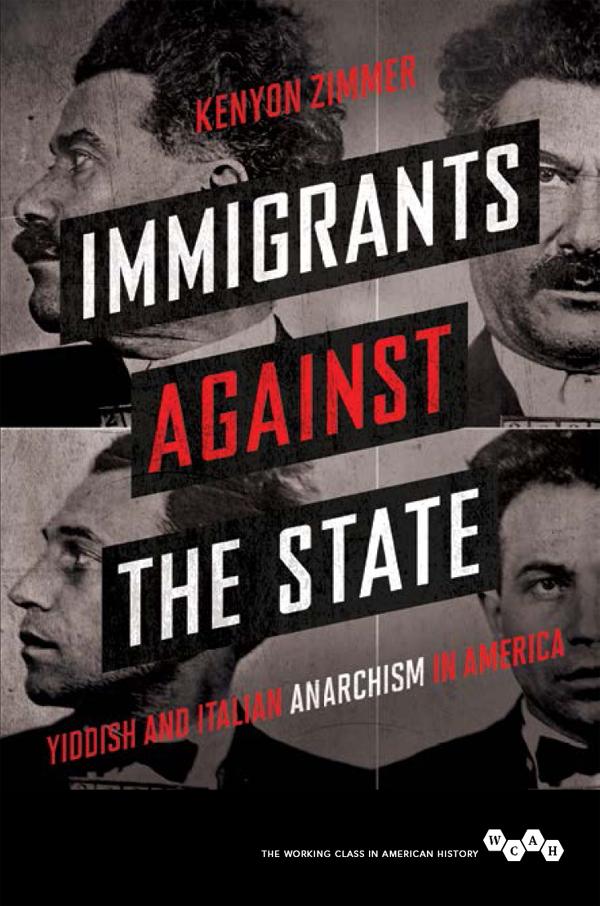
Kenyon Zimmer
From the 1880s through the 1940s, tens of thousands of first- and second-generation immigrants embraced the anarchist cause after arriving on American shores. Kenyon Zimmer explores why these migrants turned to anarchism, and how their adoption of its ideology shaped their identities, experiences, and actions. Zimmer focuses on Italians and Eastern European Jews in San Francisco, New York City, and Paterson, New Jersey. Tracing the movement's changing fortunes from the pre-World War I era through the Spanish Civil War, Zimmer argues that anarchists, opposed to both American and Old World nationalism, severed all attachments to their nations of origin but also resisted assimilation into their host society. Their radical cosmopolitan outlook and identity instead embraced diversity and extended solidarity across national, ethnic, and racial divides. Though ultimately unable to withstand the onslaught of Americanism and other nationalisms, the anarchist movement nonetheless provided a shining example of a transnational collective identity delinked from the nation-state and racial hierarchies
focuses on Italians and Eastern European Jews in San Francisco, New York City, and Paterson, New Jersey.
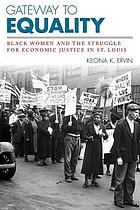
Keona K. Ervin
Like most of the nation during the 1930s, St. Louis, Missouri, was caught in the stifling grip of the Great Depression. For the next thirty years, the "Gateway City" continued to experience significant urban decline as its population swelled and the area's industries stagnated. Over these decades, many African American citizens in the region found themselves struggling financially and fighting for access to profitable jobs and suitable working conditions. To combat ingrained racism, crippling levels of poverty, and sub-standard living conditions, black women worked together to form a community-based culture of resistance -- fighting for employment, a living wage, dignity, representation, and political leadership. Gateway to Equality investigates black working-class women's struggle for economic justice from the rise of New Deal liberalism in the 1930s to the social upheavals of the 1960s. Author Keona K. Ervin explains that the conditions in twentieth-century St. Louis were uniquely conducive to the rise of this movement since the city's economy was based on light industries that employed women, such as textiles and food processing. As part of the Great Migration, black women migrated to the city at a higher rate than their male counterparts, and labor and black freedom movements relied less on a charismatic, male leadership model. This made it possible for women to emerge as visible and influential leaders in both formal and informal capacities. In this impressive study, Ervin presents a stunning account of the ways in which black working-class women creatively fused racial and economic justice. By illustrating that their politics played an important role in defining urban political agendas, her work sheds light on an unexplored aspect of community activism and illuminates the complexities of the overlapping civil rights and labor movements during the first half of the twentieth century." --Provided by publisher
Investigates black working-class women's struggle for economic justice
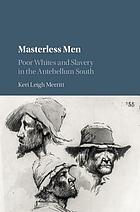
Keri Leigh Merritt
Analyzing land policy, labor, and legal history, Keri Leigh Merritt reveals what happens to excess workers when a capitalist system is predicated on slave labor. With the rising global demand for cotton--and thus, slaves--in the 1840s and 1850s, the need for white laborers in the American South was drastically reduced, creating a large underclass who were unemployed or underemployed. These poor whites could not compete--for jobs or living wages--with profitable slave labor. Though impoverished whites were never subjected to the daily violence and degrading humiliations of racial slavery, they did suffer tangible socio-economic consequences as a result of living in a slave society. Merritt examines how these 'masterless' men and women threatened the existing Southern hierarchy and ultimately helped push Southern slaveholders toward secession and civil war"-- Provided by publisher
what happens to excess workers when a capitalist system is predicated on slave labo

Kerner Commission, History Matters
President Lyndon Johnson formed an 11-member National Advisory Commission on Civil Disorders in July 1967 to explain the riots that plagued cities each summer since 1964 and to provide recommendations for the future. The Commission’s 1968 report, informally known as the Kerner Report, concluded that the nation was “moving toward two societies, one black, one white—separate and unequal.” Unless conditions were remedied, the Commission warned, the country faced a “system of ’apartheid’” in its major cities. The Kerner report delivered an indictment of “white society” for isolating and neglecting African Americans and urged legislation to promote racial integration and to enrich slums—primarily through the creation of jobs, job training programs, and decent housing. President Johnson, however, rejected the recommendations. In April 1968, one month after the release of the Kerner report, rioting broke out in more than 100 cities following the assassination of civil rights leader Martin Luther King, Jr. In the following statements to joint Congressional hearings on urban employment problems in May and June of 1968, two academics related their findings regarding overt and institutionalized discrimination. They further argued that there were no simple solutions for overcoming the racial divide.
two academics related their findings regarding overt and institutionalized discrimination, they further argued that there were no simple solutions for overcoming the racial divide.
Kerner Commission, History Matters
President Lyndon Johnson formed an 11-member National Advisory Commission on Civil Disorders in July 1967 to explain the riots that plagued cities each summer since 1964 and to provide recommendations for the future. The Commission’s 1968 report, informally known as the Kerner Report, concluded that the nation was “moving toward two societies, one black, one white—separate and unequal.” Unless conditions were remedied, the Commission warned, the country faced a “system of ’apartheid’” in its major cities. The Kerner report delivered an indictment of “white society” for isolating and neglecting African Americans and urged legislation to promote racial integration and to enrich slums—primarily through the creation of jobs, job training programs, and decent housing. President Johnson, however, rejected the recommendations. In April 1968, one month after the release of the Kerner report, rioting broke out in more than 100 cities following the assassination of civil rights leader Martin Luther King, Jr. In the following excerpts from the Kerner Report summary, the Commission analyzed patterns in the riots and offered explanations for the disturbances. In 1998, 30 years after the issuance of the Report, former Senator and Commission member Fred R. Harris co-authored a study that found the racial divide had grown in the ensuing years with inner-city unemployment at crisis levels. Opposing voices argued that the Commission’s prediction of separate societies had failed to materialize due to a marked increase in the number of African Americans living in suburbs.
delivered an indictment of “white society” for isolating and neglecting African Americans and urged legislation to promote racial integration and to enrich slums
Kerner Commission, History Matters
President Lyndon Johnson formed an 11-member National Advisory Commission on Civil Disorders in July 1967 to explain the riots that plagued cities each summer since 1964 and to provide recommendations for the future. The Commission’s 1968 report, informally known as the Kerner Report, concluded that the nation was “moving toward two societies, one black, one white—separate and unequal.” Unless conditions were remedied, the Commission warned, the country faced a “system of ’apartheid’” in its major cities. The Kerner report delivered an indictment of “white society” for isolating and neglecting African Americans and urged legislation to promote racial integration and to enrich slums—primarily through the creation of jobs, job training programs, and decent housing. President Johnson, however, rejected the recommendations. In April 1968, one month after the release of the Kerner report, rioting broke out in more than 100 cities following the assassination of civil rights leader Martin Luther King, Jr. In the following statements to a joint Congressional committee, two Commission members summarized their findings and recommended the creation of jobs. In 1998, 30 years after the Kerner Report, Harris co-authored a study that found the racial divide had grown in the ensuing years with inner-city unemployment at crisis levels. Opposing voices argued that the Commission’s prediction of separate societies failed to materialize due to a marked increase in the number of African Americans living in suburbs.
two Commission members summarized their findings and recommended the creation of jobs.
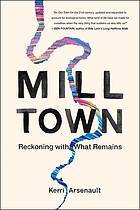
Kerri Arsenault
A galvanizing and powerful debut, Mill Town is an American story, a human predicament, and a moral wake-up call that asks: what are we willing to tolerate and whose lives are we willing to sacrifice for our own survival? Kerri Arsenault grew up in the rural working class town of Mexico, Maine. For over 100 years the community orbited around a paper mill that employs most townspeople, including three generations of Arsenault's own family. Years after she moved away, Arsenault realized the price she paid for that seemingly secure childhood. The mill, while providing livelihoods for nearly everyone, also contributed to the destruction of the environment and the decline of the town's economic, moral, and emotional health in a slow-moving catastrophe, earning the area the nickname "Cancer Valley." In Mill Town, Arsenault undertakes an excavation of a collective past, sifting through historical archives and scientific reports, talking to family and neighbors, and examining her own childhood to present a portrait of a community that illuminates not only the ruin of her hometown and the collapse of the working-class of America, but also the hazards of both living in and leaving home, and the silences we are all afraid to violate. In exquisite prose, Arsenault explores the corruption of bodies: the human body, bodies of water, and governmental bodies, and what it's like to come from a place you love but doesn't always love you back"-- Provided by publisher
A portrait of a community that illuminates not only the ruin of Mexico, Maine and the collapse of the working-class of America, but also the hazards of both living in and leaving home
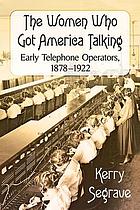
Kerry Segrave
When the need for telephone operators arose in the 1870s, the assumption was that they should all be male. Within a few years, telephone operators were all female and would remain so. The pay was low and working conditions harsh. Discipline was stern. Most were young, domestic and anything but militant. Many joined unions and walked picket lines"-- Provided by publisher
telephone operators
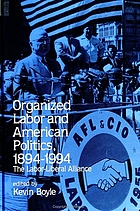
Kevin Boyle
Organized Labor and American Politics, 1894-1994 traces the rise and fall of labor's power over the course of the twentieth century. It does so through provocative and engaging essays written by distinguished scholars of the modern labor movement. The essays focus on different times and places, from turn-of-the-century steel mills to the streets of 1930s Detroit to the halls of Congress in the 1990s. Drawing on a broad range of primary sources, the authors adopt a variety of approaches, from broad syntheses to careful case studies. Altogether, the essays tell a single story of workers struggling to find a voice for themselves and their unions within the nation they helped to build. It is a story of victories won and of defeats endured
traces the rise and fall of labor's power over the course of the twentieth century through provocative and engaging essays.
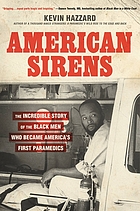
Kevin Hazzard
Up until 1968, if you suffered a medical crisis, your chances of survival were minimal. That all changed with the Freedom House EMS in Pittsburgh, a group of Black men who became America's first paramedics and set the gold standard for emergency medicine around the world, only to have their legacy erased -- until now. Born from the vision of a Nobel Prize-nominated physician, the needs of a country in pain, and the ashes of Pittsburgh's downturn in the 1960s, Freedom House brought together a group of young, uneducated Black men to forge a new frontier in health care. Their job was grueling, the rules made up as they went along, and their mandate nearly impossible: prove to a skeptical public and the politicians that paramedics were a noble and valuable endeavor and, most importantly, that they themselves were worthy professionals performing a crucial public service. Despite the long odds and attempts to shut them down, they succeeded spectacularly. In American Sirens, acclaimed journalist and paramedic Kevin Hazzard tells a dramatic story of heroes and villains, of brutal attempts to stifle hope, and the resilience of a community that fought back. He follows a rich cast of characters that includes John Moon, an orphan who found his calling as a paramedic; Peter Safar, the Nobel Prize-nominated physician who invented CPR and realized his vision for a trained ambulance service; and Nancy Caroline, the idealistic young doctor who turned a scrappy team into an international leader. At every turn they battled racism -- from the community, the police, and the government. Never-before revealed in full, this is a rich and troubling hidden history of the Black origins of America's paramedics, a special band of dedicated essential workers, who stand ready to serve day and night on the line between life and death for every one of us"-- Provided by publisher
Freedom House brought together a group of young, uneducated Black men to forge a new frontier in health care
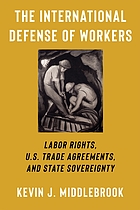
Kevin J. Middlebrook
This book examines the North American Agreement on Labor Cooperation (the NAALC), a "side-agreement" added to the North American Free Trade Agreement (NAFTA). The NAALC is a foundational case in the evolution of debates over the links between trade and labor standards in U.S. and a watershed in the international promotion of labor rights. The book investigates the origins of the agreement both in earlier twentieth-century efforts to insert labor provisions into multilateral and U.S. preferential trade agreements and in the 1990-1992 negotiations over the NAFTA; the intense political controversies that arose in 1993 among Canada, Mexico, and the United States over the NAALC's scope and institutional design; how the agreement operated in practice between 1994 and 2020, with attention to its principal successes and failures; and the longer-term policy legacies of the NAALC, including in subsequent U.S. free-trade agreements, the 2017-2019 negotiations over revising the NAFTA, and the labor rights provisions of the successor United States-Mexico-Canada Agreement (USMCA). Political scientist Kevin Middlebrook establishes a comparative context for analyzing the NAALC experience by overviewing alternative international arenas for the promotion of worker rights (like cross-border union solidarity actions, initiatives undertaken by the International Labour Organization, and corporate social responsibility campaigns) and by examining the negotiation, content, and implementation of labor rights provisions in the U.S. Generalized System of Preferences program, post-NAFTA U.S. free-trade agreements, and the USMCA, which constitute the principal international examples of the links between trade and labor rights. Most important, the discussion systematically assesses sovereignty leverage as a causal mechanism in two distinct political moments: the negotiation and subsequent implementation of labor rights provisions in trade agreements. He takes an interdisciplinary comparative approach and brings extensive previously unexamined primary research materials to bear in this analysis of international trade agreements and labor rights"-- Provided by publisher
assesses sovereignty leverage as a causal mechanism in two distinct political moments: the negotiation and subsequent implementation of labor rights provisions in trade agreements.
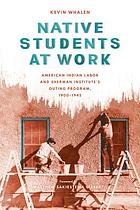
Kevin Whalen, Matthew Sakiestewa Gilbert
Native Students at Work tells the stories of Native people from around the American Southwest who participated in labor programs at Sherman Institute, a federal Indian boarding school in Riverside, California. The school placed young Native men and women in and around Los Angeles as domestic workers, farmhands, and factory laborers. For the first time, historian Kevin Whalen reveals the challenges these students faced as they left their homes for boarding schools and then endured an "outing program" that aimed to strip them of their identities and cultures by sending them to live and work among non-Native people. Tracing their journeys, Whalen shows how male students faced low pay and grueling conditions on industrial farms near the edge of the city, yet still made more money than they could near their reservations. Similarly, many young women serving as domestic workers in Los Angeles made the best of their situations by tapping into the city's Indigenous social networks and even enrolling in its public schools. As Whalen reveals, despite cruel working conditions and poor treatment, Native people used the outing program to their advantage whenever they could, forming urban Indigenous communities and sharing money and knowledge gained in the city with those back home.?
labor programs at Sherman Institute, a federal Indian boarding school in Riverside, California
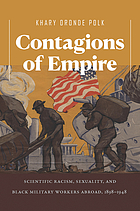
Khary Oronde Polk
From 1898 onward, the expansion of American militarism and empire abroad increasingly relied on black labor, even as policy remained inflected both by scientific racism and by fears of contagion. Black men and women were mobilized for service in the Spanish-Cuban-American War under the War Department's belief that Southern blacks carried an immunity against tropical diseases. Later, in World Wars I and II, black troops were stigmatized as members of a contagious "venereal race," and were subjected to experimental medical treatments meant to curtail their sexual desires. By turns feared as contagious, and at other times valued for their immunity, black men and women played an important part in the U.S. military's conscription of racial, gender, and sexual difference, even as they exercised their embattled agency at home and abroad. By following the scientific, medical, and cultural history of African American enlistment through the archive of American militarism, this book traces the black subjects and agents of empire as they came into contact with a world globalized by warfare"-- Provided by publisher
traces the black subjects and agents of empire as they came into contact with a world globalized by warfare.
Khayrallah Center for Lebanese Diaspora Studies
A expansive digital exhibit. lives and labor of the Arab American working class in the early twentieth century. Histories of Arab American miners, seamstresses, auto workers, Performers, Yemeni Farmworkers, 1890-1970, this digital exhibit includes many images and stories and a bibliography of sources for each of the subjects profiles, as well as lesson plans and educational resources.
This project reclaims the hidden stories of the Arab American working class. It sheds light on their rich history and their struggles to become part of the United States, securing their families’ livelihoods amidst difficult (and sometimes deadly) working conditions, labor activism, racial animosity, economic turmoil, and the fast changing landscape of America’s industrial cities and agricultural farmland. In so doing, this project invites us to rethink the prevalent narrative of Arab immigration, and to move beyond its one-dimensionality to include the richer—and more complicated—diversity of immigrant experiences.
In five parts, this project crosses the breadth of the United States and spans the years between the 1890s to the 1970s to explore the lives and labors of Arab Americans who worked in garment factories, coal mines, automobile factories, entertainment, and farming. While the majority of the stories focus on the first wave of Arab Americans (whom we know today as Lebanese, Palestinian, and Syrian), part five, "Farm Workers," departs from that and looks at the lives of Yemeni farm workers in California. In our terminology we use the overarching terms "Arab" and "Arab American" to discuss the totality of the history. However, we also use "Syrian" as a term that encompassed the earliest Arab American immigrants, while at other times we defer to "Lebanese" and "Yemeni" when speaking about particular communities who self-identified as such.
Many of the stories we narrate in this public history project have never before been written about or told outside the families who lived these remarkable lives. Others, like those of Yemeni farmworkers, have been covered by other scholars. As individual histories, each of the five chapters is filled with rich detail through text, images, audio and video recordings, interactive maps, and podcasts. Together, they create a larger narrative that clearly shows the centrality of the working classes to the Arab American immigrant experience.
We also unearth the pivotal roles Arab Americans played in American labor, and the long arc of this history. So, we find that Hanna Ramey in 1912 Massachusetts and Nagi Daifullah in 1972 California were both killed for their leading roles in their respective labor strikes and that their deaths transformed the labor movement. We discover the deep and broad participation of women and the challenges that presented to societal roles defined by gender and racial strictures and violence. And the longer narrative we tell shows how some Arab Americans struggled against a system of labor exploitation, while others benefited from it.
Histories of Arab American miners, seamstresses, auto workers, Performers, Yemeni Farmworkers, 1890-1970, this digital exhibit includes many images and stories and a bibliography of sources for each of the subjects profiles, as well as lesson plans and educational resources.
Khayrallah Center for Lebanese Diaspora Studies
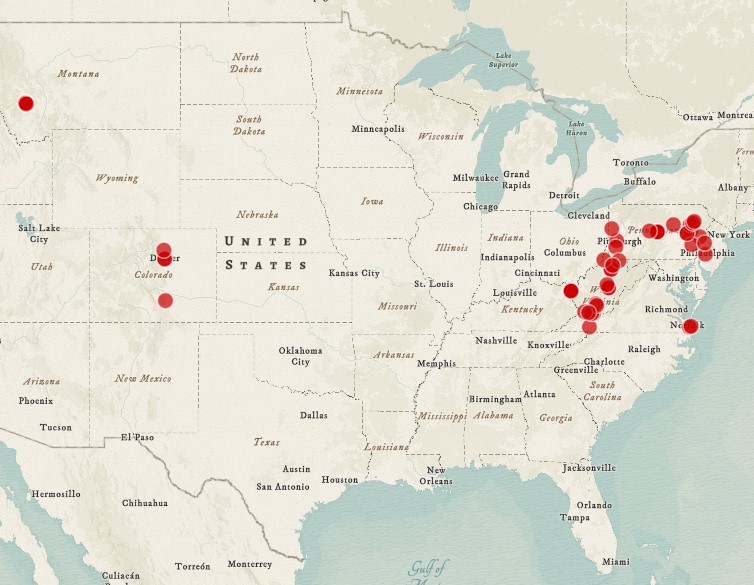
“Syrian” immigrants found steady work as coal mine laborers in Pennsylvania starting in 1880, and by the 1910s Arab immigrant communities had been established in coal and metal mining towns as far west as Utah and Montana. Arab immigrants and their children born in America sought multiple wage sources in these regions including mine labor, peddling, storekeeping, business ownership, and ranching. Contrary to long-held perception that they would not work underground, Syrian-Lebanese men did find employment within mines in the late nineteenth and early twentieth centuries. They navigated the unregulated industry alongside immigrants of other ethnic and national origins. Coal mine accident registries regularly listed the names of Arab immigrant men who were injured and killed by roof and wall collapses, haulage accidents, explosions, and falls. In addition to inherent danger, mine laborers contended with low wages and uncertain employment schedules.
Click each dot in the map to read the stories of Arab American miners across the United States in the early twentieth century
Khayrallah Center for Lebanese Diaspora Studies
An excellent set of sources on Arab American labor history
Sources for the online digital exhibit and lesson plans
Khayrallah Center for Lebanese Diaspora Studies
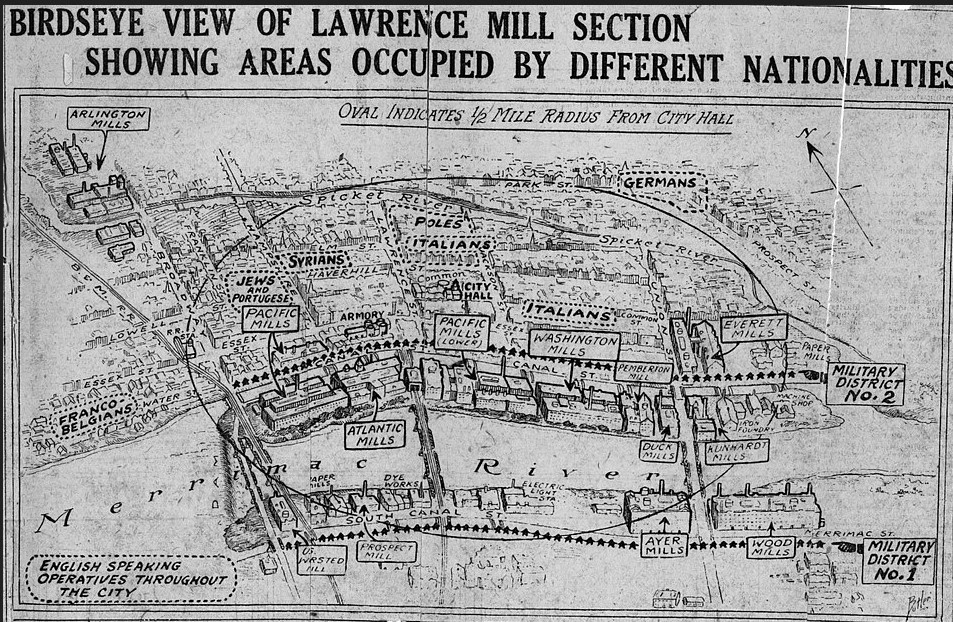
In 1912 the Bread and Roses Strike—one of the most significant struggles in US labor history—rocked the city of Lawrence, Massachusetts. By the conclusion of the nine-week strike, which involved tens of thousands of mill workers, the country had learned of the terrible working conditions (life expectancies around forty years), long hours (sixty hours per week) and low pay ($8 per week). Negotiations provided some gains, namely a 15 percent raise in pay and guarantees for better health conditions, and established unions as central to protecting both workers' rights and the American economy.
This map-story presents the Syrian immigrants who were part of this movement.
But a crucial component remains missing from most narratives about the Bread and Roses Strike: the central role that "Syrians" played in the movement. Aside from comprising part of the strike's rank and file, early Arab immigrants were fundamental in the organizing and sustaining of the strike. Faris Marad, James Brox, and Dr. Iskandar Hajjar were on the strike committee, and the majority of Arab workers became members of the IWW (International Workers of the World). Finally, and tragically, one of three strikers killed during the strike was a young Syrian man by the name of Hanna Ramey.
Syrian textile workers in the Lawrence Massachusetts moment of the 1912 Bread and Roses Strike
Museum/Exhibits
Tours
Maps
Digital Projects
Organizations
Sites
Film/Video
Audio/Interview
Podcast/Program
Text/Document
Image
Graphs/Data
Timeline
Southwest
West
Midwest
Southeast
Northeast
Mexico
Canada
Global
Books
Teaching
Lectures
Digital Archives
Journals
Bibliographies
Topic Intro