


Collections
Library
Type
Region
Coverage:
-
Published:
-
Lori Merish
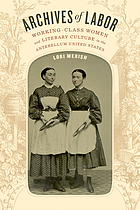
Lori Merish establishes working-class women as significant actors within nineteenth-century U.S. literary culture by analyzing previously unexplored archives of working-class women's literature, showing how white, African American, and Mexican American factory workers, seamstresses, domestic workers, and prostitutes understood themselves while forging class identity
working-class women as significant actors within nineteenth-century U.S. literary culture

Lorraine Gray
From December 1936 to February 1937 members of the United Auto Workers organized a sit-down strike inside the General Motors Fisher Body 1 and 2 plants in Flint, Michigan. They ultimately won recognition of their union and improved wages and conditions. "With Babies and Banners" tells the story of the Women's Emergency Brigade, composed of female GM workers and the wives of men involved in the sit-down strike, which not only provided support services (like running the union kitchens that provided food to the strikers occupying the plants) but did picket duty themselves. It intercuts footage from 1937 with interviews with the same women 40 years later, still active in union politics and still pressuring the UAW to acknowledge women as equals. Description written by Mark Gabrish Conlan. Potential discussion questions that might accompany this film include: 1. What strategies did the workers use? 2. What was it like to organize in a "company town"? 3. What does the film not depict?
A documentary covering the actions of the Women's Emergency Brigade from 1936-7, when they provided food, picketed, and otherwise provided critical support to the United Auto Workers who struck against General Motors in Flint, Michigan.
Lou Martin
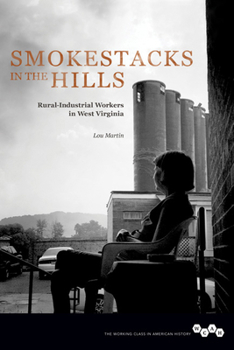
Long considered an urban phenomenon, industrialization also transformed the American countryside. Lou Martin weaves the narrative of how the relocation of steel and pottery factories to Hancock County, West Virginia, created a rural and small-town working class--and what that meant for communities and for labor.
As Martin shows, access to land in and around steel and pottery towns allowed residents to preserve rural habits and culture. Workers in these places valued place and local community. Because of their belief in localism, an individualistic ethic of 'making do,' and company loyalty, they often worked to place limits on union influence.
At the same time, this localism allowed workers to adapt to the dictates of industrial capitalism and a continually changing world on their own terms--and retain rural ways to a degree unknown among their urbanized peers. Throughout, Martin ties these themes to illuminating discussions of capital mobility, the ways in which changing work experiences defined gender roles, and the persistent myth that modernizing forces bulldozed docile local cultures.
Revealing and incisive, Smokestacks in the Hills reappraises an overlooked stratum of American labor history and contributes to the ongoing dialogue on shifts in national politics in the postwar era.
how the relocation of steel and pottery factories to Hancock County, West Virginia, created a rural and small-town working class
Louis Hyman
Every working person in the United States asks the same question, how secure is my job? For a generation, roughly from 1945 to 1970, business and government leaders embraced a vision of an American workforce rooted in stability. But over the last fifty years, job security has cratered as the postwar institutions that insulated us from volatility--big unions, big corporations, powerful regulators--have been swept aside by a fervent belief in "the market." Temp tracks the surprising transformation of an ethos which favored long-term investment in work (and workers) to one promoting short-term returns. A series of deliberate decisions preceded the digital revolution and upended the longstanding understanding of what a corporation, or a factory, or a shop, was meant to do. Temp tells the story of the unmaking of American work through the experiences of those on the inside: consultants and executives, temps and office workers, line workers and migrant laborers. It begins in the sixties, with economists, consultants, business and policy leaders who began to shift the corporation from a provider of goods and services to one whose sole purpose was to maximize profit--an ideology that brought with it the risk-taking entrepreneur and the shareholder revolution and changed the very definition of a corporation. With Temp, Hyman explains one of the nation's most immediate crises. Uber are not the cause of insecurity and inequality in our country, and neither is the rest of the gig economy. The answer goes deeper than apps, further back than downsizing, and contests the most essential assumptions we have about how our businesses should work
Explores King's profound commitment to the poor and working class and his call for "nonviolent resistance" to all forms of oppression

Louis Lingg, History Matters
Carpenter Louis Lingg stuck to his anarchist principles to the end in his final address before the court that convicted him of participating in the infamous Haymarket Square bombing in Chicago in 1886.
(teaching document) Anarchist Louis Lingg's account of police state collusion
Louis Moore
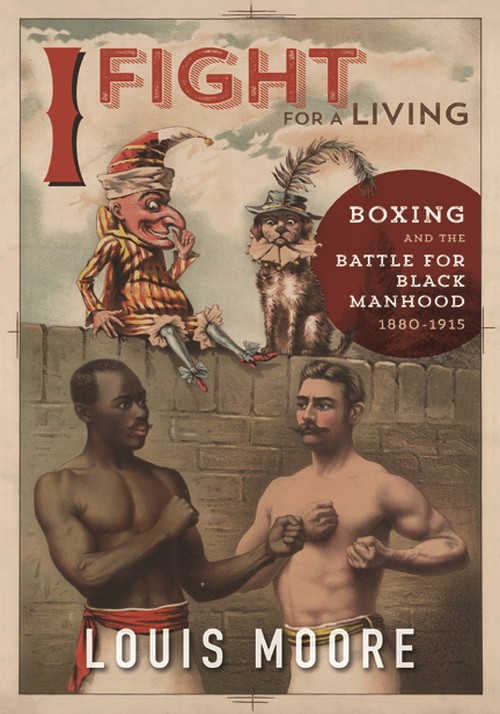
The black prizefighter labored in one of the few trades where an African American man could win renown: boxing. His prowess in the ring asserted an independence and powerful masculinity rare for black men in a white-dominated society, allowing him to be a man--and thus truly free. Louis Moore draws on the life stories of African American fighters active from 1880 to 1915 to explore working-class black manhood. As he details, boxers bought into American ideas about masculinity and free enterprise to prove their equality while using their bodies to become self-made men. The African American middle class, meanwhile, grappled with an expression of public black maleness they saw related to disreputable leisure rather than respectable labor. Moore shows how each fighter conformed to middle class ideas of masculinity based on his own judgment of what culture would accept. Finally, he argues that African American success in the ring shattered the myth of black inferiority despite media and government efforts to defend white privilege."--Amazon
life stories of African American fighters active from 1880 to 1915 to explore working-class black manhood
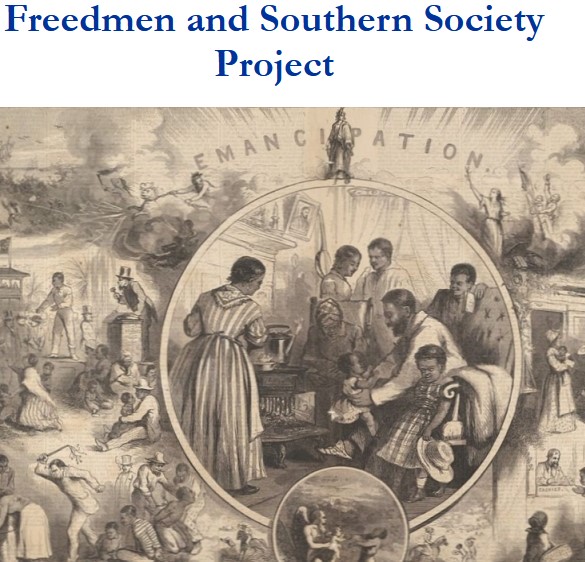
Louisiana Planters
An 1862 letter from a committee of Louisiana planters to the Commander of the Department of the Gulf, complaining of their losses during the war including former slaves, animals, and farm implements.
Writing to Union General Nathaniel P. Banks, sugar planters lamented the effect of slave flight and Union military occupation on plantation operations.

Lowell National Historical Park
Lowell’s water-powered textile mills catapulted the nation – including immigrant families and early female factory workers – into an uncertain new industrial era. Nearly 200 years later, the changes that began here still reverberate in our shifting global economy. Explore Lowell, a living testament to the dynamic human story of the industrial revolution.
Site includes section on education both on-site and virtual lesson plans
A museum park that includes hands-on visitor experiences on industrialization from workers and children's perspectives, and virtual experiences including teaching guides.

Loyola University
This small part of the Mollie West Archive is digital photos covering mostly trade union acivisites 1945-1985
A small number of items from the collection on this renowned labor activist who was at the Memorial Day Massacre at Republic Steel and a CLUW activist, have been digitized at this site

Loyola University
Digitized records related to automation in Southern Labor Archives, 1955,-2000
A Women and Leadership Archives digital exhibit exploring the twentieth-century labor movement through the historical materials donated by Polish immigrant Mollie Lieber West, who experienced the Memorial Day Massacre as a young student.
Luca Falciola
As protest movements took to the streets during the 1960s and 1970s, a group of lawyers joined forces with America's most confrontational activists. In pursuit of radical change themselves, these militant attorneys went beyond providing mere representation.
They identified with their clients, defied the habits of a conservative profession, and formulated a corrosive critique of the legal system, questioning the neutrality and transformative power of law. While exploiting the courtrooms as political forums, they developed aggressive litigation strategies and became involved with the organization of protest.
Drawing on extensive archival research and interviews, historian Luca Falciola reconstructs this largely unmapped phenomenon and challenges the reader to think anew about the pivotal role of lawyers in social movements.
a history of a group of conservative militant attourneys who used the courtroom as a megaphone for their politics.
Lucy Parsons
Lucy Parson's collection digitized
The Accused the Accusers: The Famous Speeches of the Chicago Anarchists in Court: On October 7th, 8th, and 9th, 1886."
Speeches by August Spies, Michel Schwab, Oscar Neebe, Adolph Fischer, Louis Lingg, George Engel, Samuel Fielden, Albert R. Parsons
CONTENTS:
1. Address of August Spies................. pp. 1-23
2. Address of Michel Schwab.............. pp. 24-28
3. Address of Oscar Neebe................. pp. 29-35
4. Address of Adolph Fischer.............. pp. 36-38
5. Address of Louis Lingg................... pp. 39-42
6. Address of George Engel................ pp. 43-48
7. Address of Samuel Fielden............. pp. 49-89
8. Address of Albert R. Parsons.......... pp. 90-188.
Speeches by the 8 revolutionary socialist leaders arrested in the aftermath of a bombing of the police at a demonstration held in Haymarket Square, Chicago, on May 4, 1886. Seven were sentenced to death, with Oscar Neebe sentenced to a term of 15 years in prison. The sentences of Fielden and Schwab were later commuted to life in prison by the governor. Lingg committed suicide in his cell with a blasting cap on the eve of his execution; Spies, Parsons, Fischer, and Engel were hung to death on November 11, 1887.
The three surviving Haymarket defendants were pardoned by Governor John P. Altgeld on June 26, 1893.
Perspectives of the Chicago anarchists who were convicted in 1886

Luigi Galleani
Early 20th-century editors used their newspapers to espouse their views much more than those today, and Cronaca Sovversiva was no exception. Its creator, Luigi Galleani, was a lawyer, journalist, and radical born in Italy. He was imprisoned several times in Europe for leading strikes and demonstrations for workers’ rights, fleeing from Italy to France to Egypt and London before arriving in Paterson, New Jersey, in late 1901. In Paterson, a hotbed of Italian anarchism, Galleani led a strike of silk workers in mid-1902, and was shot in the face in the process. Arrested and indicted for inciting a riot, he fled to Canada before his case went to trial.[1] Returning to the United States under the assumed name of Luigi Pimpino, Galleani settled just over the Canadian border in Barre, Vermont.[2]
Cronaca’s pages illuminate an important chapter in the history of radicalism, violence, terrorism, immigration, and government surveillance in the United States.
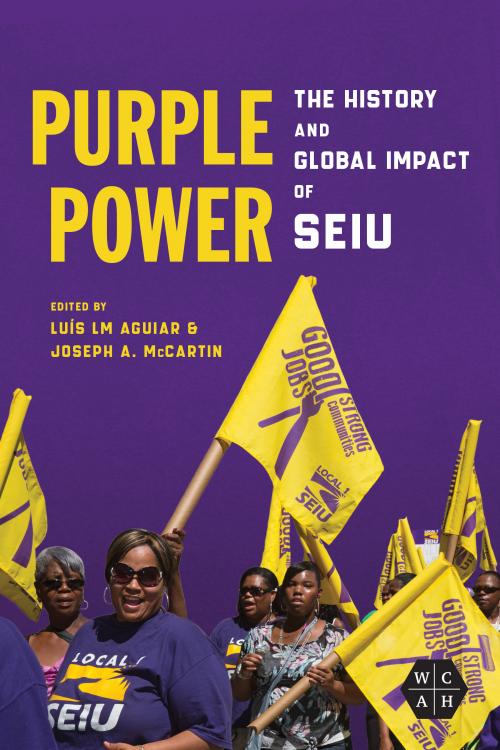
Luis LM Aguiar, Joseph A. McCartin
Chartered in 1921, the Service Employees International Union (SEIU) is a worldwide organization that represents more than two million workers in occupations from healthcare and government service to custodians and taxi drivers. Women form more than half the membership while people in minority groups make up approximately forty percent. Luís LM Aguiar and Joseph A. McCartin edit essays on one of contemporary labor's bedrock organizations. The contributors explore key episodes, themes, and features in the union's recent history and evaluate SEIU as a union with global aspirations and impact. The first section traces the SEIU's growth in the last and current centuries. The second section offers in-depth studies of key campaigns in the United States, including the Justice for Janitors and Fight for $15 movements. The third section focuses on the SEIU's work representing low-wage workers in Canada, Australia, Europe, and Brazil. An interview with Justice for Janitors architect Stephen Lerner rounds out the volume. Contributors: Luís LM Aguiar, Adrienne E. Eaton, Janice Fine, Euan Gibb, Laurence Hamel-Roy, Tashlin Lakhani, Joseph A. McCartin, Yanick Noiseux, Benjamin L. Peterson, Allison Porter, Alyssa May Kuchinski, Maite Tapia, Veronica Terriquez, and Kyoung-Hee Yu
This book features both key episodes and the overarching story of the Service Employees International Union in recent history
Luisa Lopez, History Matters
"We generally think of Puerto Rican migration to the U.S. mainland as largely a post-World War II phenomenon, since more than 800,000 Puerto Ricans came to the United States between 1940 and 1969. But immigration actually started much earlier in the century; between 1915 and 1930 more than 50,000 Puerto Rican migrants headed for the United States—especially New York City. The new immigrants faced a mixed reception, particularly from immigrants from other countries. In this interview for the radio program “Nosotros Trabajamos en la Costura”(We Work in the Garment Industry), garment worker Luisa Lopez told how she faced discrimination from European immigrant workers when she went to work in garment factories in the 1920s. Yet sometimes alliances crossed ethnic lines: Lopez found an ally in an Italian-American socialist."
Luisa Lopez faced discrimination from European immigrant workers in garment factories in the 1920s but found an ally in an Italian-American socialist."
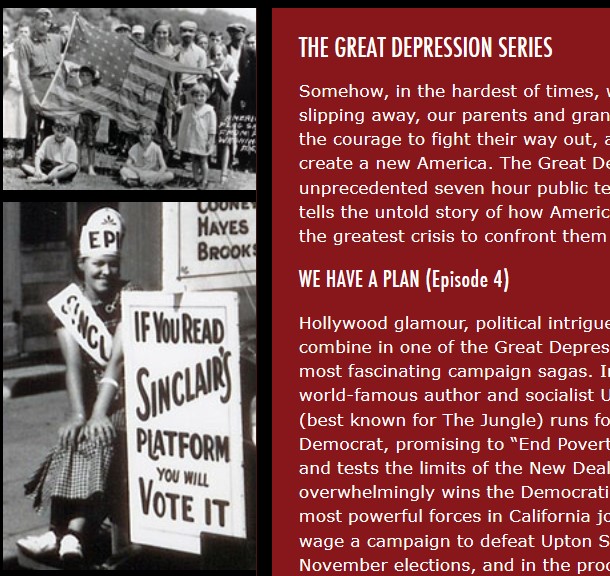
Lyn Goldfarb
This 53-minute film includes rare newsreel footage and interviews with veterans of the 1934 campaign. Produced and directed by Lyn Goldfarb for Blackside Films,it is part of the Great Depression series broadcast on PBS in 1993.
A filmabout Upton Sinclair's 1934 End Poverty in California Campaign.
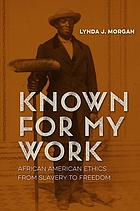
Lynda J. Morgan
Lynda Morgan builds an intellectual and social history of slave thought about labor and morality, and she traces elements through Reconstruction and the civil rights movement. She concludes her manuscript by connecting this legacy to reparations arguments and apologies for slavery that continue in the present day"--Provided by publisher
"By contending that enslaved black people's formulation of a moral economy "derived from their experiences with and analysis of bondage itself," Morgan makes a contribution to the growing literature that acknowledges the intellectual history of enslaved peoples while providing rich fodder for discussion (p. 1). The author addresses the historical oversight that ignores the influence of blacks on American political ideologies by documenting how slaves and freedpeople "intellectualized their labor experiences, drew political and moral lessons from them, and employed that body of thought to approach the problems and opportunities of the post–Civil War world and beyond" (p. 6)."-review
intellectual and social history of slave thought about labor and morality
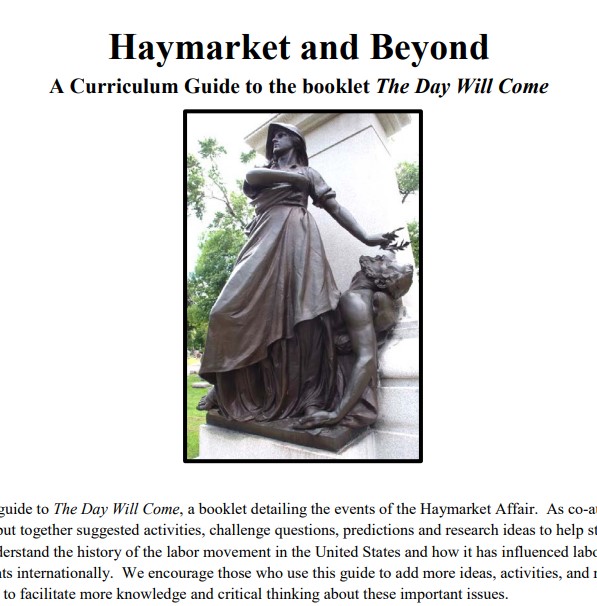
Lynn Allen, Gale Liebman, Jacquelin MczCord Harris, Mark Rogovin, Illinois Labor History Society
This is a guide to The Day Will Come, a booklet detailing the events of the Haymarket Affair.
As co-authors, we have put together suggested activities, challenge questions, predictions and research ideas to help students better understand the history of the labor movement in the United States and how it has influenced labor movements internationally.
We encourage those who use this guide to add more ideas, activities, and research questions to facilitate more knowledge and critical thinking about these important issues.
A teaching guide about the Haymarket events, centered around the historical booklet "The Day will Come," with lesson plans and teaching guides developed by Illinois Labor History Society, and for studying issues of memory and commemoration.
Lynn Waltz
When Smithfield Foods opened its pork processing plant in Tar Heel, North Carolina, in 1992, workers in the rural area were thrilled to have jobs at what was billed as "the largest slaughterhouse in the world." However, they soon left in droves because of the fast, unrelenting line speed and high rate of injury. Those who stayed wanted higher wages and safer working conditions, but every time they tried to form a union, the company quickly cracked down, firing union leaders, assaulting organizers, and setting minority groups against each other. Author and journalist Lynn Waltz reveals how these aggressive tactics went unchecked for years until Sherri Buffkin, a higher-up manager at Smithfield, blew the lid off the company's corrupt practices. Through meticulous reporting, in-depth interviews with key players, and a mind for labor and environmental histories, Waltz weaves a fascinating tale of the nearly two-decade struggle that eventually brought justice to the workers and accountability to the food giant, pitting the world's largest slaughterhouse against the world's largest meatpacking union. Following in a long tradition of books that expose the horrors of the meatpacking industry--from Upton Sinclair's The Jungle to Eric Schlosser's Fast Food Nation--Hog Wild uncovers rampant corporate environmental hooliganism, labor exploitation, and union-busting by one of the nation's largest meat producers. Waltz's eye-opening examination sheds new light on the challenges workers face not just in meatpacking, but everywhere workers have lost their power to collectively bargain with powerful corporations
tale of the nearly two-decade struggle that eventually brought justice to the workers and accountability to the food giant, pitting the world's largest slaughterhouse against the world's largest meatpacking union

M. H. Ross, Georgia State University
The Bituminous coal mine maps of Pennsylvania were created by the Works Progress Administration from 1934-1938. Workers transcribed information about the extent of underground bituminous coal mines on to these maps, as well as locations of oil and gas wells. These maps are based on 15-minute topographic quadrangles, divided into nine sections. (For example, "Altoona 1" represents the northwestern corner of the Altoona 15-minute quadrangle. "Altoona 9" represents the southeastern corner of the quadrangle).
Although some mine information was never transcribed, this set provides an excellent representation of the extent of mining throughout western and central Pennsylvania.
The counties covered include Allegheny, Armstrong, Beaver, Bedford, Blair, Bradford, Butler, Cambria, Cameron, Centre, Clarion, Clearfield, Clinton, Elk, Fayette, Forest, Fulton, Greene, Huntingdon, Indiana, Jefferson, Lawrence, Lycoming, Mercer, Somerset, Sullivan, Tioga, Venango, Washington, and Westmoreland.
Maps of PA bituminous coal mines with annotations made by coal miners

MAZON: A Jewish Response to Hunger
A virtual museum "planted" on the Washington mall, a digital project of MAZON: A Jewish Response to Hunger, which is a national organization fighting to end hunger among people of all faiths and backgrounds.
The Hunger Museum tells the story of the last 100 years of hunger and anti-hunger public policy in the United States, alongside the cultural touchstones that accompany that history, demonstrating that with a robust government response we can end hunger — and almost did. Political winds and policy changes reversed that victory, leading to an over-reliance on an already overwhelmed charitable food network — but that does not need to be our future.
Through six galleries of historical content, MAZON’s exhibits and artifacts illuminate the political, economic, and cultural influences of the time, revealing the expansion and dismantlement of the American social safety net over the last century and how, with this history in mind, we can forge a path forward to end hunger.
Today, a staggering number of Americans struggle to put food on the table. The Hunger Museum (virtual) is a powerful exploration of how we got here and how we can end hunger.
Madison Historical
Madison Historical: The Online Encyclopedia and Digital Archive for Madison County, Illinois documents, preserves, and shares the rich history of Madison County, Illinois and is coordinated by the Department of Historical Studies at Southern Illinois University Edwardsville. Through an online encyclopedia and digital archive, Madison Historical:
small collection of industrial and labor materials including coal mining from a county in Illinois
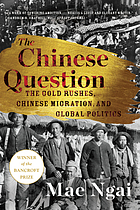
Mae Ngai
How Chinese migration to the world's goldfields upended global power and economics and forged modern conceptions of race. In roughly five decades, between 1848 and 1899, more gold was removed from the earth than had been mined in the 3,000 preceding years. But friction between Chinese and white settlers on the goldfields of California, Australia, and South Africa catalyzed a global battle over 'the Chinese Question': Would the United States and the British Empire outlaw Chinese immigration? This distinguished history of the Chinese diaspora and global capitalism chronicles how a feverish alchemy of race and money brought Chinese to the West and reshaped the nineteenth-century world, from Europe's subjugation of China to the rise of the international gold standard and the invention of racist, anti-Chinese stereotypes that linger to this day. Drawing on ten years of research across five continents, prize-winning historian Mae Ngai argues that Chinese exclusion was not extraneous to the emergent global economy but an integral part of it.
argues that Chinese exclusion was not extraneous to the emergent global economy but an integral part of it.
Mahlon Barnes, History Matters
During the 1890s, the American Federation of Labor (AFL) was faced with both the rising popularity of the People’s Party in rural areas and attempts by the Populist movement to create a farmer-labor alliance. At the same time, socialist trade unionists lobbied for greater political involvement and adoption of several key socialist positions by the AFL. One of those socialist trade unionists was J. Mahlon Barnes, a Philadelphia cigar maker, member of the Cigarmakers’ International Union, and member of the Socialist Labor Party. Barnes was a sharp critic of longtime AFL leader Samuel Gompers. In 1894 he played a key role in the only defeat that Gompers suffered in election to the AFL presidency. In this 1896 speech in Boston, Barnes chided Gompers and like-minded mainstream labor leaders for refusing to endorse socialism and, more generally, any form of direct political action.
J. Mahlon Barnes' 1896 address to an audience at the Well's Memorial Hall in Boston, on behalf of the People's Union.

Maia Surdam
Raised among Mexican American farmworkers, singer-songwriter Cris Plata spoke Spanish, ate Mexican food, and heard Mexican music played by family and friends. He also spoke English, went to school with mostly white children for at least half the year, and grew more familiar with mainstream American culture. Until he was seven, he and his family lived and worked on a ranch near Poteet, Texas.
The family became migrant farmworkers, moving from Indiana to Arkansas and Florida before finally settling in Wisconsin in 1966 to work at an Astico farm. This dual language book shares the Plata's family story of migrant farming, music, and family amid the constant change and uncertainty of migrant life. While hardships-from poor working conditions and low wages to racial prejudice-were constant in Cris Plata's upbringing, so too was the music that bonded and uplifted his family. After long days in the fields, Cris's family spent their small amount of free time playing and singing songs from Mexico and South Texas. Cris learned to play the guitar, accordion, and mandolin, beginning to strum when he was just five years old. Today, he writes his own music, performs songs in English and Spanish, and records albums with his band, Cris Plata with Extra Hot. Following Cris Plata's journey from farm fields to musical stages, the story explores how a migrant, and the son of an immigrant, decided to make Wisconsin his home.
family story of migrant farming, music, and family amid the constant change and uncertainty of migrant life
Museum/Exhibits
Tours
Maps
Digital Projects
Organizations
Sites
Film/Video
Audio/Interview
Podcast/Program
Text/Document
Image
Graphs/Data
Timeline
Southwest
West
Midwest
Southeast
Northeast
Mexico
Canada
Global
Books
Teaching
Lectures
Digital Archives
Journals
Bibliographies
Topic Intro