


Collections
Library
Type
Region
Coverage:
-
Published:
-
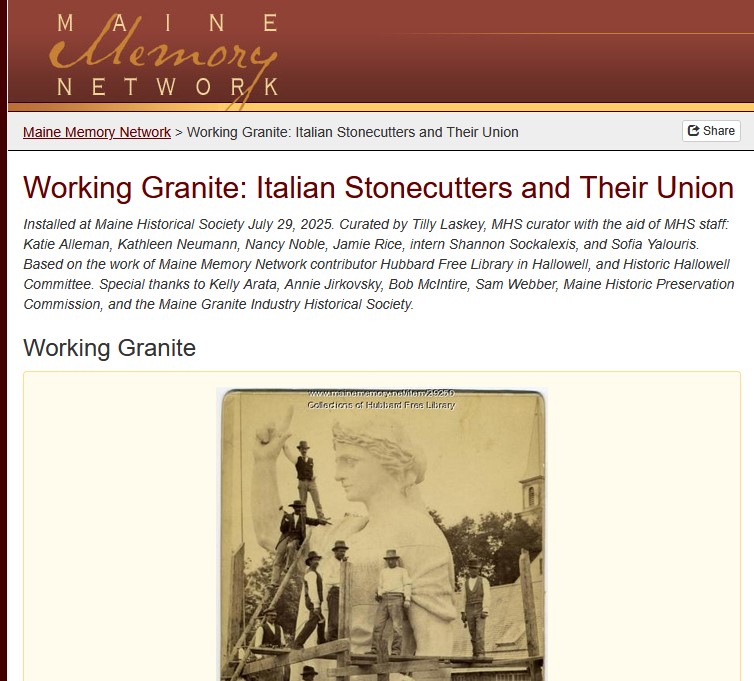
Maine Historical Society
Workers created the Granite Cutters Union in Rockland by 1877 to “establish uniform rates and improve the condition of the trade.” The union expanded to granite workers across America, including Hallowell where Italian workers led a strike in 1892.
At its peak in 1901, Maine’s granite industry ranked first in the nation for sales, reporting earnings of 2.5 million dollars—equal to over 119 million dollars in 2025. The end of World War II brought new technologies for cutting stone. Along with easy access to steel and concrete, and changing styles in architecture, Maine’s granite industry declined.
Short digital exhibit depicting Maine's granite workers and their struggles, and the role of Italitan immigrants especially. On-site exhibit lasts til July 28, 2026
Manuel Echavarria
The Central Coast Farm Labor Organizing Collection contains materials relating to migrant farm workers on the Central Coast of California, including oral histories, reports, correspondence, strike ephemera, and secondary sources. Photographs taken by Manuel Echavarria documenting the United Farm Worker movement and used in the exhibit "iViva la Causa! A Decade of Farm Labor Organizing on the Central Coast" are included in the collection. Finding aid available at https://oac.cdlib.org/findaid/ark:/13030/kt3g50363t/
52 photographs taken by Manuel Echavarria documenting the United Farm Worker movement

Manuel Gamio, Migration is Beautiful
Manuel Gamio, a University of Chicago sociologist, created this map using Mexican immigration figures from the 1920 U.S. census. University of Chicago Press, 1930
Manuel Gamio, a sociologist at the University of Chicago, created this map from the 1920 U.S. census.
Mapping American Social Movements Project
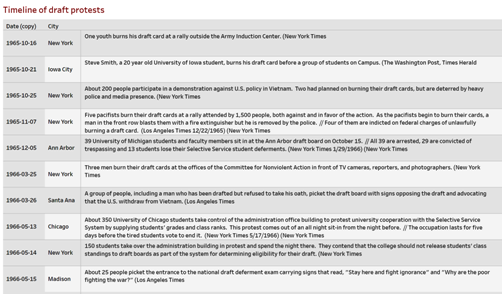
Conscription was first mandated by Congress during Civil War and then again in World War I, World War II, and the Korean War. In each instance the draft proved controversal, fostering both evasion and, less commonly, purposeful resistance. But the magnitude and intensity of opposition to the conscription during the Vietnam War was unprecedented. Evasion became so pervasive and organized resistance so effective that the Nixon administraton worried about the capacity of the Armed Forces, leading Selective Service authorities to adjust the law in late 1969 and end the practice of conscription altogether in 1973. Millions of young men found legal and nonlegal ways to avoid conscription, including fleeing the country to Canada and other countries that offered refuge. Others, women as well as men, committed themselves to openly resisting the draft in various ways. They burned or surrendered draft cards, surrendered student deferments, refused induction, and staged disruptive protests at draft boards and induction centers, employing in some cases tactics of peaceful civil disobedience, in other cases damaging property and battling with police. Traditional pacifist groups--Quakers, Mennonites, the War Resister's League-- led the early movement and provided conscientious objector counselling throughout the era. SDS launched an anti-draft campaign in 1965 and in 1967 two new efforts came together, the Stop the Draft movement that attempted to block induction centers in a number of cities, and The Resistance, which organized draft card turn-ins and supported men who faced prison for refusing induction.
Two maps, a database, a timeline, and a list showing the development of resistance to drafts that were mandated during the Vietnam War.
Mapping American Social Movements Project
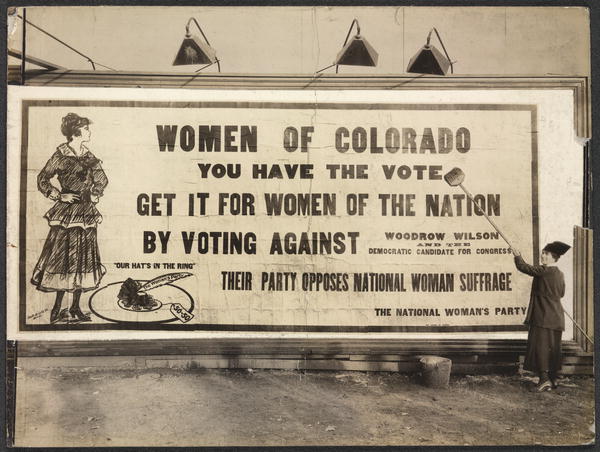
The Mapping American Social Movements Project is used in hundreds of classrooms at college and high school levels. The maps, charts, and data tables lend themselves to all sorts of observational and interpretative exercises. Sets of discussion and observation questions accompany several of social movement units.
An introduction to classroom resources assembled by participants in the Mapping American Social Movements Project.
Mapping American Social Movements Project
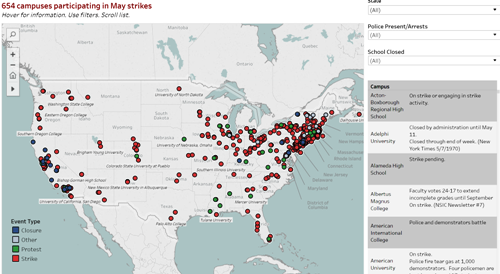
The May 1970 antiwar strikes became one of the largest coordinated sequences of disruptive protests in American history, with walkouts spreading across more than 883 campuses involving more than a million students. On April 30, 1970, President Nixon announced that American forces had invaded Cambodia in an effort to disrupt North Vietnamese supply lines. This secret widening of the Vietnam conflict drew immediate condemnation around the the world and fierce protests from antiwar activists in the United States, especially on college campuses. Five days days later, Ohio National Guard troops fired into a crowd protesting at Kent State University, killing four, wounding nine. Calls for a nationwide student strike escalated and in the days that followed students at hundreds of campuses boycotted classes. Mass protests, marches, building takeovers, attacks on ROTC facilties, clashes with police were reported at many. Authorities suspended classes on 97 campuses and 20 remained closed for the remainder of school year.
Six maps and databases showing the geographic development of the May 1970 antiwar strikes across the U.S.

Mapping American Social Movements Project
The social movements of 1960s and 1970s triggered transformations that have resonated for more than half a century. Black freedom movements and uprisings, women's liberation, gay liberation, Native American, Chicano, and Asian American struggles yielded profound legal and cultural changes, effectively rewriting the rules of race, gender, and sexuality. Antiwar and countercultural activism by millions of young people of every backgound turned campuses and cities into both battle grounds and zones of social and cultural innovation while helping to bring down two presidents and rearranging both the Democratic and Republican Parties. The impact of these movements registered widely: in the military which had to be redesigned to operate without conscription; in mass media which scrambled to recapture a generation that had discovered underground newspapers; and especially in the new ways that many Americans would from then on view their nation's institutions and role in the world.
An introduction and research portal into the Mapping American Social Movements Project's section on the geographic development of New Left and Antiwar Movements.
Mapping American Social Movements Project
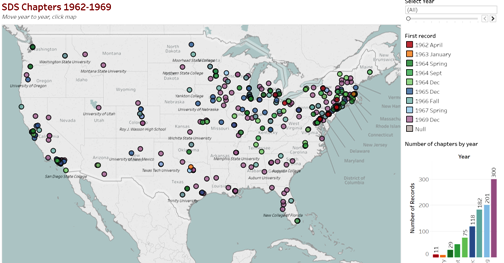
The Students for a Democratic Society (SDS) and the Student Nonviolent Coordinating Committee (SNCC) were the most influential radical organizations of the 1960s and remain closely associated with the term "New Left." Founded in 1960, SDS began to attract attention with the publication of the 1962 Port Huron Statement, a manifesto that articulated an argument for a fundamental societal transformation in the name of "participatory democracy." The organization took on a new mission after the Johnson administration escalated the war in Vietnam. In 1965, SDS organized a sequence of antiwar protests and membership surged. The organization claimed 29 chapters early in 1964 and 118 chapters at the end of 1965. In the years that followed, SDS became steadily more radical and membership followed, with estimates ranging from 30,000 to 100,000 by the start of 1969. But 1969 proved to be the year of destruction for SDS, which split into three factions, one of which, the "Weathermen," embarked on a campaign of revolutionary destruction that has ever since occluded the historical reputation of this pivotal organization. Here are resources that map the growth of SDS from a handful of chapters in 1962 to more than 300 in 1969. The key source is Kirkpatrick Sale, SDS (Random House, 1973) the classic history of the organization. This information has been supplemented with documents from the microfilm copy of the Students for Democratic Society Records, archived at the Wisconsin Historical Society, and a 1969 list of chapters identified in a congressional investigation. The color codes indicate the date a chapter first appears in any of these records, but it can't be assumed that it functioned continuously after that date. Some chapters lasted only a year or two and later may have been reestablished.
Two maps and a chart showing SDS chapters by year, state by state, and chapters by both year and state across the 1960s.
Mapping American Social Movements Project, Arianne Hermida, James Gregory
Founded in 1942 by an interracial group of University of Chicago students, CORE pioneered key tactics of the modern civil rights movement, using sit-ins and other forms of civil disobedience to challenge segregation. Winning victories in northern cities in the 1940s and 1950s, CORE became active in the South with the lunch counter sit-ins of 1960. The following year CORE organized "Freedom Rides," sending black and white students south to disrupt segregated interstate bus service. Drawing much of its membership from college campuses, CORE kept up civil disobedience campaigns in the North as well as the South. The maps and charts below show the geography of CORE activism, locating more than 600 actions linked to the organization.
Five maps and charts showing the development of CORE from its roots in the University of Chicago to becoming a major national racial equality organization with chapters across the U.S.
Mapping American Social Movements Project, James Gregory
The social movements of 1960s and 1970s would not have been possible without the underground press, an explosive new media system that spread through hundreds of communities. While the label "underground newspaper" had long been used to describe the publications of resistance groups in totalitarian societies, it was repurposed in the mid 1960s by activists in the US and other countries who published radical and countercultural tabloid-format weeklies and monthlies. Breaking open the information monopoly dominated by three TV networks, two wire services, and a string of plain-vanilla daily newspapers, the undergrounds challenged the conventions of journalism and politics with wildly new designs and uncompromising articles. In so doing they established the parameters of radical politics and the meanings of "counterculture" for this pivotal decade. These resources explore the history and geography of alternative media system with (1) interactive maps, charts, and lists that show more than 2,600 underground/ alternative periodicals from the decade between 1965 and 1975; (2) a filterable database of these publications.
An introduction and research portal into the Mapping American Social Movements Project's section on the history and geography of Underground/Alternative Newspapers.
Mapping American Social Movements Project, James Lewes
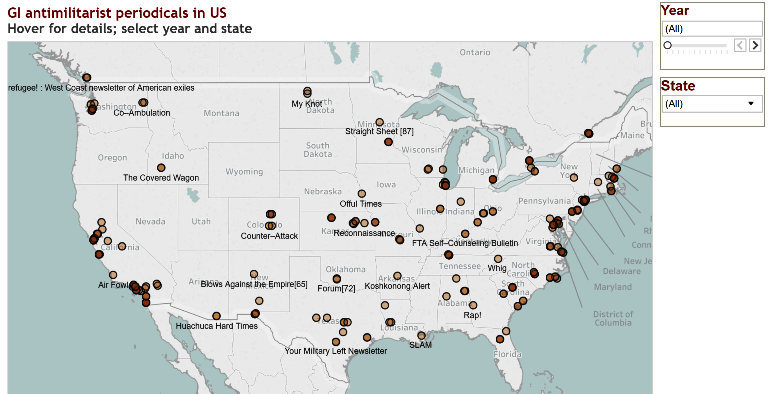
These maps and charts locate 768 periodicals associated with the GI antimilitarist movement in the era of Vietnam war. As opposition to the war grew, dissent spread through the military forces. By 1970, antiwar periodicals for GIs were available near most military bases in the US and at bases in Europe and Asia, especially in West Germany and Japan. Some were newspaper tabloids with substantial circulations, others were turned out on mimeograph machines. Many were short-lived, partly because of steps that military or local authorites took to supress them. Historian James Lewes digitized thousands of periodicals and pamphlets for the online GI Press Collection supported by the Wisconsin Historical Society. From that massive collection he has identified the newspapers and newsletters shown in these interactive maps and charts. Lewes is author of Protest and Survive: Underground GI Newspapers During the Vietnam War (Praeger Publishers, 2003).
Five maps and charts locating the periodicals and newspapers associated with the G.I. antimilitarist movmenent that was active during the Vietnam War.
Mapping American Social Movements Project, Katie Anastas
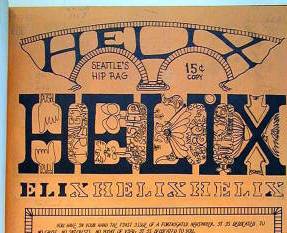
The social movements of the 1960s and 1970s transformed American politics, social life, and culture. From civil rights groups, to feminist organizations, to environmental activists, to antiwar GI’s, Americans mobilized in new ways to promote social change. Some of the notable groups that we’ve mapped include the Black Panther Party, the Student Nonviolent Coordinating Committee, and the United Farm Workers. Today, Facebook, Twitter, and other social media platforms allow us to publish and read diverse opinions, organize protests and demonstrations, support the organizations and causes we care about, and, in some cases, speak directly with people in power. In the 1960s and 1970s, the underground press served that same purpose, giving voice to marginalized groups and helping them build stronger communities.
A brief illustrated article by Katie Anastas describing the impact of underground press outlets on American social movements of the 1960s and 1970s.
Mapping American Social Movements Project, Katie Anastas, James Lewes
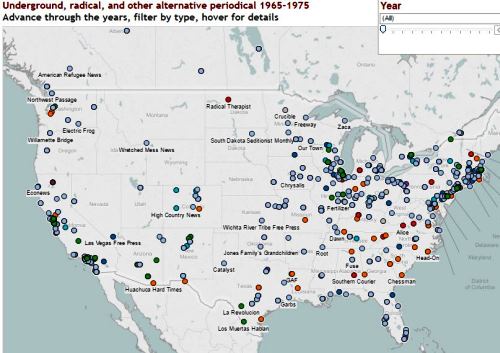
While the label "underground newspaper" was long used to describe the publications of resistance groups in totalitarian societies, it was repurposed in the mid 1960s by activists in the US and other countries who published radical and countercultural tabloid-format weeklies and monthlies. The interactive maps below show more than 2,600 underground, alternative, and other kinds of unorthodox publications from the decade between 1965 and 1975. Two observations jump out. First, it is clear that newspapers appeared in hundreds of communities, not just big cities and college towns, but also in many towns and medium-sized cities. Second, California hosted more than 400 publications, followed by New York with 306.
Five maps and charts that visualize the geographic dispersion of underground/alternative maps across the U.S., Canada, and Mexico.
Mapping American Social Movements Project, Katie Anastas, James Lewes
interactive database accompanies the maps, charts, and articles in the unit on Underground/Alternative Newspapers History and Geography of the 1960s-1970s
An interactive database that accompanies other underground press-related resources from the Mapping American Social Movements Project.
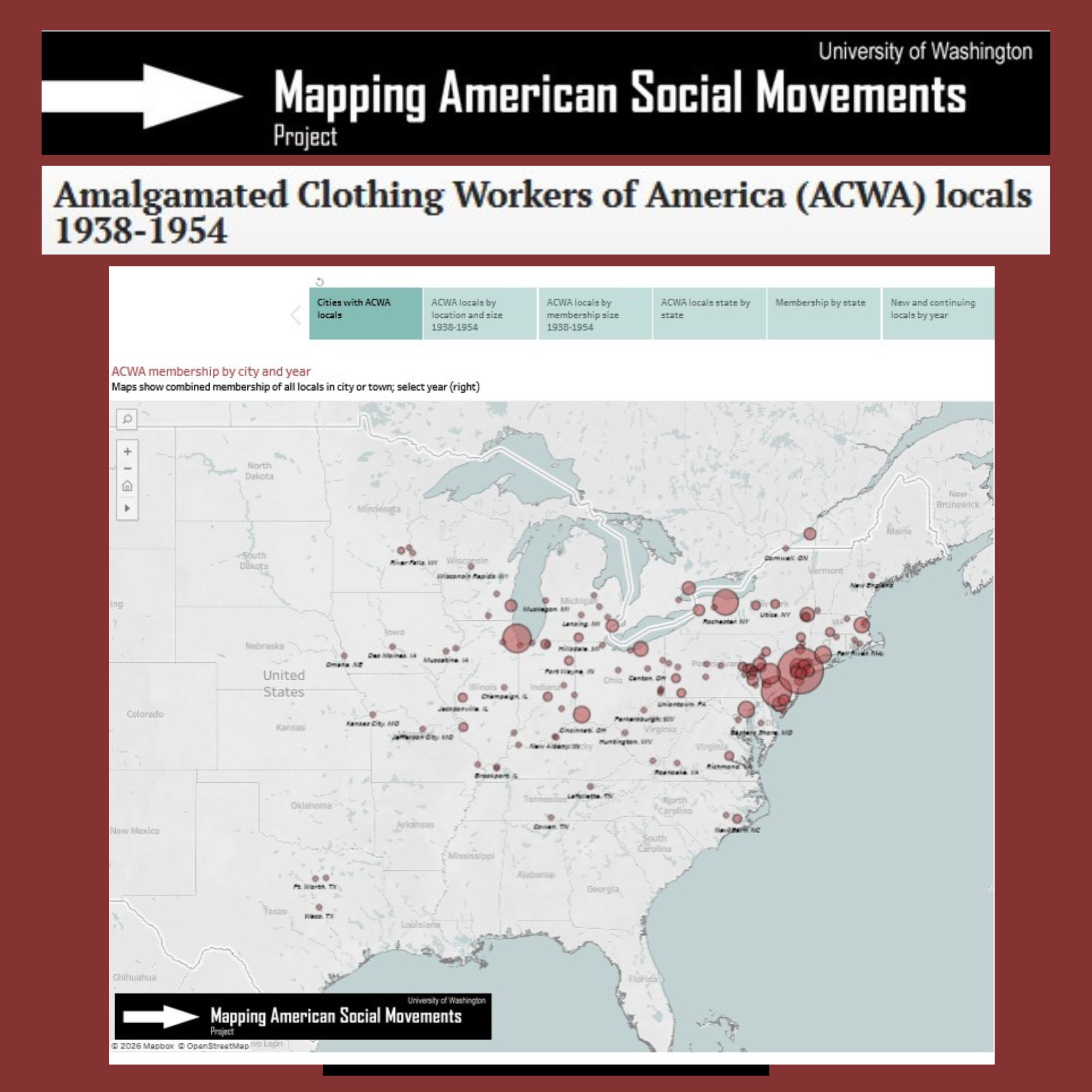
Mapping American Social Movements Project, Cameron Molyneux
The Amalgamated Clothing Workers of America was founded in 1914 by immigrant Socialist garment workers who split from the United Garment Workers (UGW), a conservative and cautious craft union affiliated with the American Federation of Labor. Overtly radical, the new union organized along industrial lines, welcoming clothing workers of all jobs and skills, reaching out to immigrant Jewish and Italian women whom the UGW often ignored. Under the leadership of President Sidney Hillman, the Amalgamated grew quickly while staving off the UGW and the AFL throughout its early years. The Great Depression decimated most unions, including the ACWA, and as it began to rebuild in 1933 the Amalgamated agreed for the first time to affiliate with the AFL. The alliance did not last. The same progressive politics that had kept the ACWA out of the AFL led to renewed tensions. Hillman and the Amalgamated advocated a program of “social unionism,” arguing that unions should fight for universal welfare programs like unemployment insurance in addition to seeking better wages for members. ACWA’s commitment to industrial unionism posed a bigger challenge. The Amalgamated claimed jurisdiction to organize all workers in the men’s clothing industry, while the AFL supported UGW jurisdictional claims. It was no surprise that the Amalgamated became one of the seven founding unions when the Committee for Industrial Organization was launched in 1935. And in 1937 when the industrial unions were expelled from the AFL, the Amalgamated became part of the Congress of Industrial Organizations (CIO) with Sidney Hillman serving as Vice-President of the newly chartered Congress. The Amalgamated had about 100,000 members when it helped launch the CIO in 1935. Aggressive organizing campaigns helped the union expand rapidly. By 1940, it claimed 239,000 members in 265 locals. Growth slowed in the World War II years, mostly because government planners moved capital and workers away from the clothing industry into defense production. Consumer demand recovered in 1946 and the union enjoyed a second growth spurt, reaching nearly 300,000 members in 1951. Moreover the geography of the union had changed. Based initially in CNew York, Philadelphia, Chicago, Rochester, and a handful of other big cities, by 1948 the Amalgamated had organized manufacturers' "runaway shops" and claimed locals in 251 cities and towns including many outside the industrial Northeast and Midwest. These maps show the geographic expansion of the ACWA from 1938 to 1954.
Six maps and charts showing the ACWA's geographic expansion in from the late 1930s to the mid-1950s.
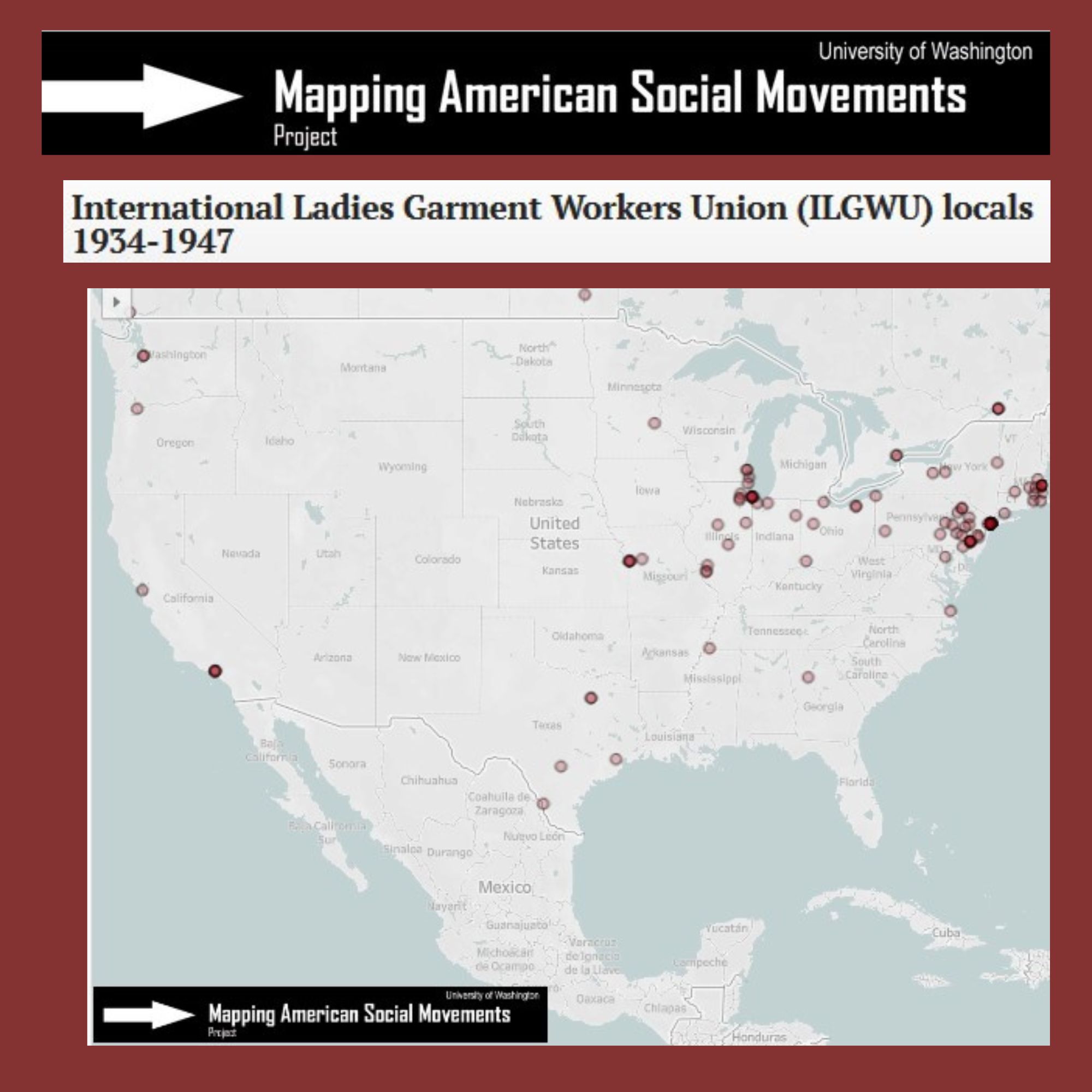
Mapping American Social Movements Project, Cameron Molyneux
The International Ladies’ Garment Workers’ Union (ILGWU) was founded in 1900 in four East Coast cities by a workforce largely comprised of immigrants who had prior trade union experience in Europe. The union name signified that the workers made ladies' clothing, but it was also true that most of the members were female, making this one of the first female majority unions in the American Federation of Labor. As one of the AFL’s few industrial unions, the ILGWU joined the Committee for Industrial Organizing in 1935 as a founding member during the CIO's initial existence as an organizing committee within the AFL. The ILGWU followed the CIO when it was expelled from the AFL in 1937, but CIO affiliation would be short lived. Opposing what it saw as rising communist influence in the CIO, the ILGWU left and reaffiliated with the AFL in 1940.
The ILGWU had at least 150,000 members in 128 locals when it helped launch the CIO in 1935 and the garment workers union grew rapidly as union organizing caught fire in the late 1930s and during World War II. By 1947 the number of locals and the number of members had more than doubled, with membership reaching 337,000. Moreover the geography of the union had changed. Based initially in New York, Philadelphia, Chicago, and a handful of other big cities, by 1947 the ILGWU had chased down and organized manufacturers' "runaway shops" and now included locals in 209 cities and towns. This reflected a new demography. Once a union largely for Jewish and Italian workers, in the 1940s the ILGWU learned how to organize Mexican-American women in Los Angeles and Texas, Chinese Americans in San Francisco, Black workers in Birmingham, and Puerto Rican and Black women in New York. The ILGWU would continue to grow in the post-war period, reaching its zenith at the end of the 1960s. The ILGWU no longer exists in its original form, as it was one of the constituent unions that merged to form UNITE HERE.
Four maps and charts showing the ILGWU's geographic expansion across the U.S. in the 1930s and 1940s.
Mapping American Social Movements Project, Cameron Molyneux
The ILWU broke away from the International Longshoreman's Association (ILA) in 1937 to join the CIO. The Pacific Coast District of the ILA had waged an 83 day strike in 1934, closing all the ports up and down the West Coast and winning employer recognition for locals that had been without bargaining rights since the 1920s. Led by militants who defied orders from ILA headquarters, the 1934 victory had set the West Coast longshore workers on a different path from the rest of the ILA well before the 1937 split. Harry Bridges, leader of the radical faction in the 1934 strike, became the first President of the International Longshore and Warehouse Union (ILWU-CIO). Over the next 12 years, the union would organize or solidify longshore locals along the entirety of the West Coast while starting successful organizing drives among farm workers in Hawaii and warehouse workers both on the West Coast and states further east. During this period, the union’s membership more than doubled, from 25,000 to 65,000 dues paying members. Like the United Electrical, Radio, and Machine Workers (UE), the ILWU would become famous for its left-wing leadership and progressive rank and file membership. Harry Bridges became a major player within the CIO, serving for several years as the organization's West Coast Director. The ILWU became the base for West Coast organizing drives in other maritime trades as well as the campaign in the timber and sawmill towns that launched the International Woodworkers of America (IWA-CIO). The union's radical leadership became a source of strength and controversy. The federal justice department said that the Australian-born Harry Bridges was a Communist and made four separate attempts to deport him. He won in court and he also maintained the loyalty of ILWU members, including those who had little sympathy for Communism. That solidarity helped the union survive the red scare and the Taft-Hartley Act. Refusing to expel Communists from leadership positions as required by law, the union was thrown out of the CIO in 1950 and faced vicious persecution. But unlike UE which lost most of its members, the ILWU stayed strong and was able to help and incorporate other persecuted unions, adding locals from the International Fisherman and Allied Workers of America (IFAWA) and the Filipino-led Alaska Cannery Workers Union in 1950.
Four maps and charts visualizing the geographic expansion of ILWU locals across the U.S. from the mid-1930s to the late 1940s.
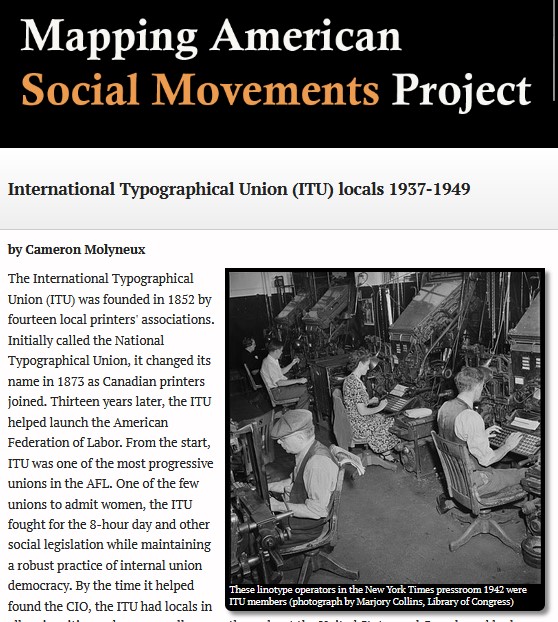
Mapping American Social Movements Project, Cameron Molyneux
The International Typographical Union (ITU) was founded in 1852 by fourteen local printers’ associations. Initially called the National Typographical Union, it changed its name in 1873 as Canadian printers joined. Thirteen years later, the ITU helped launch the American Federation of Labor. From the start, ITU was one of the most progressive unions in the AFL. One of the few unions to admit women, the ITU fought for the 8-hour day and other social legislation while maintaining a robust practice of internal union democracy. By the time it helped found the CIO, the ITU had locals in all major cities and many smaller ones throughout the United States and Canada and had established member benefits like pensions, mortuary funds, and retirement homes for their members. ITU President Charles Howard joined John L. Lewis at the 1935 AFL convention in forming the Committee for Industrial Organization and when AFL moved to block the industrial union campaigns in 1937, the ITU joined the newly independent Congress of Industrial Organizations. The move to join the CIO was initially popular with both of the ITU’s political factions, who put aside their differences to oppose the AFL when it demanded that member unions pay a tax to fight industrial organization. But internal debate quickly rekindled and in 1944, the ITU reaffiliated with the AFL upon receiving promises that it would be granted greater jurisdiction to organize within its own industry. A bastion of consistency and model of successful collective bargaining, the ITU played a unique role in the early CIO. With locals in 658 cities in 1937, the union was able to win the 40-hour week for members and other protections that set aspirational standards for other unions. Its wide geography meant that ITU members were positioned to help in the organizing campaigns of other CIO unions. That remarkable geographic spread is demonstrated in these maps. And at first glance the ITU’s membership barely seems to expand over the course of the 1940s. Upon a closer look, however, you can see the union growing modestly, adding locals in the emerging cities of the South and West. In 1949, the union claimed 836 locals in 712 cities. That was a year after the ITU defied the Taft Hartley Act requirement that local and international officers sign affidavits swearing that they were not Communists. Unlike most of the unions who defied the law, ITU was strong enough to survive and indeed grow in the 1950s.
Three maps and charts showing the geographic expansion of ITU locals across the U.S. and Canada in the 1930s and 1940s.
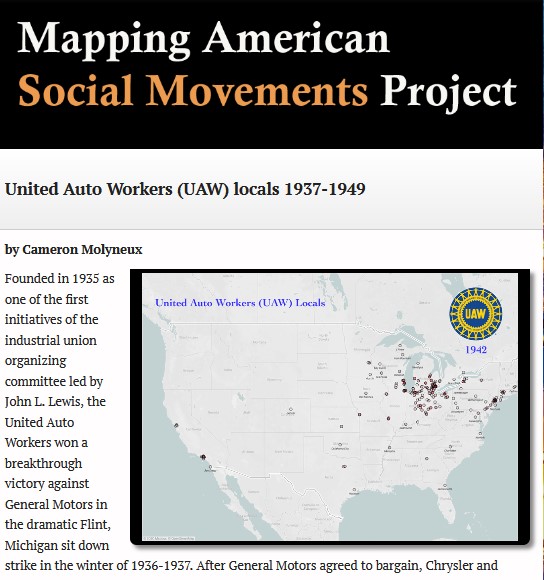
Mapping American Social Movements Project, Cameron Molyneux
Founded in 1935 as one of the first initiatives of the industrial union organizing committee led by John L. Lewis, the United Auto Workers won a breakthrough victory against General Motors in the dramatic Flint, Michigan sit down strike in the winter of 1936-1937. After General Motors agreed to bargain, Chrysler and several smaller auto companies followed suit and by mid-1937 the new union claimed 150,000 members and was spreading through the auto and parts manufacturing towns of Michigan, Ohio, Indiana, and Illinois. Then the union experienced a series of setbacks. The economy dipped into a second depression, auto sales fell, and companies announced layoffs. Meanwhile Henry Ford instructed his plant superintendents to stop the union at all costs. This was also when the American Federation of Labor expelled the CIO unions, which now regrouped as the Congress of Industrial Organizations. It wasn’t until 1941 that the union regained momentum. After battling Ford for years, the Lord of Dearborn was forced to recognize the union. The victory brought 100,000 members into the UAW. Growth accelerated when the United States entered World War II. With the federal government desperate to maintain labor peace, the UAW agreed to a no strike pledge in 1942 in exchange for mandatory membership rules. As war production ramped up and auto factories converted to tank building, the UAW organized new locals in these factories and airplane manufacturers across the country and hit a peak membership of over a million members in 1944. These maps chart the spread of the UAW from April 1939 when it counted 172 locals and about 170,000 members to 1944 with 634 locals and more than one million members though the late 1940s when conversion to civilian production and a post-war recession caused a dip in membership even as the number of locals increased.
Four maps and charts showing the UAW's growth based on roll call documents from convention proceedings.
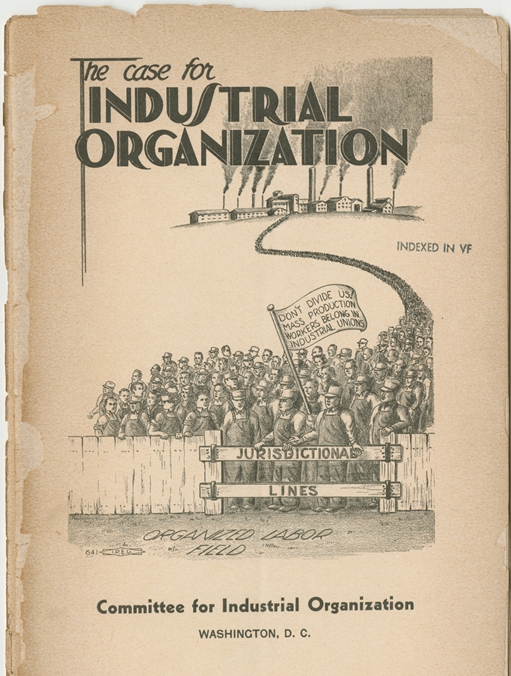
Mapping American Social Movements Project, Cameron Molyneux
The Mapping American Social Movements Project is used in hundreds of classrooms at high school and college levels. The maps, charts, and data tables lend themselves to many kinds of observational and interpretative exercises. Here are several discussion questions for the CIO unit.
An article elaborating several discussion questions about the CIO's history for teachers to use in classrooms in conjunction with the Congress of Industrial Organization's maps and other resources at the site.
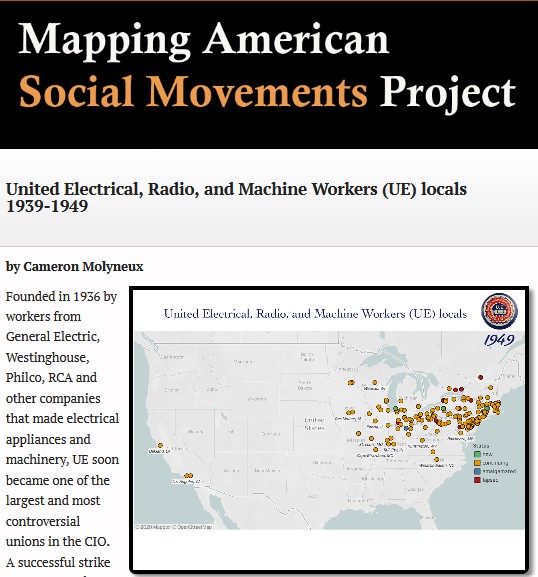
Mapping American Social Movements Project, Cameron Molyneux
Founded in 1936 by workers from General Electric, Westinghouse, Philco, RCA and other companies that made electrical appliances and machinery, UE soon became one of the largest and most controversial unions in the CIO, claiming a peak membership of 686,000 in 1944. UE was known as a left-wing union, many of its top leaders closely associated with the Communist Party, a heritage that would complicate its internal and external politics. The union took strong positions on racial and gender equality. Women were an important part of the work force and by the end of the war comprised about 40% of the membership. At the same time, the leftwing reputation left the union vulnerable to red-baiting, which nearly destroyed the union in the early 1950s. Here are five interactive maps and charts showing the year by year geography of the UE.
Five maps and charts showing UE's growth through the establishment of locals across the American Midwest, Northeast, and West.
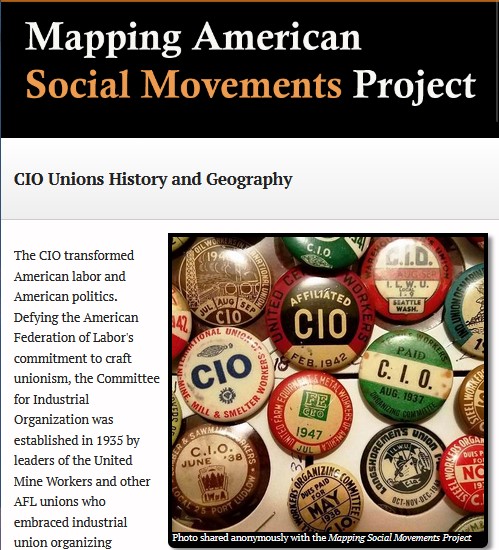
Mapping American Social Movements Project, Cameron Molyneux,
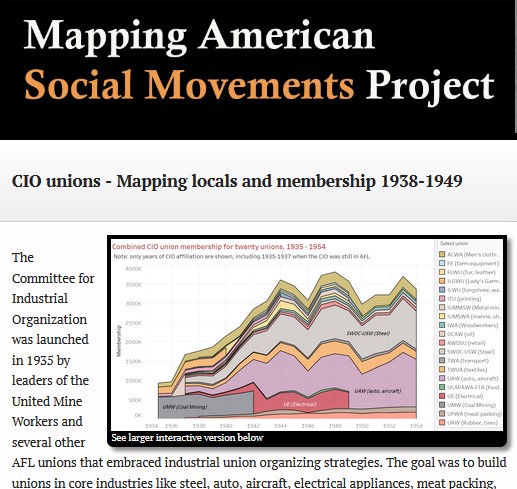
"Explore the history and geography of the CIO unions from 1935 through the end of the 1940s with maps and membership data showing the growth and in some cases decline of key CIO unions: United Auto Workers (UAW), United Electrical Workers (UE), International Ladies Garment Workers (ILGWU), Amalgamated Clothing Workers (ACWA), International Longshore and Warehouse Union (ILWU), International Typographical Union (ITU), and the International Woodworkers of America(IWA). . . .Educators may want to consult Teaching CIO Maps: Observation and Discussion Questions"
An introduction to the history and geography of the CIO, an entity that transformed American labor politics by defying craft unionism in favor of industry-wide organizing strategies.
Mapping American Social Movements Project, Cameron Molyneux, James Gregory
Site explores growth of CIO using graphs and maps of membership data of the industrial union movement of the 1930s.
"Detailed explorations of the geographic history of each of them. Here we combine membership numbers to show CIO density and the spread of locals across hundreds of cities. This is incomplete. We do not yet have geographic data for all affiliates. But shown in detail are some of the most important: United Auto Workers (UAW), United Electrical Workers (UE),Amalgamated Clothing Workers (ACWA), International Longshore and Warehouse Union (ILWU), and International Woodworkers of America (IWA). Also two that helped launch the CIO but later rejoined the AFL: International Ladies Garment Workers (ILGWU) which left the CIO in 1939, and International Typographical Union (ITU) which left in 1944. There is much more information on the separate map pages for each of the seven unions."
Four maps and charts locating twenty important CIO-affiliated unions and detailing their annual membership numbers.
Mapping American Social Movements Project, Gregory, Rebecca Flores
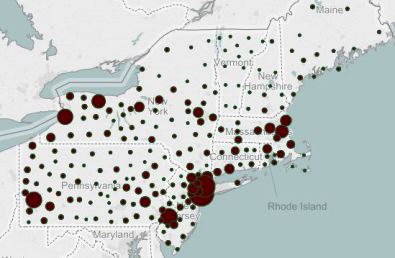
These maps and charts show voter support for Socialist candidates, candidates elected, newspapers published and membership numbers for each region. As of 2015, everything here is "preliminary and will be changing" according to resources' creators. Consult these visualizations with that mind.
Four maps and charts showing voter support for Socialist Party candidates across the U.S. based on election data, newspaper publications, and membership numbers.
Mapping American Social Movements Project, Henry John
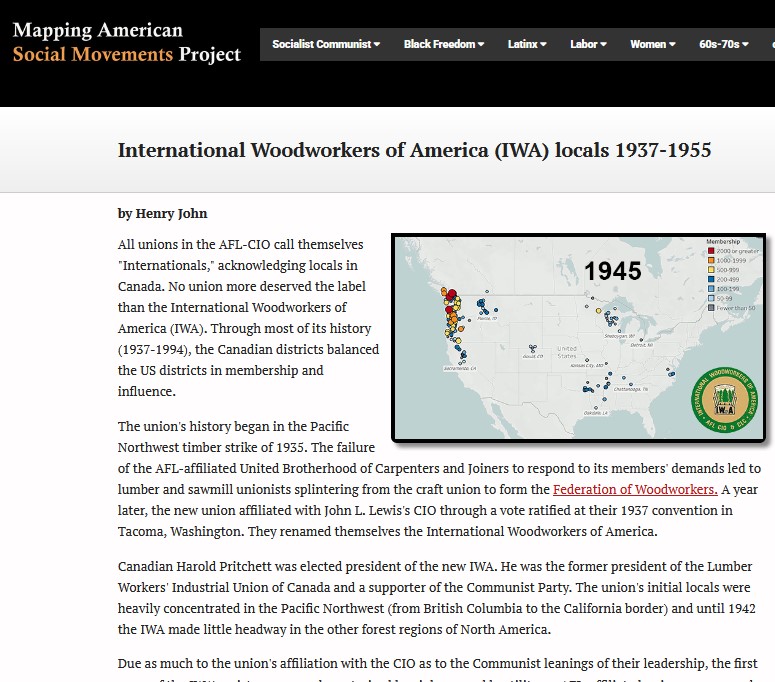
All unions in the AFL-CIO call themselves "Internationals," acknowledging locals in Canada. No union more deserved the label than the International Woodworkers of America (IWA). Through most of its history (1937-1994), the Canadian districts balanced the US districts in membership and influence. The union's history began in the Pacific Northwest timber strike of 1935. The failure of the AFL-affiliated United Brotherhood of Carpenters and Joiners to respond to its members’ demands led to lumber and sawmill unionists splintering from the craft union to form the Federation of Woodworkers. A year later, the new union affiliated with John L. Lewis’s CIO through a vote ratified at their 1937 convention in Tacoma, Washington. They renamed themselves the International Woodworkers of America.
Canadian Harold Pritchett was elected president of the new IWA. He was the former president of the Lumber Workers’ Industrial Union of Canada and a supporter of the Communist Party. The union’s initial locals were heavily concentrated in the Pacific Northwest (from British Columbia to the California border) and until 1942 the IWA made little headway in the other forest regions of North America. Due as much to the union’s affiliation with the CIO as to the Communist leanings of their leadership, the first years of the IWA’s existence were characterized by violence and hostility, as AFL-affiliated unions announced a boycott of all goods handled by IWA members. The late 1930s and early 1940s also saw sustained conflict within the IWA itself, with the anti-communist “White Bloc”, concentrated in the Columbia River District Council, waging a protracted struggle to wrest the leadership of the union away from Pritchett and the “Red Bloc” communist organizers. Pritchett was forced out of the presidency in 1940 when the U.S. government banned him from traveling into the United States. Political tensions within the union reached the breaking point in 1948 after the U.S. Congress passed the Taft-Hartley Act requiring unions to ban Communists from leadership positions. Pritchett and other British Columbia District Council 1 officers vowed to separate and launched the Woodworkers’ Industrial Union of Canada (WIUC). However, rank and file majorities rejected the move and almost all Canadian locals subsequently reaffiliated with the IWA. Despite these struggles, the 1940s were a time of explosive growth for the IWA. Between 1941 and 1948, the forestry union doubled in size from 35,000 members to 85,000. Much of this growth occured in British Columbia, where Chinese-Canadian organizer Roy Mah and South Asian organizer Darshan Singh Sangha led efforts to organize non-white workforces around the Canadian province. The IWA in British Columbia expanded from five locals and 1,151 members in 1941, to thirteen locals and 24,453 members in 1948. Although still heavily concentrated in the transnational Pacific Northwest, the union also broadened its geography and by 1948 claimed locals in 31 states and provinces. Growth continued in the early 1950s with international membership surpassing 94,000 in most years, roughly one third of it in the British Columbia locals. These maps show the geography of the IWA from 1937 to 1955 when the CIO reunited with the AFL.
Five maps and charts showing the geographic expansion and layout of the IWA between the 1930s and 1950s.
Museum/Exhibits
Tours
Maps
Digital Projects
Organizations
Sites
Film/Video
Audio/Interview
Podcast/Program
Text/Document
Image
Graphs/Data
Timeline
Southwest
West
Midwest
Southeast
Northeast
Mexico
Canada
Global
Books
Teaching
Lectures
Digital Archives
Journals
Bibliographies
Topic Intro