


Collections
Library
Type
Region
Coverage:
-
Published:
-

Mary Paul
Mary Paul was one of thousands of Lowell mill "girls." She grew up in northern Vermont, one of four children born to Bela and Marry Briggs Paul. She began her working life as a domestic in Bridgewater, Vermont, but in 1845 decided to try her luck in Lowell. She worked in the mills from 1845 through 1848, joining her father in Claremont, New Hampshire soon afterward (where he had relocated to). Two years later she returned to Vermont for a short spell, and then joined former Lowell companions at an agricultural utopian community in Redbank, New Jersey for a year. Following her brief tenure at the collective, she once again returned to New Hampshire. In 1857, she married Issac Guild who took a job at a marble works in Lynn, Massachusetts. Twenty-five of her letters, covering the years 1845 through 1862 have survived. Here are a few of them.
A collection of primary sources and other resources for researching the Lowell Mills. Includes timeline
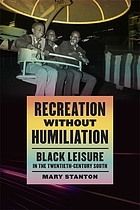
Mary Stanton
Recreation without Humiliation is the first comprehensive study of Black amusement venues established by Black Americans for Black Americans. Mary Stanton's extensive research on African American amusement parks in America explores not only segregation, class, and social barriers but also the notion of the 'pursuit of happiness' as an inalienable right for all races and classes of people. Inspired by summers spent on Coney Island, where Stanton became curious about the existence of African American amusement parks in America,
Stanton's research uncovered more than fifty such venues, most of which operated during the late nineteenth and early twentieth centuries. These were parks, theaters, juke joints, country clubs, summer colonies, baseball diamonds, and arenas. Although these venues provided much needed recreational services to an underserved Black population, many were threatened by whites, and some destroyed by them. Through her study of these sites of recreation, Stanton illuminates the history of African Americans who strove to create and maintain safe and satisfying entertainment despite segregation.
In her research, Stanton also found class divisions among Black American entertainment venues. At the pinnacle of Black society in this era were the upper class, who could afford exclusive Black summer cottages and country clubs. General entertainment for Black working-class families consisted of dancing and drinking in juke joints or patronizing small amusement parks, playgrounds, movie theaters, church-sponsored functions, and Black county fairs. African Americans in the twentieth century, especially in the South, transformed segregation into what historian Earl Lewis calls 'congregation.' Congregation implies choice, and this congregation 'provided space and support for establishing new amusements, entertainments, music, and dance' without interference or oppression"-- Provided by publisher
First comprehensive study of Black amusement venues established by Black Americans for Black Americans
Mary Thomas, History Matters
The brutal southern Colorado coal strike reached its nadir on Easter night, 1914, with the horrendous deaths by fire of three women and eleven children at the hands of the Colorado state militia. Mary Thomas, whose husband was on strike, was interviewed at age eighty eight by historian Sherna Gluck in 1974 for the Feminist History Research Project. Thomas vividly recalled the horror of the infamous Ludlow Massacre, described her efforts to save the lives of women and children by hiding them in a dry well, and her jailing in the aftermath the massacre. She was the only woman strike supporter to be jailed during the strike.
Mary Thomas, whose husband was on strike, was interviewed at age eighty eight by historian Sherna Gluck in 1974
Maryland State Archives
Teaching materials and guide. Purpose: to examine the causes and consequences of the strike against the Baltimore & Ohio Railroad in the summer of 1877
to relate the strike and ensuing riots to events nationwide and
to place the events in Baltimore into the larger context of what one historian has called the Year of Violence
See:
Suggested Reading & Viewing
Guide to Documents, including contemporary accounts
Classroom exercises and assignments
Teaching unit on Baltimore railroad strike
Maryland250
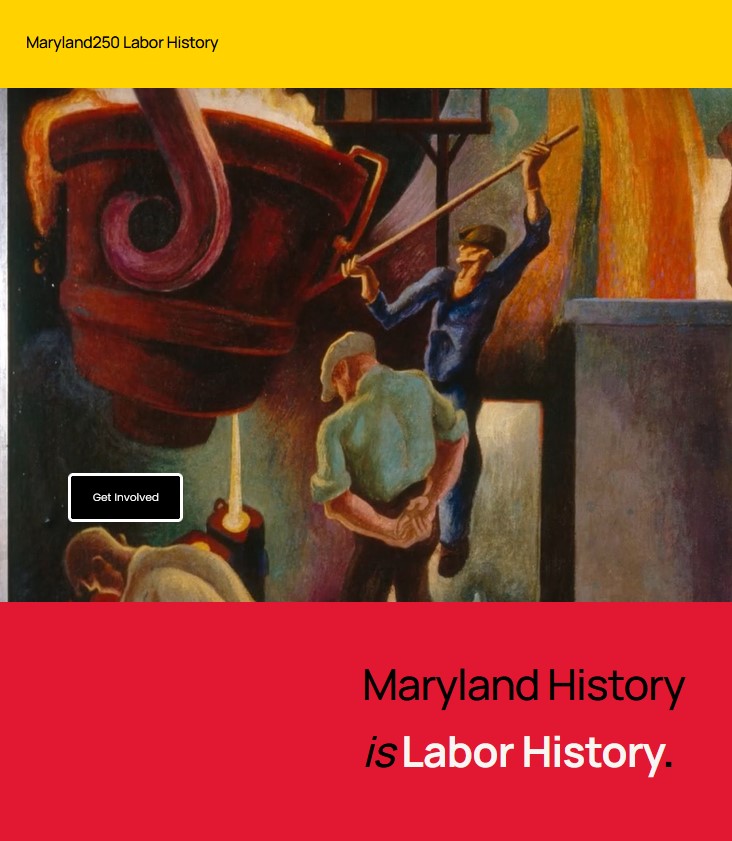
From the first national strike in 1877 to the nation’s first unionized Apple store, Maryland workers have long been at the center of labor history, fighting in the name of a better, more just life for all. As the state of Maryland celebrates its 250th anniversary, Maryland250 Labor History aims to ensure that we not only remember and celebrate this legacy, but treat it as a guide for our future.
A collaborative and volunteer-run project, MD250 Labor History is bringing this history to life through historical documents, podcasts, walking tours, videos, and more.
This is a site in development, primed to help give labor's story in the America250 commemoration. Has Timeline
Maryland250
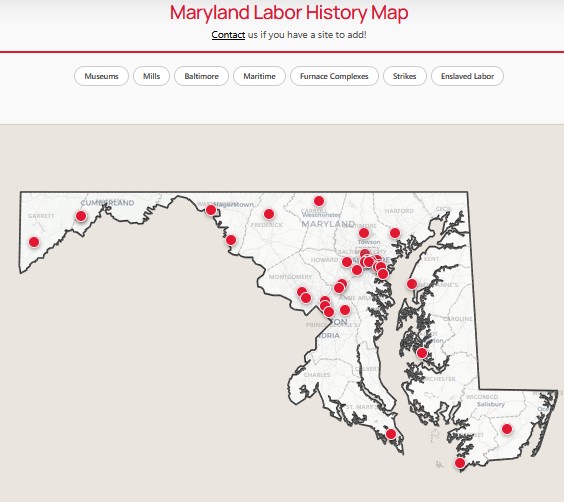
This is a developing map of sites related to labor history in the state of Maryland.
Sites of Maryland Labor HIstory -- currently under development

María Teresa Fernández Aceves
The interpretation of the revisionist historiography of the Mexican Revolution (1910–17) has focused primarily on revolutionary leaders who were men, pushing the heroines of the war to the sidelines. If women happened to be mentioned, they appeared only as symbols, not as social agents. However, the role of the Adelitas, the Cristeras, the Hijas del Anáhuac, and the women of the Ácrata Group were essential to the revolution. In Freethinkers and Labor Leaders María Teresa Fernández Aceves tells the stories of five militant feminist women who aided in the creation of a modern culture in revolutionary and postrevolutionary Mexico and, in some ways, Latin America as a whole: Belén de Sárraga Hernández (1872–1950), Atala Apodaca Anaya (1884–1977), María Arcelia Díaz (1896–1939), María Guadalupe Martínez Villanueva (1906–2002), and María Guadalupe Urzúa Flores (1912–2004).
These five women formed part of two cultural generations that participated together in the Mexican Revolution, in the consolidation of state cooperative institutions, and in the antiestablishment and dissident politics that evolved in the late 1940s. Through these social processes and their struggles as women, mothers, and workers, these women fought for secular education, labor rights, and the civil and political rights of women, redefining cultural and social constructions. Based on original, pathbreaking research, Freethinkers and Labor Leaders demonstrates how five women transformed Latin American society’s ideas of citizenship, femininity, masculinity, and politics.
Introduction
Chapter I. The “Modern Woman,” Politics, and the Mexican Revolution in Guadalajara, 1910-1917
Chapter II. Belén de Sárraga Hernández (1872-1950): Anticlericalism, Freethinkers and the Mexican Revolution (1910-1917)
Chapter III. Atala Apodaca Anaya (1884-1977): Anticlericalism, Civic Education, Progressive Forces, and the Mexican Revolution
Chapter IV. María Arcelia Díaz (1896-1939): Labor and Women’s Politics Within the Context of the Construction of the Post-Revolutionary State of Guadalajara
Chapter V. María Guadalupe Martínez Villanueva (1906-2002): The Mobilization of Women and Corporatist Politics
Chapter VI. Guadalupe Urzúa Flores (1912-2004): Advocate and Modernizer of Jalisco Rural Politics
Epilogue
5 militant feminist women who aided in the creation of a modern culture in revolutionary and postrevolutionary Mexico, as well as Latin America as a whole
Massachusetts Gazette, iHistory Matters
The constitution of the United States was composed in Philadelphia in the summer of 1787. Afterward, ratifying conventions were held in the states. In Massachusetts, site of the previous year’s Shay’s Rebellion against government enforcement of private debt collection, ratification did not go uncontested. Farmers from the western part of the state, such as the “yeomen” who signed this letter published in the Massachusetts Gazette in January, 1788, were suspicious of the power that the constitution seemed to centralize in elite hands. Rural smallholders were not the only ones who felt this way, however. Thomas Jefferson, then in Paris as the United States' minister to France, felt similarly. Massachusetts ratified the constitution on February 7, 1788.
A 1788 letter published in the Massachusetts Gazette that was signed by farmers from the Masschusetts west known as "yeoman" who sought to raise concerns about the passage of U.S. Constitution and the power it conferred to American elites.
Mathieu W. Billings, Sean Farrell
The authors look at the state's earliest Irish residents and communities and describe the critical roles played by Irish immigrants in the settlement and founding of the Prairie State
describes the critical roles played by Irish immigrants in the settlement and founding of the Prairie State.
Matilda Rabinowitz, Ileen A. DeVault
Matilda Rabinowitz's illustrated memoir challenges assumptions about the lives of early twentieth-century women. She describes the ways in which she and her contemporaries rejected the intellectual and social restrictions imposed on women as they sought political and economic equality in the first half of the twentieth century. Rabinowitz devoted her labor and commitment to the notion that women should feel entitled to independence, equal rights, equal pay, and sexual and personal autonomy.
Rabinowitz (1887-1963) immigrated to the United States from Ukraine at the age of thirteen. Radicalized by her experience in sweatshops, she became an organizer for the Industrial Workers of the World from 1912 to 1917 before choosing single motherhood in 1918. "Big Bill" Haywood once wrote a book could be written about Matilda, but her memoir was intended as a private story for her grandchildren, Robbin Légère Henderson among them. Henderson?s black-and white-scratchboard drawings illustrate Rabinowitz?s life in the Pale of Settlement, the journey to America, political awakening and work as an organizer for the IWW, a turbulent romance, and her struggle to support herself and her child
IWW organizer Matilda Rabinowitz's illustrated memoir
Matt García
Tracing the history of intercultural struggle and co-operation in the citrus belt of Greater Los Angeles, Matt Garcia explores the social and cultural forces that helped shape the city.
Tracing the history of intercultural struggle and co-operation in Los Angeles, explores the social and cultural forces that helped shape the city.

Matteo Millan, Alessandro Saluppo, eds.
This free-download book provides a comparative and transnational examination of the complex and multifaceted experiences of anti-labour mobilisation, from the bitter social conflicts of the pre-war period, through the epochal tremors of war and revolution, and the violent spasms of the 1920s and 1930s. It retraces the formation of an extensive market for corporate policing, privately contracted security and yellow unionism, as well as processes of professionalisation in strikebreaking activities, labour espionage and surveillance. It reconstructs the diverse spectrum of right-wing patriotic leagues and vigilante corps which, in support or in competition with law enforcement agencies, sought to counter the dual dangers of industrial militancy and revolutionary situations. Although considerable research has been done on the rise of socialist parties and trade unions the repressive policies of their opponents have been generally left unexamined. This book fills this gap by reconstructing the methods and strategies used by state authorities and employers to counter outbreaks of labour militancy on a global scale. It adopts a long-term chronology that sheds light on the shocks and strains that marked industrial societies during their turbulent transition into mass politics from the bitter social conflicts of the pre-war period, through the epochal tremors of war and revolution, and the violent spasms of the 1920s and 1930s. Offering a new angle of vision to examine the violent transition to mass politics in industrial societies, this is of great interest to scholars of policing, unionism and striking in the modern era.
Foreword: Coercion at work, violence in politics: what changed between 1890 and 1930?GEOFF ELEY
1 Introduction: strikebreaking and industrial vigilantism as a historical problemMATTEO MILLAN AND ALESSANDRO SALUPPO
PART 1
Institutional responses
2 Policies and practices against labour movement in the late Russian Empire VOLODYMYR KULIKOV AND IRINA SHILNIKOVA
3 Violence against strikers in the rural peripheries of the Iberian Peninsula, 1890–1915 ASSUMPTA CASTILLO CAÑIZ
4 The Swedish labour market c. 1870–1914: a labour market regime without repression?ERIK BENGTSSON
5 State authorities, municipal forces and military intervention in the policing of strikes in Austria-Hungary, 1890–1914 CLAIRE MORELON
6 Employers of the world, unite!: the transnational mobilisation of industrialists around World War IPIERRE EICHENBERGER
PART 2
Strikebreaking tactics and practices
7 Anti-labour repression in the in-between spaces of empire: the Compagnie des Messageries Maritimes and the steamship workers of the “China Line” (1900–20)CHARLES BÉGUÉ FAWELL
8 In the name of constitutionalism and Islam: the murky world of labour politics in Calcutta’s docklands PRERNA AGARWAL
9 Cairo, Athens, Salonica: strikebreaking and the anti-labour practices of employers and the state in the early twentieth-century cigarette industry THANASIS BETAS
10 In reaction to revolution: anti-strike mentalities and practices in the Russian radical right, 1905–14 GEORGE GILBERT
11 “We can kill striking workers without being prosecuted”: armed bands of strikebreakers in late Imperial Germany AMERIGO CARUSO
PART 3
Civic and industrial vigilantism
12 The wild west of employer anti-unionism: the glorification of vigilantism and individualism in the early twentieth-century United States VILJA HULDEN AND CHAD PEARSON
13 Vigilant citizens: the case of the Volunteer Police Force, 1911–14 ALESSANDRO SALUPPO
14 From “state protection” to “private defence”: strikebreaking, civilian armed mobilisation and the rise of Italian fascism MATTEO MILLAN
15 Conclusion: strikebreaking and the fault lines of mass society, 1880–1930 MARTIN CONWAY
Index
This free-download book provides a comparative and transnational examination of the complex and multifaceted experiences of anti-labour mobilisation
Matthew Casey
Haitian seasonal migration to Cuba is central to narratives about race, national development, and US imperialism in the early twentieth-century Caribbean. Filling a major gap in the literature, this innovative study reconstructs Haitian guestworkers' lived experiences as they moved among the rural and urban areas of Haiti, and the sugar plantations, coffee farms, and cities of eastern Cuba.
It offers an unprecedented glimpse into the daily workings of empire, labor, and political economy in Haiti and Cuba. Migrants' efforts to improve their living and working conditions and practice their religions shaped migration policies, economic realities, ideas of race, and Caribbean spirituality in Haiti and Cuba as each experienced US imperialism
This innovative study reconstructs Haitian guestworkers' lived experiences as they moved among the rural and urban areas of Haiti, and the sugar plantations, coffee farms, and cities of eastern Cuba.
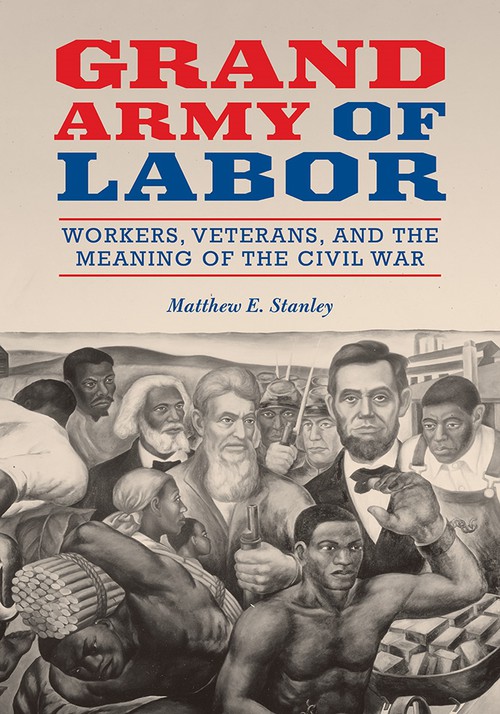
Matthew E. Stanley
From the Gilded Age through the Progressive era, labor movements reinterpreted Abraham Lincoln as a liberator of working people while workers equated activism with their own service fighting for freedom during the war. Matthew E. Stanley explores the wide-ranging meanings and diverse imagery used by Civil War veterans within the sprawling radical politics of the time. As he shows, a rich world of rituals, songs, speeches, and newspapers emerged among the many strains of working class cultural politics within the labor movement. Yet tensions arose even among allies. Some people rooted Civil War commemoration in nationalism and reform, and in time, these conservative currents marginalized radical workers who tied their remembering to revolution, internationalism, and socialism. An original consideration of meaning and memory, Grand Army of Labor reveals the complex ways workers drew on themes of emancipation and equality in the long battle for workers' rights"-- Provided by publisher
explores the wide-ranging meanings and diverse imagery used by Civil War veterans within the sprawling radical politics of the time.
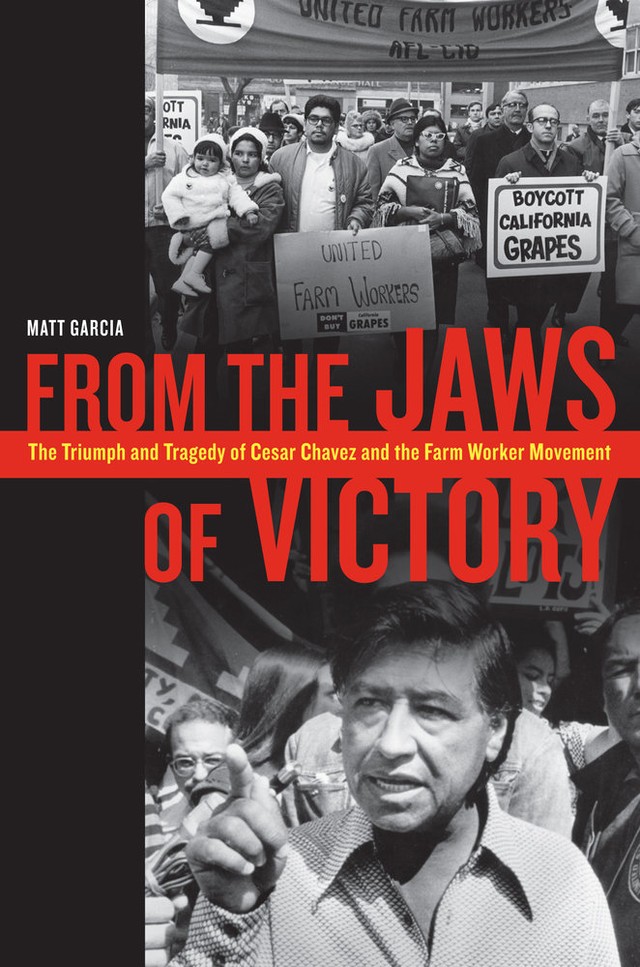
Matthew Garcia
Covering some of the same ground as previous critical histories of Chavez (see Trampling Out the Vintage) focuses on how the boycott accomplished critical goals but set the union up for Chavez's control. Consequently, " Chavez found it more difficult to organize workers and fend off rival unions. Ultimately, the union was a victim of its own success and Chavez’s growing instability."
From the Jaws of Victory delves deeply into Chavez’s attitudes and beliefs, and how they changed over time. Garcia also presents in-depth studies of other leaders in the UFW, including Gilbert Padilla, Marshall Ganz, Dolores Huerta, and Jerry Cohen. He introduces figures such as the co-coordinator of the boycott, Jerry Brown; the undisputed leader of the international boycott, Elaine Elinson; and Harry Kubo, the Japanese American farmer who led a successful campaign against the UFW in the mid-1970s.
Argues the union was a victim of its own success and Chavez’s growing instability.
Matthew Hild
Offers an examination of working-class activism, broadly defined as that of farmers' organisations, labour unions, and political movements, in Arkansas during the Gilded Age. On one level, Hild argues for the significance of this activism in its own time. He also argues that the significance of these movements lasted beyond their own time.
an examination of working-class activism, broadly defined as that of farmers' organisations, labour unions, and political movements, in Arkansas during the Gilded Age.
Matthew Hild
Historians have widely studied the late-nineteenth-century southern agrarian revolts led by such groups as the Farmers' Alliance and the People's (or Populist) Party. Much work has also been done on southern labor insurgencies of the same period, as kindled by the Knights of Labor and others. However, says Matthew Hild, historians have given only minimal consideration to the convergence of these movements.
Hild shows that the Populist (or People's) Party, the most important third party of the 1890s, established itself most solidly in Texas, Alabama, and, under the guise of the earlier Union Labor Party, Arkansas, where farmer-labor political coalitions from the 1870s to mid-1880s had laid the groundwork for populism's expansion. Third-party movements fared progressively worse in Georgia and North Carolina, where little such coalition building had occurred, and in places like Tennessee and South Carolina, where almost no history of farmer-labor solidarity existed.
Hild warns against drawing any direct correlations between a strong Populist presence in a given place and a background of farmer-laborer insurgency. Yet such a background could only help Populists and was a necessary precondition for the initially farmer-oriented Populist Party to attract significant labor support. Other studies have found a lack of labor support to be a major reason for the failure of Populism, but Hild demonstrates that the Populists failed despite significant labor support in many parts of the South. Even strong farmer-labor coalitions could not carry the Populists to power in a region in which racism and violent and fraudulent elections were, tragically, central features of politics.
Introduction . 1
One. Agrarian Discontent and Political Dissent in the South,1872–1882 . 9
Two. Building the Southern Farmer and Labor Movements,1878–1886 . 45
Three. The Knights of Labor and Southern Farmer-Labor Insurgency,1885–1888 . 79
Four. Toward a Third Party in the South and Nation, 1889–1892 . 122
Five. Southern Labor and Southern Populism, 1892–1896 . 150
Six. Southern Farmer and Labor Movements after the Populist Defeat of 1896 . 201
Appendixes . 223
in-depth examination of biracial farmer-labor insurgency across the South
during the last three decades of the nineteenth century; southern Populism as a farmer-labor movement rather than just a farmers
revolt
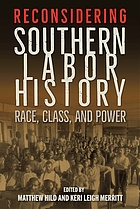
Matthew Hild, Keri Leigh Merritt
anthology of essays
Introduction / Matthew Hild and Keri Leigh Merritt
Section 1. The early republic and the Old South
Origins of the Charleston Mechanic Society: white labor activism and slave competition in Charleston, South Carolina in the early national era / Thomas Brown
"Vagrant negroes": the policing of labor and mobility in the upper south in the early republic / Kristin O'Brassill-Kulfan
Origins of the prison industrial complex: inmate labor in the deep south, 1817-1865 / Brett J. Derbes
To carry that burden: the Texas Cart War and the place of Mexican laborers in the southern landscape, 1854-1857 / Maria Angela Diaz
Section 2. Reconstruction and the gilded age
The promise of free labor: Carl Schurz and Republican conceptions of labor within the reconstruction south / Stuart MacKay
Haskins v. Royster and the liberty to be unfree: reconstructing North Carolina labor law / Linda A. Tvrdy
Unfaithful followers: rethinking southern non-unionism in the late nineteenth century / Dana M. Caldemeyer
Southern labor and the lure of populism: workers and power in North Carolina / Deborah Beckel
The Appalachian "gunmen of capitalism" / T.R.C. Hutton
Section 3. The twentieth century and civil rights
Rooted: black railroad shopmen, the 1922 strike, and southern civil rights struggles / Theresa A. Case
African American and Latino workers in the age of industrial agriculture / Erin L. Conlin
The Freedom Labor Union: economic justice and the civil rights movement in Mississippi / Michael Sistrom
"A threshold moment": public sector organizing and civil rights unionism in the postwar south / Joseph E. Hower
Section 4. The modern south
Pens, planes, and politics: how race and labor practices shaped postwar Atlanta / Joseph M. Thompson
Beyond boosterism: Fort Smith and the creation of a conservative economic culture / Adam Carson
From "the chosen" to the precariat: southern workers in foreign-owned factories since the 1980s / David M. Anderson & Andrew C. McKevitt
Section 5. Concluding thoughts
The historiographies of the labor and civil rights movements: at the intersection of parallel lines / Alan Draper
So goes the nation: southern antecedents and the future of work / Bethany Moreton
Why labor history still matters / Matthew Hild and Keri Leigh Merritt
Anthology of original scholarship from the American Revolution through the twenty-first century. List of essays and authors in the description.
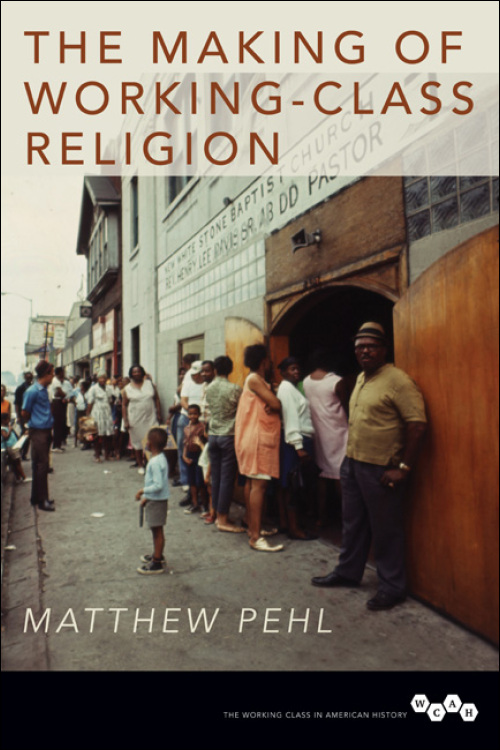
Matthew Pehl
Religion has played a protean role in the lives of America's workers. In this innovative volume, Matthew Pehl focuses on Detroit to examine the religious consciousness constructed by the city's working-class Catholics, African American Protestants, and southern-born white evangelicals and Pentecostals between 1910 and 1969.
Pehl embarks on an integrative view of working-class faith that ranges across boundaries of class, race, denomination, and time. As he shows, workers in the 1910s and 1920s practiced beliefs characterized by emotional expressiveness, alliance with supernatural forces, and incorporation of mass culture's secular diversions into the sacred. That gave way to the more pragmatic class-conscious religion cultures of the New Deal era and, from the late Thirties on, a quilt of secular working-class cultures that coexisted in competitive, though creative, tension. Finally, Pehl shows how the ideology of race eclipsed class in the 1950s and 1960s, and in so doing replaced the class-conscious with the race-conscious in religious cultures throughout the city.
An ambitiously inclusive contribution to a burgeoning field, The Making of Working-Class Religion breaks new ground in the study of solidarity and the sacred in the American heartland.
Welding solidarity to the sacred in the Motor City
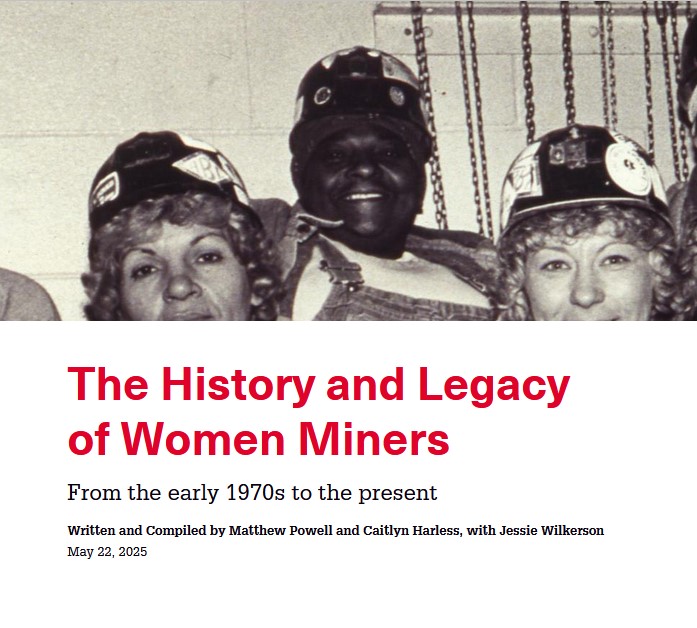
Matthew Powell, Caitlyn Harless, Jessie Wilkerson
Multi-part exhibit Free and unfree women always worked alongside men in pre-industrial coal mines, but labor patterns began to change with industrialization in the nineteenth century.
Women Into the Mines
Organizing Women Miners
Coalmining Women Support Team
Building Solidarity
Women in the UMW
Working the Double Shift
The Legacy of Women Miners
Sources
Multi-part exhibit Free and unfree women always worked alongside men in pre-industrial coal mines, but labor patterns began to change with industrialization in the nineteenth century.

Matthew Warchus
PRIDE is inspired by an extraordinary true story. It’s the summer of 1984, Margaret Thatcher is in power and the National Union of Mineworkers is on strike, prompting a London-based group of gay and lesbian activists to raise money to support the strikers’ families. Initially rebuffed by the Union, the group identifies a tiny mining village in Wales and sets off to make their donation in person. As the strike drags on, the two groups discover that standing together makes for the strongest union of all.
A film about the intersection of queer activism, Thatcher’s reign of terror on Welsh miners, and solidarity in the modern UK.
Maurice J. Hobson
Drawn from vivid primary sources and unnerving oral histories of working-class city-dwellers and hip hop artists from Atlanta's underbelly, Hobson argues that Atlanta's political leadership has governed by bargaining with white business interests to the detriment ordinary black Atlantans. In telling this history, Hobson portrays a striking schism between the black political elite and poor city-dwellers
unnerving oral histories of working-class city-dwellers and hip hop artists from Atlanta's underbelly
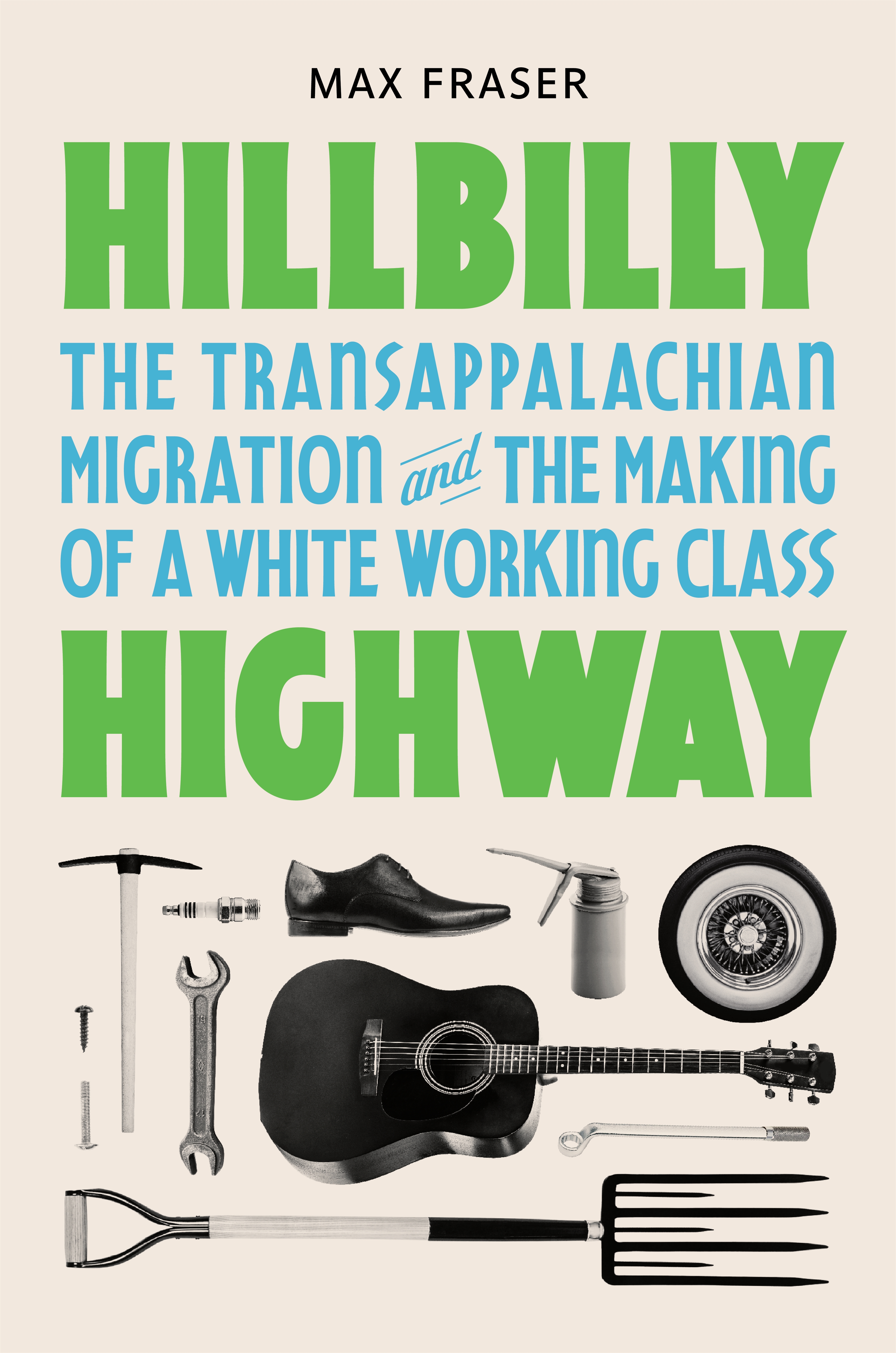
Max Fraser
Over the first two-thirds of the twentieth century, as many as eight million whites left the economically depressed southern countryside and migrated to the booming factory towns and cities of the industrial Midwest in search of work. The 'hillbilly highway' was one of the largest internal relocations of poor and working people in American history, yet it has largely escaped close study by historians. In 'Hillbilly Highway,' Max Fraser recovers the long-overlooked story of this massive demographic event and reveals how it has profoundly influenced American history and culture--from the modern industrial labor movement and the postwar urban crisis to the rise of today's white working-class conservatives. The book draws on a diverse range of sources--from government reports, industry archives, and union records to novels, memoirs, oral histories, and country music--to narrate the distinctive class experience that unfolded across the Transappalachian migration during these critical decades. As the migration became a terrain of both social advancement and marginalization, it knit together white working-class communities across the Upper South and the Midwest--bringing into being a new cultural region that remains a contested battleground in American politics to the present."-- Provided by publisher
Recounts the little-known transappalachian path many poor Southern whites took in migrating to the industrial cities of the North and the class dynamics of the migration
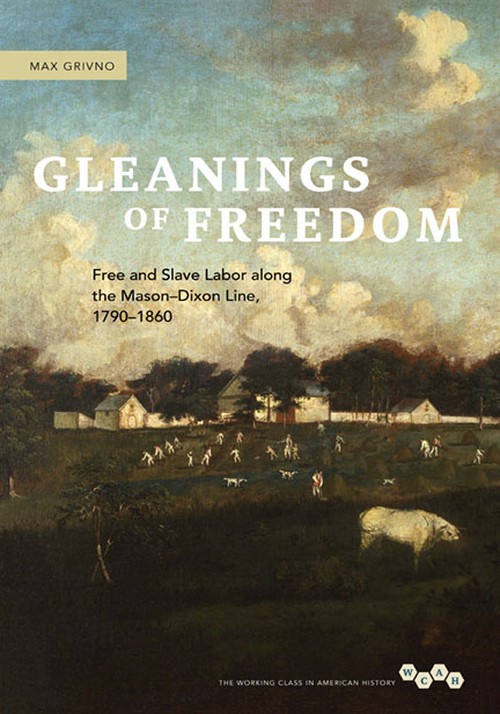
Max Grivno
Drawing from court records, the diaries, letters, and ledgers of farmers and small planters, and other archival sources, the author reconstructs how these poorest of southerners eked out their livings and struggled to maintain their families and their freedom in the often unforgiving rural economy.
In the late eighteenth and early nineteenth centuries, farmers and planters in the hinterlands of Baltimore, Maryland, cobbled together workforces from a diverse labor population of black and white apprentices, indentured servants, slaves, and hired workers. The Upper South during this period presents a unique perspective on how free and slave labor systems coexisted and interacted during a time when slavery and free labor were moving apart both geographically and ideologically. Gleanings of Freedom examines the intertwined lives of the poor whites, slaves, and free blacks who lived and worked along the Mason–Dixon Line in the decades preceding the Civil War.
Max Grivno closely examines a handful of counties in northern Maryland and southern Pennsylvania to illustrate how these rural local communities represented issues of national historical significance, including the dynamic, multifaceted relationship between slave and free labor, the lives of free black and white farmhands, the domestic slave trade's impact on the people of the Upper South, and the struggles of enslaved and free blacks to liberate themselves and their families from bondage through immediate and delayed manumissions. Grivno reconstructs the economy of this wheat-producing region to illustrate how the erratic demand for labor shaped negotiations between employers and their workers. Gleanings of Freedom illuminates the ties between the economies of the Upper and Lower South, showing how the insatiable demand for labor on the cotton and sugar plantations of the Deep South drew thousands of slaves southward and drove those who remained on the sectional border to fight for their freedom through shrewd negotiations and violent resistance.
Deftly drawing from court records, the diaries, letters, and ledgers of farmers and small planters, travelers' accounts, and testimonies of slaves and their masters, Gleanings of Freedom reconstructs how these poorest of southerners eked out their livings and struggled to maintain their families and their freedom in the often unforgiving rural economy.
reconstructs how these poorest of southerners eked out their livings and struggled to maintain their families
Max Krochmal
This work is about the other Texas, not the state known for its cowboy conservatism, but a mid-20th century hotbed of community organizing, liberal politics and civil rights activism. Beginning in the 1930s, Max Krochmal tells the story of the struggle for democracy in Texas, when African American, Mexican American and white labor and community activists came together to empower the state's marginalized minorities
when activists came together to empower the state's marginalized minorities
Museum/Exhibits
Tours
Maps
Digital Projects
Organizations
Sites
Film/Video
Audio/Interview
Podcast/Program
Text/Document
Image
Graphs/Data
Timeline
Southwest
West
Midwest
Southeast
Northeast
Mexico
Canada
Global
Books
Teaching
Lectures
Digital Archives
Journals
Bibliographies
Topic Intro