


Collections
Library
Type
Region
Coverage:
-
Published:
-
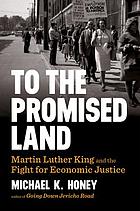
Michael K. Honey
Fifty years ago, a single bullet robbed us of one of the world's most eloquent voices for human rights and justice. [This book] goes beyond the iconic view of Martin Luther King Jr. as an advocate of racial harmony, to explore his profound commitment to the poor and working class and his call for "nonviolent resistance" to all forms of oppression--including the economic injustice that "takes necessities from the masses to give luxuries to the classes." Phase one of King's agenda led to the Civil Rights and Voting Rights Acts. But King also questioned what good it does a man to "eat at an integrated lunch counter if he doesn't earn enough money to buy a hamburger and a cup of coffee?" In phase two of his activism, King organized poor people and demonstrated for union rights, while also seeking a "moral revolution" to replace the self-seeking individualism of the rich along with an overriding concern for the common good. "Either we go up together or we go down together," King cautioned, a message just as urgent in America today as then. To the Promised Land challenges us to think about what it would mean to truly fulfill King's legacy and move toward his vision of "the Promised Land" in our own time"--Jacket
explores Kings his profound commitment to the poor and working class and his call for "nonviolent resistance" to all forms of oppression
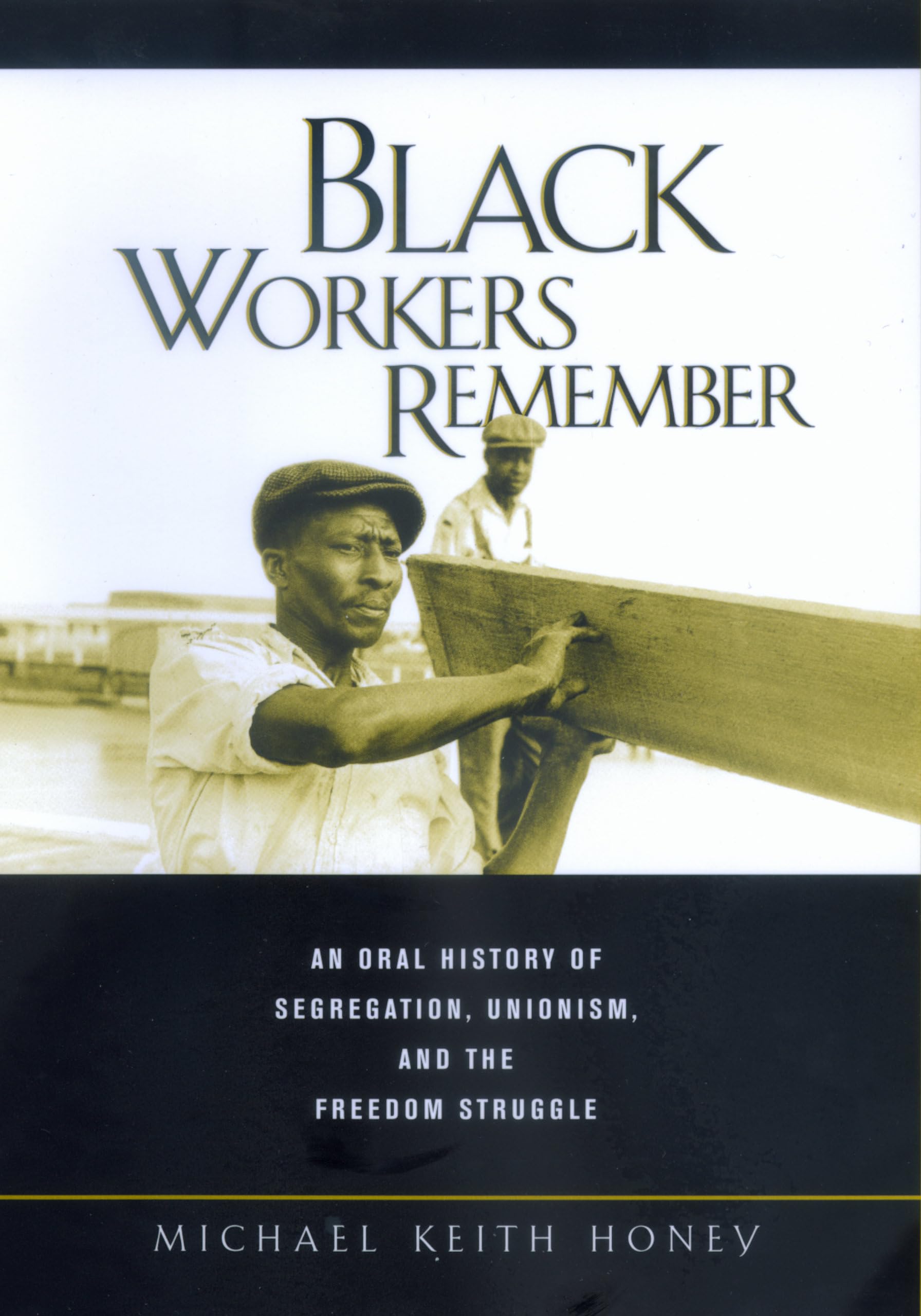
Michael K. Honey (book)
Jacqueline Jones (article)
The interviews contained in this volume shine a harsh light on the nuts-and-bolts scaffolding of American workplace apartheid. Eyewitness testimony reveals not only the political economy that undergirded racial segregation on the job, but also the wide range of tactics on the part of African-American labor organizers who resisted it. Focusing on the city of Memphis, Tennessee, editor Michael Honey has assembled a story told through more than two dozen voices, a story about African-American men and women workers who literally risked their lives on the shop floor, day in and day out, trying to provide for their families.
Two links, one to the Black Workers Remember volume of oral histories, and another to an article in The American Prospect.
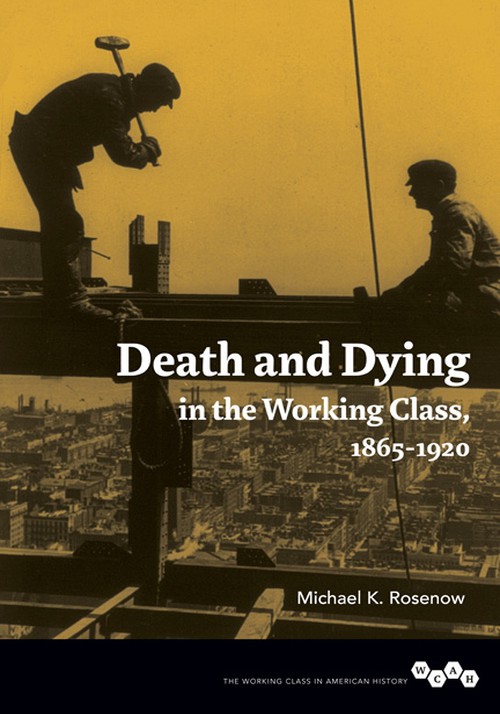
Michael K. Rosenow
Michael K. Rosenow investigates working people's beliefs, rituals of dying, and the politics of death by honing in on three overarching questions: How did workers, their families, and their communities experience death? Did various identities of class, race, gender, and religion coalesce to form distinct cultures of death for working people? And how did people's attitudes toward death reflect notions of who mattered in U.S. society? Drawing from an eclectic array of sources ranging from Andrew Carnegie to grave markers in Chicago's potter's field, Rosenow portrays the complex political, social, and cultural relationships that fueled the United States' industrial ascent. The result is an undertaking that adds emotional depth to existing history while challenging our understanding of modes of cultural transmission
How did workers, their families, and their communities experience death?

Michael Kline, Wes Harris
Written in Blood features the work of Appalachia's leading scholars and activists making available an accurate, ungilded, and uncensored understanding of our history. Combining new revelations from the past with sketches of a sane path forward, this is a deliberate collection looking at our past, present, and future. Sociologist Wess Harris (When Miners March) further documents the infamous Esau scrip system for women, suggesting an institutionalized practice of forced sexual servitude that was part of coal company policy. In a conversation with award-winning oral historian Michael Kline, federal mine inspector Larry Layne explains corporate complicity in the 1968 Farmington Mine disaster which killed seventy-eight men and became the catalyst for the passage of major changes in U.S. mine safety laws. Mine safety expert and whistleblower Jack Spadaro speaks candidly of years of attempts to silence his courageous voice and recalls government and university collaboration in covering up details of the 1972 Buffalo Creek flooding disaster, which killed over a hundred people and left four thousand homeless. Moving to the next generation of thinkers and activists, attorney Nathan Fetty examines current events in Appalachia and musician Carrie Kline suggests paths forward for people wishing to set their own course rather than depend on the kindness of corporations
features the work of Appalachia's leading scholars and activists making available an accurate, ungilded, and uncensored understanding of our history
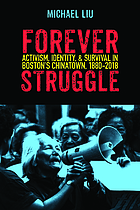
Michael Liu
Chinatown has a long history in Boston. Though little documented, it represents the city's most sustained neighborhood effort to survive during eras of hostility and urban transformation. It has been wounded and transformed, slowly ceding ground; at the same time, its residents and organizations have gained a more prominent voice over their community's fate. In writing about Boston Chinatown's long history, Michael Liu, a lifelong activist and scholar of the community, charts its journey and efforts for survival--from its emergence during a time of immigration and deep xenophobia to the highway construction and urban renewal projects that threatened the neighborhood after World War II to its more recent efforts to keep commercial developers at bay. At the ground level, Liu depicts its people, organizations, internal battles, and varied and complex strategies against land-taking by outside institutions and public authorities. The documented courage, resilience, and ingenuity of this low-income immigrant neighborhood of color have earned it a place amongst our urban narratives. Chinatown has much to teach us about neighborhood agency, the power of organizing, and the prospects of such neighborhoods in rapidly growing and changing cities"-- Provided by publisher
highlights the long struggle in Boston's Chinatown for cultural survival in spite of outside organizational pressure.

Michael M. Topp
In the first book-length history of the Italian American syndicalist movement—the Italian Socialist Federation—Michael Miller Topp presents a new way of understanding the Progressive Era labor movement in relation to migration, transnationalism, gender, and class identity. Those without a Country demonstrates that characterizations of "old" (pre-1960s) social movements as predominantly class-based are vastly oversimplified—and contribute to current debates about the implications of identity politics for the American Left and American culture generally. Topp traces the rise and fall of the Italian American syndicalist movement from the turn of the twentieth century to the executions of Sacco and Vanzetti in 1927. His use of Italian-language sources, combined with his attention to transnationalism and masculinity, provides new vantage points on a range of related topics, including the 1912 Lawrence, Massachusetts, textile workers’ strike, the impact of World War I on this immigrant community, and the genesis of both fascism and antifascism. Those without a Country brings forward fascinating new material to revise and refine our views of not only Progressive Era radicalism but immigration, gender, and working-class history as well.
the first book-length history of the rise and fall of the Italian American syndicalist movement from the turn of the twentieth century to 1927

Michael M. Topp, ed.
In 1920 Nicola Sacco and Bartolomeo Vanzetti, two Italian immigrants and devout anarchists, were accused of robbery and murder. Their subsequent trial and execution captivated the world and exposed many of the cultural and political tensions of 1920s America. Sacco and Vanzetti's supporters claimed the two anarchists had been persecuted for their beliefs and not their actions, while their detractors saw proof of the country's ability to protect itself from dangerous foreign elements. Michael Topp's collection of documents examines both sides and provides a presentation of the trial while emphasizing the broad historical context in which it was conducted. An interpretive introductory essay, document headnotes, a chronology, and questions for consideration provide further pedagogical support. A bibliographic essay and a brief discussion of artistic productions based on the trial are also included
Brief historical and biographical essays as well as primary source documents recounting the social environment surrounding the Sacco and Vanzetti case

Michael Mark Cohen
Between the 1880s and 1920s, a broad coalition of American dissidents, which included rabble-rousing cartoonists, civil liberties lawyers, socialist detectives, union organizers, and revolutionary martyrs, forged a culture of popular radicalism that directly challenged an emergent corporate capitalism. Monopoly capitalists and their allies in government responded by expanding conspiracy laws and promoting conspiracy theories in an effort to destroy this anti-capitalist movement. The result was an escalating class conflict in which each side came to view the other as a criminal conspiracy.
In this detailed cultural history, Michael Mark Cohen argues that a legal, ideological, and representational politics of conspiracy contributed to the formation of a genuinely revolutionary mass culture in the United States, starting with the 1886 Haymarket bombing. Drawing on a wealth of primary sources, The Conspiracy of Capital offers a new history of American radicalism and the alliance between the modern business corporation and national security state through a comprehensive reassessment of the role of conspiracy laws and conspiracy theories in American social movements.
Introduction: “The Conspiracy of Capital”: The Dialectics of Conspiracy in the Age of Monopoly
1. This Worn-Out Piece of Tyranny: Clarence Darrow, the Haymarket Generation, and the Secret History of Conspiracy Law
2. “Sensational Writing and a Fight”: Dangerous Knowledge, Socialist Detectives, and the Rise and Fall of the Appeal to Reason
3. “The Marks of Capital”: The Wobblies versus the Invisible Government
4. “The Ku Klux Government”: Law and Terror in the Red Scare
Conclusion: “Will Fascism Come to America?”: Civil Liberties, Antifascism, and the Legacy of the Haymarket Generation
Offers a new history of American radicalism and the alliance between the modern business corporation and national security state through a comprehensive reassessment of the role of conspiracy laws and conspiracy theories in American social movements.

Michael McCann, Conor Casey
In November, 2013, the small suburban city of SeaTac passed Proposition 1, authorizing a $15 minimum wage policy phased in over several years; after surviving a lawsuit filed by business groups, the policy went into effect in January, 2014. Six months later, the Seattle City Council, led by socialist council member Kshama Sawant and Mayor Ed Murray, expanded a similar $15 minimum wage policy to nearly 20,000 workers. These policy innovations arose from struggles by a broad coalition of labor unions and community partners around a host of issues concerning low wage workers’ rights in the years following the Occupy movement. Building on similar struggles for and by low wage workers around the nation, the victories in the Puget Sound catalyzed a proliferating array of campaigns to raise the minimum wage in many cities and states.This digital web archive documents the stories of those involved, as supporters and opponents, in or affected by the struggles over a $15 minimum wage at SeaTac and in Seattle as well as the broader, ongoing effects and efforts at a national level. Faculty Profile: Michael McCann and Archivist Profile: Conor Casey. Browse Documents
Browse Interviews
Browse Archived URLs
Related Resources
Timeline
Guide to the Working Washington Ephemera Collection
Inventory of US City and County Minimum Wage Ordinances
This digital web archive documents the stories of those involved in the struggles over a $15 minimum wage at SeaTac and in Seattle
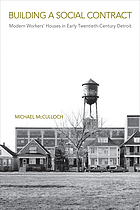
Michael McCulloch
The dream of the modern worker’s house emerged in early twentieth-century America as wage earners gained access to new, larger, and better-equipped dwellings. Building a Social Contract is a cogent history of the houses those workers dreamed of and labored for. Michael McCulloch chronicles the efforts of employers, government agencies, and the building industry who, along with workers themselves, produced an unprecedented boom in housing construction that peaked in the mid-1920s.
Through oral histories, letters, photographs, and period fiction, McCulloch traces wage earners’ agency in negotiating a new implicit social contract, one that rewarded hard work with upward mobility in modern houses. This promise reflected workers’ increased bargaining power but, at the same time, left them increasingly vulnerable to layoffs.
Building a Social Contract focuses on Detroit, the quintessential city of the era, where migrant workers came and were Americanized, and real estate agents and the speculative housebuilding industry thrived. The Motor City epitomized the struggle of Black workers in this period, who sought better lives through industrial labor but struggled to translate their wages into housing security amid racist segregation and violence. When Depression-era unemployment created an eviction crisis, the social contract unraveled, and workers rose up—at the polls and in the streets—to create a labor movement that reshaped American capitalism for decades.
Today, the lessons McCulloch provides from early twentieth-century Detroit are a necessary reminder that wages are not enough, and only working-class political power can secure affordable housing.
chronicles the efforts of employers, government agencies, and the building industry who, along with workers themselves, produced an unprecedented boom in housing construction that peaked in the mid-1920s.
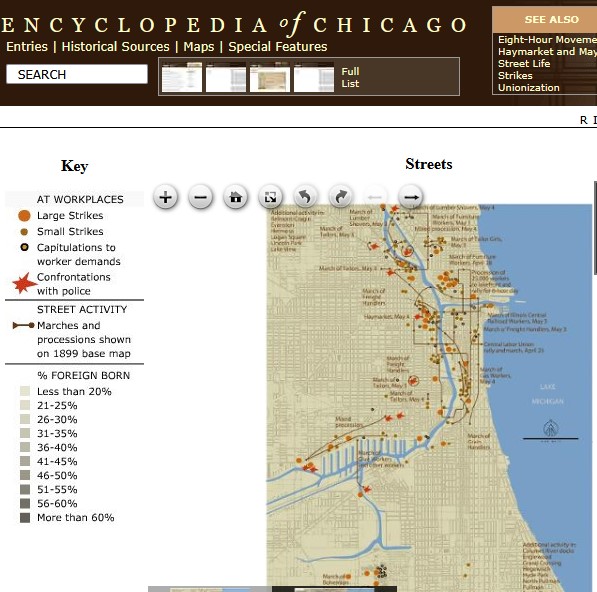
Michael P. Conzen, Christopher P. Thale
color coded, shows marches and processions, strikes, police confrontation, ethnicities, in a rich map, Chicago April 25-May 4, 1886;
Workers throughout Chicago and its suburbs took part in the nationwide movement for an eight-hour day with strikes, meetings, and parades in early to mid-1886. Reflecting the city's economic and social geography, labor activity was concentrated in industrial areas along the Chicago River and in nearby working-class neighborhoods. Tens of thousands went on strike, and many strikers marched from workplace to workplace, displaying solidarity and summoning fellow workers to join them. On two separate days, thousands of railroad freight handlers marched for miles from one terminal to another. But worker processions were more often neighborhood affairs, centered on local employment concentrations and sometimes displaying ethnic clustering. To avoid strikes, many employers agreed to worker demands. Though most labor activity was peaceful, violent confrontations with the police also occurred.
A clash on May 3rd between workers and police near the McCormick Reapers Works (to the left of the maps, near Blue Island and Western) led to the call for a protest meeting at the Randolph Street Haymarket. The Haymarket (upper center, at Randolph between Halsted and Desplaines) was the starting point for two parades and the scene of a May 4th protest meeting which ended in violence. In the aftermath, the eight-hour movement came to a resounding halt for the time being.
color version of 1886 Chicago Upheaval, associated with Haymarket events, shows marches and processions, strikes, police confrontation in a rich map, Chicago April 25-May 4, 1886
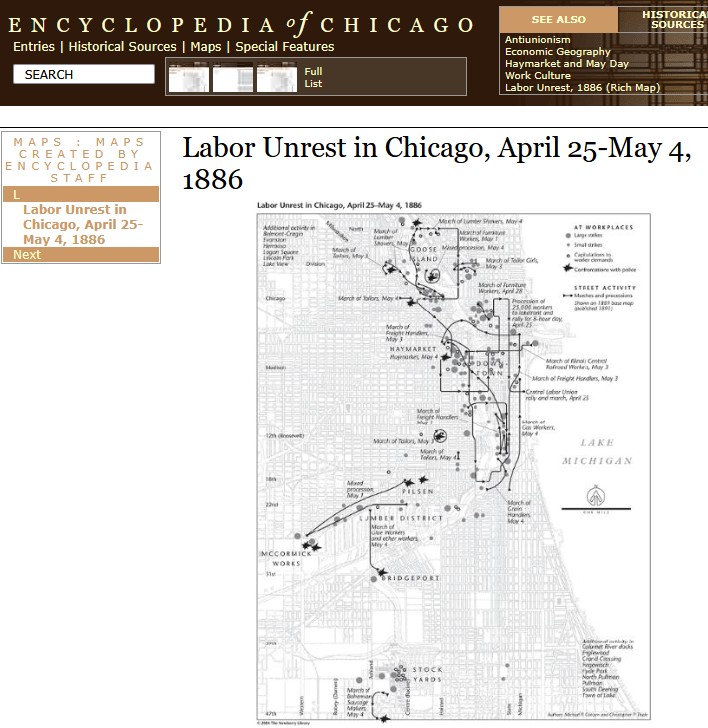
Michael P. Conzen, Christopher P. Thale
Workers throughout Chicago and its suburbs took part in the nationwide movement for an eight-hour day with strikes, meetings, and parades in early to mid-1886. Reflecting the city's economic and social geography, labor activity was concentrated in industrial areas along the Chicago River and in nearby working-class neighborhoods. Tens of thousands went on strike, and many strikers marched from workplace to workplace, displaying solidarity and summoning fellow workers to join them. On two separate days, thousands of railroad freight handlers marched for miles from one terminal to another. But worker processions were more often neighborhood affairs, centered on local employment concentrations and sometimes displaying ethnic clustering. To avoid strikes, many employers agreed to worker demands. Though most labor activity was peaceful, violent confrontations with the police also occurred. A clash on May 3rd between workers and police near the McCormick Reapers Works (left) led to the call for a protest meeting at the Randolph Street Haymarket. The Haymarket (upper center) was the starting point for two parades and the scene of a May 4th protest meeting which ended in violence. In the aftermath, the eight-hour movement came to a resounding halt for the time being.
map of 1886 Chicago Upheaval, associated with the Haymarket events
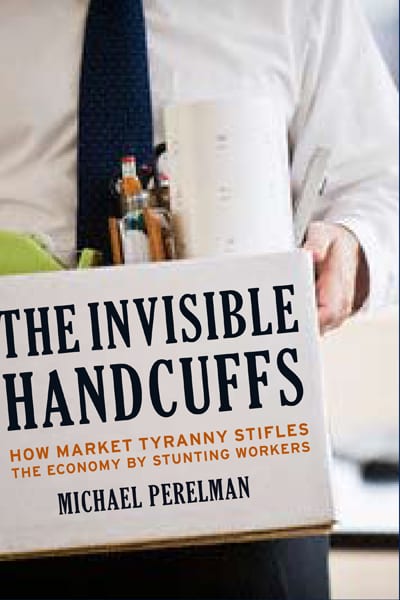
Michael Perelman
Mainstream, or more formally, neoclassical, economics claims to be a science. But as Michael Perelman makes clear in his latest book, nothing could be further from the truth. While a science must be rooted in material reality, mainstream economics ignores or distorts the most fundamental aspect of this reality: that the vast majority of people must, out of necessity, labor on behalf of others, transformed into nothing but a means to the end of maximum profits for their employers. The nature of the work we do and the conditions under which we do it profoundly shape our lives. And yet, both of these factors are peripheral to mainstream economics.
By sweeping labor under the rug, mainstream economists hide the nature of capitalism, making it appear to be a system based upon equal exchange rather than exploitation inside every workplace. Perelman describes this illusion as the “invisible handcuffs” of capitalism and traces its roots back to Adam Smith and his contemporaries and their disdain for working people. He argues that far from being a basically fair system of exchanges regulated by the “invisible hand” of the market, capitalism handcuffs working men and women (and children too) through the very labor process itself. Neoclassical economics attempts to rationalize these handcuffs and tells workers that they are responsible for their own conditions. What we need to do instead, Perelman suggests, is eliminate the handcuffs through collective actions and build a society that we direct ourselves.
Argues that far from being a basically fair system of exchanges regulated by the “invisible hand” of the market, capitalism handcuffs working men and women (and children too) through the very labor process itself.

Michael Pierce
Historians have typically thought of Populism as a radical agrarian movement. In this much-needed corrective, Pierce argues that, in Ohio, Populism was an urban, not rural, movement, and that industrial workers and trade unionists formed the core of the People's (or Populist) Party. Through case studies of Cleveland, Cincinnati, and Columbus, Pierce examines the efforts of Ohio unions―especially the United Mine Workers―to protect the rights of workers, curb the abuses of corporations, and reform the state's and nation's government through an alliance with the People's party. Striking with the Ballot focuses on the Crisis of the 1890s: when the Panic of 1893, the Pullman strike and boycott, the arrest of Debs, Coxey's march, and the failure of the nationwide coal strike threw the country into disarray. Pierce demonstrates that trade unionists in Ohio, and throughout the Industrial Midwest, responded by mobilizing politically under the banner of the People's Party. Support for the People's Party was so strong among the nation's trade unionists that Ohio's leading Populist, John McBride, won the presidency of the American Federation of Labor in 1894. Ohio labor's reform agenda survived the subsequent collapse of the People's Party and informed labor's political activity through the Progressive era. Pierce offers a provocative new narrative for those interested in labor history, Populism, Progressivism, and Ohio history.
Showcases the urban strain of Populism prevalant in Ohio, closely tied to radical industrial labor in the Midwest
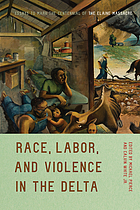
Michael Pierce, Calvin White Jr
This essay collection grew out of a conference marking the hundredth anniversary of one of the nation's deadliest labor conflicts - the 1919 Elaine Massacre, during which white mobs ruthlessly slaughtered over two hundred African Americans across Phillips County, Arkansas, in response to a meeting of unionized Black sharecroppers. The essays here demonstrate that the brutality that unfolded in Phillips County was characteristic of the culture of race- and labor-based violence that prevailed in the century after the Civil War"-- Provided by publisher
essay collection on the 1919 Elaine Arkansas terror

Michael Poreda
Grade Level: 6th - 8th grade Course: US History, World History Key Words: Slave Trade; Memorial; Middle Passage; Mortality Rates; Writing skills
This lesson asks students to demonstrate mastery of their knowledge about the Middle Passage by designing a memorial. The lesson contains several steps which teachers can use at their discretion to build an appreciation for what enslaved Africans were subjected to as they were forced to the New World, why this part of history should get a public memorial, and how that memorial should be expressed in words and image. The lesson uses mortality statistics from the database to help students gain an understanding of how many people died on a voyage, as well as reading comprehension questions and a PowerPoint Presentation of various monuments.
middle school lesson plan using Slave Voyages site
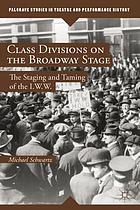
Michael Schwartz
Examining twenty-five years of theatre history, this book covers the major plays that feature representations of the Industrial Workers of the World. American class movement and class divisions have long been reflected on the Broadway stage and here Michael Schwartz presents a fresh look at the conflict between labor and capital.
Examining twenty-five years of theatre history, this book covers the major plays that feature representations of radical labor.

Michael Sragow
Guide to 2 movies from the 1950s that had class and union issues embedded
An article elaborating the connections between labor and the 1954 film I'm All Right Jack, which also compares it to a 1963 film entitled The Organizer.
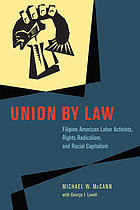
Michael W. McCann, George I. Lovell
Michael McCann and George Lovell offer a history of Filipino salmon cannery workers in Alaska and the Pacific Northwest, focusing on their experiences with law, union organizing, and progressive politics over the course of the 20th century. Coming to this country after the American conquest of the Philippines, many worked at the salmon canneries. The salmon workers were segregated in both the jobs they could have and where they lived. Higher scale jobs were reserved for whites; lower scaled jobs for Filipino workers. Company housing for seasonal workers was also segregated on the same basis. The authors focus on the development of labor unions and fights over the rights of workers to organize effectively during World War II and the Cold War. They argue that economic interests used law to fight the efforts of Filipino workers to organize"-- Provided by publisher
offers a history of Filipino salmon cannery workers in Alaska and the Pacific Northwest, focusing on their experiences with law, union organizing, and progressive politics over the course of the 20th century
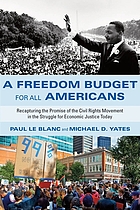
Michael Yates, Paul le Blanc
While the Civil Rights Movement is remembered for efforts to end segregation and secure the rights of African Americans, the larger economic vision that animated much of the movement is often overlooked today.
That vision sought economic justice for every person in the United States, regardless of race. It favored production for social use instead of profit; social ownership; and democratic control over major economic decisions. The document that best captured this vision was the a Freedom Budget for All Americans: Budgeting Our Resources, 1966-1975, To Achieve Freedom from Wanta published by the A. Philip Randolph Institute and endorsed by a virtual who's who of U.S. left liberalism and radicalism. Now, two of today leading socialist thinkers return to the Freedom Budget and its program for economic justice.
Paul Le Blanc and Michael D. Yates explain the origins of the Freedom Budget, how it sought to achieve OC freedom from wantOCO for all people, and how it might be reimagined for our current moment. Combining historical perspective with clear-sighted economic proposals, the authors make a concrete case for reviving the spirit of the Civil Rights Movement and building the society of economic security and democratic control envisioned by the movementOCOs leadersOCoa struggle that continues to this day."
Introduction
The battle for civil rights
Appendix: Marxist perspectives
For jobs and freedom
A freedom budget for all Americans
The political economy of the freedom budget
Defeat of the freedom budget
The U.S. political economy from the freedom budget to the present
Poverty and its attendant evils today
Toward a new freedom budget
Appendix: A freedom budget for all Americans
the origins and vision of the 1965 Freedom Budget, a forgotten document of the civil rights connected to labor rights
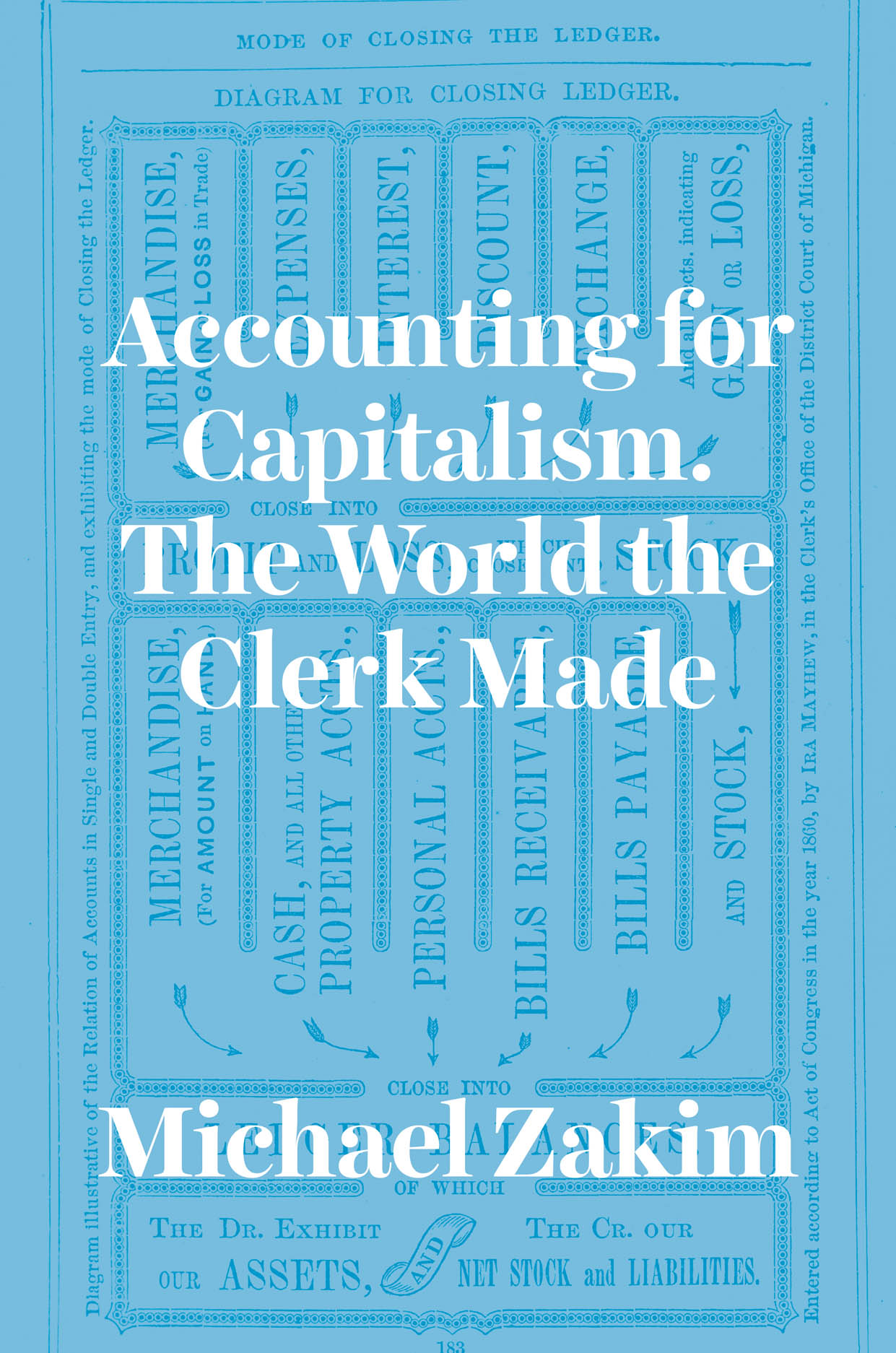
Michael Zakim
The clerk attended his desk and counter at the intersection of two great themes of modern historical experience: the development of a market economy and a society governed from below. Who better illustrates the daily practice and production of this modernity than someone of no particular account assigned with overseeing all the new buying and selling? In Accounting for Capitalism, Michael Zakim has written their story, a social history of capital that seeks to explain how the “bottom line” became a synonym for truth in an age shorn of absolutes, grafted onto our very sense of reason and trust.
This is a big story, told through an ostensibly marginal event: the birth of a class of “merchant clerks” in the United States in the middle of the nineteenth century. The personal trajectory of these young men from farm to metropolis, homestead to boarding house, and, most significantly, from growing things to selling them exemplified the enormous social effort required to domesticate the profit motive and turn it into the practical foundation of civic life. As Zakim reveals in his highly original study, there was nothing natural or preordained about the stunning ascendance of this capitalism and its radical transformation of the relationship between “Man and Mammon.”
The story of how everyday nineteenth-century clerks helped to articulate modern capitalism.
Michael Zakim
Most scholarship on nineteenth-century America's transformation into a market society has focused on consumption, romanticized visions of workers, and analysis of firms and factories. Building on but moving past these studies, Capitalism Takes Command presents a history of family farming, general incorporation laws, mortgage payments, inheritance practices, office systems, and risk management an inventory of the means by which capitalism became America's new revolutionary tradition. This multidisciplinary collection of essays argues not only that capitalism reached far beyond the purview of the economy, but also that the revolution was not confined to the destruction of an agrarian past. As business ceaselessly revised its own practices, a new demographic of private bankers, insurance brokers, investors in securities, and start-up manufacturers, among many others, assumed center stage, displacing older elites and forms of property. Explaining how capital became an "ism" and how business became a political philosophy, Capitalism Takes Command brings the economy back into American social and cultural history. -- Provided by publisher
Introduction: an American revolutionary tradition / Michael Zakim and Gary J. Kornblith
The agrarian context of American capitalist development / Christopher Clark
The mortgage worked the hardest: the fate of landed independence in nineteenth-century America / Jonathan Levy
Toxic debt, liar loans, collateralized and securitized human beings and the panic of 1837 / Edward E. Baptist
Inheriting property and debt: from family security to corporate accumulation / Elizabeth Blackmar
Slave breeding and free love: an antebellum argument over slavery, capitalism, and personhood / Amy Dru Stanley
Capitalism and the rise of the corporation nation / Robert E. Wright
Capitalist aesthetics: Americans look at the London and Liverpool docks / Tamara Plakins Thornton
William Leggett and the melodrama of the market / Jeffrey Sklansky
Producing capitalism: the clerk at work / Michael Zakim
Soulless monsters and iron horses: the Civil War, institutional change and American capitalism / Sean Patrick Adams
Afterword: Anonymous history / Jean-Christophe Agnew
argues not only that capitalism reached far beyond the purview of the economy, but also that the industrial revolution was not confined to the destruction of an agrarian past.
Michael Zweig
Class, Race, and Gender: Challenging the Injuries and Divisions of Capitalism is for those who want to understand the underlying connections among today's social justice movements. Bringing forth the basic operations of capitalist economies, it reveals what is driving many of today's most urgent and vexing problems: the common origins of the inequalities of income, wealth, and power; environmental devastation; militarism; racism and white supremacy; patriarchy and male chauvinism; periodic economic crises; and the cultural conflicts that are tearing at US life. Michael Zweig illuminates all propositions with specific examples from US history, from the first settlement of the New World to current life, including his own lived experiences as an activist, educator, and organizer over the past six decades. As such, the book is an urgently needed resource for activists and organizers seeking structural and moral transformation of life in the US. Building on his analysis, Zweig also presents strategies for political action in electoral and movement-building work.-- Provided by publisher
Bringing forth the basic operations of capitalist economies, it reveals what is driving many of today's most urgent and vexing problems
Michael Zweig
In the second edition of his essential book Michael Zweig warns that by allowing the working class to disappear into categories of "middle class" or "consumers," we also allow those with the dominant power, capitalists, to vanish among the rich.
Preface to the Second EditionAcknowledgments Introduction1. The Class Structure of the United States2. What We Think about When We Think about Class3. Why Is Class Important?4. Looking at the "Underclass"5. Looking at Values—Family and Otherwise6. The Working Class and Power7. Power and Globalization8. Power and the Government9. Into the MillenniumNotesIndex
warns that by allowing the working class to disappear into categories of "middle class" or "consumers," we also allow those with the dominant power, capitalists, to vanish among the rich.
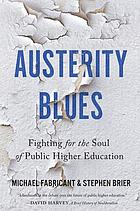
Michael, Stephen Brier Fabricant
Public higher education in the postwar era was a key economic and social driver in American life, making college available to millions of working men and women. Since the 1980s, however, government austerity policies and politics have severely reduced public investment in higher education, exacerbating inequality among poor and working-class students of color, as well as part-time faculty. In Austerity Blues, Michael Fabricant and Stephen Brier examine these devastating fiscal retrenchments nationally, focusing closely on New York and California, both of which were leaders in the historic expansion of public higher education in the postwar years and now are at the forefront of austerity measures.--publisher
devastating fiscal retrenchments
Museum/Exhibits
Tours
Maps
Digital Projects
Organizations
Sites
Film/Video
Audio/Interview
Podcast/Program
Text/Document
Image
Graphs/Data
Timeline
Southwest
West
Midwest
Southeast
Northeast
Mexico
Canada
Global
Books
Teaching
Lectures
Digital Archives
Journals
Bibliographies
Topic Intro