


Collections
Library
Type
Region
Coverage:
-
Published:
-

Michele Fazio
The Handbook maps the current state of the field and presents a visionary agenda for future research by mingling the voices and perspectives of founding and emerging scholars. In addition to a framing Introduction and Conclusion written by the co-editors, the volume is divided into six sections: Methods and principles of research in working-class studies; Class and education; Work and community; Working-class cultures; Representations; and Activism and collective action. Each of the six sections opens with an overview that synthesizes research in the area and briefly summarizes each of the chapters in the section.
Throughout the volume, contributors from various disciplines explore the ways in which experiences and understandings of class have shifted rapidly as a result of economic and cultural globalization, social and political changes, and global financial crises of the past two decades
Introduction / Michele Fazio, Christie Launius, and Tim Strangleman
Class analysis from the inside: scholarly personal narrative as a signature genre of working-class studies / Sherry Lee Linkon
Reconceiving class in contemporary working-class studies / Joseph Entin
Mediating stories of class borders: first generation college students, digital storytelling, and social class / Jane A. Van Galen
The 'how to' of working-class studies: selves, stories, and working across media / Christine J. Walley
Class beyond the classroom: supporting working-class and first-generation students, faculty, and staff / Colby R. King and Sean H. McPherson
Working class student experiences: towards a social class-sensitive pedagogy for k-12 schools, teachers, and teacher educators / Colleen H. Clements and Mark D. Vagle
The pedagogy of class: teaching working-class life and culture in the academy / Lisa A. Kirby
Being working class in the English classroom / Diane Reay
Getting schooled : working-class students in higher education / Bettina Spencer
Learning our place : social reproduction in k-12 schooling / Deborah M. Warnock
Deindustrialization and its consequences / Steven High
Economic dislocation and trauma / Patrick Korte and Victor Tan Chen
Working-class studies, oral history and industrial illness / Arthur McIvor
Precarity's affects: the trauma of deindustrialization / Kathryn Marie Dudley
Feeling, re-imagined in common: working with social haunting in the English coalfields / Geoff Bright
There is a genuine working-class culture / Jack Metzgar
Class, culture, and inequality / Jessi Streib
Post-traumatic living: precarious employment and learned helplessness in the working class / Barbara Jensen
Activist class cultures / Betsy Leondar-Wright
The Australian working class in popular culture / Sarah Attfield
Writing Dubai : Indian labour migrants and taxi topographies / Christiane Schlote
The cinema of the precariat / Tom Zaniello
The 'body of labor' in U.S. postwar documentary photography : a working-class studies perspective / Carol Quirke
Mapping working-class art / Janet Zandy
'Things that are left out' : working-class writing and the idea of literature / Ben Clarke
Lit-grit : the gritty and the grim in working-class cultural production / Simon Lee
Mass incarceration, prison labor, prison writing / Nathaniel Heggins Bryant
Marketing millennial women : embodied class performativity on American television / Jennifer H. Forsberg
From stigma to solution: centering the community college through activism in the classroom and the community / Karen Gaffney
Border crossing with day laborers and affordable housing activists / Terry Easton
Finding class in food justice efforts / Leslie Hossfeld, E. Brooke Kelly, and Julia F. Waity
The mutual determination of class and race in the United States : history and current implications / Michael Zweig
Documenting Lumbee working-class history : a service-learning approach / Michele Fazio
Precarious workers and social mobilization in Portuguese call centre assembly lines / Isabel Roque
Post-Fordist Affect : unions, the labor movement, and the weight of history / Joseph Varga
Conclusion / Michele Fazio, Christie Launius and Tim Strangleman
maps the current state of the field and presents a visionary agenda for future research by mingling the voices and perspectives of founding and emerging scholars.

Michele Paludi
A half-century after the women's movement of the 1960s, women still have not achieved equality in the workplace, in part because the burdens of family still fall largely upon their shoulders. This in-depth review examines legislation, social-science research, and human resources management practices dealing with women's integration of work and life roles. It explores the context and theory that explain new workplace trends and realities, and it offers practical recommendations on how women and companies can cope.The book is based on the premise that to attract and retain top talent and be competitive in the 21st century, employers must redesign their organizations to meet the needs of employees. A sort of "paper mentor" for women, it spells out the myths and realities of combining employment with motherhood and a committed relationship. The expert essays are also a guide for corporations, intended to help them understand the necessity of easing women's burdens—and nurturing their talent—through attention to work hours and to policies that can facilitate the integration of work and life roles.
A sweeping collection of new essays gathers historical background, theoretical perspectives, and the latest research on integrating work and personal life in a multigenerational workforce"-- Provided by publisher

Michelle Follette Turk
The United States has a long and unfortunate history of exposing employees, the public, and the environment to dangerous work. But in April 2009, the spotlight was on Las Vegas when the Pulitzer committee awarded its public service prize to the Las Vegas Sun for its coverage of the high fatalities on Las Vegas Strip construction sites. The newspaper attributed failures in safety policy to the recent "exponential growth in the Las Vegas market." In fact, since Las Vegas' founding in 1905, rapid development has always strained occupational health and safety standards. A History of Occupational Health and Safety examines the work, hazards, and health and safety programs from the early building of the railroad through the construction of the Hoover Dam, chemical manufacturing during World War II, nuclear testing, and dense megaresort construction on the Las Vegas Strip. In doing so, this comprehensive chronicle reveals the long and unfortunate history of exposing workers, residents, tourists, and the environment to dangerous work--all while exposing the present and future to crises in the region. Complex interactions and beliefs among the actors involved are emphasized, as well as how the medical community interpreted and responded to the risks posed. Few places in the United States contain this mixture of industrial and postindustrial sites, the Las Vegas area offers unique opportunities to evaluate American occupational health during the twentieth century, and reminds us all about the relevancy of protecting our workers.
comprehensive chronicle reveals the long and unfortunate history of exposing workers, residents, tourists, and the environment to dangerous work

Michelle Follette Turk
Gambling with Lives is a history of occupational health and the conflicts between workplace safety and regulations in Las Vegas, Nevada. The revised and expanded edition is updated through 2020 with new discussions of the Harvest Festival Shooting, Legionnaire's disease outbreaks at the resorts, work-related disorders in the service industry, and COVID-19.
a history of occupational health and the conflicts between workplace safety and regulations in Las Vegas, Nevada.
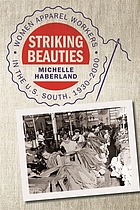
Michelle Haberland
Apparel manufacturing in the American South, by virtue of its size, its reliance upon female labor, and its broad geographic scope, is an important but often overlooked industry that connects the disparate concerns of women's history, southern cultural history, and labor history. In Striking Beauties, Michelle Haberland examines its essential features and the varied experiences of its workers during the industry's great expansion from the late 1930s through the demise of its southern branch of the twentieth century
apparel manufacturing with the lens of women's history, southern cultural history, and labor history
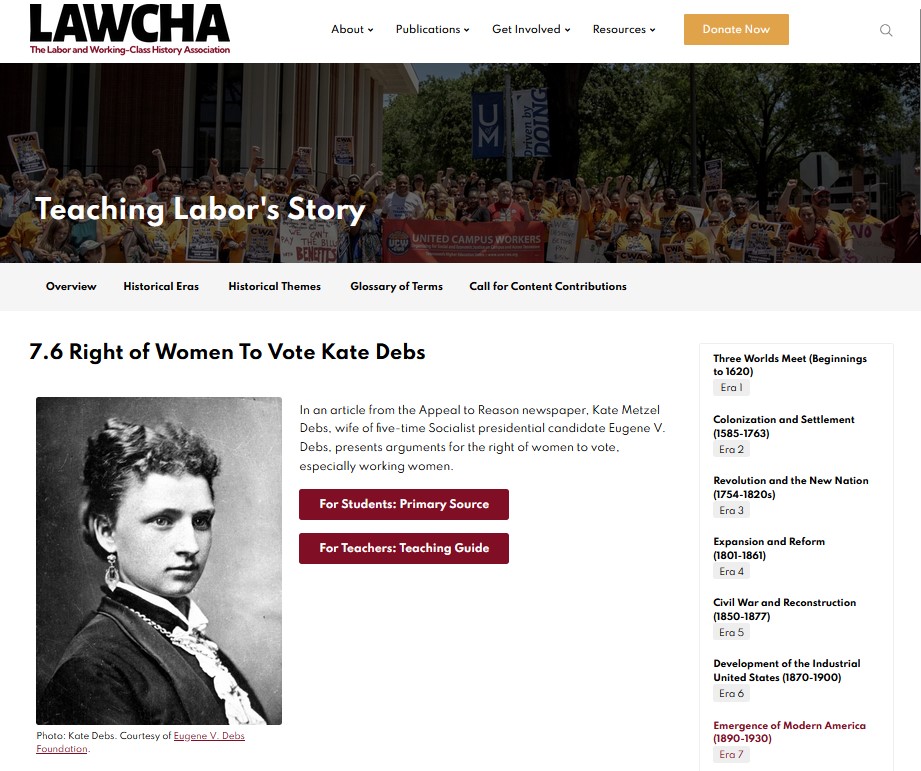
Michelle Killion Morahn, Teaching Labor's Story
Kate Metzel Debs was a long-time supporter of women’s suffrage. Shewas active in her local chapter of the Women’s Franchise League, which drew much support from working-class women. Kate Debs was the wife of labor organizer and Socialist Party presidential candidate, Eugene V. Debs. This articlewas published in the weekly The Appeal to Reason,the largest paid circulation socialist newspaper in the country in 1910 (with a circulation of half a million). Includes Documetn and teaching guide
In an article from the Appeal to Reason newspaper, Kate Metzel Debs, wife of five-time Socialist presidential candidate Eugene V. Debs, presents arguments for the right of women to vote, especially working women.

Michiana Memory
The Historic Newspapers collection aims to preserve and make accessible smaller local newspapers, especially short-lived titles. It includes newspapers produced for black and migrant labor communities in the Midwest. Prominent examples include The Reformer (1967-1970), a newspaper produced by the South Bend African-American community, and The Farm News of St. Joseph County (1944-1959).
A primary source collection containing roughly 1,000 documents across eight local Midwestern newspapers.
Michiana Memory Digital Collections
newsletters and ephemera on housing and some on working conditions in South Bend Indiana, a working class city
This collection brings together primary historical sources illuminating progress towards full civil rights for all the people of this diverse community, with a special emphasis on the history and development of the African American community. Dr. Bernard Streets Sr. and his wife, Odie Mae Streets, were instrumental leaders in the South Bend Chapter of the NAACP and in other human rights activities.
newsletters and ephemera on housing and some on working conditions in South Bend Indiana, a working class city
Michiana Memory Digital Collections
Studebaker, Oliver, Wilson Bros., South Bend Lathe...this collection houses information about the companies, large and small, that contributed to making our area a center of manufacturing and a business hub for over 150 years. 446 items including annual reports to employees and their families, company newsletters, Bulk of the material is in from the 1940s-1950s
Images of Studebaker workers, Packard workers, strikes, migrant labor, child labor, farm labor, United Autoworkers Local 5 from 1950s-1970s.
Michiana Memory Digital Collections
Images of Studebaker workers, Packard workers, strikes, migrant labor, child labor, farm labor, United Autoworkers Local 5 from 1950s-1970s. This is part of a collection
collection is made up of approximately 12,000 digitized photographic negatives created by the South Bend Tribune staff from 1937-1990. The bulk of the digitized materials date from 1950-1989 and are in a variety of film formats accompanied by news clippings. The full collection of approximately 1 million items was generously donated to the library by the South Bend Tribune in 2019.. Bulk of the material is in from the 1940s-1950s
labor-related images from South Bend (Indiana) Tribune
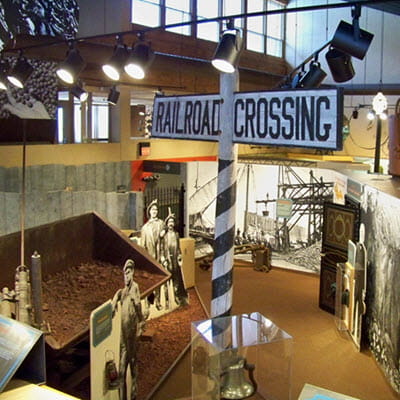
Michigan Iron Industry Museum
This museum features an exhibit on the working people of Upper Peninsula Michigan
The Michigan Iron Industry Museum offers a variety of presentations that are adaptable for any grade level. The presentations, some interactive, teaches students about topics such as lighthouse keepers on the Great Lakes, Iron Ore and early settlement in Michigan.
Located eight miles west of the City of Marquette in the forested ravines of the Marquette Iron Range, this modern museum facility overlooks the Carp River and the site of the first iron manufactory in the Lake Superior region. The museum tells the story of Michigan’s three iron ranges and the people who worked them, through dramatic exhibits, audio-visual programs, and outdoor interpretive trails. A high-definition video, “Iron Spirits: Life on the Michigan Iron Range,” is shown six times daily in the museum’s 88-seat auditorium.
The museum also offers an active education program including community outreach, seasonal events, a lecture series, and the Future Historians, a youth association that meets monthly during the school year. Every summer, the Future Historians share their knowledge and test their skills by providing costumed first-person interpretation for visitors at another Michigan History Center site, Fort Wilkins, through four 3-day living history camps.
Exhibit on the working people of Upper Peninsula Michigan
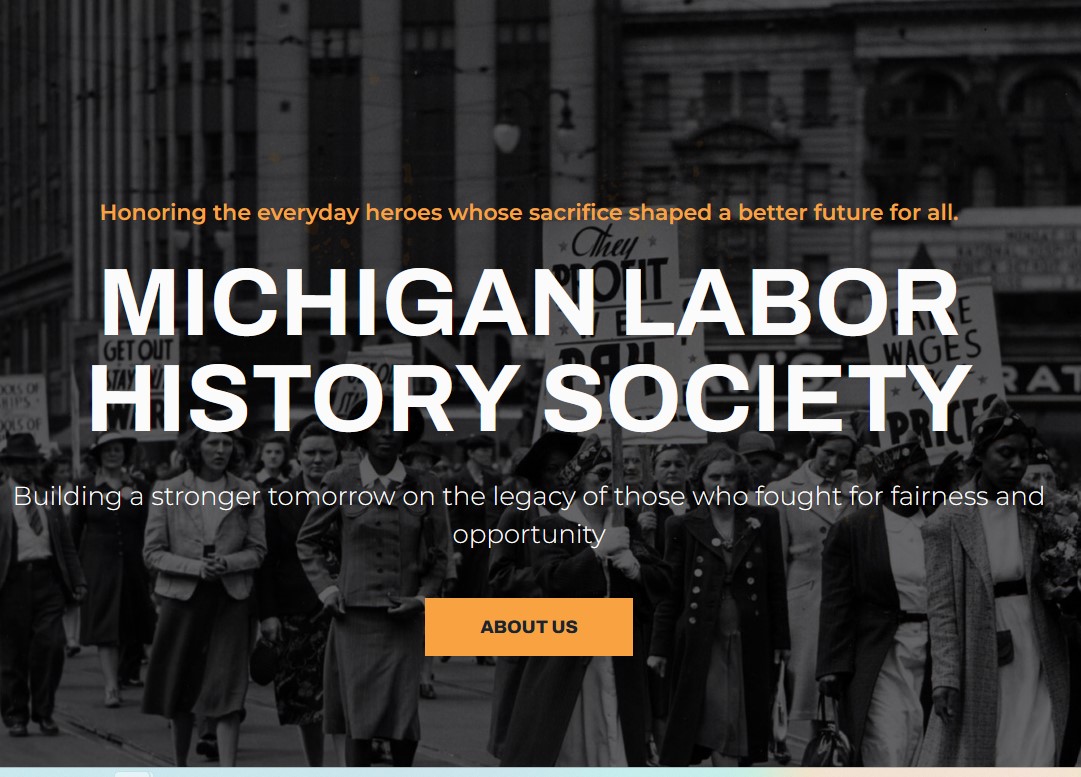
Michigan Labor HIstory Society
Guided Tours Available MLHS can arrange for tours of “Transcending,” the Labor Legacy Landmark in Detroit, for union locals, students and teachers, community groups, and others. Tours can also be arranged during union conventions or conferences. Please contact us at: Michigan Labor History Society, 5401 Cass, Detroit MI 48202, or telephoning our office at 313-577-4003.
Checkout events and get involved with the Michigan Labor History Society
Michigan Labor History Society
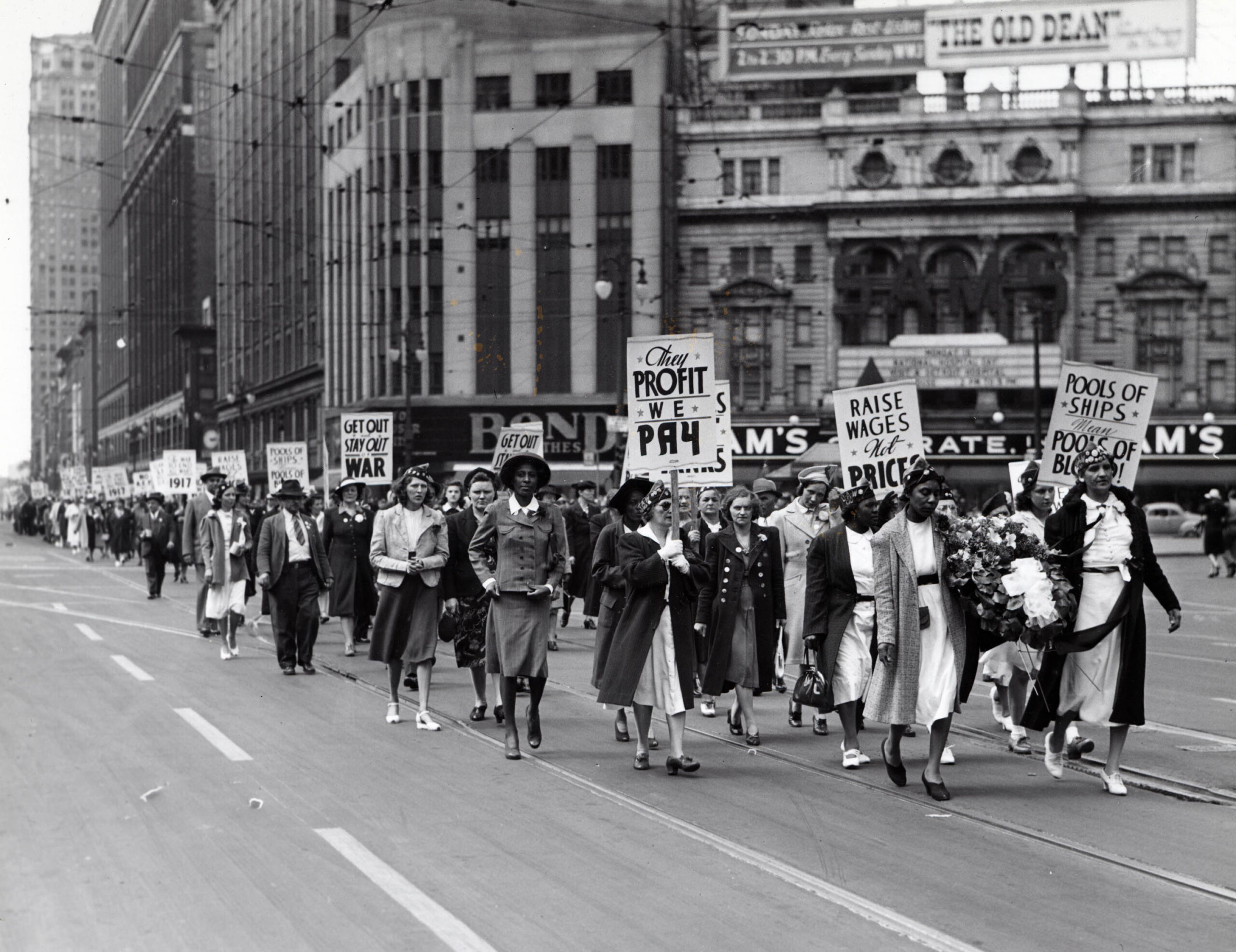
A map that details the labor history across Michigan. Provided by the Michigan Labor History Society
map of labor sites in Michigan, enabling a self-guided tour

Michigan Labor History Society
Call 313-577-4003 or visit 5401 Cass, Detroit MI 48202 to reserve your spot on Michigan Labor History Society's bus tours.
tours of Michigan Labor History

Michigan State University
An old site that includes images, oral history excerpts audio clips with some transcripts, and maps While hard to navigate, it is worth exploring. The listing of all the materials is on the search page. See alll these interviews in another site: https://digitalarchives.umflint.edu/digital/collection/p16210coll3
To provide an introduction to the sit-down strike for those students or members of the general public who are unaware of the history of this momentous event in American history.
To provide an immediacy and personal touch to this historical knowledge through the use of digitized audio files, which contain the actual voices of former sit-downers reminiscing about their experiences.
To make a site that was usable on several levels of interactivity, with information and sound files accessible through several different galleries, a Flash-generated map, a timeline, and various search functions.
To preserve the interviews done by Leighton etal. in a form that was relatively permanent and easily accessible.
Most of the strike participants were over seventy years old at the time of their interviews, and many were over eighty. Yet their memories of what transpired more than forty years earlier turned out to be surprisingly clear. They remembered the working conditions that led to the strike, especially the dreaded "speed-up"; they remembered what they were doing during the strike, inside the plants and out; and they remembered the difficult months after the strike when the fledgling UAW was trying to establish long-term credibility. Their memories, added together, create a comprehensive oral history of the event, and are an invaluable complement to scholarly books available on the subject.
As these audio clips demonstrate, the strike itself has remained interesting because it was a classic case of David versus Goliath. In 1936, General Motors was the richest industrial corporation in the world, with plants in over fifty cities and towns across the United States. Moreover, the largest stockholders were the fabulously wealthy Du Ponts. The strikers, on the other hand, averaged about a tenth grade education, came from poor families, and consisted of many Southerners and Eastern European immigrants. As such, it was easy for strike opponents to claim that they were being forced into their acts of radicalism by "outside agitators" (code words for Communists and Socialists). To a certain degree this charge may have been true, yet it is untrue to say that the aim of most of the strikers was to take over the plants on a permanent basis. Like most of the country, they only wanted a "new deal" that might help them better their lot in life. This meant not only better working conditions and higher pay; it also meant an affirmation of their basic humanity.
An extensive curated digital archive for studying the Flint sit-down, with an emphasis on the 1936-1937 General Motors sitdown.
Michigan Technical University
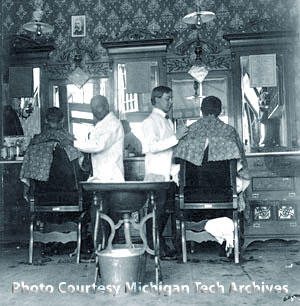
This photo essay provides a visual introduction to the significant geological and mining activities which have drawn people to this region for centuries, the social aspects of the communities and lives which have occurred here, as well as the place that Michigan Technological University has had in these stories
A photographic essay linking location, community and campus in Michigan's Copper Country.
Michigan Technical University
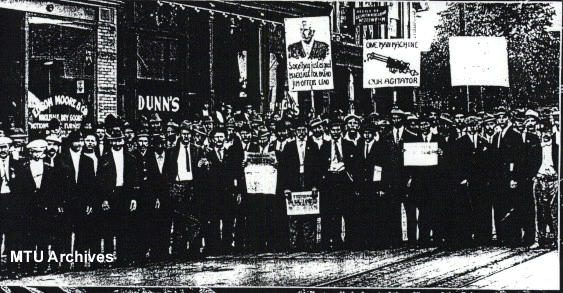
The influence of the mining industry is critical to Copper Country history. Around the turn of the century, the big companies in the area were reaping their greatest profits. All this would come to a halt in the summer of 1913, as disenchanted miners began a strike that would tear the region apart. Aided by the Montana-based union The Western Federation of Miners (WFM), the strikers fought against local law enforcement, strike breakers, and even the Michigan National Guard. Months of vandalism, terror, harassment and violence followed. The strike finally ended following one of the greatest tragedies of the early 20th century, and its effects can still be seen and felt in the area to this day.
This section of the VUP will examine the strike. Topics include: an overview of the causes and events of the strike; exploration of the one man drill, one of the main issues at stake; and a presentation of coded telegrams sent between Quincy Mining Co. headquarters in Boston and the local office in Calumet. Also included are documents from the Copper Country Archives, available for download and further study.
A virtual project on the Copper Mine Strike of 1913-14, which took place in Michigan's "Copper Country" when the Western Federation of Miners notified all companies of a general strike; contains links to archives, documents, visuals, and other useful sources from the strike.
Michigan Technological University
The exhibit contains six panels that document the early years of the Copper Range Railroad, from the founding of the road until its initial expansion beyond the main line. The exhibit also provides a glimpse beyond the formative years, including the impact of the decline of mining in the area, the school train runs, and the dissolution of the company. This online exhibit is a companion to the traveling exhibit so that anyone with an interest in rail history can engage with the material.
A Michigan Technological University online exhibit detailing the history of Michigan's Copper Range Railroad.
Michigan Technological University
Black Voices in the Copper Country: Exploring Community and Michigan Tech Campus Life, 1850-1990, an exhibit by the Michigan Technological University Archives and Copper Country Historical Collections, examines the African American experience in the Keweenaw. This online exhibit is intended to highlight materials that explore the stories of underrepresented individuals and narratives in Michigan history and serves to encourage researchers to consider more inclusivity when telling regional and state history. The Black Voices project is a multifaceted research initiative that has included substantial archival research, public programming and exhibits.
While this project aims to highlight aspects of the African American experience in the western Upper Peninsula, no project can succeed in being a holistic representation of all aspects and perspectives of regional history. This project can serve as an introduction to a topic that deserves to be acknowledged and more deeply investigated. This exhibit includes examples of primary sources related to African American individuals and broader social history in the western Upper Peninsula. We encourage researchers, students and historians to consider how African Americans contributed to the history of the Upper Peninsula. How did they make a living? What were their experiences living in the Copper Country and participating in day-to-day life in the community and at Michigan Tech? In the end, this exhibit can serve as a stepping stone to further research by encouraging critical investigation into collections held by the Michigan Tech Archives and other regional repositories to uncover stories and individuals not widely known, but still important to the rich heritage of the Copper Country and its unique history.
A digital exhibit by the Michigan Technological University Archives and Copper Country Historical Collections that examines the African American experience in the Keweenaw.
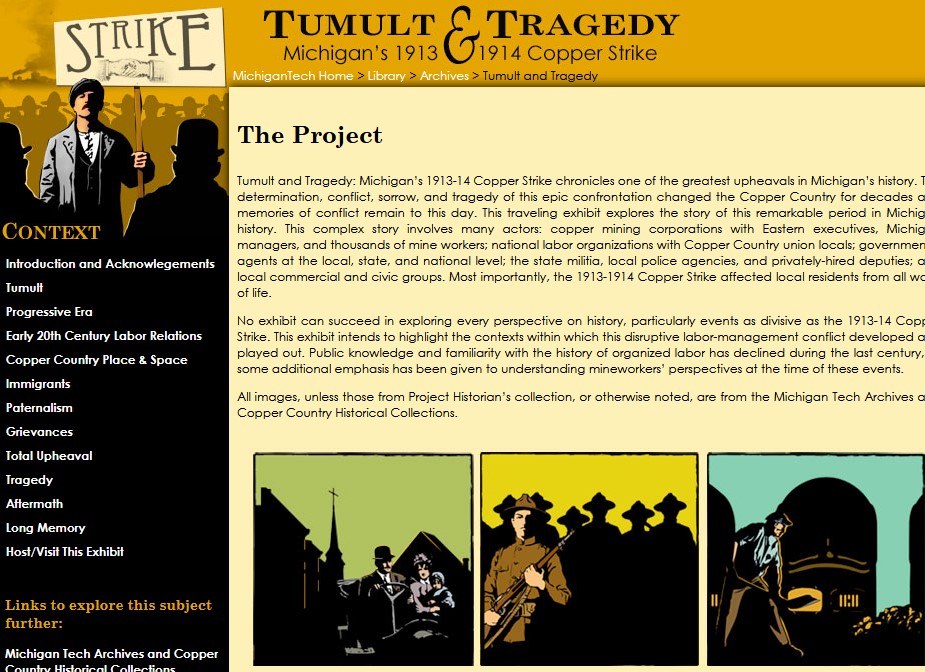
Michigan Technological University
Tumult and Tragedy: Michigan’s 1913-14 Copper Strike chronicles one of the greatest upheavals in Michigan’s history. The determination, conflict, sorrow, and tragedy of this epic confrontation changed the Copper Country for decades and memories of conflict remain to this day. This traveling exhibit explores the story of this remarkable period in Michigan history. This complex story involves many actors: copper mining corporations with Eastern executives, Michigan managers, and thousands of mine workers; national labor organizations with Copper Country union locals; governmental agents at the local, state, and national level; the state militia, local police agencies, and privately-hired deputies; and local commercial and civic groups. Most importantly, the 1913-1914 Copper Strike affected local residents from all walks of life.
An online exhibit about Michigan's 1913-14 Copper Strike, with an emphasis on the perspective of mineworkers.

Midvale Steel, Hagley
The Midvale Steel and Ordnance Company motion picture films (Accession 1970.034) collection consists of five reels of film that document operations at the Midvale Steel Plant. While the reels are not dated, they are believed to be from 1919. The films document the various stages of production at the plant with a focus on the precision steel making process. The films show the various stages of steel production at the plant, and include footage of an integrated workforce with African American and white employees working together on the shop floor.
The films advertise the capabilities and operations at the Midvale Steel and Ordnance Company in Philadelphia. Based on our research, we believe they were produced in the late 1910s and have assigned a circa date of 1919. Having pre-1930s film footage like this is rare -- the Film Foundation estimates 90% of ALL films made before 1929 have been lost or destroyed. That alone makes our circa 1919 footage unique, but that the films depict one of the first integrated industrial labor forces in the Philadelphia region makes them especially significant.
The films advertise the capabilities and operations at the Midvale Steel and Ordnance Company in Philadelphia. Based on our research, we believe they were produced in the late 1910s and have assigned a circa date of 1919. Having pre-1930s film footage like this is rare -- the Film Foundation estimates 90% of ALL films made before 1929 have been lost or destroyed. That alone makes our circa 1919 footage unique, but that the films depict one of the first integrated industrial labor forces in the Philadelphia region makes them especially significant. https://www.hagley.org/librarynews/films-midvale-steel-philadephia-1919
1919 views of Midvale steelworkers
Mignon Duffy
Mignon Duffy uses a historical and comparative approach to examine and critique the entire twentieth-century history of paid care work--including health care, education and child care, and social services̮drawing on an in-depth analysis of U.S. Census data as well as a range of occupational histories. Making Care Count focuses on change and continuity in the social organization along with cultural construction of the labor of care and its relationship to gender, racial-ethnic, and class inequalities
An examination and critique of the twentieth-century history of paid care work, focusing on the social industry's connection to the production of inequality

Mignon Duffy, Amy Armenia, Clare L. Stacey
A nurse inserts an I.V.A personal care attendant helps a quadriplegic bathe and get dressed. A nanny reads a bedtime story to soothe a child to sleep. Every day, workers like these provide critical support to some of the most vulnerable members of our society. Caring on the Clock provides a wealth of insight into these workers, who take care of our most fundamental needs, often at risk to their own economic and physical well-being. Caring on the Clock is the first book to bring together cutting-edge research on a wide range of paid care occupations, and to place the various fields within a comprehensive and comparative framework across occupational boundaries. The book includes twenty-two original essays by leading researchers across a range of disciplines--including sociology, psychology, social work, and public health. They examine the history of the paid care sector in America, reveal why paid-care work can be both personally fulfilling but also make workers vulnerable to burnout, emotional fatigue, physical injuries, and wage exploitation. Finally, the editors outline many innovative ideas for reform, including top-down and grassroots efforts to improve recognition, remuneration, and mobility for care workers. As America faces a series of challenges to providing care for its citizens, including the many aging baby boomers, this volume offers a wealth of information and insight for policymakers, scholars, advocates, and the general public"-- Provided by publisher
Foreword by Margaret K. Nelson
Acknowledgments
Part I Paid Care Work
Chapter 1. On the Clock, Off the Radar: Paid Care Work in the United States Mignon Duffy, Amy Armenia, and Clare L. Stacey
Chapter 2. Beyond Outsourcing: Paid Care Work in Historical Perspective Mignon Duffy
Part II Contexts of Care
Chapter 3. The Best of Both Worlds? How Direct Care Workers Perceive Home Health Agencies and Long-Term-Care Institutions Kim Price-Glynn and Carter Rakovski
Chapter 4. The Business of Caring: Women’s Self-Employment and the Marketization of Care Nickela Anderson and Karen D. Hughes
Chapter 5. Are Frontline Healthcare Jobs “Good” Jobs? Examining Job Quality across Occupations and Healthcare Settings Janette S. Dill
Chapter 6. Orienting End-of-Life Care: The Hidden Value of Hospice Home Visits Cindy Cain
Part III Hazards of Care
Chapter 7. The Health Hazards of Health Care: Physical and Psychosocial Stressors in Paid Care Work Alicia Kurowski, Jon Boyer, and Laura Punnett
Chapter 8. When the Home Is a Workplace: Promoting Health and Safety for a Vulnerable Workforce Pia Markkanen, Margaret Quinn, and Susan Sama
Chapter 9. Part of the Job? Workplace Violence and Social Services Jennifer Zetocaulnick
Chapter 10. Double Isolation: Immigrants and Older Adult Care Work in Canada Ivy Bourgeault
Part IV Identities and Meaning Making
Chapter 11. The Caring Professional? Nurse Practitioners, Social Work, and the Performance of Expertise LaTonya J. Trotter
Chapter 12. Building a Professional Identity: Boundary Work and Meaning Making among West African Immigrant Nurses Fumilayo Showers
Chapter 13. Ethnic Logics: Race and Ethnicity in Nanny Employment Cameron Lynne Macdonald
Chapter 14. Caring or Catering? Emotions, Autonomy, and Subordination in Lifestyle Work Rachel Sherman
Part V: Work and FamilyChapter 15. Low-Wage Care Workers: Extended Family as a Strategy for Survival Naomi Gerstel and Dan Clawson
Chapter 16. “It’s Like a Family”: Caring Labor, Exploitation, and Race in Nursing Homes Lisa Dodson and Rebekah M. Zincavage
Chapter 17. Caught between Love and Money: The Experiences of Paid Family Caregivers Clare L. Stacey and Lindsey L. Ayers
Chapter 18. Paying Family Caregivers: Parental Leave and Gender Equality in Sweden Mary K. Zimmerman
Part VI: Paths to Change
Chapter 19. For Children and Self: Understanding Collective Action among Early Childhood Hammonds
Chapter 20. Creating Expertise and Autonomy: Family Day Care Providers’ Attitudes toward Professionalization Amy Armenia
Chapter 21. Building a Movement of Caring Selves: Organizing Direct Care Workers Deborah L. Little
Chapter 22. Healthy Diversity: Promoting a Diverse Healthcare Workforce Through Innovative Partnerships Michelle C. Haynes, Meg A. Bond, Robin A. Toof, Teresa Shroll, and Michelle D. Holmberg
Chapter 23. Building Meaningful Career Lattices: Direct Care Workers in Long-Term Care Jennifer Craft Morgan and Brandy Farrar
Epilogue: Making Care Work Mignon Duffy, Clare Stacey, and Amy Armenia
References
Notes on Contributors
why paid-care work can be both personally fulfilling but also make workers vulnerable to burnout, emotional fatigue, physical injuries, and wage exploitation

Migration Policy Institute
This fact sheet serves as a guide and timeline of all major U.S. immigration laws from 1790 through the present. Starting with the 1790 Naturalization Act, which established the country's first uniform naturalization law, the work examines the laws through 2006, when Congress enacted the Secure Fence Act after the Senate failed to adopt immigration reform legislation that had passed the House in 2005.
The fact sheet explains all of the the laws that have come to shape the United States' immigration policy, and helps paint a picture of where the debate on comprehensive immigration reform may head in the near future.
A factsheet showing all major U.S. immigration laws from 1790 to the present.

Migration is Beautiful, Iowa Women's Archives
In the early twentieth century, Mexicans settled in working-class neighborhoods (barrios) across Iowa. They built communities in Des Moines in central Iowa, Council Bluffs in the west, and Fort Madison in the south. In the northern part of the state, they settled in Sioux City, Manly, and Mason City. They lived in barrios in the Quad Cities region of the Mississippi River - in East Moline, Moline, Rock Island, and Silvis on the Illinois side, and in Davenport and Bettendorf on the Iowa side. By the 1920s, Mexicans had also settled in small enclaves in Iowa City, West Liberty, and Muscatine. As this new generation of immigrants established communities and raised families, Iowa's Mexican population rose steadily from around 500 in 1910 to about 2,600 in 1925.
There are several sections of this digital part of the Migration is Beautiful website including
La Yarda, Silvis, Illinois
Cook's Point, Davenport
Holy City, Bettendorf
El Cometa, Fort Madison
Iowa City Barrio
Muscatine
Bibliography
Ethnically concentrated neighborhoods were not unique to Mexicans. Earlier generations of immigrants to Iowa - whether Italians in Des Moines or Germans in Muscatine - had also lived in specific neighborhoods in concentrated numbers. Segregation was often the product of a desire to build ethnic community and preserve cultural traditions. But it could also become entrenched when a particular community found that obstacles to employment opportunities and upward mobility prevented them from moving into more affluent neighborhoods.
Segregated living conditions and limited employment opportunities reflect how, by the early twentieth century, Iowa employers and communities had racialized Mexicans as "other" and "non-white." Residents in barrio neighborhoods filled low-wage jobs with harsh working conditions and little opportunity for advancement. They lived near and in railroad yards or on the outskirts of towns in areas close to rivers that flooded regularly, often adjacent to city dumps. Some lived in company housing and paid rent to their employers; others owned their own homes and paid land rent to landowners.
Faced with discrimination and austere living conditions, barrio residents developed a strong sense of community. Women often formed the backbone of tight-knit neighorhoods, supporting each other through difficult times and preserving customs and traditions from their homeland. They worked as primary caretakers and supplemented family incomes by taking in laundry and sewing, cooking, cultivating garden plots, and raising small livestock. Some assumed responsibilities as primary breadwinners when faced with the death, illness or abandonment of a spouse. Their employment opportunities were often limited to jobs in low-wage factories and hotels.
Digital exhibit in multiple sections exploring the history of working-class Mexican neighborhoods in the Midwest, including those in Iowa (Cook's Point, Davenport; Holy City, Bettendorf; El Cometa, Fort Madison; Iowa City Barrio; Muscatine) and Illinois (La Yarda, Silvis).
Museum/Exhibits
Tours
Maps
Digital Projects
Organizations
Sites
Film/Video
Audio/Interview
Podcast/Program
Text/Document
Image
Graphs/Data
Timeline
Southwest
West
Midwest
Southeast
Northeast
Mexico
Canada
Global
Books
Teaching
Lectures
Digital Archives
Journals
Bibliographies
Topic Intro