


Collections
Library
Type
Region
Coverage:
-
Published:
-

Miriam Pawel
A generation of Americans came of age boycotting grapes, swept up in a movement that vanquished California's most powerful industry and accomplished the unthinkable: dignity and contracts for farm workers.
Four decades later, Cesar Chavez's likeness graces postage stamps, and dozens of schools and streets have been renamed in his honor.
But the real story of Chavez's farm workers' movement-both its historic triumphs and its tragic disintegration-has remained buried beneath the hagiography.
Drawing on a rich trove of original documents, tapes, and interviews, Miriam Pawel chronicles the rise of the UFW during the heady days of civil rights struggles, the antiwar movement, and student activism in the 1960s and '70s. From the fields, the churches, and the classrooms, hundreds were drawn to la causa by the charismatic Chavez, a brilliant risk-taker who mobilized popular support for a noble cause.
But as Miriam Pawel shows, the UFW was ripped apart by the same man who built it, as Chavez proved unable to make the transition from movement icon to union leader. Pawel traces the lives of several key members of the crusade, using their stories to weave together a powerful portrait of a movement and the people who made it.
A tour de force of reporting and a spellbinding narrative, The Union of Their Dreams explores an important and untold chapter in the history of labor, civil rights, and immigration in modern America.Some primary sources available at: https://unionoftheirdreams.com/Primary_Sources.php
Table of Contents
The Grape strike, September 1965-July 1970
Growing pains, August 1970-April 1973
War, again, April 1973-June 1975
The new world, June 1975-March 1977
Movement or a union?, April 1977-July 1978
Up from the fields, July 1978-January 1989
the UFW was ripped apart by the same man who built it, as Chavez proved unable to make the transition from movement icon to union leader.
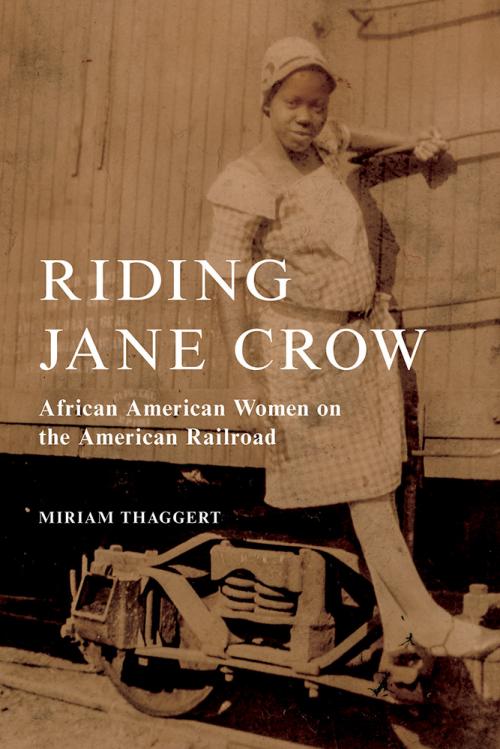
Miriam Thaggert
Miriam Thaggert illuminates the stories of African American women as passengers and as workers on the nineteenth- and early-twentieth-century railroad. As Jim Crow laws became more prevalent and forced Black Americans to 'ride Jim Crow' on the rails, the train compartment became a contested space of leisure and work. Riding Jane Crow examines four instances of Black female railroad travel: the travel narratives of Black female intellectuals such as Anna Julia Cooper and Mary Church Terrell; Black middle-class women who sued to ride in first class 'ladies' cars'; Black women railroad food vendors; and Black maids on Pullman trains. Thaggert argues that the railroad represented a technological advancement that was entwined with African American attempts to secure social progress. Black women's experiences on or near the railroad illustrate how American technological progress has often meant their ejection or displacement; thus, it is the Black woman who most fully measures the success of American freedom and privilege, or 'progress,' through her travel experiences"-- Provided by publisher
luminates the stories of African American women as passengers and as workers on the nineteenth- and early-twentieth-century railroad.

Missouri Digital Collections
The Brotherhood of Locomotive Engineers was organized on May 8, 1863 in Detroit, MI. The organization was fraternal in nature and only open to locomotive engineers; locomotive firemen and other railroad employees formed their own organizations. This collection contains the records of the early years of the Brotherhood of Locomotive Engineers, Division 83, the first union organized in Springfield, MO. The records consist primarily of membership dues payment records (1871-1900, 1904-1905) and minutes (1871-1892, 1904-1907, 1916-1934, and 1944-1954).
A Missouri State University collection of seventeen total historical records from the Brotherhood of Locomotive Engineers.

Missouri State
UNITE formed after the International Ladies' Garment Workers' Union (ILGWU) and the Amalgamated Clothing and Textile Workers Union (ACTWU) merged in 1995. The majority of the digitized material here comes from the ILGWU in the 1930s-1980s and especially focuses on St. Louis, Missouri, but also includes material from other parts of Missouri as well as other states.
A Missouri State University digital collection gathering materials relevant to Midwestern labor history between the 1930s and 1980s, union activism, the merger of the International Ladies' Garment Workers Union and the Amalgamated Clothing and Textile Workers Union, and interracial unionizing in the 1980s.

Missouri State University
Claud Hawley was born in Aurora, Missouri, on August 24, 1903. In 1937, he founded the Union Labor Record. This collection consists of biographical information and material about Claud Hawley such as his obituary, where he was born, and where he went to school. It also contains letters and memos labor union mediator career. His scrapbook contains photographs of Hawley, his family, and his bowling teams; newspaper clippings; minstrel show materials; and other items.
A Missouri State University collection from the personal papers of Missouri-born newspaper worker and founder Claud Hawley, who created the Union Labor Record.

Missouri State University
The collection mainly consists of materials regarding the Missouri Farmers Association (MFA) Milling Company in Springfield, Missouri, including photographs of the inside of their building and of floods at their building in the late 1920s; MFA financials; and meeting minutes for the Exchange Managers of Southwest Missouri, especially regarding the purchase of a new mill. Also included in the collection is information regarding the Flour, Cereal, Feed Mill, and Grain Elevator Workers Union.
This digital collection mainly consists of primary source documents regarding the Missouri Farmers Association (MFA) Milling Company in Springfield, Missouri

Missouri State University
This collection of St. Louis-San Francisco Railway Company (Frisco) depot floor plans from the early 20th century includes stations in Missouri, Oklahoma, Arkansas, Kansas, Mississippi, Alabama, Texas, and Tennessee. Many of the plans show segregated bathrooms and waiting areas, as well as information such as when the stations were built and what materials were used.
Missouri State University's collection of floor plans demonstrating racial segregation across the U.S. Midwest and South.

Missouri State University
This digital collection includes a selection of ephemera, documents, postcards, photographs, and artifacts used in creating Special Collections and Archives' Frisco Travel Exhibit in 2008. The original items come from several different collections related to the St. Louis-San Francisco Railway Company ("Frisco") now held by Special Collections and Archives.
A digital collection comprised of materials from Missouri State University's Frisco Travel Exhibit in 2008.

Missouri State University
A small selection from approximately 2,000 field recordings of Gordon McCann, a Springfield musician and historian who in the mid-1970s began collecting Ozarks fiddle tunes. Full recordings are available on the MSU Libraries YouTube Channel.
Missouri State University's collection of the field recordings of musician and historian Gordon McCann, who helped preserve a great deal of Missouri's folk culture and music.

Missouri State University
In 1982, Missouri State University's Dr. Katherine Lederer developed the exhibit "Springfield's Lost Black History" about the African American community from in and around Springfield, Missouri. Featuring images from her own collection, as well as materials made available to her by the community, this collection grew to include copies of over 450 photographs, documents, and published pages.
An online exhibit and collection of primary sources on the African American community in Springfield, Missouri ranging from 1855 to 1982, hosted by Missouri State University.

Missouri State University
This collection is comprised of labor union charters and certificates of affiliation. The collection was received piecemeal at various times. The majority of the documents are from Springfield labor unions, but there are a few from other Missouri communities (Joplin and Jefferson City), as well as Wichita, Kansas, and Parsons, Kansas. Among the collection are charters from local women's auxiliaries.
Missouri State University's holdings of forty-four labor union charters dating from 1884 to 1994.

Missouri State University
This collection includes miscellaneous materials related to various Ozarks labor unions, such as dues books, constitutions, and a cipher code.
A Missouri State collection of labor union materials for those based or active in the Ozarks region.

Missouri State University
Otto Bowles was born October 19, 1904, to Lon and Cora Bowles in Lawrence County, Missouri. He served in the Navy from 1923 to 1929. He then moved to Springfield, Missouri, where he started working in construction as a laborer. He joined Laborers Union local 676 in 1938, serving as a steward on such jobs as the construction of the U. S. Medical Center and O'Reilly Hospital. In 1941 he was asked to serve as the secretary treasurer of the local, and accepted the job. Shortly afterward, the local's business agent was drafted into the Army, and Bowles held both offices until 1943. He also served as business manager of the Building and Construction Trades Council in Springfield. In 1947, he quit both union posts in Springfield to become business manager of the Greater Kansas City District Laborers' Council. This small collection contains minutes of the district council and memorabilia of Mr. Bowles.
A small collection from the papers of union staffer Otto Bowles (1904-1998), who worked in the Laborer's Union, the Building and Construction Trades Council, and the Greater Kansas City District Laborers' Council.

Missouri State University
St. Louis headquarters materials; UNITE formed after the International Ladies' Garment Workers' Union (ILGWU) and the Amalgamated Clothing and Textile Workers Union (ACTWU) merged in 1995. The majority of the digitized material here comes from the ILGWU in the 1930s-1980s and especially focuses on St. Louis, Missouri, but also includes material from other parts of Missouri as well as other states.IL
A Missouri State University digital collection gathering materials relevant to Midwestern labor history between the 1930s and 1980s, union activism, the merger of the International Ladies' Garment Workers Union and the Amalgamated Clothing and Textile Workers Union, and interracial unionizing in the 1980s.

Missouri State University
This collection contains the personnel records and other various documents of the Frisco Railroad. The collection is divided up into two series. The first contains personnel records listed in alphabetical order. These folders contain materials such as: personal letters, telegrams, accident reports, and applications and application letters. The second series, identified as “subject files,” contains various documents related to the railroad such as: lists of Frisco employees, railroad association reports, accident/wreck reports, Mr. Veregge’s website, and guest lists.
Railroad personnel records and Frisco documents collected by Fred Veregge make up the contents of this collection.
Missouri State, Neal W. Moore
In 1983, Neal W. Moore, a retired union printer, publisher, and editor, founded the Ozarks Labor Union Archives (OLUA) with a few files and borrowed closet space. Mr. Moore's passion for labor history and working class issues, his involvement in the Ozarks Labor Historical Society, and his acquaintance with Missouri State Economics professor J. David Lages led to the establishment of the archives.
His appreciation of and dedication to the preservation of labor's history drove him to create a labor archives in a region considered to have few, if any, unions. Over two decades later, OLUA is a major repository for labor and working class records, with over 100 collections totaling over 1,300 linear feet of primary source material.
As part of his interest in labor issues, Mr. Moore wrote a great deal about the Ozarks' labor history and often spoke at conferences and to other groups. Much of that research has been compiled into an unpublished work, Labor Unions in the Ozarks.
This website takes the opportunity to showcase portions of Mr. Moore's work, who passed away in September 2005 at 90 years of age. Select a link below to view the article.
Digitized narrative by a labor unioinist who sought to preserve the record of unions in the Springfield Missouri area of the Ozarks. Covers socialist Reuben Wood and Streetcar Strike of 1916-1917
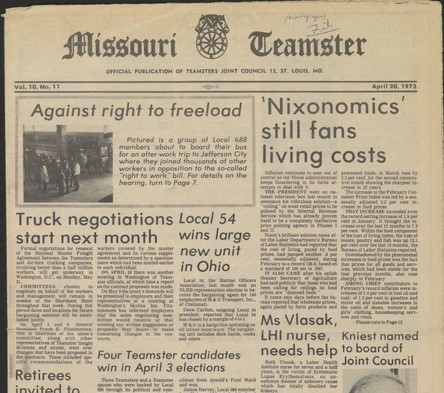
Missouri Teamster
International Brotherhood of Teamsters in Missouri became part of Labor for Peace, an anti-war organization during this time
Magazine of the Missouri Teamsters
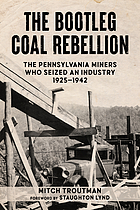
Mitch Troutman, Staughton Lynd
Told with great intimacy and compassion, The Bootleg Coal Rebellion uncovers a long-buried history of resistance and resilience among depression-era miners in Pennsylvania, who sunk their own mines on company grounds and fought police, bankers, coal companies and courts to form a union that would safeguard not just their livelihoods, but protect their collective autonomy as citizens and workers for decades. Community and Labor organizer Mitch Troutman brings this explosive and accessible American tale to life through the bootleggers' own words. Scholars, historians, organizers and activists will celebrate this story of the people who literally seized mountains and stood their ground to create the Equalization movement, the miners' union democracy movement, and the Communist-led Unemployed Councils of the anthracite region. This epic story of work, love and community stands as a testament to the power of collective action; a story that is sorely needed as communities today rise to confront neoliberal policies ravaging our planet
uncovers a long-buried history of resistance and resilience among depression-era miners in Pennsylvania
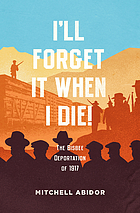
Mitchell Abidor
On July 12, 1917, in the mining town of Bisbee Arizona, twelve hundred striking miners and their supporters were rounded up by forces organized by the town sheriff and the mining companies, marched through the town, parked in the town & rsquo;s baseball field, and then put in boxcars and shipped into the New Mexican desert. The deportees were largely members or supporters of the radical IWW labor union and mostly foreign-born.
The roundup and deportation was part of a xenophobic and anti-radical campaign being carried out by bosses and the government throughout the country in the early days of US participation in World War I. The mine owners then took control of the town and patrols prevented any union miners from even entering it. This little-known story is a shocking and fascinating one on its own, but the sentiments exploited and exposed in Bisbee in 1917 speak to America today.
A retelling of the deportation of striking IWW members, migrants, and radical miners from Bisbee Arizona to the middle of the New Mexico desert
Mitchell Newton-Matza
Intelligent and Honest Radicals explores the Chicago labor movement’s relationship to Illinois legal and political system especially as seen through the eyes of the Chicago Federation of Labor (CFL). Newton-Matza focuses on the significant era between the great strike in 1919 and Franklin D. Roosevelt’s inauguration and the beginning of the New Deal in 1933. He brings to light a number of victories and achievements for the labor movement in this period that are often overlooked. Newton-Matza shows the Chicago labor movement as a progressive agency intent on changing the workers’ world through words and peaceful actions, drawing upon their personal experiences and ideology.
The ghosts of upheaval : Chicago law and labor in the nineteenth century
Whoopla ho! : the creation of the Chicago Federation of Labor and into the twentieth century
Everybody is watching us now : the CFL and the dream of a Labor Party
The crack of the whip : the battle against the labor injunction
The Chicago controversy : the Landis Award
A brisk war over a new constitution for Illinois
Conclusion : out of the twenties and into the New Deal
Appendix 1: Constitution of the LPCC
Appendix 2: Platform of the Labor Party of Illinois
Appendix 3: Chicago Labor Party’s Platform
Appendix 4: New Party Platform of 1923
Appendix 5: Robert Buck’s Speech to the Farmer-Labor Party Convention of 1923 Appendix 6: John Fitzpatrick’s Speech to the CFL, May 18, 1924
Appendix 7: Judge Landis’s Rules for Arbitration
Appendix 8: The Landis Award
Appendix 9: The Uniform Agreement
Appendix 10: Application for Employment
Appendix 11: Leaflet No. 4 By The Joint Building Trades Publicity Committee Appendix 12: The State Federation Report on the Proposed Constitution Appendix 13: Public Ownership League Report on the Proposed Constitution Appendix 14: Save Our Liberties!
Bibliography
shows the Chicago labor movement as a progressive agency intent on changing the workers’ world through words and peaceful actions
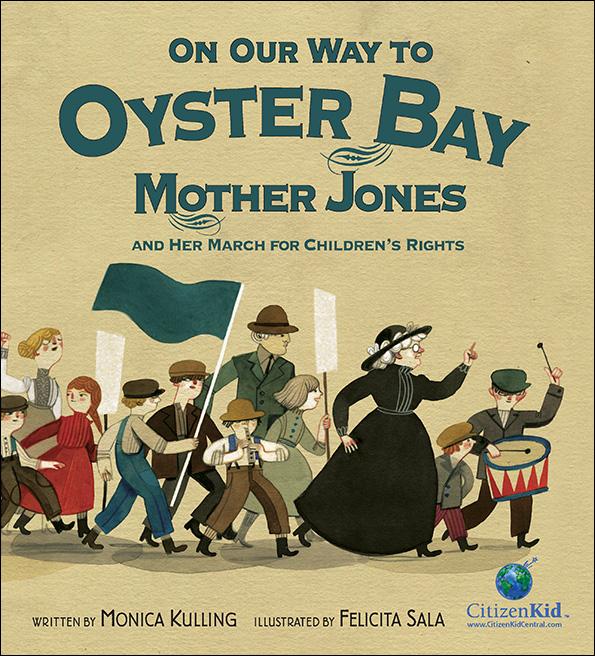
Monica Kulling
includes lesson plans and teaching activities
Young childrens lesson plan on Mother Jones
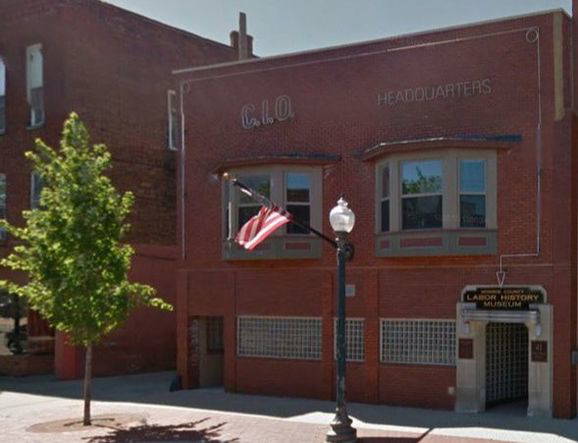
Monroe County Labor Museum
Visit "the only labor museum in Michigan" at 41 W Front St, Monroe, MI 48161. Exhibits feature industrialization in Michigan and the link between civil rights and labor. Special tours can also be organized by following the link on the hompage.In 2001, the Monroe County Council CIO Social and Welfare Association conceived a bold plan for the adaptive re-use of the historic hall - creation of a labor history museum for Monroe County dedicated to, preservation and display of artifacts documenting the rich heritage of the State of Michigan and Monroe County as well as education and outreach to the general public, youth and organized labor, illustrating the importance of Monroe County to the American labor movement. The museum is located in the heart of Downtown Monroe among many wonderful shops, restaurants, cafes, the Monroe County Historical Museum, the River Raisin Centre for the Arts and much more.
Located downtown in the former CIO Headquarters, the Monroe County Labor History Museum stands as one of the only museums dedicated to the history of labor movements and the workforce in the state of Michigan. The museum not only examines the technological aspects of the Industrial Revolution that changed how work was carried out, but also the movements to create safer conditions for workers and the way in which the American Dream influenced and was influenced by various labor movements.
With open hours on Saturdays and options for private tours, this museum is a must stop for anyone interested in the industrialization of America and the history of labor in Michigan and the United States.
Michigan's only labor museum

Montana Labor News
The Montana Labor News was first published in 1925 in Butte, Montana. The 3-column, 4-page weekly was published by the Silver Bow Trades and Labor Council (now Montana AFL-CIO). Its first known editor was F.E. Cleves. Other editors between the 1920s and 1951 included Charles Sebold, Clarence E. Blewitt, John Vickers, and Ed C. Vawter.
As "The Official Organ of the Montana State Federation of Labor," the paper's stance on labor issues and politics was clear. The masthead declared the Labor News was "A Fearless Champion of Human Rights Devoted to the Interests and Voicing the Demands of the Trade Union Movement."
Content in the newspaper included an editorial column, a combination humor and socio-political commentary column titled "Timely and Untimely Observations," and national labor news in "The Washington Scene." Local content focused strongly on labor issues in the copper industry, though other trades were also represented. Headlines such as "Miners Urge Silicosis Compensation" appeared beside warnings against patronizing local businesses that were "unfair to organized labor." Other content included coverage of state and national labor conventions and reports on the Fort Peck Dam project from the labor perspective. The Labor News peppered phrases such as "Butte Copper Means Butte Prosperity" and "Agitate–Educate–Organize" between articles and other content. The paper printed legal notices and rosters for unions in Butte, Missoula, Miles City, Anaconda, and Bozeman. Further rosters for Glasgow, Billings, Havre, and Helena appeared later.
In 1928, editor Cleves faced a libel charge for comments he made about the president of the Federation of Labor, Stephen Ely. The Helena Daily Independent reported on January 11 that the criminal libel information filed in district court the day before "contains alleged extensive and voluminous excerpts from the Labor News, in which Ely is called a thief and crook, and charged with tampering with votes cast at the official election last year." The filing went on to say Cleves referred to Ely as "one of the most damnable cancers on the breast of the labor movement," and that he was "ignominiously bounced" from the United Mine Workers after a "five year period of doubtful service during which the records show that he had extracted the tidy sum of $35,000." Cleves pleaded not guilty, and soon afterward the libel charge, Cleves was dismissed on the condition he would print a retraction in his paper.
Montana Labor Paper
Montana State Library
More than 600 interviews conducted in the 1980s on now in a digital format. Montanans at Work Oral History Project focuses on change and continuity in three main industries in Montana: agriculture, mining, and forest products. The interviews captured the stories of laborers, labor leadership, and support industry workers, from the expansion in extractive economy jobs during World War II to the decline of those industries in the 1980s.
Collection Summary
Through the Voices of Labor: Preserving the Montanans at Work and New Deal in Montana Oral History Interviews project, the Montana Historical Society digitized three major oral history projects in its collections: Montanans at Work, Metals Manufacturing in Four Montana Communities, and New Deal in Montana/Fort Peck Dam. Montanans in the mining, agriculture, and forest products industries, as well as Montanans working in Depression-era New Deal programs, especially the construction of the Fort Peck Dam.
An index exists for each of the three oral history projects through the ArchivesWest website. Please note access to online copies of interviews is not possible through these indexes. To access online copies please click on the links below or by searching by name on this website.
The Metals Manufacturing in Four Montana Communities Oral History Project concentrates on residents of Anaconda, Black Eagle, Columbia Falls, and East Helena, who share their experiences as merchants, bartenders, union organizers, and families of smelter workers living in towns dominated by metals manufacturing plants.
The New Deal in Montana/Fort Peck Dam Oral History Project documented the economic recovery programs initiated by President Franklin D. Roosevelt in 1930s and 1940s Montana, such as the construction of Fort Peck Dam under the Public Works Administration, as well as efforts by the Civilian Conservation Corps, and the Resettlement Administration.
digitized interviews with Montana's workers from the 1980s
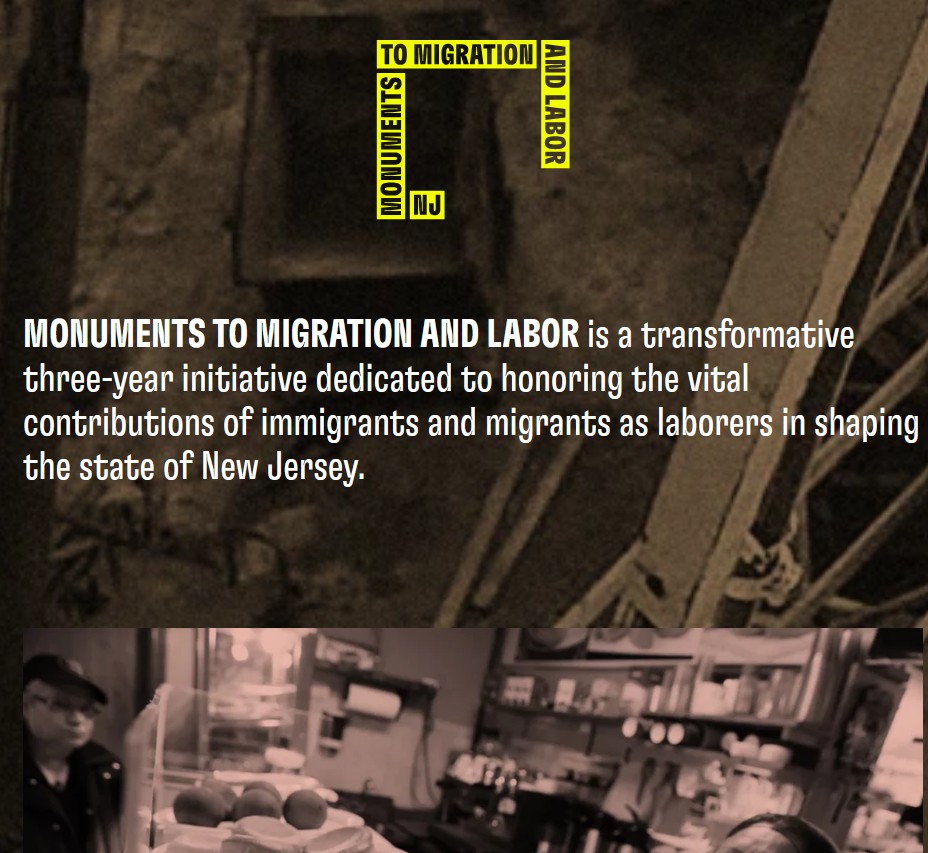
Monuments to Migration and Labor
Working in close partnership with community stakeholders over multiple stages, MONUMENTS TO MIGRATION AND LABOR is creating public art, monument installations, and programming that explore what it has meant to migrate to and work in New Jersey.
The first of its kind, this project offers a model for how public history and art, and monumental expressions, can actively and democratically involve the public in constructing new and more inclusive commemorative landscapes.Examining immigrants who have come to New Jersey from abroad, as well as Southern Blacks and Puerto Ricans who moved to the state, this project confronts the hostility and exclusions that groups migrating for work have historically encountered.
Demonized in the media and political discourse as economic burdens, criminals and worse, this project represents a collective opportunity and effort to change perceptions. We aim to examine how im/migrant laborers are essential to New Jersey and the United States, while also interpreting their complicated stories.
An organization dedicated to creating public art, monument installations, and programming that explore what it has meant to migrate to and work in New Jersey.
Museum/Exhibits
Tours
Maps
Digital Projects
Organizations
Sites
Film/Video
Audio/Interview
Podcast/Program
Text/Document
Image
Graphs/Data
Timeline
Southwest
West
Midwest
Southeast
Northeast
Mexico
Canada
Global
Books
Teaching
Lectures
Digital Archives
Journals
Bibliographies
Topic Intro