


Collections
Library
Type
Region
Coverage:
-
Published:
-
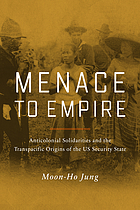
Moon-Ho Jung
Menace to Empire is a profoundly original and ambitious book, a history of race and empire that traces both the colonial violence and the anticolonial rage that the United States spread across the Pacific between the Philippine-American War and World War II. Author Moon-Ho Jung argues that the US national security state as we know it was born out of attempts to repress and silence colonized subjects, from the Philippines and Hawai'i to California and beyond, whose anticolonial aspirations challenged US claims to sovereignty. Jung examines how the contradictions of race, nation, and empire generated waves of revolutionary movements spanning the Pacific--anticolonial, antiracist, and labor movements that exposed and confronted the US empire. In response, the US state closely monitored and brutally suppressed those movements by racializing particular politics and distinct communities as seditious, exaggerating fears of pan-Asian solidarities and sowing anti-Asian racism under the guise of national security. Menace to Empire transforms familiar themes in American history to highlight the critical role of colonial violence in the formation of radical movements and the antiradical origins of anti-Asian racism. Radicalized by their opposition to the US empire and racialized as threats to US security, peoples in and from Asia pursued a revolutionary politics that gave rise to the national security state--the heart and soul of the US empire ever since"-- Provided by publisher
history of race and empire that traces both the colonial violence and the anticolonial rage
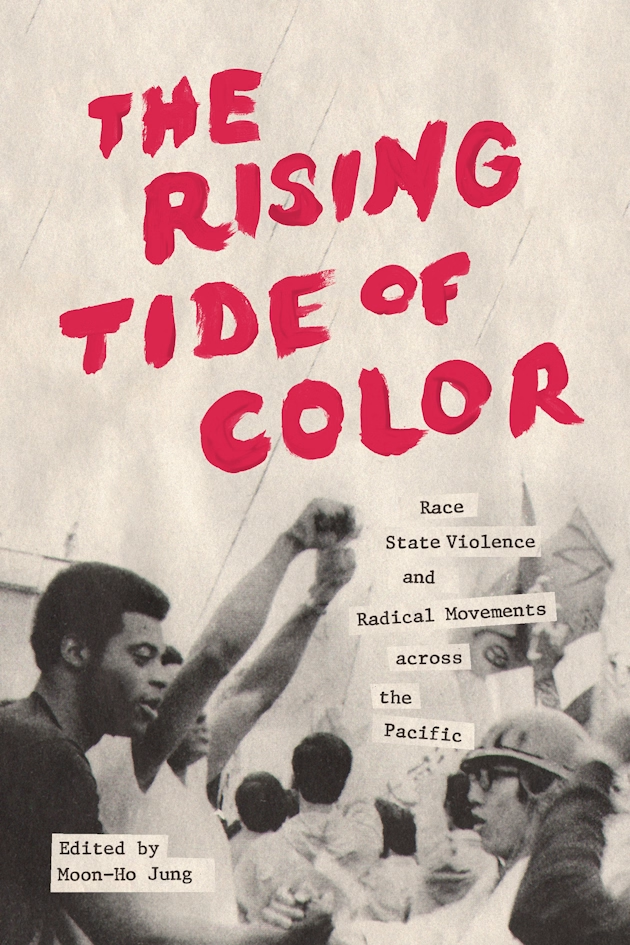
Moon-Ho Jung
The Rising Tide of Color challenges familiar narratives of race in American history that all too often present the U.S. state as a benevolent force in struggles against white supremacy, especially in the South. Featuring a wide range of scholars specializing in American history and ethnic studies, this powerful collection of essays highlights historical moments and movements on the Pacific Coast and across the Pacific to reveal a different story of race and politics. From labor and anticolonial activists around World War I and multiracial campaigns by anarchists and communists in the 1930s to the policing of race and sexuality after World War II and transpacific movements against the Vietnam War, The Rising Tide of Color brings to light histories of race, state violence, and radical movements that continue to shape our world in the twenty-first century.Part One. Framing Race, State Violence, and Radical Movements -- Introduction: Opening Salvo / Moon-Ho Jung -
- "Standing at the Crossroads" : Why Race, State Violence, and Radical Movements Matter Now / George Lipsitz -
- Part Two. Traversing the Pacific -- Mobilizing Revolutionary Manhood : Race, Gender, and Resistance in the Pacific Northwest Borderlands / Kornel Chang
-- Dangerous Amusements : Hawaii's Theaters, Labor Strikes, and Counterpublic Culture, 1909-1934 / Denise Khor
-- Part Three. Forging Multiracial Fronts -- Positively Stateless :
Marcus Graham, the Ferrero-Sallitto Case, and Anarchist Challenges to Race and Deportation / Kenyon Zimmer -
- Relief and Revolution : Southern California Struggles against Unemployment in the 1930s / Christina Heatherton
-- Part Four. Seeing Radical Connections
-- Policing Gay LA : Mapping Racial Divides in the Homophile Era, 1950-1967 / Emily K. Hobson
-- Carceral Migrations : Black Power and Slavery in 1970s California Prison Radicalism / Dan Berger
-- Part Five. Fighting a State of Violence
-- Hypervisibility and Invisibility : Asian/American Women, Radical Orientalism, and the Revisioning of Global Feminism / Judy Tzu-Chun Wu
-- Radicalizing Currents : The GI Movement in the Third World / Simeon Man.
Anthology of essays including on labor-related subjects
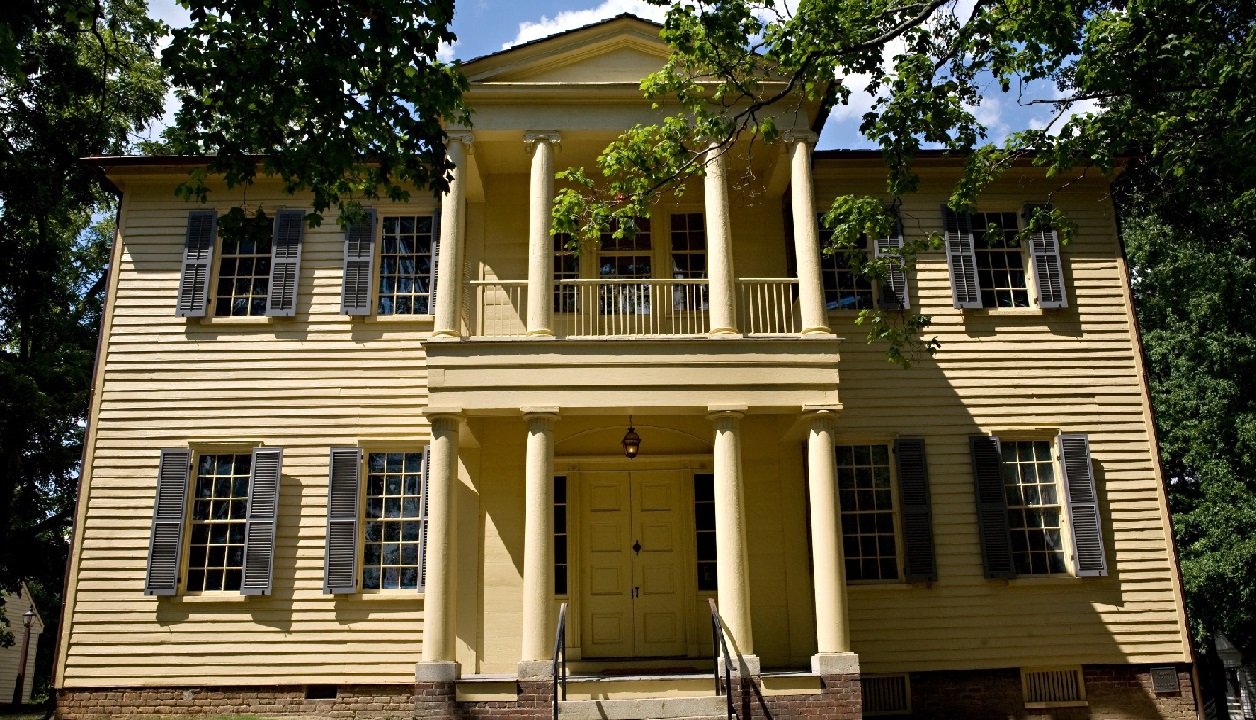
Mordecai Historic Park Museum
The Mordecai House is the oldest house in Raleigh in its original location. Once the largest plantation in Wake County, it was home to the Lane and Mordecai families and enslaved and freed African Americans from 1785 to the 1960s.
Mordecai Historic Park offers one-hour guided tours of the park’s historic buildings and grounds. Tickets for tours may be purchased at the Visitor Center.
Tours leave the Visitor Center at the top of the hour, beginning at 10 a.m., and the last tour leaves at 3 p.m. Each tour is approximately 60 minutes long. Self-guided tours of the building exteriors and park grounds are available when the park is open. Stop by the Visitor Center to pick up a self-guided map to begin your tour. Please note that visitors may only enter park buildings on a guided tour.
Offers tours and interpretation of largest plantation in Wake County, North Carolina, home to the Lane and Mordecai families and enslaved and freed African Americans from 1785 to the 1960s.
Morgan Waterman
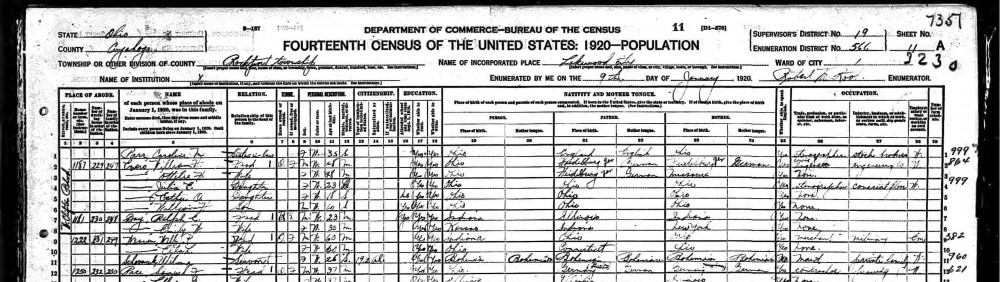
The incarceration rate in the United States today is so high that it can only be described as a pattern of mass incarceration. Worse, this system of mass incarceration operates through structures of gendered and racial discrimination which unfairly target black men. Societal racism in the forms of federal policy and residential segregation produce and normalize this discrimination. However, racial ideologies and practices, as well as segregation, have differed geographically throughout United States history. I examine the racial dynamics of incarceration on a state level, asking how racism and segregation have intersected with the demographics of incarceration in the United States over the last 90 years. Since women make up such a small proportion of the prison population, I narrow my focus to the mass incarceration of men, specifically the disproportionate representation of black men in American prisons.
An article that tells a narrative of U.S. history through census data.
Morris Hilquit, Samuel Gompers, Max J. Hayes
Testimonials and debate between Samuel Gompers, president of the American Federation of Labor, and Morris Hilquit, leader of the Socialist Party of America. This text reveals the similarities and differences in the AFL's and SP's politics.
Testimonials and debate between Samuel Gompers, president of the AFL, and Morris Hilquit, leader of the Socialist Party

Mother Jones
The miners and railroad boys of Birmingham, Ala., entertained me one evening some months ago with a graphic description of the conditions among the slaves of the Southern cotton mills. While I imagined that these must be something of a modern Siberia, I concluded that the boys were overdrawing the picture and made up my mind to see for myself the conditions described. Accordingly I got a job and mingled with the workers in the mill and in their homes. I found that children of six and seven years of age were dragged out of bed at half-past 4 in the morning when the task-master's whistle blew. They eat their scanty meal of black coffee and corn bread mixed with cottonseed oil in place of butter, and then off trots the whole army of serfs, big and little. By 5:30 they are all behind the factory walls, where amid the whir of machinery they grind their young lives out for fourteen long hours each day. As one looks on this brood of helpless human souls one could almost hear their voices cry out, "Be still a moment, O you iron wheels or capitalistic greed, and let us hear each other's voices, and let us feel for a moment that this is not all of life."
Mother Jones, originally appearing in the International Socialist Review, published by the Charles H. Kerr Company, in Chicago, March, 1901.
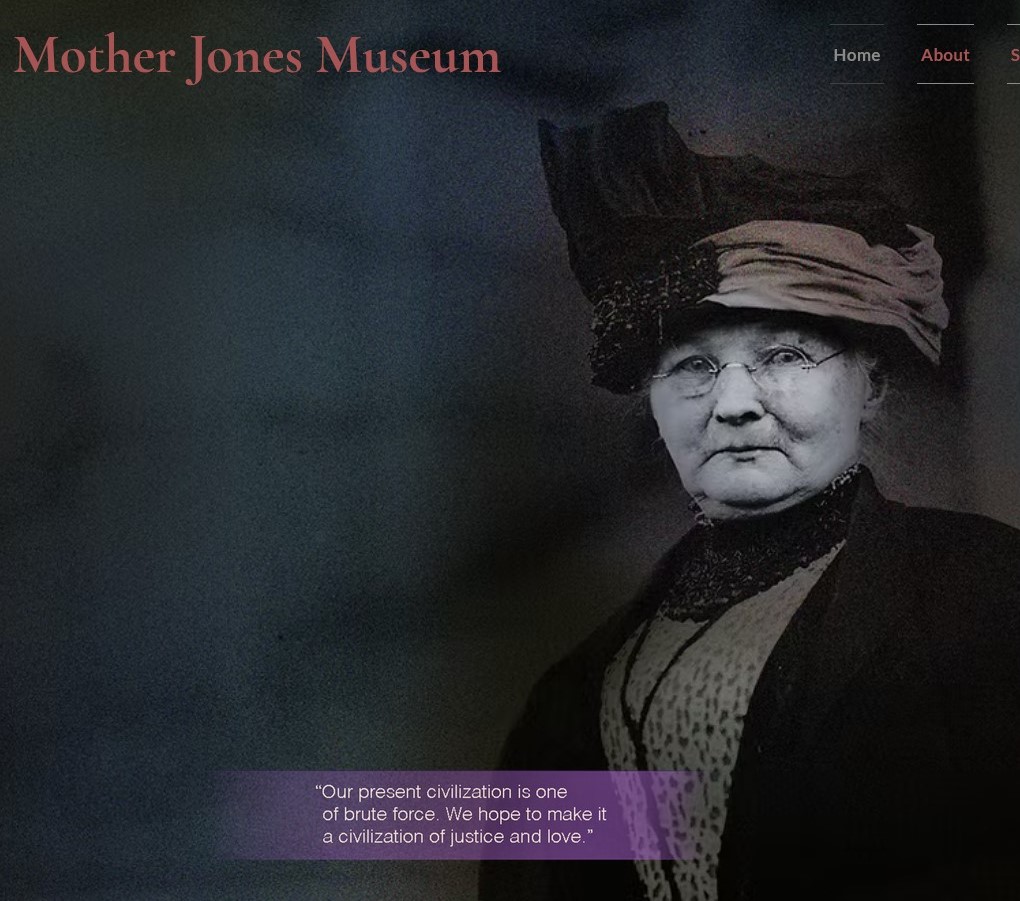
Mother Jones Heritage Project
Mother Jones Museum is the website of the Mother Jones Heritage Project. The project is guided by the philosophy & model of Mother Jones, whose base was in Chicago, but who travelled s the US to organize and fight for justice. So while the Mother Jones Museum has traditional museum exhibits in several locations, it takes Mother Jones on the road, creates ways for people to experience her continuing relevance and the weight of the past on the present. The museum is currently sponsoring a campaign to put her on a statue in Chicago. It will go up in a place designated as Mother Jones Plaza by the City, and will be near Trump Tower.
The museum's core project originated in 2014, inspired by the Cork Spirit of Mother Jones Festival. This website originated in 2008, as a project to revive Mother Jones and the early history of the activist labor and immigrant movement. The museum is proud to work with partners across the U.S. and the globe.
A digital and physical museum dedicated to advocating for the relevance of Mary Harris "Mother" Jones' contributions to the U.S. labor movement, particularly as this goal pertains to remembrance, and Mother Jones' historical relevancy in the present.
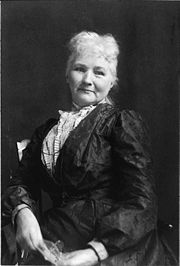
Mother Jones, Pennsylvania State University
Indiana University of Pennsylvania
Correspondence from Mother Jones to John Brophy
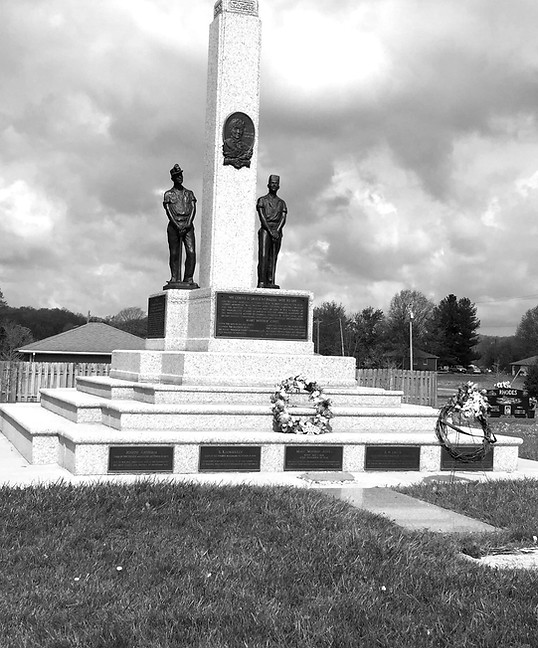
MotherJonesMuseum.org, Rosemary Feurer
This is a unique place in the history of the labor movement; it was the only union-owned cemetery in the country. This is a place with a monument to Mother Jones, but it also evokes the power and potential of the labor movement. It is a place of reflection and remembering, of thinking of the labor movement’s roots. It is a shrine not only to Jones but to the sacrifices that connected human rights and labor rights, a place where people wonder when and why labor lost power.
Other options: The Clio version of the tour. https://theclio.com/entry/70331
Guided tour of the resting place of Mother Jones, and insights into the mine wars of the 1930s
Mount Clare Museum
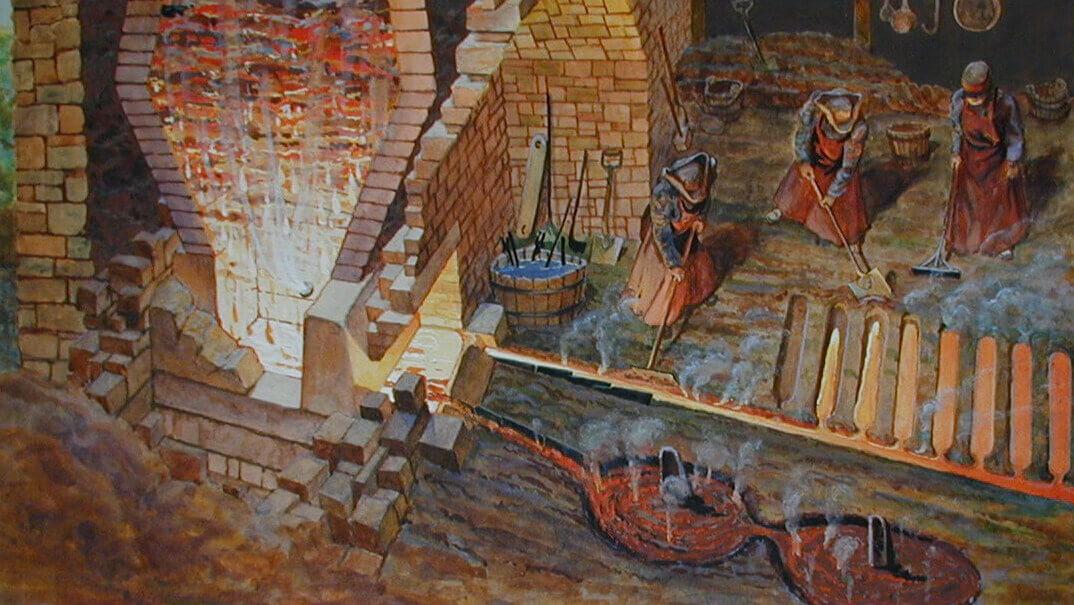
Museum is site of a manor house of a plantation. There are multiple links at this site that are very excellent surveys of paid and unpaid labor, enslaved and indentured, convict labor, and industrialization stories. Mount Clare has a self-guided exhibit on the industrial development of the former plantation and the workers who labored there. A separate display tells the history of the property after three generations of the Carroll family moved out. The museum also showcases its significant collection of 18th and 19th century decorative arts, including paintings, furniture, silver, and export china. Visitors may take a guided one-hour tour of the house or wander through on their own.Endowed with rich iron ore deposits, abundant timber, and navigable waterways, the Baltimore region sustained a long history of iron and steel making. During the colonial period, iron was needed for constructing ships, buildings, weapons, and tools. The Baltimore Iron Works, which operated from 1731 to 1799, was the second iron operation to be organized in the colony, but the first to be locally owned. British investors had established The Principio Company in 1719 in Cecil County.
For nearly 150 years, the primitive but effective cold-blast furnace technology was used by a succession of 13 companies in Baltimore County to manufacture iron. However in 1889, a small firm at Baltimore’s Sparrows Point began producing a stronger, more versatile alloy called steel. By 1954, the Sparrows Point mill, then owned by Bethlehem Steel, was the largest in the world. Its dominance would not last. Technological advances and foreign competition forced it into bankruptcy by 2001. Today, the former steel plant is a distribution center for retailers like Amazon and Under Armour.
Museum exhibits and tours on plantation slavery and industrialization
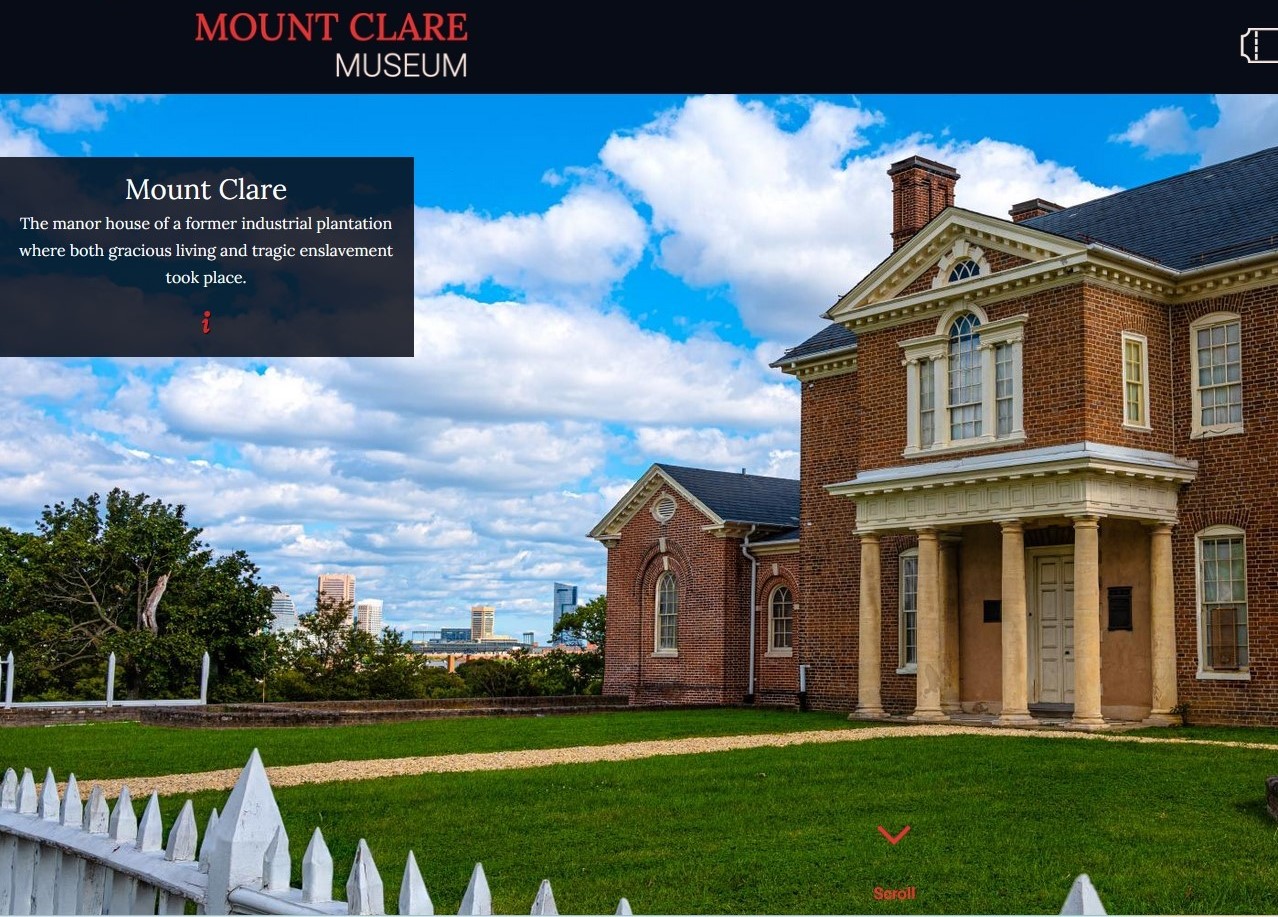
Mount Clare Museum
Mount Clare has a self-guided exhibit on the industrial development of the former plantation and the workers who labored there. Visitors may take a guided one-hour tour of the house or wander through on their own.
Mount Clare Museum is dedicated to preserving the house, a National Historic Landmark, and its supporting collections in a way that authentically represents and contextualizes life in Maryland since the 18th century and explores how the past continues to affect life in America today. The museum strives to tell the stories of all who lived and worked at Mount Clare and Georgia Plantation, including the Carroll family, enslaved people, indentured servants and transported convicts.
A self-guided exhibit on the industrial development of the Mount Claire and the workers who labored there.
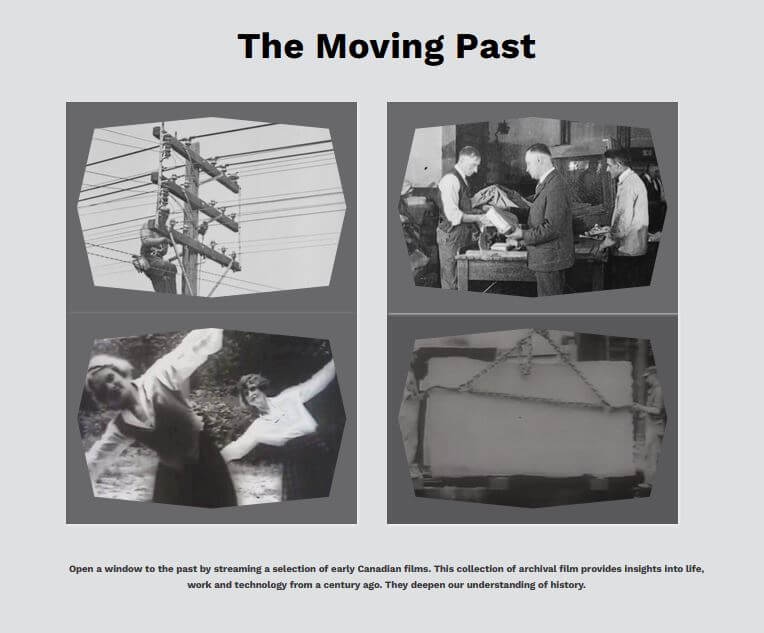
Moving Past
Made between 1918 and 1929, these Canadian films are a useful resource for historical research and teaching. They also complement other primary sources. Widely viewed and popular with the public at the time, they are useful for understanding how perceptions and perspectives were influenced and constructed. For more detailed views of the film
This specific Library and Archives Canada film collection is significant, exceeding 1,000 films. Their subjects are diverse and will be of interest to labour and social historians; better farming techniques, celebrations of industrial technology, scenic vacation spots for the leisure class and appropriate workplace behavior, are just some subjects addressed by the films in the collection. More detailed descriptions of each film can be found here
Open a window to the past by streaming a selection of early Canadian films. This collection of archival film provides insights into life, work and technology from a century ago. They deepen our understanding of history.
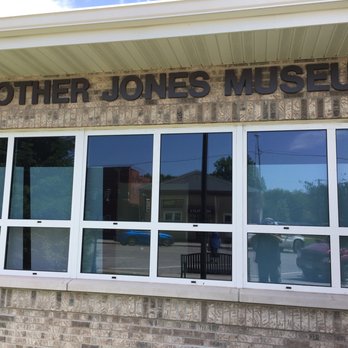
Mt. Olive City Hall
City-owned Mother Jones Museum focuses on the local story of the coal mners of the area, in a room in City Hall
A one room museum that focuses on the local story of the coal miners of the area
Murphy O’Hea, History Matters
Religious concepts and metaphors suffused the words and ideas of many late nineteenth-century American workers. The New and Old Testaments provided not only personal succor to many working people but also a set of allusions and parables they applied directly to their lives and struggles in industrial America. Working-class ideas and writing often were cast in stark millenarian terms, with prophesies of imminent doom predicted for capitalists who worshipped at Mammon’s temple and imminent redemption for hard-working, long-suffering, and God-fearing laboring men and women. Christ was uniformly depicted in workers' writing as a poor workingman put on Earth to teach the simple principles of brotherhood and unionism. In this 1897 essay in the Railway Times, titled “Christ,” Murphy O’Hea suggested that Jesus Christ’s early career as a “poor humble carpenter” proved "that the cause of Labor is holy."
Source: Murphy O’Hea, “Christ,” The Railway Times, 1 November 1895.
An 1897 essay in the Railway Times written by Murphy O'Hea, who relates Jesus Christ's career with the validity of the labor movement.
Murray Plopper, History Matters
Recommendations by the National War Labor Board during World War II to pay male and female workers equal wages yielded few changes in the gender wage gap. Women continued to receive less money for comparable work, and into the 1960s want ads characterized jobs as “male” or “female” with resulting salary differences based on gender. The Equal Pay Act (EPA) made it illegal to pay men and women differently for similar work. Although the EPA was passed in 1963, it was debated in workplaces and courtrooms for decades thereafter. In this Senate hearing testimony, union leader Murray Plopper argued that the “race against the Communist bloc of nations” demanded an end to gender discrimination. Plopper used specific examples of retail clerks’ working conditions and earnings to argue for passage of the law. He also noted that “women work because they must” and challenged the provisions of the law that would exempt small stores.
argues that the “race against the Communist bloc of nations” demanded an end to gender discrimination
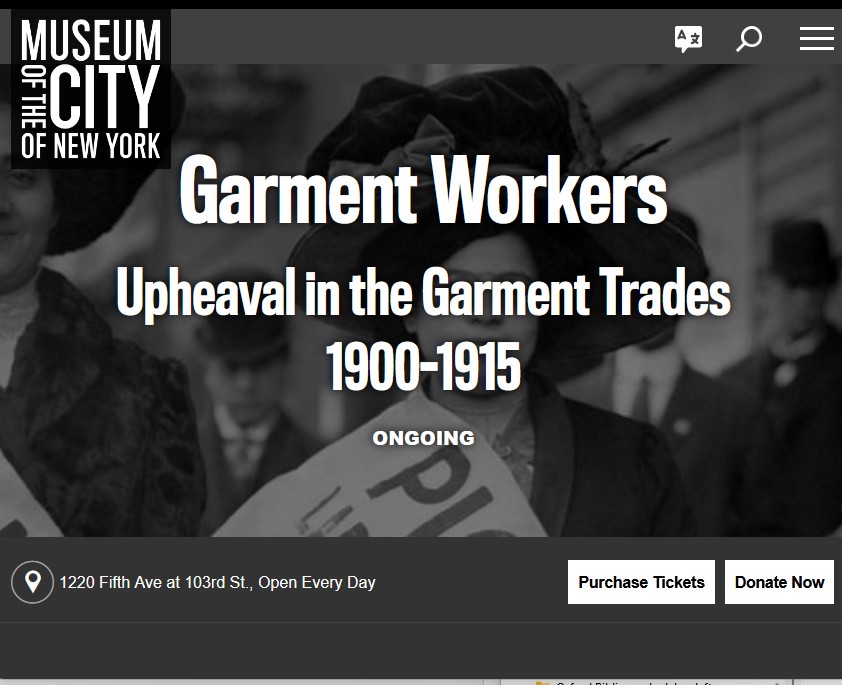
Museum City of New York staff
Through analyzing photographs, illustrations, objects, and flyers, students will learn about the complex relationship between organized labor and civil rights activism, including efforts to desegregate labor unions as well as the role unions played in the fight for racial equality. Key figures: Ella Baker, Frank Ferrell, Reverend Milton Galamison, Reverend Martin Luther King, Jr., Mae Mallory, Rhody McCoy, Albert Shanker
Standards and goals and procedure outlined for each lesson. 1880-1970
A lesson plan that helps students analyze primary source materials that highlight the relationship between labor and civil rights activism.
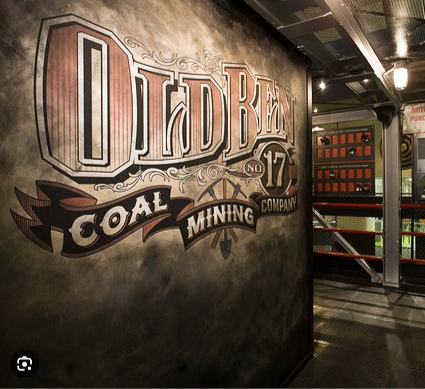
Museum of Science and Industry
Take a a trip down a recreated coal mine right in downtown Chicago! Also take time to see the American Factory Worker Sculptures located on museum grounds.
includes some workplace elements, including a trip down a virtual mine
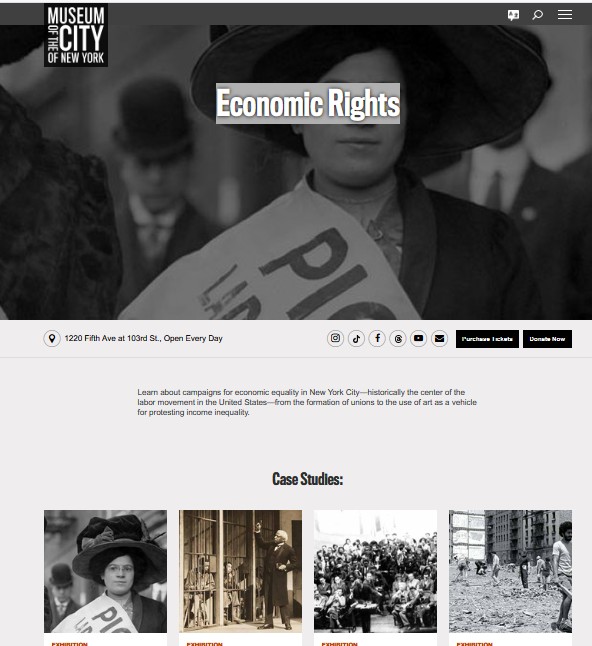
Museum of the City of New York
Upheaval in the Garment Trades | 1900-1915 In the early 20th century, New York was the largest city and garment production the largest manufacturing business in America. The garment trade was made possible by tens of thousands of immigrant workers, who labored long hours under unsafe conditions in crowded tenements or factories
Activist Literature
In the 1930s, in the midst of the Great Depression, many New York writers used novels and poems as tools to address the working class, or “proletariat.” Using the written word to advance their political agenda, these writers espoused their views on class, communism, and global affairs. This movement “does not believe in literature for its own sake,” explained writer and editor Mike Gold, “but in literature that is useful, has a social function.”
Young Lords
“¡Basta ya!”—”Enough!” was the feeling of Young Lords member Mickey Melendez and other East Harlem activists. It was the summer of 1969, and the group had blocked traffic on 110th Street with piles of garbage to protest inadequate sanitation services. They had already asked the city for brooms to clean their neighborhood’s streets and, when refused, they went ahead and took them.
South Bronx
In the decades after the new Cross-Bronx Expressway bisected the South Bronx in the 1950s, abandonment and arson claimed large swaths of the borough. Facing diminishing revenues, some landlords were accused of burning their own buildings.
Young Lords
“¡Basta ya!”—”Enough!” was the feeling of Young Lords member Mickey Melendez and other East Harlem activists. It was the summer of 1969, and the group had blocked traffic on 110th Street with piles of garbage to protest inadequate sanitation services. They had already asked the city for brooms to clean their neighborhood’s streets and, when refused, they went ahead and took them. Housing Activism
Learn about a powerful period of rent strikes, tenant mobilizations, and policy reforms that laid the groundwork for housing justice movements still shaping our city today.
Learn about campaigns for economic equality in New York City—historically the center of the labor movement in the United States—from the formation of unions to the use of art as a vehicle for protesting income inequality.
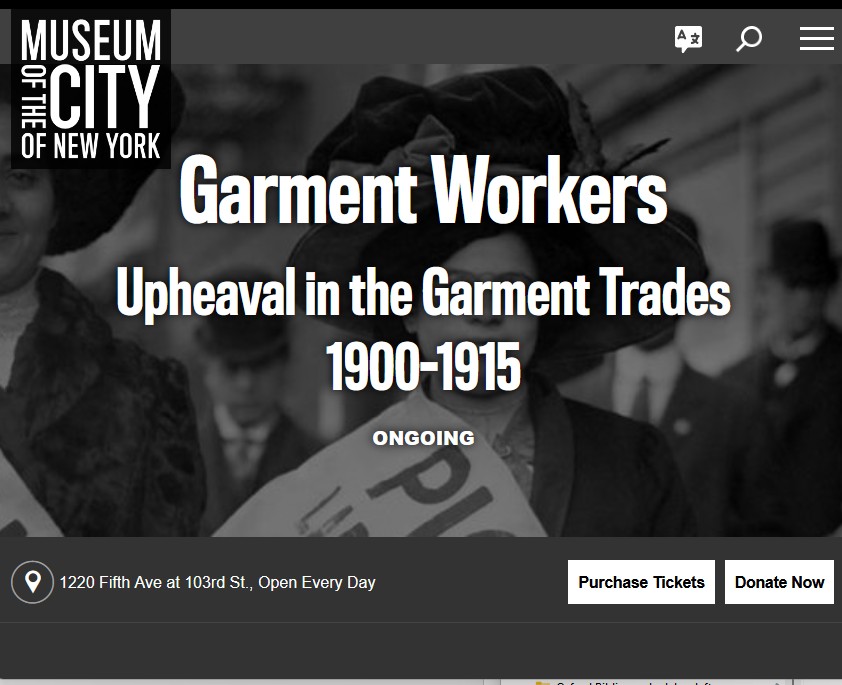
Museum of the City of New York
A multi-part exhibit with digital material on-line. Includes a lesson plan that is driven by documents and photos examined critically.
In the early 20th century, New York was the largest city and garment production the largest manufacturing business in America. The garment trade was made possible by tens of thousands of immigrant workers, who labored long hours under unsafe conditions in crowded tenements or factories.
On November 22, 1909, immigrant worker Clara Lemlich of the International Ladies’ Garment Workers’ Union (ILGWU) called for a General Strike. Lemlich’s “Uprising of the Twenty Thousand” and a devastating fire at the Triangle Waist Company factory in Greenwich Village in 1911 illuminated the contributions of working women and made labor unions key players in the life of the city.
New York working people had been organizing unions since 1794, when the city’s industrial revolution began creating wage workers distinct from business owners. But the garment activists of 1909-1911 transformed the city’s labor movement and ushered in a new era, one in which labor unions—and working women in particular—became central players in the city’s economy.
Alongside labor activists, elected officials and Tammany Hall reformers made New York a model of workplace legislation, and unions became crucial to Franklin D. Roosevelt’s New Deal.
Yet in the mid-20th century, many garment factories left in search of lower costs and fewer regulations, and union power diminished. Unions criticized manufacturers for abandoning New York, while manufacturers blamed unions for keeping labor costs too high. But in recent years, organized labor has made new inroads in the service economy, and the garment industry has renewed its emphasis on “Made in New York.”
An multi-part physical and digital exhibit that is ongoing, including a lesson plan that uses photos and images covering the International Ladies' Garment Workers Union
Myra K Wolfgang, Lena Miller, History Matters
In the years following the 1920 ratification of the 19th Amendment extending voting rights to women, the National Woman’s Party, the radical wing of the suffrage movement, advocated passage of a constitutional amendment to make discrimination based on gender illegal. The first Congressional hearing on the equal rights amendment (ERA) was held in 1923.
Many female reformers opposed the amendment in fear that it would end protective labor and health legislation designed to aid female workers and poverty-stricken mothers. A major divide, often class-based, emerged among women’s groups. While the National Woman’s Party and groups representing business and professional women continued to push for an ERA, passage was unlikely until the 1960s, when the revived women’s movement, especially the National Organization for Women (NOW), made the ERA priority.
The 1960s and 1970s saw important legislation enacted to address sex discrimination in employment and education—most prominently, the Equal Pay Act of 1963, Title VII of the Civil Rights Act of 1964, and Title IX of the 1972 Higher Education Act—and on March 22, 1972, Congress passed the ERA. The proposed amendment expired in 1982, however, with support from only 35 states - three short of the required 38 necessary for ratification.
Strong grassroots opposition emerged in the southern and western sections of the country, led by anti-feminist activist Phyllis Schafly. Schlafly charged that the amendment would create a “unisex society” while weakening the family, maligning the homemaker, legitimizing homosexuality, and exposing girls to the military draft.
In the following 1970 Senate hearing, two representatives of labor unions voiced opposition to the ERA, arguing that it would threaten protective legislation based on gender difference.
Source: Congress, Senate, Committee on the Judiciary, Equal Rights 1970: Hearings before the Committee on the Judiciary, 91st Cong., 2d sess., September 9, 10, 11, and 15, 1970, (Washington: U.S. Government Printing Office, 1970).
two women representatives of labor unions voiced opposition to the ERA, arguing that it would threaten protective legislation based on gender difference, in 1970
Myron R. Stowell, History Matters
Myron R. Stowell's account of the 1892 Homestead Strike, or "the story of the most exciting climax in the history of Labor versus Capital." According to Stowell, he witnessed the events of Homestead firsthand and recounted them in this book alongside other participants' recollections, official military reports, court records, and newspapers.
A witness to the Homestead strike discusses recollections
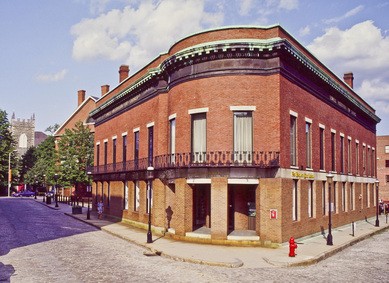
NEH Edsitement
This walking tour of the historic center of Lowell focuses on labor and industry, and the ways they shaped the fabric of everyday life in Lowell.
This walking tour of the historic center of Lowell focuses on labor and industry, and the ways they shaped the fabric of everyday life in Lowell.
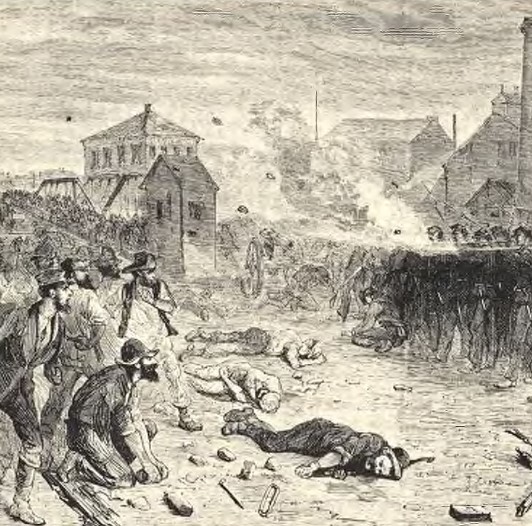
NIU digitization
The NIU Digital Library contains a rich collection of photographs from the 1894 Pullman Strike. Most of the collection contains pictures of the Pullman grounds. Among the best for a project or analysis could be a map of Pullman in relation to the then-Chicago suburbs, images of the “Working-Men’s Cottages,” a picture of the Illinois National Guard in front of the Arcade Building during the strike, or the statement of John Altgeld in the 1895 US v. Debs case. Most prominently, the Pullman collection features anti-labor political cartoons from 1894 editions of Harper’s Weekly, such as “The Vanguard of Anarchy” and “King Debs.” --Jack Vavrinchik
Use this guide to navigate the site:
Site navigation: >Browse
> Subject, select Topic.
> “Labor”
> “Pullman Strike, 1894” NOTE: The subject filter “Strikes and Lockouts—Railroads—United States, pulls up the same information.
Some important sources on the Pullman Strike can be found outside of the “Pullman Strike, 1894” subject filter. Among them are the full Report of the Chicago Strike of June-July, 1894, from the U.S. Strike Commission and a history of the Pullman Strike authored by Eugene Debs, John Altgeld, and W.F. Burns in 1894.To access the full list, open and advanced search, put “Pullman Strike” under search terms, and select “all collections.”
hundreds of items including text and photos
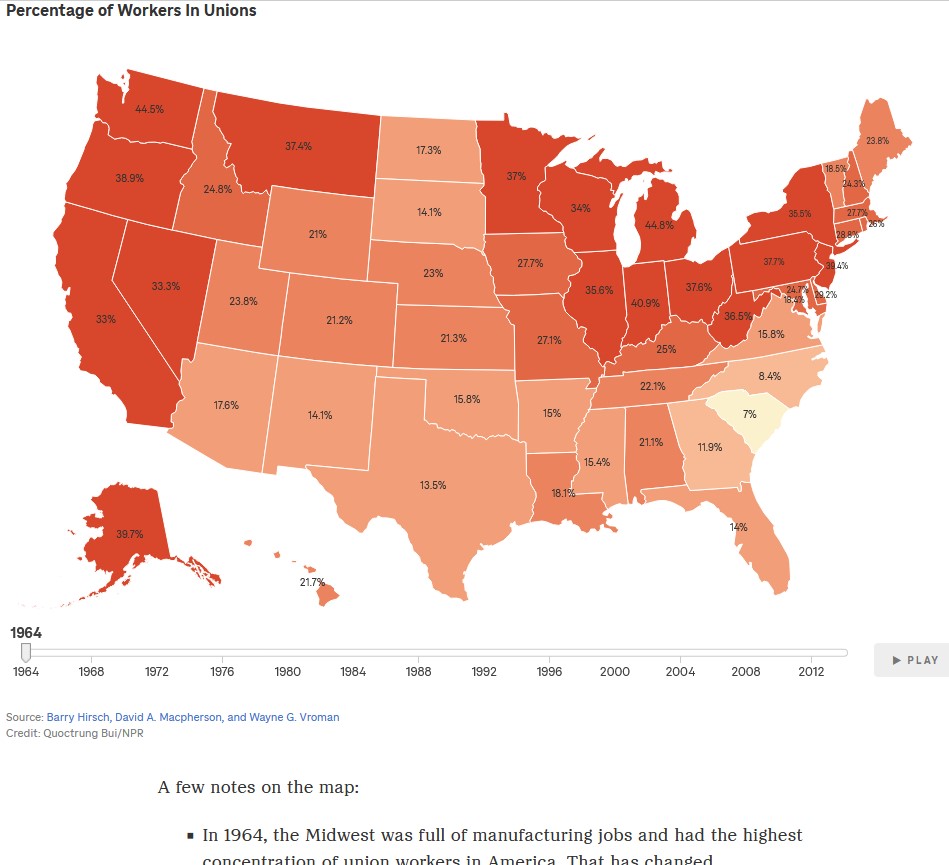
NPR
From 2015-Fifty years ago, nearly a third of U.S. workers belonged to a union. Today, it's one in 10. But the decline has not been the same for every state. Here is a map showing how union membership has changed across the country.
A graphic demonstration of decline in membership, by state
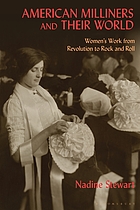
Nadine Stewart
Studies of millinery tend to focus on hats, rather than the extraordinarily skilled workers who create them. American Milliners and their World sets out to redress the balance, examining the position of the milliner in American society from the 18th to the 20th century. Concentrating on the struggle of female hat-makers to claim their social place, it investigates how they were influenced by changing attitudes towards women in the workplace.
Drawing on diaries, etiquette books, trade journals and contemporary literature, Stewart illustrates how making hats became big business, but milliners' working conditions failed to improve. Taking the reader from the Industrial Revolution of the 1760s to the sexual revolution of the 1960s, and from Belle Epoque feathers to elegant cloches and Jackie Kennedy's pillbox hat, the book offers a new insight into the rise and fall of a fashionable industry.
Beautifully illustrated and packed with original research, American Milliners and their World blends fashion history and anthropology to tell the forgotten stories of the women behind some of the most iconic hats of the last three centuries.
This book examines the social world of the American milliner from the 18th century to the 1960s, focusing on the female workers who made the hats, and their struggle to assume a position in society"-- Provided by publisher
Museum/Exhibits
Tours
Maps
Digital Projects
Organizations
Sites
Film/Video
Audio/Interview
Podcast/Program
Text/Document
Image
Graphs/Data
Timeline
Southwest
West
Midwest
Southeast
Northeast
Mexico
Canada
Global
Books
Teaching
Lectures
Digital Archives
Journals
Bibliographies
Topic Intro