


Collections
Library
Type
Region
Coverage:
-
Published:
-
Nelson Lichtenstein
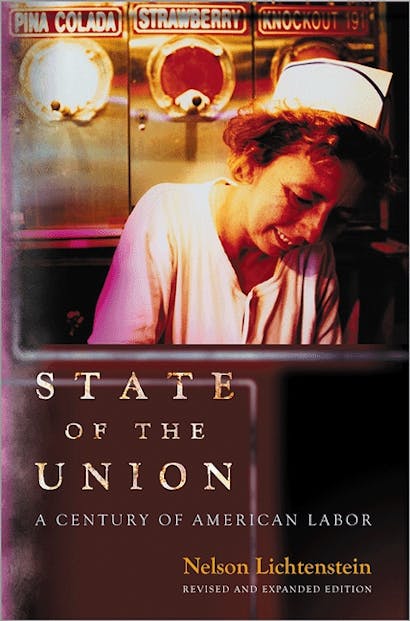
The "labor question" became a burning issue during the Progressive Era because its solution seemed essential to the survival of American democracy itself. Beginning there, Lichtenstein takes us all the way to the organizing fever of contemporary Los Angeles, where the labor movement stands at the center of the effort to transform millions of new immigrants into alert citizen unionists. He offers an expansive survey of labor's upsurge during the 1930s, when the New Deal put a white, male version of industrial democracy at the heart of U.S. political culture. He debunks the myth of a postwar "management-labor accord" by showing that there was (at most) a limited, unstable truce. Lichtenstein argues that the ideas that had once sustained solidarity and citizenship in the world of work underwent a radical transformation when the rights-centered social movements of the 1960s and 1970s captured the nation's moral imagination. The labor movement was therefore tragically unprepared for the years of Reagan and Clinton: although technological change and a new era of global economics battered the unions, their real failure was one of ideas and political will. Throughout, Lichtenstein argues that labor's most important function, in theory if not always in practice, has been the vitalization of a democratic ethos, at work and in the larger society. To the extent that the unions fuse their purpose with that impulse, they can once again become central to the fate of the republic. State of the Union is an incisive history that tells the story of one of America's defining aspirations
Lichtenstein's take on labor's fate
Nelson Lichtenstein
Walter Reuther, the most imaginative and powerful trade union leader of the past half-century, confronted the same problems facing millions of working Americans today: how to use the spectacular productivity of our economy to sustain and improve the standard of living and security of ordinary Americans. As Nelson Lichtenstein observes, Reuther, the president of the United Automobile Workers from 1946 to 1970, may not have had all the answers, but at least he was asking the right questions. The Most Dangerous Man in Detroit vividly recounts Reuther's remarkable ascent: his days as a skilled worker at Henry Ford's great River Rouge complex, his two-year odyssey in the Soviet Union's infant auto industry in the early 1930s, and his immersion in the violent labor upheavals of the late 1930s that gave rise to the CIO. Under Reuther, the autoworkers' standard of living doubled
recounts Walter Reuther's remarkable ascent into the auto industry and union politics.
Nelson Lichtenstein
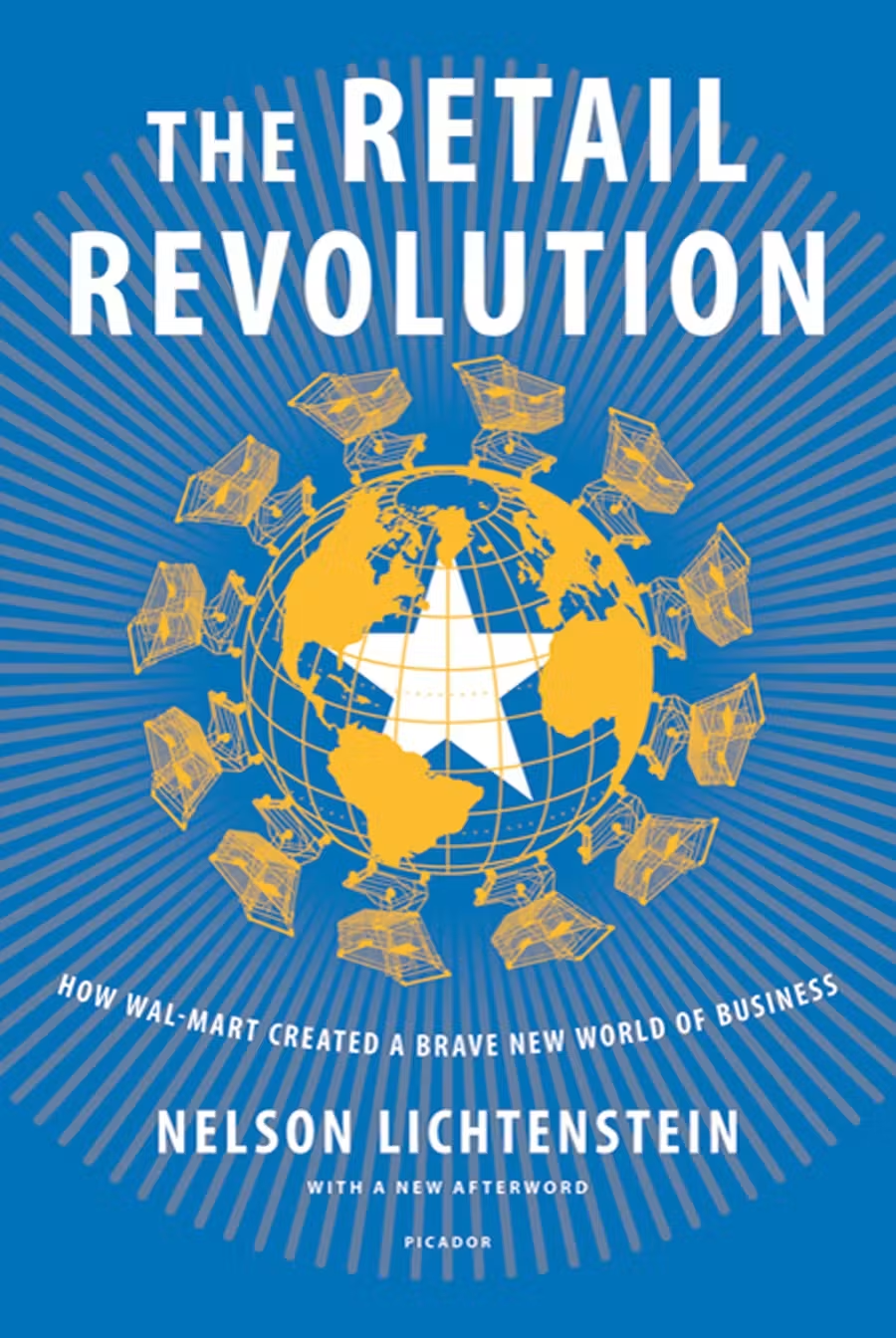
Insightful, original, and steeped in the culture of retail life, "The Retail Revolution" draws on first-hand reporting from coastal China to rural Arkansas to give a fresh and necessary understanding of how Wal-Mart has transformed international commerce
draws on first-hand reporting to give a fresh and necessary understanding of how Wal-Mart has transformed international commerce.
Nelson Lichtenstein
This title explores the multifaceted history and range of conservative hostility toward unionism, opening the door to a fascinating set of individuals, movements, and institutions that help explain why, in much of the popular imagination, union leaders are always 'bosses' and trade union organizers are nothing short of 'thugs'
ntroduction. Entangled histories: American conservatism and the U.S. labor movement in the twentieth and twenty-first centuries / Nelson Lichtenstein, Elizabeth Tandy Shermer
Unions, modernity, and the decline of American economic nationalism / Andrew Wender Cohen
The American legion and striking workers during the interwar period / Christopher Nehls
Democracy or seduction? The demonization of scientific management and the deification of human relations / Chris Nyland, Kyle Bruce
Capital flight, "states' rights," and the anti-labor offensive after World War II / Tami J. Friedman
Orval Fau bus and the rise of anti-labor populism in northwestern Arkansas / Michael Pierce
"Is freedom of the individual Un-American?" Right-to-work campaigns and anti-union conservatism, 1943-1958 / Elizabeth Tandy Shermer
Singing "The right-to-work blues": the politics of race in the campaign for "voluntary unionism" in postwar California / Reuel Schiller
Whose rights? Litigating the right to work, 1940-1980 / Sophia Z. Lee
"Such power spells tyranny": business opposition to administrative governance and the transformation of fair employment policy in Illinois, 1945-1964 / Alexander Gourse
Pattern for partnership: putting labor racketeering on the nation's agenda in the late 1950's / David Witwer
"Compulsory unionism": Sylvester Petro and the Career of an anti-union idea, 1957-1987 / Joseph A. McCartin, Jean-Christian Vinel
Wal-Mart, John Tate, and their anti-union America / Nelson Lichtenstein
"All deals are off": The Dunlop Commission and employer opposition to labor law reform / John Logan
Is democracy in the cards? A democratic defense of the Employee free choice act / Susan Orr
explores the multifaceted history and range of conservative hostility toward unionism.
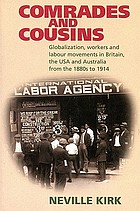
Neville Kirk
"In this ambitious, challenging and innovative study, Neville Kirk focuses on organised labour's attitudes and practices towards class, race and politics in Britain, Australia and the USA during an earlier period of globalization and imperialism, from the 1880s to 1914." "This book advances our knowledge of labour and popular attitudes in new and significant ways and will appeal to all those interested in the past, present and future of the labour movement and other progressive causes in an increasingly globalized context."--Jacket
focuses on organised labour's attitudes and practices towards class, race and politics in Britain, Australia and the USA during an earlier period of globalization and imperialism.

Neville Kirk
A study of workers, organized labour and society in Britain and America from the 18th century to the 20th. The second of a set of two, this study deals with the uneven development of corporate capitalism and responses of employers and the state to workers' organizations, particularly trade unions.
deals with the uneven development of corporate capitalism and responses of employers and the state to workers' organizations, particularly trade unions.
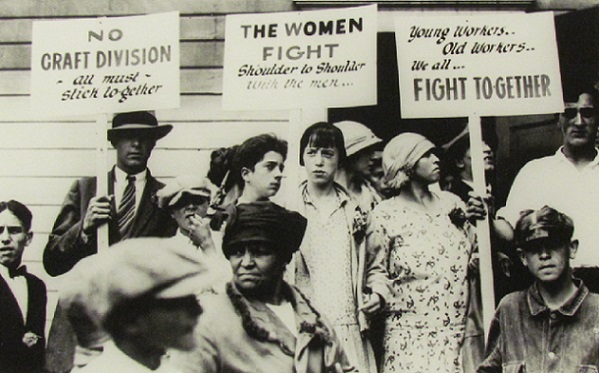
New Bedford Guide
Over 20,000 factory workers went on a strike for six months and ultimately ended in a 5% pay cut, being the largest labor strike in New England during the 1920s. This event and continuing pressure from the unions which were growing in strength injured the textile industry and contributed to its eventual downfall. Many owners simply relocated their factories further south.
short story of the New Bedford 1928 Textile Strike

New Haven Trades Council
The masthead of the Connecticut Labor Press of 1920 declared the 3-cent weekly “Organized labor’s only newspaper in New Haven” and “A newspaper for the people.” While certainly a manifestation of the political and social power of the New Haven Trades Council, the paper covered not only local, but also state, national, and international labor news.
The Labor Press editors identified strongly with the relatively moderate craft union and “non-partisan” political perspectives of the president of the American Federation of Labor, Samuel Gompers, as well as the related positions of the Connecticut Federation of Labor (CFL). Numerous editorials identified anti-union employers and Bolsheviks as the twin enemies of trade unionism. Other opinion pieces expressed consternation at the attempts of state legislators and manufacturers to associate the Labor Press with “the radical element” and reminded labor’s detractors that the CFL had eradicated the influence of the factory militants who had gone on strike during the war in Bridgeport. Still other editorials chastised the activists of the Hartford Central Labor Union, a group that insisted on running candidates under the umbrella of the American Labor Party.
New Haven Trades Council newspaper, covered not only local, but also state, national, and international labor news.

New Haven Trades Council
The masthead of the Connecticut Labor Press of 1920 declared the 3-cent weekly “Organized labor’s only newspaper in New Haven” and “A newspaper for the people.” While certainly a manifestation of the political and social power of the New Haven Trades Council, the paper covered not only local, but also state, national, and international labor news.
The Labor Press editors identified strongly with the relatively moderate craft union and “non-partisan” political perspectives of the president of the American Federation of Labor, Samuel Gompers, as well as the related positions of the Connecticut Federation of Labor (CFL). Numerous editorials identified anti-union employers and Bolsheviks as the twin enemies of trade unionism. Other opinion pieces expressed consternation at the attempts of state legislators and manufacturers to associate the Labor Press with “the radical element” and reminded labor’s detractors that the CFL had eradicated the influence of the factory militants who had gone on strike during the war in Bridgeport. Still other editorials chastised the activists of the Hartford Central Labor Union, a group that insisted on running candidates under the umbrella of the American Labor Party.
On January 21, 1921, the publication of the Labor Press was taken over directly by I. M. Ornburn, long a leader of the New Haven Trades Council, now also president of Ornburn Press. The Labor Press was renamed the Labor News. The announcement of the transfer of ownership hinted at troubling developments that “forced the new publishers (All Organized Labor Men) to get away from the ‘has been,’” reaffirm the newspaper’s essentially “official” relationship with the CFL and the local Trades Council, and put out a “bigger and better” paper. The new publisher’s statement said that the Labor News would be “an exponent of justice to all, a square deal to employer and employee alike, with a desire to serve the best principles of trade unionism and at the same time create a better understanding and co-operation between capital and labor.”
Nonetheless, the content of the Connecticut Labor News reflected the deep divide between moderate trade unionists and the Connecticut legislators, manufacturers, and Chambers of Commerce who advocated the “American Plan” for ridding the state of the closed shop, the 40-hour week, and certain conditions of work. Each issue of both the Press and the News described ongoing employer efforts to increase productivity and lower costs in various branches of construction and industry, including textile and brass, as well as union efforts to organize a defense of the status quo. Political struggles over the post-war re-privatization of the railways, high prices and “profiteering,” a state “anti-strike bill,” the open shop, the use of the court injunction against collective labor action, attempts to install “city manager”-type municipal governments, and the Child Labor Amendment of 1924 were the kind of topics treated in-depth weekly. Connecticut visits by prominent American Federation of Labor leaders sent to rally the troops, and sermons by clerics opposed to the open shop, were given much attention. Syndicated fiction, feature columns, cartoons, sports, and a women’s page offered some respite from all this deeply serious news.
On March 14, 1925, the Ornburn Press announced that the Connecticut Labor News would suspend publication and reopen later in the year under new management, but no successor publication is known to exist.
“Organized labor’s only newspaper in New Haven” and “A newspaper for the people.”
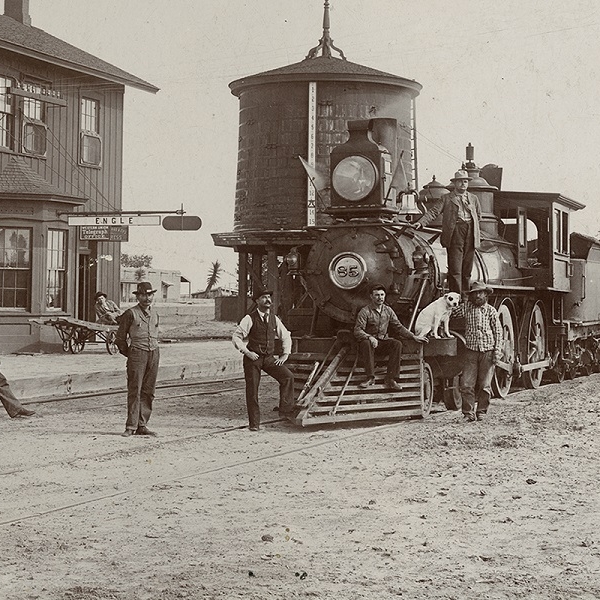
New Mexico History Museum
Working on the Railroad, availalble as a virtual tour (and on exhibit thru 2027) tells another side of New Mexico’s locomotive history that makes no mention of passenger trains or tourism; visitors will leave the exhibition with a greater appreciation of the difficulty of this work. All workers are represented – women, people of color, immigrants, young and old – and most jobs are represented, both on and off the tracks. The exhibit will remain virtually available after that time.
From steel gangs to machinists and car cleaners to conductors, every role in the railroad industry served an important purpose.
Working on the Railroad is featured in the Mezzanine Gallery of the History Museum near the Fred Harvey installation.
Tells another side of New Mexico’s locomotive history that makes no mention of passenger trains or tourism; visitors will leave with a greater appreciation of the difficulty of this work. All workers are represented – women, people of color, immigrants, young and old – and most jobs are represented, both on and off the tracks.
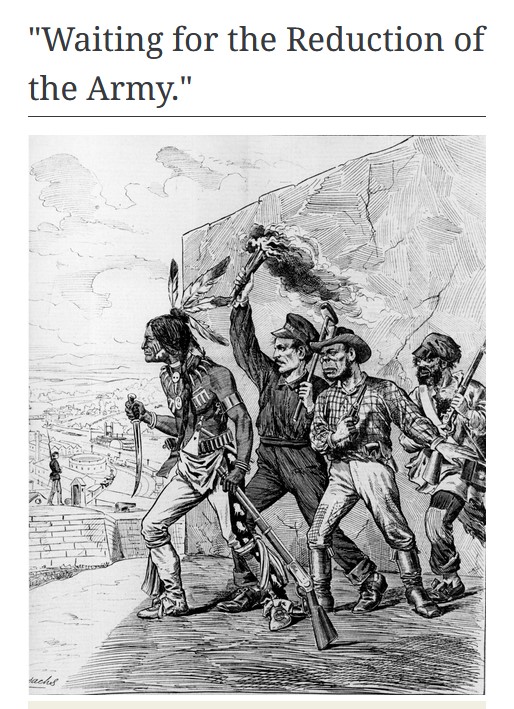
New York Daily Graphic, History Matters
The massive strike of 1877 shook the very foundations of the political and economic order. Begun with a spontaneous railroad strike in West Virginia, the “Great Uprising” spread rapidly across the country, as the entire working populations of many cities went out on strike. Workers across the country along with sympathizers in their communities were galvanized by official violence, as state and federal troops fired on protesters in several cities. As this 1878 cartoon from the New York Daily Graphic indicated, in the aftermath of the strike Indians, trade unionists, immigrants, and tramps were increasingly grouped together in the press as symbols of disorder and opposition to the nation’s progress.
(teaching document/illustration) Indians, trade unionists, immigrants, and tramps were increasingly grouped together in the press as symbols of disorder
New York Firemen, HIstory Matters
One of the greatest industrial tragedies in U.S. history occurred on March 25, 1911, when 146 workers, mostly young immigrant women, died in a fire at the Triangle Shirtwaist company in New York City. In this brief excerpt from their testimony before the Factory Investigation Commission, New York City Fire Chief Edward F. Croker and Fire Marshall William Beers commented on the safety lapses—the locking of an exit door, the inadequate fire escapes, and the overcrowded factory floor—that led to the deaths of the Triangle workers.
Source: State of New York, Preliminary Report of the Factory Investigating Commission, 1912, Vol. II (Albany: The Argus Company, Printers, 1912), 14, 19–20, 21.
(teaching document) Specifics of the Triangle Fire from witness firemen,

New York Labor History Association
The New York Labor History Association (NYLHA) was founded in 1976 by trade unionists, academics, students, archivists, educators, labor editors, attorneys, and retirees, mostly from New York State. NYLHA encourages the study of workers and their organizations and serves as a bridge between past and present labor unionists and academics.
New York Labor History Association hosts events, prizes, book reviews, newsletter

New York Labor History Association, Tamiment Library, Robert F. Wagner Labor Archives
The map documents the history of working men and women in New York City and their struggles to gain concessions such as the eight-hour work day, better pay, improved working conditions, decent and affordable housing, collective bargaining rights, healthcare, and pension plans. It also documents important aspects of the city's political and social history, major union leaders and contributors, and their work to better conditions for workers. The map was created with the hope that people will be able to use the map as an alternative teaching and learning tool.
a map of selected New York City sites that tell the story of labor organizing, strikes, culture, events, organizations

New York Public Library
Over 33,000 photographs. from 1930s-1940s NYPL's Farm Security Administration (FSA) collection is comprised of approximately 40,000 photographs taken during the 1930s and 1940s by Dorothea Lange, Arthur Rothstein, Walker Evans, and Russell Lee, among others. Initially the government project documented the Resettlement Administration’s distribution of cash loans to displaced and struggling farmers and its construction of planned communities, but later broadened its focus to include migratory laborers in the Midwest and West, as well as sharecroppers in the South. Eastern locations including New York, New Jersey, and Connecticut are represented as well. Migratory workers, housing, farm labor, unemployed, cotton strike of 1938, Under the Office of War Information, the agenda shifted to themes of patriotism and war production. NYPL's FSA photographs were transferred to the Wallach Division’s Photography Collection from the Library's Picture Collection.
a vast archive of material from the 1930s and 1940s of farm workers and resettlement camps and war workers

New York Public Library
There are a great number of items in this searchable database. The Yiddish Theater and Actors Union collection is of interest, but a search for workers or labor union returns many results. It also has digitized Farm Security Administration photos from the New Deal agency. For example, the words "labor union"
search over 1 million pages of digital records for labor-related items
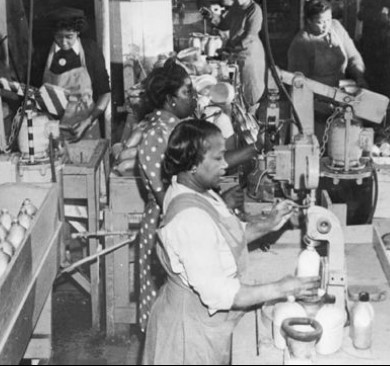
New York Public Library
Collection depicts African Americans engaged in a variety of occupations and date from the 1900s to the 1990s with the bulk of the images being from the 1930s to the 1950s. Images capture blue-collar and white-collar workers performing their jobs. Other collections depicting people at work include Education, Businesses, Military, Farm Security Administration, and the National Youth Administration. Studio and candid portraits of noted individuals from various fields are found in the Portrait Collection. Organized into five series: I. General; II. Business professionals; III. Legal and law enforcement professionals; IV. Medical professionals; V. War industry workers.
The General (1800-1990) series comprises the majority of the collection and documents diverse occupations including air pilots, astronauts, clothing workers, construction workers, disc jockeys, engineers, factory workers, filmmakers, food industry workers, jewelers, journalists, maritime workers, office workers, photographers, realtors, scientists and laboratory technicians, service industry workers, union representatives and transportation workers. Very few images are from the nineteenth century. Of note are a series of images of Pennsylvania Railroad Workers produced for an advertising campaign in the African American press (1940s-1950s).
The Business professionals series (194?-198?) include images of business professionals and employees in the advertising, airline, alcohalic beverage, insurance, entertainment, manufacturing, and publishing industries.
The Legal and law enforcement professionals series (193?-199?) consists of images of judges, lawyers, law clerks, and police officers. Images of law enforcement professionals range from uniformed police officers to commissioners and document on-the-job activities, ceremonies, and community out-reach programs.
The Medical professionals series (192?-199?) shows doctors, nurses, dentists, veterinarians, and medical assistants at work. Included are images of World War II cadet nurses and nurses/nannies from the nineteenth century, one depicting Mary E. Mahoney, the first African American registered nurse in the United States.
The War industry workers series (1942-1946?) documents the contributions of African Americans to the defense industry during World War II. Depicted are men and women laborers engaged in shipbuilding, airplane construction, arms and ammunition manufacturing and construction projects. Women are also shown sewing and preparing uniforms and parachutes. Among the work sites depicted is the Picatinny Arsenal, Dover, New Jersey (1944) where employees are depicted in both on-the-job as well as leisure activities.
Dozens of photos of Black workers on the job
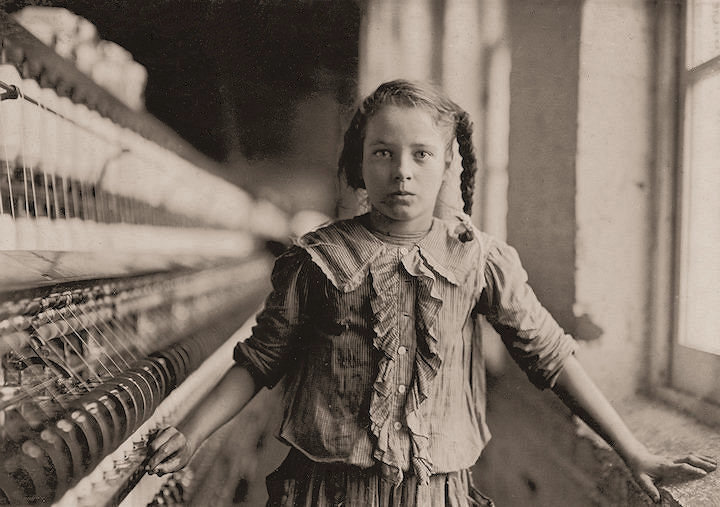
New York Public Library
Interior and exterior views concerning labor in various light and heavy industries, worker's housing and social conditions in the United States including Connecticut, Illinois, New England, New Jersey, New York, North Carolina, Pennsylvania, South Carolina, Tennessee, Virginia and Washington, D.C.
102 photos Interior and exterior views concerning labor in various light and heavy industries, worker's housing and social conditions in the United States including Connecticut, Illinois, New England, New Jersey, New York, North Carolina, Pennsylvania, South Carolina, Tennessee, Virginia and Washington, D.C.
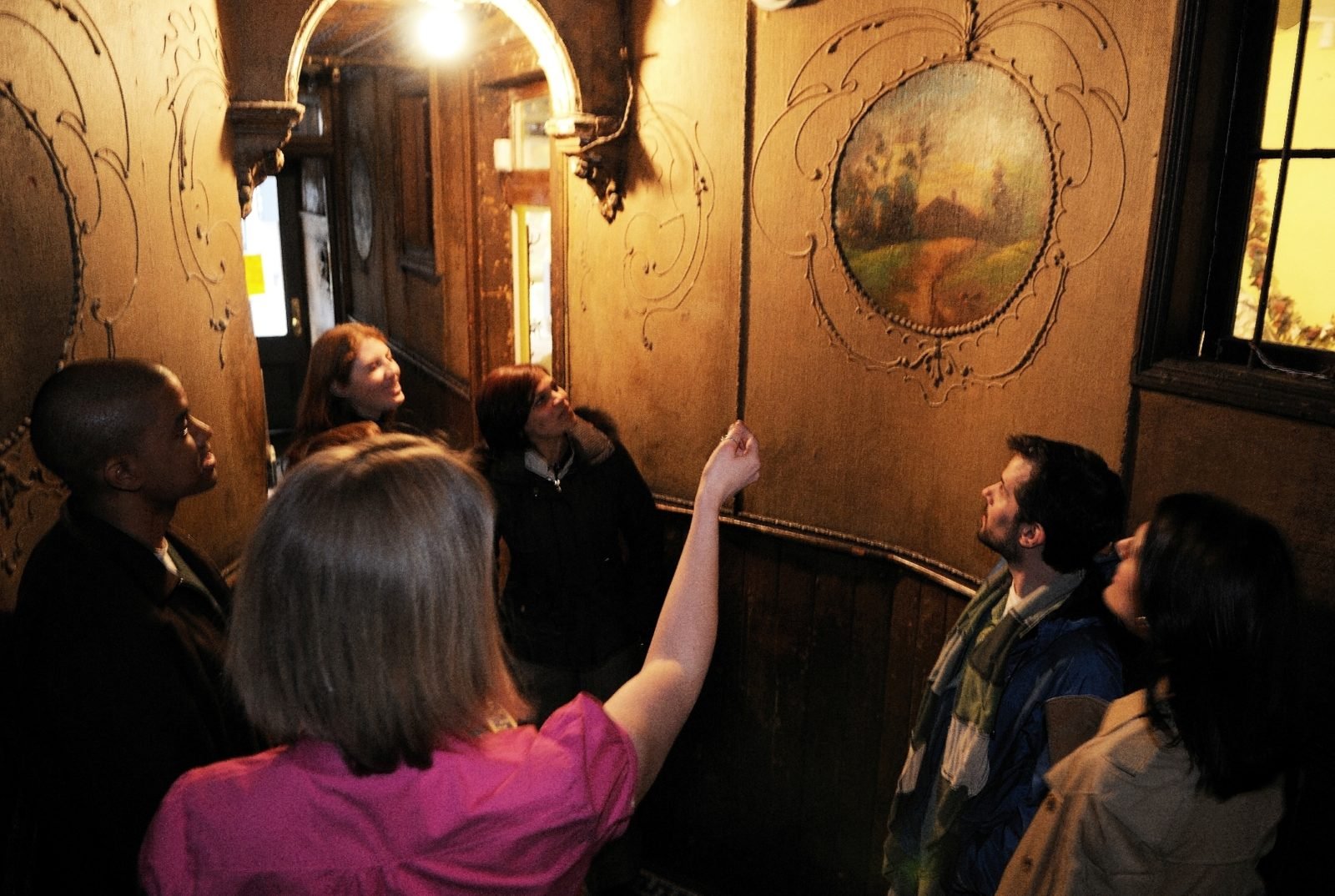
New York Tenement Museum
The NY Tenement Museum tell the stories of working-class tenement residents who moved to New York City from other countries and other parts of the country. Their work helped build the city and nation, and their stories help us understand our history. While textbooks often overlook the stories of ordinary people, Tenement Museum tours immerse visitors in the tenement hallways, kitchens, and parlors where families carved out new lives. The Tenement Museum share primary sources and research that help us explore the stories of tenement families. Public programs, curricula, and the museum's Your Story Our Story website continue the conversation, using our stories as points of departure to connect the past to present.
We aim to build an inclusive and expansive American identity and believe that the exploration of our complex history—one with moments of both inclusion and exclusion—helps prepare us to recognize and discuss today’s complex issues with empathy and nuance.
The main webpage of the New York City Tenement Museum, which emphasizes sharing the history of working-class tenement residents through primary source-based exhibits, events, and exploration. Also regular tours.

New York University
198 digitally interviews at https://findingaids.library.nyu.edu/tamwag/oh_014/audio/ The New York City Immigrant Labor History Project was led by Herbert Gutman, a professor of history at the City College of New York (CCNY), between 1972 and 1976. The project sought to reexamine immigrants' and migrants' patterns of cultural adaptation to urban and industrial life in the early 20th century in order to challenge the prevailing theories in social history at the time. The collection consists of 222 interviews with Eastern European, Irish, Italian, Russian, Scandinavian, and West Indian immigrants and Black and Puerto Rican migrants, most of whom settled in New York, New York between between 1900 and 1930. Topics discussed in the interviews include education, childhood, and early life in the narrators' countries and states of origin; arrival at Ellis Island and first impressions of New York City; assimilation; women's roles in the workforce and in the household; courtship, marriage, and family life; processes of acquiring and retaining work; job responsibilities, wages, and working conditions; ethnic and racial makeup of different workforces, factories, and shops; labor unions and organizing in different industries; ethnic and racial relations in the community and the workplace; living conditions in different neighborhoods in New York City; politics; leisure activities; and religion.
198 digitally available interviews from the 1970s focused on working class and ethnic life in the early 20th century

New York University
This collection consists of thirty-three interviews with women who entered the industrial workforce (automobiles, shipbuilding, aircraft manufacturing, electrical equipment manufacturing, and transportation) during the years of World War II (1939-1945). Topics covered include gender relations and discrimination at work, union experience, industrial work, family roles, transitioning from rural to urban environments, education, race relations, and post-war employment experiences. Transcripts are available for all interviews. Topics covered include gender relations and discrimination at work, union experience, industrial work, family roles, transitioning from rural to urban environments, race relations, and post-war employment experiences. Transcripts are available for all interviews. These interviews were recorded as a part of a collaborative media project by Spargel Productions and New York University's Tamiment Library. These oral histories were created on digital video and portions of them are used in the Spargel Production new media project "The Girl With The Rivet Gun." They are being preserved at the Tamiment Library.
digital video interviews with 37 women who entered workforce during WWII
New York University
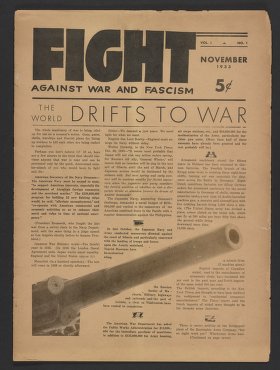
The Fight Against War and Fascism (1933-1939) was published by the American League Against War and Fascism. It was an initiative of the Communist Party, USA, but its membership was very broad and included members of other left-wing groups, trade unions, and African American civic organizations. This digital edition reproduces the holdings of the Tamiment Library & Robert F. Wagner Labor Archives at New York University.
American League Against War and Fascism newspaper has some labor-oriented materials
New York World, History Matters
While many assume that workers in the nineteenth-century American West enjoyed easily available land and a fluid social structure, the region’s history of radical unionism at the turn of the century suggests otherwise. In Cripple Creek, Colorado, for example, violent conflict broke out in 1903 between members of the Western Federation of Miners (WFM) and corporate mining interests determined to crush the union. Before it was over, thirty men were dead and the union was defeated. But the battles of Cripple Creek were fought not only with bullets and dynamite—they were fought with words waged in the press. Telegrams between the New York World, the pro-mine owner governor of Colorado, and WFM Secretary William Haywood underscored how the national press served as a public outlet in which both management and labor explained their motives and actions.
Telegrams between the New York World, the pro-mine owner governor of Colorado, and WFM Secretary William Haywood
New-York Daily Tribune
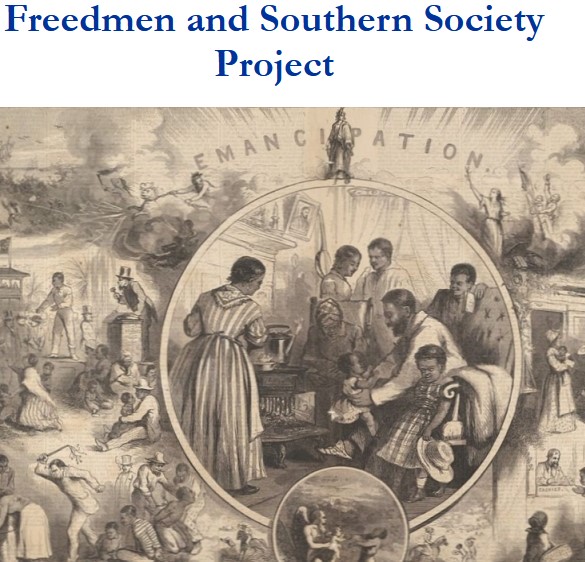
A clipping from the New-York Daily Tribune that details a meeting between black religious officials and U.S. political figures in Savannah, Georgia.
Minutes of an interview between ministers of color and church officers at Savannah with the Secretary of War and Major-Gen. Sherman.

Newark Leader
The Newark Leader began on November 24, 1917, under the leadership of the Newark Trades and Labor Assembly and publisher Julius Juch. Juch was a German immigrant who ran the German-language newspaper the Newark Express, which ended in October that same year. It published six columns weekly on Saturdays, until at some point shifting to Thursdays with seven columns.
The Newark Leader was not attached to any specific union, but rather to the labor movement in general. In its inaugural issue, it claimed to “stand for loyalty, civic betterment, for honesty, efficiency and probity, in the individual, and especially for those who serve the public.” To those ends, the Newark Leader focused on conveying union news to members in a timely fashion by partnering with Local Union secretaries for updates. It also had an interest in uplifting Newark citizens with suggestions ranged from thrifty spending tips to Do-It-Yourself projects and recipes. In an effort to convince people to join a union, the paper often included explanations of how unions benefited both laborers and the economy at large. Although the Newark Ledger resolved to leave political news and local personals to the daily newspapers of the area, it actively criticized price gouging and non-local business. It advertised strictly local businesses that sold union label goods. The Newark Leader adopted a Democratic stance in 1928.
By the 1940s, the Newark Leader began to include items of more social interest. Although it still reported on items of national importance to the labor movement, personal news became more of a prominent feature. Social visits and accomplishments could be commonly found, but marriages, divorces, and births were included with only bare minimum details under the “Statistical Roundup” section. It occasionally had serial fiction chapters or other light entertainment. The advertising stayed local, and editorials still criticized spending money outside the community, condemning popular delivery services like mail-order houses. For unknown reasons, the Newark Leader appeared to cease publication in 1946.
Newspaper of the Newark Ohio Trades and Labor Assembly published by German immigrant
Museum/Exhibits
Tours
Maps
Digital Projects
Organizations
Sites
Film/Video
Audio/Interview
Podcast/Program
Text/Document
Image
Graphs/Data
Timeline
Southwest
West
Midwest
Southeast
Northeast
Mexico
Canada
Global
Books
Teaching
Lectures
Digital Archives
Journals
Bibliographies
Topic Intro