


Collections
Library
Type
Region
Coverage:
-
Published:
-
Newberry Library
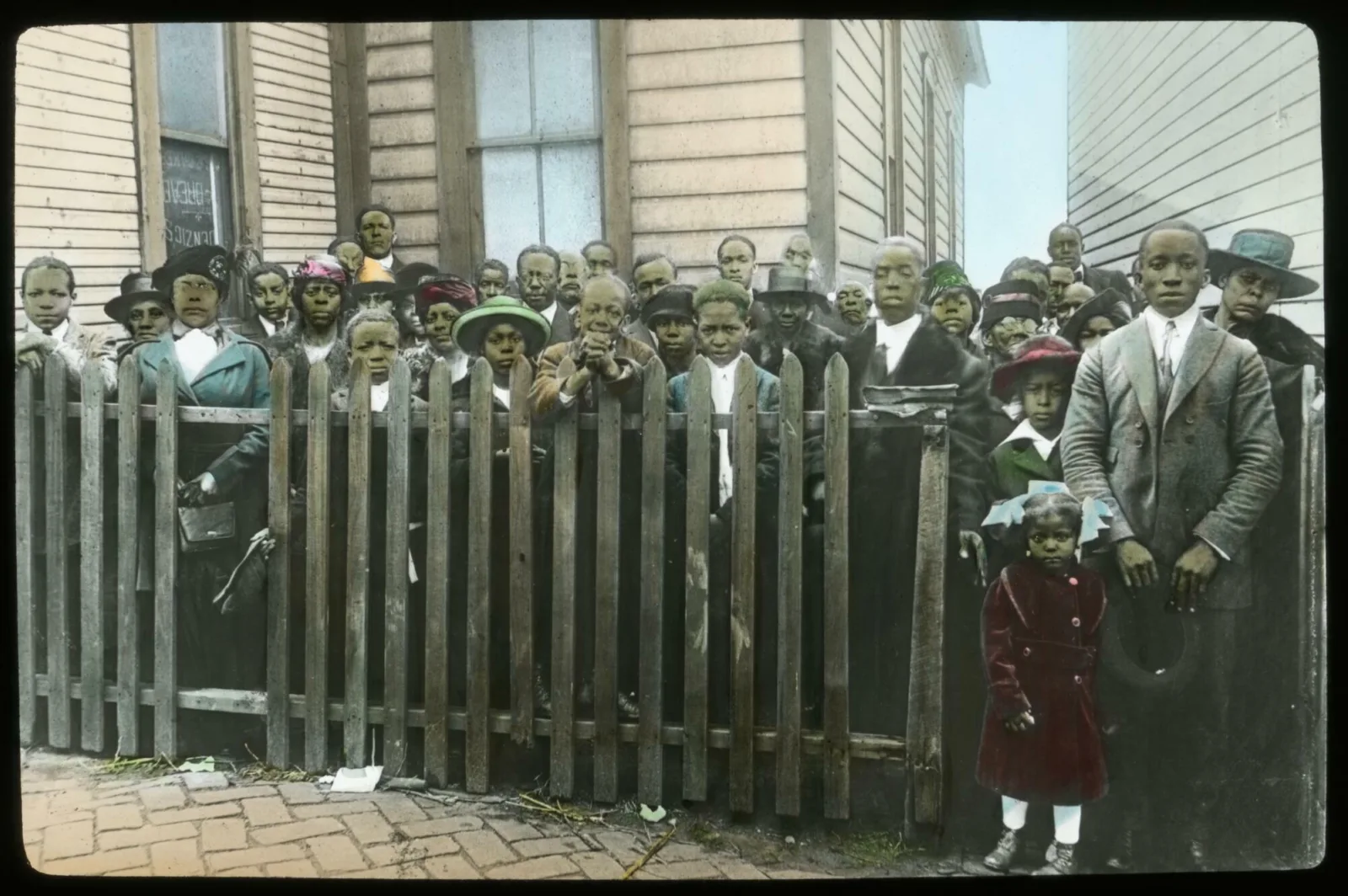
44 glass slidess Collectively, the 44 glass slides are a striking visual record of the Great Migration, when millions of African Americans relocated from rural areas of the South to urban centers of the North. The images now available at the Newberry offer a window into the new lives Black migrants built for themselves: there are images of youth basketball players posing for a team photo, nurses caring for children, men working in a foundry, and families attending church together. FOr more context, see https://www.newberry.org/news/new-acquisition-rare-images-from-the-great-migration
44 rare slides of Great Migration to Chicago

Newberry Library
Drawing on historical material from cultural organizations across the Midwest, this digital exhibit presents representative stories of the many migrations that have transformed the Midwest—and continue to do so to this day.
Contents
Early Indigenous Migration
Anishinaabe
Meskwaki
German Immigration
Utopias in Nauvoo
Early Black Migration
East to Midwest and Back
Great Migration
Mexican Migration
Postwar Japanese-American Migration
For Teachers
About
this digital exhibit presents representative stories of the many migrations that have transformed the Midwest
Newberry Library
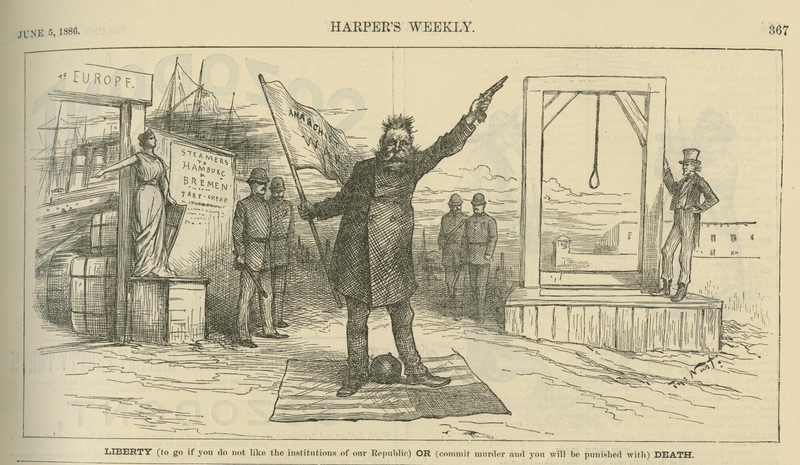
The city of Chicago provided a crucial battleground for a national struggle over the meaning of political radicalism in the late nineteenth and early twentieth centuries. The term political radicalism refers to individuals and parties who advocate far-reaching political and social reform. During this period, writers usually applied the term radical to activists and parties on what is known as the left side of the political spectrum, such as Communists, socialists, and anarchists. Leftist radicals were also called Reds, after the color of their party flags. There were significant ideological differences between these parties and each party’s positions changed over time. But all of them rejected the concept of private property and promoted the rights of workers against those of the people for whom they worked, wealthy factory and business owners, known as capitalists.
From the 1880s through the 1960s, Chicagoans engaged in a passionate debate over how government should respond to political radicalism. On one side, were proponents of civil liberties, the freedoms and rights promised to every member of society by the U.S. Constitution. They argued that political radicals and their organizations were protected by the First Amendment, which guarantees freedom of speech. On the other side, were people primarily concerned with security. They wanted to maintain social order and protect the government from violence or radical change. These concerns increased during wartime. Many political radicals, like the workers they claimed to represent, were recent immigrants from northern and eastern Europe. Their opponents often raised alarms about foreign influences in the United States.
Adding to the complexity of these debates was the difficulty in defining who or what constituted a real threat to the United States. A small number of political radicals engaged in deliberately violent or overtly treasonous activities, such as bombings or espionage. But these people were affiliated with larger movements and parties that included many people committed to reforming, not overthrowing, the U.S. government and society. Many radicals sought workplace protections for laborers, African Americans, and women that are now widely accepted. They made important contributions, for example, to movements to prohibit child labor or to enforce an eight-hour workday. The documents that follow represent some of the milestones in Chicago’s history of political radicalism from the Haymarket Affair of 1886 through the Palmer raids of 1920 into the McCarthy era of the 1950s.
What is the history of political radicalism in Chicago from the 1880s through the 1950s? How did the government and the public respond to radical movements?

Newberry Library
This is an educational resource designed with teachers, students, and families in mind. Maps, manuscripts, photographs, and other primary sources tell the story of topics from the Crusades to the Great Migration, selected by educators, with essays and discussion questions for use in the humanities classroom.
The Newberry Library's offerings of resources for the classroom, with featured topics such as world history, black history, literature, and the arts.

Newsreel
The Willmar 8 is Lee Grant's documentary about working women which tells the story of eight unassuming, apolitical women in America's heartland--Willmar, Minnesota--who were driven by sex discrimination at work to take the most unexpected step of their lives and found themselves in the forefront of the struggle for women's rights. Risking jobs, friends, family and the opposition of church and community, they began the longest bank strike in American history in a dramatic attempt to assert their own equality and self-worth. There is a full transcript of the film available under the title "The Willmar 8 Transcript (1981)". Also consider pairing this film with a guide for active viewing, entitled "Women's Worth: Valuing Our Own Worth - Realizing Our Own Value".
A documentary covering the longest bank strike in American history, where Boris Boshart, Irene Wallin, Sylvia Erickson Koll, Jane Harguth Groothuis, Sandi Treml, Teren Novotny, Shirley Solyntjes, and Glennis Ter Wisscha (or, "the Willmar 8") struck over charges of gender discrimination.
Newsreel
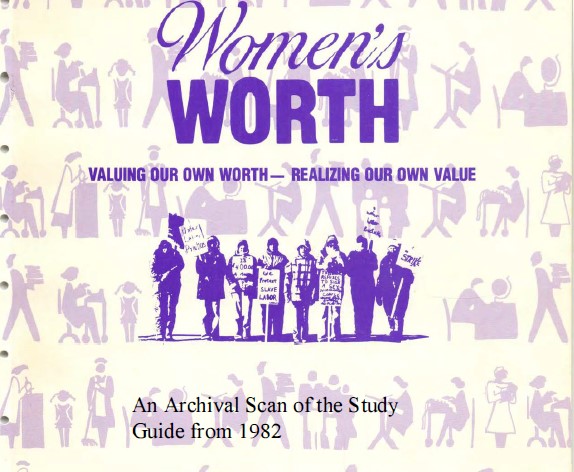
The Willmar 8 is Lee Grant's documentary about working women which tells the story of eight unassuming, apolitical women in America's heartland--Willmar, Minnesota--who were driven by sex discrimination at work to take the most unexpected step of their lives and found themselves in the forefront of the struggle for women's rights. Risking jobs, friends, family and the opposition of church and community, they began the longest bank strike in American history in a dramatic attempt to assert their own equality and self-worth. There is a full transcript of the film available under the title "The Willmar 8 Transcript (1981)". Also consider pairing this film with a guide for active viewing, entitled "Women's Worth: Valuing Our Own Worth - Realizing Our Own Value".
The full transcript for The Willmar 8 (1981) documentary.

Nicholas Coles
America's workers have been singing, reciting, performing, telling stories, writing, and publishing for more than three centuries. Ranging from early colonial times to the present, American Working-Class Literature presents more than 300 literary texts that exemplify this tradition. It demonstrates how American working people live, labor, struggle, express themselves, and give meaning to their experiences both inside and outside of the workplace. The only book of its kind, this groundbreaking anthology includes work not only by the industrial proletariat but also by slaves and unskilled workers, by those who work unpaid at home, and by workers in contemporary service industries. As diverse in race, gender, culture, and region as America's working class itself, the selections represent a wide range of genres including fiction, poetry, drama, memoir, oratory, journalism, letters, oral history, and songs. Works by little-known or anonymous authors are included alongside texts from such acclaimed writers as Frederick Douglass, Upton Sinclair, Tillie Olsen, Philip Levine, Maxine Hong Kingston, and Leslie Marmon Silko. A rich selection of contemporary writing includes Martin Espada's poem "Alabanza" about the September 11, 2001, attack on the World Trade Center.
American Working-Class Literature is organized chronologically into seven sections that highlight key historical and cultural developments in working-class life. The book is enhanced by an editors' introduction, section introductions, and individual head notes for each selection that provide biographical and historical context.
A timeline of working-class history, rich illustrations, sidebars, reading lists, and a bibliography of critical commentary are also included. This unique volume is ideal for courses in American literature, cultural and working-class studies, and labor history.An amazing, incomparable introduction to literature Table of Contents
Preface
Introduction
I. Early American Labor: Hard, Bound, and Free 1600s-1810s
"The Trappan'd Maiden: Or, the Distressed Damsel" (mid-1600s)
James Revel, "The Poor, Unhappy Transported Felon" (1680s)
Gottlieb Mittelberger, "Gottlieb Mittelberger's Journey to Pennsylvania in the Year 1750 and Return to Germany in the Year 1754" (1754)
"Petition of a Grate Number of Blackes" to Thomas Gage, May 25, 1774
Olaudah Equiano, ["I Was in Another World: The Slave Ship"] from The Interesting Narrative of the Life of Olaudah Equiano, or Gustavus Vassa, the African, Written by Himself (1789)
Phillis Wheatley, "To the Right Honourable William, Earl of Dartmouth, His Majesty's Principal Secretary of State for North America, Etc." (1773)
"A Sea Song"
Francis Hopkinson, "The Raising: A New Song for Federal Mechanics" by A. B. (1788)
John McIlvaine, "Address to the Journeymen Cordwainers L.B. of Philadelphia" (1794)
Tecumseh's Speech to the Osages (Winter 1811-12)
II. New Kinds of Work, Old Practices 1820s-1850s
Sorrow Songs and Spirituals
"Nobody knows de trouble I've seen"
"Steal away to Jesus"
"Swing Low, Sweet Chariot"
"Many Thousand Gone"
"Bredden, don't git weary"
W. E. B. DuBois, "The Sorrow Songs" (1903)
Maria W. Stewart, "Lecture Delivered at the Franklin Hall, Boston, September 21, 1832"
The Lowell Mill Girls
Josephine L. Baker, "A Second Peep at Factory Life" (1845)
Mary Paul, "Letters to Her Father" (1845-1848)
"The Lowell Factory Girl"
Harriet Hanson Robinson, "Characteristics of the Early Factory Girls" (1898)
Helena Minton, "From the Same Cloth: For the Mill Girls, Lowell, Massachusetts, circa 1840" (1985)
Frederick Douglass, ["In the Shipyards"] (1845 and 1855)
"An Address to the Colored People of the United States" from The North Star (1848)
Herman Melville, "The Paradise of Bachelors" and "The Tartarus of Maids" (1855)
John Greenleaf Whittier, "The Ship-Builders" (1850)
Fanny Fern (Sara Payson Willis Parton), "Soliloquy of a Housemaid" (1854)
"The Working-Girls of New York" (1868)
Frances Ellen Watkins Harper, "The Slave Mother" (1857)
Harriet E. Wilson, ["Keep her . . . She's real handsome and bright, and not very black, either."]
Walt Whitman, "A Song for Occupations" (1855)
"The Wound Dresser" (1865)
Nineteenth-Century Work Songs
"Peg An'Awl"
"Paddy Works on the Railway"
"The Housekeeper's Lament"
"The Farmer Is the Man"
"John Henry"
III. Beneath the Gilded Surface: Working-Class Fictions and Realities, 1860-1890s
Rebecca Harding Davis, "Life in the Iron Mills" (1861)
I. G. Blanchard, "Eight Hours" (1866, poem; set to music, 1878)
Lucy Parsons, "To Tramps" (1884)
Songs of the Knights of Labor
"Knights of Labor" (1898)
"Storm the Fort, Ye Knights" (1885)
"Thirty Cents a Day" (1892)
"America" (1890)
"Father Gander's Melodies" (1887)
"One More Battle to Fight" (1892)
The Battle of Homestead, 1892
AAISW Preamble (from the Constitution of the Amalgamated Association of Iron and Steel Workers)
"Tyrant Frick"
"A Man Named Carnegie"
"Father Was Killed by the Pinkerton Men"
"A Fight for Home and Honor"
Stephen Crane, "The Men in the Storm" (1894)
Hamlin Garland, "Under the Lion's Paw" (1889)
Edwin Markham, "The Man with the Hoe" (1899)
"Lifelets: Life Stories of Undistinguished Americans" from the Independent
"A Georgia Negro Peon" (1904)
"The Autobiography of a Labor Leader": James Williams (1902)
"A Negro Nurse" (1912)
Maxine Hong Kingston, "The Grandfather of the Sierra Nevada Mountains" from China Men (1980)
Angel Island Poems by Chinese Immigrants (1910-1940)
IV. Revolt, Represssion, and Cultural Formations: 1900-1929
Eugene V. Debs, "How I Became a Socialist" (1902)
"Statement to the Court" (1918)
Miners' and Other Labor Poems
J. A. Edgerton, "The Man Behind the Pick" (1903)
"Scab, Scab, Scab" (1904)
Shorty P., "The Eight Hour Day" (1904)
Joe R. Lazure, "A Colorado Miner's Fourth" (1905)
J. P. Thompson, "Union Poem" (1909)
Unknown Worker, "Labor Speaks" (1909)
Joe Foley, "Wadda Ya Want to Break Your Back for the Boss For" (c. 1917)
Berton Braley, "The Worker," (1917)
Eugene Barnett, "Political Prisoners" (1921)
"St. Peter and the Scab" (1923)
Upton Sinclair, ["The Hog-Squeal of the Universe"] from The Jungle (1906)
Jack London, "The Apostate" (1906)
"Pinched": A Prison Experience (1907)
Rose Schneiderman, "A Cap Maker's Story" (1905)
The Triangle Shirtwaist Fire, March 25, 1911
Rose Schneiderman, "Triangle Memorial Speech" (1911)
Morris Rosenfeld, "Requiem on the Triangle Fire" (1911)
Contemporary Poems on the Triangle Shirtwaist Factory Fire
Mary Fell, "The Triangle Fire"
Chris Llewellyn, "Four from Sonya," "I Am Appalled," "Survivor's Cento," "Sear"
Carol Tarlen, "Sisters in the Flames"
Safiya Henderson-Holmes, "rituals of spring (for the 78th anniversary of the shirtwaist factory fire)"
James Oppenheim, "Bread and Roses" (1914)
Arturo Giovannitti, "The Walker" (1914)
John Reed, "War in Paterson" (1913)
Fellow Workers: IWW Oral Histories
(from Solidarity Forever, An Oral History of the IWW 1985)
Sophie Cohen, ["Paterson had a prison-like feeling"]
James Fair, ["Working the Docks"]
Mother Jones, "The March of the Mill Children" (1903)
The Wobblies, the "Little Red Song Book," and the Legacy of Joe Hill (1879-1915)
Elizabeth Gurley Flynn, "Joe Hill--Martyred Troubadour of Labor" from The Rebel Girl: My First Life (1906-1926)
Joe Hill, "The Rebel Girl" (song) and letter to Elizabeth Gurley Flynn
From The Little Red Song Book (1913)
"Preamble of the Industrial Workers of the World"
Joe Hill, "The Tramp"
Ralph Chaplin, "Solidarity Forever!"
Joe Hill, "The Preacher and the Slave"
T-Bone Slim, "The Popular Wobbly"
Joe Hill, "Joe Hill's Last Will"
Ralph Chaplin, "Mourn Not the Dead"
Alfred Hayes, "Joe Hill" (1928)
Cheri Register, "A Dream of Joe Hill" (2000)
Sarah N. Cleghorn, "Through the Needle's Eye: 1. Comrade Jesus 2. Quatrain" (1915)
Carl Sandburg, "Chicago" (1916)
"Muckers" (1916)
"Child of the Romans" (1916)
from "The People, Yes" (1936)
Lola Ridge, "The Ghetto" (1918)
Anzia Yezierska, "The Free Vacation House" (1920)
Edith Summers Kelley, "Billy's Birth," restored chapter of Weeds (1923)
Poetry of the Harlem Renaissance
James Weldon Johnson, "O Black and Unknown Bards" (1908)
Jean Toomer, "Reapers" (1923)
Claude McKay, "The Harlem Dancer" (1917)
"If We Must Die" (1919)
"The Lynching" (1920)
Countee Cullen, "For a Lady I Know" (1925)
"From the Dark Tower" (1927)
Sterling A. Brown, "Ma Rainey" (1930)
"Scotty Has His Say" (1932)
"Call Boy" (1932)
Alice Dunbar-Nelson, "I Sit and Sew" (1920)
Angelina Weld Grimké, "Fragment" (c. 1930)
John Beecher, "Report to the Stockholders" (1925)
"Beaufort Tides" (1934)
Bartolomeo Vanzetti, "Last Speech to the Court" (1927)
Agnes Smedley, ["The Wanderlust in My Blood"] from Daughter of Earth (1929)
"Mining Families" 1937
V. Economic Depression and Cultural Resurgence: 1930s
Langston Hughes, "The Weary Blues" (1925)
"Johannesburg Mines" (1928)
"Christ in Alabama" (1931)
"Park Bench" (1934)
"Let America Be America Again" (1936)
"Office Building Evening" (pub. 1960)
Genevieve Taggard, "Words Property of the People" (1934)
"Life of the Mind, 1935" (1935)
"At Last the Women Are Moving" (1935)
Mary Heaton Vorse, "The Emergency Brigade at Flint" (1937)
Mike Gold, "Go Left, Young Writers!" (1929)
"Jews and Christians" from Jews Without Money (1935)
Appalachia Voices
Aunt Molly Jackson, "Kentucky Miners' Wives Ragged Hungry Blues" (1932)
Sarah Ogun Gunning, "I Am a Girl of Constant Sorrow"
Kathy Kahn, "They Say Them Child Brides Don't Last: Florence Reece" from Hillbilly Women (1972)
Florence Reece, "Which Side Are You On?" (1931)
Jim Garland, "The Murder of Harry Simms"
Tillman Cadle, "Commentary on Harry Simms" (1932)
John Dos Passos, "Harlan: Working Under the Gun" (1931)
Maggie Anderson, "Among Elms and Maples, Morgantown, West Virginia, August, 1935" (1986)
"Mining Camp Residents, West Virginia, July, 1935" (1986)
"Long Story" (1992)
Don West, "Clods of Southern Earth: Introduction" (1946)
"Mountain Boy" (1931-1932?)
"Clodhopper" (1940)
"There's Anger in the Land" (1950)
"No Lonesome Road" (1940)
"I Am a Woman Worker": A Scrapbook of Autobiographies from the Summer Schools for Women Workers (1936)
"Soldering"
"One Day of Labor"
"Bean Picking"
"The Piece-Work System"
"The President Visits the Mill"
Boxcar Bertha (Ben Reitman) [" 'Are You Bill's Broad?' "] from Sister of the Road : The Autobiography of Boxcar Bertha (1937)
Richard Wright, "I Have Seen Black Hands" (1935)
"Fire and Cloud" (1938)
Tillie Olsen, "I Want You Women Up North to Know" (1934)
Meridel Le Sueur, "I Was Marching" (1934)
"Eroded Woman" (1948)
Muriel Rukeyser, from The Book of the Dead (1938)
"The Road"
"Gauley Bridge"
"Praise of the Committee"
"Absalom"
"The Disease"
"George Robinson: Blues"
"The Book of the Dead"
Joseph Kalar, "Night Shift" (1934)
"Proletarian Night" (1934)
"Papermill" (1931)
"Worker Uprooted" (1932)
"Now that Snow Is Falling" (1930)
Kenneth Patchen, "Joe Hill Listens to the Praying" (1936)
"The Orange Bears" (1949)
Jack Conroy, "Monkey Nest Camp" from the Disinherited (1933)
Pietro Di Donato, "Geremio" from Christ in Concrete (1939)
Tom Kromer, ["Three Hots and a Flop"] from Waiting for Nothing (1935)
Zora Neale Hurston, ["Polk County Blues"] from Mules and Men (1935)
John Steinbeck, "Starvation Under the Orange Trees" (1938)
["The spring is beautiful in California"] from The Grapes of Wrath (1939)
Sanora Babb ["Dust"] from Whose Names Are Unknown (2004)
Wilma Elizabeth McDaniel, from A Primer for Buford (1990)
"A Primer for Buford"
"Origins"
"Farm Children in the Grip of 1933"
"Via Dolorosa"
"You Can't Go Back"
"Okie Boy Boss at Puccinello's, 1936"
"Abdication Day"
"Picking Grapes, 1937"
"American Folk Music, 1937"
"Roster"
"Day of Return, August 4, 1986"
Woody Guthrie, "Pretty Boy Floyd" (1939)
"1913 Massacre" (1945)
"Two Good Men" (1946)
"Christ for President" (circa 1938)
["Listening to the Little Girls' Song Drift Out Across the Dark Wind"] from Bound for Glory (1943)
Clifford Odets, Waiting for Lefty (1935)
Thomas Bell, "Zinc Works Craneman to Wed" (1936)
William Attaway, ["The Moss Brothers Enter the Mill"] from Blood on the Forge (1941)
VI. Affluence, Cold War, and the Other America: 1940s-1970s
Ann Petry, "Like a Winding Sheet" (1946)
Carlos Bulosan, "If You Want to Know What We Are" (1940)
"The Story of a Letter" (1946)
Harriette Arnow, ["I'm Gertie Nevels from Balew, Kentucky"] from The Dollmaker (1954)
Alice Childress, "Like One of the Family" (1956)
"Sometimes I Feel So Sorry" (1956)
Hisaye Yamamoto, "Seventeen Syllables" (1949)
Edwin Rolfe, "Are You Now or Have You Ever Been" (c. 1952)
"Little Ballad for Americans, 1954"
Thomas McGrath, "A Long Way Outside Yellowstone" (1940)
"Ars Poetica: or Who Lives in the Ivory Tower?" (1949)
"A Little Song About Charity" (1949)
"On the Memory of a Working-Class Girl" (1940s)
"O'Leary's Last Wish: In Case the Revolution Should Fail" (1940s)
Tillie Olsen, "I Stand Here Ironing" (1956)
Gwendolyn Brooks, "Bronzesville Woman in a Red Hat" (1960)
"The Ballad of Rudolph Reed" (1960)
"The Blackstone Rangers" (1968)
James Wright, "Autumn Begins in Martins Ferry, Ohio" (1963)
"Honey" (1982)
Judy Grahn, "The Common Woman" (1969)
Breece D'J Pancake, "The Honored Dead" (posthumous, 1983)
Studs Terkel, from Working (1972)
"Dolores Dante, waitress"
"Mike Lefevre, steelworker"
Toni Cade Bambara, "The Lesson" (1972)
VII. The New World Order and Its Consequences: 1980s to 2005
Philip Levine, "You Can Have It" (1979)
"Among Children" (1992)
"What Work Is" (1992)
Nellie Wong, "Unemployment" (1983)
"The Death of Long Steam Lady" (1986)
Tomás Rivera, from . . . y no se lo tragó la tierra / And the Earth Did Not Devour Him (1987)
"It's That It Hurts"
"And the Earth Did Not Devour Him"
"The Portrait"
"When We Arrive"
John Gilgun, "Counting Tips" (1995)
"Whitman's Hands" (1991)
Bill Witherup, "Mother Witherup's Top Secret Cherry Pie" (1989)
Lucille Clifton, excerpt from Generations: A Memoir (1976)
"At the cemetery, walnut grove plantation, south carolina, 1989" (1991)
Marge Piercy, "To Be of Use" (1973)
"Her Gifts" (2002)
Sue Doro, "The Cultural Worker" (1992)
"Hard Times in the Valley" (1992)
"Blue Collar Goodbyes" (1992)
Simon J. Ortiz, "My Father's Song" (1988)
"Final Solution: Jobs, Leaving" (1992)
"We Have Been Told Many Things" (1992)
Gloria Anzaldúa, from Borderlands/La Frontera (1987)
"We Call Them Greasers"
"To Live in the Borderlands Means You"
Hattie Gossett, "the cleaning woman/labor relations #4" (1988)
Larry Smith, "The Company of Widows" (2002)
Ernie Brill, "Crazy Hattie Enters the Ice Age" (1980)
Karen Brodine, "Woman Sitting at the Machine, Thinking" (1984)
Linda Hogan, "Making Do" (1986)
"The New Apartment, Minneapolis" (1988)
"Blessing" (1994)
Carolyn Chute, "Faces in the Hands" (2000)
Yusef Komunyakaa, "Work" (1988)
"The Whistle" (1992)
Michael Casey, "The Company Pool" (1999)
"Positivity Poster" (1999)
"Positivity Poster #75" (1999)
"Urgent Need for Blood" (1999)
"Positivity Poster #76" (1999)
Leslie Marmon Silko, "Lullaby" (1981)
Dorothy Allison, "Mama" (1988)
Leslie Feinberg, ["It was time to find a factory job"] from Stone Butch Blues (1990)
Susan Eisenberg, "Homage" (1984)
"Hanging in Solo" (1984)
"First Day on a New Jobsite" (1984)
"Wiretalk" (1984)
Dagoberto Gilb, "Romero's Shirt" (1994)
Joy Harjo, "The Woman Hanging from the Thirteenth Floor Window" (1983)
"Perhaps the World Ends Here" (1994)
Jeanne Bryner, "The Story of My Village" (1999)
"Mileage" (1999)
"Release of the Spirit" (1999)
"Blue Collar" (1999)
Kate Rushin, "The Black Back-Ups" (1993)
Cherríe Moraga, "Heroes and Saints" (1983)
Jimmy Santiago Baca, "The New Warden" (1979)
"So Mexicans Are Taking Jobs from Americans" (1982)
"Perfecto Flores" (1986)
Jan Beatty, "Awake in a Strange Landscape" (1994)
"Louise" (2002)
"The Rolling Rock Man" (1994)
"A Waitress's Instructions on Tipping" (1994)
"The Waitress Angels Speak to Me in a Vision" (2002)
Helena María Viramontes, The Cariboo Café" (1988)
Peter Oresick, "My Father" (1977)
"The Story of Glass" (1977)
"After the Deindustrialization of America" (1990)
"Toward the Heaven of Full Employment" (1990)
"Now" (1990)
Jim Daniels, "Digger Thinks About Numbers" (1985)
"Digger Goes on Vacation" (1985)
"Digger Laid Off" (2002)
"Digger, the Birthday Boy" (2002)
"Digger's Territory" (1989)
Martín Espada, "Who Burns for the Perfection of Paper" (1993)
"The Toolmaker Unemployed" (1993)
"Alabanza: In Praise of Local 100" (2002)
Lois-Ann Yamanaka, "Lovey's Homemade Singer Sewing Class Patchwork Denim Hiphuggers" (1996)
Melida Rodas, "El Olor de Cansansio (The Smell of Fatigue)" (2000)
Contents by Genre
Select Bibliography
A Timeline of American Working-Class History
Credits
Index by Author
Index by Title
About the Editors America's workers have been singing, reciting, performing, telling stories, writing, and publishing for more than three centuries. Ranging from early colonial times to the present, American Working-Class Literature presents more than 300 literary texts that exemplify this tradition. It demonstrates how American working people live, labor, struggle, express themselves, and give meaning to their experiences both inside and outside of the workplace. The only book of its kind, this groundbreaking anthology includes work not only by the industrial proletariat but also by slaves and unskilled workers, by those who work unpaid at home, and by workers in contemporary service industries. As diverse in race, gender, culture, and region as America's working class itself, the selections represent a wide range of genres including fiction, poetry, drama, memoir, oratory, journalism, letters, oral history, and songs. Works by little-known or anonymous authors are included alongside texts from such acclaimed writers as Frederick Douglass, Upton Sinclair, Tillie Olsen, Philip Levine, Maxine Hong Kingston, and Leslie Marmon Silko. A rich selection of contemporary writing includes Martin Espada's poem "Alabanza" about the September 11, 2001, attack on the World Trade Center.
American Working-Class Literature is organized chronologically into seven sections that highlight key historical and cultural developments in working-class life. The book is enhanced by an editors' introduction, section introductions, and individual head notes for each selection that provide biographical and historical context. A timeline of working-class history, rich illustrations, sidebars, reading lists, and a bibliography of critical commentary are also included. This unique volume is ideal for courses in American literature, cultural and working-class studies, and labor history.
An incomparable collection of literature of working class Americans
Nicholas F. Centino
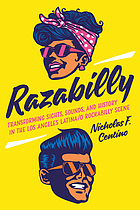
A close examination of the sights, sounds, and sensibilities of the Latina/o Rockabilly scene in Los Angeles, its ties to working-class communities, and its dissemination through the post-NAFTA global landscape. Introduction
From London to East Los: a cultural history of the international Rockabilly scene
C'mon baby, let the good times roll! Sites of leisure and memory in the formation of the Chicana/o and Latina/o Rockabilly scene of Greater Los Angeles
Fashioning Razabilly bodies: embodied style and stance in the Chicana/o and Latina/o Rockabilly scene of Greater Los Angeles
Your roots are showing: tracing genealogies and building cultural memory through the malleable canon of the Greater Los Angeles Rockabilly scene
Epilogue
A close examination of the sights, sounds, and sensibilities of the Latina/o Rockabilly scene in Los Angeles.

Nick Fischer
The McCarthy-era witch hunts marked the culmination of an anticommunist crusade launched after the First World War. With Bolshevism triumphant in Russia and public discontent shaking the United States, conservatives at every level of government and business created a network dedicated to sweeping away the 'spider web' of radicalism they saw threatening the nation. In this groundbreaking study, Nick Fischer shines a light on right-wing activities during the interwar period. Conservatives railed against a supposed Soviet-directed conspiracy composed of socialists, trade unions, peace and civil liberties groups, feminists, liberals, aliens, and Jews. Their rhetoric and power made for devastating weapons in their systematic war for control of the country against progressive causes. But as Fischer shows, the term spider web far more accurately described the anticommunist movement than it did international communism. Fischer details how anticommunist myths and propaganda influenced mainstream politics in America, and how the right's efforts paved the way for the McCarthyite 1950s and augured the conservative backlash that would one day transform American politics"-- Provided by publisher
Documents the rise of conservative and anticommunist politics in the United States during the Interwar period
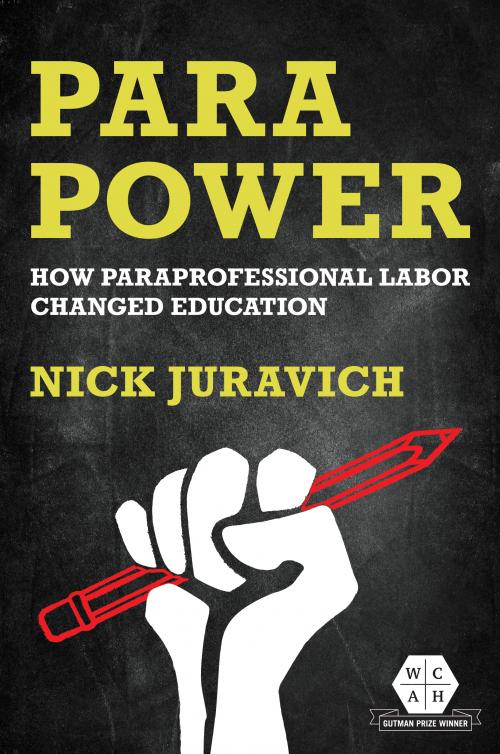
Nick Juravich
Paraprofessional educators entered US schools amidst the struggles of the late 1960s. Immersed in the crisis of care in public education, paras improved systems of education and social welfare despite low pay and second-rate status. Understanding paras as key players in Black and Latino struggles for jobs and freedom, Nick Juravich details how the first generation of paras in New York City transformed work in public schools and the relationships between schools and the communities they served.
Paraprofessional programs created hundreds of thousands of jobs in working-class Black and Latino neighborhoods. These programs became an important pipeline for the training of Black and Latino teachers in the1970s and early 1980s while paras' organizing helped drive the expansion and integration of public sector unions. An engaging portrait of an invisible profession, Para Power examines the lives and practices of the first generation of paraprofessional educators against the backdrop of struggles for justice, equality, and self-determination"-- Provided by publisher
Understanding paras as key players in Black and Latino struggles for jobs and freedom
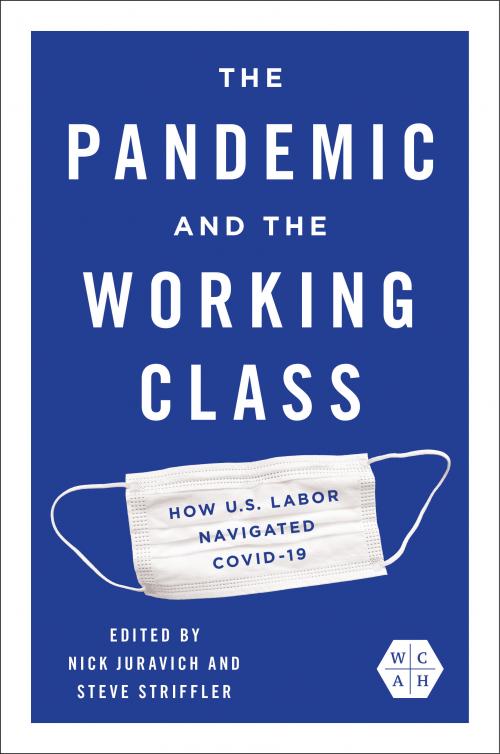
Nick Juravich, Steve Striffler
During the COVID-19 pandemic, thousands of workers lost their jobs in sectors from hospitality to transportation, while healthcare and frontline service workers faced a new world of brutal hours in unsafe and even deadly conditions. Yet, as the US economy reopened, workers experienced a rare moment of leverage as demand for labor and government support powered a surge of collective action that allowed working people to seek rights, respect, and power on the job through resignations, walkouts, strikes, and union organizing. The lessons and legacies of this upsurge in organizing continue to shape work, activism, and politics across the nation today.
Nick Juravich and Steve Striffler edit a collection that examines the effects of the pandemic on workers. Sections of the book focus on specific impacts and government efforts to restructure the economy; the dramatic effect of the pandemic on the hospitality industry; educators’ response on behalf of themselves and their students; frontline healthcare workers; and the innovative forms of labor organizing that emerged during and after COVID.
Contributors: Carlos Aramayo, Kathleen Brown, Sandrine Etienne, Ismael García-Colón, Puya Gerami, Maura Hagan, Connor Harney, Devan Hawkins, Leigh Howard, Marian Moser Jones, Doris Joy, Nick Juravich, Eric Larson, Kathryn M. Meyer, Samir Sonti, Steve Striffler, Lia Warner, Andrew B. Wolf, and Jennifer Zelnick"-- Provided by publisher
An anthology of essays that examine the effects of the pandemic on workers, with special attention paid to educational and medical workers.
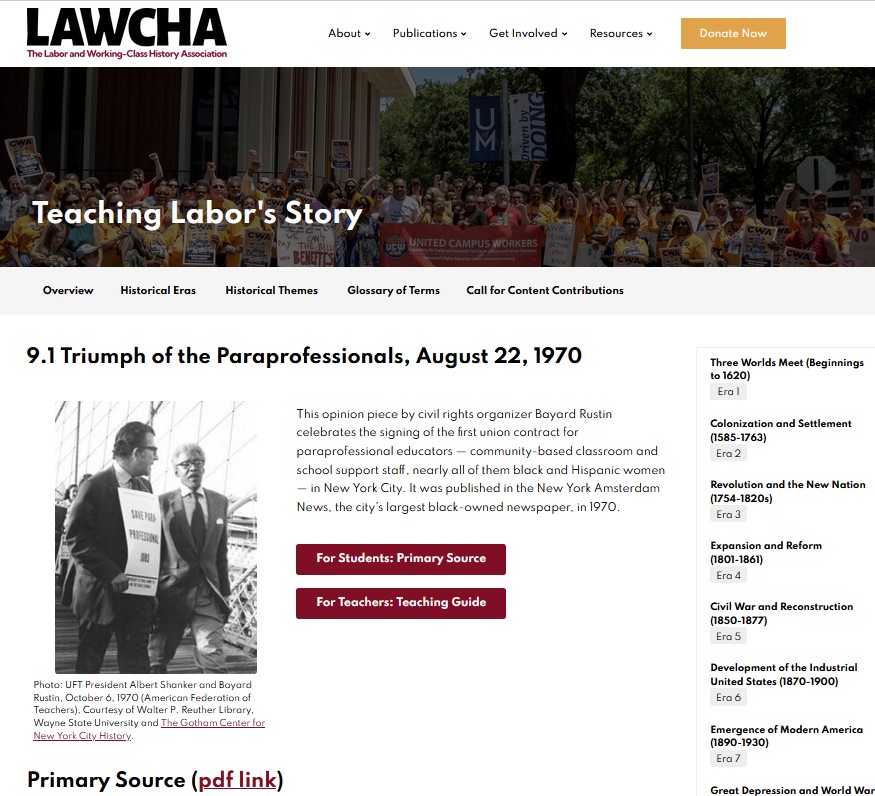
Nick Juravich, Teaching Labor's Story
This opinion piece by civil rights organizer Bayard Rustin celebrates the signing of the first union contract for paraprofessional educators --community-based classroom and school support staff, nearly all of them black and Hispanic women --in New York City. It was published in the New York Amsterdam News, the city’s largest black-owned newspaper, in 1970.
An extensive teaching guide helps to place the source in context.
Bayard Rustin’s op-ed, “Triumph of the Paraprofessionals,” sits at the intersection of three histories: (1) the history of the civil rights movement, (2) the history of the War on Poverty, and (3) the history of the labor movement. These histories are sometimes taught separately, but this document shows us how they are Historical EraPOSTWAR UNITED STATES (1945-early 1970S)Document 9.1Document Title: TRIUMPH OF THE PARAPROFESSIONALS, 1970Document Type:Newspaper Op-Ed [opinion-editorial]Brief Description:This opinion piece by civil rights organizer Bayard Rustin celebrates the signing of the first union contract for paraprofessional educators --community-based classroom and school support staff, nearly all of them black and Hispanic women --in New York City. It was published in the New York Amsterdam News, the city’s largest black-owned newspaper, in 1970. Understanding the collaborations and tensions between the civil rights movement, the War on Poverty, and the labor movement expands our understanding of all three.
This opinion piece by civil rights organizer Bayard Rustin celebrates the signing of the first union contract for paraprofessional educators — community-based classroom and school support staff, nearly all of them black and Hispanic women — in New York City. It was published in the New York Amsterdam News, the city’s largest black-owned newspaper, in 1970.
Nick Mansfield
The book outlines how class is single most important factor in understanding the British army in the period of industrialisation. It challenges the 'ruffians officered by gentlemen' theory of most military histories and demonstrates how service in the ranks was not confined to 'the scum of the earth' but included a cross section of 'respectable' working class men. Common soldiers represent a huge unstudied occupational group. They worked as artisans, servants and dealers, displaying pre-enlistment working class attitudes and evidencing low level class conflict in numerous ways. Soldiers continued as members of the working class after discharge, with military service forming one phase of their careers and overall life experience. After training, most common soldiers had time on their hands and were allowed to work at a wide variety of jobs, analysed here for the first time. Many serving soldiers continued to work as regimental tradesmen, or skilled artificers. Others worked as officers' servants or were allowed to run small businesses, providing goods and services to their comrades. Some, especially the Non Commissioned Officers who actually ran the army, forged extraordinary careers which surpassed any opportunities in civilian life. All the soldiers studied retained much of their working class way of life. This was evidenced in a contract culture similar to that of the civilian trade unions. Within disciplined boundaries, army life resulted in all sorts of low level class conflict. The book explores these by covering drinking, desertion, feigned illness, self harm, strikes and go-slows. It further describes mutinies, back chat, looting, fraternisation, foreign service, suicide and even the shooting of unpopular officers
how class is single most important factor in understanding the British army in the period of industrialisation
Nicola Pizzolato
Beginning in the 1950s, and with growing momentum throughout the 1960s and 1970s, Detroit and Turin were both sites of significant political and social upheaval. This comparative and transnational study examines the political and theoretical developments that emerged in these two "motor cities" among activist workers and political militants during these decades. Workers and activists in both locations formed a common understandings of the realities of capitalism and developed similar critiques and strategies of opposition. Interaction between individuals and groups in Detroit and Turin - through personal correspondence, the exchange and translation of publications, and personal visits - furthered this common understanding. At the same time, the protesters merged, often unconsciously, the local, national, and transnational dimension of their movements. Their political activism blended agitation in the factory and in the neighborhoods; it involved opposition to car manufacturers as well as labor unions; and it comprised ordinary people who had never been involved before in industrial disputes as well as veterans of working-class militancy. It was also characterized by the interplay of race, ethnicity, and regional provenience as well as class, and as this analysis shows, differences between Detroit and Turin with respect to social identity points towards new insights into the unrest during this period
comparative and transnational study
Nicola Verdon
This book offers a new history of the farmworker in England from 1850 to the present day. It focuses on the paid worker, considering how the experiences of farm work - the work performed, wages earned and conditions of hiring - were shaped by gender, age and region. Combining data extracted from statistical sources with personal and autobiographical accounts, it places the individual farmworker back into a broader collective history. Beginning in the mid-Victorian era, when farmworkers were the most numerically significant occupational group in England, it considers the impact of economic, technological and social change on the scale and nature of farm work over the next hundred and fifty years, whilst also highlighting the continuation of some practices, including the use of casual and migrant workers to perform low-paid, seasonal work. Written in a lively and accessible manner, this book will appeal to those with an interest in rural history, gender history and modern British history."--Back cover
farmworker in England from 1850 to the present day
Nicolas G. Rosenthal
For decades, most American Indians have lived in cities, not on reservations or in rural areas. Still, scholars, policymakers, and popular culture often regard Indians first as reservation peoples, living apart from non-Native Americans. In this book, Nicolas Rosenthal reorients our understanding of the experience of American Indians by tracing their migration to cities, exploring the formation of urban Indian communities, and delving into the shifting relationships between reservations and urban areas from the early twentieth century to the present. With a focus on Los Angeles, which by 1970 had more Native American inhabitants than any place outside the Navajo reservation, Reimagining Indian Country shows how cities have played a defining role in modern American Indian life and examines the evolution of Native American identity in recent decades. Rosenthal emphasizes the lived experiences of Native migrants in realms including education, labor, health, housing, and social and political activism to understand how they adapted to an urban environment, and to consider how they formed--and continue to form--new identities. Though still connected to the places where indigenous peoples have preserved their culture, Rosenthal argues that Indian identity must be understood as dynamic and fully enmeshed in modern global networks.
reorients our understanding of the experience of American Indians by tracing their migration to cities, exploring the formation of urban Indian communities, and delving into the shifting relationships between reservations and urban areas from the early twentieth century to the present.
Nicole M. Brown
We Are Each Other's Business, by Nicole Marie Brown, explores the erasure of Black women's contribution to the strategic sophistication of the convergence of the Consumer Rights, Women's Rights, and Welfare Rights Movements in Chicago in the late 1960s and early 1970s, before what became the larger Welfare Rights Movement associated with the National Welfare Rights Organization.
She argues that while Black women were central to this early period, they were stifled by the Consumer Rights and Women's Rights Movements inability to see poor Black women as fellow political actors. Brown analyzes Black women's use of the technology of consumer credit to demonstrate the vision and skill that these women deployed. Utilizing an archival and computational approach, the book's chapters focus on the similarities and differences of The Woodlawn Organization and Jobs or Income Now, how consumer spaces instill legitimacy, how poor people were caught by the Nixon administration's welfare policies, and it concludes with a consideration of how this effort failed and allowed for the rise of subprime lending in poor communities"-- Provided by publisher
analyzes Black women's use of the technology of consumer credit to demonstrate the vision and skill that these women deployed.
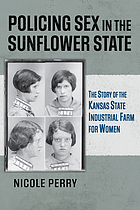
Nicole Perry
Policing Sex in the Sunflower State recounts the little-known story of Chapter 205, a state law that gave the Kansas Board of Health broad powers to quarantine individuals with venereal diseases. Though the law was officially gender-neutral and the state initially detained a few men under the ordinance, Chapter 205 was almost exclusively enforced against women by the early 1920s. State officials quarantined women alongside regular female prisoners at the Kansas State Industrial Farm for Women (KSIFW) throughout the 1920s and 1930s, with women sentenced under Chapter 205 averaging 71% of the total inmate population between 1918 and 1942. Their confinement at the WIF was indefinite, with doctors and superintendents deciding when they were physically and morally "cured" enough to reenter society; in practice, women detained under Chapter 205 spent an average of four months at the Farm. Though the numbers of women imprisoned under Chapter 205 declined in the 1940s, women were quarantined under the law as late as 1955. Policing Sex in the Sunflower State tells the story of Chapter 205 through the experiences of three groups of women-the activist women who lobbied to create the Farm, the professional women who ran it, and the working-class women who were imprisoned there-in order to explore the intersections of social hierarchies in interwar Kansas.
tells the story of Chapter 205 through the experiences of three groups of women-the activist women who lobbied to create the Farm, the professional women who ran it, and the working-class women who were imprisoned there-in order to explore the intersections of social hierarchies in interwar Kansas.
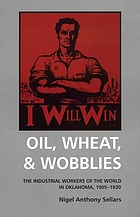
Nigel Anthony Sellars
The Industrial Workers of the World, or Wobblies, a radical labor union, played an important role in Oklahoma between the founding of the union in 1905 and its demise in 1930. In Oil, Wheat, & Wobblies, Nigel Anthony Sellars describes IWW efforts to organize migratory harvest hands and oil-field workers in the state and relationships between the union and other radical and labor groups such as the Socialist Party and the American Federation of Labor. Focusing on the emergence of migratory labor and the nature of the work itself in industrializing the region, Sellars provides a social history of labor in the Oklahoma wheat belt and the midcontinent oil fields. Using court cases and legislation, he examines the role of state and federal government in suppressing the union during World War I. Oil, What, & Wobblies concludes with a description of the IWW revival and subsequent decline after the war, suggesting that the decline is attributable more to the union's failure to adapt to postwar technological change, its rigid attachment to outmoded tactics, and its internal policy disputes, than to political repression. In Sellars's view, the failure of the IWW in Oklahoma largely explains the failure of both the IWW and the labor movement in the United States during the twenties
describes IWW efforts to organize migratory harvest hands and oil-field workers in the state and relationships between the union and other radical and labor groups.

Nigel Cole, Sony Pictures Classics
Set against the backdrop of the 1960s, Made in Dagenham is based on a true story about a group of spirited women who joined forces, took a stand for what was right, and in doing so, found their own inner strength. Although far from the Swinging Sixties of Carnaby Street, life for the women of Dagenham, England is tinged with the sounds and sights of the optimistic era, heard on their radios and seen on their TV sets. Rita O'Grady (Sally Hawkins) reflects that upbeat era, along with her friends and co-workers at the city's Ford Motor Factory -- Sandra (Jamie Winstone), Eileen (Nicola Duffett), Brenda (Andrea Riseborough), Monica (Lorraine Stanley) and Connie (Geraldine James) -- who laugh in the face of their poor conditions. Lisa (Rosamund Pike) is a fiercely intelligent Cambridge-educated woman who feels a bit trapped, tending to the home with a husband that suggests she keep her opinions to herself. She may not live in the same world as the other women, but she shares their views. No one thought the revolution would come to Dagenham, until one day, it did. Rita, who primarily sees herself as a wife and mother, is coerced into attending a meeting with shop steward Connie, sympathetic union representative Albert (Bob Hoskins) and Peter Hopkins (Rupert Graves), Ford's Head of Industrial Relations. What she expects to be simply a day out of work, complete with a free lunch, turns into much more when she and her colleagues become outraged by the lack of respect shown in the meeting to the women employees. With humor, common sense and courage Rita and the other women take on their bosses, an increasingly belligerent local community, and finally the government, as their intelligence and unpredictability proves to be a match for any of their male opponents. Daring to stand up and push boundaries, the women changed a system that no one wanted to admit was broken.
Film about the fight for equal pay for equal work in 1960s England.

Nikil Saval
“Man is born free, but he is everywhere in cubicles.” How did we get from Scrooge’s office to “Office Space”? From bookkeepers in dark countinghouses to freelancers in bright cafes? What would the world be like without the vertical file cabinet? What would the world be like without the office at all? In Cubed, Nikil Saval chronicles the evolution of the office in a fascinating, often funny, and sometimes disturbing anatomy of the white-collar world and how it came to be the way it is. Drawing on the history of architecture and business, as well as a host of pop culture artifacts—from Mad Men to Dilbert (and, yes, The Office)—and ranging in time from the earliest clerical houses to the surprisingly utopian origins of the cubicle to the funhouse campuses of Silicon Valley, Cubed is an all-encompassing investigation into the way we work, why we do it the way we do (and often don’t like it), and how we might do better.
“Man is born free, but he is everywhere in cubicles.”

Nikki Caro, Warner Bros.
When Josey Aimes returns to her hometown in Northern Minnesota after a failed marriage, she needs a good job. A single mother with two children to support, she turns to the predominant source of employment in the region -- the iron mines. The mines provide a livelihood that has sustained a community for generations. The work is hard but the pay is good and friendships that form on the job extend into everyday life, bonding families and neighborhoods with a common thread. It's an industry long dominated by men, in a place unaccustomed to change. Encouraged by her old friend Glory, one of the few female miners in town, Josey joins the ranks of those laboring to blast ore from rock in the gaping quarries. She is prepared for the back-breaking and often dangerous work, but coping with the harassment she and the other female miners encounter from their male coworkers proves far more challenging. Times are tough. The last thing the miners want is women competing for scarce jobs -- women who, in their estimation, have no business driving trucks and hauling rock anyway. If these newcomers want to work the mines they'll have to do it on the terms set by the veteran workforce and it won't be easy. Take it or leave it. When Josey speaks out against the treatment she and her fellow workers face she is met with resistance -- not only from those in power but from a community that doesn't want to hear the truth, her disapproving parents and many of her own colleagues who fear she is only making things worse. In time, even her friendship with Glory will be tested, her already difficult connection with her father, a lifelong miner, will be pushed to its limit and elements of her personal life exposed to scrutiny. The fallout from Josey's battle to make a better future for herself and her children will affect every aspect of her life, including her relationship with her young daughter and her sensitive teenage son, who must first cope with the embarrassment of his mother's sudden notoriety and then face harsh details of her past she was hoping he would never have to know. Through these struggles Josey will find the courage to stand up for what she believes in -- even if that means standing alone. Inspired by a true story, North Country follows Josey's journey on a road that will take her farther than she ever imagined, ultimately inspiring countless others, and leading to the nation's first-ever class action lawsuit for sexual harassment.
A story of gender, labor, and the dual exploitation of working women in the mines of Minnesota - consider pairing the film with Leadership in Cinema's "North Country Viewing Guide."
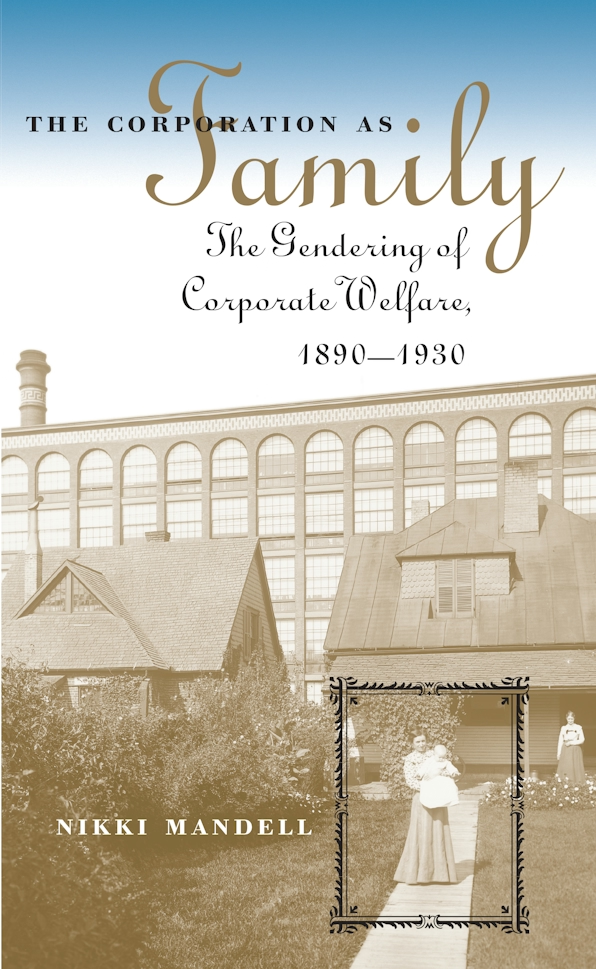
Nikki Mandell
The corporate welfare system and modern industrial relations, with a lens of gender at the center
The beginning of the twentieth century witnessed a remarkable growth of corporate welfare programs in American industry. By the mid-1920s, 80 percent of the nation’s largest companies — firms including DuPont, International Harvester, and Metropolitan Life Insurance — engaged in some form of welfare work. Programs were implemented to achieve goals that ranged from improving basic workplace conditions, to providing educational, recreational, and social opportunities for workers and their families, to establishing savings and insurance plans.
Employing the critical lens of gender analysis, Nikki Mandell offers an innovative perspective on the development of corporate welfare. She argues that its advocates sought to build a new relationship between labor and management by recasting the modern corporation as a Victorian family. Employers assumed the authoritative position of fathers, assigned their employees the subordinate role of children, and hired male and female welfare managers to act as “corporate mothers” charged with creating a harmonious household. But internal conflict and external pressures weakened the corporate welfare system, and it eventually gave way to a system of personnel management and employee representation. With the abandonment of the familial model, the form of corporate welfare changed; but, as Mandell demonstrates, its content left an enduring legacy for modern industrial relations.
“A lively portrait of the women and men who first sought to manage labor relations, adding a needed dimension to existing histories of management and contributing to a growing literature on gender and business.” — Enterprise & Society
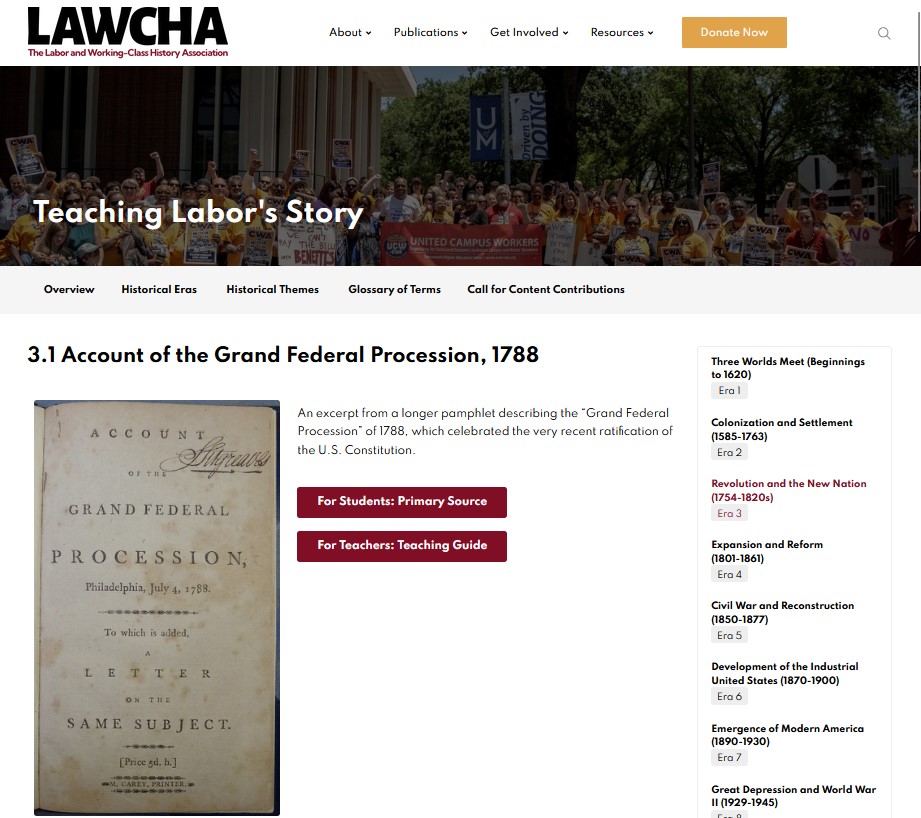
Nikki Mandell, Teaching Labor's Story
Account of the Grand Federal Profession Performed at Philadelphia on Friday, July 4th1788 By Frances Hopkinson -- Teaching guide will help students seeing how pride in work and skill transferred to claims of rights and workplace dignity
The Grand Federal Procession was a parade organized to celebrate the ratification of theU. S. Constitution. The author, Frances Hopkinson,had signed the Declaration of Independence, served as a delegate tothe 1787 Constitutional Convention, and was the main organizer of this Grand Procession. He wrote a long pamphlet describing the paradefour days after the parade.Pamphlets werea major form of journalismandmethod ofpolitical debatein the Revolutionary Era. They were widely read and discussed. Thomas Paine’s Common Senseis, perhaps, the most famous pamphlet of that era.This is an excerpt from Hopkinson’s pamphlet.
An excerpt from a longer pamphlet describing the “Grand Federal Procession” of 1788, which celebrated the very recent ratification of the U.S. Constitution.
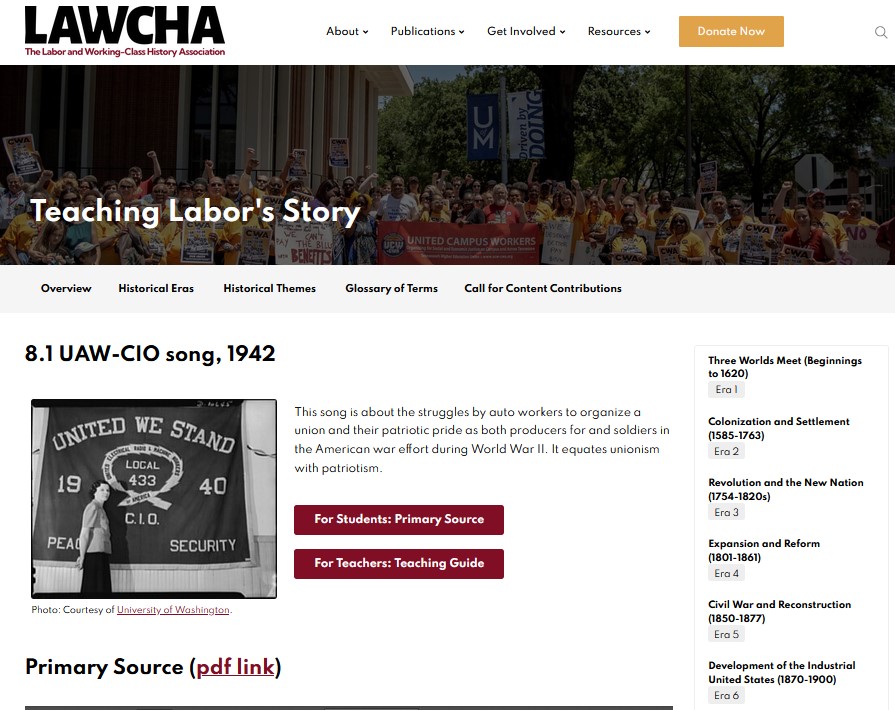
Nikki Mandell, Teaching Labor's Story
This song was written five years after the newly formed United Auto Workers [UAW] won a major strike against General Motors,and shortly after the US entered World War II.At its founding in 1937,the UAW was one of the largest unions in thenewly formed Congress of Industrial Unions [CIO]. The Union Boysfolk musicgroup, which included Pete Seeger and Josh White, performed the song atunioneventsand various progressive gatherings. They recordedthe song in 1944 as part of Asch Records’ “Songs for Victory”album. Includes song and teaching guide
This song is about the struggles by auto workers to organize a union and their patriotic pride as both producers for and soldiers in the American war effort during World War II. It equates unionism with patriotism.
Museum/Exhibits
Tours
Maps
Digital Projects
Organizations
Sites
Film/Video
Audio/Interview
Podcast/Program
Text/Document
Image
Graphs/Data
Timeline
Southwest
West
Midwest
Southeast
Northeast
Mexico
Canada
Global