


Collections
Library
Type
Region
Coverage:
-
Published:
-
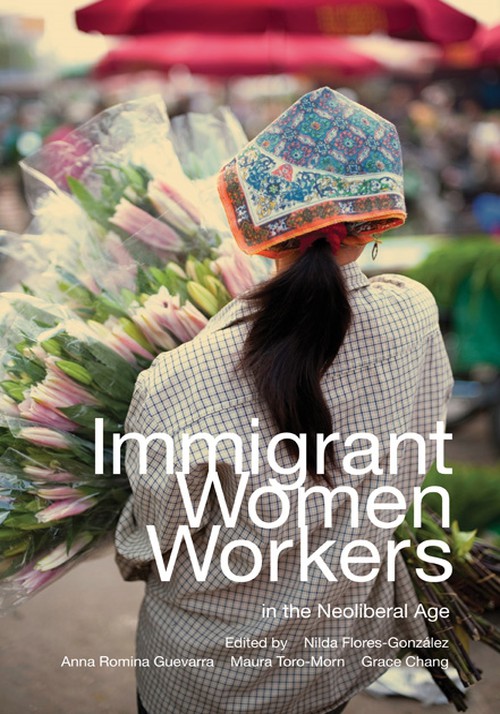
Nilda Flores-González, Anna Romina Guevarra, Maura Toro-Morn, Grace Chang, eds
Much of the research on immigrant women and labor forces has focused on the participation of immigrant women on formal labor markets. In this study, contributors focus on informal economies such as health care, domestic work, street vending, and the garment industry, where displaced and undocumented women are more likely to work. Because such informal labor markets are unregulated, many of these workers face abusive working conditions that are not reported for fear of job loss or deportation.
In examining the complex dynamics of how immigrant women navigate political and economic uncertainties, this collection highlights the important role of citizenship status in defining immigrant women's opportunities, wages, and labor conditions
contributors focus on informal economies such as health care, domestic work, street vending, and the garment industry, where displaced and undocumented women are more likely to work.

Nome Industrial Worker
The Nome Industrial Worker was a weekly newspaper owned and produced by the local 240 chapter of the International Union of Mine, Mill and Smelter Workers in cooperation. It began on July 5, 1907 and was printed on the press of the Nome Daily Nugget.
Alaska socialist paper
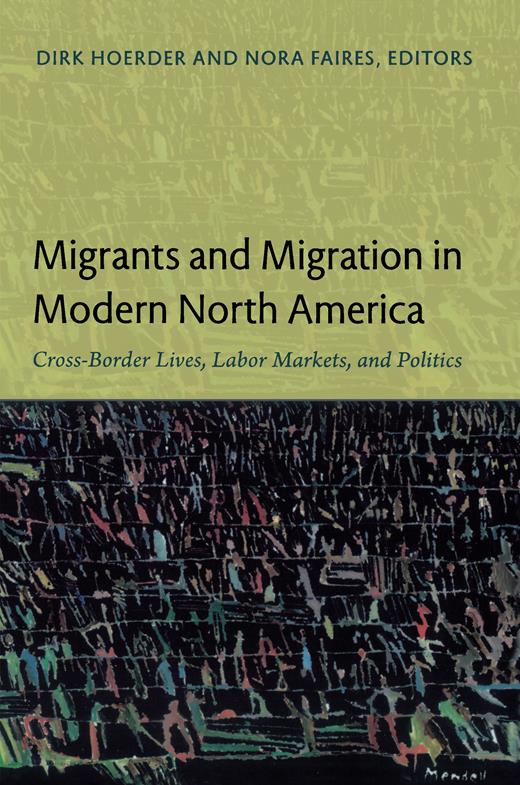
Nora Faires, Dirk Hoerder
This collection of twenty essays provides an integrated view of migration in North America—within and between Canada, the Caribbean, Mexico, and the United States—during the past two centuries.
Mirando atrás : Mexican immigration from 1876 to 2000 / Jaime R. Aguila and Brian Gratton
Through the northern Borderlands : Canada-U.S. migrations in the nineteenth and twentieth centuries / Bruno Ramirez
The making and unmaking of the circum-Caribbean migratory sphere : mobility, sex across boundaries, and collective destinies, 1840-1940 / Lara Putnam
Population movements and the making of Canada-U.S. not-so-foreign relations / Nora Faires
Greater southwest North America : a region of historical integration, disjunction, and imposition / Carlos G. Vélez-Ibáñez with Dirk Hoerder
Independence and interdependence : Caribbean-North American migration in the modern era / Melanie Shell-Weiss
Migration to Mexico, migration in Mexico : a special case on the North American continent / Delia González de Reufels and Dirk Hoerder
The construction of borders : building North American nations, building a continental perimeter, 1890s-1920s / Angelika E. Sauer
The United States-Mexican border as material and cultural barrier / Omar S. Valerio-Jiménez
Migration and the seasonal round : an Odawa family's story / Susan E. Gray
Market interactions in a borderland setting : a case study of the Gila River Pima of Arizona, 1846-1862 / Dan Killoren
Paying attention to moving Americans : migration knowledge in the age of internal migration, 1930s-1970s / James N. Gregory
The Black experience in Canada revisited / Sarah-Jane (Saje) Mathieu
Circumnavigating controls : transborder migration of Asian-origin migrants during the period of exclusion / Yukari Takai
Migration and capitalism : the rise of the U.S.-Mexican border / John Mason Hart
Central American migration and the shaping of refugee policy / María Cristina Garcia
Central American transmigrants : migratory movement of special interest to different sectors within and outside Mexico / Rodolfo Casillas-R
Interrogating managed migration's model : a counternarrative of Canada's seasonal agricultural workers program / Kerry Preibisch
1867 and all that
: teaching the American survey as continental North American history / Angelika Sauer and Catherine O'Donnell
Book provides an integrated view of migration in North America during the past two centuries.
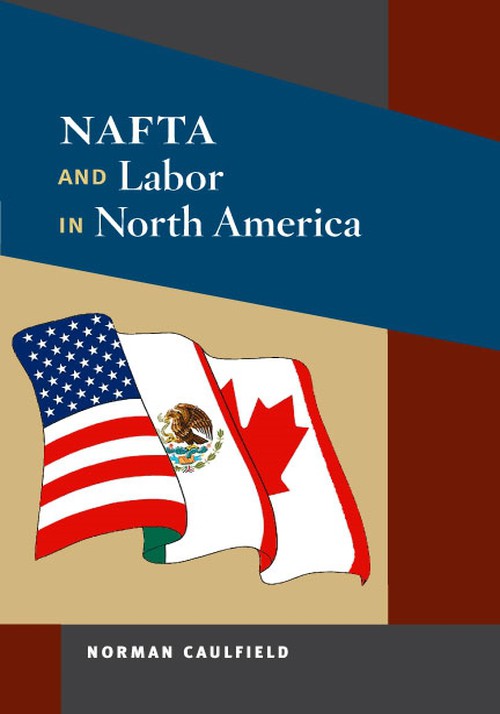
Norman Caulfield
"As companies increasingly look to the global market for capital, cheaper commodities and labor, and lower production costs, the impact on Mexican and American workers and labor unions is significant. National boundaries and the laws of governments that regulate social relations between laborers and management are less relevant in the era of globalization, rendering ineffective the traditional union strategies of pressuring the state for reform." "Focusing especially on the effects of the North American Free Trade Agreement and the North American Agreement on Labor Cooperation (the first international labor agreement linked to an international trade agreement), Norman Caulfield notes the waning political influence of trade unions and their disunity and divergence on crucial issues such as labor migration and workers' rights. Comparing the labor movement's fortunes in the 1970s with its current weakened condition, Caulfield notes the parallel decline in the United States' hegemonic influence in an increasingly globalized economy. As a result, organized labor has been transformed from organizations that once pressured management and the state for concessions to organizations that now request that workers concede wages, pensions, and health benefits to remain competitive in the global marketplace."--BOOK JACKET
Labor and global capitalism in North America, 1850-1970
The politics of Mexican labor and economic development in crisis
Mexican labor and workers' rights under NAFTA and NAALC
Labor mobility and workers' rights in North America
The crisis of union-management relations in the United States and Canada
The North American auto industry : the apex of concessionary bargaining
VEBA Las Vegas! Unions play casino capitalism : autoworkers lose
Book argues organized labor has been transformed from organizations that once pressured management and the state for concessions to organizations that now request that workers concede wages, pensions, and health benefits to remain competitive in the global marketplace.
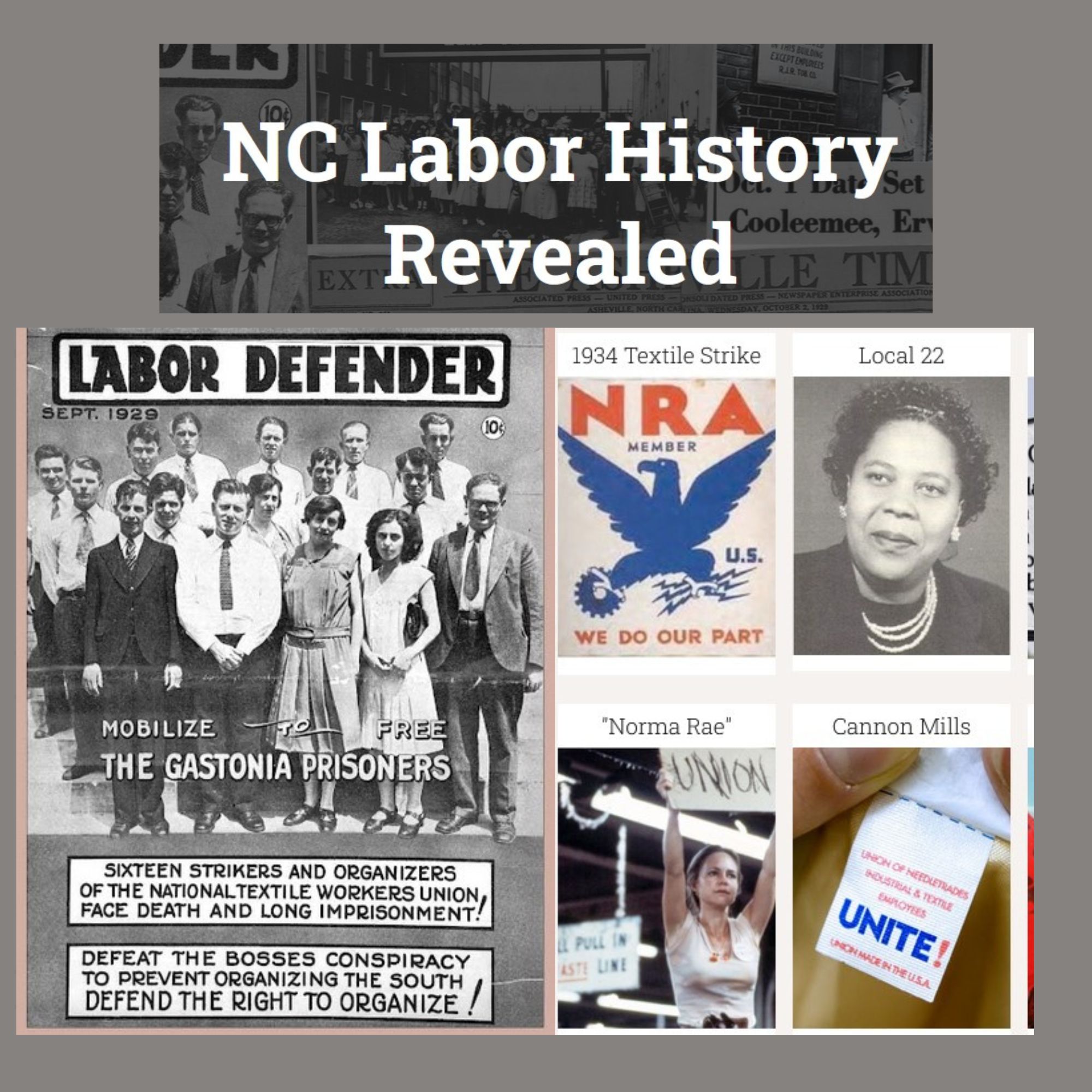
North Carolina AFL-CIO, Charles Lumsden, Nathan Sperry
Segments on multiple topics: Limited Series Podcasts all listed below
Early Unions in NC
Loray Mill Strike
Marion Massacre
Textile Strike of 1934
Local 22
Operation Dixie
Norma Rae
Cannon Mills
Mt. Olive Boycott
Victory at Smithfield
UAW of NC
Duke Faculty
Labor & Civil Rights
Public Employees
4 podcasts on:
Episode 1 - Roots
Episode 2 - Race
Episode 3 - Resistance
Episode 4 - Revival
A site containing information on museum exhibits as well as a limited podcast covering the history of labor agitation in North Carolina
Northern Illinois University
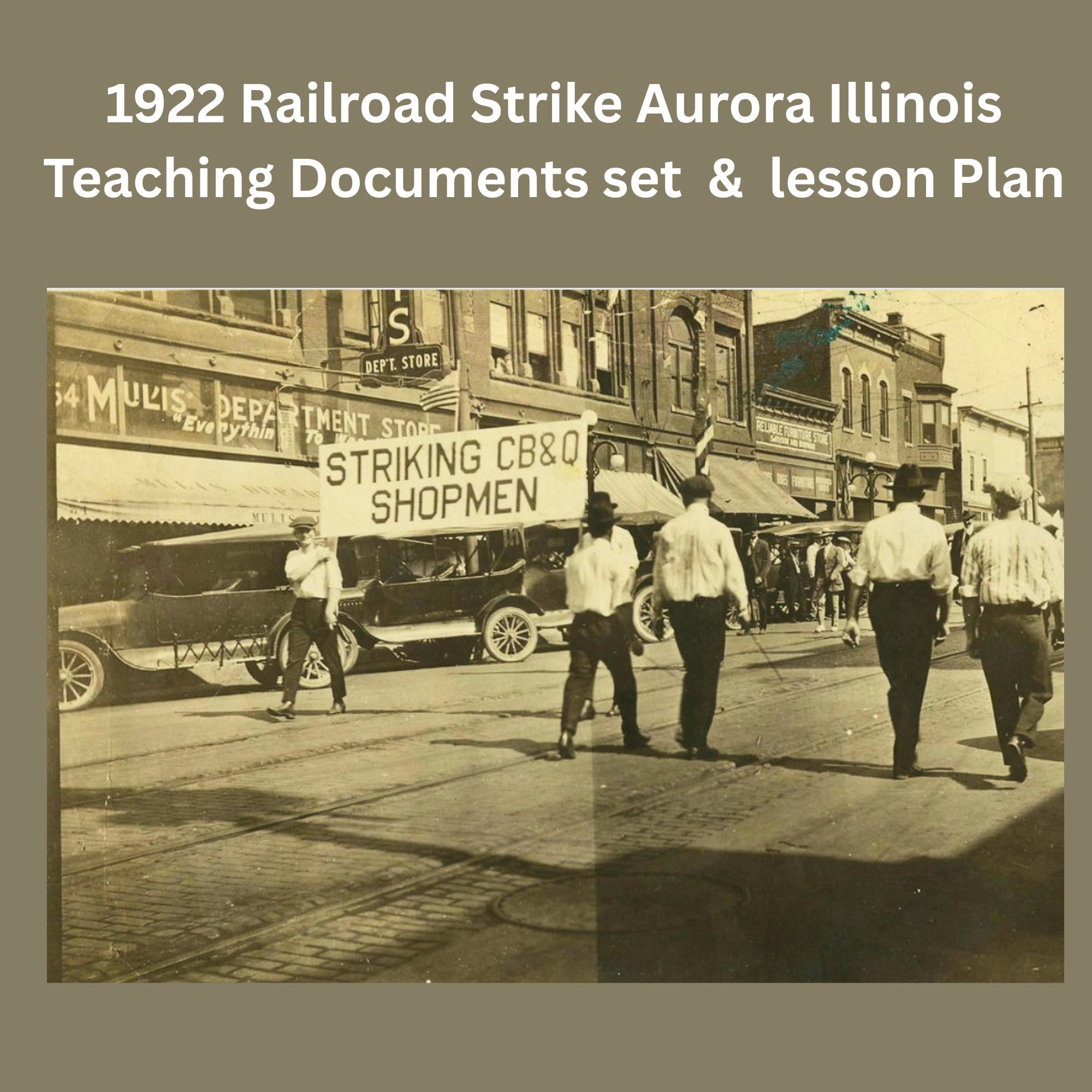
A 2-4 day lesson plan Summary: On July 1, 1922 the first nationwide work stoppage in U.S. railroad history began. At least 400,000 members of six unions walked off of their jobs and the Burlington Railroad strike had begun. In Aurora, Illinois, 1700 shopmen, or skilled workers, struck the Chicago Burlington and Quincy Railroad. Management at the railroad fought the strike by bringing in new workers or “new men”, and setting up dormitories for them in the shops so that they would not have to cross picket lines. The Regional History Center has extensive records of this strike action. These records include special agent reports, legal documents, correspondence and oral history transcriptions. In this lesson, students will view primary source materials and organize them in order to reconstruct some of the conditions under which the strike occurred, and to report some of the events that took place during the strike. The students will then reenact some of the arguments of the different parties involved in the strike based upon their reports. Finally, the students will evaluate the ultimate outcome of the strike action.
Standards: CCSS. ELA Literacy RH 9-10. 9 Compare and contrast treatment of the same topic in several primary and secondary sources.
Objective: The students will be able to look at an historical event from multiple points of view based on primary source documents.
The students will be able to organize and summarize the evidence to create a multi-perspective simulation of the Burlington Railroad Strike of Aurora, Illinois. The students will be able to evaluate some of the historical outcomes of the Burlington Shopmen’s strike.
Evidence: RC 217, Burlington Railroad Strike of Aurora Illinois Collection, Regional History Center at Northern Illinois University
Many thanks for the work of James Flynn.
A 2-4 day lesson plan using spy documents and other archival material about the, 1922 the first nationwide work stoppage in from Auroral Illinois base of material.
Northern Illinois University
NIU’s Digital Library includes one of the largest collections of digitized materials pertaining to the 1886 Haymarket Affair. The 300 individual primary sources and secondary materials are a significant body of information related, including images, cartoons, documents.
One of the largest collections on Haymarket, plust mini-lectures; 338 primary sources appear across three collections. See our instructions for finding these effectively through the search engine.
Northern Illinois University
Illinois in the Gilded Age's interpretive materials can serve to introduce anyone with a basic knowledge of American history to the major events of this period. These resources can also introduce project users to scholars' major interpretive themes and debates, and help them to formulate their own historical questions and begin research in the online databases.
Isolate labor items by subject, or with the topic "labor" on the left side bar.
brings together primary source materials from a number of libraries, museums and archives
Northern Illinois University
Dime novels were a format of inexpensive popular fiction produced in the United States between 1860 and 1930. Available for as little as a nickel or as much as a dime, they opened up leisure reading for the masses in a way previously not possible. Originally featuring stories about the American frontier and the West, cowboys eventually gave way to detectives, like Nick Carter, and boy adventurers and entrepreneurs, like Frank Reade Jr. This site contains materials from two major dime novel collections in Rare Books and Special Collections at Northern Illinois University, the Albert Johannsen and Edward T. LeBlanc Collections. This work has been generously supported by the Council on Library and Information Resources (CLIR) and the National Endowment for the Humanities (NEH). Visitors may browse the entire full-text collection, explore a particular series or author, or start at our about pages to learn more about dime novels.
In addition to thousands of digitized dime novels, this site features essays and spotlights on particular novels, which serve as entry-points into the collection. This work is part of a decades-long effort at NIU and partner institutions to preserve and document an important part of American culture with support provided by the Council on Library and Information Resources, the National Endowment for the Humanities, the Horatio Alger Society, and individual donor
digitized collection of dime novels, literature can be text-mined

Northwest Labor Press
This publication has chronicled the labor movement since 1900. Though each edition was written for present-day readers, over time the archives have become a rich resource for historical research. What most of our readers call “the Labor Press” has gone through several name changes since its founding. It was known as:
Portland Labor Press from 1900 to 1915;
Oregon Labor Press from 1915 to 1986;
Oregon/Washington Labor Press 1986 to 1987; and
Northwest Labor Press from 1987 to today.
There are several ways to access our archives.
1910-2023 — online via Newspapers.com
1900-1915 — online via University of Oregon library
1915-1986 — online via University of Oregon library
1900-today — in person via bound volumes or microfilm at 11 libraries
1997-2011 — via the html archive on this site
This publication has chronicled the labor movement since 1900.

Nunzio Pernicone
Historians have frequently portrayed Italian anarchism as a marginal social movement that was doomed to succumb to its own ideological contradictions once Italian society modernized. Challenging such conventional interpretations, Nunzio Pernicone provides a sympathetic but critical treatment of Italian anarchism that traces the movement’s rise, transformation, and decline from 1864 to 1892. Based on original archival research, his book depicts the anarchists as unique and fascinating revolutionaries who were an important component of the Italian socialist left throughout the nineteenth century and beyond. Anarchism in Italy arose under the influence of the Russian revolutionary Bakunin, triumphed over Marxism as the dominant form of early Italian socialism, and supplanted Mazzinianism as Italy’s revolutionary vanguard. After forming a national federation of the Anti-Authoritarian International in 1872, the Italian anarchists attempted several insurrections, but their organization was suppressed. By the 1880s the movement had become atomized, ideologically extreme, and increasingly isolated from the masses. Its foremost leader, Errico Malatesta, attempted repeatedly to revitalize the anarchists as a revolutionary force, but internal dissension and government repression stifled every resurgence and plunged the movement into decline. Even after their exclusion from the Italian Socialist Party in 1892, the anarchists remained an intermittently active and influential element on the Italian socialist left. As such, they continued to be feared and persecuted by every Italian government.
This history provides a sympathetic but critical treatment of Italian anarchism that traces the movement’s rise, transformation, and decline from 1864 to 1892

Ohio Daily-Express
The Daily Bulletin and Ohio Daily-Express were African American newspapers published in the 1940s and 1950s in Dayton, Ohio. By 1944, the Daily Bulletin‘s full title as it appeared in its masthead was The Daily Bulletin Combined with the Ohio Express, further described as “One of the Two Only Negro Dailies in the World.” Here, Ohio Express refers to the Ohio Daily-Express, which officially began publication in 1946 when its publisher, Paige H. Strickland, apparently purchased the Daily Bulletin. It is unclear whether a separate Daily Bulletin existed in Dayton between its origin in 1942 and the first known issue in 1944, or if such a publication continued alongside the combined version. In November 1950, the Ohio Daily-Express dropped “Ohio” and became the Daily Express. The similarities in format, frequency, and content, in addition to the combination of titles from 1944-1946, suggest that the two represent a singular and continuous lineage.
The Daily Bulletin published a four-column, four-page daily newspaper featuring syndicated material from the Negro Newspaper Publishers’ Association (now the National Newspaper Publishers Association) and the Associated Negro Press (ANP). The Express leaned more heavily on the ANP for its article content. The Express also added a fifth column and occasionally printed up to six pages, but it kept the same publication frequency.
The Daily Bulletin and Ohio Daily-Express were African American newspapers published in the 1940s and 1950s in Dayton, Ohio.
Ohio Memory
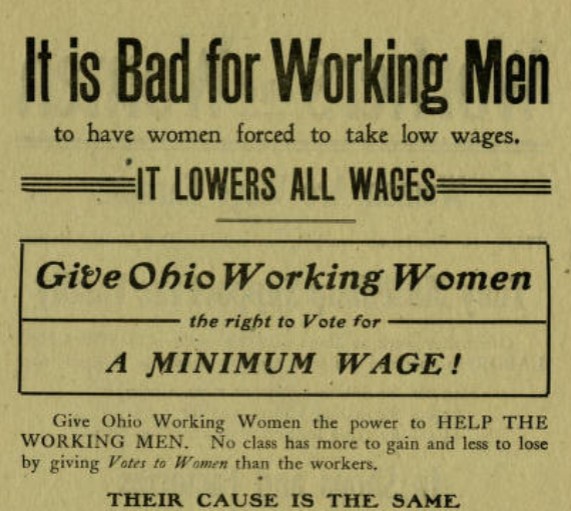
Searchable database. Results have many items related to the steel industry, especially ARMCO, Youngstown Sheet & Tube, Republic Steel and Pollock company, US Steel, but this is just a starting point for searching this huge database.
Ohio Memory began in 2000 as a digital repository containing contributions from hundreds of cultural heritage institutions around the state. A lot of content has been added to the site since then, but most of the original contributions can be seen here, representing a variety of topics, time periods and institutions.
searchable database that results in a wide range of posters, letters, newspapers,
Ohio State Univerity
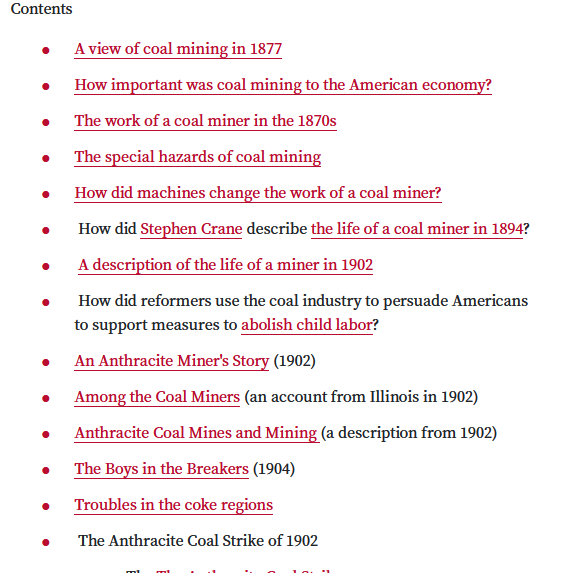
An online exhibition from Ohio State University libraries featuring articles, descriptions, and primary documents on the U.S. coal industry in the Gilded Age and Progressive Era.
Contents
A view of coal mining in 1877
How important was coal mining to the American economy?
The work of a coal miner in the 1870s
The special hazards of coal mining
How did machines change the work of a coal miner?
How did Stephen Crane describe the life of a coal miner in 1894?
A description of the life of a miner in 1902
How did reformers use the coal industry to persuade Americans to support measures to abolish child labor?
An Anthracite Miner's Story (1902)
Among the Coal Miners (an account from Illinois in 1902)
Anthracite Coal Mines and Mining (a description from 1902)
The Boys in the Breakers (1904)
Troubles in the coke regions
The Anthracite Coal Strike of 1902
The The Anthracite Coal Strike
A 1904 description of anthracite coal communities
The Molly Maguires
Avondale Disaster from The Coal Mines, by Andrew Roy, State Inspector of mines of Ohio, 1876. pp. 134-137.
Work of a Coal Miner from Andrew Roy, The Practical Miner's Companion; or, Papers on Geology and Mining in the Ohio Coal Field (Columbus: Westbote Printing Company, 1885): 108-110.
The Life of a Coal Miner
scanned from The World's Work 4 (October 1902): 2659-60
Turn-of-the-Century Coal Mining Machinery from Cassier's Magazine
The Coke Region Troubles scanned from Frank Leslie's Illustrated Newspaper 1891 Vol. 72, p. 240.
Images from A view of coal mining in 1877 scanned from Frank Leslie's Popular Monthly, vol. III, no. 1, Jan. 1877, pp. 116-126.
A view of coal mining in 1877 webpage by C. Gordon Moffat and
modified by K. Austin Kerr
Among the Coal-Miners scanned from Missionary Review 1902,
Vol. 25, pp. 835-39
Anthracite Coal Mines and Mining from The American Monthly Review
of Reviews, November, 1902.
The Boys in the Breakers from Anthracite Coal Communities,
by Peter Roberts, 1904, pp.174-181
The Anthracite-Carrying Railways was scanned from The American Monthly Review of Reviews, July,
1902. pp. 66-69.
A General View of the Coal Strike By Talcott Williams scanned from The American Monthly Review of Reviews, 1902.
John Mitchell: The Labor Leader and the Man scanned from The American Monthly Review of
Reviews, 1902.
The Progress of the World scanned from The American Monthly Review of
Reviews, November, 1902, pp. 515-527
Pages originally designed by Patrick J. Hall
Site revised by Mitchell R.K. Shelton
From Coal: Information on the American Coal Industry and Child Labor and Child Labor Reform in American History
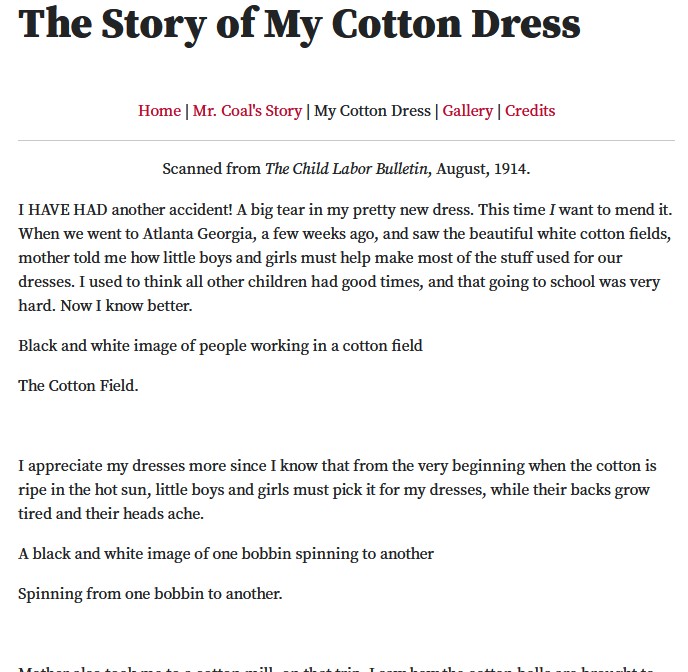
Ohio State Univerity
Story of a dress made with child labor. Scanned from The Child Labor Bulletin, August, 1914.
Child labor expose from 1914
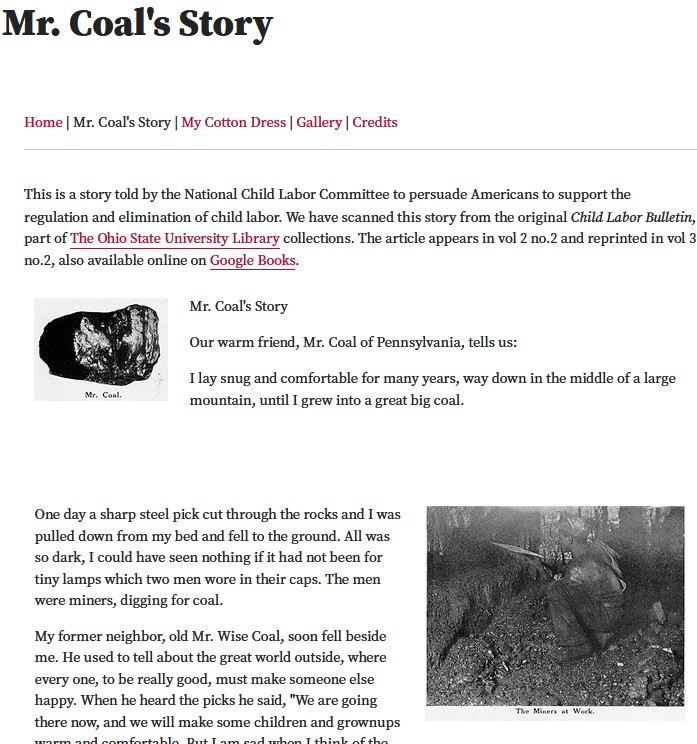
Ohio State University
This is a story told by the National Child Labor Committee to persuade Americans to support the regulation and elimination of child labor. The Ohio State University Libraries have scanned this story from the original Child Labor Bulletin, part of The Ohio State University Library collections. The article appears in vol 2 no.2 and reprinted in vol 3 no.2, also available online on Google Books.
(teaching document) A National Child Labor Committee story designed to create support for the abolition of child labor, accompanied by several photographs of coal mining and child labor.

Ohio State University
An Ohio State University-hosted webpage on the 1902 Anthracite Coal Strike which contains thirteen resources including short background essays, information on anthracite carrying railways, descriptions of relevant historical figures, and visuals.
The Ohio State University's online exhibition for primary sources from the 1902 Anthracite Coal Strike.
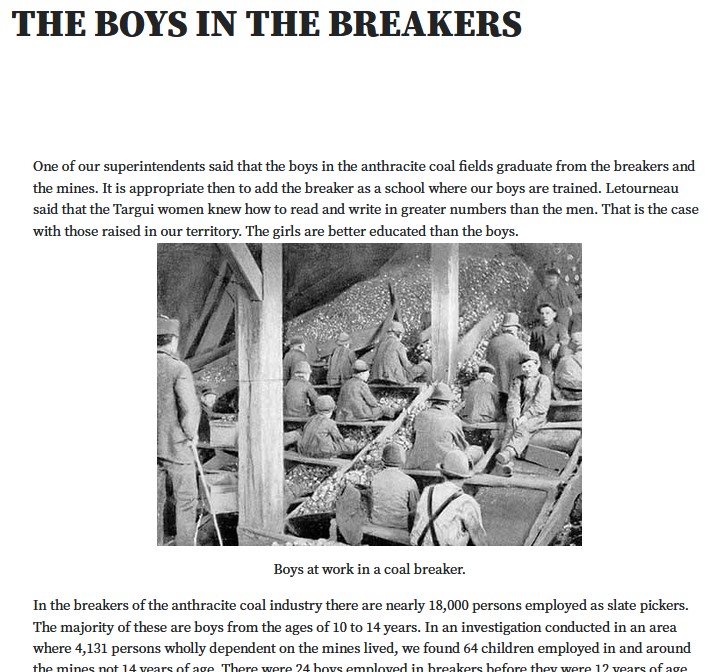
Ohio State University
In the breakers of the anthracite coal industry there are nearly 18,000 persons employed as slate pickers. The majority of these are boys from the ages of 10 to 14 years. In an investigation conducted in an area where 4,131 persons wholly dependent on the mines lived, we found 64 children employed in and around the mines not 14 years of age. There were 24 boys employed in breakers before they were 12 years of age. In other sections of the coal fields the evil of employing children under age in breakers and mines is worse than in our limited area. But if the proportion above mentioned prevails in these coal fields, there are employed in the breakers about 2,400 boys under 12 years of age, and nearly 6,400 boys under 14 years of age working in and around the mines. The tabulated report of superintendents of public schools in Lackawanna county given above, shows how prevalent the evil of child labor is. Improved machinery for cleaning coal has displaced many boys, and it is hoped that a still further improvement and utilization of such machinery will render unnecessary the labor of boys hardly in their teens in these breakers. No industry demands the service of boys whose bone and muscle are not hardened and whose brain has not been developed for continuous and effective thinking. Muscle without intelligence is annually depreciating, being displaced by machinery which does nearly all the rough work. To stunt the body and dull the brains of boys in breakers is to rob them of the mental equipment which is essential to enhance their social worth and enable them to adjust themselves to the requirements of modern life.
(teaching document) A photograph of child coalbreakers and an excerpt of a chapter from The Boys in the Breakers, which describes the working conditions and legal issues of employing child coal miners in Progressive Era-Pennsylvania

Ohio Valley Worker
Ohio Valley Worker : Official Paper of the Federated Trades Council of Louisville, Trades and Labor Council of New Albany, Central Labor Union of Jeffersonville ([Louisville, Ky.]) only one issue digitally available
Ohio Valley Labor Paper
Olaudah Equiano, Gustavus Vassa
Olaudah Equiano (c.1745-1797) was an eighteenth-century African writer, antislavery activist, mariner, explorer, and Britain's first black civil servant.
According to his famous autobiography, written in 1789, Equiano was born in what is now Nigeria. Kidnapped and sold into slavery in childhood, he was taken as a slave to the New World. As a slave to a captain in the Royal Navy, and later to a Quaker merchant, he eventually earned the price of his own freedom by careful trading and saving. As a seaman, he travelled the world, including the Mediterranean, the Caribbean, the Atlantic, and the Arctic, the latter in an abortive attempt to reach the North Pole.
Coming to London, he became involved in the movement to abolish the slave trade, an involvement which led him to be employed as Britain's first black civil servant and, later, to him writing and publishing The Interesting Narrative of the Life of Olaudah Equiano, or Gustavus Vassa the African (1789) a strongly abolitionist autobiography. The book became a bestseller and, as well as furthering the anti-slavery cause, made Equiano a wealthy man. He married Susanna Cullen of Soham in Cambridgeshire in 1792, but died in London in March 1797.
These web pages aim to reflect the best in Equiano scholarship. Click on the links to find out more, and return to this site soon, as information is regularly updated.
Brycchan Carey's main website page for historical resources related to the famed African writer and antislavery activists Olaudah Equiano, including several excerpts of his writing, links to materials for Equiano Studies, maps, an illustrated bibliography, and portraits.
Olaudah Equiano, History Matters
In one of the largest forced migrations in human history, up to 12 million Africans were sold as slaves to Europeans and shipped to the Americas. Most slaves were seized inland and marched to coastal forts, where they were chained below deck in ships for the journey across the Atlantic or “Middle Passage,” under conditions designed to ship the largest number of people in the smallest space possible. Olaudah Equiano had been kidnapped from his family when he was 11 years old, carried off first to Barbados and then Virginia. After serving in the British navy, he was sold to a Quaker merchant from whom he purchased his freedom in 1766. His pioneering narrative of the journey from slavery to freedom, a bestseller first published in London in 1789, builds upon the traditions of spiritual narratives and travel literature to help create the slave narrative genre.
Olaudah Equiano's account of enslavement and eventual self-purchase freedom, often credited with helping found the so-called "slave narrative genre."
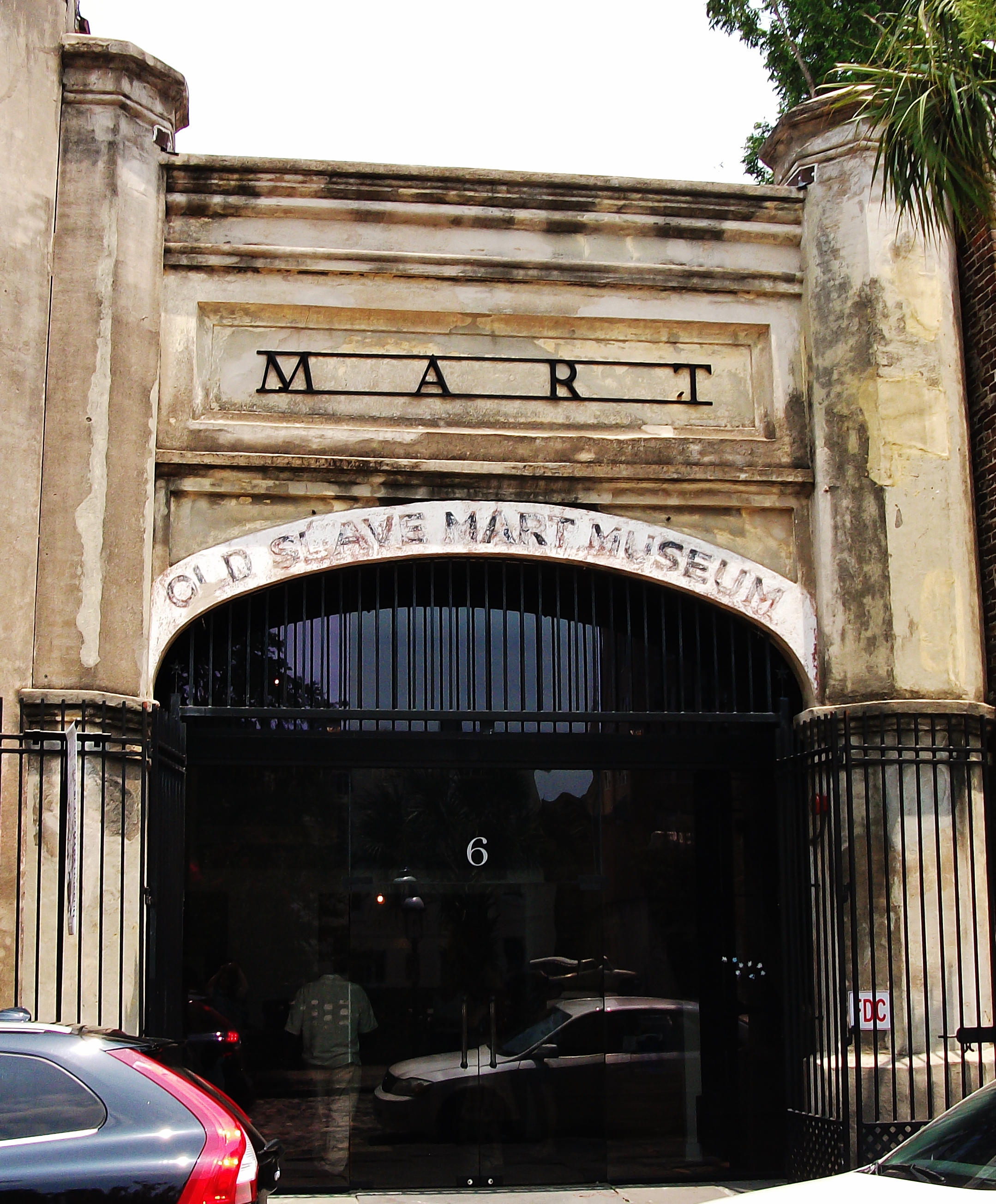
Old Slave Mart Museum
Established in 1938, the Old Slave Mart Museum is Charleston’s oldest museum of African American history and the first museum on the history of slavery in the United States. Located in the heart of downtown Charleston, the museum is housed in a portion of the city’s last major slave market. Today, the Old Slave Mart Museum is owned and operated by the City of Charleston and is dedicated to sharing the story of the domestic slave trade.
Ryan’s Mart was a four-building complex that stretched from Chalmers Street to Queen Street. The Old Slave Mart Museum is housed in the Mart’s last remaining structure, which served as a salesroom and showroom. During its years of operation, Ryan’s Mart also included a kitchen, an infirmary, a four-story jail where enslaved people were confined prior to sale, and a large enclosed lot used as a slave pen.
After the Civil War, former property that made up the Mart was broken up and served a variety of roles, including as tenement housing for local African Americans. In 1938, Miriam B. Wilson opened the Old Slave Mart Museum in the former salesroom building at Chalmers. Privately owned for its first fifty years, the museum was acquired in 1988 by the City of Charleston, who renovated and reopened it in 2007.
First museum of slavery in the United States, at the site where signficiant numbers of enslaved were sold.

Oliver Betts, Laura Harrison, Laura Christine Price
Economic and political uncertainty has brought the language of class – especially discussion of the working class – to a broad audience across scholarship and social debate. This introductory volume shows how the history of the working class has, is, and can be researched, written, and represented.
The book is structured in three parts: perspective, context, and application. Each offers an introduction to both classic historiography and new ideas and methodologies. With chapters covering a span of the years c.1750–present, the book focuses on three essential questions: What is working-class history and what should it become? What can a focus on working-class history reveal? What are the possibilities of this research in the university classroom, the heritage world, and beyond? Doing Working-Class History will appeal to students and scholars of working-class history, whether relative newcomers to the field or veteran researchers interested in new approaches and material. It will also be of interest to local and family historians, museum and heritage professionals, and general readers.
Introduction: A Time for Working-Class Histories
Oliver Betts, Laura Harrison, and Laura Christine Price
Part 1: Working-class History in Perspective
1. Disability in Working Class History
Ben Curtis
2. Parasites Unite: Sensory History, the Possibilities of Transgression, and the Perceptual Manifesto of the Proletariat
Andrew Kettler
3. ‘What are those ones with the hammers?’: Teaching Working-class History in Secondary Schools
Laura Christine Price4. ‘Everyone has a tale to tell’: Family History, Family Historians, and Working-class Histories
Laura Harrison
5. Museums and Heritage Sites as Sources for Working-class History
Oliver Betts
6. Reading against the Grain: Non-plebian Sources in Working-class History
Oliver Betts
7. Accessible Bibliography
Laura Christine Price
Part 2: Working-class History in Context
8. The Daily Citizen: Class v consumerism in the Early Labour Press
Christopher Shoop-Worrall
9. Gender Politics of Class: Exploring the Connections and Collaboration between the Irish Labour Movement and the Irish Women’s Franchise League in Dublin, 1908–1916
Erin Geraghty
10. Bootstraps and Bras: Maidenform, the International Ladies’ Garment Workers Union, and the Creation of a New Export-Led Economy in Puerto Rico
Natasha Synycia
11. Patriotism and the English Working Class, c. 1902–1929
David Swift
12. Medical Care for Working-class Children in the Late Eighteenth and Early Nineteenth Century
Claire Phillips
13. ‘I have told her that it was neglected, and asked her why’: Working–class Women and Discourses of ‘Bad Motherhood’ in England and Wales, 1870–1939
Daniel J.R. Grey
14. Unorganised Workers: Wool Textile Workers and Class Identities in Twentieth-century Yorkshire
Laura Christine Price
15. ‘Where the Brass Band is Beloved’, Brass Bands and Working-class Cultural Identity: Inventing a Musical Metonym in the Southern Pennines, c.1840–1914
Stephen Etheridge
16. Street Life: The Leisure Spaces and Places of Working-class Youth in Britain, c. 1870–1960
Laura Harrison
17. Coal Miners in the Industrialisation and Deindustrialisation of France and Germany: A Comparative Synthesis of the Nord/Pas-de-Calais and the Ruhr
Brian Shaev
Part 3: Working-class History in Application
18. Representations of Working-class Lives at Criminal Justice Heritage Sites
Dan Johnson and Rose Wallis
19. How Broadside Ballads Followed Us into This Century
Jennifer Reid
20. ‘We tell our own stories’: Bussing Out, a Creative Installation about Working-class Children in Bradford
Shabina Aslam
21. ‘The Past We Inherit, the Future We Build’: The Praxis of Working-class History
Rhian E. Jones
This introductory volume shows how the history of the working class has, is, and can be researched, written, and represented, giving examples of working class history from 1750 to the present. Notable section on disability history
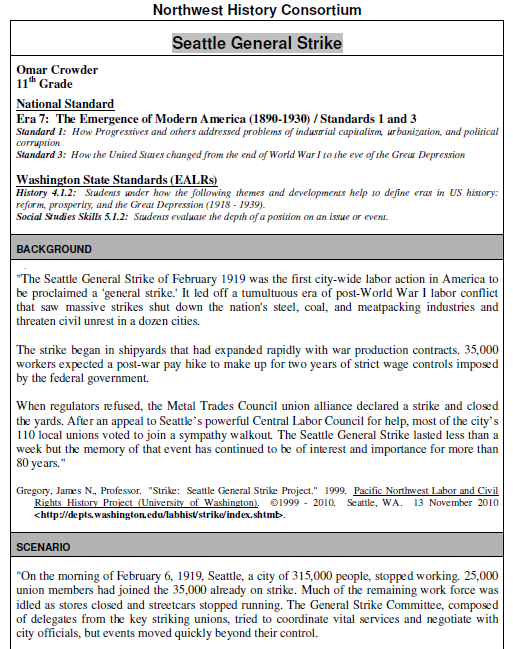
Omar Crowder, Northwest History Consortium
Seattle General Strike Lesson Plan that asks students to write an editorial. Desinged for 11th grade
National Standard
Era 7: The Emergence of Modern America (1890-1930) / Standards 1 and 3
Standard 1: How Progressives and others addressed problems of industrial capitalism, urbanization, and political
corruption
Standard 3: How the United States changed from the end of World War I to the eve of the Great Depression
A lesson plan for teaching the Seattle General Strike.
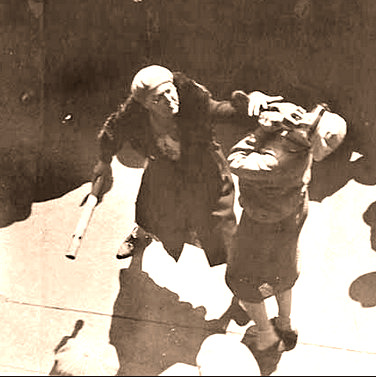
One Day in July
from soup kitchen to battles with police
33 photos from Minneapolis Truckers Strike 1934, a major event in 1930s rebellion