


Collections
Library
Type
Region
Coverage:
-
Published:
-
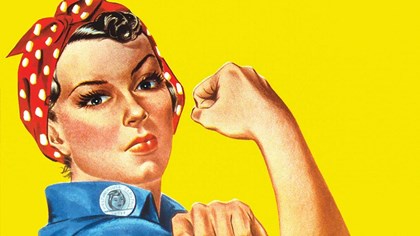
Oral History Center
In collaboration with the National Park Service and the City of Richmond, the Oral History Center conducted over 250 interviews focusing on the World War II Home Front experience. Starting with over one hundred interviews focused on the home front experiences in the Bay Area, we focused on why people from different backgrounds came to the Bay Area, what they did when they arrived, and what they learned from the fluidity and flux of wartime life that affected decisions they made after the war ended. What did women learn about the relationships between work and family life? How did attitudes change toward education? How did war affect race relations and reshape civil rights struggles? Did new ideas about sexuality take root, and if so, why and where? What happened to entertainment? To what degree did religious organizations provide people with a new sense of community? Oral histories collected are used in the National Park Service’s Visitor Education Center at the Rosie the Riveter/World War II Homefront National Historic Park and the Bancroft Library and available online below in transcript — and when possible — with videos synced to transcripts.
over 250 interviews focusing on the World War II Home Front experience
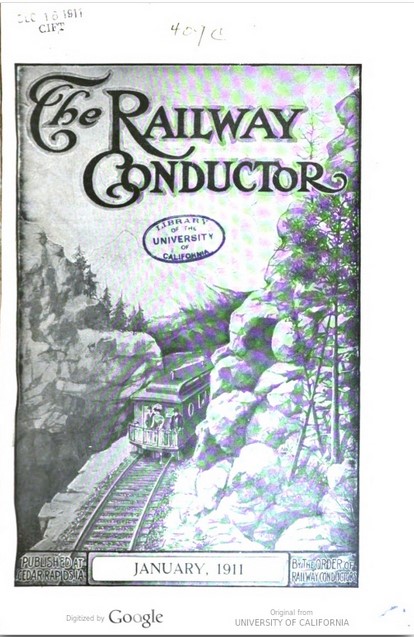
Order of Railway Conductors and Brakemen.
Magazine of the Brotherhood of Order of Railway Conductors and Brakemen.
Railroad brotherhood journal. Official publication of the Order of Railway Conductors and Brakemen.. Most issues available from 1884-1949

Oregon Historical Society
Oregon HIstorical Society Digital collections related to labor --almost 2000 items to start your search
Oral history, photos, video interviews, and other items related to labor unions
Oregon State Historic Preservation Office
By narrowing this study to paid labor and within this time frame, the authors hope to better define the spaces within which women have operated and address the impacts on
women and their ability to earn income. This contains a timeline.
Introduction 1
Project Background 1
Potential Approaches 5
Project Approach and Methodology 10
2.
Oregon Women’s Labor History 13
Era of Protectionism for Women in the Workforce: 1903–1919 18
Rise of Labor Feminism and Wartime Employment: 1920–1945 43
Fight for Equality and a Place in the Workforce: 1946–1967 64
Push for Equality and Fairness and Second Wave Feminism: 1968–1990 83
3.
Associated Property Types 105
4.
Conclusion 115
Summary 115
5.
Bibliography 121
6.
Appendices 131
Annotated Bibliography 132
Timeline of Events 151
List of Known Resources 155
Focusing on waged work for women, this is a great resoure with timeline and bibliography
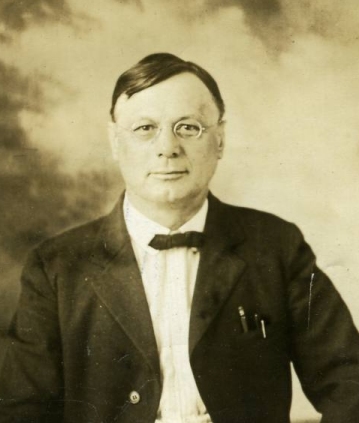
Oscar Ameringer
Libraries in the late 19th century were seen by their founders as instruments of social and cultural uplift, meant to raise the working class out their ignorance and teach them how to be middle class. But men like Oscar Ameringer, who immigrated to the United States from Germany when he was 15 and later became a socialist organizer, humorist, and editor, took away different lessons. In this selection from his 1940 autobiography, Ameringer described his discovery of American history books, translated into German, at the local public library.
A selection from Oscar Ameringer's 1940 autobiography that describes his powerful experience of discovering the Cincinnati Public Library in 1888, and exploring the German language textbooks it held.
Oscar Ameringer, History Matters
Labor organizer and newspaper editor Oscar Ameringer the “Mark Twain of American Socialism,” as he was often called, was born in Bavaria in 1870 to a cabinetmaker father and a freethinking mother. In this excerpt from his autobiography,If You Don’t Weaken, published in 1940, he discussed his decision to emigrate to America in 1885 as a fifteen-year-old “hellion.” In America, Ameringer ultimately carved out a remarkable and colorful career as a musician, labor organizer, and especially, an editor of socialist and radical newspapers.
An excerpt from the autobiography of labor organizer and newspaper editor Oscar Ameringer where he focuses on migration and labor.
Oscar Ameringer, History Matters
The Haymarket bombing in 1886 marked a major turning point in the history of nineteenth-century labor. Used by capitalists as an excuse for a crackdown on labor organizations, the bombing also splintered what up had been until then the strongest labor organization in the United States—the Knights of Labor. The anti-labor reaction that followed in the wake of the bombing helped precipitate a rapid decline in membership in the Knights which was eventually supplanted by the American Federation of Labor. In this excerpt from his autobiography, Oscar Ameringer, a Knight himself in 1886, recalled receiving the news about the Haymarket bombing while on strike in Cincinnati.
(teaching document) Labor movement set-back after Haymarket
Oscar Neebe, History Matters
Oscar Neebe and the Haymarket Affair (History Matters): The Chicago radicals convicted of the infamous May 4, 1886 Haymarket Square bombing in which one policeman was killed remained openly defiant to the end. Unlike the other seven men convicted of the bombing, Oscar Neebe, a New York-born labor organizer who had been raised in Germany, received not death, but a fifteen-year jail sentence. Although Neebe insisted (accurately) that “there is no evidence”that he had connection with the bombing, he maintained, in this brief address, his solidarity with his comrades. “Your honor,” he told the judge, “I am sorry I am not to be hung with the rest of them.”
(teaching document) Leading Chicago anarchist tells of role of police in strikes and corrupted judicial proceedings regarding the Haymarket trial

Oscar Rosales Castañeda, Maria Quintana
National level compared to Washington State, 1870-2006
brief overview of organizing campaigns of farm workers in Washington state and national level
Our Daily Work
Dani Willcutt of the MSU Department of History delivers the presentation "A Housewife's Crusade, Desegregation, and General Motors' Reign -or- Lansing, Michigan's Westside Neighborhood in 3D April 16th, 2024. "Serving It Up in the Capital City: Restaurants, Labor and Restaurant Labor in Lansing, Michigan, 1963 - 2008"
discusses desegregation and labor conflict at General Motors
Our Daily Work/Our Daily Lives
From "Our Daily Work/Our Daily Lives" Brown Bag Series. 75-minute video program recorded in the Green Room of the MSU Library on Friday, November 15, 2019. Co-sponsored by the MSU Library Colloquia Series.
A performance of labor songs in this filmed event
Our Daily Work/Our Daily Lives
Nancy Wallach presents "Attention Must Be Paid: The Insistent Voice of Ralph Fasanella" on zoom and in the MSU Library Green Room. With questions and a response by Marc Fasanella. Part of the Visionary Art of Ralph Fasanella, an Our Daily Work / Our Daily Lives Symposium. September 14th, 2002.
covers the artistic message of Fasanella, famous labor artist
Our Daily Work/Our Daily Lives
A presentation of audiovisual materials drawn from the Ralph Fasanella Collection and Archive at the American Folk Art Museum: including selected television interviews,excerpts from documentaries, and rarely seen footage fromevents such as the artist’s 80th birthday and memorialservice. This presentation investigates tensions visible inFasanella’s self-presentation as both artist and worker, tracing influences and situating him in a lineage of artists inspired byworking-class communities. Followed by a discussion with Metropolitan Museum of Art Film Staff Stephanie Wuertzand Christopher Alessandrini, Introduced by Dean Rehberger
A presentation of audiovisual materials drawn from the Ralph Fasanella Collection and Archive at the American Folk Art Museum
Our Daily Work/Our Daily Lives
Art of Labor: Social Realism as a context for Fasanella –Peter Carravetta • The Migrant evidenced in MaterialCulture as depicted by Fasanella – Loredana Polezzi • Notesfor a film on Italian American Artists / Authors and othertransnational experiences – Simone Brioni • Venus Off theHalf Shell: Semiotic Translations of Female Icons…comparative analysis of two artists' interpretations ofmythical / typical women – Domenica Diraviam • FamilySupper: A Semiotic of Yesteryear – Anthony TamburriIntroduced by Marc Fasanella
a group of talks about how best to contextualize Fasanella's art and contributions
Our Daily Work/Our Daily Lives
Father, Friend, Folk Icon: a conversation with Ralph. Fasanella’s inner circle. Introduced by Kurt Dewhurst
a conversation with artist Ralph Fasanella’s inner circle
Our Daily Work/Our Daily Lives
Marc Fasanella talks about his father, Ralph Fasanella, one of the most important and influential painters of the late Twentieth Century. Ralph Fasanella’s works captured the lives, struggles, aspirations, and joys of workers and the labor movement for five decades from the 1940’s until his death in 1997. Fasanella is best known for his series of paintings on the 1912 Lawrence Textile Strike, his canvases looking at his neighborhood and immigrant family, and his paintings that captured baseball in both professional ballparks and local sandlots. His paintings also have a strong political flavor with some of his works focusing on the execution of Ethel and Julius Rosenberg and the death of John F. Kennedy among others. Marc Fasanella is the author of Ralph Fasanella: Images of Optimism, which was published in 2017 by Pomegranate. Marc has taken a strong hand in the website, www.Fasanella.org, which is hosted on MSU’s Matrix site. Marc Fasanella is introduced by Michigan State University Professor John P. Beck. Part of the "Our Daily Work/Our Daily Lives" Brown Bag series sponsored by the Michigan Traditional Arts Program (MSU Museum) and the Labor Education Program (MSU School of Human Resources and Labor Relations).
Marc Fasanella talks about his father, Ralph Fasanella
Our Daily Work/Our Daily Lives, John P. Beck
This session explores the labor and work themes withinRalph Fasanella's art. It also highlights the ways in whichFasanella's paintings have been used to build union pride andsolidarity and a larger appreciation of workers culture andlabor history. The panelists include Elise Bryant, the ExecutiveDirector of the Labor Heritage Foundation; Ron Carver,former union staff member and organizer of Public Domain;Christian McSweeney, Organizing Director of the AFL-CIO;and Jurg K. Siegenthaler, retired Professor of Sociology and aprime mover in the annual Lawrence, Massachusetts Breadand Roses Festival. John P. Beck, co-director of Our DailyWork/Our Daily Lives, will chair the panel.
lecture explores the labor and work themes within Ralph Fasanella's art.
Our Daily Work/Our Daily Lives, Anna Pegler-Gordon
"Breaking Curfew: Japanese American Workers and Everyday Resistance to World War Two Restrictions” presented by Anna Pegler-Gordon of James Madison College's Asian Pacific American Studies at MSU.
describes how Japanese-Americans resisted federal restrictions on their livelihoods
Our Daily Work/Our Daily Lives, David Correia
David Correia, of University of New Mexico/s American Studies Department, presents a zoom presentation titled "Set the Earth on Fire: Coal Miners, Capital and Cops in the Great Anthracite Strike of 1902" for Our Daily Work or Daily Lives. Correia argues that this labor struggle constructed modern policing.
podcast covers the Great Anthracite Strike of 1902
Our Daily Work/Our Daily Lives, Debbie Goldman
“Becoming a Force of Workplace Resistance: Call Center Workers after the AT&T Breakup” A Zoom presentation presented by Debbie Goldman, Former Research Director Communication Workers of America. Wednesday, December 7, 2022 12:15 - 1:30 EST. Presented as part of Our Daily Work/Our Daily Lives brown bag series, celebrating its 28th year. The complete collection of ODWODL recordings is available at the MSU Library.
podcast covers call center work
Our Daily Work/Our Daily Lives, Dom Flemons
Working the Ranch and Range: The Music of the Black CowboyDom Flemons is known as “The American Songster®" since his repertoire covers over one hundred years of American roots music. Flemons is a folk musician, black country artist, songwriter, multi-instrumentalist, music scholar, historian, actor, slam poet, record collector, curator, podcaster, cultural commentator, influencer, and the creator, host, and producer of the American Songster Radio Show on WSM in Nashville, TN. He is the Co-Founder and original member of the groundbreaking Carolina Chocolate Drops, the first ever black string band to win a GRAMMY Award. Over the past 25 years, he has received major awards, gained world-wide media recognition and has become one of the most influential and highly decorated voices in American roots music."
covers the life and music of Don Flemmons
Our Daily Work/Our Daily Lives, Este Shirley
Eshe Sherley from the Department of History at the University of Michigan, presents 'Care in Crisis: Black Women and the Politics of Labor in Atlanta, 1965-1985" on Zoom. Part of Our Daily Work/Our Daily Lives brown bag series and co-sponsored by MSU African American and African Studies and MSU Center for Gender in Global Context.
discusses the intricacies of care work from the perspective of Black women
Our Daily Work/Our Daily Lives, Ethan Veenhuis
Ethan Veenhuis, from MSU's History department, presents “The First to Merge: The United Teachers of Flint, Racial Parity, and School Integration, 1968-1985” on Zoom and in the MSU Library Green Room on Wednesday January 21th, 2024.
dicusses school and workplace integration
Our Daily Work/Our Daily Lives, Gabe Logan
Gabe Logan, from Northern Michigan University's Department of History, presents “Red Jerseys in Detroit: Soccer and Industrial Workers, 1926 - 30” on Zoom. Part of the "Our Daily Work/Our Daily Lives" Brown Bag series sponsored by the Michigan Traditional Arts Program (MSU Museum) and the Labor Education Program (MSU School of Human Resources and Labor Relations).
podcast covers the connections between sports and labor
Our Daily Work/Our Daily Lives, Jack Metzgar
“Working Class Culture in a Middle-Class Society", by Jack Metzgar.Jack Metzgar is a professor at Roosevelt University and the author of Bridging the Divide: Working Class Culture in a Middle-Class Society (ILR Press, November 2021). This is a virtual Zoom presentation from Friday, January 28, 2022.
discusses how working class culture has bled into the middle class
Museum/Exhibits
Tours
Maps
Digital Projects
Organizations
Sites
Film/Video
Audio/Interview
Podcast/Program
Text/Document
Image
Graphs/Data
Timeline
Southwest
West
Midwest
Southeast
Northeast
Mexico
Canada
Global
Books
Teaching
Lectures
Digital Archives
Journals
Bibliographies
Topic Intro