


Collections
Library
Type
Region
Coverage:
-
Published:
-
Pullman Foundation
Union Contracts and other Labor documents and photos from electrical, steel, auto manufacturing; over 7000 items are searchable at this site, which focuses on Pullman, steel industry among a vast number of other ephemera
Union Contracts are predominant documents in this collection, search term union.
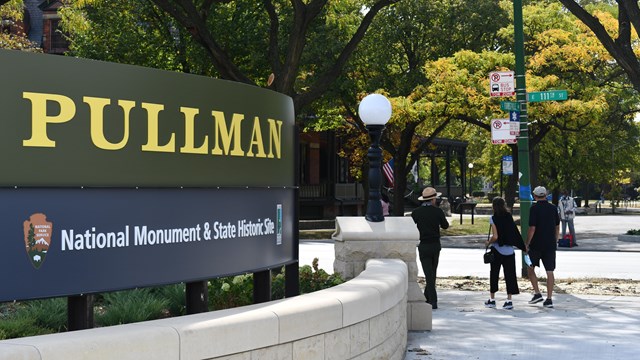
Pullman National Historical Park
Designated in 2015, Pullman National Historical Park is the first National Park Service unit in Chicago. Preserving the story of one of the first planned industrial communities in the United States, the park includes many historic buildings located in what is now the Pullman neighborhood of Chicago.
In 1880, the Pullman Palace Car Company broke ground on its own industrial community, consisting of factories and infrastructure, including streets, a town, and housing for its workers. By 1883, over 8,000 workers lived in Pullman. Over the next decade, orders declined and wages were cut, but rent charged for company housing was not. Soon workers were left with starvation wages as corporate dividends remained undisturbed. A strike broke out in May 1894 and factory workers walked out after failed negotiations for better wages and living conditions. This led to a national boycott of handling Pullman cars, drastically affecting rail traffic across the country, and violence and vandalism broke out as soldiers were dispatched to aid local authorities. The strike was eventually quelled by an injunction from the Supreme Court, but its effects were far-reaching.
In 1925, A. Phillip Randolph founded the Brotherhood of Sleeping Car Porters (BSCP), the first African American labor union. At the time, porters made up 44% of the Pullman workforce, making it the nation’s largest employer of African Americans. BSCP advocated for an improvement of working conditions and treatment of African American railroad porters and maids. In 1937, BSCP and the Pullman Company reached a landmark agreement, an important step for African American civil rights.
preserving the story of one of the first planned industrial communities in the United States, the park includes many historic buildings located in what is now the Pullman neighborhood of Chicago.

Pullman Strikers, History Matters
For workers at the Pullman Palace Car Company in the 1890s, home was the company town of Pullman, Illinois, and rent was deducted from their wages. While owner George Pullman touted it as a model town, the men and women who labored there during the 1893 depression endured starvation wages, deplorable living and working conditions, and, worst of all, Pullman’s paternalistic control over all aspects of their lives. Workers appealed to the American Railway Union (ARU), which organized a nationwide strike and boycott against Pullman. This statement from a Pullman striker, delivered at the June 1894 Chicago convention of the ARU, reflected the depth of the strikers’ hatred of their employer and their commitment to the union.
1894 statement from a Pullman striker reflected the depth of the strikers’ hatred of their employer and their commitment to the union.
Pullman workers, History Matters
The American Railway Union’s unsuccessful strike against the Pullman Palace Car Company in 1894 left many workers without jobs. Not only did the company take on hundreds of new workers in place of the strikers, but total employment in the shops dropped. On August 17, 1894, the desperate and destitute strikers appealed to Illinois Governor John P. Altgeld. The sympathetic governor wrote George Pullman a total of three times, asking him to do something about the “great distress” among his former workers. Typically, Pullman blamed the workers for their problems, arguing that if they had not struck they would not be suffering. He rejected the solutions proposed by Altgeld. The strikers’ appeal to Altgeld and the governor’s three letters to Pullman are included here. The public was more sympathetic with the plight of the Pullman workers. Contributions of food eased the distress and many Pullman residents eventually moved to find work elsewhere.
The strikers’ appeal to Altgeld and the governor’s three letters to Pullman are included here.
Pumpkin Smasher, History Matters
Religious concepts and metaphors suffused the words and ideas of many late nineteenth-century American workers. The New and Old Testaments provided not only personal succor to many working people but also a set of allusions and parables they applied directly to their lives and struggles in industrial America. Working-class ideas and writing often were cast in stark millenarian terms, with prophesies of imminent doom predicted for capitalists who worshipped at Mammon’s temple and imminent redemption for hard-working, long-suffering, and God-fearing laboring men and women. Christ was uniformly depicted in workers' writing as a poor workingman put on Earth to teach the simple principles of brotherhood and unionism. In this 1894 hellfire-and-brimstone editorial in The United Mine Workers Journal, “Pumpkin Smasher” counseled the “honest workman” to have faith in the ultimate punishment of those responsible for making miners' lives harsh and brutal.
(teaching document) In this 1894 hellfire-and-brimstone editorial in The United Mine Workers Journal, “Pumpkin Smasher” counseled the “honest workman” to have faith in the ultimate punishment of those responsible for making miners' lives harsh and brutal.
Pun Chi, History Matters
Nineteenth-century officials and businessmen eager for cheap labor for California’s manufacturing, mining, and agricultural industries encouraged Chinese migrants to voyage to the United States. In the 1850s, however, as the Chinese population grew, an anti-Chinese movement mounted. The California legislature and courts restricted the rights of Chinese immigrants with the Foreign Miners Tax of 1852 and a California Supreme Court decision—People v. Hall (1854) —that excluded Chinese testimony from the courts, further sanctioning violence against Chinese residents. Pun Chi, a young Chinese merchant, wrote this appeal to Congress, sometime between 1856 and 1868, seeking help against growing anti-Chinese sentiments in the West. Reminding Congress that Chinese migration had been encouraged and that migrants deserved legal protection once in the United States, he gave graphic accounts of the mining tax collectors' abuses and the murder of Chinese miners. William Speer, a Presbyterian minister and missionary in San Francisco’s Chinatown, translated Pun Chi’s appeal from Chinese and published it in 1870.
(teaching document) Chinese American Pun Chi's appeal to Congress =graphic accounts of the mining tax collectors' abuses and the murder of Chinese miners.

R. Alton Lee, Steven Cox
When Sunflowers Bloomed Red reveals the origins of agrarian radicalism in the late nineteenth-century United States. Great Plains radicals, particularly in Kansas, influenced the ideological principles of the Populist movement, the U.S. labor movement, American socialism, American syndicalism, and American communism into the mid-twentieth century. Known as the American Radical Tradition, members of the Greenback Labor Party and the Knights of Labor joined with Prohibitionists, agrarian Democrats, and progressive Republicans to form the Great Plains Populist Party (later the People’s Party) in the 1890s. The Populists called for the expansion of the money supply through the free coinage of silver, federal ownership of the means of communication and transportation, the elimination of private banks, universal suffrage, and the direct election of U.S. senators. They also were the first political party to advocate for familiar features of modern life, such as the eight-hour workday for agrarian and industrial laborers, a graduated income tax system, and a federal reserve system to manage the nation’s money supply. When the People’s Party lost the hotly contested election of 1896, members of the party dissolved into socialist and other left-wing parties and often joined efforts with the national Progressive movement.
Introduction
1. The Capitalistic Socialist
2. The Empathetic Socialist
3. The Female Socialists
4. The Mining Socialists
5. The Successful Socialists
6. The Wobblies
7. The Losing Socialists
8. The Depression Radicals
Conclusion
A book documenting 8 types of radicals throughout early 20th century Kansas
R.E. Olds Transportation Museum
On June 3rd at 3 PM, the R.E. Olds Transportation Museum (REOTM) will open its new permanent exhibit, “Assembled in Lansing: Building a Workforce. Building a Union.” This exhibit was developed in partnership with America250MI, the statewide commemoration of the nation’s 250th anniversary. “We are honored to partner with America250MI to expand our interpretation of Lansing’s automotive history and future. This effort underscores our shared commitment to preserving the region’s automotive heritage,” stated Michael Rodriguez, board president of R.E. Olds Transportation Museum.
When you are visiting the museum, check out the new Wayside signs installed outside; one of the four signs focuses on the Lansing Labor Holiday, the successful one day general strike in 1937.
A new permanent exhibit dedicated to Lansing automotive labor history,

Rachel Bohlmann
Kevin Boyle
This teaching guide asks students to consider questions based around race, migration, and civil rights as thousands moved to the Urban North and Midwest from 1945 through the 1970s.
Core questions include: What does de facto segregation in the urban North look like? How is it similar and different from de jure segregation in the South?
How did African Americans respond to the segregation and racism they faced in the North? How did the civil rights movement in the urban North connect to the movement in the South?
A teaching guide in the form of an illustrated essay, complete with questions, a gallery, and selected sources.

Rachel Boyle
First and foremost, the Midwest is the home of Indigenous peoples past and present. Well before Europeans arrived on the continent, Indigenous groups migrated across and within the Midwest. They established settlements and conducted trade as well as growing, hunting, and gathering food. From the sixteenth to the early nineteenth centuries, Indigenous groups increasingly accommodated the growing, European-driven fur trade that came to dominate the Great Lakes region. The linked lakes in the French map above reflect the knowledge of Indigenous sources that communicated navigation information as a series of rivers and lakes. In the nineteenth century, Euro-American settlers forcibly removed Indigenous nations from the Midwest, often with state and federal backing. Yankees from the East and immigrants from Europe occupied the area, pursuing agriculture, building utopian settlements, or fleeing unrest. Both enslaved and free African Americans also lived in the region over the course of the nineteenth century, and in the twentieth century, the Great Migration of millions of African Americans from the South transformed Midwestern cities. War and economic factors brought numerous other groups to the Midwest in the twentieth century and beyond, including formerly interned Japanese Americans who moved to Chicago after World War II.
Whether forced or voluntary, peaceful or violent, the migration of people in and out of the Midwest provides a useful way to begin understanding the region.
Rachel Donaldson Maxwell Sickler, National Park Service
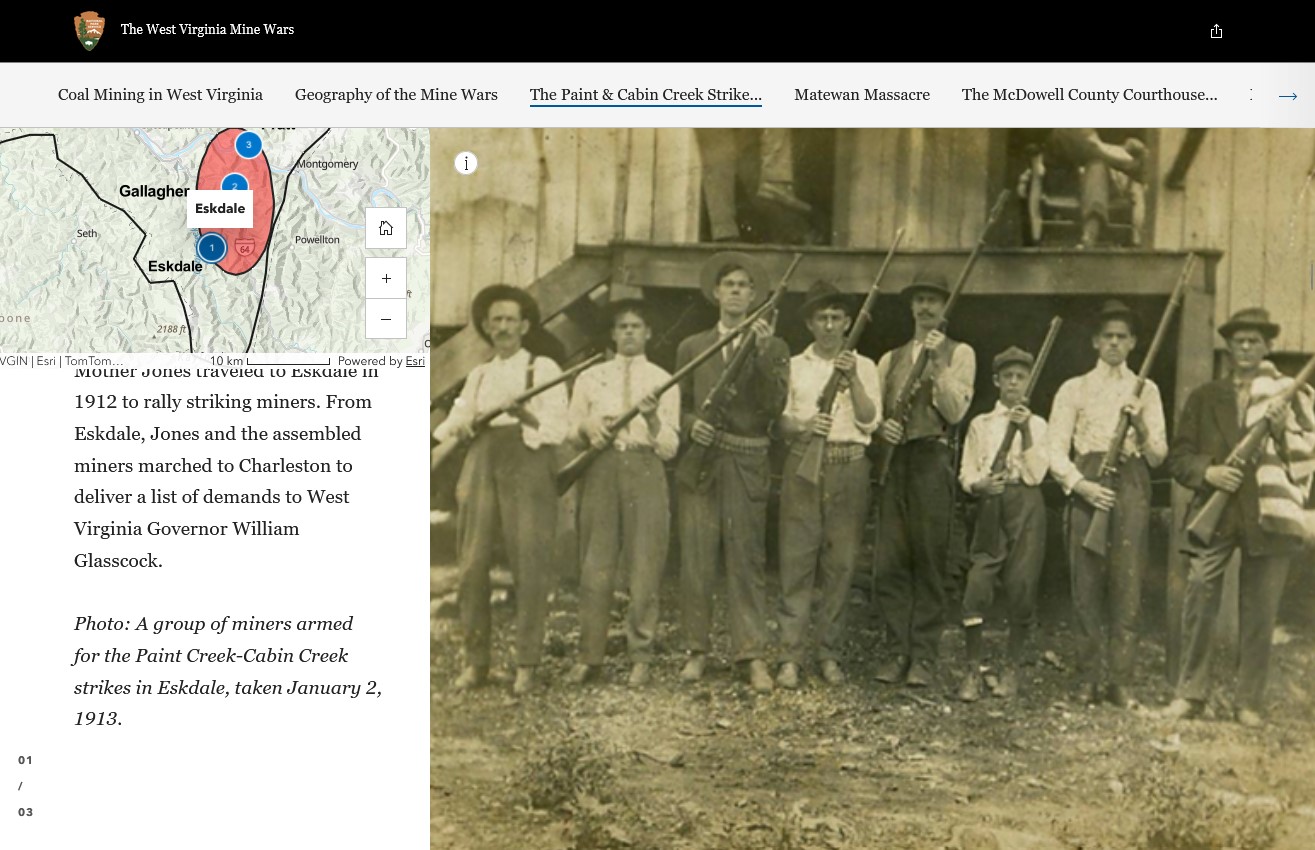
From 1912 to 1921, thousands of coal miners in the southern coalfields of West Virginia fought violently against coal company operators to secure their right to unionize and abolish the brutal mine guard system. This storymap, whose content was written by Rachel Donaldson, a labor and public historian, is an excellent introduction
Multi-part storymap of the Paint Creek, Cabin Creek, Blair Mountain events from 1913-1921
Rachel Donaldson, James Green
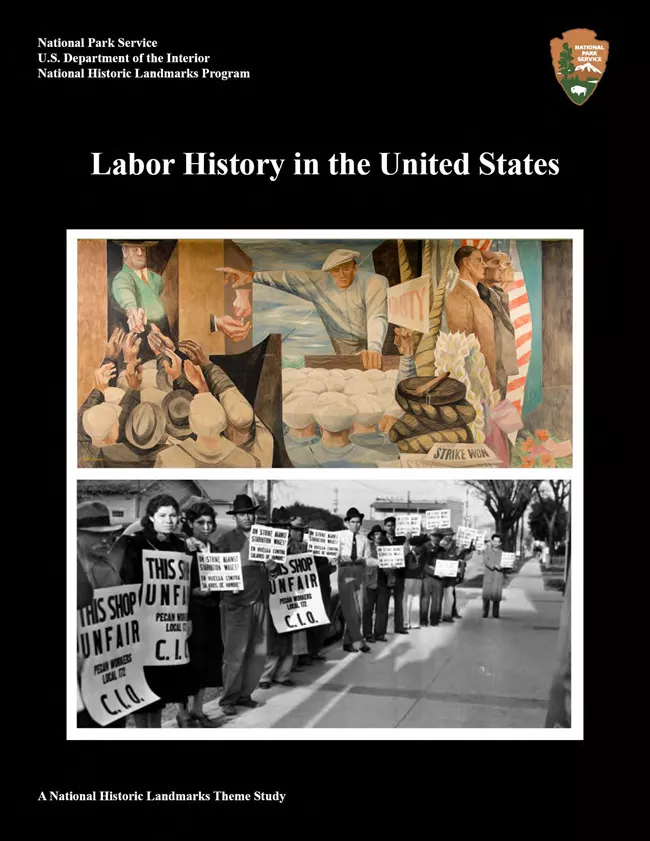
Theme study released in June 2022 by the National Historic Landmarks (NHL) Program, highlights the many stories of Americans at work through current scholarship on labor history and nationally significant places. It includes thematic chapters focusing on work in agriculture, extraction industries like mining or lumbering, manufacturing, transportation, and the service sector. While labor organizing is a theme throughout, the focus on occupational groups highlights up-to-date research on a wide variety of working people: union and non-union, native and foreign-born, male and female, White and Black, northern and southern, and those of various religious affiliations.
Theme study highlights the many stories of Americans at work through current scholarship on labor history and nationally significant places.
Rachel Donaldson, National Parks Service
The history of labor in the United States is a national story; it encompasses all of the social, political, economic, ethnic, and racial groups that together constitute the proverbial American people. Recognizing places significant to labor history helps connect the stories of workers to national historical events, movements and themes. Visitors to these places have the opportunity to consider events often ignored by mainstream historical sources. Over the past fifty years, historians have discovered a popular interest in rediscovering labor’s past and in reinterpreting the contribution of working people to local and national developments. To this end, workers have collaborated with historians in this process of democratizing and publicizing the past.
National Parks Service publication on sites of labor history in the National Parks

Radnička Borba
The Croatian-language Radnička Borba(“Workers” Struggle”) began in 1907 as the official organ for the New York branch of the South Slavic Socialist Federation (SSSF). Within the SSSF, there was dissent over which American Socialist party to support – members in New York supported the Socialist Labor Party (SLP) while a faction in Chicago supported the Socialist Party – leading to a split in the SSSF and establishment of two separate newspapers: the Radnička Borba in New York and the Radnička Straža (“Workingmen’s Guard”) in Chicago.
Of these two groups, the Chicago-based group had more success because the Socialist Party was the less radical and less sectarian. A lack of support for the SLP led to the Radnička Borba suspending publication in early 1908 after just five issues. SLP members in Ohio decided to take over and moved the group’s headquarters to Cleveland where the Radnička Borba resumed publication in 1909. The SLP did not have money to assist in the publication of the Radnička Borba, but the Cleveland group managed to raise $500 for a printing press. Donations continued to provide financial support for the Radnička Borba over its run.
The Radnička Borba‘s staff was all volunteer, and its editors received little pay. Partially because of the lack of funding and partially because of issues with the editorial board, there was a high turnover of editors in the Radnička Borba‘s early years. These initial editors were Blagoje Savić, Dragutin Kuharić, Josip Kraja, Milan Jetrić, and Lazar Petrović. Two of them in particular increased support for the paper: Kuharić was a good public speaker, though knew little about Socialism, and Jetrić brought a knowledge of both journalism and socialism to the paper. The Radnička Borbawas upfront about its Socialist agenda, its banner decrying capitalism and praising Marxism. It supported the interests of striking workers, condemned companies that did not take care of their workers, and decried the ruling class everywhere. As the years went on, the publishing enterprise expanded, producing an almanac, the Deleonist, as well as Marxist literature translated into Croatian, Serbian, and occasionally Slovene, all of which were sold in the Radnička Knjižara (“Workers’ Bookstore”). This became the most productive South Slavic immigrant press in the United States. Sometime after the mid-1940s, the Radnička Borba moved to Detroit, where it was published until its end in 1970.
Croatian-language socialist paper, with much labor coverage. MOved to Detroit in mid-1940s
Rafael Marchán, History Matters
In 1918, a U.S. Employment Service Bulletin estimated that 75,000 unemployed laborers in Puerto Rico were available for work in the United States. The War Department agreed to transport workers to labor camps in the United States where they would be housed and fed while working on government construction contracts at defense plants and military bases. Many of these work camps, however, subjected the new migrants to harsh conditions and even forced labor, which Rafael Marchán described in his 1918 deposition to the commissioner of Puerto Rico. Workers like Marchán appealed to the U.S. government to improve sanitary conditions, provide adequate food, and stop widespread beatings at Fort Bragg in Fayetteville, North Carolina. In 1918 and 1919, almost one hundred Puerto Rican migrants died in Arkansas labor camps
In 1918 and 1919, almost one hundred Puerto Rican migrants died in Arkansas labor camps
Rafael Marchán, History Matters
In 1917 the United States declared the inhabitants of Puerto Rico, a U.S. posession since 1898, to be citizens of the United States—a “gift” that many Puerto Ricans resented. Seeing an untapped source of inexpensive labor, the U.S. Labor Department worked with industry to facilitate the migration of Puerto Rican workers to America. During the First World War the War Department agreed to transport Puerto Rican workers to labor camps in the United States where they would be housed and fed while working on government construction contracts at defense plants and military bases, many of which subjected the new migrants to harsh conditions and even forced labor. Rafael Marchán was one of a group of Puerto Rican workers at Fort Bragg in North Carolina who protested to the commissioner of Puerto Rico over the intolerable conditions in the work camp. He gave this deposition in Washington, D.C., in October 1918.
Rafael Marchán was one of a group of Puerto Rican workers at Fort Bragg in North Carolina who protested to the commissioner of Puerto Rico over the intolerable conditions in the work camp.
Rand School of Social Science
American Labor Year Book was a 20th century review of labor in the US, published by the Department of Labor Research of the Rand School of Social Science. A
A yearbook roundup of people, organizations and places associated with labor left, digitized
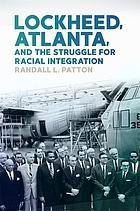
Randall L. Patton
Lockheed, Atlanta, and the struggle for racial integration tells the story of business/government equal employment opportunity policies by examining Georgia's Lockheed Aircraft, 1950-1990 ... This book connects the local story of workplace desegregation to national narratives of civil rights reform; affirmative action; the role of government and public/private partnerships; and the business reaction to both state intervention in employment generally in the late 70s/1980s and to the emergence of black political power in the same time frame
connects the local story of workplace desegregation to national narratives of civil rights reform
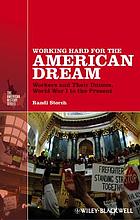
Randi Storch
This book examines the various economic, social, and political developments that shaped labor history in the United States from World War I until the present day. It presents an overview of labor history that also considers women workers, ethnic America, and post-World War II workers, while incorporating the most recent scholarship in labor history
verview of labor history that also considers women workers, ethnic America, and post-World War II workers
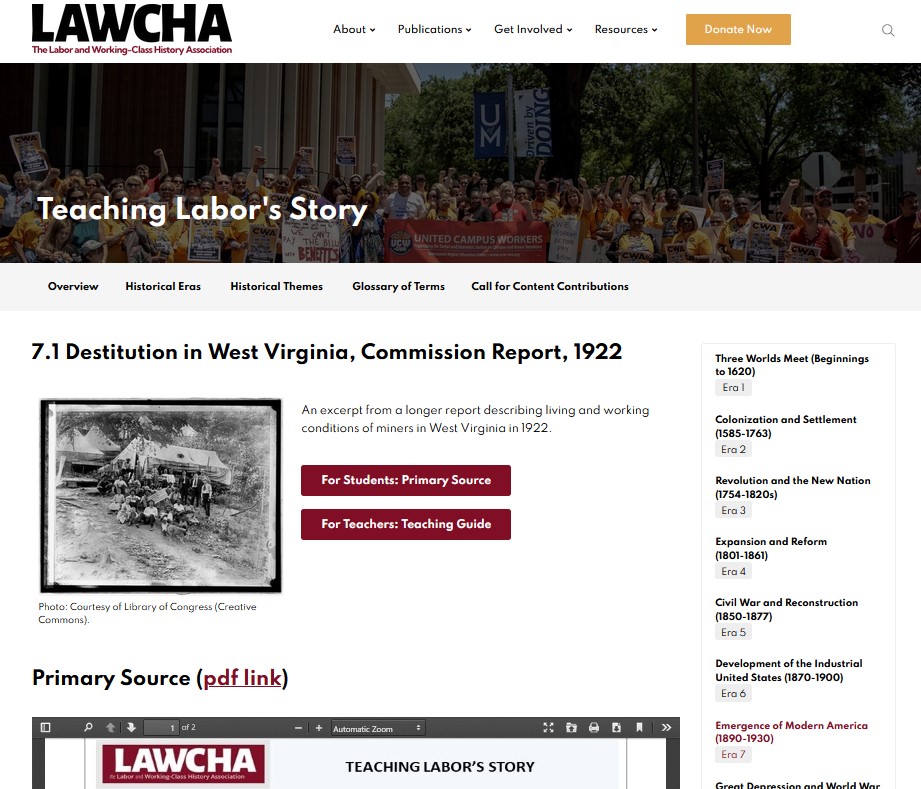
Randi Storch, Teaching Labor's Story
The United Mine Workers of America [UMWA]beganorganizing coal miners in West Virginia as early at 1892. Coal operatorsresisted, often hiringprivate police to enforce their will on union-inclined workers. Decades of conflictensued. One of the deadliestconflicts erupted inthe town of Matewan in1920, culminating in a three-day battle in August 1921 which sparked an uprising, known as the Battle on Blair Mountain,by8,000 citizens against the mine companies.This drew national attention to the West Virginia coal fields. The New River Coal Operators Association, representing the owners, insisted that there was no “necessary” suffering and invited a well-known progressive reformer to organize a commission to investigate conditionsin the coalfields. Commission members spent a week investigating living and working conditions of miners in the New River Coal Fields.This document is an excerpt from the Commission’s report, describing living and working conditions of miners in West Virginia in 1922.
An excerpt from a longer report describing living and working conditions of miners in West Virginia in 1922.
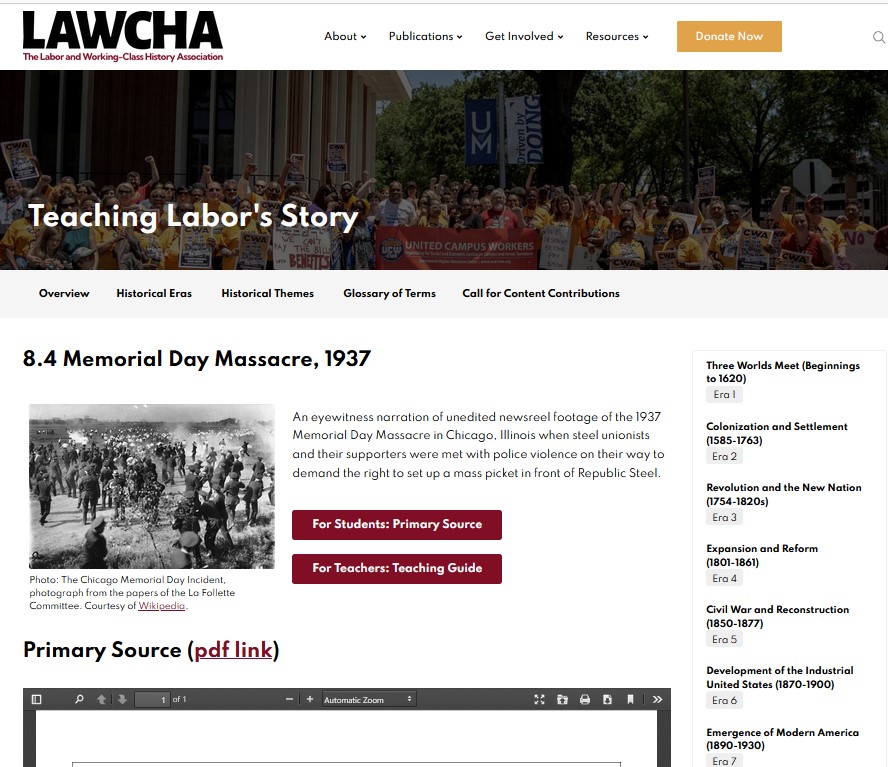
Randi Storch, Teaching Labor's Story
This excerpt from a larger documentary includes the unedited Paramount newsreelfootage of the 1937 Memorial Day march by steel unionists and their supporters tothe Republic Steel plant. At the time, workersat Republic Steel, as well as other steel plants, were on strike demandinghigher wages, shorter hours, and safer working conditions. The events captured in the newsreel are explained by one of the workers who participated in the march. Curated by Randi Storch Excerpts and teaching guide
Chicago, Illinois, repression, Republic Steel, Memorial Day Massacre,

Randy M. Browne
The story of the driver is the story of Atlantic slavery. Starting in the seventeenth-century Caribbean, enslavers developed the driving system to solve their fundamental problem: how to extract labor from captive workers who had every reason to resist. In this system, enslaved Black drivers were tasked with supervising and punishing other enslaved laborers. In The Driver's Story, Randy M. Browne illuminates the predicament and harrowing struggles of these men-and sometimes women-at the heart of the plantation world. What, Browne asks, did it mean to be trapped between the insatiable labor demands of white plantation authorities and the constant resistance of one's fellow enslaved laborers? In this insightful and unsettling account of slavery and racial capitalism, Browne shows that on plantations across the Americas, drivers were at the center of enslaved people's working lives, social relationships, and struggles against slavery. Drivers enforced labor discipline and confronted the resistance of their fellow enslaved laborers, aiming to maintain a position that helped them survive in a world where enslaved people were treated as disposable. Drivers also protected the people they supervised, negotiating workloads and customary rights to essentials like food and rest with white authorities. Within the slave community, drivers helped other enslaved people create a sense of belonging, as husbands and fathers, as Big Men, and as leaders of diasporic African "nations." Sometimes, drivers even organized rebellions, sabotaging the very system they were appointed to support. Compelling and original, The Driver's Story enriches our understanding of the never-ending war between enslavers and enslaved laborers by focusing on its front line. It also brings us face-to-face with the horror of capitalist labor exploitation. While critics attacked the driving system as barbaric and backwards, in pushing workers to their utter limits it was, in fact, fundamentally modern-a stark example of what historian Walter Rodney called capitalism without its loincloth"-- Provided by publisher
Analyzes slavery through the lives of drivers: enslaved Black people who disciplined their fellow slaves, protecting the slave system from enslaved resistance

Rare Historical Photos
Inside the Hoovervilles of the Great Depression, 1931-1940
Chicago, Illinois Hooverville sprung up at the foot of Randolph Street near Grant Park, which also claimed its own form of government, with a man named Mike Donovan, a disabled former railroad brakeman and miner, as its “Mayor.”
In an interview with a reporter, Donovan would say “Building construction may be at a standstill elsewhere, but down here everything is booming.Ours is a sort of communistic government. We pool our interests and when the commissary shows signs of depletion, we appoint a committee to see what leavings the hotels have.”
images of Hoovervilles across the nation
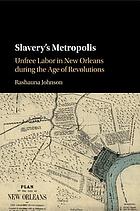
Rashauna Johnson
New Orleans is an iconic city, which was once located at the crossroads of early America and the Atlantic World. New Orleans became a major American metropolis as its slave population exploded; in the early nineteenth century, slaves made up one-third of the urban population. In contrast to our typical understanding of rural, localized, isolated bondage in the emergent Deep South, daily experiences of slavery in New Orleans were global, interconnected, and transient. Slavery's Metropolis uses slave circulations through New Orleans between 1791 and 1825 to map the social and cultural history of enslaved men and women and the rapidly shifting city, nation, and world in which they lived. Investigating emigration from the Caribbean to Louisiana during the Haitian Revolution, commodity flows across urban-rural divides, multiracial amusement places, the local jail, and freedom-seeking migrations to Trinidad following the War of 1812, it remaps the history of slavery in modern urban society"-- Provided by publisher
uses slave circulations through New Orleans between 1791 and 1825 to map the social and cultural history of enslaved men and women
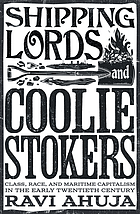
Ravi Ahuja
Explains the business logic driving the pervasive use of irrational racist ideology for structuring the maritime labour market. "When eighty-seven passengers and crew died in the shipwreck of the Royal Mail ship Egypt in 1922, the accident gave rise to a racist international press campaign against the employment of Indian seafarers, such as those who made up most of the ship's crew. This was not unusual at a time when a fifth of the British mercantile marine's workforce was recruited from the subcontinent. Ravi Ahuja explains the business logic behind a labour regime steeped in racist irrationalism and examines the scope for solidarity among a divided workforce in an age of imperialism - an issue that is no less relevant in our own time."
Introduction: 'Lascar' seamen and 'racial management' under steamship capitalism
Collision course: British merchant shipping and the loss of a mail steamer
Good copy: The savagery of panic-stricken 'natives'
Spelling disaster: Class and race when a ship goes down
Indian outrage: Who speaks for the 'lascar'?
Lines of defence: 'Natives, properly led'
Discomforting testimonies: Eight 'native seamen' in court
Communication collapse: The steamship and 'naval Hindustani'
Fireroom hierarchy: Stoking, skill, and status
Stoker's stigma: The two lives of the 'hairy ape'
Gains of 'racial management': Manning scales and liner schedules
The break-up: Findings, rulings, and the limits of 'racial management'
Course adjustment: The names of the 'native'
This book explores imperial-era maritime labor in the British Empire to explore the racist, and irrational, influences that guide maritime economy.
Museum/Exhibits
Tours
Maps
Digital Projects
Organizations
Sites
Film/Video
Audio/Interview
Podcast/Program
Text/Document
Image
Graphs/Data
Timeline
Books
Teaching
Lectures
Digital Archives
Journals
Bibliographies
Topic Intro