


Collections
Library
Type
Region
Coverage:
-
Published:
-

Raymon Elozua
LOST LABOR: Images of Vanished American Workers 1900-1980 is a selection of 155 photographs excerpted from a collection of more than 1100 company histories, pamphlets, and technical brochures documenting America's business and corporate industrial history This collection has been assembled over the last 20 years and many of the titles are rare and difficult to find. Since the images document factories, machinery, and jobs that no longer exist, LOST LABOR provides an unusual visual and historical record of work in 20th century America. The term "lost labor" can derive from the effects of mechanization, computer automation, technological advances, or through the consequences of corporate takeovers, downsizing and globalization. In many cases, these meanings can and do overlap.
Many of the images document factories and jobs that no longer exist. Whether it is a photograph of a laborer hauling a three foot block of ice at the York Ice Machinery Corporation, or one of a man carving a half hull model for the New York Shipbuilders Corporation, or others jiggering ceramic plates for the Mayer China Company, hand spraying a wicker baby carriage for the E.A. Whitney Carriage Company, or blocking a rim for the Knox Hat Company, all are examples of lost skill and crafts. These images are not intended to evoke feelings of nostalgia, or the desire to return to a simpler era when "real work" was done with sweat and muscle but rather to honor the role of labor, a reminder of the individuals who helped to build industrial America.
selection of 155 photographs excerpted from a collection of more than 1100 company histories
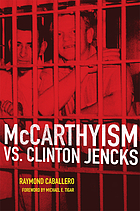
Raymond Caballero, Michael E. Tigar
For twenty years after World War II, the United States was in the grips of its second and most oppressive red scare. The hysteria was driven by conflating American Communists with the real Soviet threat. The anticommunist movement was named after Senator Joseph R. McCarthy, but its true dominant personality was FBI director J. Edgar Hoover, who promoted and implemented its repressive policies and laws.
The national fear over communism generated such anxiety that Communist Party members and many left-wing Americans lost the laws' protections. Thousands lost their jobs, careers, and reputations in the hysteria, though they had committed no crime and were not disloyal to the United States. Among those individuals who experienced more of anticommunism's varied repressive measures than anyone else was Clinton Jencks. Jencks, a decorated war hero, adopted as his own the Mexican American fight for equal rights in New Mexico's mining industry. In 1950 he led a local of the International Union of Mine, Mill, and Smelter Workers in the famed Empire Zinc strike--memorialized in the blacklisted 1954 film Salt of the earth--in which wives and mothers replaced strikers on the picket line after an injunction barred the miners themselves.
But three years after the strike, Jencks was arrested and charged with falsely denying that he was a Communist and was sentenced to five years in prison. In Jencks v. United States (1957), the Supreme Court overturned his conviction in a landmark decision that mandated providing to an accused person previously hidden witness statements, thereby making cross-examination truly effective. [This book] reveals for the first time that the FBI and the prosecution knew all along that Clinton Jencks was innocent. Jencks's case typified the era, exposing the injustice that many suffered at the hands of McCarthyism. The tale of Jencks's quest for justice provides a fresh glimpse into the McCarthy era's oppression, which irrevocably damaged the lives, careers, and reputations of thousands of Americans."-- Provided by publisher
Jencks, a decorated war hero, adopted as his own the Mexican American fight for equal rights in New Mexico's mining industry
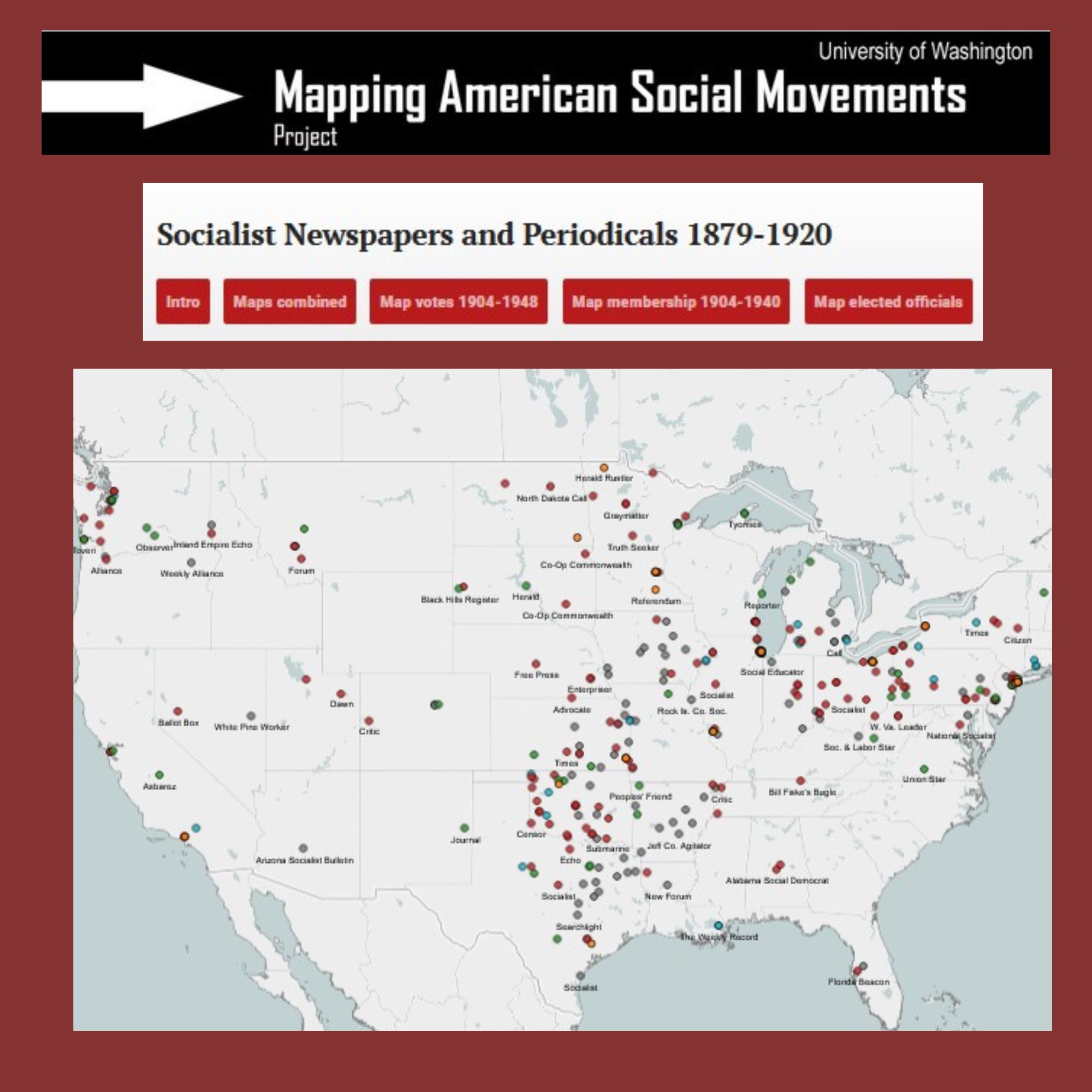
ReMapping American Social Movements Project, becca Flores
These maps locate 380 newspapers affiliated with the Socialist Party between 1900 and 1920 providing detail about editors, circulation, and about the towns and cities where they were published.
Six maps and charts showing the geographic distribution of Socialist Party-affiliated newspapers across the early-twentieth-century United States.

Rebecca Burlend, History Matters
Thirty-eight year old Rebecca Burlend and her family left England in 1831 for a new life in Pike County, Illinois. Driven to emigrate by poverty, they hoped to own their own land in the United States and chose Pike County based on the letters of “Mr. B.,” a settler who had gone before them. After more than two months at sea, the family landed in New Orleans, where Burlend observed the horrors of the slave trade firsthand. From there they traveled by steamboat up the Mississippi River to Illinois. Many immigrants—then and now—experience the kind of fear and confusion that the Burlends felt on arriving at what looked to them like a deserted wilderness. After the “many difficulties” of the book’s title, the family settled successfully in Illinois. Rebecca Burlend wrote this book with the assistance of her son, the author and teacher Edward Burlend, during a return visit to England in 1846.
An excerpt from a book written by Rebecca Burlend and her son Edward, who immigrated to the U.S. in 1831 and settled in Illinois; the full text is linked here, but this section focuses on Rebecca's witnessing the New Orleans slave trade among other things.
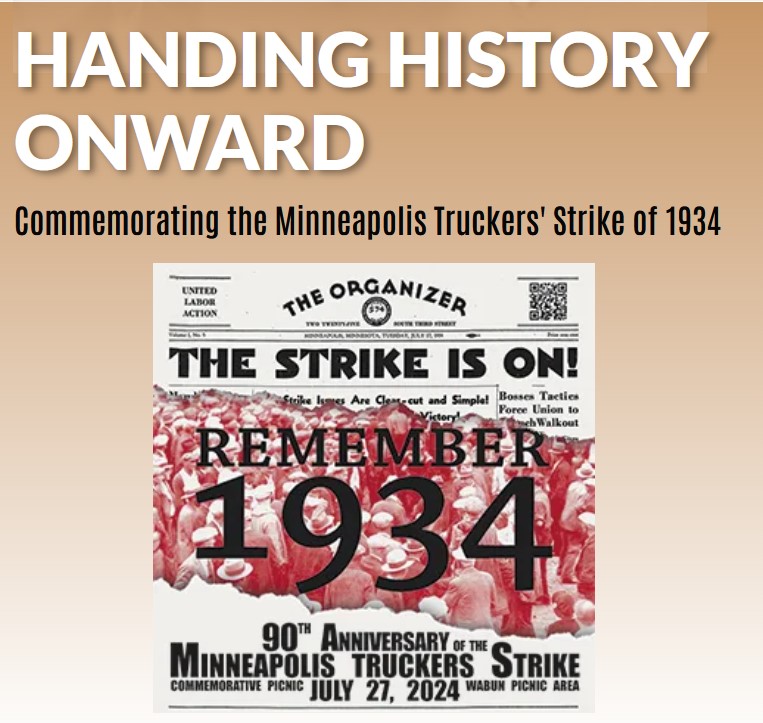
Remember 1934
REMEMBER 1934 is a collective organization that commemorates the great Minneapolis Truckers’ Strike of 1934. It organizes regular gatherings of social justice and labor activists, union members and strike descendants to celebrate the event and it’s relevance in current issues. The goal is to promote equity, worker self-representation
a public history project in Minneapolis that commemorates and amplifies the meaning of the 1934 Minneapolis Strike
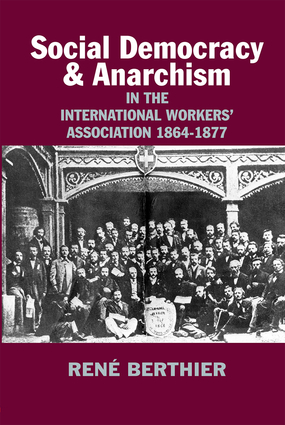
René Berthier
This book explores the conflicts that took place in the First International. Social and economic conditions varied greatly in Europe in the 1860s and 1870s. The strategies adopted by the various federations and sections of the International Workers' Association, or IWA, reflected this diversity. Although Marx and Engels have been seen as the leaders of the International, there were many who rejected their leadership. René Berthier reviews the historiography of this conflict. This book sheds new light on differences between the emerging Social-democratic and Anarchist traditions, and explores the history of the IWA.
Explores the history of the International Workers' Association and sheds new light on the emerging Social-Democratic and Anarchist traditions

Reuel Schiller
The three decades after the end of World War II saw the rise and fall of a particular version of liberalism in which the state committed itself to promoting a modest form of economic egalitarianism while simultaneously embracing ethnic, racial, and religious pluralism. But by the mid-1970s, postwar liberalism was in a shambles: while its commitment to pluralism remained, its economic policies had been abandoned, and the Democratic Party, its primary political vehicle, was collapsing. Schiller attributes this demise to the legal architecture of postwar liberalism, arguing that postwar liberalism's goals of advancing economic egalitarianism and promoting pluralism ultimately conflicted with each other. Through the use of specific historical examples, Schiller demonstrates that postwar liberalism was riddled with legal and institutional contradictions that undermined progressive politics in the mid-twentieth-century United States"-- Provided by publisher
postwar liberalism was riddled with legal and institutional contradictions
Reuther Library
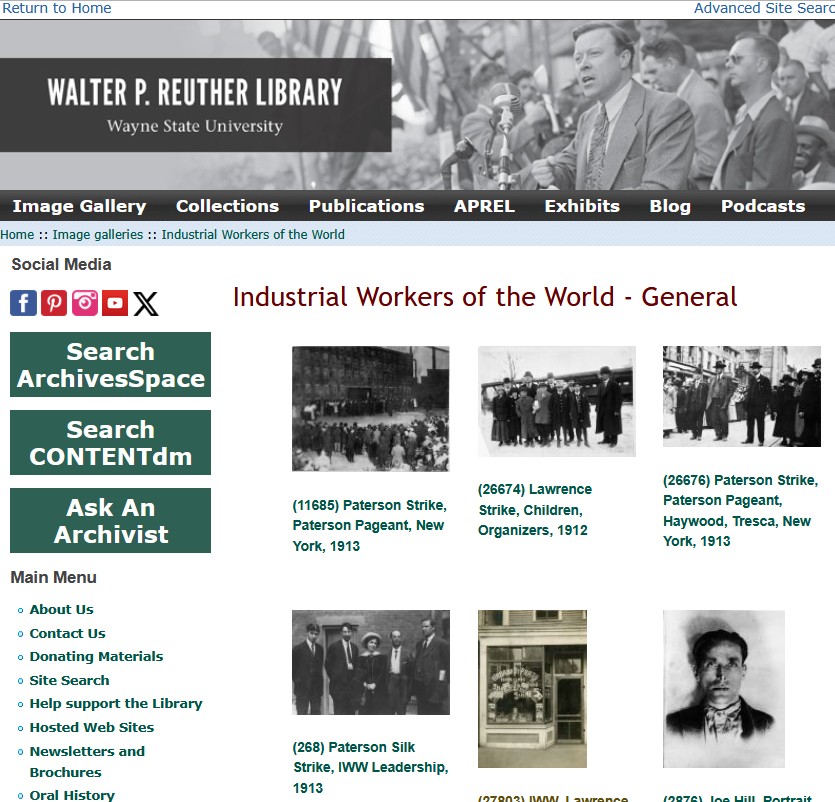
During its long and often arduous existence, the Industrial Workers of the World (IWW) has been influential beyond its size. Often known by their nickname, the “Wobblies,” the IWW was founded in 1905 by a polyglot of militant unionists and political leaders. The Wobblies made a name for themselves by organizing workers who had been ignored by nearly everyone else in American labor: women, African-Americans, immigrants, and even migrant farm workers who rode the rails across America’s agricultural heartland looking for work. Despite many hardships, the IWW still is functioning today and continues the fight. Walter P. Reuther Library's holdings of IWW-related historical materials.
Image gallery of Industrial Workers of the World, 500 images

Reuther Library Podcast
Roger Biles and Mark Rose discuss the legacy of Eddie Sadlowski, a charismatic and progressive Chicago steelworker who, unhappy with the United Steelworker of America’s closed-rank authoritarian leadership and tepid support for rank-and-file members, led a highly visible yet unsuccessful dissident campaign in the contentious election for the USWA’s presidency in 1977.
Dr. Biles is a Professor Emeritus of history at Illinois State University. Dr. Rose is a professor of history at Florida Atlantic University. Their article, “’Oil Can Eddie’ and the Battle for the Steelworkers’ Union,” was published in the Journal of the Illinois State Historical Society.
Podcast discussing the life of Ed Sadlowski, a renegade rank-and-file leader in the Steelworkers Union
Reuther Library Wayne State University
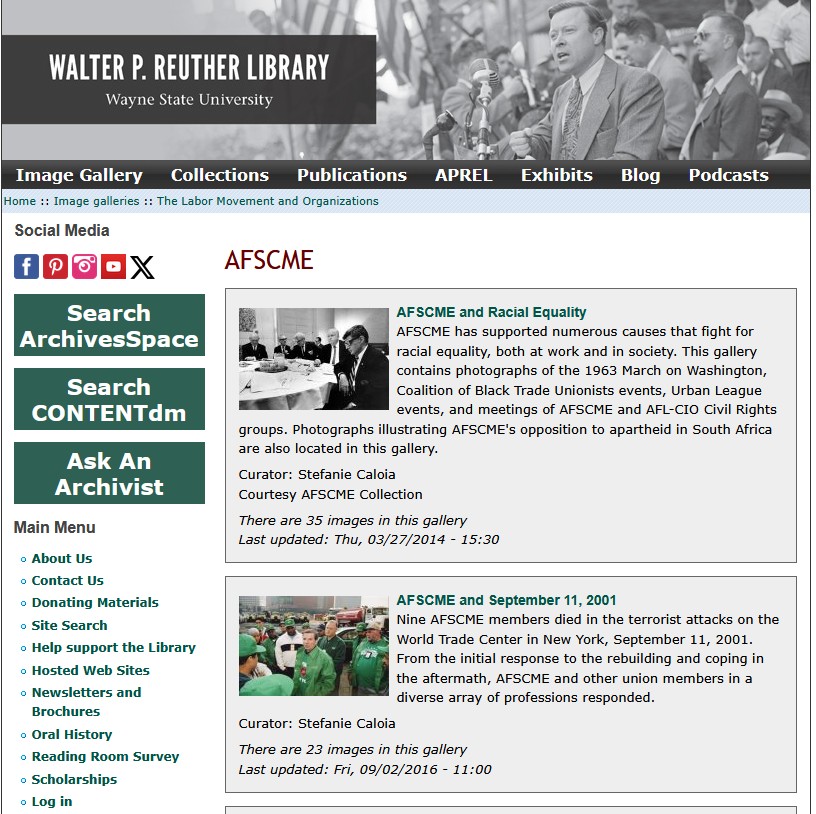
The American Federation of State, County, and Municipal Employees (AFSCME) traces its roots to Madison, Wisconsin where, in 1932, a small group of professional state employees organized to protect and promote the civil service. By 1936, the group gained recognition from the American Federation of Labor (AFL) and became AFSCME. By 1955 when the AFL merged with the Congress of Industrial Organizations (CIO), AFSCME’s composition was expanding to include blue-collar public employees, and it shifted its focus to collective bargaining. Since that time, AFSCME has grown to one of the largest unions in the AFL-CIO, boasting 1.4 million members today. AFSCME represents workers in a variety of roles including corrections, emergency services, education, health care, law enforcement, public administration, public works, housing, and transportation.
Wayne State University's holdings of AFSCME photograph collections, totaling 1,359 images relevant to the organization's involvement in a variety of causes like civil rights and labor organizing.
Reuther Library Wayne State University
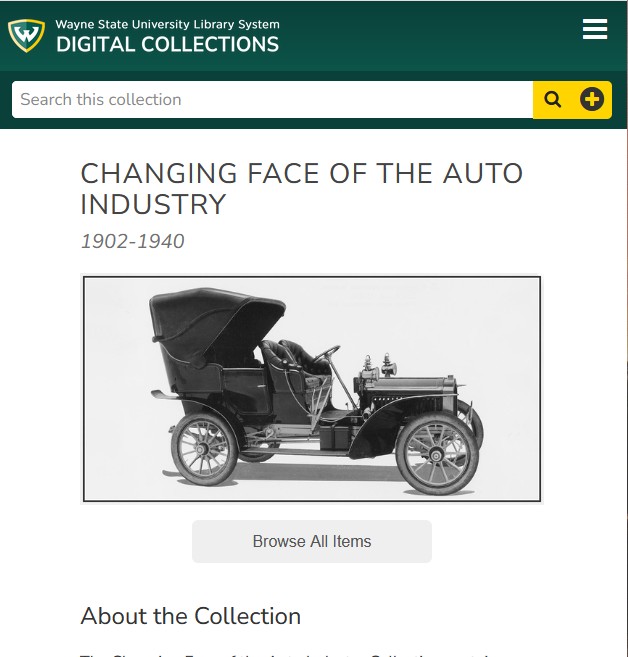
These photographs and postcards document the auto industry in the Detroit area during the first half of the twentieth century. disaster, hazards, tragedy
The Changing Face of the Auto Industry Collection contains images from the Detroit Public Library's National Automotive History Collection and Burton Historical Collections. These photographs and postcards document the auto industry in the Detroit area during the first half of the twentieth century.
This digitized collection is the result of a partnership between the Detroit Public Library and Wayne State University. The original images are held in the Special Collections at the Detroit Public Library. Additional images and other related resources, including books, owner's manuals, advertising, and archival materials can be found in the remainder of the National Automotive History Collection
2000 images across many decades of the industry and its workers
Reuther Library, Elizabeth Clemens, Deborah Rice
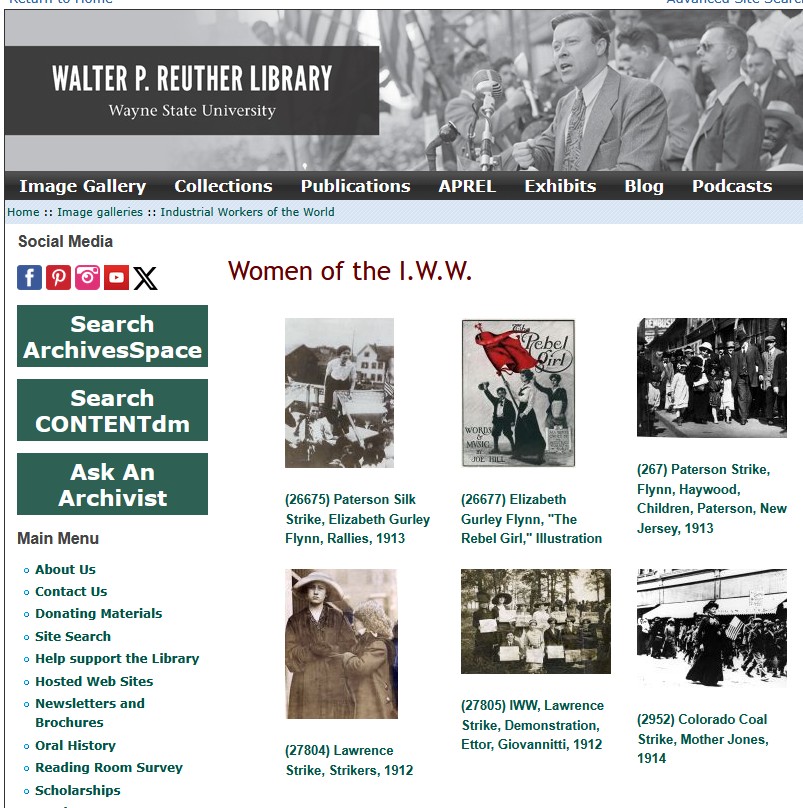
The Industrial Workers of the World (I.W.W.) was one of the first industrial unions to adopt the concept of gender equality and extend its membership to women. As organizers, agitators, advocates, and active members, women played an important part in the union’s development. This gallery holds images of photographs, graphics, and artifacts that illustrate the role of women in the One Big Union.
Curator: Elizabeth Clemens and Deborah Rice
This gallery holds images of photographs, graphics, and artifacts that illustrate the role of women in the Industrial Workers of the World
Reuther Library, Wayne State University
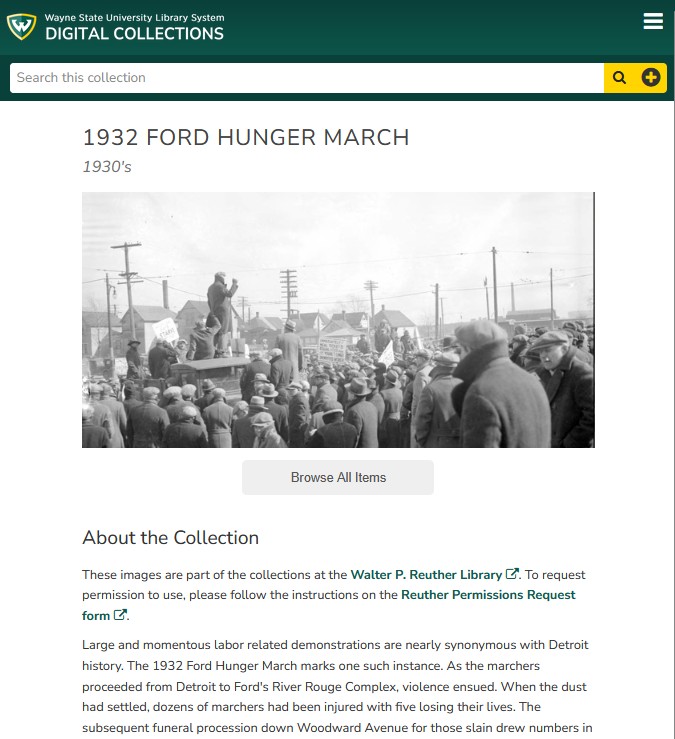
Large and momentous labor related demonstrations are nearly synonymous with Detroit history. The 1932 Ford Hunger March marks one such instance. As the marchers proceeded from Detroit to Ford's River Rouge Complex, violence ensued. When the dust had settled, dozens of marchers had been injured with five losing their lives. The subsequent funeral procession down Woodward Avenue for those slain drew numbers in the tens of thousands.
A Wayne State University photograph collection comprised of twenty-four images from the 1932 Ford Hunger March.

Reuther Library, Wayne State University
The American Federation of State, County, and Municipal Employees (AFSCME) traces its roots to Madison, Wisconsin where, in 1932, a small group of professional state employees organized to protect and promote the civil service. By 1936, the group gained recognition from the American Federation of Labor (AFL) and became AFSCME. By 1955 when the AFL merged with the Congress of Industrial Organizations (CIO), AFSCME’s composition was expanding to include blue-collar public employees, and it shifted its focus to collective bargaining. Since that time, AFSCME has grown to one of the largest unions in the AFL-CIO, boasting 1.4 million members today. AFSCME represents workers in a variety of roles including corrections, emergency services, education, health care, law enforcement, public administration, public works, housing, and transportation.
This image gallery has been curated by Johanna Russ, Meghan Courtney, and Stefanie Caloia.
1358 images from AFSCME's history
Reuther Library, Wayne State University
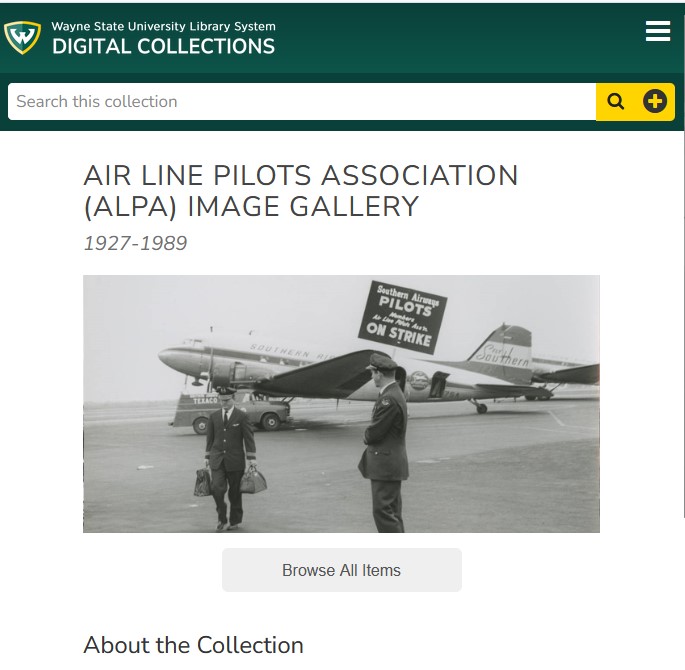
The Air Line Pilots Association was unofficially founded in 1930 and then officially in 1931, but its roots can be traced all the way back to the mid-1920's. The economic pressures of the depression, and increased flying hours with less pay are ultimately what lead to the formation of ALPA to protect pilot needs and rights. While initially formed in secret by a handful of pilots, ALPA grew steadily over time and by the end of World War II its membership approached 5,000 and had become a well-respected organization. Today it represents nearly 53,000 pilots at 37 U.S. and Canadian airlines and is the largest airline pilot union in the world. While representation and advocacy are major services to its members, safety and security has always been the most important service and for over 70 years ALPA has been part of most important safety improvement in the airline industry.
Wayne State University's collection on the ALPA (Airline Pilots Association), containing 135 images and documents from the organization's history.
Reuther Library, Wayne State University
The Air Line Pilots Association was unofficially founded in 1930 and then officially in 1931, but its roots can be traced all the way back to the mid-1920's. The economic pressures of the depression, and increased flying hours with less pay are ultimately what lead to the formation of ALPA to protect pilot needs and rights. While initially formed in secret by a handful of pilots, ALPA grew steadily over time and by the end of World War II its membership approached 5,000 and had become a well-respected organization. Today it represents nearly 53,000 pilots at 37 U.S. and Canadian airlines and is the largest airline pilot union in the world. While representation and advocacy are major services to its members, safety and security has always been the most important service and for over 70 years ALPA has been part of most important safety improvement in the airline industry.
135 images from the Airline Pilots Union
Reuther Library, Wayne State University
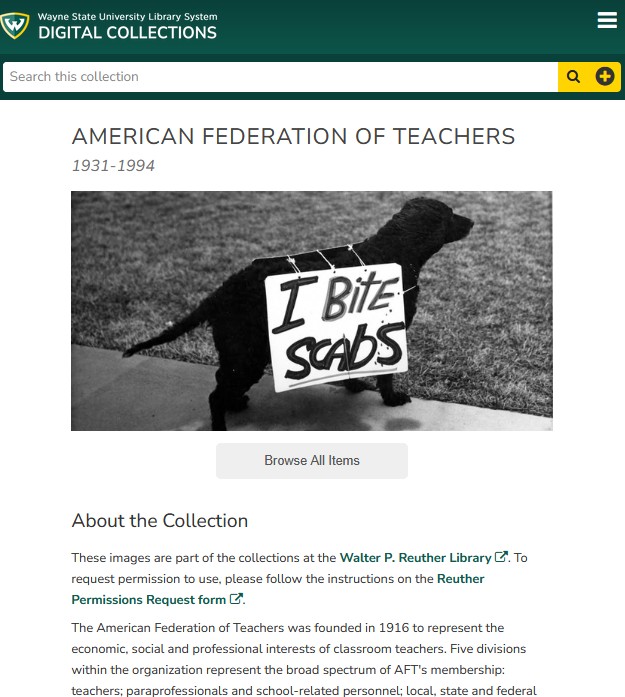
The American Federation of Teachers was founded in 1916 to represent the economic, social and professional interests of classroom teachers. Five divisions within the organization represent the broad spectrum of AFT's membership: teachers; paraprofessionals and school-related personnel; local, state and federal employees; higher education faculty and staff; and nurses and other healthcare professionals.
A Missouri State University collection of 495 historical images of the American Federation of Teachers.

Reuther Library, Wayne State University
Browse the Reuther's audio clips for miscellaneous radio spots, interviews, and speeches. Currently this area of the Reuther's Web site includes content from American Federation of State, County and Municipal Employees (AFSCME) and Society of Women Engineers (SWE), speeches of Martin Luther King, Maria Moreno interview, Agricultural Workers Organizing Committee, Interviews on the 1913-1914 Copper Country Strike, Interview with Elizabeth Gurley Flynn, 1962, Detroit Police Commissioner on 1967 Detroit Riot,
Browse the Reuther's audio clips for miscellaneous radio spots, interviews, and speeches. Currently this area of the Reuther's Web site includes content from American Federation of State, County and Municipal Employees (AFSCME) and Society of Women Engineers (SWE).
Reuther Library, Wayne State University
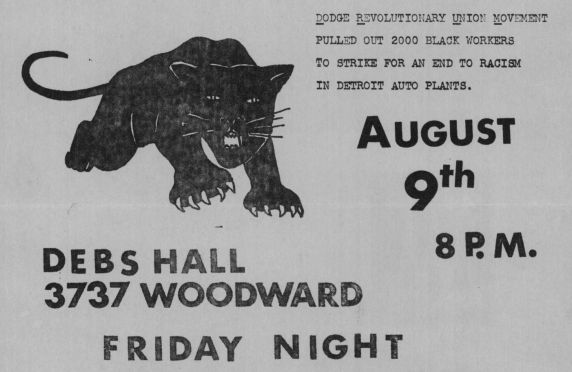
The Walter P. Reuther Library, Archives of Labor and Urban Affairs has placed the Detroit Revolutionary Movements (DRM) Records online. From the site: "These materials offer firsthand information about the demands, political viewpoints and allies of Black workers during the late 1960s and early 1970s. The records are especially relevant today as evidence of community-based activism that is formative to today’s social and political movements.
For decades, the collection has been popular with researchers for its intimate look into the League of Revolutionary Black Workers (LRBW), a federation of radical, grassroots groups of Black autoworkers across plants in Southeastern Michigan. The LRBW formed in 1969 as Black workers, inspired by the 1968 wildcat strike of the Dodge Revolutionary Union Movement (DRUM) at the Dodge Main plant, joined together to fight systemic racism in organized labor — particularly in the UAW, which represented the plants where the League organized. Workers spread their movement through flyers and provocative newsletters, many of which are available in the collection.
David Goldberg, associate professor of African American studies at Wayne State University, explains, “The Detroit Revolutionary Movements Collection at the Walter Reuther Archive is an invaluable resource for anyone interested in American labor, urban and social movement history. Centered on the collections of General Baker and Ron Glotta, the records — including critically important documents — are especially useful to those who study the Black Power movement, the New Left, Black Marxism, labor and labor law, and revolutionary organizational activity during the late 1960s and 1970s.”
In addition to the full collection, the Reuther offers a curated set of documents aimed at helping students consider the views and work of the LRBW. https://projects.library.wayne.edu/omeka-s/s/docsets/page/League
Archivists at the Reuther Library spent years developing this project, holding discussions with the materials’ donors, scanning documents for preservation, ensuring privacy measures and incorporating the collection into an online interface. Reuther Library is hopeful that increased access to this collection will inspire students, community members and researchers to further investigate the important role of DRM in Detroit and in American society."
Entire collection Digitized Collection of the League of Revolutionary Black Workers, formed in 1969 as Black workers, inspired by the 1968 wildcat strike of the Dodge Revolutionary Union Movement (DRUM) at the Dodge Main plant, joined together to fight systemic racism in organized labor — particularly in the UAW, which represented the plants where the League organized. Workers spread their movement through flyers and provocative newsletters, many of which are available in the collection.
Reuther Library, Wayne State University
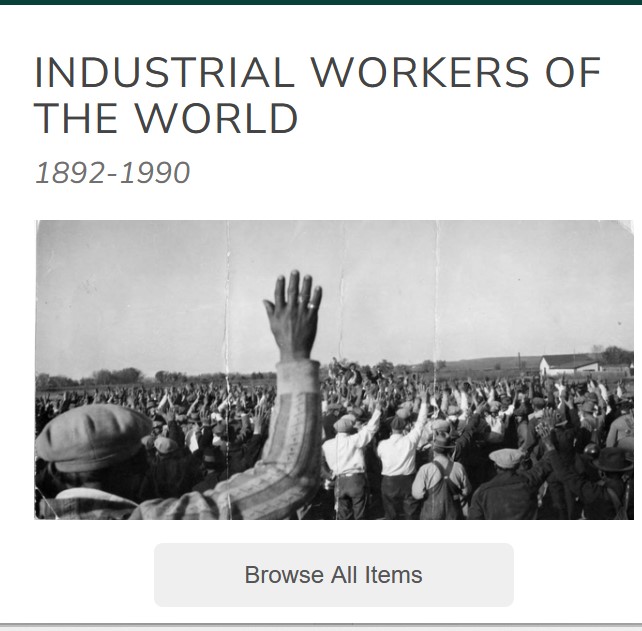
During its long and often arduous existence, the Industrial Workers of the World (IWW) has been influential beyond its size. Often known by their nickname, the “Wobblies,” the IWW was founded in 1905 by a polyglot of militant unionists and political leaders. The Wobblies made a name for themselves by organizing workers who had been ignored by nearly everyone else in American labor: women, African-Americans, immigrants, and even migrant farm workers who rode the rails across America’s agricultural heartland looking for work. Despite many hardships, the IWW still is functioning today and continues the fight.
This image gallery has been curated by Mary Wallace and Elizabeth Clemens.
490 images 1892-1990 from IWW, Reuther Library
Reuther Library, Wayne State University
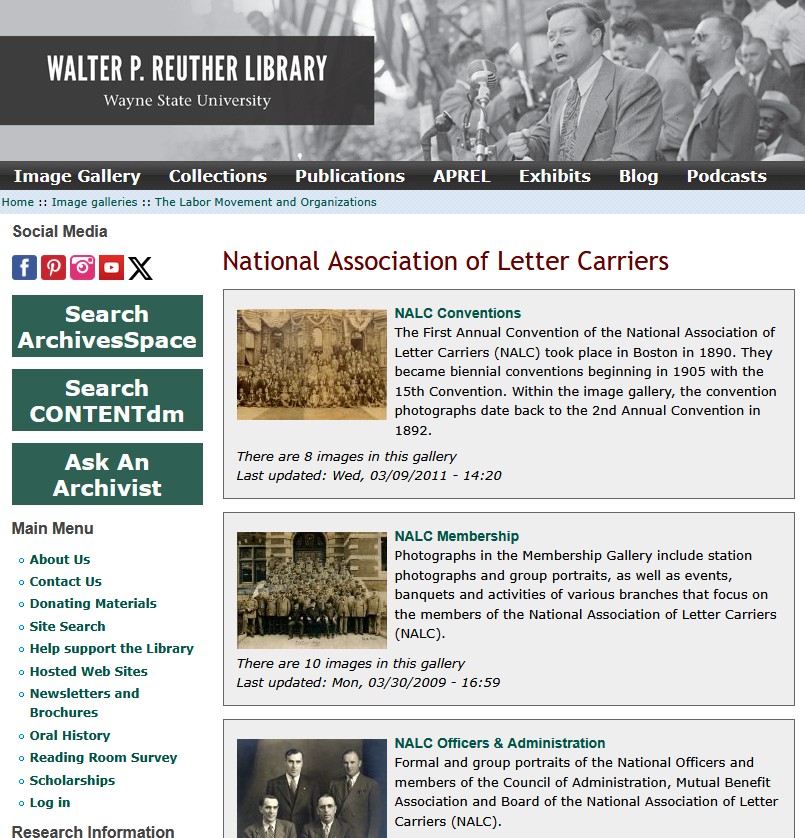
Letter Carriers answered a call to meet in Milwaukee in 1889, with the intention to form a national association to ensure improved salaries, better working conditions, and greater security for letter carriers and their families. Today, the National Association of Letter Carriers (NALC) continues its efforts while representing over 300,000 active and retired city letter carriers from 2,500 branches across the country.
A Wayne State University photograph collection comprised of twenty-five images in three galleries from the history of the National Association of Letter Carriers.

Reuther Library, Wayne State University
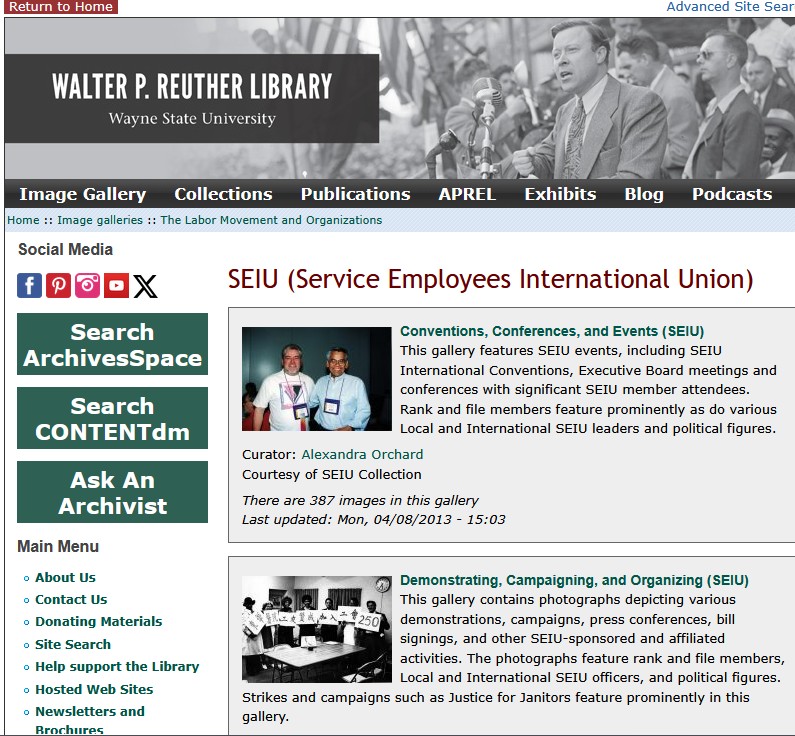
The Service Employees International Union has always sought to organize workers in a wide range of occupations. Beginning with janitors and elevator operators when it formed in 1921, SEIU soon added security guards, window cleaners, health care workers, office workers and public sector employees. By 1968, the union represented service workers in over 100 occupations around the nation. This exhibit chronicles the union’s history of organizing and the people who made it happen.
This image gallery has been curated by Gavin Strassel, Alexandra Orchard, Louis Jones.
1139 images related to the this union, a union including a wide range of occupations in the public and private sector
Reuther Library, Wayne State University
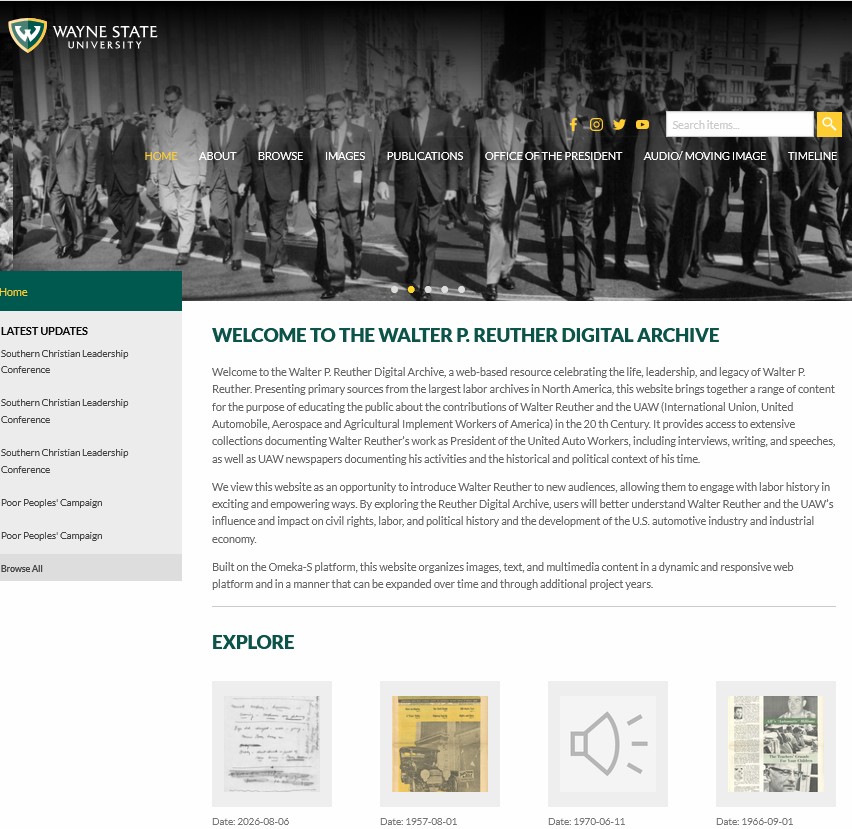
The Service Employees International Union has always sought to organize workers in a wide range of occupations. Beginning with janitors and elevator operators when it formed in 1921, SEIU soon added security guards, window cleaners, health care workers, office workers and public sector employees. By 1968, the union represented service workers in over 100 occupations around the nation. This exhibit chronicles the union’s history of organizing and the people who made it happen.
Wayne State University's holdings of the Service Employees International Union (SEIU) Photo Galleries, including 1,168 images across eight galleries.
Reuther Library, Wayne State University
The United Automobile Workers of America (UAW) is the primary union within the American automobile industry. Founded in 1935, the UAW became one of the most powerful unions in the United States, both on the shop floor and within the American polity. This gallery contains photographs that depict the United Auto Workers Union history, including strikes, parades, conventions, and other union-sponsored activities. The photographs highlight the achievements of the union and feature the union rank and file and officers, as well as historically influential national and international figures.
416 images from UAW history, including some iconic images of strikes and leaders
Reuther Library, Wayne State University
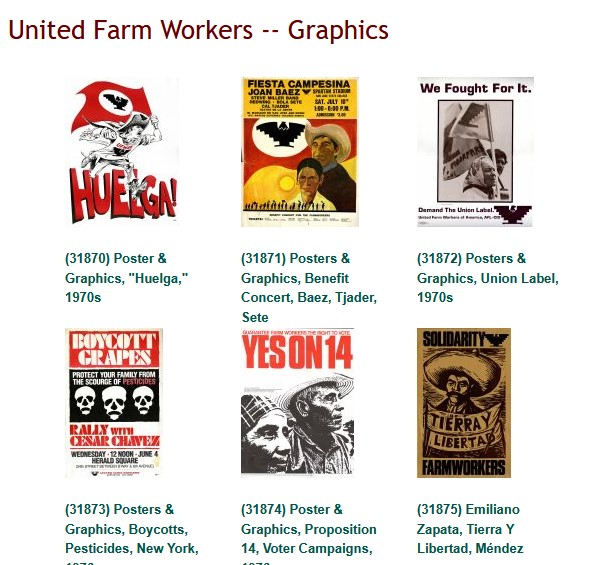
Posters and graphics from the United Farm Workers campaigns, 1960s-1970s
a small collection of posters or graphic arts produced by and for the United Farm Workers campaigns in the 1960s-1970s
Museum/Exhibits
Tours
Maps
Digital Projects
Organizations
Sites
Film/Video
Audio/Interview
Podcast/Program
Text/Document
Image
Graphs/Data
Timeline
Southwest
West
Midwest
Southeast
Northeast
Mexico
Canada
Global
Books
Teaching
Lectures
Digital Archives
Journals
Bibliographies
Topic Intro