


Explore thousands of items. Use clickable links under collections and library for broad categories. Search by keyword (including topic,city, state.) Limit by time period, type of item, region. See our search tips page for more assistance.
Collections
Library
Type
Region
Coverage:
-
Published:
-
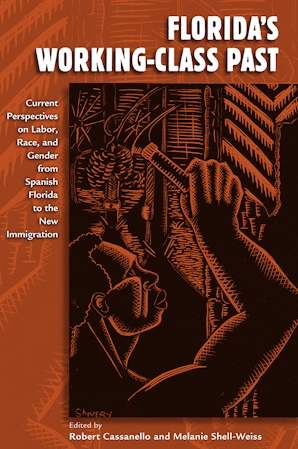
Robert Cassanello, Melanie Shell-Weiss
University Press of Florida (2011)
Viewed from the perspective of the Florida peninsula, the essays in this collection explore the history of labor in the United States and Caribbean, highlighting the ways this view provides new insights into shifting race and ethnic relations, gender roles, class definitions, and human migration from the Spanish colonial period through the present day. Florida provides a unique window onto the transformation of American labor over the past four centuries, underscoring the international and national developments that have shaped, and been shaped by, the lives of working men and women. Book jacket
book explores the history of labor in the United States and Caribbean, highlighting the ways this view provides new insights into shifting race and ethnic relations, gender roles, class definitions, and human migration

Robert Cherny
University of Illinois Press (2024)
Founded in 1919, the Communist Party (CP) in San Francisco survived an ineffectual early period to become a force in the trade union heyday of the 1930s. Robert Cherny uses the lives and careers of more than fifty members to tell the story of the city's CP from its founding through 1958.
Cherny draws on FBI files, the records of the CP at the Russian State Archive for Social and Political History, interviews, and memoirs to follow male and female party and union leaders, rank-and-file members, and others. His history reveals why people joined the CP while charting the frequent changes in policy, constant member turnover, and disruptive factionalism that limited party aims and successes. Cherny also follows his subjects through their resignations, expulsions, or other reasons for departure and looks at the CP's influence on their lives in subsequent years.
Vivid and exhaustively researched, San Francisco Reds is a long view account of the personal motivations and activism of an Old Left generation in a West Coast city.
This book explores the Bay Area's Communist Party as revealed through the lives of its members

Robert E. Weir
Revised and expanded (2013)
This encyclopedia traces the evolution of American workers and labor organizations from pre-Revolutionary America through the present day
Two volume encyclopedia of workers in US

Robert F Burk
University of Illinois Press (2015)
Marvin Miller changed major league baseball and the business of sports. Drawing on research and interviews with Miller and others, Marvin Miller, Baseball Revolutionary offers the first biography covering the pivotal labor leader's entire life and career. Baseball historian Robert F. Burk follows the formative encounters with Depression-era hard times, racial and religious bigotry, and bare-knuckle Washington and labor politics that prepared Miller for his biggest professional challenge--running the moribund Major League Baseball Players Association.
Educating and uniting the players as a workforce, Miller embarked on a long campaign to win the concessions that defined his legacy: decent workplace conditions, a pension system, outside mediation of player grievances and salary disputes, a system of profit sharing, and the long-sought dismantling of the reserve clause that opened the door to free agency. Through it all, allies and adversaries alike praised Miller's hardnosed attitude, work ethic, and honesty.
Comprehensive and illuminating, Marvin Miller, Baseball Revolutionary tells the inside story of a time of change in sports and labor relations, and of the contentious process that gave athletes in baseball and across the sporting world a powerful voice in their own games.
The story of how labor leader Marvin Miller shaped modern professional baseball

Robert F. Alegre
University of Nebraska Press, (2011)
Despite the Mexican government's projected image of prosperity and modernity in the years following World War II, workers who felt that Mexico's progress had come at their expense became increasingly discontented. From 1948 to 1958, unelected and often corrupt officials of STFRM, the railroad workers' union, collaborated with the ruling Institutionalized Revolutionary Party (PRI) to freeze wages for the rank and file.
In response, members of STFRM staged a series of labor strikes in 1958 and 1959 that inspired a nationwide working-class movement. The Mexican army crushed the last strike on March 26, 1959, and union members discovered that in the context of the Cold War, exercising their constitutional right to organize and strike appeared radical, even subversive. Railroad Radicals in Cold War Mexico examines a pivotal moment in post-World War II Mexican history.
This study of railroad labor activism argues that the railway strikes of the 1950s constituted the first and boldest challenge to PRI rule and marked the beginning of mass dissatisfaction with the ruling party. In addition, Robert F. Alegre gives the wives of the railroad workers a narrative place in this history by incorporating issues of gender identity in his analysis"-- Provided by publisher
argues that the railway strikes of the 1950s constituted the first and boldest challenge to the ruling Institutionalized Revolutionary Party (PRI) in Mexico

Robert F. Zeidel
Northern Illinois University Press (2020)
This book explores how the convergence of American industrialization and the influx of immigrant workers helped to define the frequently-contentious labor and ethnic relations during the Gilded Age and Progressive Era.
explores how the convergence of American industrialization and the influx of immigrant workers helped to define the frequently-contentious labor and ethnic relations during the Gilded Age and Progressive Era.

Robert Fitch
Public Affairs (2006)
"Solidarity for Sale shows how the American labor movement's decent, even essential, ends are continually undermined by its tawdry means - a diet of daily corruption longer than the menu at a Long Island diner. Understood properly, corruption reveals why American union leaders cannot organize, win strikes, offer a progressive political agenda, keep labor standards from falling, or reform themselves."
1. The curse on the house of labor -- 2. The hidden cost of corrupt unions -- 3. The revolt against solidarity -- 4. The fall of Sam Parks -- 5. Dynamite organizing -- 6. Solidarity for sale, Chicago, 1905 -- 7. Totally mobbed up : daily life in the laborers union -- 8. DC 37 : a progressive kleptocracy -- 9. UNITE's garment gulag -- 10. Ron Carey : martyr or mountebank? -- 11. Teamsters for a democratic union : how bottom-up reform hit bottom -- 12. Eyes off the prize : reform's rebuff in DC 37 -- 13. Andy Stern's dead souls -- Conclusion : solidarity for real.
reveals why American union leaders cannot organize, win strikes, offer a progressive political agenda, keep labor standards from falling, or reform themselves.

Robert Forrant
Routledge (2017)
In Lawrence, Massachusetts, fully one-half of the population 14 years of age or over is employed in the woolen and worsted mills and cotton mills". Thus begins the federal government's Report on Strike of Textile Workers in Lawrence, Massachusetts in 1912 . This book follows up, one hundred years later. The story's retelling offers readers an exciting reexamination of just how powerful a united working class can be. The Great Lawrence Textile Strike of 1912 - the Bread and Roses Strike - was a public protest by 20,000 to 25,000 immigrant workers from several countries, prompted by a wage cut. Backed by skillful neighborhood organizing, supported by hundreds of acts of solidarity, and unified by a commitment to respect every striker's nationality and language, the walkout spread across the city's densely packed tenements. Defying the assumptions of mill owners and conservative trade unionists alike that largely female and ethnically diverse workers could not be organized, the women activists, as one mill boss described them, were full of "lots of cunning and also lots of bad temper. They're everywhere, and it's getting worse all the time." Events in Lawrence between January 11 and March 25, 1912, changed labor history. In this volume the authors tackle the strike story through new lenses and dispel assumptions that the citywide walkout was a spontaneous one led by outside agitators. They also discuss the importance of grasping the significance of events like the 1912 strike and engaging in the process of community remembrance. This book appeals to a wide constituency. Most directly, it is of great relevance to historians of labor, industrialization, immigration, and the development of cities, as well as researchers studying social movements. The story of the Bread and Roses Strike resonates strongly with social justice supporters, the women's movement, advocates for children's well-being, and anti-poverty organizations. Social studies and college-level teachers will find it a rich resource. Graduate-level students will find inspiration for further research. The Bread and Roses strike has excellent name recognition and has always had a considerable international audience.
tackles the strike story through new lenses and dispel assumptions that the citywide walkout was a spontaneous one led by outside agitators.

Robert Forrant, Mary Ann Trasciatti
University of Illinois Press (2022)
"The labor movement in the United States is a bulwark of democracy and a driving force for social and economic equality. Yet its stories remain largely unknown to Americans. Robert Forrant and Mary Anne Trasciatti edit a collection of essays focused on nationwide efforts to propel the history of labor and working people into mainstream narratives of US history.
Contributors: Jim Beauchesne, Rebekah Bryer, Rebecca Bush, Conor Casey, Rachel Donaldson, Kathleen Flynn, Elijah Gaddis, Susan Grabski, Amanda Kay Gustin, Karen Lane, Rob Linné, Erik Loomis, Tom MacMillan, Lou Martin, Scott McLaughlin, Kristin O’Brassill-Kulfan, Karen Sieber, and Katrina Windon
Part I. In Practice: Collecting and Interpreting the History for the Public
Chapter 1. Public Memory and the West Virginia Mine Wars Museum
Chapter 2. Interpreting Barre, Vermont's Granite Industry in All Its Rich Complexity
Chapter 3. Lawrence, Massachusetts, and the 1912 Bread & Roses Strike at Street Level: Interpretation Over Time
Chapter 4. "Like a Family" or "A Committee of Half-Starved Human Beings": Multiple Perspectives in Interpreting Southern Mill Labor History
Chapter 5. History, Memory, and Community in the Redeveloped Loray Mill
Chapter 6. "Cut Off from Fair Play": Representing Labor Issues in the Context of the Elaine Massacre
Chapter 7. Corrective Collecting and Democratizing Documentation: Preserving, Interpreting, and Promoting Regional Workers' History at the Labor Archives of Washington
Part II: Writing the History
Chapter 8. Labor History and the National Park Service: How the Government Does and Does Not Remember Our Working Past
Chapter 9. The Southern Tenant Farmers Museum and the Difficult History of Agricultural Organizing
Chapter 10. Labor Sweated Here: Commemorating Workers and Their Activism in Paterson, New Jersey
Chapter 11. Latinx Murals of Texas: Memorials to Immigrant Experience, Working-Class History, and Solidarity
Chapter 12. Labor and Art: Interpreting the Maine Labor Mural Controversy
a collection of essays focused on nationwide efforts to propel the history of labor and working people into mainstream narratives of US history.

Robert Greenwald; Youtube Contributor - "Brave New Films"
The film presents a negative picture of Walmart's business practices through interviews with former employees, small business owners, and footage of Walmart executives. Greenwald also uses statistics interspersed between interview footage, to provide an objective analysis of the effects Walmart has on individuals and communities.
A documentary film exposing Wal-Mart's unscrupulous business practices through interviews with former employees, small business owners, and footage of Walmart executives.

Robert H. Woodrum
University of Georgia Press (2007)
In 1930 almost 13,000 African Americans worked in the coal mines around Birmingham, Alabama. They made up 53 percent of the mining workforce and some 60 percent of their union's local membership. At the close of the twentieth century, only about 15 percent of Birmingham's miners were black, and the entire mining workforce had been sharply reduced. Robert H. Woodrum offers a challenging interpretation of why this dramatic decline occurred and why it happened during an era of strong union presence in the Alabama coalfields. Drawing on union, company, and government records as well as interviews with coal miners, Woodrum examines the complex connections between racial ideology and technological and economic change. Extending the chronological scope of previous studies of race, work, and unionization in the Birmingham coalfields, Woodrum covers the New Deal, World War II, the postwar era, the 1970s expansion of coalfield employment, and contemporary trends toward globalization. The United Mine Workers of America's efforts to bridge the color line in places like Birmingham should not be underestimated, says Woodrum. Facing pressure from the wider world of segregationist Alabama, however, union leadership ultimately backed off the UMWA's historic commitment to the rights of its black members. Woodrum discusses the role of state UMWA president William Mitch in this process and describes Birmingham's unique economic circumstances as an essentially Rust Belt city within the burgeoning Sun Belt South. This is a nuanced exploration of how, despite their central role in bringing the UMWA back to Alabama in the early 1930s, black miners remained vulnerable to the economic and technological changes that transformed the coal industry after World War II.
examines United Mine Workers and its tepid efforts to address attacks on solidarity, often coming through racial violence, in the 20th century

Robert H. Zieger
The University Press of Kentucky (2014)
Work has always been central to the African American experience. Whether as slaves or freedmen, African Americans have struggled to gain economic opportunity. For Jobs and Freedom: Race and Labor in America since 1865 analyzes the position of African American workers in the U.S. economy and social order over the past century and a half. This comprehensive study focuses on black workers' efforts to gain equal rights in the workplace and deals extensively with organized labor's complex and tumultuous relationship with African Americans.
Introduction; 1. The First Fruits of Freedom;
2. Into the New Century;
3. Great War, Great Migration;
4. Race and Labor in Depression and War;
5. Race and Labor in the Postwar World;
6. Affirmative Action and Labor Action;
7. Back to the Future; Notes; Bibliographical Essay;
focuses on black workers' efforts to gain equal rights in the workplace and deals extensively with organized labor's complex and tumultuous relationship with African Americans.
Robert H. Zieger
University of Kentucky Press (1969)
At no other time in American history had labor unrest been more evident than the period immediately after World War I. Robert H. Zeiger here recounts the labor problems that faced the Republican administrations of Presidents Harding and Coolidge--massive strikes, antiracial hysteria, and the hardening of class attitudes throughout the nation-- and describes the programs and policies of Republican leaders--particularly those of Herbert Hoover--to solve them. Zeiger finds that while suspicion and animosity between the Republicans and the union leaders persisted, the rising prosperity of the nation, together with the adroit efforts of Hoover and his associates, tended to lessen the influence of extremists in both groups. Labor reached an accommodation of sorts with the Coolidge administration; and when, in 1928, Hoover defeated Al Smith, the substantial labor vote he received was among the factors that lent stature to his victory
recounts the labor problems that faced the Republican administrations of Presidents Harding and Coolidge and describes the programs and policies of Republican leaders to solve them.

Robert H. Zieger
University of Tennessee Press (1997)
"A collection of original essays based on oral history and archival research, this volume illuminates diverse aspects of southern workers' experience in the modern era."--BOOK JACKET. "Included here are essays on agricultural workers, teachers, and fire fighters, as well as pieces on air transport, paper manufacturing, and aircraft production. Other topics include workers' organizations that fall outside the traditional labor movement and the role of cotton textile workers in the recent history of southern labor relations. Themes involving race, the varieties of union representation, and labor's impact on southern politics are especially prominent throughout this collection."--BOOK JACKET
A collection of original essays that illuminates diverse aspects of southern workers' experience in the modern era

Robert H. Zieger
The University of North Carolina Press (1995)
Robert Zieger charts the rise of the Congress of Industrial Organizations (CIO) from its founding in 1935 to its merger with the American Federation of Labor in 1955. The book combines the institutional history of the CIO with depictions of working-class life in this critical periodIntroduction: the fragile juggernaut
Before the CIO
Founding the CIO, 1935-1936
Over the top, 1936-1937
The diverse arenas of the CIO, 1936-1938
Stasis and schism, 1938-1940
1941, Year of decision
World War II
After the war
The CIO and its communists
The Korean War
The postwar CIO
The final years of the late great CIO
Merger and beyond
the rise of the Congress of Industrial Organizations (CIO) from its founding in 1935 to its merger with the American Federation of Labor in 1955.

Robert H. Zieger, Gilbert J. Gall, Timothy Minchin
Johns Hopkins University Press (2014)
"Highly acclaimed and widely read since its first publication in 1986, American Workers, American Unions provides a concise and compelling history of American workers and their unions in the twentieth century and the first decade of the twenty-first. Taking into account recent important work on the 1970s and the Reagan revolution, the fourth edition newly considers the stagflation issue, the rise of globalization and big box retailing, the failure of Congress to pass legislation supporting the right of public employees to collective bargaining, the defeat in Congress of legislation to revise the National Labor Relations Act, the emasculation of the Humphrey-Hawkins Act, and the changing dynamics of blue-collar politics. In addition to important new information on the 1970s and 1980s, the fourth edition contains a completely new final chapter. Largely written by Timothy J. Minchin, this chapter provides a rare survey of American workers and their unions between 9/11 and the 2012 presidential election. Gilbert J. Gall presents new information on government workers and their recent battles to defend workplace rights. An extensive collection of bibliographical material will be made available online"-- Provided by publisher The New Industrial Regime
War, Prosperity, and Depression, 1914-1933
Rebirth of the Unions, 1933-1939
Labor Goes to War, 1939-1945
Strikes, Politics, Radicalism, 1945-1950
Affluent Workers, Stable Unions
Race, War, Politics
Labor at the Close of the 20th Century
Losing Ground : Workers and Unions since 9/11
A large history that takes into account larger economic processes and law's effects on labor and the labor movement.

Robert J Steinfeld
The University of North Carolina Press (2019)
Examining the emergence of the modern conception of free labour - labour that could not be legally compelled, even though voluntarily agreed upon - Steinfeld explains how English law dominated the early American colonies, making violation of al labour agreements punishable by imprisonment.
explains how English law dominated the early American colonies, making violation of al labour agreements punishable by imprisonment.

Robert J. Gordon
Princeton University Press (2016)
Summary of The Rise and Fall of American Growth by Robert J. Gordon Includes Analysis Preview: The Rise and Fall of American Growth is an analysis of American growth from 1870 to the present. It focuses especially on the unprecedented "special century" of 1870-1970. Throughout most of human history, economic growth was basically flat or advanced very slowly. After the Civil War in the United States, however, life began to improve exponentially. This was due to a series of "Great Inventions," including, most notably, electricity, the means of channeling and directing electricity, and the internal combustion engine. Homes became tied to systems of electricity, heat, and sewage. The last was particularly important, as cleaner water, abetted by new medicines that immunized against childhood disease, led to a dramatic drop in infant and child mortality. The progress between 1870 and 1970 is routinely underestimated by measures of gross domestic product (GDP) because GDP does not measure the quality of life improvement by increased life expectancy ... PLEASE NOTE: This is key takeaways and analysis of the book and NOT the original book.
An analysis of American economic growth from 1870 to the present, focusing specifically on the rise of American standard of living
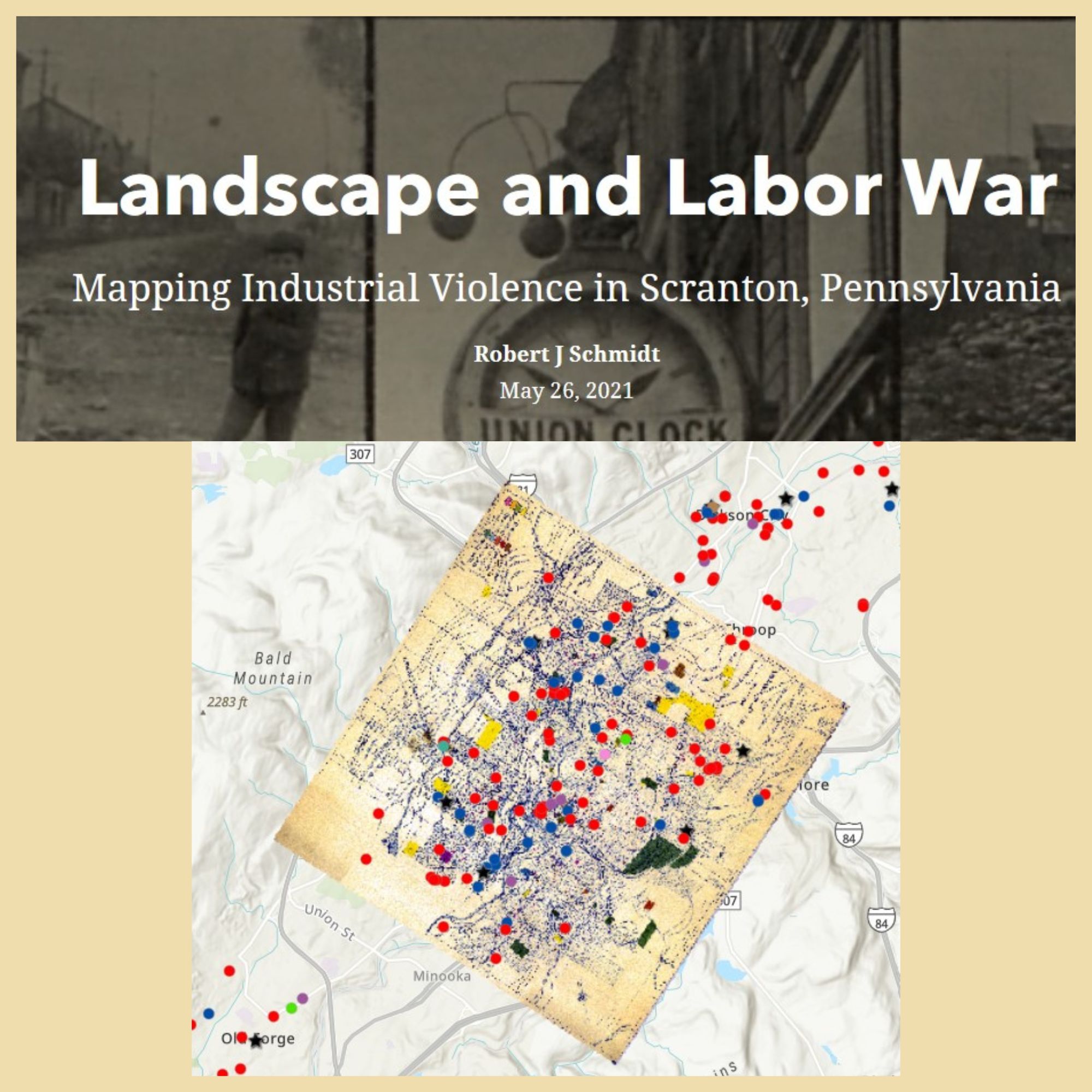
Robert J. Schmidt
storymap of industrial violence in Scranton Pennsylvania, from 1871-1877 and 1900-1937. Significant visualization of strife. Across the region, strikes over wages, working conditions, and union recognition occurred with regularity. Violence unfolded unevenly across space and was clustered within certain parts of the region over time, particularly between in 1868-1877, 1897-1902, and 1922-1938. Ironically, the 1910-1915 period that the U.S. Commission on Industrial Relations called the “age of industrial violence” for the country as a whole were years of relative labor peace in Northeast Pennsylvania.
storymap of industrial violence in Scranton Pennsylvania, from 1871-1877 and 1900-1937

Robert Kern
University of New Mexico Press (1983)
A century of labor in New Mexico / Robert Kern
Early labor movements / Michael Casillas and Robert Kern
The knights of labor and native protest in New Mexico / Robert W. Larson
Social history and labor / Robert Kern
New Mexico farm women, 1900-1940 / Joan Jensen
Labor struggle, 1900-1936 / Robert Kern
Political regression in New Mexico : the destruction of the National Miner's Union in Gallup / Harry R. Rubenstein
Intellectuals and labor / Robert Kern
Gomorrah on the Puerco : a critical study of Philip Stevenson's proletarian epic / The Seed, Connie Capers Thorson and James L. Thorson
Postwar labor and renewed labor strife / Robert Kern
Empire and opposition : "the salt of the earth" strike / Jack Cargill
Evolution of a movement / Robert Kern
New Mexico labor legislation, 1912-1949 / Haven Tobias
Recent labor developments / Sanford Cohen
A collection of essays covering New Mexico's labor history.

Robert La Follette
In response to government harassment of unionizing federal railway postal workers in April 1911, Wisconsin Senator, “Fighting Bob” La Follette said: “The railway mail clerks have the right to organize. If the officers of the department are endeavoring to prevent them from doing so by threats of dismissal, such action is without legal or moral right. If I find conditions in the railway postal service to be generally such as has been reported, I shall introduce and do everything in my power to pass a bill to prevent the continuation of such un-American practices and to preserve for all government employees the right of petition which belongs to every citizen and the right to form or join organizations for the improvement of their labor conditions.”
A primary document in which Wisconsin Gov. Robert La Follette spoke out in favor of postal unions

Robert Michael Smith
Ohio University Press (2003)
Publisher's description: From the beginning of the Industrial Age and continuing into the twenty-first century, companies faced with militant workers and organizers have often turned to agencies that specialized in ending strikes and breaking unions. Although their secretive nature has made it difficult to fully explore the history of this industry, From Blackjacks to Briefcases does just that. By digging through subpoenaed documents of strike-bound companies, their mercenaries, and the testimony of executive officers and rank-and-file strikebreakers, Robert Smith examines the inner workings of the antiunion industry. In a clear and lively style, he brings to life the violent armed guards employed on the picket line or in the coal camps; the ruffians who filled the armies marshaled by the "King of the Strikebreakers", Pearl Bergoff; the labor spies who wrecked countless unions; and, after the Wagner Act, those who manipulated national labor law to serve their clients. In From Blackjacks to Briefcases, Smith follows the history of this ongoing struggle and tells a compelling story that parallels the history of the United States over the last century and a half
examines the inner workings of the antiunion industry by digging through subpoenaed documents of strike-bound companies.

Robert Ovetz
Pluto Press (2020)
Rumours of the death of the global labour movement have been greatly exaggerated. Rising from the ashes of the old trade union movement, workers' struggle is being reborn from below. By engaging in what Karl Marx called a workers' inquiry, workers and militant co-researchers are studying their working conditions, the technical composition of capital, and how to recompose their own power in order to devise new tactics, strategies, organisational forms and objectives. These workers' inquiries, from call centre workers to teachers, and adjunct professors, are re-energising unions, bypassing unions altogether or innovating new forms of workers' organisations.In one of the first major studies to critically assess this new cycle of global working class struggle, Robert Ovetz collects together case studies from over a dozen contributors, looking at workers' movements in China, Mexico, the US, South Africa, Turkey, Argentina, Italy, India and the UK. The book reveals how these new forms of struggle are no longer limited to single sectors of the economy or contained by state borders, but are circulating internationally and disrupting the global capitalist system as they do
Rising from the ashes of the old trade union movement, workers' struggle is being reborn from below.

Robert P. Wolensky
Penn State University Press; (2020)
By the mid-1930s, Pennsylvania's anthracite coal industry was facing a steady decline. Mining areas such as the Wyoming Valley around the cities of Wilkes-Barre and Pittston were full of willing workers (including women) who proved irresistibly attractive to New York City's "runaway shops"--Ladies' apparel factories seeking lower labor and other costs. The International Ladies' Garment Workers' Union (ILGWU) soon followed, and the Valley became a thriving hub of clothing production and union activity. This volume tells the story of the area's apparel industry through the voices of men and women who lived it. Drawing from an archive of over sixty audio-recorded interviews within the Northeastern Pennsylvania Oral and Life History Collection, Sewn in Coal Country showcases sixteen stories told by workers, shop owners, union leaders, and others. The interview subjects recount the ILGWU-led movement to organize the shops, the conflicts between the district union and the national office in New York, the solidarity unionism approach of leader Min Matheson, the role of organized crime within the business, and the failed efforts to save the industry in the 1980s and 1990s. Robert P. Wolensky places the narratives in the larger context of American clothing manufacturing during the period and highlights their broader implications for the study of labor, gender, the working class, and oral history. Highly readable and thoroughly enlightening, this significant contribution to the study of labor history and women's history will appeal to anyone interested in the relationships among workers, unions, management, and community; the effects of economic change on an area and its residents; the role of organized crime within the industry; and Pennsylvania history--especially the social history of industrialization and deindustrialization during the twentieth century
showcases sixteen stories told by workers, shop owners, union leaders, and others.

Robert Shepard, Migration is Beautiful, Iowa Women's Archives
A map amplifies the Migration is Beautiful Iowa website takes to geolocation and stories, starts in mid 19th century and tracks growth of Latinx/a/o communities
An ArcGIS map application that allows users to search for individual people and their experiences as catalogues by the Migration is Beautiful project.