


Explore thousands of items. Use clickable links under collections and library for broad categories. Search by keyword (including topic,city, state.) Limit by time period, type of item, region. See our search tips page for more assistance.
Collections
Library
Type
Region
Coverage:
-
Published:
-
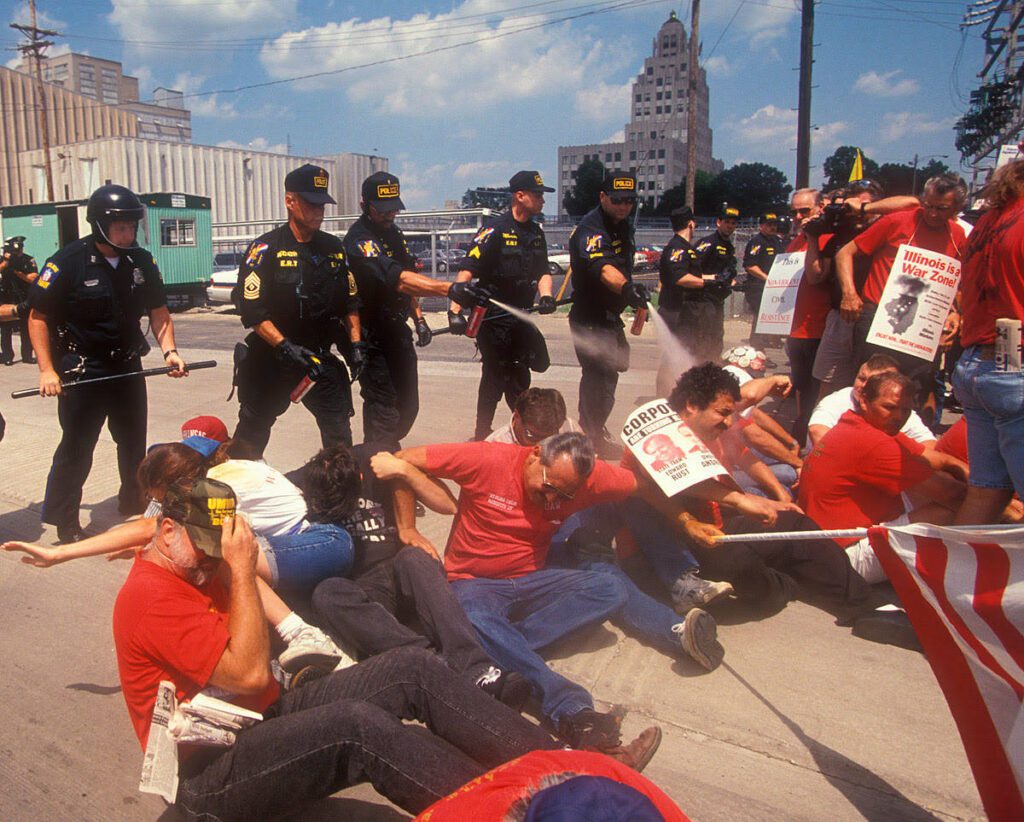
Rosemary Feurer, LaborVision
Agit-prop documentary focuses on the battle at Staley where workers were locked out by the employer; they did not actually go on strike. Having observed an earlier failed 1991-92 strike at Caterpillar, the membership voted instead to approve an extremely militant form of inside plant protest called “work to rule.”
25 minute LaborVision video created in 1993 for the Decatur based A.E. Staley labor conflict at a corn-processing plant. Producer: Rose Feurer; Rosemary Feurer; Dave Rathke; LaborVision (St. Louis)

Rosemary Feurer, Laura Vazquez
A 24 minute film Mother Jones, America's Most Dangerous Woman (24 minutes) is available for free at this link, or on DVD from our shop for a donation. It is in English and Spanish. We will soon have the Spanish version available here. • A short introduction documentary about Mother Jones
• In English and in Spanish–both versions are on each DVD
• 24 Minutes – perfect for teachers, union meetings
Mother Jones: America’s Most Dangerous Woman is a new documentary about the amazing labor heroine, Mary Harris Jones, known as “Mother” Jones. Mother Jones mobilized thousands of workers in struggles for justice in the early 20th century.
The documentary shows how Mother Jones’ organizing career influenced the history of early 20th century United States. Featuring historian Elliott Gorn, leading biographer of Mother Jones, it shows how Mother Jones transformed personal and political grief and rage into an effective persona that led workers into battles that changed the course of history.
This documentary depicts her life and times in a 24 minute film, ideal for classroom, union meetings and other events.
It is sure to spark discussions and reflections. For labor activists such as Mother Jones, labor and civil rights such as freedom of speech and assembly were often a goal rather than a reality. The documentary evokes the terrible conditions and labor oppression that motivated her to travel across the country, mobilizing thousands to fight back.
This documentary “should be shown in schools all over the country.”
—Howard Zinn, author of The People’s History of the United States
A “music video” of the 1914 “Ludlow massacre” and Mother Jones’ role in these events brings to life a forgotten vista of brutalities that immigrant laborers in the U.S. faced a century ago. The use of hired mercenaries and public police forces to brutalize and suppress workers rights was a common condition of the period. While we are taught that the U.S. has guaranteed basic
freedoms, the history of this period reveals an oft-buried history of the fragile status of freedom for labor in this country.
The documentary includes rare photos as well as the only existing live footage of her at age “100″ proclaiming she is still a radical, still awaits the day that the people will “replace this moneyed civilization,” and “longs for the day when labor will have the destination of the nation in her own hands.”
The documentary was produced, co-directed, and written by Rosemary Feurer. Feurer is a labor historian who teaches at Northern Illinois University. She is the author of Radical Unionism in the Midwest, 1900-1950. It was co-directed by Laura Vazquez, NIU Communications Department.
A 24 minute introduction to the life and times of the leading organizer of the early 20th century
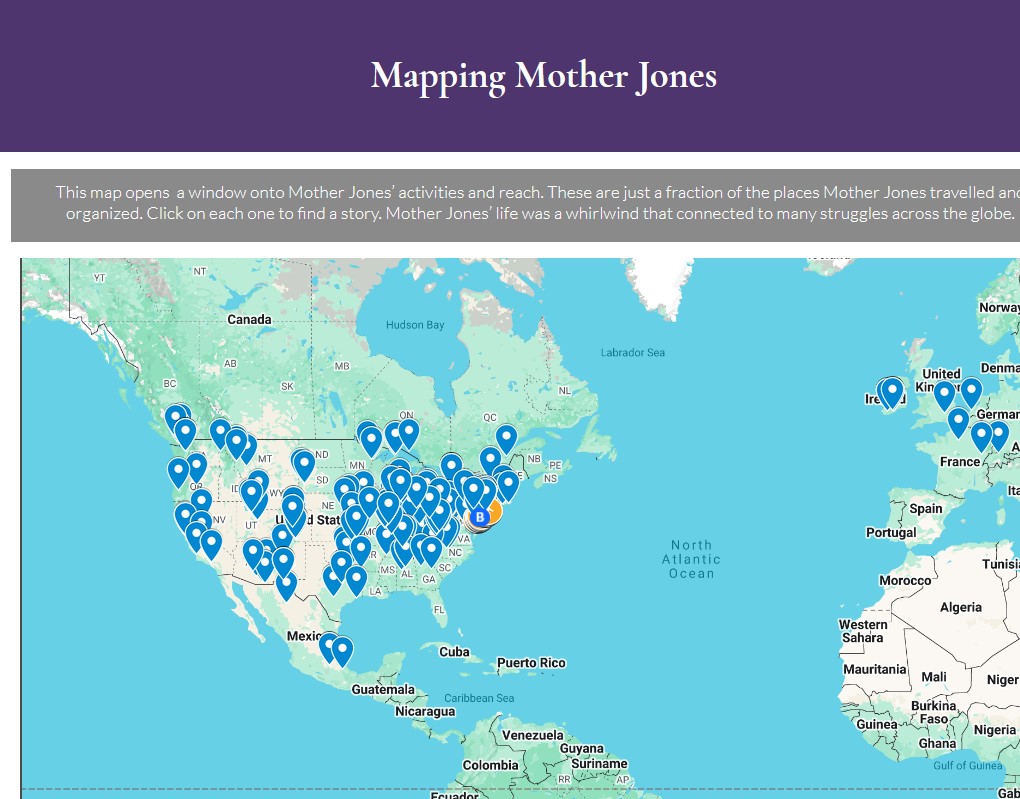
Rosemary Feurer, Mother Jones Heritage Project
Map that shows sites of Mother Jones activism across the US and Mexico
A map of some of the sites associated with Jones, leading labor organizer, including a complete map of the March of the Mill Children, 1903

Ross Barrett
University of California (2014)
Rendering Violence explores the problems and possibilities that the subject of political violence presented to American painters working between 1830 and 1890, a turbulent period during which common citizens frequently abandoned orderly forms of democratic expression to riot, strike, and protest violently. Examining a range of critical texts, this book shows for the first time that nineteenth-century American aesthetic theory defined painting as a privileged vehicle for the representation of political order and the stabilization of liberal-democratic life. Analyzing seven paintings by Thomas Cole, John Quidor, Nathaniel Jocelyn, George Henry Hall, Thomas Nast, Martin Leisser, and Robert Koehler, Ross Barrett reconstructs the strategies that American artists developed to explore the symbolic power of violence in a medium aligned ideologically with lawful democracy. He argues that American paintings of upheaval "render" their subjects in divergent ways. By exploring the inner conflicts that structure these painterly projects, Barrett sheds new light on the politicized pressures that shaped visual representation in the nineteenth century and on the anxieties and ambivalences that have long defined American responses to political turmoil
How could a mob be painted? Picturing political violence in the Jacksonian era -- Painting that 'might prove injurious': Cinque and the representation of African American political violence -- Riot, rowdyism, and reform: George Henry Hall and the picturing of midcentury urban upheaval -- Trouble on the home front: art, democracy, and disorder during the Civil War -- Painting and political violence at century's end
Analyzing seven paintings by Thomas Cole, John Quidor, Nathaniel Jocelyn, George Henry Hall, Thomas Nast, Martin Leisser, and Robert Koehler, Ross Barrett

Ross Perlin
Verso (2011)
Millions of young people--and increasingly some not-so-young people--now work as interns. They famously shuttle coffee in a thousand magazine offices, legislative backrooms, and Hollywood studios, but they also deliver aid in Afghanistan, map the human genome, and pick up garbage. Intern Nation is the first exposé of the exploitative world of internships. In this serious investigative work, Ross Perlin profiles fellow interns, talks to academics and professionals about what unleashed this phenomenon, and explains why the intern boom is perverting workplace practices around the world
the first exposé of the exploitative world of internships

Roxanne Newton
Routledge (2013)
Table of Contents
Ch. 1 The Fabric of Hope and Resistance
Ch. 2 A Feminist Working-Class Narrative Study
Ch. 3 "Good as a Man": Identity [Re]formation in Male-Dominated Jobs
Ch. 4 "I Had to Constantly Fight": Solidarity and Social Activism
Ch. 5 "I Just Couldn’t Say No": Self-Abnegation and Sacrifice
Ch. 6 "I Do the Politics": Union Feminism and Social Justice
Ch. 7 Global Solidarity: The Warp and Weft of Change
Notes
women unionists' life histories through the lens of narrative analysis

Roy Rosenzweig
Cambridge University Press (1983)
In the first comprehensive study of American working-class recreation, Professor Rosenzweig takes us to the saloons, the ethnic and church picnics, the parks and playgrounds, the amusement parks, and the movie houses where industrial workers spent their leisure hours. Focusing on the city of Worcester, Massachusetts, he describes the profound changes that popular leisure underwent.
the first comprehensive study of American working-class recreation.

Rudi Batzell
The University of Chicago Press (2025)
During the rise of the labor movement in the late nineteenth century, why were American workers unable to organize inclusive trade unions like those formed by their counterparts in the United Kingdom? Comparing American and British capitalism in the port cities of Baltimore and Liverpool and the steel cities of Pittsburgh and Sheffield, Rudi Batzell reveals that the answer lies in the legacies of slavery and entrenched structures of racial inequality. Strikebreaking succeeded more often in the United States because landless Black Americans were, out of economic desperation, more likely to become scabs and fracture the class solidarity of any union movement. Batzell shows, in short, how racism was and is deeply connected to class, migration, and capitalism in a global economy marked by slavery and empire. In emphasizing the geography of economic inequality, this book offers new clarity on the late-nineteenth-century successes and failures of working-class formation. More broadly, Organizing Workers in the Shadow of Slavery makes it clear that the pursuit of justice today will require sustained economic reparations for slavery and colonialism.
Introduction
Part I. Rural Peripheries, Labor Uprisings, and the Migrant Strikebreaker
1. Near-Peripheries: Land and the Reserve Army of Labor
2. Parallel Rebellions: The Knights of Labor and the New Unionism
3. Divergence: Strikebreaking at Labor’s Turning Point
Part II. The Pivot of the 1890s: Organized Workers and the Construction of Racial Boundaries
4. Drawing the Boundaries of Craft: The Challenge of Inclusive Unionism
5. Black Workers and the Boundaries of White Supremacy in the United States
6. National Boundaries: Immigration Restriction in the Shadow of Slavery
7. Drawing the Boundaries of White Supremacy in the British Empire
Part III. Homes, Sports, and the Rise of Unions: Solidarity and Segregation in Workers’ Social Worlds
8. Solidarity and Segregation in the Industrial Suburb
9. Fordist Masculinity: Workers Organized in the Sports Bureaucracy
10. Crowds, Labor Bureaucrats, and the Politics of Redistribution
Conclusion: The Shadow of Slavery, Present and Future
This history of the early American labor movement argues that the legacy of slavery, corporate use of black strikebreakers, and racism account for the inability of American trade unions to create inclusive movements

Rudyard Kipling
In February 1899, British novelist and poet Rudyard Kipling wrote a poem entitled “The White Man’s Burden: The United States and The Philippine Islands.” In this poem, Kipling urged the U.S. to take up the “burden” of empire, as had Britain and other European nations. Published in the February, 1899 issue of McClure’s Magazine, the poem coincided with the beginning of the Philippine-American War and U.S. Senate ratification of the treaty that placed Puerto Rico, Guam, Cuba, and the Philippines under American control. Theodore Roosevelt, soon to become vice-president and then president, copied the poem and sent it to his friend, Senator Henry Cabot Lodge, commenting that it was “rather poor poetry, but good sense from the expansion point of view.” Not everyone was as favorably impressed as Roosevelt. The racialized notion of the “White Man’s burden” became a euphemism for imperialism, and many anti-imperialists couched their opposition in reaction to the phrase.
The racialized notion of the “White Man’s burden” became a euphemism for imperialism, and many anti-imperialists couched their opposition in reaction to the phrase.
Russell A. Nixon, History Matters
President Lyndon Johnson formed an 11-member National Advisory Commission on Civil Disorders in July 1967 to explain the riots that plagued cities each summer since 1964 and to provide recommendations for the future. The Commission’s 1968 report, informally known as the Kerner Report, concluded that the nation was “moving toward two societies, one black, one white—separate and unequal.” Unless conditions were remedied, the Commission warned, the country faced a “system of ’apartheid’” in its major cities. The Kerner report delivered an indictment of “white society” for isolating and neglecting African Americans and urged legislation to promote racial integration and to enrich slums—primarily through the creation of jobs, job training programs, and decent housing. President Johnson, however, rejected the recommendations. In April 1968, one month after the release of the Kerner report, rioting broke out in more than 100 cities following the assassination of civil rights leader Martin Luther King, Jr. In the following statements to joint Congressional hearings on urban employment problems in May and June of 1968, two academics related their findings regarding overt and institutionalized discrimination. They further argued that there were no simple solutions for overcoming the racial divide.
The 1968 statement of Russell A. Nixon, Associate Director of the New York University Center for Study of the Unemployed, who responds to the findings of the Kerner Report.

Russell M. Lawson
Praeger (2018)
The dispossessed people of Colonial America included thousands of servants who either voluntarily or involuntarily ended up serving as agricultural, domestic, skilled, and unskilled laborers in the northern, middle, and southern British American colonies as well as British Caribbean colonies. Illustrates how a majority of residents in Colonial America at any given time from 1607 to 1776 were dispossessed of basic freedoms Explains how the dispossessed Colonial American, deprived of basic rights, generated principles of freedom and equality that resulted in the American Revolution Shows that the basic rights of children were ignored in Stuart and Georgian England, which resulted in their transportation to America Describes how thousands of inhabitants of Colonial America were felons reprieved of the death penalty and prisoners of war
a majority of residents in Colonial America at any given time from 1607 to 1776 were dispossessed of basic freedoms
Ruth Bleasdale
University of Toronto Press (2018)
Rough Work is an accessibly written yet rigorous study of the galvanization of a major segment of Canada's labour force over four decades of social and economic transformation. "Rough Work is an exhaustive social history of public works projects, the men who labored on them, and the men who tried to keep these laborer’s in line. Bleasdale has made a vital contribution by diligently documenting this time and place."
A social history of public works projects, the men who labored on them, and the men who tried to keep these laborers in line

Ruth Frager and Carmela Patrias
University of Toronto Press (2005)
The years between 1870 and 1939 were a crucial period in the growth of industrial capitalism in Canada, as well as a time when many women joined the paid workforce. Yet despite the increase in employment, women faced a difficult struggle in gaining fair remuneration for their work and in gaining access to better jobs. Discounted Labour analyses the historical roots of women's persistent inequality in the paid labour force. Ruth A. Frager and Carmela K. Patrias analyse how and why women became confined to low-wage jobs, why their work was deemed less valuable than men's work, why many women lacked training, job experience, and union membership, and under what circumstances women resisted their subordination.
Distinctive earning discrepancies and employment patterns have always characterized women's place in the workforce whether they have been in low-status, unskilled jobs, or in higher positions. For this reason, Frager and Patrias focus not only on women wage-earners but on women as salaried workers as well. They also analyze the divisions among women, examining how class and ethnic or racial differences have intersected with those of gender. Discounted Labour is an essential new work for anyone interested in the historical struggle for gender equality in Canada.
A sweeping study of the rise of working women in Canada, both focusing on the lives of wage laborers and salaried workers, ultimately seeking to uncover why women's labor became less valued than men's

Ruth Milkman
University of Illinois Press (1987)
"By analyzing the process of work in both the electrical and the automobile industries, the supplies of male and female labor available to each, the varying degrees of labor-intensive work, the proportion of labor costs to total costs, and the extent of male resistance to female entry into the industry before, during, and after the war, Milkman offers a historically grounded and detailed examination of the evolution, function, and reproduction of job segregation by sex."--Grace Palladino, Journal of American History
offers a historically grounded and detailed examination of the evolution, function, and reproduction of job segregation by sex.

Ruth Milkman
Polity (2020)
Immigration has been a contentious issue for decades, but in the twenty-first century it has moved to center stage, propelled by an immigrant threat narrative that blames foreign-born workers, and especially the undocumented, for the collapsing living standards of American workers. According to that narrative, if immigration were summarily curtailed, border security established, and ""illegal aliens"" removed, the American Dream would be restored. In this book, Ruth Milkman demonstrates that immigration is not the cause of economic precarity and growing inequality, as Trump and other promoters of the immigrant threat narrative claim. Rather, the influx of low-wage immigrants since the 1970s was a consequence of concerted employer efforts to weaken labor unions, along with neoliberal policies fostering outsourcing, deregulation, and skyrocketing inequality.These dynamics have remained largely invisible to the public. The justifiable anger of US-born workers whose jobs have been eliminated or degraded has been tragically misdirected, with even some liberal voices recently advocating immigration restriction. This provocative book argues that progressives should instead challenge right-wing populism, redirecting workers' anger toward employers and political elites, demanding upgraded jobs for foreign-born and US-born workers alike, along with public policies to reduce inequality.
Why immigrants aren't to blame for the erosion of the US labor market

Ruth Milkman
Cornell University Press (2006)
The "Wicked City": labor and Los Angeles exceptionalism
Turning the clock back: anti-union reaction, the return of the sweatshop, and the new immigration
Organizing the "Unorganizable": immigrant unionization and labor revitalization in the 1990s
"Si, Se Puede": union organizing strategies and immigrant workers
From Publisher: Sharp decreases in union membership over the last fifty years have caused many to dismiss organized labor as irrelevant in today's labor market. In the private sector, only 8 percent of workers today are union members, down from 24 percent as recently as 1973. Yet developments in Southern California--including the successful Justice for Janitors campaign--suggest that reports of organized labor's demise may have been exaggerated. In L.A. Story, sociologist and labor expert Ruth Milkman explains how Los Angeles, once known as a company town hostile to labor, became a hotbed for unionism, and how immigrant service workers emerged as the unlikely leaders in the battle for workers' rights. L.A. Story shatters many of the myths of modern labor with a close look at workers in four industries in Los Angeles: building maintenance, trucking, construction, and garment production. Though many blame deunionization and deteriorating working conditions on immigrants, Milkman shows that this conventional wisdom is wrong. Her analysis reveals that worsening work environments preceded the influx of foreign-born workers, who filled the positions only after native-born workers fled these suddenly undesirable jobs. Ironically, L.A. Story shows that immigrant workers, who many union leaders feared were incapable of being organized because of language constraints and fear of deportation, instead proved highly responsive to organizing efforts. As Milkman demonstrates, these mostly Latino workers came to their service jobs in the United States with a more group-oriented mentality than the American workers they replaced. Some also drew on experience in their native countries with labor and political struggles. This stock of fresh minds and new ideas, along with a physical distance from the east-coast centers of labor's old guard, made Los Angeles the center of a burgeoning workers' rights movement. Los Angeles' recent labor history highlights some of the key ingredients of the labor movement's resurgence--new leadership, latitude to experiment with organizing techniques, and a willingness to embrace both top-down and bottom-up strategies. L.A. Story's clear and thorough assessment of these developments points to an alternative, high-road national economic agenda that could provide workers with a way out of poverty and into the middle class.
explains how Los Angeles became a hotbed for unionism, and how immigrant service workers emerged as the unlikely leaders in the battle for workers' rights.

Ruth Milkman
University of Illinois Press (2016)
Ruth Milkman's groundbreaking research in women's labor history has contributed important perspectives on work and unionism in the United States. On Gender, Labor, and Inequality presents four decades of Milkman's essential writings, tracing the parallel evolutions of her ideas and the field she helped define. Milkman's introduction frames a career-spanning scholarly project: her interrogation of historical and contemporary intersections of class and gender inequalities in the workplace, and the efforts to challenge those inequalities. Early chapters focus on her pioneering work on women's labor during the Great Depression and the World War II years. In the book's second half, Milkman turns to the past fifty years, a period that saw a dramatic decline in gender inequality even as growing class imbalances created greater-than-ever class disparity among women. She concludes with a previously unpublished essay comparing the impact of the Great Depression and the Great Recession on women workers"-- Provided by publisher
anthology of writings by leading sociologist of labor
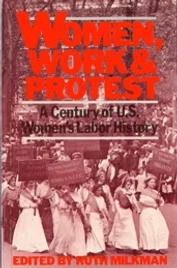
Ruth Milkman
Routledge (2016)
Available digitally at https://www.ruthmilkman.info/women-work-and-protest As paid work becomes increasingly central in women's lives, the history of their labor struggles assumes more and more importance. This volume represents the best of the new feminist scholarship in twentieth-century U.S. women's labor history. Fourteen original essays illuminate the complex relationship between gender, consciousness and working-class activism, and deepen historical understanding of the contradictory legacy of trade unionism for women workers. The contributors take up a wide range of specific subjects, and write from diverse theoretical perspectives. Some of the essays are case studies of women's participation in individual unions, organizing efforts, or strikes; others examine broader themes in women's labor history, focusing on a specific time period; and still others explore the situation of particular categories of women workers over a longer time span. This collection extends the scope of current research and interpretation in women's labor history, both conceptually and in terms of periodization - emphasis is placed on the post-World War I period where the literature is sparse. This book will be valuable for scholars, students and general readers alike
Contents:
Editor’s Preface 1 “Bread before roses: American workingmen, labor unions and the family wage,” by Martha May
2 “Labor organizing and female institution-building: The Chicago Women’s Trade Union League, 1904-24,”
by Colette A. Hyman
3 “Bread and roses revisited: Women’s culture and working-class activism in the Lawrence strike of 1912,” by Ardis Cameron pdf
4 “The women of the Colorado Fuel and Iron strike, 1913-14,” by Priscilla Long
5 “Another look at the International Ladies’ Garment Workers’ Union: Women, industry structure and collective action” by Roger Waldinger
6 “Problems of coalition-building: Women and trade unions in the 1920s,” by Alice Kessler-Harris
7 “Survival strategies among African-American women workers: A continuing process,” by Rosalyn Terborg-Penn
8 “‘I know which side I’m on’: Southern women in the labor movement in the twentieth century,” by Mary Frederickson
9 “‘Where I was a person’: The Ladies’ Auxiliary in the 1934 Minneapolis Teamsters’ strikes,” by Marjorie Penn Lasky
10 “‘We’re no Kitty Foyles’: Organizing office workers for the Congress of Industrial Organizations, 1937-50,” by Sharon Hartman Strom
11 “Organizing the United Automobile Workers: Women workers at the Ternstedt General Motors parts plant,” by Ruth Meyerowitz
12 “Women and the United Automobile Workers’ Union in the 1950s,” by Nancy Gabin
13 “Unionized women in state and local government,” by Deborah E. Bell
14 “Women workers, feminism and the labor movement since the 1960s,” by Ruth Milkman
Index pdf
A collection of 14 essays that hollistically ex[plores women's labor history.

Ruth Milkman , Eileen Appelbaum
Cornell University Press (2013)
Unfinished Business documents the history and impact of California's paid family leave program, the first of its kind in the United States, which began in 2004. Drawing on original data from fieldwork and surveys of employers, workers, and the larger California adult population, Ruth Milkman and Eileen Appelbaum analyze in detail the effect of the state's landmark paid family leave on employers and workers. They also explore the implications of California's decade-long experience with paid family leave for the nation, which is engaged in ongoing debate about work-family policies. Milkman and Appelbaum recount the process by which California workers and their allies built a coalition to win passage of paid family leave in the state legislature, and lay out the lessons for advocates in other states and localities, as well as the nation. Because paid leave enjoys extensive popular support across the political spectrum, campaigns for such laws have an excellent chance of success if some basic preconditions are met. Do paid family leave and similar programs impose significant costs and burdens on employers? Business interests argue that they do and routinely oppose any and all legislative initiatives in this area. Once the program took effect in California, this book shows, large majorities of employers themselves reported that its impact on productivity, profitability, and performance was negligible or positive. Unfinished Business demonstrates that the California program is well managed and easy to access, but that awareness of its existence remains limited. Moreover, those who need the program's benefits most urgently--low-wage workers, young workers, immigrants, and disadvantaged minorities--are least likely to know about it. As a result, the long-standing pattern of inequality in access to paid leave has remained largely intact
history and impact of California's paid family leave program, the first of its kind in the United States, which began in 2004

Ruth Milkman, Ed Ott
Cornell University Press (2014)
New York City boasts a higher rate of unionization than any other major U.S. city, roughly double the national average, but the city's unions have suffered steady and relentless decline, especially in the private sector. With higher levels of income inequality than any other large city in the nation, New York today is home to a large and growing "precariat": workers with little or no employment security who are often excluded from the basic legal protections that unions struggled for and won in the twentieth century
ront matter -- Contents -- Preface and Acknowledgments / Milkman, Ruth / Ott, Ed -- Introduction: Toward a New Labor Movement? Organizing New York City's Precariat / Milkman, Ruth -- Part I IMMIGRANT UNION ORGANIZING AND UNION- COMMUNITY PARTNERSHIPS --
1. Taking Aim at Target: West Indian Immigrant Workers Confront the Difficulties of Big-Box Organizing / Becker, Benjamin --
2. Organizing Immigrant Supermarket Workers in Brooklyn: A Union-Community Partnership / Shapiro, Ben --
3. Faith, Community, and Labor: Challenges and Opportunities in the New York City Living Wage Campaign / Broxmeyer, Jeffrey D. / Michaels, Erin --
4. United New York: Fighting for a Fair Economy in "The Year of the Protester" / Turner, Lynne --
Part II ORGANIZING THE PRECARIAT, OLD AND NEW --
5. Infusing Craft Identity into a Noncraft Industry: The Retail Action Project / Ikeler, Peter --
6. Street Vendors in and against the Global City: VAMOS Unidos / Dunn, Kathleen --
7. Protecting and Representing Workers in the New Gig Economy: The Case of the Freelancers Union / King, Martha W. --
Part III IMMIGRANT STRUGGLES FOR JUSTICE IN AND BEYOND THE WORKPLACE --
8. The High- Touch Model: Make the Road New York's Participatory Approach to Immigrant Organizing / McAlevey, Jane --
9. Bridging City Trenches: The New York Civic Participation Project / McFarland, Stephen --
10. Creating "Open Space" to Promote Social Justice: The MinKwon Center for Community Action / McQuade, Susan --
Part IV GOING NATIONAL: NEW YORK's WORKER CENTERS EXPAND --
11. An Appetite for Justice: The Restaurant Opportunities Center of New York / Brady, Marnie --
12. Not Waiting for Permission: The New York Taxi Workers Alliance and Twenty- First- Century Bargaining --
13. "Prepare to Win": Domestic Workers United's Strategic Transition following Passage of the New York Domestic Workers' Bill of Rights / Goldberg, Harmony --
Afterword: Lessons from the New Labor Movement for the Old / Ott, Ed --
Notes -- Bibliography -- About the Contributors -- Index
workers with little or no employment security explained

Ruth O'Brien
The University of North Carolina Press (1998)
This text reinterprets the roots of 20th-century American labour law and politics, claiming that Republicans developed the fundamental principles, not New Deal Democrats. It demonstrates the establishment of procedural rights of workers in Republican-formulated labour legislation of the 1920s.
reinterprets the roots of 20th-century American labour law and politics, claiming that Republicans developed the fundamental principles, not New Deal Democrats.
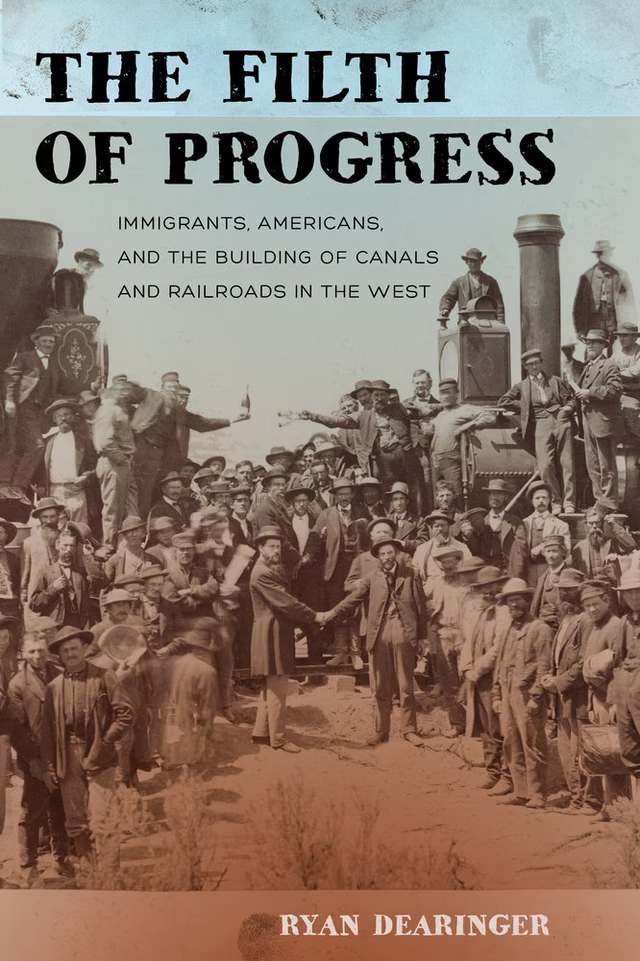
Ryan Dearinger
University of California Press (2015)
I examine the rise of Western canals and railroads to national prominence through the menial labor of countless men, largely hidden from view because they left virtually no paper trail, who strung together livelihoods at the economic fringes of society. This book examines the contest for control of American progress and history as distilled from the competing narratives of canal and railroad construction workers and those fortunate enough to avoid this faten America's historical imagination, toil and triumph against nature and overwhelming odds characterizes such achievements as the Erie Canal and the transcontinental railroad.
Triumph transformed canal and railroad entrepreneurs into visionaries whose work brought the nation bountiful riches and did the Lord's bidding. Celebrated for their spirit and perseverance in 'building' the nation's infrastructure, they found respect for looking to tomorrow and creating a future. For generations, most indexes of American history supported and reinforced this narrative of progress. Yet, if this is the historical memory, it is conveniently stunted. What of those whose bodies strained and broke under the load of such glories? What of those men beyond the din and fanfare who only appear in old photographs with faces blurred and indistinguishable? In their lives and deaths in the mud, muck, and mountains is another history of American achievement. These barely visible and forgotten, ordinary men, 'unskilled' immigrants from Ireland and China, Mormons, and native-born American workingmen rank, as well, as the creators of national growth and progress. Their experiences and voices, along with those of the privileged and well-connected, are the subjects of this study.
the rise of Western canals and railroads to national prominence through the menial labor of countless men

Ryan Patrick Murphy
Temple University Press (2016)
In 1975, National Airlines was shut down for 127 days when flight attendants went on strike to protest long hours and low pay. Activists at National and many other U.S. airlines sought to win political power and material resources for people who live beyond the boundary of the traditional family. In Deregulating Desire, Ryan Patrick Murphy, a former flight attendant himself, chronicles the efforts of single women, unmarried parents, lesbians and gay men, as well as same-sex couples to make the airline industry a crucible for social change in the decades after 1970. --Publisher description
efforts of single women, unmarried parents, lesbians and gay men, as well as same-sex couples to make the airline industry a crucible for social change in the decades after 1970
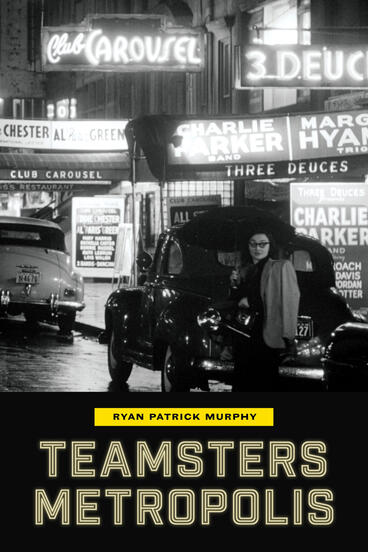
Ryan Patrick Murphy
University of Michigan Press (2025)
In the 1950s, the International Brotherhood of Teamsters empowered poor immigrants who had grown up in the crowded blocks of the central city to move upward and outward to comfortable suburbs. It delivered unprecedented benefits to workers—especially to those in retail, services, and light manufacturing—locking in hourly pay that bought the patio furniture sets, the pontoon boats, and the station wagons that defined the consumer culture of the decade. Yet suburban comfort came with strict, new institutions that defined the middle-class culture of the era: the nuclear family, heterosexual monogamy, the husband breadwinner, and the dependent wife. Many workers yearned for the pleasures they left behind in the core of the industrial city, even as poor people, people of color, and queer people were locked out of the suburbs.
Teamsters Metropolis argues that the union achieved unprecedented organizing success in the immediate postwar period precisely because its members defied bourgeois cultural standards. They wore overly flamboyant clothes, instigated jarringly violent confrontations, used aliases, extorted money, flouted the law, and often blended friendship, sex, and love in a way that challenged the boundaries of heteronormativity. Perhaps no one exemplified this freedom more than Jimmy Hoffa, who delivered better pay and worker conditions to marginal workers while also using coercive tactics, embezzling money, and colluding with the Mafia. Rather than impeding the union’s growth, unruly organizing, illicit business techniques, and dissident cultural practices appealed to prospective members and offered an opportunity to circumvent some of the suburban regulations, helping the International Brotherhood of Teamsters become the largest U.S. union of the mid-twentieth century.
Acknowledgements
Introduction: Building a Metropolitan Union: Service Labor Activism in the Age of Suburbanization
Chapter 1: Organizing the Teamsters Metropolis: Unruly Unionism in New York City’s Service Industry
Chapter 2: Blackmailers, Safe Crackers, Dope Peddlers, White Slavers, and Sodomists: Regulating Teamster Culture at the McClellan Committee Hearings
Chapter 3: Invested in Pleasure: Resisting the Work Ethic on Jimmy Hoffa’s Miami Beach
Chapter 4: What Are We Paying Dues For?: Young Workers of Color Confront the Teamsters Metropolis
Chapter 5: What If We Had Known about Sylvia Pagano?: An Intimate History of a Downtown Apartment in the Age of Suburbia
Epilogue: Queer Nightlife in the Teamsters Metropolis: Teamster Unionism as an Embodied Practice
Notes
Bibliography
Index
How an unruly union culture helped workers establish comfortable, suburban living
Ryan S. Pettengil, Teaching Labor's Story
Song Lyrics by Maurice Sugar; sung to the tune of the well-known song, “My Bonnie Lies Over the Ocean.”Sugar was a labor lawyer who served as the general counsel for the United Auto Workers (UAW) fromthe union’s founding in 1937 to 1947. “The Soup Song” was a participatory sing-along, widely sung by workers who learned the lyrics at marches and rallies, and through song-books published by workers’ organizations Teaching guide facilitates rich discussion.
“The Soup Song” uses humor and sarcasm to convey workers’ experiences and attitudes during the Great Depression. As a widely popular participatory song, it was an effective tool for labor organizing.
Museum/Exhibits
Tours
Maps
Digital Projects
Organizations
Sites
Film/Video
Audio/Interview
Podcast/Program
Text/Document
Image
Graphs/Data
Timeline
Southwest
West
Midwest
Southeast
Northeast
Mexico
Canada
Global
Books
Teaching
Lectures
Digital Archives
Journals
Bibliographies
Topic Intro