


Explore thousands of items. Use clickable links under collections and library for broad categories. Search by keyword (including topic,city, state.) Limit by time period, type of item, region. See our search tips page for more assistance.
Collections
Library
Type
Region
Coverage:
-
Published:
-

Ryan S. Pettengill
Temple University Press (2020)
Communists and Community chronicles labor activism and community organizing sponsored by the Communist Party in Detroit from 1942 to 1956, to investigate the changing nature of community-based activism in the twentieth century
chronicles labor activism and community organizing sponsored by the Communist Party in Detroit.

S. Paul O’Hara
Johns Hopkins University Press (2016)
Between 1865 and 1937, Pinkerton's National Detective Agency was at the center of countless conflicts between capital and labor, bandits and railroads, and strikers and state power. Some believed that the detectives were protecting society from dangerous criminal conspiracies; others thought that armed Pinkertons were capital's tool to crush worker dissent. Yet the image of the Pinkerton detective also inspired romantic and sensationalist novels, reflected shifting ideals of Victorian manhood, and embodied a particular kind of rough frontier justice. Inventing the Pinkertons examines the evolution of the agency as a pivotal institution in the cultural history of American monopoly capitalism. Historian S. Paul O'Hara intertwines political, social, and cultural history to reveal how Scottish-born founder Allan Pinkerton insinuated his way to power and influence as a purveyor of valuable (and often wildly wrong) intelligence in the Union cause. During Reconstruction, Pinkerton turned his agents into icons of law and order in the Wild West. Finally, he transformed his firm into a for-rent private army in the war of industry against labor. Having begun life as peddlers of information and guardians of mail bags, the Pinkertons became armed mercenaries, protecting scabs and corporate property from angry strikers. O'Hara argues that American capitalists used the Pinkertons to enforce new structures of economic and political order. Yet the infamy of the Pinkerton agent also gave critics and working communities a villain against which to frame their resistance to the new industrial order. Ultimately, Inventing the Pinkertons is a gripping look at how the histories of American capitalism, industrial folklore, and the nation-state converged.
how Pinkertons became armed mercenaries, protecting scabs and corporate property from angry strikers
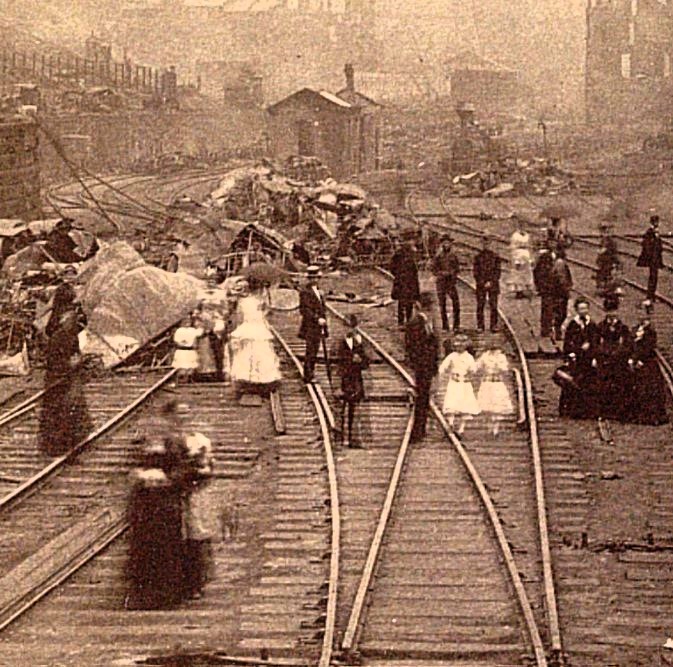
S. V. Albee
Forty-three stereoviews depicting the aftermath of the Railroad Strike of 1877, also known as The Railroad War, in Pittsburgh, Pennsylvania. All but one by Seth Voss Albee, more widely known as S. V. Albee (1838-1930).
What is a stereoview? Stereoviews, also known as stereographs or stereoscopic cards, are an early form of 3D photography. The pictures are taken with a stereoscopic camera, which has two lenses, simulating the views received by the left and right eye. Two nearly identical pictures are then developed and printed, and are mounted next to each other, usually on a piece of card stock. When looked at through a stereoscope, the image can then be seen in 3D. Stereoscopes were a 19th century amusement devise.
43 images of the aftermath of the 1877 Railroad Strike in Pittsburgh, showing destruction
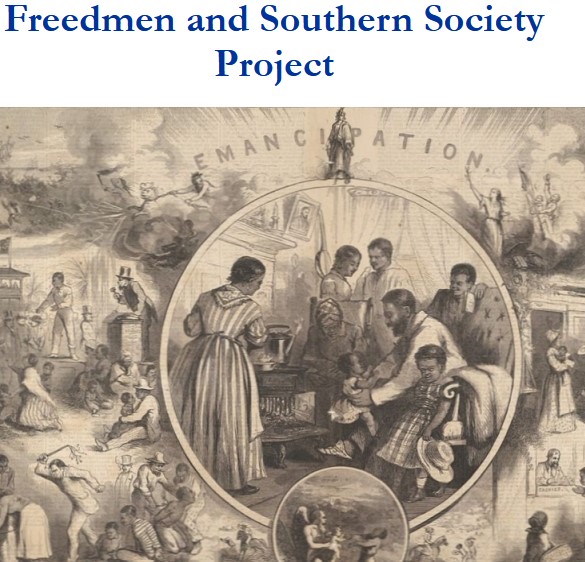
S. W. Cozzens
Regulations by S. W. Cozzens, [Feb? 1864], filed between P-76 and P-77 1864, Letters Received, series 1920, Civil Affairs, Department of the Gulf, U.S. Army Continental Commands, Record Group 393 Pt. 1, National Archives.
Although this printed copy bears no evidence of its date of issue, Cozzens's regulations probably date from about February 15, 1864, when he transmitted a slightly different handwritten version to a subordinate “inspector of plantations.” (S. W. Cozzens to Mr. Charles L. Dunbar, 15 Feb. 1864, vol. 123, pp. 119–21, Outgoing Correspondence of the Plantation Bureau, 3rd Agency, Civil War Special Agencies of the Treasury Department, Record Group 366, National Archives.)
A broadside that announced the rules governing the employment of black laborers on plantations in Union-occupied Louisiana.

S.J. Childs
How do I teach social studies without depressing students with all those stories about injustice? How do I investigate the effects of colonialism and globalization but not perpetuate a view of victimization? How do I help students think critically about the suffering in the world without making it one long sad story? Over the years author S.J. Childs included in their curriculum at Portland, Oregon Franklin High School examples of resistance, set up simulations and activities where students challenged the system or took on the roles of change-makers. Still, Childs sent too many students into the world as cynical young adults when what they wanted was to empower students to become active citizens — thinking critically about society, identifying its problems and working toward solutions. Childs wanted to start this school year with one hopeful story we could return to repeatedly. They found it in Salt of the Earth, a compelling and dramatic film that demonstrates alliances, solidarity, and resistance.
A lesson plan that pairs with the 1954 film Salt of the Earth, which encourages educators to pervade lessons on imperialism, colonialism, and globalization with a sense of hopefulness.

S.L. Price
Atlantic Monthly Press (2016)
In the early twentieth century, down the Ohio River from Pittsburgh, the Jones & Laughlin Steel Company built one of the largest mills in the world and a town to go with it. Aliquippa was a beacon and a melting pot, pulling in thousands of families from eastern and southern Europe and the Jim Crow South.
The J&L mill, though dirty and dangerous, offered a chance at a better life and hope for the future. It produced the steel that built American cities and won World War II and, thanks to hard-fought union victories, made Aliquippa something of a workers' paradise. But then, in the 1980s, the steel industry cratered. The mill closed. Crime rose and crack hit big. But another industry grew in Aliquippa. The town didn't just make steel; it made elite football players, from Mike Ditka to Ty Law to Darrelle Revis. Despite its troubles--maybe even because of them--Aliquippa became legendary for producing greatness.
In Playing Through the Whistle, celebrated sportswriter S. L. Price tells the remarkable story of Aliquippa and through it, the larger history of American industry, sports, and life. Price charts the fortunes of Aliquippa's celebrated team through championships under charismatic coaches and through hard times after the mill died. In an era when sports has grown from novelty to a vital source of civic pride, Price reveals the shifting mores of a town defined by work--and the loss of it--yet anchored by a weekly game. Today, as our view of football shifts and participation drops, in Aliquippa the sport can still feel like the one path away from life on the streets, the last force keeping the town together.--Adapted from dust jacket
remarkable story of Aliquippa and through it, the larger history of American industry, sports, and life

Sally M. Miller
Praeger (1995)
The 1940s were a pivotal decade in the history of the American labor movement. American labor historians and labor studies specialists will find this collection fills a major void in the research on American labor.
These essays examine topics including aspects of the institutional development of the labor movement at the national level.

Sam Davies, Colin J. Davis, David de Vries
Ashgate Publishing (2000)
A two-volume project which goes beyond existing individual studies of dock workers to develop a genuinely comparative international perspective over a long historical period. Volume 1 contains 22 studies of major ports worldwide. volume 2 contains thematic essays which draw on information provided in the port studies to identify important aspects and recurring themes.
Workers who loaded and unloaded ships have formed a distinctive occupational group over the past two centuries. As trade expanded so the numbers of dock labourers increased and became concentrated in the major ports of the world. This ambitious two-volume project goes beyond existing individual studies of dock workers to develop a genuinely comparative international perspective over a long historical period. Volume 1 contains studies of 22 major ports worldwide. Built around an agreed framework of issues, these 'port studies' examine the type of workers who dominated dock labour, their race, class and ethnicity, the working conditions of dockers and the role of government as employer, arbitrator and supporter. The studies also detail how dockers organized their labour, patterns of strike action and involvement in political organizations. The structure of the port city is also outlined and descriptions given of the waterside environment. These areas of investigation form the basis for a series of 11 thematic studies which comprise Volume 2. Drawing on the information provided in the port studies, these essays identify important aspects and recurring themes, and explain how and why particular cases diverge from the rest. The final chapter of the book synthesizes the various approaches taken to offer a model which suggests several configurations of dock labour and presents suggestions for future research. This major scholarly achievement represents the most sustained attempt to date to provide a comparative international history of dock labour. An annotated bibliography completes this essential reference work.
Contents:
Part One - Introduction: Towards a comparative international history of dockers, Sam Davies and Klaus Weinhauer;
Part Two - Port Studies:
Danish dock workers: Aarhus, 1870-1970, Svend Aage Andersen;
Race and labour in a Southern U.S. port: New Orleans, 1860-1930, Eric Arneson;
Dock labour in Le Havre, 1790-1970, John Barzman;
Dockers of Turku, c.1880-1970, Kari Teräs and Tapio Bergholm ;
Longshoremen of San Francisco Bay, 1849-1960, Robert W. Cherny;
’To utilize the organized strength of all for the welfare of each’: dock labour in St. John’s, Newfoundland, 1880-1921, Jessie Chisholm;
Port labour in a colonial society: Mombasa, 1850-1965, Frederick Cooper;
The history of Hull dockers, c.1870-1960, Sam Davies;
New York city and London, 1945-60, Colin J. Davis;
Nationalism and the making of dock labour in British-ruled Palestine, David De Vries;
New Zealand waterside workers in Auckland, Wellington and Lyttelton, 1915-51, Anna Green;
Dock labour at Shanghai, Linda Cooke Johnson;
The war of clubs: life, labour and struggles of the Tanga dockworkers, Frederick J. Kaijage;
A struggle for recognition and independence: the growth and development of dock unionism at the port of Glasgow, c.1853-1932, William Kenefick;
From guild membership to casualisation: dockworkers in Bremen, c.1860-1939, W. R. Lee;
The port of London, 1790-1970, Roy Mankelow;
Longshoremen in the port of New York, 1850-1940, Bruce Nelson;
Undeserving casuals: Rotterdam dockers and their unions, 1880-1965, Erik Nijhof;
Godis, tolis and mathadis: dock workers of Bombay, Mariam Dossal Panjwani;
The history of dock labour: Liverpool, c.1850-1914, Eric Taplin;
Waterfront labour at Fremantle, 1890-1990, Malcolm Tull;
Dock labour in Hamburg: the labour market, the labour movement and industrial relations, 1880s-1960s, Klaus Weinhauer;
Part Three - Thematic Studies: Dockworkers and labour history, Frederick Cooper;
Formation and reproduction of dockers as an occupational group, Colin J. Davis;
contains thematic essays which draw on information provided in the port studies to identify important aspects and recurring themes.
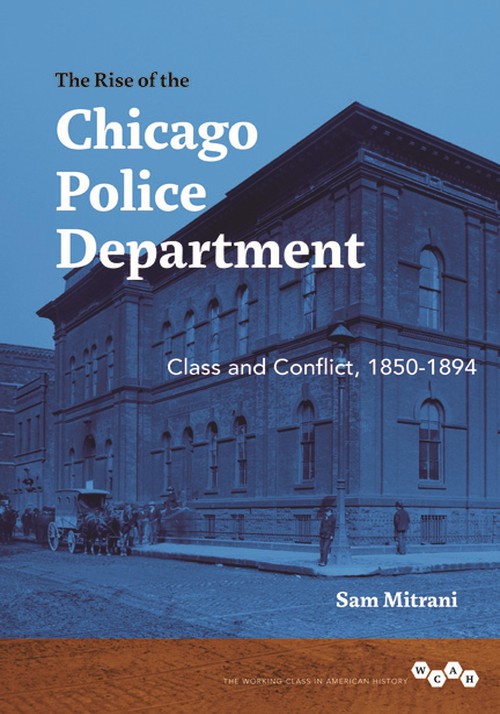
Sam Mitrani
University of Illinois Press (2013)
In this book, Sam Mitrani cogently examines the making of the police department in Chicago, which by the late 1800s had grown into the most violent, turbulent city in America.
Chicago was roiling with political and economic conflict, much of it rooted in class tensions, and the city's lawmakers and business elite fostered the growth of a professional municipal police force to protect capitalism, its assets, and their own positions in society. Together with city policymakers, the business elite united behind an ideology of order that would simultaneously justify the police force's existence and dictate its functions.
Tracing the Chicago police department's growth through events such as the 1855 Lager Beer riot, the Civil War, the May Day strikes, the 1877 railroad workers strike and riot, and the Haymarket violence in 1886, Mitrani demonstrates that this ideology of order both succeeded and failed in its aims. Recasting late nineteenth-century Chicago in terms of the struggle over order, this insightful history uncovers the modern police department's role in reconciling democracy with industrial capitalism."-- Provided by publisher
Book argues that police were organized on behalf of capital and against labor

Samuel Gompers
Christian Herald (in McKinley's anthology) ()
Samuel Gomper's chapter in William McKinley's Republic or Empire? The Philippine Question. Gompers argues against American intervention in foreign countries from an anti-imperialist perspective, stating that foreign wars "keep the workers and the lovers of reform and simple justice divided, or divert their attention, and thus render them powerless to expose abuses and remedy existing injustice."
Gompers argues against American intervention in foreign countries from an anti-imperialist perspective

Samuel Gompers
The American West’s history of radical unionism at the turn of the century reflects the breadth of nineteenth-century class struggle. In Cripple Creek, Colorado, for example, violent conflict broke out in 1903 between members of the Western Federation of Miners (WFM) and corporate mining interests determined to crush the union. Before it was over, thirty men were dead and the union was defeated. Though hostile to the Socialist-leaning WFM, American Federal of Labor leader Samuel Gompers issued the following June 20, 1904, statement in support of the striking miners at Cripple Creek.
Samuel Gompers issued this 1904 statement in support of the striking miners at Cripple Creek.

Samuel Gompers Papers Project
The nation’s leading trade unionist in the late 19th and early 20th centuries, Samuel Gompers was president of the American Federation of Labor from 1886 until he died in 1924. "If there is any truth at all in democracy, if democracy has any real justification," he said, "it is as thoroughly justified in our industrial life as it ever was in our political life." Site offers primary sources, secondary source essays, timelines and biographies of other labor officials
An older site covering biographical information on Samuel Gompers, first president of the AFL
Samuel Gompers Project Papers
"The Order of the Knights of Labor (KOL), founded in 1869, was the leading general organization of workingmen during the early 1880s. Originally a secret society open to all producers, the KOL excluded only "parasites" like stockbrokers, gamblers, lawyers, bankers, and liquor dealers. Members joined local assemblies that were either mixed or single trade bodies (like LA 2814, composed of New York City cigarmakers). Local assemblies were then grouped into regional district assemblies."
Webpage with general information on the Knights of Labor and links to related topics.
Samuel Gompers, History Matters
In 1892 the possibility of a Labor-Populist alliance circulated. Populist orators like Mary Lease sought to build ties between the Farmer’s Alliance and the labor movement by mobilizing farmers to send wheat and corn to striking workers at Carnegie’s Homestead mill. Top labor leaders like Samuel Gompers did not respond to Lease’s and other Populist leaders’ overtures. Gompers’s opposition to labor support for Populism was part of his broader reluctance to entangle the labor movement in any political alliance or in political action at all. Despite Gompers’s opposition, the 1892 AFL convention did endorse the Populist calls for initiative, referendum, and government ownership of the telephone and telegraph system as well as a campaign to increase trade unions’ political activities. In 1896 there was renewed pressure for the AFL to endorse the combined Democratic-Populist ticket headed by William Jennings Bryan. Gompers sought to meet that pressure with this circular to “affiliated unions,” which argued against allying with the Populist Party.
An 1896 circular from then AFL President Samuel Gompers, who strongly urged AFL members and "affiliated unions" to resist the urge to create a Labor-Populist alliance by allying themselves with the Populist Party.
Samuel Gompers, History Matters
Even before the 1890s depression struck with devastating force in 1893, large numbers of jobless men and women competed in tight labor markets and faced homelessness. One of the best first-hand descriptions of “what it is to look for work and fail to find it” comes from political economist Walter Wycoff’s two-volume study of The Workers: An Experiment in Reality, first published in 1899. Wycoff had abandoned his studies at Princeton to seek a more concrete appreciation of social problems. His record of his two years spent as a common laborer became an early classic of sociological writing.
An excerpt from political economist William Wycoff's 1899 book The Workers: an Experiment in Reality, focusing on his experiences as a common laborer.

Samuel Haber
University of Chicago Press (1964)
A history of the origins of Taylorism as well as some biographical details of Frederick Taylor's life
A history of the origins of Taylorism told through the life of Frederick Taylor and his successive "scientific managers"

Samuel Proctor Oral History Program
This is the site of the bloodiest conflict of the post WWI era labeled the red summer. The Samuel Proctor Oral History Program was in the area doing research and had the privilege of taking the tour with Mr. Quiney.
tour and oral history of the Elaine, Arkansas massacre
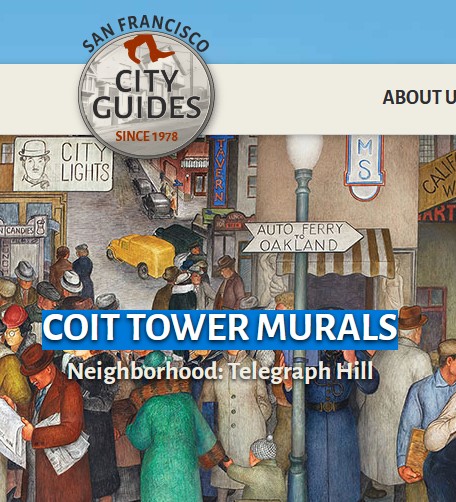
San Francisco City Guides
Tucked away in an unpainted tower on a hill, one of the greatest works of Social Realist art in America lies hidden away. A set of murals created by 26 of California’s best artists, it documented California life in the 1930s from a socialist perspective: romanticizing workers, illustrating inequality, and sometimes even winking at the Soviet Union. It was controversial, sure. But as a work of art? Nobody could deny that it was stunningly gorgeous.
Discover how Californians lived, worked and played in the 1930s, rendered in an evocative style that’s inspired artists for decades. Climb the stairs to see murals not usually open to the public. See the tower funded by local legend Lillie Coit and hear about how her love for San Francisco manifested in a massive donation to beautify the city. Learn about the passionate “rounds man” who took care of the tower for so many years. Splendid art and rich history — what more could you ask for?
A set of murals created by 26 of California’s best artists, it documented California life in the 1930s from a socialist perspective
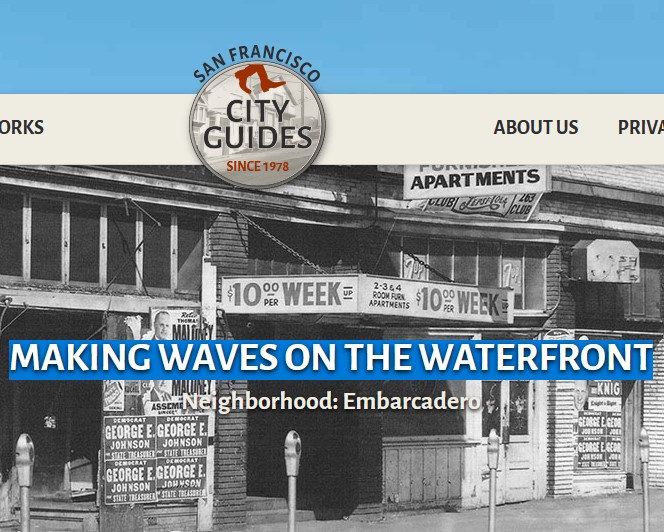
San Francisco City Guides
San Francisco’s northern waterfront has long been a site of legendary innovation. Before the tech boom revolutionized the world, local inventors were dreaming up modern staples like denim jeans and TVs. Labor and human rights organizers catalyzed movements. It’s a city defined by forward progress — if you slow down, you get left in the dust.
Feel the surge of disruption that ripples throughout the San Francisco waterfront. Learn about the Gold Rush pioneers, entrepreneurs, inventors and architects that created this modern marvel of a city. We’ll explore level ground (no hills to climb), visiting a grand collection of historic sites and hidden parks, all along the sensational northern shoreline.
A tour of San Francisco's Northern Waterfront, with special attention paid to sites of important labor struggles.

San Francisco General Strike
San Francisco Longshore Strike: Marchers along waterfront / several views of marchers - sign,"Smash the Fink Hall" / struck ship behind marchers / milling strikers carrying plackards / deserted piers / CU milling crowds of strikers / long line of marchers walking by building / outside meeting / idle ship behind marchers / men walking up gangway - ladder alongside ship / getting onto small boats / boats on the bay / various shots of men and piers
A brief, two-minute cut of original film from the 1934 San Francisco Longshore Strike.
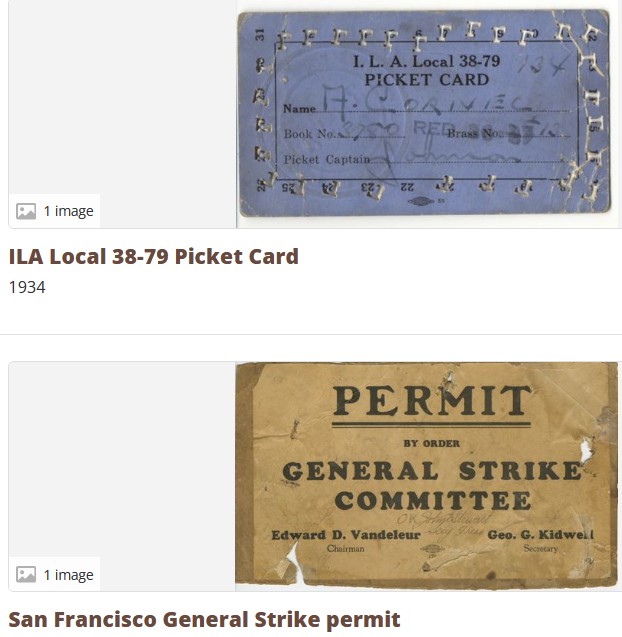
San Francisco Labor Archives
over 2600 items with subject term "farm labor" in the San Francisco Labor Archives; from 1930s to 1970s on Southern and Western farm workers including braceros; includes images, manifestos, and ephemera
2600 items on farm labor from 1930s-1970s

San Francisco Labor Archives
Approximately 1500 items from the Henry P. Anderson Papers were digitized and are now available for browsing. Browse the entire collection or curated subjects collected by Anderson over the course of his life.
Henry P. Anderson (1927-2016) was a researcher, labor organizer, and advocate for farm workers. His papers, held at the Labor Archives and Research Center, cover agricultural labor conditions, corporate agriculture and farm economy, pesticide use and effect on workers, agriculture-related legislation, farmer associations, and labor, religious and political organizing efforts to improve agricultural working conditions. The papers include extensive correspondence and news clippings, and Anderson’s graduate research into the Bracero Program in California.
The Labor Archives exhibit, Fields of Struggle: Agricultural Laborers in California, 1939-1966, uses materials from the Henry P. Anderson Papers to examine the tensions and solidarity between distinct groups of migrant agricultural laborers, with an emphasis on the Bracero Program and the Agricultural Workers Organizing Committee (AWOC).
1500 items from a farm worker organizer
San Francisco Labor Archives
Few regions can rival the rich, lively labor history of the San Francisco Bay Area. This history is preserved in primary source and vintage history materials at the Labor Archives and Research Center (LARC). Founded in 1985 by trade union leaders, historians, labor activists and university administrators, the Labor Archives is a unit of the J. Paul Leonard Library at San Francisco State University. The Labor Archives has an Advisory Board drawn from the labor, academic and community leaders of the Bay Area. Includes an amazing range of material, including newpapers covering sharecroppers, farm laborers,
primary source and vintage history materials

San Francisco Labor Archives
Primary source document with rich timeline
timeline of the 1934 San Francisco general strike
San Francisco Museum
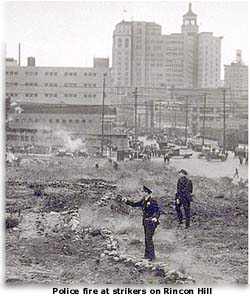
San Francisco's maritime strike, which began May 9, 1934, tumbled out of control when the Industrial Association, made up of employers and business interests who wished to break the strike, and the power of San Francisco unions, began to move goods from the piers to warehouses.
The first running battles between unionists and police began Tuesday, July 3, 1934. There was a lull during the July 4 holiday when no freight was moved, but disturbances picked up again Thursday, July 5, 1934 – known as "Bloody Thursday."
This is the San Francisco News' coverage of the first day of the rioting – July 3, 1934.
The area where the rioting took place is now the heart of San Francisco's Multimedia Gulch.
An archived page of newspaper coverage of the 1934 Longshoreman Strike in San Francisco.
Museum/Exhibits
Tours
Maps
Digital Projects
Organizations
Sites
Film/Video
Audio/Interview
Podcast/Program
Text/Document
Image
Graphs/Data
Timeline
Southwest
West
Midwest
Southeast
Northeast
Mexico
Canada
Global
Books
Teaching
Lectures
Digital Archives
Journals
Bibliographies
Topic Intro