


Explore thousands of items. Use clickable links under collections and library for broad categories. Search by keyword (including topic,city, state.) Limit by time period, type of item, region. See our search tips page for more assistance.
Collections
Library
Type
Region
Coverage:
-
Published:
-

San Francisco Organized Labor
Henry George, San Francisco, Chinese, anti-Chinese, Chinese American
The Museum of the City of San Francisco's page on nativism in the U.S. labor movement, focusing specifically on the Japanese and Korean Exclusion League's efforts to have U.S. lawmakers add Japanese and Korean immigrants in the Chinese Exclusion Act.

San Francisco Port
Outdoor exhibit/walking tour of Islais Creek A Place to Live – A Place to Work – A Place to Play -- For more on the public history behind this walking tour/interpretive site, see Public History on the San Francisco Waterfront https://lawcha.org/2026/03/30/public-history-on-the-san-francisco-waterfront/Islais
This watershed was ideal for human settlement. Here, fresh water from uphill springs flowed into saltwater marshlands filled with abundant wildlife. The native Ohlone people fished, hunted, and gathered wild foods such as the “Islay” fruit that gave the creek its name. Eventually, communities of workers who labored in the industrial areas lining the wetlands settled on nearby Bayview and Potrero hills. The east shoreline of the bay and creek were gradually filled in to create room for development, resulting in the “channelization” of Islais Creek.
The original landscape has been dramatically transformed, but the channel remained vital for cargo handling and maritime industries. Labor movements sprung up in the factories and on the docks along the creek, and became important longshore and warehouse workers’ unions. Today, the urban shoreline of Islais Creek provides recreation opportunities, and is the subject of visionary resilience strategies to protect the bay shoreline and the local community from sea level rise.
Outdoor exhibit/walking tour of Islais Creek, Learn history while strolling the San Francisco waterfront

Sandra L. Albrecht
Lexington Books (2016)
The Assault on Labor details the 1986 strike against Trans World Airlines (TWA) by the Independent Federation of Flight Attendants (IFFA), a predominantly female labor force of over 6000 members who garnered respect throughout the labor movement for their solidarity and determination in a three year struggle to return its workers to the line.
The story of the 3-year long 1986 Trand World Airlines strike, led by 6000 female flight attendents

Sanford Jacoby
Princeton Univ Press (1999)
Offers a history of twentieth-century welfare capitalism, that is, the history of nonunion corporations that looked after the economic security of employees. Building on three case studies of "modern manors" this book argues that welfare capitalism did not expire during the Depression, as traditionally thought.
Offers a history of twentieth-century welfare capitalism.

Sanford M. Jacoby
Lawrence Erlbaum (2004)
"This book will be of interest to scholars and practitioners of human resource management. Professors and students in economics, history, industrial relations, organizational behavior and sociology will find this a great resource."--Jacket
shows how the American workplace shifted from a market-oriented system to a bureaucratic one.

Sanford M. Jacoby
Princeton University Press (2021)
From award-winning economic historian Sanford M. Jacoby, a fascinating and important study of the labor movement and shareholder capitalismSince the 1970s, American unions have shrunk dramatically, as has their economic clout. Labor in the Age of Finance traces the search for new sources of power, showing how unions turned financialization to their advantage. Sanford Jacoby catalogs the array of allies and finance-based tactics labor deployed to stanch membership losses in the private sector. By leveraging pension capital, unions restructured corporate governance around issues like executive pay and accountability. In Congress, they drew on their political influence to press for corporate reforms in the wake of business scandals and the financial crisis. The effort restrained imperial CEOs but could not bridge the divide between workers and owners. Wages lagged behind investor returns, feeding the inequality identified by Occupy Wall Street. And labor's slide continued. A compelling blend of history, economics, and politics, Labor in the Age of Finance explores the paradox of capital bestowing power to labor in the tumultuous era of Enron, Lehman Brothers, and Dodd-Frank
explores the paradox of capital bestowing power to labor in the tumultuous era of Enron, Lehman Brothers, and Dodd-Frank.

Sanford M. Jacoby
Oxford University Press (1995)
The underlying argument of this book is that societies which organize work differently from practices in the US and the UK (German, Japan, Scandinavia, and East Asia) have something to teach us about how talents can be better deployed to promote social harmony and economic competitiveness.
Contributors
1: Sanford M. Jacoby: Social Dimensions of Global Economic IntegrationI. Industrial Relations Consequences
2: Christopher L. Erickson and Sarosh C. Kuruvilla: Labor Cost Incentives for Capital Mobility in the European Community
3: Daniel J.B. Mitchell: Employee Benefits in Europe and the United States
4: Peter Lange, Michael Wallerstein, and Miriam Golden: The End of Corporatism? Wage Setting in the Nordic and Germanic Countries
5: George Tsebelis and Peter Lange: Strikes Around the World: A Game Theoretic Approach
6: Ruth Milkman: The Impact of Foreign Investment on U.S. Industrial Relations: The Case of California's Japanese-Owned Plants
II. Policy Issues
7: Michael Storper: Boundaries, Compartments, and Markets: Paradoxes of Industrial Relations in Growth Pole Regions of France, Italy, and the United States
8: Kenneth L. Sokoloff: Some Thoughts and Evidence on Industrial Policy: Industrialization in South Korea and Mexico
9: Jeffry A. Frieden: Labor and the Politics of Exchange Rates: The Case of the European Monetary SystemIndex
argues societies which organize work differently from practices in the US and the UK have something to teach us about how talents can be better deployed to promote social harmony and economic competitiveness.

Sara Matthiesen
University of California Press (2021)
The landmark case Roe v. Wade redefined family: it is now commonplace for Americans to treat having children as a choice. But the historic decision also coincided with widening inequality, an ongoing trend that continues to make choice more myth than reality. In this new and timely history, Matthiesen shows how the effects of incarceration, for-profit healthcare, disease, and poverty have been worsened by state neglect, forcing most to work harder to maintain a family
shows how the effects of incarceration, for-profit healthcare, disease, and poverty have been worsened by state neglect, forcing most to work harder to maintain a family

Sara Nelson, Slate
Sara Nelson invokes Mother Jones in this terrific interview where Sara is in top form for this moment.
Strikes are essential part of freedom and working class advancement

Sarah Deutsch
Oxford University Press (2023)
Long after the Mexican-American War brought the Southwest under the United States flag, Anglos and Hispanics within the region continued to struggle for dominion. From the arrival of railroads through the height of the New Deal, Sarah Deutsch explores the cultural and economic strategies of Anglos and Hispanics as they competed for territory, resources, and power, and examines the impact this struggle had on Hispanic work, community, and gender patterns.This book analyzes the intersection of culture, class, and gender at disparate sites on the Anglo-Hispanic frontier--Hispanic villages, coal mining towns, and sugar beet districts in Colorado and New Mexico--showing that throughout the region there existed a vast network of migrants, linked by common experience and by kinship. Devoting particular attention to the role of women in cross-cultural interaction, No Separate Refuge brings to light sixty years of Southwestern history that saw Hispanic work transformed, community patterns shifted, and gender roles critically altered. Drawing on personal interviews, school census and missionary records, private letters, and a wealth of other records, Deutsch traces developments from one state to the next, and from one decade to the next, providing an important contribution to the history of the Southwest, race relations, labor, agriculture, women, and Chicanos. This thirty-fifth anniversary edition reflects on its place in the history of the Anglo-Hispanic borderland, class, and gender. -- Provided by publisher
explores the cultural and economic strategies of Anglos and Hispanics as they competed for territory, resources, and power, and examines the impact this struggle had on Hispanic work, community, and gender patterns.

Sarah F. Rose
The University of North Carolina Press (2017)
In the late nineteenth and early twentieth centuries, a major transformation was occurring in many spheres of society: people with every sort of disability were increasingly being marginalized, excluded, and incarcerated. Disabled but still productive factory workers were being fired, and developmentally disabled individuals who had previously contributed domestic or agricultural labor in homes or on farms were being sent to institutions and poorhouses.
[The author] pinpoints the origins and ramifications of this sea-change in American society, exploring the ways that public policy removed the disabled from the category of "deserving" recipients of public assistance, transforming them into a group requiring rehabilitation in order to achieve "self-care" and "self-support." By tracing the experiences of advocates, program innovators, and disabled people caught up in this epochal transition, Rose ... integrates disability history and labor history to show how disabled people and their families were relegated to poverty and second-class economic and social citizenship, with vast consequences for debates about disability, poverty, and welfare in the century to come"-- Provided by publisher
public policy removed the disabled from the category of "deserving" recipients of public assistance,

Sarah Haley
The University of North Carolina Press (2016)
In the late nineteenth and early twentieth centuries black women imprisoned in convict lease camps and chain gangs were forced to perform grueling work to industrialize the South. They faced daily assault and devastating conditions in a punishment system that was central to the maintenance of white supremacy. Drawing upon black feminist criticism and a diverse array of archival materials, Sarah Haley uncovers this brutal history, while also revealing how imprisoned women sabotaged carceral structures of gendered racial capitalism and offered alternative conceptions of social and political life
black women imprisoned in convict lease camps and chain gangs

Sarah L. H. Gronningsater
University of Pennsylvania Press (2024)
This book chronicles the long history of emancipation in the United States through the cradle-to- grave experiences of a unique generation of black northerners. It focuses on the legal and political efforts of the "children of gradual abolition," boys and girls born in the early republican North who, as grown-ups, shaped national and state campaigns for legal equality and the end of slavery nationwide"-- Provided by publisher
the legal and political efforts of the "children of gradual abolition,"

Sarah L. Staszak
Oxford University Press (2024)
Staszak found that arbitration’s origins lay in a liberal impetus in the early 1900s to make dispute resolution easier for those seeking a less adversarial process. “Arbitration was used between institutions of relatively equal bargaining power, so between unions and their employers, for example." In the 21st century, Staszak private arbitration will be, in power differential, “me or you against Tesla.” In her book, Staszak argues that this transformation was not accidental, but the result of deliberate efforts by a multifaceted group of actors, such as business-friendly conservatives in government and the private sector, who targeted each branch of government to redirect arbitration’s historical purpose. The rest of the book explains how this process, which she calls “institutional conversion,” panned out.
One of Staszak’s significant concerns is the rise of mandatory arbitration clauses, like those mentioned at the beginning of this piece. Individuals often sign binding clauses unknowingly as part of the fine print for obtaining a credit card, cellphone contract, loan, or in the conditions for getting a job.From the publisher: In early 2018, the text of an employment contract surfaced on Twitter. Munger Tolles & Olson, a prominent Los Angeles law firm, required its summer associates to sign a contract that contained a binding arbitration clause. In and of itself, this was not unusual; binding arbitration clauses are ubiquitous in today's employment contracts. They require employees to submit all employment related grievances to a private, binding system of arbitration and to forfeit their access to the legal system. But this contract was unusually explicit in spelling out the true enormity of what it required new associates to give up. In addition to explaining that, by agreeing to arbitrate, "you are giving up your right to a jury trial," it specified that employment-related claims would include, "without limitation," all "federal, state and local statutory, constitutional, and contractual and/or common law claims." The contract went on to highlight a few examples, such as all claims arising under Title VII of the Civil Rights Act of 1964, the Age Discrimination in Employment Act, the Equal Pay Act, the Fair Labor Standards Act, and the Americans with Disabilities Act, as well as a variety of similar state laws. Combined with a non-disclosure requirement, the clause all but ensured that any arbitration proceedings would be kept private, no matter how grave the injury or how unsatisfactory the dispute resolution process"-- Provided by publisher
Introduction
Part I: Arbitration's institutional orders
Collective bargaining and labor's industrial democracy
Disjointed origins: the rise of commercial and securities arbitration
Part II: The first wave: The bipartisan origins of arbitration's conversion
Employment rights as civil rights
The consumer rights movement
Part III The second wave
Privatizing the workplace in the new millennium
Consumers beware the fine print
Conclusion
Origins of mandatory arbitration clauses, which force people to forgo their rights to resolve disputes through litigation and resort to private arbitration.

Sarah McNamara
The University of North Carolina Press (2023)
When we think about the origins of Cuban immigration to the United States, we often imagine the anti-Communist exiles who fled the regime of Fidel Castro and settled in South Florida during the 1950s and 1960s. But before Miami became Havana USA, a wave of leftist, working-class migrants from prerevolutionary Cuba crossed the Florida Straits and made Ybor City the center of the immigrant South and the global capital of the Cuban cigar industry. Located on the eastern edge of Tampa, a port city along Florida's Gulf Coast, Ybor was a multiracial, multiethnic neighborhood where radical thinkers and laborers found work and refuge against the shifting tides of international political turmoil during the early half of the twentieth century. In this book, Sarah McNamara tells the story of how immigrant women ensured and fought for community survival across generations and against the backdrop of a post-Confederate, Jim Crow-controlled southern order"--Provided by publisher
bor was a multiracial, multiethnic neighborhood where radical thinkers and laborers found work and refuge
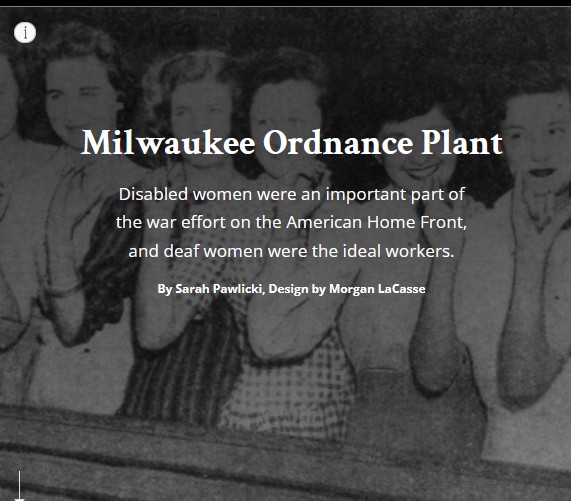
Sarah Pawlick, Morgan LaCasse
The Milwaukee Ordnance Plant, located at 4600 N Port Washington Road, produced artillery used by Allied troops during World War II. The plant’s manager sought out Deaf women as workers, suggesting deafness provided them with unique, valuable skills.
A digital storymap and exhibit for understanding the role disabled women played in wartime industry

Saul Schniderman, Labor Heritage Association
The Inventory of American Labor Landmarks, directed by Saul Schniderman, is a catalog of sites in the United States commemorating the history and heritage of America’s workers. These include: monuments, memorials, historic markers, union halls, historic buildings, restored dwellings, public sculpture, museums, history tours, heritage projects, preservation areas, and murals. A printed version of the Inventory of American Labor Landmarks is available in the Labor Heritage Foundation store.
Browse through our inventory of 170 labor landmarks
catalog of sites in the United States commemorating the history and heritage of America’s workers.
Schlesinger Library on the History of Women in America
over 3,100 books and trade catalogs, 900 archives and manuscript items, and 1,400 photographs.
The collection is an exploration of women's impact on the economic life of the United States between 1800 and the Great Depression. Working conditions, workplace regulations, home life, costs of living, commerce, recreation, health and hygiene, and social issues are among the issues documented"
Most of the items in this collection originate or were published in the Northeast, focusing on white women iregarding the topics above.
A digital collection mostly focused on the Northeast US and published items

Scott Malloy
Clippings from the Providence Journal, Providence Evening Bulletin, Providence Morning Herald, Manufacturers and Farmers' Journal, and Providence Morning Star, 1867-1902. Compiled by Scott Molloy, with the cooperation of the Rhode Island Historical Society, 1993. Clippings are grouped by year but do not appear in exact chronological order. Look for Additional Files at bottom of link
digitized collecition of newspaper articles from Rhode Island labor history

Scott NearingHistory Matters
The Appeal to Reason was the most popular radical publication in American history. The socialist newspaper, founded in 1895, reached a paid circulation of more than three-quarters of a million people by 1913. During political campaigns and crises, it often sold more than four million individual copies. J. A. Wayland, the paper’s founder and publisher until his suicide in 1912, had become a socialist through reading. He built his paper on the conviction that plain talk would convert others to the socialist cause. From its Kansas headquarters, the Appeal published an eclectic mix of news (particularly of strikes and political campaigns), essays, poetry, fiction, humor, and cartoons. It ceased publication in November 1922, a victim of editorial instability, the declining fortunes of the Socialist Party, and U.S. government repression of radicalism. In the August 12, 1916 issue, Scott Nearing offered a disheartening prognosis for the social mobility of wage workers.
Scott Nearing's 1916 article from the Appeal to Reason, one of America's most popular and influential radical socialist newspapers.

Scott P. Stephen
The University of Alberta Press (2019)
With Masters and Servants, Scott P. Stephen has revealed startling truths about the men of the Hudson's Bay Company.
Rather than dedicating themselves body and soul to the Company's interests, these workers hired out like domestic servants, joining a 'household' with its attendant norms of duty and loyalty.
Through painstaking documentary research, Stephen shines welcome light on the lives of these largely overlooked historical actors. The household system produced a remarkably stable political-economic entity, connecting early Canadian resource extraction to larger trends in British imperialism and its emerging social relations.
An essential book for labour historians, Masters and Servants will appeal to scholars of early modern Britain, the North American fur trade, Western social history, or business history, and anyone intrigued by the reach of the HBC."-- Provided by publisher
tartling truths about the men of the Hudson's Bay Company.

Sean Burns
University of Illinois Press (2011)
Devoted to understanding the diverse customs of working people, Archie Green (1917-2009) tirelessly documented these traditions and educated the public about the place of workers' culture and music in American life. Doggedly lobbying Congress for support of the American Folklife Preservation Act of 1976, Green helped establish the American Folklife Center at the Library of Congress, a significant collection of images, recordings, and written accounts that preserve the myriad cultural productions of Americans. Capturing the many dimensions of Green's remarkably influential life and work, Sean Burns draws on extensive interviews with Green and his many collaborators to examine the intersections of radicalism, folklore, labor history, and worker culture with Green's work. Burns closely analyzes Green's political genealogy and activist trajectory while illustrating how he worked to open up an independent political space on the American Left that was defined by an unwavering commitment to cultural pluralism"-- Provided by publisher
Explores the role of Archie Green in preserving historical working-class culture in America

Sean Griffin
University of Pennsylvania Press (2024)
The Root and the Branch examines the relationship between the early labor movement and the crusade to abolish slavery between the early national period and the Civil War. Tracing the parallel rise of antislavery movements with working-class demands for economic equality, access to the soil, and the right to the fruits of labor, Sean Griffin shows how labor reformers and radicals contributed to the antislavery project, from the development of free labor ideology to the Republican Party’s adoption of working-class land reform in the Homestead Act. By pioneering an antislavery politics based on an appeal to the self-interest of ordinary voters and promoting a radical vision of “free soil” and “free labor” that challenged liberal understandings of property rights and freedom of contract, labor reformers helped to birth a mass politics of antislavery that hastened the conflict with the Slave Power, while pointing the way toward future struggles over the meaning of free labor in the post-Emancipation United States.
Bridging the gap between the histories of abolitionism, capitalism and slavery, and the origins of the Civil War, The Root and the Branch recovers a long-overlooked story of cooperation and coalition-building between labor reformers and abolitionists and unearths new evidence about the contributions of artisan reformers, transatlantic radicals, free Black activists, and ordinary working men and women to the development of antislavery politics. Based on painstaking archival research, The Root and the Branch addresses timely questions surrounding the relationships between slavery, antislavery, race, labor, and capitalism in the early United States.
Traces the parallel rise of antislavery movements with working-class demands for economic equality, access to the soil, and the right to the fruits of labor
Sean Griffin, Teaching Labor's Story
This short introduction is designed for assisting teachers who want to learn essential context for teaching labor's role in the early republic.
"Beginning in the late eighteenth century, a series of economic, technological, and social changes began to transform the early United States.
Contrary to the expectations of many in the Founding Era, these changes did not bring about the rapid demise of slavery, nor did they transform a majority of Americans into self-sufficient, landowning farmers—the “yeoman republic” envisioned by Thomas Jefferson and others. Rather, they accelerated the sectional differences that had characterized the North and South since the colonial period. Between 1800-1830, two systems of labor expanded together: enslaved labor in the South and wage labor in the North. Southern states became increasingly dependent on slavery. Northern states gradually emancipated the enslaved, and increasingly relied on wage labor. Many called this “free labor,” but the exact meaning of the term was not clear. Workers’ responses to these developments played a pivotal role in shaping the contested meaning of “free labor,” as well as driving the conflict that led to the Civil War, and helping to define the issues that would continue to be debated in the post-Civil War economy and society of the United States." continues at site.
A short introduction to labor in the early republic, commissioned essay
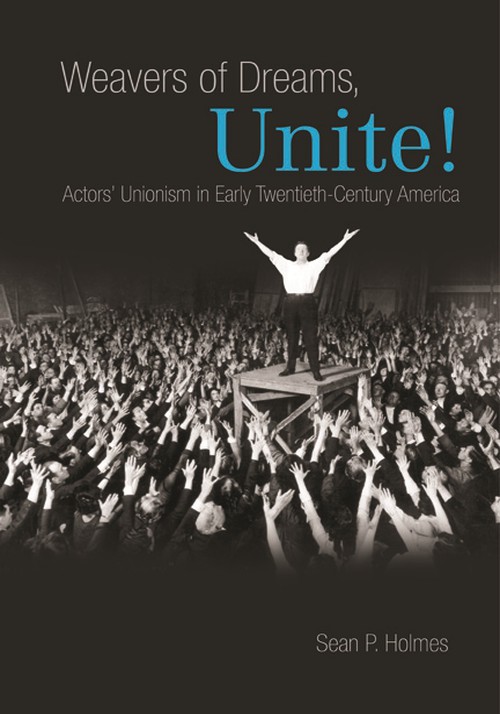
Sean P. Holmes
University of Illinois Press (2013)
Weavers of Dreams, Unite!' explores the history of actors' unionism in the United States from the late 19th century to the onset of the Great Depression. Drawing upon hitherto untapped archival resources in New York & Los Angeles, Sean P. Holmes documents how American stage actors used trade unionism to construct for themselves an occupational identity that foregrounded both their artistry & their respectability
how American stage actors used trade unionism to reinforce artistry & respectability; important insights into the nature of cultural production in the early twentieth century, the role of class in the construction of cultural hierarchy, and the special problems that unionization posed for workers in the commercial entertainment industry.
Museum/Exhibits
Tours
Maps
Digital Projects
Organizations
Sites
Film/Video
Audio/Interview
Podcast/Program
Text/Document
Image
Graphs/Data
Timeline
Southwest
West
Midwest
Southeast
Northeast
Mexico
Canada
Global
Books
Teaching
Lectures
Digital Archives
Journals
Bibliographies
Topic Intro